
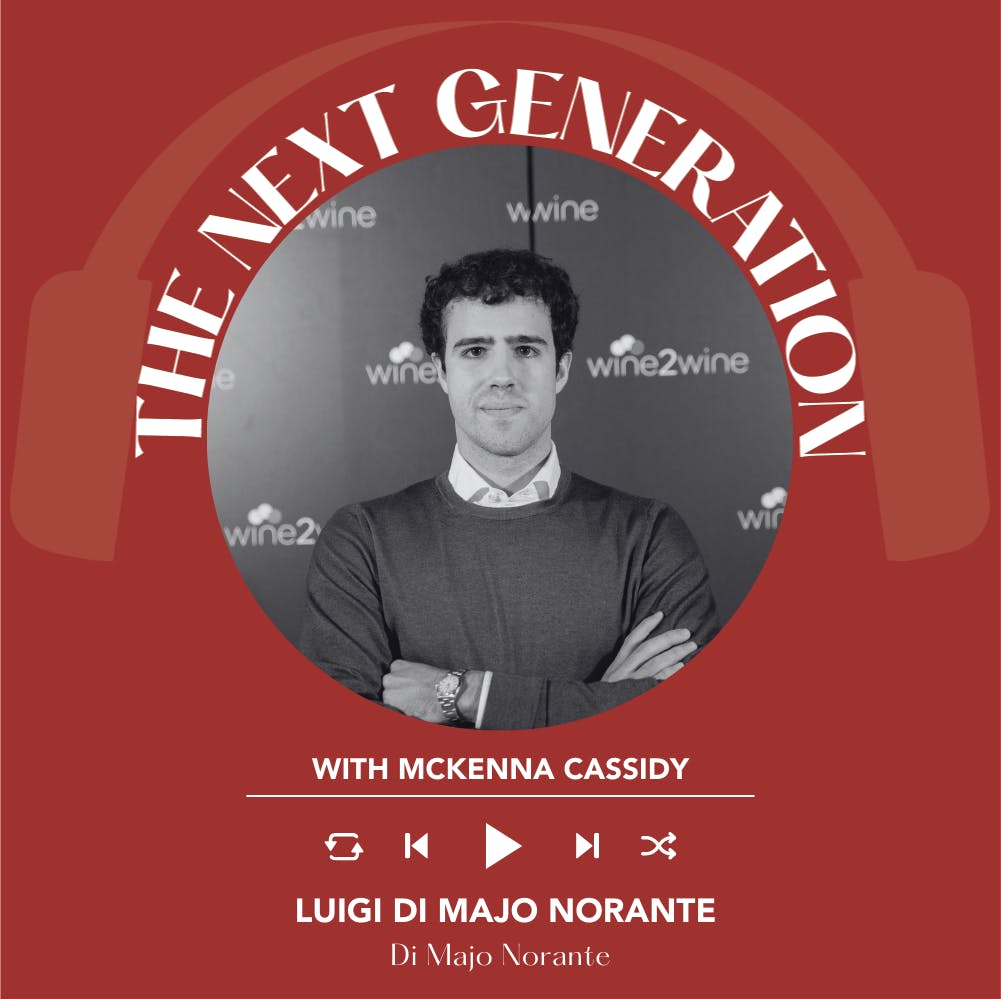
Ep. 1741 McKenna Cassidy Interviews Luigi Di Majo Norante | The Next Generation
The Next Generation
Episode Summary
Content Analysis Key Themes and Main Ideas 1. The unique and pioneering role of Molise in the Italian wine landscape. 2. The Dimaja de Marante family's multi-generational commitment to quality, innovation, and heritage. 3. The significant impact of Molise's specific terroir (proximity to the sea, thermal excursions, varied altitude) on winemaking. 4. The importance of sustainable and biological winemaking practices. 5. Insights into the ""next generation"" of wine professionals and consumers, emphasizing communication challenges. Summary In this episode of the Italian Wine Podcast's ""The Next Generation,"" host Mckenna Cassidy interviews Luigi Dimaja de Marante, the grandson of the founder of Dimaja de Marante wines in Molise. Luigi discusses his family's pioneering efforts in Molise, a lesser-known Italian wine region, highlighting their status as the first winery to produce qualitative wines, vinify local varieties, plant Aglianico, and achieve international market presence from the region. He details the winery's history, from their noble lineage and land reforms to their current extensive operations, including 140 hectares of vines. Luigi emphasizes the critical role of Molise's unique terroir, with its continuous sea breeze and significant day-to-night temperature variations, which naturally support their biological farming practices since the 1990s. The conversation also explores specific wines like the flagship Molise Rosso Don Luigi (a late-harvest Montepulciano), the delicate Tintilia, and Luigi's personal favorite, Contado. Finally, Luigi shares his journey into the wine industry, his global educational background, and his perspective on the generational divide in wine consumption. He stresses the need for improved direct communication between wineries and end consumers to better convey the passion and information behind each bottle. Takeaways * Molise, though Italy's second smallest region, boasts pioneering winemakers like Dimaja de Marante. * Dimaja de Marante was instrumental in establishing Molise's reputation for quality, internationalization, and sustainable winemaking. * The winery effectively leverages Molise's unique terroir, including sea breezes and significant thermal excursions, to produce distinct wines and practice biological farming. * Late-harvest Montepulciano (Molise Rosso Don Luigi) from Dimaja de Marante is a flagship known for concentration without excessive alcohol. * Molise is also known for its high concentration of truffle hunters, a point of regional pride. * Young wine professionals like Luigi Dimaja de Marante see a crucial need to enhance direct communication between producers and consumers. * There's a noticeable gap in purchasing habits between ""wine lovers"" seeking unique wines and ""normal consumers"" opting for trendy or label-driven choices. Notable Quotes * ""We're actually the first winery, Mauriza that started to produce, qualitative wines... we were the first wines to actually, bring the wines from this region internationally..."
About This Episode
The speakers discuss the Italian wine industry and their success in promoting young wine drinkers. They talk about their success in promoting young wines and their own success with winemaking in a small family farm in China. They also discuss their experience with winemaking and their approach to maintaining healthy and clean health while using biological products. They also talk about their philosophy on producing wines with high quality and being tasting by using grapes that are highly rated. They emphasize the importance of maintaining healthy health while using biological products and their love for the wine industry. They also discuss their personal preferences for wines with fish and raw fish, and their plans to visit the winery in Italy.
Transcript
The Italian wine podcast is the community driven platform for Italian winegeeks around the world. Support the show by donating at italian wine podcast dot com. Donate five or more Euros, and we'll send you a copy of our latest book, my Italian Great Geek journal. Absolutely free. To get your free copy of my Italian GreatGeek journal, click support us at Italianpodcast dot com, or wherever you get your pods. Welcome to the Italian wine podcast. This is the next generation with me, your host, Mckenna Cassidy. For the next thirty minutes, I invite you to explore with me what young adults are up to in the Italian wine scene. Today, let's feast on our discussion of Italian wine, travel, food, and culture. Thank you for being here. Grab a glass with us. Chinching. Cool. So I'm Makenna. I'm here with Luigi Dimaja de Marante. He is the grandson of the founder of Dimachan Arante wines. Correct? And it's a joy. Hi. Hi, Mathena. I'm Luigi. I'm twenty two years old, and I work in the commercial side of the Dimino Ranta family. That's awesome. And you're coming here to us today from where? I'm coming from Rome because during the weekends, usually I'm staying there. Okay. But yeah, during the week, usually I'm staying at the Diminerante family or anywhere the work brings me to. So fatal. Any market that I'm following, for example, Germany or Belgium and other places. Cool. I'm so excited to learn about all the different places you've traveled. And So this winery is awesome. We don't usually get to interview producers from Molize. So, Dimaja Naranta is in Malize, and I'm really excited to to dive into the wines here. And then Luigi has an awesome perspective on the under thirties generation of Italian wine drinkers and international wine drinkers are interested in exploring, and so I'm excited to learn from him and get a new perspective. So thank you in advance. Welcome. Let's say that Mauriza is not, famous for wine, winemaking. We're actually the first winery, Mauriza that started to produce, qualitative wines, where the first winery that we have, VINification, which is the local variety, were the first winery who planted the Ayani grapes in, in Mauriza, and were the maybe the first winery that, made it to a worldwide market because many local producers are not to focus on quality, any internationalization of the, Melissa wines, while we were the first wines to actually, bring the wines from this region internationally and in terms of, also of, pricing. Oh, fabulous. And so your grandfather started the winery. And can you tell me, like, kind of when he started it and why? Okay. So, the my grandmother family was, noble family in Malaysia after a couple police color forms and everything. They lost most of their, lands. Okay. They used to have more than a thousand hectares and introduced to three hundred and fifty because of their political reform. Okay. And then, with the head iritage and everything, then my grandmother remained with forty actors in the southern part of Mauriza. Okay. And there, my grandfather was, was producing many agricultural products together with wine. Okay. He started to discover that there was a lot in the territory to exploit in terms of, winemaking. So he started to to focus a lot on qualitative wines. Okay. And the winery started to get recognized, in Italy, and a little bit internationally. Then from the around the nineties, my father started to cover also the wine business of, of my grandfather. And, in that part, the wine re really did the, the step up become like a really important player in, entirely winemaking. Wow. Now we count around a hundred and, forty hectares, about forty hectares of other products such as oil, tomatoes, or grains Are you enjoying this podcast? Don't forget to visit our YouTube channel, mama jumbo shrimp for fascinating videos covering Stevie Kim and her travels across Italy and beyond, meeting winemakers, eating local food, and taking in the scenery. Now back to the show. Oh, wonderful. It sounds like your grandparents drowned like a very special passageways, were there many other people doing the same thing, or were they kind of pioneering that? I assume other people were growing. No. They were really pioneers in, Okay. In the ages, there were no no other agriculture places where they were doing wines like this. And, yeah, we were the first ones to experiment kind of, new types of, clones in weiner's new typologies. Okay. So, yeah, we're really step up there. But also, I have to say we had, we have a very good, conditions to make wines. Okay. Because we're very close to the sea. We're about two kilometers from the sea side. Okay. So we have, like, a continuous breeze that helps a lot to reduce at minimum, treatments in the vineyards. Uh-huh. Because obviously, there is, less humidity. So there are, less possibilities for diseases to go in the vineyards. Okay. Then we have a very good thermic excursion from day to night. In the summer, it can get over twenty degrees. So it helps a lot of grapes to express their, aromatic, compounds, you know, to increase the the aromatic compounds of the grapes. Okay. So it's a warm, dry climate. Yeah. As everyone who's listening, I'm sure is aware, the apennine mountains run down the center of Italy and Wilzilize is on the East Coast of the country. So it's very interesting because there's access to the sea, but there's like different slopes. But your vineyards, it sounds like, are a little lower in elevation, like, towards the ocean. Or do you have hillside? It depends. Like, we have weiners, at the the sea level. Okay. And we have also wines, winers, not wine. Two hundred, three hundred meters above sea level. Oh, okay. Like about five kilometers from the winery, especially for, and other varieties, for example, tintilla can be made only two hundred meters above sea level. So it's mandatory to to have, like, the Yeah. Okay. It needs that, that of altitude. Yeah. Exactly. Have a bit cooler climate. Exactly. Yeah. Moniza, it's quite interesting territory. Yeah. Because it starts from the sea, and it goes up until to the mountains. So it's like a steep. So it starts from the sea level, and it goes up. Yeah. It's it's not like, you know, mountains, then hill. No. It's like an exponential slope. It just goes, like, directly high. That's very unique and it's a little bit like concentrated towards the sea, but the mat yeah. That's awesome. You could be in the on the beach one hour in the next hour, be Yeah. Up in the mountains. Oh, how diverse? That's so cool. And tell me about the molliz de rosso don luigi, like, where does this wine sit? Is this a flagship wine of yours? And then it's multiple giano. How is that made? And and what's that wine like? Okay. Yeah. Luigi the wine that actually, made the the wine very famous in terms of, pricing. Okay. So all the terbicheri, the wine spectator, over ninety points Yeah. And things like this. It's a Montepeuciano, hundred percent, late harvest. So the the grapes are, peaked a little bit later after, the normal moderation time. Okay. Is it, like, October or September? It depends on the, on the vintage. Yeah. But I would say about one or two weeks after the normal multiple channel grapes are picked. Got it. So wine, like, the two maturation, it's made to concentrate the the taste and the aroma of the of the wines, but we decided not to make it too strong, too powerful, too weak to alcohol, you know, in terms of alcohol degree. It has an aging of about two years in Barif and Tono. Mhmm. And then about, two years aging in the, in the bottle. Wonderful. Yeah. And, so it's a wine. It's a very rich wine, very powerful, very round, you have some notes of, mature fruits, some, vanilla, some tobacco. It's a very complex wine, very, very particular. So Monteciano is one of, like, the most important Italian red grapes in it. When it's beenified well as it you do some nice aging and some, touch of oak and the late harvest is very interesting because you're you're risking high alcohol, but you obviously don't need to vinify it in that way. But it's always very, like, plush, velvety texture, very rich, but refreshing at the same time. And it sounds like you have the opportunity for some altitude, which will maintain that acidity as well. It's also interesting that you would do late harvest and have medium, medium, plus acid. This is some of the fascinating stuff of Italian wines. It's like you can have this tension between richness and refreshingness at the same time. And then this tension between, like, ripe fruit and herbs, savory notes, like, dry texture that seems this opposite. So it that's the ironic harmony of it all, which is so cool. Yeah. It would be particular attention on when to pick the grapes. Okay. Because obviously, if you go too far, you will have too high alcohol degree. But also while you're concentrating the grapes, you'll get, more color intensity, more phenolic maturation, higher phenolic maturation. That's very important for the aromas of the wines. And also, a very important acidity because obviously by, like, evaporating a little bit of water from the, from the bunch. You have, more concentrated wine, so also a little bit higher acidity. So it helps also a lot for the aging of the of the wine. Recently, we did some vertical testing. Yeah. Which changes. So we did ninety. Okay. Ninety five, two thousand, two thousand five, two thousand ten, fifteen, and twenty. And I have to say, even the the nineteen ninety five, we're still holding on very nice. Wonderful. So it's it's very particular as, as a tasting essay. Also, sometimes we do not that far, but we do also tasting to to control the development of the wine over time So we'd see how how it develops over time. We we make testing notes Mhmm. To see at what point how how it tasted and how it changed over the years. Mhmm. And that helps a lot to to improve our wine over time. Okay. What's the goal of this wine or any of your wines? Is it to express? Well, is it to make the best example of Montopocciano? Is it do both? Like, what's the goal? Yeah. Actually, our philosophy is to produce wines of the highest quality by using grapes that are part of our, regional heritage and and tradition. But at the same time, experimenting new techniques and technology Okay. To make the the grapes express the the best of them and their, their water. Wonderful. So harmony of all of the above Yeah. Exactly. With a special family touch. That's awesome. And also, we have a particular head also for, for nature. We are, east by the fact that we can use list less treatment. I was talking about it before about the ventilation. Right. But also we are biological since the nineties. So even before the regulation occurred, and, we don't use any notice of, substance in, of any kind on the on the treatments of the wires. Are other producers in the area do it using treatment? Then you choose not to, or is it kind of the trend of the region? Most of them, most of them, I'd say no, but, I guess that we made this decision off for a commercial choice. Because our goal is to keep winders as as healthy as possible. In our case, we don't need any chemicals that is no safe to to keep the winder because we have low humidity. For us, it's enough to use biological product. In that case, we respect also nature. It's very good, like, for for both. So we're very happy with it because we have, very healthy winers and, bunches. Okay. And at the same time, we we respect nature. Of course. Okay. A good balance. And who's the team right now? Who's the winemaker and the vineyard manager. So in the winery, we have a neurological person, which is Christopher. Okay. And an agronomical person, which is Francesco, which are then supervised by the Ricardo Cortrella group. Okay. Which is a very famous, analogist from, from Italy. Okay. So he helps us, like, on the quality control over time. So he supervised, like, what we're doing if we're doing things correctly. Mhmm. But, yeah, we have also our own team. Okay. Oh, wonderful. And how far is your running from Campobas? So From Campobas, it's about one hour, one hour, and a half. So we are located in the southern part of the region, about two kilometers from the sea, and about five from the border with Poria. Okay. So we're far south in the southeast in the region. Very close. And but Monis, it's a very small region. It's I think the second smallest region in in Italy. It's not very it's not very populated. It's not too far to go from from one place to another. I'm excited to go someday. I have yet to go. And I think it has its own unique beauty amongst all of Italy, all these days, different Yeah. And set apart. Yeah. It has many interesting facts that not many people know For example, up in the mountains, there is a very big production of, extraction of truffles. Mauriz is actually the region with the highest percentage of, truffle hunters in the, in Italy. Yes. And and it's very interesting because it's not a region known for those kind of products. Right. Right. Right. While like we we have moved to the top of them. Of course. I assume truffles go quite well with some of your wines then. Yeah. Yeah. Now it's truffle season, actually. Yes. In November. Yeah. We bring some truffles, from the mountains. We do also some events. And it's, it's very nice at all truffles. And there are dark truffles or light truffles? Oh, it's white and Okay. It's actually more white than, I mean, in terms of, it's, like, a lot of white and also oblique. Oh, fabulous. Yeah. That's great. And I'm excited to hear your personal story, but before we move there, I just wanted to recap the winery makes wonderful expressions of Falangina, tintelia, which is like a tinto means like red in Spanish. So it's a red grape and it's it has like this tension of spicy notes, floral notes, medium rich body, like, very right? Yeah. It's a it's a very particular grape, it's not too powerful, so it's very delicate, but very elegant at the same time. Cool. So we have to stay very careful when working on it because, if we use, for example, too much oak or, a barrel which is too much toasted, cover totally the flavor. So, usually, we use, old dog. Okay. So, old barics and to know, to to make it express as it is. Otherwise, we will cover too much the flavor. Yeah. And, it's very particular also because it it can be paired with different kinds of food. Some people also pair it with fish. Obviously, not the raw fish, but for example, a greasy type of fish that could be salmon or a honey boat or Like a fattier fish. It can go well. And, it's very nice. It's very refreshing wine. It's, it's very particular. Coming from America, a lot of people are like, oh, I put, you know, pinot noir with my salmon, but I picture a world where people in the new world, like, are putting Tintilio with their salmon instead. Yeah. Exactly. It's really the goal. Yeah. It's not easy to find a pairing as for any other wine. Yeah. But yeah, pair red red wine with fish. It's, a complicated cool, but in my opinion, if we understand well, the dish and the wine, we can make an a favor to spare. Mhmm. And you can add spice and richness to the fish to, like, build it up, to match the wine a little bit. Yeah. Exactly. That's great. And the Italian ones always add such flavor and herbs to the dish that you would lack in many other wines. So and then there's a the Rosay and the Grequer Bianco. Could you describe the blend of the Rosay? The Rosay is a hundred percent ayanico. Okay. Yes. Ayanico, it's a grape, which is very tannic. So we pay a lot of attention in the contact with the skin. Cause, obviously, if we put the wine in too much in contact with the skins, we'll have a red wine, a tonic wine. So to keep it as fresh and floral as possible, the contact with the skin is limited at a very short time. It has an aging of about, six months in steel and about three months in the bottle. And then, it goes on the market. Yeah. We we decided to keep us, fresh and, and floral as possible. It's a very particular wine. And, Is it screw cap? No. No. It's a no cork. Okay. We're actually thinking about moving to the screw cap. But at the moment we use cork. Okay. Wonderful. Which one that your family makes is your favorite personally? My personal favorite person. Your time. Yeah. I'd say it's the Contado. Maybe in terms of absolute values, maybe the SASios, which is, his older brother, but the Contado, it's a wine that is amazing for, for its price also. What's in it? It's a one hundred percent. Oh, beautiful. It's a wine that, has won many, many, many, prizes in terms of price to racial quality. Okay. But, actually, once it wants also the wine that's best wine in Italy for, price to racial quality, It's an amazing wine. It's not too powerful, it's not too strong. It's perfect for, like, an everyday kind of, meal. Totally. It's, it's very particular. And then also another one, there is a little gem. It's a a passy to wine. Mhmm. It's a royal muscato dried on the plant. Thanks a lot to also to our ventilation, the breeze that I was talking to you about that was coming from the sea. We keep the muscato grapes, the vineyard, until it's very, very dry. Mhmm. Then we've unified it. Mhmm. And it's a very particular wine. It's not too sweet. So it's as a very good balance between acidity and sweetness. Mhmm. So it's perfect for, both the dessert. And also for our Jesus. We did many events with cheese tasting. I did a very particular product. Oh, that's fabulous. I can't wait to try that someday. It's not too rich to then start off your meal with with the Jesus. No. Yeah. I would say, you know, that's for, maybe, either aperitiv or, end of the meal. Yeah. And, it's a wine, you know, sometimes the passito wines, so the sweet wines Yeah. Are too sweet. So you take a sip and then you stop drinking it because it's too sweet. While in this case, we have this, good balance that, enrich the flavor of what you're eating or, or, yeah, drinking. That's awesome. That's great. Thank you for sharing that. Yeah. No problem. And tell me about yourself, what's your story? Like, you we were talking before. You've been all over the world. So how where have you been? What have you seen in wine? And then we'll talk about what the young people are drinking. Okay. So I was born in Rome. So I grew up in Rome. I stayed there until the thirtieth of high school. Then I moved to Canada one year, and I graduated there. So I skipped the the last year of high school in in Italy, because in Italy, high school is five years. Oh. And, in Canada is four. And I went directly to university. I studied three years in Belgium economics, Mhmm. And I finished last year, so two thousand twenty two. And, now I'm working in the in the winery. I first did some, some experience, in my winery, in the production side. Then I moved to the commercial part of the of the winery. And then since, May, until, one month ago, I was working in, familial Cortarela, also in, in production. Okay. When you were traveling and doing your school and other countries, did you ever imagine not having a career in wine, or did you always feel called to come back to wine? No. To be honest, I always wanted to to work in wine since I was quite young. My father was bringing me to Vin Italy Verona or other first. Okay. So I've been in contact with this with this word, since I was young, and I always loved it. To tell people, explain about your wines, to travel around. Also, I I remember also always my father going to many countries to visit and then bring just presence. It was very nice. A constant adventure. Since I was in high school, I decided that I wanted to work in the wine business. Okay. I was unsure about the the field, so either production or commercial. Right. I decided to move in, in the commercial part of the winery, but still doing some, some experience. So I'm not in an analogies, but I know how to move around also in the production part. Okay. Are your friends in wine as well, or are you one of the only ones? I made many friends, that are winemakers, also here, where I'm we're doing the podcast. That's true. Friends, and we're following some, Oh, that's great. Some courses together. But, yeah, I brought many, many friends to the wine world. For example, with my friend, Franchesco, we take a couple of weeks every year to visit, a specific region in Italy or outside Italy and visit some vineyards. And I always try when I'm a dinner to explain to him about wines, and explain the passion that I have. That's awesome. Wonderful. It sounds like my friends are always looking at me, like, Gotta tell us about this wine. Sometimes I get messages, you know, I'm at the store. I get to do. Which wine should I issue they take? When you get that text, what do you say? What are you eating, or what do you want? Like, what's your price range? Actually, what are you eating? And also, show me maybe a picture of the showcase, maybe I recognize some wines, totally. And then I just tell them to go to one variety. Totally. What was your one of your recent recommendations? Sovignon, it's a wine that I recommend a lot with, with fish, with raw fish. Mhmm. Because it's just a very nice acidity. There are some white wines that are too sweet. So they're not Yeah. They they do not do well with, with raw fish. Uh-huh. But yeah, with sauvignon, it's a it's a very good choice for it. Made in Italy or somewhere else. Oh, in Italy, in freeway. Yeah. Mhmm. I like Samuel from Freolia a lot. That's awesome. It's one of the wine I prefer most from from Italy. That's great. And then what might you qualify between, like, maybe young Italian wine consumers that are, like, our age, like, twenties versus your international friends? Like, are they drinking different things? Do you see them all with a passion for Italian wine? Like, what are their drinking habits look like? Here, I make a distinction. So between wine lovers and, normal consumers, obviously, wine lovers because they know a lot about wines. They try to to pick more the particular kind of wines. Maybe the the wines they they don't know. Mhmm. While the the the normal consumers usually are not too acquainted with the wine word, So they try to choose usually the wines that they heard about. So maybe the trendy wines or they are attracted by the label or and and things like this. So, yeah, there is a difference between these two type of Do you think as evangelists for wine as we are? Do you think the goal is to make new friends of wine from those people who are not attracted to it currently and or strengthen the relationships with the wine lovers already? With Italian wine, for example. Yeah. I would say that, winemakers in, in general, like, I'm not talking only about Italy, but in the war, needs to improve the communication between the winery and the terwarf, with the end consumers. Because usually, there is no contact at all between the producer and the end consumer because usually, we pass through an importer or an agent. And, so usually, the, the end consumer do not get the information that the the winery can give. So when drinking a product, they do not they do not know about much about about it. While, there are many things that are very fascinating that can be learned during this this thing. So, yeah, in my opinion, a goal that the one word needs to have is the communication between the, wine producers and and customers. Okay. Reminds me of the phrase that the longest journey in life is the journey from the head to the heart. Yeah. I'm sorry. Like this twelve inch distance is the longest journey in life and it feels like, somewhat of metaphysics, like, a similar distance between the consumer and the producer of, like, this area of communication in between there, like, what makes up that space and what links them together, you know? Yeah. Oh, that's wonderful. You are so knowledgeable about the area and the wine industry, and I'm very excited to see what more you will do. So thank you for all that you do to share a time with others. And for all the wines your family makes, I can't wait to taste more of them. I'll have to come back to Vin Italy to taste them, I think. Yeah. You're welcome. Also whenever you want to visit Melissa and the winery, we'll wait for you. Amen. Thank you so much. Cheers, Tete. For joining me today. Remember to catch our episodes weekly on the Italian one podcast. Available everywhere you get your pods.
Episode Details
Keywords
Related Episodes

Ep. 2434 Giulia Stocchetti interviews Alberto Sabaini and Sara Piubelli from Cantina Sabaini | Next Generation
Episode 2434

Ep. 2427 Margherita Andrenacci interviews Alejandro Fargosonini of Châteauneuf-du-Fargosonini | Next Generation
Episode 2427

Ep. 2415 Giulia Stocchetti interviews Claudia Bustos from Viña Raíz Criolla | Next Generation
Episode 2415
Ep. 2409 McKenna Cassidy interviews Riccardo Baldi of La Staffa | Next Generation
Episode 2409

Ep. 2402 Margherita Andrenacci interviews Erin Kirschenmann of Wine Business Monthly | Next Generation
Episode 2402

Ep 2396 McKenna Cassidy interviews Luca Paolo Virgilio of Caprera Winery in Abruzzo | Next Generation
Episode 2396