
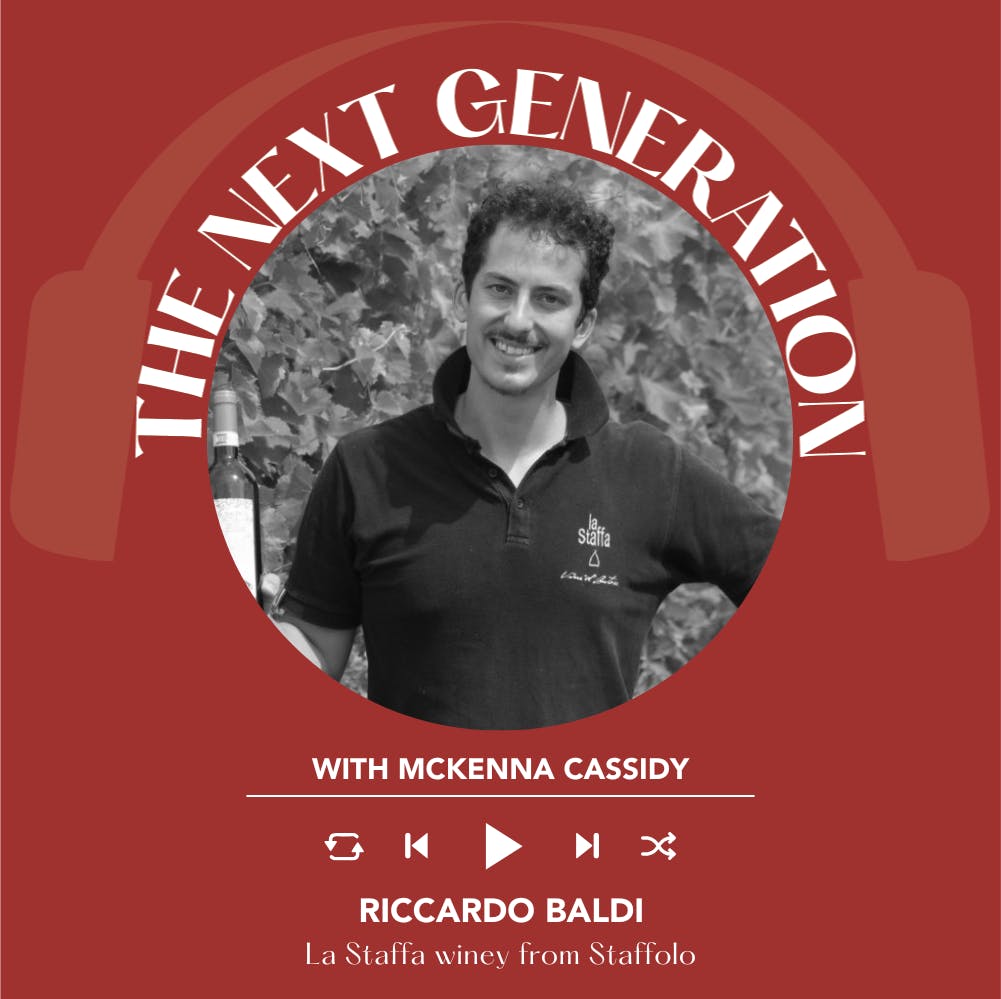
Ep. 2409 McKenna Cassidy interviews Riccardo Baldi of La Staffa | Next Generation
The Next Generation
Episode Summary
Content Analysis Key Themes and Main Ideas 1. The unique terroir of the Marche region, particularly Staffolo, and its influence on Verdicchio wine. 2. Ricardo Baldi's ""neo-classical"" winemaking philosophy, blending tradition with modern, scientifically-backed organic practices. 3. The significance of specific winemaking techniques, like aging in concrete tanks on lees, for Verdicchio's complexity and texture. 4. The evolving preferences of wine consumers, especially younger generations, towards complex white wines. 5. The allure of the Marche region as an untouristed, peaceful, and gastronomically rich destination. 6. The importance of patience, continuous learning, and a long-term vision in quality winemaking. Summary In this episode of the Italian Wine Podcast's ""The Next Generation,"" host Makenna interviews Ricardo Baldi, the winemaker and creator of La Stafa in Staffolo, Marche region. Ricardo, despite being under thirty, shares his journey into winemaking, embracing his family's tradition while developing a ""neo-classical"" philosophy. He emphasizes working *with* nature through deep knowledge, employing organic farming methods focused on soil health and natural nitrogen enrichment, and utilizing native yeasts for fermentation. Ricardo highlights the unique terroir of Staffolo, particularly its high calcium carbonate content, which imparts distinctive salty, citrus, and mineral notes to their Verdicchio wines. He explains the crucial role of aging Verdicchio in concrete tanks on its lees to enhance complexity and texture. Ricardo also discusses the versatility of Verdicchio, noting its appeal to younger generations seeking complex white wines with lower alcohol. He passionately describes the Marche region as an untouristed Italian gem offering a peaceful, quality life and exceptional culinary experiences. Takeaways - Verdicchio from Staffolo (Castelli di Jesi) is notably influenced by high calcium carbonate in the soil, resulting in characteristic salty, citrus, and mineral notes. - Ricardo Baldi advocates a ""neo-classical"" winemaking approach, respecting tradition while adapting to modern tastes (e.g., vibrant wines with less alcohol). - La Stafa practices organic farming, focusing on natural soil management and root development rather than disruptive tilling. - Concrete tanks are essential for La Stafa's Verdicchio, providing an ideal environment for long-term aging on lees, which builds complexity and texture. - Ricardo distinguishes his approach from ""random wine"" natural winemaking, emphasizing the need for deep knowledge and intentionality even when working with nature. - Verdicchio is presented as a versatile white grape capable of producing serious, complex wines that can age well. - The Marche region is portrayed as a beautiful, lesser-known Italian destination offering a high quality of life and authentic experiences. - There is a growing consumer trend towards complex white wines, which Verdicchio is well-positioned to satisfy. - Patience and a long-term perspective are fundamental to achieving quality in winemaking, as encapsulated by the motto ""the drop deeks the rock."
About This Episode
The Italian wine industry has been successful for many years, with winemakers like Ricardo Baldi and Le knewe, both among the top stars. The speakers emphasize their unique approach to creating a unique and distinctive wine, including their use of concrete tanks and experimenting with new ideas. They also discuss their approach to obtaining better agricultural yields by learning from nature and using it as a tool for personal development. They also mention their love for reading and favorite restaurants, including Le knewe and Le knew, as well as their favorite restaurants in their hometown, Le knewe and Le knew. They invite listeners to visit the wines and offer them a chance to study more about Verdicchio.
Transcript
The same approach I used in the Vineer, I used this in the cellar. So try to work with the nature, but with a deep knowledge of all the chemical things and all the chemical process in the way to try to push or to drive the natural in the way you want. So, no, with a lot of knowledge, you plan the natural to do the job for you. Welcome to the Italian wine podcast. This is the next generation with me, Mackenzie. For the next episode, I invite you to explore with me what young adults are up to in the Italian wine scene. Let's feast on our discussion of Italian wine and culture. Grab a glass with us changing. Good morning. Hello, everyone. I'm Makenna from the Italian wine podcast in the next generation, and it's my joy today to be joined by Ricardo Baldi. Chow Ricardo. Welcome. Thank you so much. Ricardo calling us from, Stafalo, the town in Ancona in La Marque region, and he is the winemaker and creator of LaStafa, known for their Verdicchio wines. And today is a great opportunity to learn more about those and then also us about Ricardo as a person who is a role model for many young winemakers and has been doing it for several vintages himself, but he is under thirty years old. So it's pretty awesome. And so just for some background, Ricardo, farms twelve hectares of vines in Staffelo. And again, Verdicchio, which is an ancient grape variety. Today is a great opportunity for the listeners to go a little bit deeper on the grape and then understand how it grows in Yeezy and Metellica, etcetera, the kind of subapplications of this region. So I'll turn it over to you Ricardo. Would you please just tell us who you are and what you do and, about how we're here today. Hey, thank you so much. Yes. I'm Ricardo from, LaStafa. We are in a staff follow. That is a tiny village in the area of Castelli Diazi. The area of Castel Diaz is a very particular appelation because we have twenty five different villages where we are allowed to produce Verdicchio from Castelades see appelation. Staff follow with Cooper Montana and Montecarotto the three most important villages for the making of, Verdecio in the the nomination of Castele Diaz. They are very important because the quality of the wine that we made, but also because in terms of history, there's three villages out there. Villages where we have more story of way making. Stafalo is a particular village also because we have, twenty wineries in a town of, in a village of only two thousand people. So almost everyone are involved in the WAN business. And, the area of Stafford is very rich of tiny artisanal company. My family used to make wine like his hobby in the past, my father, my uncle, before to my father, And, my history is, it's not very cool. When when I was a child, I was not so involved. They were in business or in the idea of making wine in the future, but little by little, I felt the low with the idea of making wine also because I grew up in this town where, everywhere. You are surrounded by vineyard and wine and wineries. And, when I was nineteen, my father was very busy in his main job. So when I was nineteen, I did the harvest almost alone, help my father, but almost alone. And I fell too low with India to make my own wine. So, from, the intag, twenty ten, I started to make my wines. I took over the capital vector of vineyard, my father used to have at the time, and, I found my company. Little by Little, I grow as a winemaker, in term of knowledge. I start to read a lot. I start the university studying economic science So nothing related to what I'm making, but I fell below with idea, and so I start to study a lot and start to have a close relationship with a a couple of very important winemaker in the area. That, the most important was, Lucia from Fatria Coroncino that was my mentor. Unfortunately, he passed away in twenty twenty one, but, I had to say thank you to him a lot because, it really helped me to be more precise and more, close to the area where we are. The village of Stalfolo is a place where we have clay limestone soil, but the most important characteristic of my village is to have a lot of calcium carbonate. And this characteristic is something that belongs only to a half of staff full and a half of cupra Montana because we have a kind of soil that when the hill come up from the ocean, from the sea, a little piece of land between Stapo and Cooper Montana totally flipped over. So in the surface, we have a soil that is four million years older. Compared to the rest of the nomination. And for this reason, we have a lot of calcium carbonate that in the wine, we made all the area of stuff for half of stuff with enough of cupar Montana. You can find this very beautiful, salty, citricos, mineralic. And I always say that it's the signature. This kind of minerality is the signature of, it's the trademark of, barbecue from, from staff. Hello. This is awesome. And I'm gonna, like, directly, the like, chemical balance of calcium carbonate. It raises the pH, I believe, in the soil, which thus lowers the pH in the results. In the white. Yeah. So you're looking at kind of a higher acidity, complexity, and intensity. Yeah. And I know your wines are known for that too. You work with several specific clones, I believe, for, like, the Rinkrona wine, and then also the salvarisoto. You're using concrete to kind of bring out about this wealthy texture. And your wines are known. I mean, we have a ton of fans of your wine just in Chicago alone, but anyone listening who hasn't had La Stapo, like, this is just a brilliant example of Verdicchio and the difference like, wines that Ricardo makes express something specific about the Gallicchio itself. So, yeah. Yeah. The idea was since the beginning. When I start, the wine word was very different compared to today. We were at the beginning of the revolution of natural wines to be organic at the time. It was something very weird, very strange, very new as well. And so when I start, I realized very quick that if we want to do something cool and something important. We have to start to understand more than we can, the testing and the most important characteristics of our career in the way to make something that is very unique and very distinctive because it's the expression of only a piece of land. Obviously, it's very easy to say a little bit more difficult to make. And for sure, you have to have something unique in terms of terwar, because, you know, nowadays, we are able to make very good wine almost everywhere in the world. But at the same time, there is only one burgundy. There is only one, there is only one, le lang, you know, So some specific characteristic below only to some very unique area. And Casteli Diaz is for sure one of these very huge, beautiful area for the quality of the soil composition. The only things we need is to tell more to our customers about our area. We are at the beginning of, this process in my opinion. And so the idea was to focus ourselves in the training of the binary in the way to let them able to reflect the quality of the soil, the soil in the glass, and, work with a lot of micro humidification from all our different plots in the way to have different shades of Erdicchio and different, tasting of radicchio because the soil change a lot. We are in a hill area where we have pioneer between four hundred and five hundred meters above the sea. So also in terms of moderation, we have a lot of differences. And the use of concrete tanks to make wine in concrete tanks. First of all, it is very historical in the air of Castellide. Yes. Concrete tanks were here since the beginning of, maybe two hundred years ago. I have some friends that make one in very, very old sellers built at the beginning of twentieth century, and they have concrete tanks built inside the the seller at the time. Second, the reason concrete tanks is a kind of thing that is perfect for Verdicchio, because Verdicchio is a white, very serious white wine that has a very beautiful relationship with, is a own lease. So the aging on the lease for a Verdicchio is very important. Thanks to a concrete thing. You have, a very beautiful environment where to age the wine during the aging process on the lease. But most important, the shape of our tank, we have no hacks. We have the square root tanks. So the bottom of the tank is, totally flat, and it's very wide, very, you know, large. So you have a a big guest surface of contact between the lease and the wind up to the lease. And, it makes a lot of difference when you Avard BQ for ten months, one year on the lease. If you made the same engine, you have concrete tanks on steel tanks. Concrete tanks, you have more relationship between the lease and the wine, and you have more complexity. And, you can have a beautiful texture in the wine. So for this reason, I love a concrete tax. And, to hand to answer to your question, Rinkrock and Silbatisotto are two single, bioneer selection, because working in this way, trying to understand that a war, made us able after years to understand that some of our plots were more important compared to the other or more complex compared to others. So I decided during the years, during these fifteen years, to make a couple of single vinyl selection because a couple of our viners are really distinctive and really unique compared to all the other one we have. That's really well said. It sounds like you have the freedom now to kind of embrace this tradition of using the concrete tanks and also distinguishing amongst single vineyards. Mhmm. Is there any, like, innovations that you're working on or excited to work on in the future that kind of incorporate with this tradition to move the winemaking forward, or do you find yourself, like, really dwelling on what has worked traditionally and and using that? You know, it's always something very interesting thing, and difficult to explain. Because when you talk about tradition, sometimes tradition seems like something close in a box that you are not able to change. And, look at the tradition in this way, in my opinion, it's a big mistake because tradition is always something that changed, maybe a little bit slower compared to the rest. But what is traditional now was not traditional, one hundred years ago. So I always like to say that my wine my idea of winemaking is a neo classical way of winemaking. It is like neo classical architecture. So at the time in the eighteenth centuries. They fell below with the Roman and the Greek architecture. They take expiration and re invent something that was helpful for the moment of history where they were leaving. And the same today, we have to work with idea of the tradition, with the testing of the real Verdicchio, but at the same time to try to make it work with the this moment of history. So it means that in the past, they were they like to have very round, and I call it verbichio. And now we like to have a little bit more vibrant, and with less alcohol in inside our wines. So we take the testing of the real barbecue. We try to, you know, to work in the way to have a real testing, but at the same time, changing a little bit of tradition compared to the past this is my idea. And, in terms of winemaking, I'm very happy with what we are doing now, but at the same time, if you want to continue to work well in, like, in agriculture and winemaking, you you have never to stop. To try new things and to open your mind and try to understand how to deal with new problems. In this moment, I'm very focusing, the vineyard in terms of experimenting new new things. The way we train the soil is very, very important because we are lost in this moment of history. A lot of nitrogen because the mistake we did in the last fifty years, and a lot of way your agriculture are not so well for the future. So we are studying a lot how to work better the soil or not work the soil and increase naturally the nitrogen. And at the same time, I remember. How would you do that? How would you, like, take us to the vineyard and how does that work? We are in a hilly area. It's very important to take care about the soil. And so in the past, we, ten years ago, twelve years ago, I start to break to work, either be the soil after the harvest in the way. To help the rain from the winter to go deep inside the soil. And at the same time, also to plant fava beans and other kind of beans that increase the quantity of nitrogen in natural way in the soil. And also the same kind to break a little bit, the most superficial roots of the bioneers because when you cut the superficial roots, you force the roots to go down in the soil. So The idea is to have a more balanced binder. But the problem is when you broke the soil, you increase the hydrogen and then you lost the nitrogen because if you are flipped over the soil, we were not flipped totally over the soil, but a little bit too. You flipped over the soil. So if you please flip over the soil, you lost the nitrogen that you increased the year before, so it doesn't make any sense. So I start to ask this question to myself, and I start to travel and see if the other way maker has the same, problem or idea. And I discover a new kind of, very easy machine that moved the soil just up and down without broke it. And so you have you can have a less compact soil with the water inside, etcetera without flicked over them. But plus, we are buying a new machine that we can put the fava beans without move the soil. So a kind of, the machinery you can use to plant the soil in the way to have, in the middle of, the line, not the normal grass, but to have, a very specific kind of, seeds that you choose a parcel after parcel in the way to increase and to control in a more natural way, the kind of, grass you have, and the quantity of nitrogen in the soil without loss in nitrogen because you flipped over the soil. This is awesome. And this is all part of your organic farming methods using the nature to bring out the very best of the vines and grains. Same in the seller. The idea, you know, when I started to make wine, it was the moment of the revolution of natural wine. And I remember that I really traveled a lot to natural wine fair, etcetera, etcetera. Yeah. At the time the idea was, for a lot of white makers, I don't do nothing. I want to make one another way. And in my opinion, it means that we are just to crush the boundaries. And in my opinion, it doesn't make any sense because if there is something in agriculture that was, think and was studied since the Greek or the Roman Empire was wine. It's the only product or agriculture that we always generation after generation, try to do it in a better way. And now we arrive in this moment of history. Let's say, oh, we don't I I don't need to know nothing because nature make everything. It's not natural wine. It's a random wine. One year is good, one year is not. And, in the same approach, I used in the Vineer, I used this in the cellar. So try to work with the nature, but with a deep knowledge of all the chemical things and all the chemical process in the way to try to push or to drive the nature in the way you want. So, you know, with a lot of knowledge, you play the natural do the job for you. So, fermentation with the native east, aging, with the lease. Thanks to the lease. We can we are able to absorb a lot of oxygen from the wine. So we can aid the wine without had any sulfides until the moment of the bothering. But it's all a lot of different shades of the same idea. Working very well to have a water quality wine and, to, use the nature as a your, not as your enemy, but as a help for you. Top two that have you. Absolutely. So when you're traveling and you're tasting your wines and you notice that the consumers are younger, you are engaging, like, the young new friends of wine or Mhmm. Or people learning about wine or the next generation. What's the reaction? And do you think that the style of Lastapa is really a great one, the lower alcohol, the organics, the acidity, the electricity, seems to be a great style. That's very attractive to to drinkers of wine. It is. Yeah. Yeah. It is. It's, you know, in my opinion, it's a very particular moment of, for the way business in this now. The young generation really love my wines normally. So and also older generation, but in a different way. And because older generation love more or very iconic wines in general, or very easy to drink white wines. And my whites are lot not a lot of alcohol, but they are not easy wines. They are very serious white wine. So also the vermicura staff that is our entry level, is a wine that we release after twelve eighteen months of aging. So it's a white wine with a beautiful body and a beautiful complexity. And for young generation, it's more my style. I I I understand that the style of wine that I love and that my terwar made is the kind of, style people want to drink right now. In my opinion, we are facing a big changing from, people that drink, majority of red wines, to people that drink majority of white wines. And people that used to drink a lot of red wines, when they moved to white wines, they want to have something complex. I don't want to say round, but with texture and not some very, very, very, very easy white wine that we normally drink in the past. And for this reason, in my opinion, verdiceo is the best is the perfect kind of white wine because it's a white wine, very versatile. And also, when it is, very young, is always round and rich and complex. So is, You can also age it for a long time. Even though some people, you'll drink it young, you can drink it old. I know that you and Jageta, wrote that Verdicchio is one of Italy's greatest white grapes and the wines made. I just enjoyed LaStafa playing cards on the rooftop last weekend, and it was the perfect, like Cool. Thank you. Like, have a snack, have a glass of white wine, plate. It was really, really perfect. Yeah. Also. Yeah. Also because the kind of acidities and saltiness, we have in here. You know, it's perfect for the kind of situation you describe because the acidity, refresh you, the saltiness, clean your palette and, and, make you salivate. So make you more tasty. It really does. Yeah. You could have another sip. So It's pretty awesome. It's amazing. And that it's just made so purely is awesome. I'm also jealous for all the listeners who can't see, but Ricardo, it's he's seven hours ahead of me and he gets to interview with a glass of wine. So I will be joining him soon. Okay, Ricardo. Let's move into our rapid fire questions. And this is a opportunity for us to get to know you more as a person. So what do you do for fun when you're not making wine? Well, it's fun to reply to this question because, I don't want to sound weird, but, in the last fifteen years, I worked six days a week, nine hours a day. So not a lot of fun. You're always making wine. Yeah. No. No. No. But to answer, I love to read. I don't have a lot of time to do it, but I when I have time, I do it, I love to to read books are not only in wine, but more like biography of important person, politician or economic or entrepreneurs. And, I love to travel. I always travel thanks to my job, but it's, you know, it's totally different kind of traveling. You know, when you are loud, and you are you are more relaxed, you have more time to look around you. Yeah. Yeah. So what's your favorite restaurant? In your hometown. Le Marqu is a very particular region because it's a little bit unknown, but we are very generous to be unknown, because we live a really I always say that Le Marqu is the real country life for Italy because it looked like tuscany in terms of, so maybe people that list them our podcast know more tuscany in terms of, environment. So round hills, a lot of agriculture, only trees, Vineyard, a lot of free fields, but it's totally untourished. So all the villages, like in Castelli DES, twenty five villages are twenty five, like, million euro cash soles. Two thousand, one thousand people that live in these villages. Everything is very quiet, very peaceful. So it's like you can really live a a slow life in a beautiful outstanding environment. And so one of the most important things of Lemarket is also restaurants. We have a very, very, very high level of restaurants My favorite is, I have to give you two different names in Sanigalia. Sanigalia is a city forty thousand people in the seaside of, I'm calling forty minutes far away from my cellar. Sanigalia is a place full of restaurants. In Siligalia, we have a three Michelin Star restaurant. There are two Michelin Star restaurant in a city of forty thousand people. So one of the two, Olias, is my is my favorite restaurant. It's a three Michelin Star restaurant. And also, in the opposite side, a very beautiful Victoria that is called the Reno Hebo. The real, Victoria, seaside, the criteria that I really really love them. They're very tiny place for the seats, forty five seats. Everything is made with huge quality fish and vegetables. So, yeah, I really suggest to everyone to go to Ulya for a fine dining Uh-huh. For vino Echibo for, an amazing good criteria. Beautiful. Okay. If you could swap lives with any fictional character, who would it be? I know you're reading nonfiction in your free time, but No. If I had to be someone else, I really I I told you I, study. I start to study economic science. So Yeah. Warren buffet is a yeah. He's a he's a person. He's a man that I really, really read up. But not because of money. Oh, also because if you know his philosophy doesn't care about, wealth or spend money, stupid things, but I really love his, birth severance. Is is he? Yeah, perseverance. It's very smart. It's very patience. And I love his view in the long run. And in my opinion, it makes a lot of sense if you say the same in the wine business. We make something that normally needs ears to be good. When we plant a new virus, we start to harvest grapes after three, four years. So it's something that you have to think and to build very slowly, and you have to be very patient. And so in his view in, the Warren Buffett view in, in a stock picking and investment is, in, in my opinion, is the same, a a winemaker as to every this award of winemaking with with a where everyone wants to start to make wine now and be famous tomorrow, but to be good as a winemaker to make something important, you had to say, you had to think, twenty years from now. And, so, it makes very my opinion make, well, he's a great guy, a great person, and I if I had to say someone for just one Yeah. One day for sure him. Also, because, yeah, it makes sense a lot. The motto of my company is a Roman way of seeing. It's a Latin way of seeing. It's a good, the translation in English is the drop deeks the rock. It's like, you know, it's a very old way of yeah. At the time. Yeah. Yeah. It's a Roman way of saying that totally makes sense in the wine business in my opinion if you want to make something, something important and quality. You have to do the correct choice every day for ten years, and then someone will understand you and say, oh, this guy was, was doing this the current thing. So now he makes good wine because in the last ten years, he always try to make the correct the decision. Perfect. Okay. We have time for one more question. Yeah. I know I gave you the last two questions. Which one would you like to answer? I don't know. The the the the invention or the Yeah. Which one do you wanna answer? I don't know how to say it in English. The invention, they they let us portal. Oh, tell like, you wanna teleport. Okay. So for the listener, so my my question to Ricardo is what's one invention you wish? Existed right now no matter how wild or unrealistic. And his answer is to teleport. You want to wherein if we were to reference the great Harry Potter books to apparate from place to place like that. Yeah. Yeah. You know, he's a Is that what you think? Yeah. Yeah. Yeah. I I I think if you ask the same to ninety percent of people in the world, in and out of time before behind all Yeah. But also in the same line of time, doesn't doesn't matter. But you can do a lot of different things because you are so productive. Every five minutes, you you can be you can be. Boom boom boom boom boom boom. With so many things to do, teleportation would be Yeah. And then you can work for only eight hours a day, Ricardo, and you still get the same amount of stuff done. I have an hour to go on and run or something. That's awesome. Well, I can't thank you enough for sharing so much of yourself. About your winery, your projects, your colleagues during this time. Is there anything else you'd like to share with the listeners so that they can know your wines all the more? I think I do wanna say that anyone who hasn't had the wines we're talking about yet, find them ASAP. They'll truly just broaden your understanding of Italian white wine. They really are a fantastic example of Verdicchio, a grape that I know in the US, we don't call for as often as we could and should. And so Bring them as soon as possible. Yeah. No. Absolutely. I invite everyone to visit telemarket because it's a very beautiful and unknown region. And, he's a very, he's a is there a place, on earth where you can really you are able to choose the speed of your life. You can live a very, very, very fast life for the same time. You can live a very slow life and enjoy the moment. And also, I want to suggest to everyone to start to study more about Verdicchio and to drink more Verdicias because they are the white wine of the moment in my opinion in terms of shape of white wines. I really trust in this. I've been trusting the quality of ridiculously. It's the beginning, obviously, but I really trust that in this moment of history is the, where ridiculous, the kind of white wine people really like to drink, maybe some times, they don't know. I'll re they don't know that the the vehicle is this kind of wine, but they if they start to drink it, they will feel they will, fill it up for sure. Yeah. I heard that, amen. Thank you. Well, thank you again so much. And, tears, we can't wait to listen back. Tears. Thank you. Thanks so much for being here with me today. Remember to catch our episodes weekly on the Italian wine podcast, available everywhere you bet your pods. Saloo's day.
Episode Details
Keywords
Related Episodes

Ep. 2769 The Younger Wines from the Volcano with Giulia Monteleone & Darya Nagornyak IWA | Clubhouse Ambassadors' Corner
Episode 2769

Ep. 2745 Discovering the "Rive" of Conegliano Valdobbiadene with Lucia Fragoso IWA & Alessandro Favaro of Rivaluce Winery | Clubhouse Ambassadors' Corner
Episode 2745

Ep. 2683 Alberto Rivera IWA interviews Andi Punter of Franz Haas winery in Alto Adige | Clubhouse Ambassadors' Corner
Episode 2683

Ep. 2660 Elena Barattini IWA interviews Ondine de La Feld of Tenuta di Tavignano in Marche | Clubhouse Ambassadors' Corner
Episode 2660

Ep. 2645 From Cheese to Wine: A Food Scientist’s Role in the Wine Industry — with Rebecca Siefring | Next Generation
Episode 2645
Ep. 2638 Ekaterina Vislinskaya IWA interviews Andrea Pieropan of Pieropan Winery in Soave, Part 2 | Clubhouse Ambassadors' Corner
Episode 2638