

Ep. 1870 McKenna Cassidy interviews Angelo Di Grazia Pt. 1 of 2 | The Next Generation
The Next Generation
Episode Summary
Content Analysis Key Themes and Main Ideas 1. The detailed history and winemaking philosophy of Tenuta Tonnaratte on Mount Etna, Sicily. 2. Angelo de Gracia's personal journey in winemaking, influenced by family tradition and mentors. 3. The unique characteristics of Mount Etna's terroir, specifically contrasting high and low altitude *contrade* (Pietrarizzo vs. Trimarcisa). 4. The importance of native Sicilian grape varieties (Nerello Mascalese, Nerello Cappuccio, Carricante, Cataratto). 5. The philosophy of ""gentle touch"" winemaking and the belief that wine is primarily made in the vineyard. Summary In this episode of the Italian Wine Podcast's ""The Next Generation,"" host McKenna Cassidy interviews Angelo de Gracia, associate winemaker at Tenuta Tonnaratte on the northern slopes of Mount Etna. Angelo shares his personal journey, from learning winemaking as a child with his grandfather in Montevago to formally studying in Piedmont and later working with Sicilian ""guru"" Salvo Foti. He details Tenuta Tonnaratte's origins, founded in 2010 by Giuseppe Tornatore, and its specialization in native Etna grape varieties. A key focus is the discussion of Etna's diverse terroir, contrasting two *contrade*: Pietrarizzo (higher altitude, stony soil, 100% Nerello Mascalese) and Trimarcisa (lower altitude, sandier soil, blend of Nerello Mascalese and Cappuccio). Angelo emphasizes the winery's philosophy of respecting the land and allowing the wine to express the unique characteristics of Etna with a minimal, ""gentle touch"" from the winemaker. Takeaways - Tenuta Tonnaratte is a family winery on Mount Etna with a long history in Sicily, specializing in native varietals. - Angelo de Gracia learned early winemaking principles from his grandfather, emphasizing hard work and problem-solving. - Etna's volcanic soil composition varies significantly with altitude; higher elevations have more stones, lower elevations have more sand. - Wines from different Etna *contrade* exhibit distinct characteristics due to variations in altitude, soil, and weather. - Old vines (e.g., 45-50 years at Trimarcisa) are crucial for producing high-quality grapes due to lower yields and deeper root systems. - The winemaking philosophy at Tenuta Tonnaratte focuses on respecting the terroir, allowing the ""Aetna"" to be felt in the wine. - Salvo Foti's ""human wines"" philosophy, which eschews separation between winemaker and product, had a significant influence on Angelo. Notable Quotes - ""The vines is like a person. When you are shy, you are like explosive, you can do everything. You just start to grow up and maybe you can stay more, you know, more specialize. Yeah. You know what you have to do."
About This Episode
The conversation covers Tonatore's passion for problem solving, his partnership with Aetna, and his approach to problem solving. The speakers discuss the importance of problem solving, winemakers, and the human side of Aetedna. They also touch on the differences in characteristics of wines and how they differ from competitors. The length of length of the length of the length of the length of the length of the length of the length of the length of the length of the length of the length of the length of the length of the length of the length of the length of the length of the length of the length of the length of the length of the length of the length of the length of the length of the length of the length of the length of the length of the length of the length of the length of the length of the length of the length of the length of the length of the length of the length of the length of the length of the length of the length of the length of
Transcript
The Italian wine podcast is the community driven platform for Italian winegeeks around the world. Support the show by donating at italian wine podcast dot com. Donate five or more Euros, and we'll send you a copy of our latest book, my Italian Great Geek journal. Absolutely free. To get your free copy of my Italian GreatGeek journal, click support us at italian wine podcast dot com, or wherever you get your pots. Welcome to the Italian wine podcast. This is the next generation with me, your host, Mckenna Cassidy. For the next thirty minutes, I invite you to explore with me what young adults are up to in the Italian weinstein. Today, let's feast on our discussion of Italian wine, travel, food, and culture. Thank you for being here. Grab a glass with us. Chinching. Welcome, everyone. I'm Tenna. I'm here with Angela de Gracia. He's the associate winemaker at Torna Torre on the northern slopes of Mount Aetna. Welcome, Angelo. Shaw, Makenna. Ciao. Thank you for being here. So today, we're gonna talk about Tonatore winery. We'll talk about some of the native grapes that you farm there and make wine from, and we'll talk about to your perspective on young people in the wine industry and what's happening in the Italian wine industry in particular. So let me provide a short introduction for those listeners who aren't as familiar with Tonatorre. Tonatorre is a family who's been farming on Sicily since the early fifteen hundreds. And in the nineteenth century, Giuseppe Tonatorre started to make wine. His great grandson later, who was the first to go to college, he ultimately was an engineer and then came back to found the family's namesake winery age. Tronitore in twenty ten, right in the town of Casionesicilia, and the winery specializes in native grape varieties, Nuella Moskaleza, Navella Capucho, Karicante, and Katarato. In particular, into Contrale, Pietarizzo, and Trimarquise, which I'm so excited to ask you questions about Angelo. I'm I love those crews, so it's very cool. I love the way that you say Petarizzo and Trimarquise. So incredible. Oh, thank you. Irish background won't stop me. Oh, yeah. Yeah. Now you speak a really, incredible Italian, so it's perfect, you know, it's so yeah. Thank you. Of course. And Angelo is so cool. So you are from the small town of Monte Ibeli. I am Cecilian, please try to unjog it. Mhmm. Please can. Thank you. Yeah. Okay. So between Catania and Rajusa. Yeah. Exactly. Yeah. It's a little town, you know, we have a small place. Oh, wonderful. How many people live there? I guess less than three thousand. You know? It's a really small town. We are in a hill. So more like six hundred and something meters above the sea. It's a little town. First sooner or later, you need to come, you know, to see this beautiful town. It's so famous in season. So, not just because it's my town. That's it. You know, you don't have It's famous because you live there. Evangelist there. Was your grandfather who you learned winemaking from there as well? Yeah. Yeah. You know, I grew up in a in a family where we always speak about agriculture. We have lands. We have grapes. So we make some wine at Tommy. It was like, you know, I was a child. So for me, it was like a game, you know, just playing with my grandfather. My grandfather, he has my same name, Cassandra, you know? It's easily at this time, you know, we have this tradition just to maintain the generation, you know. So it's actually my grandfather. So maybe my son, the name it would be Giuseppe, like my father. So it's always the generation that we have been sisily. By the way, my grandfather was an humble man was really a simple man. I was, really passionate about, his work. In my opinion, you know, when you see the grandfather with the eyes of the child, you know, when you are The kid for me was like my hero because it was for me an artist. It was me something really incredible because he always had solution for everything. He always say me, Angel, the you don't have to think about the problems because you have only solutions. It was incredible, you know. So so he's part of me giving me value such, you know, honesty, sincerity, work, you need to work hard if you want to arrive where you want. Mhmm. So that's it. Just a grandchild. Yeah. That's wonderful. It sounds like you learned problem solving from him, but mostly solution building. And in particular, connection to wine, what would he do with I mean, you just made the wine at home? Did he make wine in larger capacities too? We have, like, a few vineyards. So we sell the grapes, really. Okay. Okay. But he did some experiments. So we made some wine at home. He I, you know, we made some sparkly wine and some bottle explode, you know, was Yes. Because it didn't take the he didn't study. So it doesn't have the the knowledge to make the wine. It was, like, all about Easter. It has the grapes. It was ready to harvest. It has the wine. It's ready to bot link. In any way, I took from him this kind of secret. And, of course, the one that he he put in the bottle was incredible. You know, I have some bottle and my seller, put away just when sometimes I open one bottle, like, random, you know. And it's incredible. Are you enjoying this podcast? Don't forget to visit our YouTube channel, mama jumbo shrimp for fascinating videos covering Stevie Kim and her travels across Italy and beyond, meeting winemakers, eating local food, and taking in the scenery. Now, back to the show. In my opinion, you know, was one of the natural white maker in the past. You know, because it it didn't put nothing. Easter sulfide, no, you know, filtration on something like that. So Uh-huh. It worked, like, just for easting. And, of course, what I took, it's working out in Vineyard. Yeah. It's the first point to have the great, great wine. So if you work really out in, vineyard, you can have, incredible wine. Yeah. A lot of producers say the the wine is really made in the vineyard. Was your grandpa he was supportive of you when you went to Alba to learn Viticulture and inology? Yeah. When I was there, my grandfather passed away when I was for ten years old. You know, I won't continue. Exactly. Exactly. So my father and my family gave me the chance to go to studying, in Kemonte. So in Alba. Mhmm. And, I was there for several years then I study and work for different kind of, seller. I had the chance to know a lot of wine producer. I had the chance to work with a different kind of winemakers. And of course, you know, when you move from Sicily to Piamonte to Alba in this case, I really understand the, really, the value for the wine, the importance of the wine, not you know, better than me. Uh-huh. It's, of course. You know? So You were mostly you were mostly well, Alba, obviously, you're gonna be very close to Barolo, and there's me a lot of Arbera and Yviello. Yeah. Exactly. I was mostly in, longer than in Monroeero. But, of course, I am I study also some wine from Monroeero. I have a lot of friends that's making a Royal wines. Anyway, all the area that you, of course, you know, it's an incredible area. So I took from them really what means making wine in different kind of way because Sicily there's not a lot of story of sicily for the wine. You know, you know about Marcella, for example, for the first one. But for the red and for the white, maybe we have, I don't know, twenty five years or thirty years of story, more or less. I don't know. Right. So if we are we want to speak about maybe marketing or something like that in that point in that point of view. It's funny because Sicily, I mean, it's been occupied by different tribes over the centuries, but only recently has been like, noticed as a commercial wine growing area. I think recently is relative to other areas, of course. It sounds like you go to meet different winemakers on your journey, Angela. You worked with them in Piedmont, but then you came back to Sicily to work with Salva Forti. What was that like? Sabu for me is like, I don't know. Sometimes, you know, when I think about, all the experience with Salvo, I can just say thank you to him for everything that, he gave me the opportunity that, he gave me because, you know, first of all, to stay close to him and learn about him, his philosophy, his point of view. And, of course, learn a lot about Etram because in my opinion, Salbo is the guru of Aetra. Oh. Because, he did a lot of work. And, within, I had a great opportunity to learn about all the different kind of contrada. Different kinds of, side of Aetna, you know, north side, south east, south west east side. So we did a lot of work because the collaboration within was, fantastic. And I worked with him for, several years. And, now I am really happy when I, sometimes, in some, wine testing or in some occasion, I have the chance to meet simone and Andrea. Yes. Yes. I'm really happy to meet them because, you know, it's like, my baby is really big to say, but I I feel part of family in a way, you know, because I live a lot of years with them. They were incredible. So I never stopped to say thank you to him for everything that he gave me. That's wonderful. He's so instrumental in the bit of culture of Sicily and Aetna in particular, of course, like making what he calls human wines Yeah. Instead of just natural or organic or something, like, we're heroic. He wants them to be human because his philosophy is fascinating and that it's intricately connected to the human being, making it. And there's no separation between the two almost. It's very precise philosophy, which I think is super special that you got influenced by that at a younger age. Yeah. Of course. Of course. Of course. You know, when you say inflow, you can say everything, you know, he found in a way, the call is wine, human wines, and I I agree about this kind of vision because, this vision, this philosophy, it's really close to his philosophy. So, yeah, I completely agree about that wide, you know. So Oh, that's wonderful. And so now working with Vincenzo Bambino, what is it like working with him? So Vincenzo, and you lead the winemaking for Tonatorre. Vincenzo, the head winemaker, how does his philosophy kind of relate or differ from your grandfathers or salvos? Bog, my grandfather is something else, you know. We can't compare. You know, my my grandfather is something really incredible. So no bodies can compare. Mean, so anyway Of course not. Of course not. No one's touching it. I've been trying so bambino to completely different from, saga of course, two different kinds of philosophy. And two different kind also, the way to making the wine, you know, to making wine is completely different. But I found in the chance of something, really interested because our personalities are really close in some way. And, I really close to him. And this connection that we have give us the chance, you know, when we're making wine, we make a wine in a way, you know, It's like we love to make that. Happy wine. So, exactly. So we love to make, tonatorre wines because we are really close also with a family, you know, with, and all the family are really close. It's like a big family. And we mentioned, so we found this kind of, more or less a deal or maybe a compromise. Okay. So, it took, my knowledge is on my ideas, my philosophy to make, making the wine. And I took his philosophy and and his way to make the wine. And then we found this kind of deal. And first of all, the the wine needs to be the wine of the place that you produce the wine. So Right. If you produce Aetna, you need to feel Aetna. You can feel something different. So it's like when making with a lot of, respect for the terrovar you need to be able to the terroir. You know, the touch of the wave maker needs to be really, really touch. It's not to be too much, you know? Because when you drink it, exact it's gentle touch because when you taste, when you drink a ton of wine, the red wine or the white wine, every label, you need to feel, the motion in the wine. So it's just a message. Behind the bottle and beyond glass. Okay. So in a crew, like, tree Marquiza, and you're it's gonna be mostly Narello Masca. What personality for the Narello Masca is coming through? Is it gonna be certain flavors and aromas or structure or just the way the vineyards are treated? No. Trimarcissa, you know, we have several, contrados in all our domain. You're talking about Beatrice and Trimarcissa, you know? Peterito is our contrada and what we are more or less seven hundred meters. Three Marquiza is more or less four hundred thousand meters. The difference, first of all, is the altitude, of course, intermarquiza, because it's our lowest contrada. There you have a volcanic soil of course. Might is a mix between sand also, you know. You have also a bit of white soil. We are because we are close to the alcantara river that divide the Catania province with the Messina province. So until the encounter, you are in DOC, Aetna. When you pass the encounter, you are in Messina province. So you have the file of EOC. It's another kind of other card topology, of wines. Tim Marquiza, first of all, you have all lines. And it's a mix between Nelo Mascales and Nelo capuch. Nelo Mascales, a hundred percent, you find only in Petrobrito. So three Marquis, we have more or less forty five, fifty years old average for the plants, for the vines. Mhmm. So, of course, you know, better than me, more the vines are old, more the grapes are incredible. Because less production, more quality. The vines start to know what they're doing after decade, after decades. It's like a person. The vines is like a person. When you are shy, you are like explosive, you can do everything. You just start to grow up and maybe you can stay more, you know, more specialize. Yeah. You know what you have to do. So in that in three Marquisia, you have this kind of balance. We work with the concrete tank and a big barrel of, it depends the harvest twenty five hectares of fifty hectares to have a gentle wine because the ten minutes you need to balance, you know, so it needs a bit of time. So three Marquise is something that is completely different from all the other competitors that we have. It's interesting when you go there to see a really the soil. Which is partly sand you mentioned? Exactly. So the soil, anyway, on ethanol, in my opinion, and in my experience, soil is everything to do because you have But it depends the soil and it depends, what happened and millions and millions years ago. You have different kind of, wines, different kind of grapes, first of all. So We learned in the Van Italy Academy course. We learned how the youngest soils are towards the top of the volcano, and the oldest soils are gonna be down below. And so because of that, the younger soils haven't decomposed as much as the older soils, which will result in more kind of like they're called aliphanes. They're in the soil. But in general, the wines lower in altitude seem to be like more fruit forward richer in a way, and then as you move up the mountain, it becomes more ethereal, more petrichor kind of those mineral elements. It's very interesting the way that the soil decomposes specifically volcanic soil and the effect that'll have on the grapes and the wine. You know, what you say is the distance is between, ten minutes more or less by car. It's completely different. You know? Petarito, you have big stones. So it's really Okay. Really volcanic. Soil. You know, what what do you image about the volcanic? Because this is the the point. When you think about the volcanic soil, you think about the rocks. Right. You don't think about the sand. So when you think about the rocks, you have to imagine, like you said before, it's the first part of the volcano. So more you go high in the volcano, more stones you have, more you go down close to the river that that I mentioned before is our carpet, more sand you have because, of course, the rocks going down. Sub breaks, and then you have this kind of sand. Might always, we can extend. But, of course, the rocks give to the plants something completely different from the sand. And, you have different kind of wines anyway. Of course, when you go to seven hundred meters, the weather is completely different. And when you go to four hundred meters, the weather is completely different. So, of course, you mean age the vineyard in different kind of way. Tante grazier for joining me today. Remember to catch our episodes weekly on the Italian wine podcast. Available everywhere you get your pods.
Episode Details
Keywords
Related Episodes

Ep. 2434 Giulia Stocchetti interviews Alberto Sabaini and Sara Piubelli from Cantina Sabaini | Next Generation
Episode 2434

Ep. 2427 Margherita Andrenacci interviews Alejandro Fargosonini of Châteauneuf-du-Fargosonini | Next Generation
Episode 2427

Ep. 2415 Giulia Stocchetti interviews Claudia Bustos from Viña Raíz Criolla | Next Generation
Episode 2415
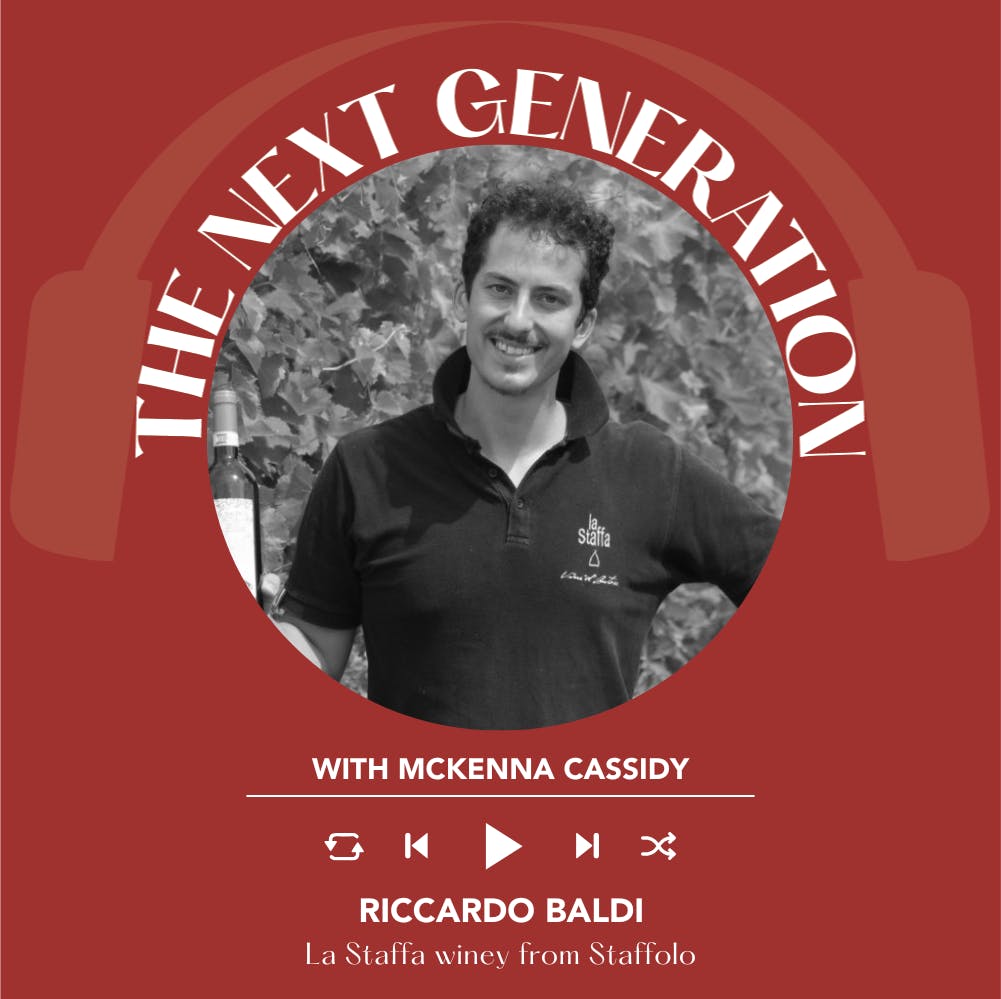
Ep. 2409 McKenna Cassidy interviews Riccardo Baldi of La Staffa | Next Generation
Episode 2409

Ep. 2402 Margherita Andrenacci interviews Erin Kirschenmann of Wine Business Monthly | Next Generation
Episode 2402

Ep 2396 McKenna Cassidy interviews Luca Paolo Virgilio of Caprera Winery in Abruzzo | Next Generation
Episode 2396