

Ep. 1931 Victoria Cece interviews Margherita Sgubin | The Next Generation
The Next Generation
Episode Summary
Content Analysis Key Themes and Main Ideas 1. The journey and career path of young Italians in the food and wine industry. 2. The emotional connection and legacy of family-run wineries in Italy. 3. The educational pursuit of wine management and its practical application. 4. The unique characteristics and appreciation of wines from Friuli Venezia Giulia. 5. Generational perspectives on wine consumption and the need for inclusivity. 6. The intertwined relationship between Italian food, wine, and culture. Summary In this episode of ""The Next Generation,"" host Victoria Cetje interviews Margarita, a young Italian pursuing a Master's in Wine Management in Burgundy, with plans to return to her family's winery in Friuli Venezia Giulia. Margarita shares her emotional journey of gaining external experience before settling back into the family business, emphasizing her deep love for her home region. The conversation delves into the specifics of her family's winery, known for white wines and indigenous varieties, and explores the broader issue of wine's perceived exclusivity, particularly among younger generations. Margarita advocates for ""drinkability"" and approachability in wine, explaining how personal context and social connections shape wine appreciation. She also highlights the family's restaurant background and shares a traditional Friulian dish, ""chasons,"" underscoring the vital link between Italian cuisine and wine. Takeaways - ""The Next Generation"" podcast showcases young Italians in the food and wine sector. - Margarita is pursuing a Master's in Wine Management in Burgundy before returning to her family's winery. - Her family winery is located in Friuli Venezia Giulia and primarily produces white wines, including indigenous varieties like Ribolla Gialla and Filano. - Gaining external experience and perspective is a valuable step for young people involved in family businesses. - Wine is often perceived as exclusive, posing a barrier to entry for new, particularly younger, consumers. - ""Drinkability"" (easiness to drink without sacrificing complexity) is a key factor in making wine more accessible. - Personal relationships, context, and mood significantly influence wine enjoyment. - Italian family wineries often have deep roots, with multiple generations contributing to their legacy. - Traditional regional dishes, like Friulian ""chasons,"" are intrinsically linked to local wines and cultural identity. Notable Quotes - ""I truly understood that I love my region. I love Italy and my region as well. And I know that my place would be that."
About This Episode
Representatives from a wine podcast discuss their love for their family's winery and their desire to return. They also talk about their emotional journey with alcohol and their grandfather's death. They emphasize the importance of sensory capabilities and finding a middle ground for people to not feel like they fit in. They also discuss the use of red wines and their passion for wine, while expressing their interest in the Italian wine podcast and the restorationiponomy industry.
Transcript
The Italian wine podcast is the community driven platform for Italian winegeeks around the world. Support the show by donating at italian wine podcast dot com. Donate five or more Euros, and we'll send you a copy of our latest book, my Italian Great Geek journal. Absolutely free. To get your free copy of my Italian GreatGeek journal, click support us at italian wine podcast dot com, or wherever you get your pots. Welcome to the next generation with me, your host Victoria Cetje. This is your podcast to learn about all the cool things Italians thirty and under are up to in the food and wine scene. And yes, that includes all the best sixteen. Call, everyone. Welcome to another episode of the next generation. Today, you have me, one of your hosts, Victoria with today Margaritas, who've been from We're going to Fruliovenexa Julia today, which is really exciting. A region I've never been to, which is crazy. Tom, not a good eval. Hi, Victoria. Hi. Thank you. How's it going? Nice to be here. I'm so happy you're here. Where are you right now? Are you at? Winery? Or No. Actually, I'm currently in Burgundy. I have started my master degree here, one year ago, and I'm kind of reaching the hand. So I'm staying here for two more weeks, and then I'm going back to to home. So, yeah, still here. Oh, exciting. What are you doing your master's in? So, basically, I wanted to I have my my bachelor degree in business and management. After finishing it, I started working at home and I started to realize that I was more interested into wine, and I wanted to learn more. So I just decided to apply to this master degree in wine management that basically focused more both on the production part because it gave us the knowledge in terms of analogy and also agronomy. But also in the business part, so finance of the marketing, sales and distribution Well, that's so exciting. So what's your dream? What do you wanna do with this? So ultimate goal is that of, going back home for sure. But now I'm more open to work somewhere else. Just to gain more hands on experience. I'm applying for some marketing and communication position, but I'm also considering the sales, but, of course, always keeping the final idea of going back home and work there. Of course. I mean, we'll get into your family winery shortly, but I could imagine with such, you know, a legacy and something so beautiful. It's, like, always kind of calls you back a bit. No. Exactly. And also, I think it was, like, nice opportunity to realize that being here for one year, I truly understood that I love my region. I love Italy and my region as well. And I know that my place would be that. Well, can you tell us one reason, like, that you love your region? Like, what makes it special to you? I think it's the fact that, you know, you wake up in the morning. You are surrounded by the nature, even if it's a place which is truly, like, located nowhere because it's a small village. But, you know, you're surrounded by nature, and it feels like being in a truly, like, peaceful place. So it's like in oasis, I think. This is what I've been missing here. Really wanna actually ask more about that because you're in burgundy, which obviously is a world renowned wine region. And so is in food even at Sedulia, but like, you know, it's burgundy. We have to say that. So what is it that burgundy doesn't have. Not to be a little bit, you know, controversial, but Burgundy, of course, as also be sparked because it's full of vineyard. It's very green. However, I'm living in Dijon, which is, the northernmost city of, the cut door, even if it's not like, a metropolis because it's not at all. But still, you're not immersing in nature, and you have to have a car to actually go visit peanuts, but I don't have it here. So I believe it's I understand the whole car situation because I currently don't have a car based in Rome. And even though everyone's like, oh, driving in Rome is nuts, it's when you don't have one though and you need to do things, like, you know, for work or whatnot, it's it becomes really stressful and you feel like you can't. And the special thing about Italy is, you know, how you can go from a small metropolis to small city or big city and then go straight into like nature, like super rustic and so of a time, which is really special. But anyways, let's talk a little bit more about your history and your family winery just to give the listeners a little bit of background. Do you wanna tell us a little bit about, like, your family's winery? We are located in Kalia, in the Laña del Kalia, which is located on the border with Lavinia in the northeast of Italy. Here, we mainly produce as the entire region as the trend, white wines, with indigenous grade ranging from Ribula Jolla to Philano, to also other international varieties like, sovignan Blanc, pinot Bianco, pinot Grido, and so on. And we have, of course, some indigenous red varieties like Scupetino together with, middle in cabinet, Frank, and cabinet, sovignon. Our winery is a family managed, so maybe by my parents, and my aunt and my brother. I always get very emotional when I hear about family winery because it's such a special thing. I mean, I can only imagine the calling to be a part of it. But what's really special about talking to you right now is I think we don't always get to talk to people who are in their journey of like that part where you step away from the family business to explore your dreams and your vision and then come back because we always talk about it in the past. They'll be like, oh yeah, I went here and I went there. And you're like, oh, that's nice and now I'm back. So I think for me, this is really special talking to you because you're very young. What are you like? Twenty four, twenty three? And turning twenty forties here. Wow. I was right off the plan. Really happy. I guess not right. And that's, like, such a, well, it's beautiful time. Like, be a very beautiful age. And and and you're really growing into it, so you're finding your place and like, do you wanna share a little bit more about that experience, like, that emotional journey? You know, when you leave home, you know that you're gonna come back as a different person because you are aware of the fact that you're going to meet new people that they're gonna share their point of view and perspective with you, but actually, when you get to the end of your journey and you have the complete awareness of what it has actually meant, it is really valuable, let's say. Like, I've been here, being in burgundy. Every day can be a chance to meet someone, either wine lover, but also some person related to the business. So every day might be a a chance to learn even more. And, it was like putting all the pieces together when you hear the point of view of someone, the different approach they have to whine. If I put in together all the pieces and build your own idea of wine and what actually it means to you, it was truly a priceless experience to me. It's something that really takes you out of your own bubble because you grow up and seeing one thing and then you go and you have to experience something completely different, different culture entirely in different approaches to wine. Like, when you were growing up, was there, like, something that you liked the most, like, in the winery as a young kid? Like, do you have any kind of memories, special memories? I was loving to go in the vineyards with my grandparents I'm the third generation, so everything started with my grandfather. Mhmm. And I kind of, like, being around the wine, so my whole life and around vineyards as well. So I think that the best memory I have here is it was those that of him bringing me with him in the field. That's so special. Have you mind if I ask, do you still is your grandfather still with you? Is he still around? Yeah. Yeah. Yeah. Yeah. He's he's now ninety six. He's still Oh my god. Of course. He's not working anymore, but he's still, you know, having a look over everything and wants to say his own opinion on everything. So Are you enjoying this podcast? Don't forget to visit our YouTube channel, mama jumbo shrimp. For fascinating videos covering Stevie Kim and her travels across Italy and beyond, meeting winemakers, eating local food, and taking in the scenery. Now, back to the show. She's drinking wine? Yes. Of course. But, you know, I had my grand grandmother. She passed away when she was one hundred and two years old. Oh my god. And she has always been saying that wine was her kind of easier because she had a glass of white one for her entire life. I don't know if that is true, but she reached the age of one hundred and two. So I can still support that because my grandma, she lived to ninety eighty seven or ninety eight. And she drank a glass of white wine with dinner every day. And also she had to finish her meal with something sweet. So she would always have like a little, like, pacitian or something. And it was I was just like, is this thing secret? Like, make it change, you know. No. No. That's just I'm sure your grandfather is so excited for you to come home. Yeah. Of course. Every time I call back home, he's saying me on the phone. Come back. We're missing you. So It's so special. Well, I have to ask you your generation with gen z. I'm millennial the last year. So I'm old. I'm okay. But with your friends and going out, to drink and stuff, how do you see the wine industry among, you know, like, your age group. If I have to think of it here, it was different because I used to go out with people that were mainly my classmates. So all of them were interesting into wines and were into wine already. At home, of course, I go out with my brother and his friends who are also passionate. But for my close friends, I don't think none of them is into one yet, but it's something that I'm gonna try to change when I will be back home. But I think that the main issue with, with one, there's also something that I realized while I was here is that for so long, it has been considered at something very exclusive, and that's also people assumed Like, a deep knowledge was required to actually understand it and approach it. So I think this is the main buyer in the world of wine. And this is, I think, something that we also should strive to change. Yeah. I agree. I think it still maintains. Well, the exclusivity thing is shifted a bit in the sense that it's not like in the past where it's only for older like wealthy people. But now I feel like almost even in, like, some of the natural wine communities, it becomes a bit exclusive because it's, like, very, very hip and very, like, another extreme. And people, they don't feel like they fit in or they don't know. They don't wanna, you know, engage. And I think there's definitely need to find some kind of middle ground, like like someone like, you know, yourself, you know, you're you're learning, you're young, you have this history, but you're also you have friends that are, you know, not as interested and you can be that conduit. The person that's like, okay. Well, you can drink, you know, something simple. Like, I mean, well, like, what's your favorite thing to drink? Like, of wine? Like, you're, like, every day, like, your grandmother, your great grandmother. Like, if you were to It depends, of course, on the context, but I left Italy, which I was more into white wines. Like, I come from a region, which is maybe, producing white. I love Pinobianco as a variety, which I think it's very underrated and not really under not fully understood, but also Ebola because of its freshness. But now I'm kind of shifting. I don't know if it's a phase of my life to reds. So, of course, here in Burgundy, I could enjoy pinot noir. But, also, I am starting to appreciate more and more descriptive, which is another indigenous variety we have, in in Firdi. So, yeah, it depends on the context, on the people, who I'm out with, but something that I always look for and look after into wines is the, let's say, easiness to drink, not in terms of simplicity, but in terms of drinkability. You know what I mean? Yeah. No. I know exactly what you mean because red wines can be a little bit, you know, I mean, obviously there's a whole spectrum of types of red wine, but the general consumer may hear the word red, especially if they're not a red wine drinker and go, like, that's you know, with it bodied or something and more intense, whereas there's especially in Northern Italy, there's incredibly fresh and less intense red wines, but still elegant. I know. It's also something that I could, find an opinion which is shared among the people that I knew here, like, my my my classmates or the people I used to go out with. So, yeah, it's even, I think, in this case, if you start appreciating in a way, like, to approach the wine work, these types of wine, I think it's even easier. You get closer to it with the freshness, and then you might decide to go deeper and to also explore other tastes. And I think you bring up a very important point about wine drinking is that there's kind of a mood. Like, you get in different phases. You have different times. Like, you obviously can really like one wine, but it's like if you're saying it's just a door and entry point to another kind of wine you may like. And then you may like that for a couple months or maybe years. And then all of a sudden, you're like, nope. I think I'm going back here. Like, I'm a very seasonal wine drinker. Like, I have my weird phases. And I mean, the one phase I'll never get out of is like bubbles. Like, very good sparkling wine. That will be a forever phase, but this is Yeah. Yeah. I totally agree. Yeah. That's like the one thing. I think I think that's always the this little secret sometimes when people are like, I don't really know if I like wine. I'm like, you know, have you had a really good bottle of, I don't know, like, obviously champagne or tons of offers something But anyways, but yeah, I think that's a really important, like, topic to discuss more about, like, how to this, like, how line is is. There's so many kinds and, you know, you're always it really does reflect your mood. Also, your sensory capabilities, right? Because if you taste a wine when you're just, I don't know, like, maybe we're spelling something else or whatever, you might be like, oh, I'm trying to, like, think about it, bringing it down to, like, if I didn't have my wine experience and, like, you know, we're a little more emotionally triggered because we don't have the technical background. So it's like you go, I don't really like this, but it doesn't mean you don't like wine, you know? No. No. Indeed. I agree. Yeah. But also, I truly believe that one is related a lot with the people you drink it and also with the people that gets you closer to this industry. Yeah. I a hundred percent agree with that. I think the table, the community, Like, that is the biggest part in those memories that you have around the bottle. One. Exactly. Thank you. Remember the most for sure. Well, before we wrap up, I have always asked about food because I love food. And I think, like, bringing it together and you talked a bit about your grandparents. If you had to pick, you know, one dish maybe that your grandma or grandpa made for you with something special and it's a parrot with one of your family's lines, So, yeah, I didn't mention it before, but my family has also been involved into the restoration gastronomy industry. Yeah. Everything started with the restaurant, and then, more efforts were also spend on the winery. So at our place, we mainly work with, seasonal ingredients and also ingredients which are from the region. And I love this, dish, which are called chasons, They are a kind of typical ravioli slash gnocchi, I would say, that you can find field differently according to the place you go. So at our place, we fill them with, smoked ricotta and automatic herbs, like ranging from mint to, medicine, and then rosemary and many others. These are very delicate, but very typical, and it's something that I truly love. My gosh. That sounds divine. And how do you, what kind of sauce is it in? Like, what do you toss it? They're just like with some butter, and then we are served with, a small ricotta on top. Some fresh, leaves of mint, and that's it. Oh my gosh. Similar, the better. That's fantastic. I wish I had asked before. It's that's beautiful that you you started with the restaurant because that brings us back to what you're saying. And also, yeah, the cord line is, like, at the table and and coming together. And oh, by the way, what why would you pair with that from your family's winery? I think I would pair it with it will pair very well because of the freshness also of the wine. Thank you so much, Margarita. It's been a pleasure chatting with you and getting to know you. And I wish you all the luck on your journey, especially as you wrap up your masters. And through your next adventure in the wine world before Italy calls you back. Thank you very much. It was very nice to have this chat. Yes. Wonderful. Thank you for taking the time. Thank you. As always, a big gracie for hanging out with me today. Remember, you can catch me on the Italian wine podcast every Sunday and anywhere you can get your pots.
Episode Details
Keywords
Related Episodes

Ep. 2434 Giulia Stocchetti interviews Alberto Sabaini and Sara Piubelli from Cantina Sabaini | Next Generation
Episode 2434

Ep. 2427 Margherita Andrenacci interviews Alejandro Fargosonini of Châteauneuf-du-Fargosonini | Next Generation
Episode 2427

Ep. 2415 Giulia Stocchetti interviews Claudia Bustos from Viña Raíz Criolla | Next Generation
Episode 2415
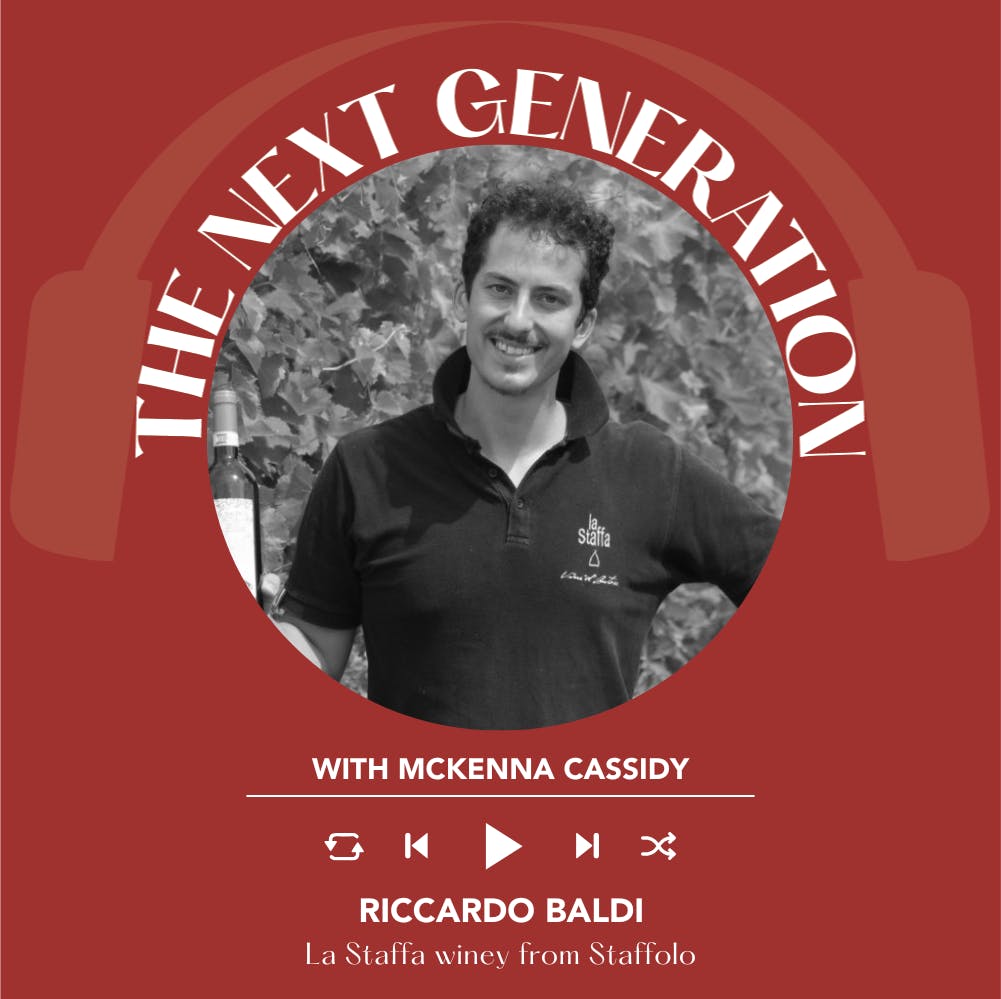
Ep. 2409 McKenna Cassidy interviews Riccardo Baldi of La Staffa | Next Generation
Episode 2409

Ep. 2402 Margherita Andrenacci interviews Erin Kirschenmann of Wine Business Monthly | Next Generation
Episode 2402

Ep 2396 McKenna Cassidy interviews Luca Paolo Virgilio of Caprera Winery in Abruzzo | Next Generation
Episode 2396