
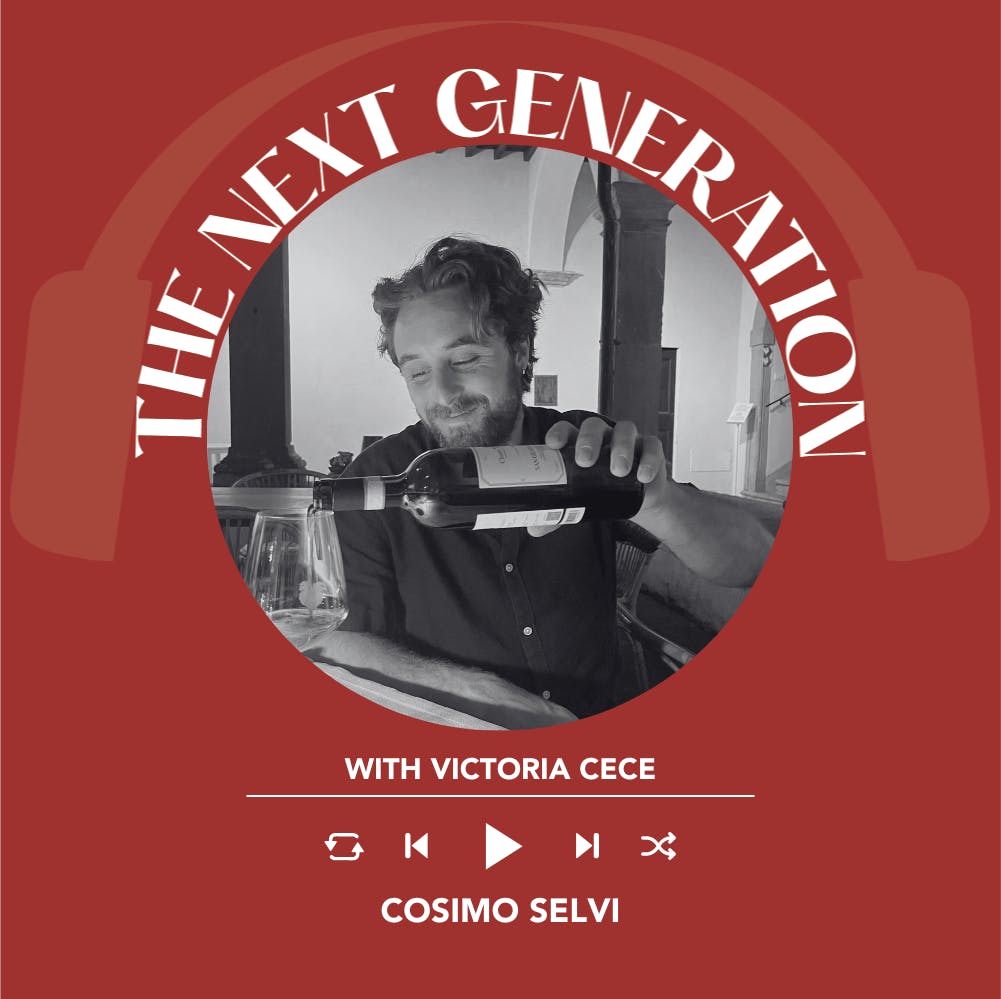
Ep. 1990 Victoria Cece interviews Cosimo Selvi | The Next Generation
The Next Generation
Episode Summary
Content Analysis Key Themes and Main Ideas 1. The evolving role of young winemakers in historic Italian wine regions. 2. Balancing tradition and modern challenges (like climate change) in winemaking. 3. The unique history and generational commitment within Italian family wineries. 4. The hands-on, multi-faceted nature of work in small-scale Italian wineries. 5. Adaptability and persistence as key traits for contemporary winemakers. Summary In this episode of ""The Next Generation"" on the Italian Wine Podcast, host Victoria Chesche interviews Cosimo, a young winemaker from Florence born in 1996. Cosimo shares his journey working at his family's small Chianti Classico winery, Fattoria Pomona, which produces around 20,000 bottles annually. He discusses his dual role, working tirelessly at his family estate doing everything from vineyard to cellar work, while also consulting for other wineries in grape growing. Cosimo highlights the vibrant community of young winemakers in Chianti Classico who are dedicated to preserving the region's traditional wine character amidst modern challenges, particularly climate change. He emphasizes that great wine primarily comes from well-grown grapes, with cellar work focused on gentle handling. Cosimo also delves into the unique history of Fattoria Pomona, revealing that he is the first generation to formally study oenology, as previous generations took over the winery from diverse professional backgrounds, drawn back by the ""magnetism"" of the place. The interview concludes with Cosimo sharing his current wine preferences (high-acid white wines) and his favorite wine bar in Siena. Takeaways - Young winemakers in Chianti Classico are actively preserving traditional winemaking while adapting to new challenges. - Cosimo represents a new generation that is formally trained in oenology but also deeply committed to hands-on farm work. - Small family wineries like Fattoria Pomona require diverse skills and a ""do-everything"" approach from their owners. - Climate change is a significant and ongoing challenge that young winemakers are grappling with, aiming to maintain wine quality. - The history of many Italian wineries shows a strong generational ""magnetism,"" where family members return to manage the estate regardless of their initial career paths. - Adaptability (like Sangiovese, Chardonnay, or Merlot) is crucial for winemakers and grapes to thrive in changing conditions. Notable Quotes - ""Nature doesn't wait for anyone... It's gonna go the way it wants to go."
About This Episode
Speaker 4 talks about his small farm and how he needs to take care of everything, including taking care of everything. Speaker 3 suggests that Speaker 4's career is a hustle and emphasizes the importance of learning and adapting to changing environments. They discuss the challenges of maintaining respect for wines and the importance of high acidity in wines. Speaker 3 emphasizes respect for the wine's characteristics and the need for a winemaker. They also discuss the importance of communication between wineries and the challenges of family businesses. Speaker 1 talks about the importance of high acidity and mineral wines in family businesses, while Speaker 3 reminds Speaker 4 to follow the factoria gotten by and reminds them to follow the factoria on Instagram. Speaker 1 thanks Speaker 4 for their time and wishes them all the best.
Transcript
The Italian wine podcast is the community driven platform for Italian wine Geeks around the world. Support the show by donating at italian wine podcast dot com. Donate five or more Euros, and we'll send you a copy of our latest book. My Italian Great Geek journal. Absolutely free. To get your free copy of my Italian GreatGeek journal, click support us at italian wine podcast dot com, or wherever you get your pods. Welcome to the next generation with me, your host Victoria Chesche. This is your podcast to learn about all the cool things Italians thirty and under are up to in the food and wine sea. And yes, that includes all the best things to eat. Hello. Hello, everyone. We are back to another episode of the next generation. Today, we are traveling to Tuscany to We have a special guest here today, and it is Kazimos, already on. Are you there Kazimos? Hello there. Yes. I'm on. Hello. Hello. Welcome. Thank you. Thanks for having me. Thank you for being on and taking the time to chat. So Cazimo, are you where are you right now? Actually, now I'm I mean, my newly built office in Pumuna, really, really small office. Every year, we have something more to add to our small farm. So right now, I'm here alone in my new office. You're alone, but it's good. I mean, get some work done maybe. Yeah. Yeah. Yeah. Yeah. This is a moment of the year in in the farm where you really have to to run, run fast. Yes. So you you need to find the time to do everything wise. You're going mad. So tell us what does running fast look like on a farm like a winery in county Glasgow in June? Usually, May, June, July, sometimes more intense month of the year. Maybe in the winter, you have more time to think and to organize things because plants are dormant or sleeping, let's say. So you have the time set the thing. During the summer, they are growing, and that's the key part. They don't wait for you. So you gotta to take care of them and fighting up the vineyards, getting ready to to the summer. During the summer, usually works are a bit slower. Yeah. But in this period, this is the most intense, of course. Yes. In in working in the vineyards. Of course. I mean, you said it perfectly Nature doesn't wait for anyone. Yeah. And doesn't wait for everyone. It's gonna go the way it wants to go. Yeah. But before we get down that track in that conversation, How about you tell us a little bit about yourself for the audience from your words? Who is Cosimo? Okay. I'm Cosimo born in Florence in nineteen ninety six. I I was born and raised here in Canti Glasgow and the house where I grew up, the house of my grandparent in the farm in fact in Fatoria Pumona. So I've always see during my life, the farm life, let's say, after high school, I decided to study analogy in Florence, and I studied for three years. Then I decided I wanted to to stop my study and learning to work. So I started to to work in the winery, doing everything you you need to do. Also, because our winery Fatoria Fomona is a really, really small estate. It's six sectors, which means producing around twenty thousand bottles each year. If if everything goes well. Really, really small winery. So you gotta do, everything you need from the work in the vineyard to the work in the cellar and office work and so on. So I started working in the winery, and now I'm doing two works at a time. That's the tricky part because I work in the winery, and also I work for other wineries in grape growing, let's say. So I'm learning to be, kind of a consultant in buying training. I was lucky to find the mentor that is teaching me still now how to do it because it's a really, really slow thing. As we said before, you need to follow the time of nature, you know. So every year has his cycle and you can't repeat it, you know. So if something goes wrong in maybe in a part of the year, then you're you need to to wait for the other year to to learn something more, you know? So, yeah, that's that's me now. Two different people trying to work, work it out. Both things. That's that's hard. But Really fun. Kudos to you. I mean, it's a hustle. I mean, and it's really smart what you're doing is like enhancing your skills and also setting the tone for the future because you never know where where your career will lead you no matter what, like, you know, with your, your family winery or beyond. And I think that's really that's really awesome, but I can imagine how busy you are. Yeah. That's it. Yeah. Yeah. Yeah. And it's a moment tough moment, but, it's fun. As I said, it's fun. Yeah. And also because I'm curious guy, let's say. So it's plan to be around. I work just in Canti classical for now. So I have the luck to go around and round the Canti classical every weeks and see what other people is doing right now. How how they're training the vineyard, how they doing this kind of stuff, talk with wine people and farmers and, yeah, people who ride the tractor, and it's really, really interesting. You know? Yeah. Exactly. I mean, there's so many there's so many people behind a bottle of wine. Right? Like, there's so many things going on. And I think that's the beauty, especially that you're you're part of a small winery, which I'm always somebody who is like go, like, you know, if you're if you're when in doubt, go small, like, look at small producers because they're the ones really getting their hands super dirty and figuring everything out, like, you know, face to face. Like, you like yourself. Like, I'm sure. And I'm, again, thank you for taking the time to talk today because I know that your brain is probably going, like, a million kilometers per hour. Yeah. But It's it's a pleasure. Of course. But I'm I'm curious. So as you because County Glasgow, obviously, one of the most historic wine areas in Italy. Yeah. Like, as you go around and you do your work, do you find that there's a lot of young people Working? Oh, yeah. Mhmm. There's a lot of people around my age that works in the winery, but also not just owned a winery, but also who works for a, for other state. It's it's like a community in the community, you know, it's really interesting to have the community and be inspired by what's going on? Yeah. Especially with the climate change Mhmm. Things that is going on. Like energy. Of course, there's a lot of energy going on with younger people in winemaking. Chanti classical, as you said, it's really historical region, historical winemaking region. So the key part for me is to trying to maintain the same kind of wine, you know, in other parts of the world, maybe you see young people trying to make fancy wine, let's say, you know, I think in Canti Glasgow, it's not necessary because you already have all you need to make a fantastic wine. It makes me really happy that there's a lot of excitement and inspiration in an area that's so famous already because oftentimes, like you're saying with other places, like, where perhaps there's more of a brand image, you know, that you kinda have to follow. Whereas, you know, if you really go back to it, it's in the hands of the farmers and what you can really create. Yes. That the key continuing making a great wines to find a way to continue making wine like twenty years ago, but with different variables, I think I'm kind of a conservative about wine especially in this region need to be preserved as they are. Mhmm. Let me explain. Of course, you you already have whatever you need to make a great wine because wine comes from grape. The work is made by the grape. In making a grape wine, it's eighty percent from grape and twenty percent in cellar work. In cellar, you just need to be careful and gentle. You just need to grow a grape rate. So, yeah, you already have whatever you need to make a grapevine the difficult part is to keep doing it, and that's the challenge. And and that's maybe one of the first topic we chat about when I have the opportunity to talk about it with my colleagues. Yes. You you, of course, do a wine, which is suits more the recent year. Let's say, with this, I mean, you find more fresher wine, light bodied wine, more dynamic, let's say, younger wine. Which are typically made by younger people from here. But the heart of the wines is still the same as a wine of thirty years ago. It's just how you treat the grade, the difference. And that's maybe the only difference that I see also, of course, you have many new technology that you use to make it wine better, of course, which I didn't mention. Yeah. You wanna respect, like, the personality and the the soul of the grape, and and obviously how it's treated will have different expressions. But you always kind of wanna maintain respect for the grape ultimately and not manipulate it. Yeah. Not manipulated. Yes. That's the most important thing. Yeah. You need to just be respectful the important work is in the vineyard, as I said. And you difficult part is to find a way to let the plant express even in period like this where the summers are hotter. This, of course, affect the wine you make. The climate change, it's something difficult to to handle. This is the challenge of the new generation. Yes. This is the big one. A good winemaker is a winemaker that will make wine like they used to do thirty years ago. That's difficult part. Are you enjoying this podcast? Don't forget to visit our YouTube channel, mama jumbo shrimp. For fascinating videos covering Stevie Kim and her travels across Italy and beyond, meeting winemakers, eating local food, and taking in the scenery. Now back to the show. Well, not to change the subject but you just gave I don't know why I feel inspired of the crazy question that just came to mind. But for people to understand more about you, if you were a grape causing mom, which grape would you be? Oh, Sanjuveza, of course. Of course, it would be part of this. What kind of question? No. No. But I know. I feel like I set myself up there. Okay. But I think a bit more. You know, I I studied, you know, I I studied, you know, I I studied, you know, also about other grapes. And of course, international grapes, you talk about a lot. Also as a xenologist, that I don't refer to me like an anologist because it's not the most important thing I do in my life, but this, of course, affects my way in seeing wine and understanding wine. So maybe also a chardonnay. I don't know, but I I feel chardonnay. Oh, I like that. I like I like that you chose a four in one, and then you have an Italian great Yeah. Because it's one of those grape that is like also or merlot. I I mean, international grape because they are really plastic. So they can adapt to all kind of situation. Yeah. You gotta see as an international grape to survive and be good for the future years. I like that. That means that you're adaptable and you will survive and you will persist. Yeah. Yeah. Yeah. Yeah. Which is important because we need people like you in this kind of energy, especially in Italian wine and the wine world because and I'm I'm really happy we're having this conversation from, you know, the different, you know, the young people in Counti Glassico too, which great for you because I think there's more enthusiasm about Italian wine amongst young Italians than we realize, and we have to, like, you know, get it together. And and even if that means identifying more as Chardonnay, but it's okay because there's a lot of Chardonnay in Italy planted. So, again, I don't want to take away from you in this conversation. I'm gonna call you mister Chardonnay now. Okay. Mister Shardonette. Mister Shagini. I also like Shagini, but as well. But if you could tell us a little bit, like, what's the vibe of your winery? Like, tell us a little bit about it. I really like your Instagram, by the way, winery's Instagram. Oh, thank you. The Instagram followed my girlfriend that we which is coming along with us now. So starting to work with us. So that's great. I I really appreciate that. The vibe is to You know, here, Pumona is the winery, which has a a big, big history. It's a place. It's an old place. This is the the history, and it changed a lot during the decades. It started when when my great grandfather bought it in eighteen ninety, it was a furnace. So they used to make terracotta here. Then Oh, wow. Yeah. Yeah. And then he bought it, bought this place, and it was a really smart guy course, he didn't know of him, but was a really, really smart guy for sure. And he saw the the potential that was here to make wine. Also different times, so it wasn't just wine making. He was a proper farm. So with animals and fields and with Bali, and of course olive grows and vines. So he started them, during the twentieth century, there were many stop and goes, because of the wars. It started to be a winery with my grandmother, of course. They started in the eighties, early eighties, and they started to do it. It was more like an hobby. It wasn't a proper winery, let's say. And then eighties were a moment, but winemaking was starting in Tuscany rising up, you know? And then my my mother came in two thousand seven. She started to make it more, proper winery. All this story to say that all the generation has in common one thing, except for me. I think that they had in common that every person that guide the winery started making another job. And then, for a reason or for another, they finished in directing the the winery. This place is like Pomona for me, but can't I think Canti classical for every wine winery is like a magnet. When something can happen, when someone say, I can't do do it anymore. Or you take place or or we sell, you just can't sell. The vibe is like it's like a magnet this place and you end being here and take care of the the displays. And I am the first generation that actually studied and prepared to make wine. This is something I always find that interesting. My mother, for example, was a veterinarian. Until two thousand and seven. And my grandmother was Germany. It was a translator. My grandfather was a doctor. It was so on. Every moment that happened, that the previous generation said, I'm full. I'm I'm okay. I want to retire the future generation, which was doing some something else, said, okay, I'm stopping whatever I'm doing now to take care of the winery. I I think this this pretty, pretty strong and interesting. I think and hope is something that will never change. That's really special. Yes. That's the vibe. The power of communication from this place to the family, the linkage, which is here is really interesting, you know, and it's deep So that's that's the vibe. The communication between the place and the people that live here. I love that. Thank you for just going and explaining all that because I I wasn't expecting that from the family winery, you know, you sometimes expecting more of a typical story not to, like, put anyone in a box, but No. No. But I love that that commitment and that love. And I like you said, it's a magnet, like, you always come back. And also Congratulations to you for being, like, you know, the first generation to be, like, committed, understanding the grapes and, in the vines and, and setting a tone for the winery's future that I'm sure we'll be very, very fascinating because it seems that you have all the hands in the dirt instead of maybe being halfway in in surgery and halfway in the vine. Yeah. Actually, as I said, I'm I'm going to to job. So maybe in ten or twenty years, I will have to stop. I I have always thought about it. I started a new job. I'm doing both now. At the point in my life, maybe I couldn't do it anymore. We'll see. I don't think about it. I just go. Yeah. You exactly. And you're young. And I think you're also an inspiration for many people, especially those listening who have dreams of working in wine or currently working in wine in some capacity and and worry maybe you know, oh, like I have to dive full force into it and do only one thing where the reality is, especially in our world today, is that you can do multiple things or do two things and and and figure it out. Yeah. Yeah. You can. And it doesn't mean that the wine's going to leave you or your opportunity. It's just that, you know, you're you're young and you you wanna see, like, you know, what you like and where you wanna be. And then, obviously, given that you have your family wine, are you, like, the beauty of that, like you're saying before is it it comes back and your knowledge will always be part of, like, given back to the winery, which I think is a really special thing. Yeah. Yeah. It's it's fun. Sometimes there are tough moments because, of course, five, six people that has to say what you have to do. I mean, someone say you need to do this thing like that. Yeah. And the other say, no, you gotta do it like that. So sometimes it's challenging. But I think it's it's part of a family estate to sort it out talking about it. Sometimes it's difficult. Sometimes you maybe have even little fights, but I I think the good stuff can came out also from this kind of problems. Yeah. Yeah. I mean, family businesses are not easy for anyone whether No. It's not easy. Whether wine or not. I mean, my dad has a family business and well Sometimes it's hard. I'm happy I'm not part of it. Let's just say that. Yeah. But if it was wine, it'd probably be different for me, but I I totally I totally you have to have the passion first because then you can get over all the difficulty that may come by. Before we wrap up, let's finish on one very important note. What are you drinking these days, Cosimo? Oh, in these days, I'm drinking as I said, I really like to drink. It was not in these actual days, but white wines from the northern part of Italy and Slovakia. I'm in love with riesling from Slovakia. That's maybe the the first things that came to my mind, but all the white wines that came from, let's say, Trentino Alto Adije from also Germany, Austria, high high acidity, mineral wines. Yeah. That that's my kind of wine now also because we are in in the summer, so start to get hot. That's the most frequent thing that I'm drinking, gink, in those days, maybe. Or I will drink. If not tonight, maybe tomorrow as soon as possible. No. A hundred percent. I think, you know, that those are the perfect wines to drink right now, like, especially with the heat that's hitting Italy now slowly. I saw the forecast for next week and it gonna get hot again. So, yeah, you need high acid mineral white wines or Yeah. Bubbles to get you through and get you, like, refresh. And then my last question for you, because I'm trying to steal all your secrets for everyone. Where do you and your friends go to drink in Florence? I actually don't go very often in Florence. Or in Canti Glasgow. Usually, when I go out, I actually don't drink that much wine. I drink wine at home. Maybe wine that exchange this with someone else. When I go out, I usually go, maybe a long drink. So that's not really interesting. No. It's okay. I'm a cocktail girl too. Don't worry. A lot of times, it's a martini, not not one. Yeah. Yeah. I usually drink, yeah, maybe, or a gin and tonic or an old fashioned I'd like to drink, something like that. I go more often than in Sienna. Which is maybe not so much to offer like in Florence, but it's nearer to my house. So I go more often there. I mean, can you can you share it? Is it a big secret? The name of the place? Yes. Yeah. I I often go in a place in Sienna, a wine bar, which is named trefilari, which is, in English, it's like three lines of of the vineyard. Mhmm. Has really, really big wine menu, really variable. So it's it's fun to go there and drink something new. Every time you go, you find something new. So you want to go there. Yeah. Fantastic. No. I I love Sienna, and I think, I actually go to Sienna often because I have family that lives Well, not in the city proper, but, like, on the periphery. Yeah. So I I'm I'm definitely gonna check that out next time, but thank you. I love yeah. Because, you know, I think a lot of young people always, you know, there's you know, they can find things on Instagram and social media, but sometimes it's good to hear where, you know, a young winemaker and a young person like themselves goes and drinks. So they can have some fun too. Yeah. Well, thank you so much, Cosimo. It's been lovely, lovely chatting. I hope you had some fun. Yeah. Yeah. Sure. Of course. Thank you so much. Thank you. And I wish you all the best. I know you're you're on some intense time, so I'm gonna let you go now. But, yes, everyone, I want everyone to go on their Instagrams right now and follow factoria Pomona. It's really cute, and I love what you guys are doing. And, again, wish you all the best. Thank you so much, and have a great summit. You too. I wish you all the luck. As always, of big good answer for hanging out with me today. Remember, you can catch me on the Italian wine podcast every Sunday, and anywhere you can get your pots.
Episode Details
Keywords
Related Episodes

Ep. 2434 Giulia Stocchetti interviews Alberto Sabaini and Sara Piubelli from Cantina Sabaini | Next Generation
Episode 2434

Ep. 2427 Margherita Andrenacci interviews Alejandro Fargosonini of Châteauneuf-du-Fargosonini | Next Generation
Episode 2427

Ep. 2415 Giulia Stocchetti interviews Claudia Bustos from Viña Raíz Criolla | Next Generation
Episode 2415
Ep. 2409 McKenna Cassidy interviews Riccardo Baldi of La Staffa | Next Generation
Episode 2409

Ep. 2402 Margherita Andrenacci interviews Erin Kirschenmann of Wine Business Monthly | Next Generation
Episode 2402

Ep 2396 McKenna Cassidy interviews Luca Paolo Virgilio of Caprera Winery in Abruzzo | Next Generation
Episode 2396