
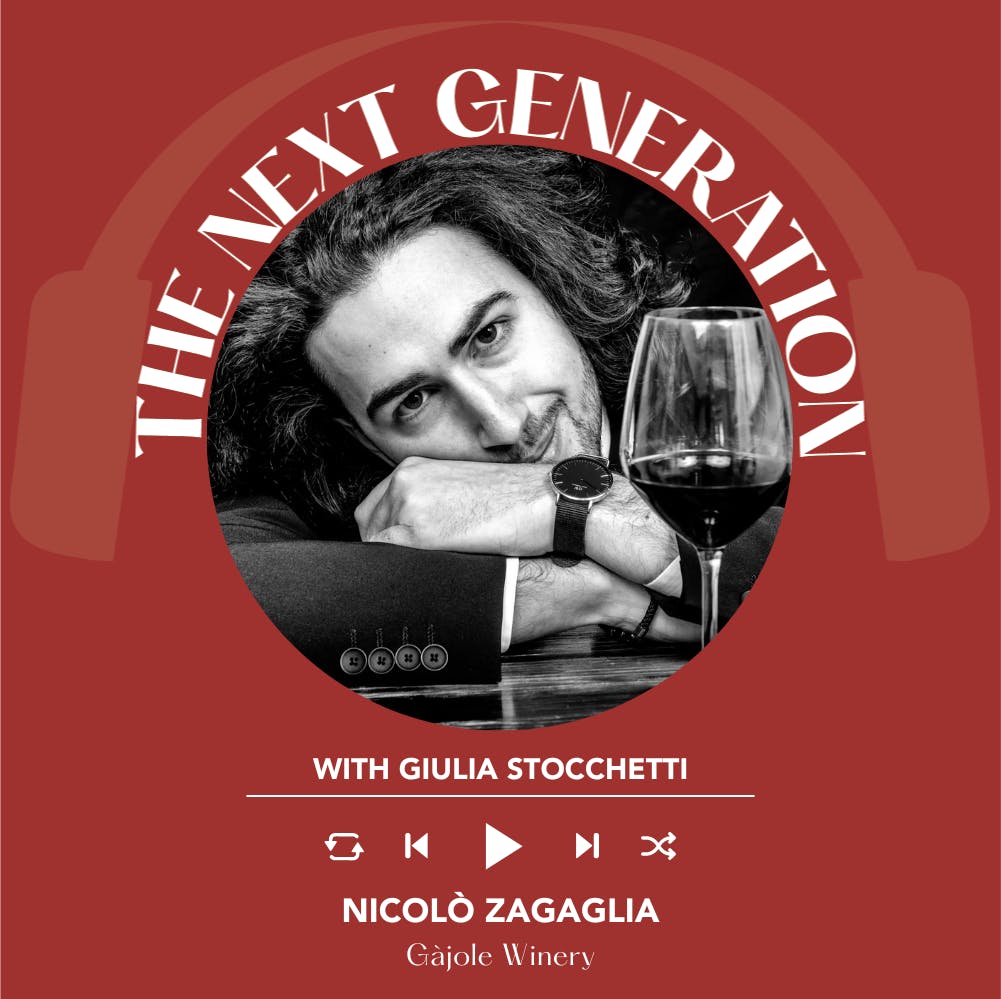
Ep. 2019 Giulia Stocchetti interviews Nicolò Zagaglia | The Next Generation
The Next Generation
Episode Summary
Content Analysis Key Themes and Main Ideas 1. The Entrepreneurial Journey of a Young Winemaker: Nicola Zagalia's unconventional path from enology student to establishing his own winery, Gaiola, at a young age. 2. Unique Winemaking Model: The ""guest winery"" approach and its implications for starting a wine business with limited capital. 3. Verdicchio di Matelica: Focus on this specific DOC white wine, its characteristics, aging potential, and the distinctive Matelica terroir. 4. Winemaking Philosophy and Techniques: Nicola's emphasis on elegance, longevity, hyperoxidation, and meticulous vineyard/cellar practices. 5. Holistic Approach to Wine Business: Nicola's engagement in not just winemaking but also consultancy in wine marketing and business advisory. 6. Challenges and Aspirations: The realities of the Italian wine industry for young professionals, the importance of consumer education, and future goals for Gaiola. 7. Traditional Wine Revival: The project to produce a traditional Vino Cotto dessert wine. Summary In this episode, host Julia Stockcetti interviews Nicola Zagalia, a young and passionate Italian winemaker from Matelica, founder of Gaiola. Nicola shares his unique journey, detailing his decision to return to Italy after international experience in New Zealand, driven by a desire to build his own project rather than be an employee. He explains Gaiola's distinctive operational model, where he utilizes a ""guest winery"" system to produce his wines, allowing him to manage every stage from grape to bottle without significant initial capital. Nicola delves into his flagship wine, ""M,"" a Verdicchio di Matelica DOC, highlighting its elegant style, remarkable aging potential (up to 20 years), and the specific techniques like hyperoxidation he employs to achieve this longevity. Beyond winemaking, he discusses his role as a wine marketing and business consultant, emphasizing the importance of continuous learning and practical experience over academic certificates. Nicola also introduces an exciting new project: the revival of Vino Cotto, a traditional dessert wine. He touches upon the challenges of educating consumers and expresses his ambitious future plans for Gaiola, including expanding vineyard holdings, increasing production, global export, and producing extended-aged Verdicchio reserves. Takeaways * Nicola Zagalia founded Gaiola winery at age 25, choosing independent entrepreneurship over traditional employment. * His ""guest winery"" model allows for complete control over production with reduced initial investment. * Gaiola's Verdicchio di Matelica, ""M,"" is crafted for exceptional elegance and a long shelf life, capable of aging for 20+ years. * Nicola utilizes specific techniques like hyperoxidation to enhance the wine's longevity and stability. * He values practical experience, networking, and continuous self-education alongside formal qualifications. * Nicola provides consulting services in wine marketing and business operations, demonstrating a comprehensive understanding of the industry. * He is embarking on a project to produce Vino Cotto, a traditional Italian dessert wine, highlighting cultural preservation. * His approach to consumers emphasizes educating interested individuals about the meticulous work behind the wine. * Future goals include significant expansion of vineyard land, increased bottling, and global export for Gaiola. Notable Quotes * ""I inherited my passion for wine from my father."
About This Episode
Speaker 2 introduces the owner of the company, Nicola Zagalia, who produces the beauty of Madelica. Speaker 1 and Speaker 3 discuss Speaker 1's background and experience with wines, including learning by experience and working for other wineries. They also discuss the process of making Vintaals, the importance of age and the use of different techniques for production, and the importance of shelf-life and proper storage. Speaker 3 currently produces 13,000 bottles a year and plans to produce 40,000 in three or four years. They also discuss the importance of educating customers and being a new wine producer, as well as the need for a strong experience. Speaker 1 thanks Speaker 2 for their time and asks if there is anything else they want to add before ending the episode.
Transcript
The Italian wine podcast is the community driven platform for Italian wine Geeks around the world. Support the show by donating at italian wine podcast dot com. Donate five or more Euros, and we'll send you a copy of our latest book, my Italian Great Geek journal. Absolutely free. To get your free copy of my Italian GreatGeek journal, click support us at italian wine podcast dot com, or wherever you get your pods. Ben Venuti, welcome to the next generation with me, your host, Julia Stockcetti. Join me as I take you on a journey to discover young stars of the Italian food and wine world, PRonti andiamo. Hi, everyone, and welcome back to the next generation on the Italian wine podcast. This is Julia, your host And today, I'm super excited to have here with me, Nicola Zagalia, who's based in Matelica, who produces an outstanding Verdicchio from the area. He basically graduated in a knowledge and and then he traveled to New Zealand for the harvest where he was actually offered some career opportunities, but he refused to stay twenty four hours away from home. And he decided to go back to his homeland to start something new and something on his own. That's how Gail was born. Establish when he was only twenty five years old. That's sad. I don't wanna spoil you anything else because I'm excited to have here, Nicola, telling us everything about Goyole, about himself and about his lines. Shawnicolor. Hi. Hi, everyone. My name is Nicole Ozzagaya, and I am from the market region. I am the owner of value the company where I produce verdic of Matellica, and I am a household wine consultant, specialized in the business of and wine marketing. Nice. So, basically, that's who you are and what you do in your life. Right? My life, I produce the beauty of Madelica. Nicole, how old are you? Hi. I'm twenty eight. How come you became a wine maker? I mean, what's your story? I inherited my passion for wine from my father. He is, simply wine lover. I started out studying withiculture and, analogy at, and coordinate university. Once I finished it, I started working. First, I tried to find the work in Stellenbosch, South Africa, but, without Sussex. Then I started to work, in Castelli DSE, where the cure area. Then I tired of being in Italy, and, I went to do a vintage in New Zealand, in delegate, Oster Bay near Henwick. At this point, a problem, arose because the work, comparison between Italy and New Zealand was, Mayor Simmons. The kind of contract the kind of work is more specialized in New Zealand and everything. So it was easier to build your own career there in New Zealand. Correct? Yes. Of course. It's more easy, but sometimes I took the the guys that, go in New Zealand and go in California or out of Italy probably did it for easy career. In the first moment, I thought that was like escape from the problem. But in a second time, I think it is not so bad because, of course, the life can't be so, so hard. And should not be so hard. So maybe it's a choice as every choice is, very best not. So you enjoy it. The time you spent in New Zealand. You learned lots of stuff. How was that? Yes. I learned, a lot of stuff, but a different kind of, winemaking, okay, the companies are more big than Italy. In Italy, the average companies are small. Medium company ownership is a family ownership in New Zealand, not in New Zealand, our big company, for example, delegate Bay where I worked at producing the twenty millions, per years. I don't know if, they are the biggest producer in, Malderog, but I saw a lot of one of his, very, very big with a, a huge bet of vacation. So it's a very different country for the one making, and the taste is very different. Maybe in the hold the word like France and Italy is very different also the taste. Maybe in here, we are looking more for the legacy nice balance instead of the new word, maybe in UK USA or Australia. There are more international style, you know, more softness. So very different between New Zealand and Italy, but also for the unification. So you were a winemaker in New Zealand. You were as a winemaker. Was your main position? Not exactly. I worked at, as a seller and. Okay. Nice. But anyway, you were making wine, basically, helping out making wines. Right? Yeah. I was in the white team during the shift After your experience, why had you decided to found a winery? After the New Zealand I was in a crossroad, either have a good job on the other side of the world overturned, but, not as, an employee. But to develop my home project. This was because I could no longer stand the the life of an employee in Italy with terrible contract and the wages that only allow you to float, you know, you can build a normal life Yeah. But basically, this is almost, like, in every sector. Right? I mean, is the tough condition in Italy, unfortunately? Yeah. For, while I carry it on the Gallule project, so working for all the wineries. In the meantime. And, in the meantime, so I was studying for a specialist degrees in Udina, which I left because I consider it useless for my path. I only had three exams left. So you quit with only three exams left. Yes. I think that the certificate is not everything. Many companies, many people see the certificate, the graduate, but I started the the last two years, the university just for develop my knowledge. Now, I am an entrepreneur. So for me now, the certificate are participating US less. So you want to make experience basically. Instead of learning by studying, you wanna learn by experience and doing things. Yes. Experience, but also the network with other people that I know, and also in Verona because the my trust degrees was divided in two different universities. But basically, I started the last two years for the knowledge, just the knowledge. Today, I produce very big deal with my home company, and this is okay for me. For this reason, I don't need another degree. Yeah. You're improving by doing things. Yes. But also because to arrive in Odine, I need, eight, ten hours from Machanada. Yeah. It's quite far away. Was consuming enough of time. So you're wondering, I see that is quite unique because basically is you taking care of every single stage of the process from the grapes to the final bottle. So I was wondering how does it work? How is your routine? Yes. It is a unique model that's a lowered me to start without the need for a large amount of capital. I am a guest in winery that allow me to make wines as I want. And, I also collaborate with our logistic company that has an underground warehouse where I store my wine. And they ship it, to me when I want. So generally, I manage the timing very well. I don't have, the routine, exactly the routine. The wire is the one thing that, dictates the time most, but generally, I work every time without heavy haps because I manage very well the jobs to do. So every time I have a lot of time to complete the task. Nice. It's really important to have time to do things properly in the right way. So you only work at your winery now, or you're also still a consultant? I will answer the consulting to other wineries that mainly are, winemaking consulting, but in this year, I specialized at, so in wide marketing and, in business advisory. So balance sheet, revenues, cash flow, all the things that I studied first of all for me. And now I can consult for the other one. I mean, I think it would have been much easier for you just to complete university instead of embarking on all these new studies you're making. And that's fantastic because you're literally doing your job in the world of wine in a three hundred and sixty degree. I mean, you do everything. So you left university, but you're still learning a lot. I see. So that's beautiful. Every day, I study one hour or more. Of course, there are some days that I can't because I think it's very important that collateral knowledge with our collateral knowledge, you have, more chance to develop project you have a better vision about the all the project. Yeah. Definitely. That's right. And I was wondering if between all these things you're doing, you have, like, some interesting projects going on right now, like, maybe based on Verdicchio, Matelica. Yeah. I have many projects this year. I did a new plant of wired where I planted my home clothes of Arditude because I really think that the knowledge of the primary material, the grapes are the base for a great product. So, the first of all, I have the totally knowledge about the grapes for this vintage, the next vintage, I would like, and I will do a new production of Vino Goto is a suite dessert wine from music from the mask that I'll cook. And with the cookie, it's like a flotation. So the dirty part of the grapes go hot. Okay. And let's remove this ice process because with the act, must be every time less than one hundred degrees. So ninety degrees. And for how long do you cook the must? One day. It's very slow slow process. And then the fermentation starts, or how does it work? Starts when the mass, lost temperature and when, arrived to thirty degrees, start to fermentate. It's a funny process because with the temperature, I integrate all the oxidable enzyme. So this the cert wine, is like, portal. It's not oxyable, no more. Okay. So I have a very long shelf life. It's possible, taste, been a couple from, sixty years. There are no one oxidation is, perfect. We'll we'll do a little production. Yeah. Just to try. But are you using, like, stainless steel tanks? Are you using oak, What kind of vessels are you going to use to make this wine? The cookie is making, stainless tank with the fire under the bed and, the fermentation and the aging is doing to the bowel. Oh, wow. It's like a small barrel or a big barrel, old new. Generally, they could give a strong flavor to the vina cottos. So you can use, high toaster, the barrel, and small barrel, also very little barrel. Five three liters. Caratelli. Yeah. Carabelli. It's possible. Do it with Caratelli because the flavor is very strong. So I like toasted barrel, it's difficult to feel it. Right? Not in the tasty. And how long does the wine stay in these small barrels? More or less. Basically, when wanted, but after ten years, can take the the nomination, stereo. So the translation is ultra whole wine. So you're going to leave your experiment in Caracelli for like ten years. Do you have all this patient? I don't use Cara at the end, but I will use a bike. I will produce one bar per year. So this is the major project that I have the focus right now because this Vintajevo will do it. Still with verdicchio grapes, right? Yes. But not only verdicchio because, you can do the vino go to it. So mix the white and the red grapes. There are no skin contact in, Vinogotho. So when you use the red skinned grape, you can have, the color a little bit red that give a very nice orange flavor Fantastic when you taste it. More complexity, you can use also only white or only red break. It sounds delicious and so curious to try some because I've never had Vino Kapto, really. I think I've never had it before. So it's something really new. Yeah. It's produced in Abruzzo and South Picchino areas between market and Abruzzo region. But every region, say, this is my typical product to load your there are conflicts between the market and also. It sounds so Italian in this situation. Like, for the tramet Zena, where does it come from? Tour in Venice, who knows? Everyone is claiming to be the homeland of Carmelzino, like Avino Kalta, but you never know. Yes. It's very stunning. Are you enjoying this podcast? Don't forget to visit our YouTube channel, mama jumbo shrimp for fascinating videos covering Stevie Kim and her travels across Italy and beyond, meeting winemakers, eating local food, and taking in the scenery. Now, back to the show. What would you pair with Vino Cotto? You will have it just by itself, like, after dinner or with some, I don't know, desserts. For me, the best comparison with Vino Corto is the, but I think, it will be also during after the dinner in front of a fire just for meditation. So when will your wine be ready, will be for sale your Vino Kotto? How many years do we have to wait? I've produced Vino Kotto just for fun, for my petrum. I love so much, Vino Goto. So the first motivation is for me, for myself, for this reason, I will put on the market this wine when I will just satisfy of the finding and the aging. So now, for me, it's impossible to say a year. Maybe I will do directly the strawberry cream kind of, or maybe after, three years. I don't know, depending on how we'll age the wine. So you better stay tuned on Gallolet to know when the Vino Coto will be ready if your courage is to have some. And I think that will be definitely worth it. No. I told you a fun fact in the last, the Gantair Wine award, the fifth wine of the market region for the score is a winogled. Oh, wow. Ninety seven points. Oh my god. Yes. That's unbelievable. Yeah. Wow. This is pretty astounding. But actually, in Italy, you can't consider the winogled to us a win for the rules It's like a special category. Right? This kind of dessert wine is, more typically, more family can be oxidized. So I think, does have more attention. Well, but that's cool. You're doing that. I'm sure your, you know, cocktail will taste delicious. So I wanna make sure to try some. And that said, you're making Vena cocktail, but in total, how many ones do you make? Actually, for now, I produce only one wine and, ma'am, that did your automatic, d o c. Why the name m? Every time people send me this. Every time I don't have the transfer because, I projected to this name, for this reason. Everyone give a whole sign to this label and this is the better part of this label. No one give the same sign to the label. Maybe someone, and for Metellica officially haven't got a sign. For me, I have a sign, but, like, for you, probably, you can leave, different sign to the label? So free interpretation, m, can send for whatever comes up to your mind while you're tasting this wine, enjoying this wine. That's cool. I like the idea, the freedom to decide what m stands for you. Yes. For this level, you just don't try to understand. Just fill it. Beautiful. And how many bottles do you produce a year of this wine? You currently produce thirteen thousand bottle. And I would like to get to forty thousand in three or four years. Oh, wow. It's such a nice production. Should be delicious too. Yes. That's very reasonable. And how do you produce wine? Like, in stainless steel, in oak, concrete. M is produced from a selection to a wired in the cellular assault pressing, and I do a hyper oxidation of the mask that is done in order to reduce the oxidable charge of the finish at y, then I do a spontaneous fermentation. It's done in cement, and it ages in the steel for seven months with about ten to have fiveteen percent of oak. The elanco is, very different kind of oak because are from Austria, from Livonia, and Hungary, and French oak. After I do the branding, and it concludes with two months into the bottom. A very simple objective to produce elegance, fine, and very long shelf life wine. For this reason, I put everything to give a long shelf life with a hyperoxidation, with a salary and that operation, very careful as of the cat. Of the bottle, because I would like to think that I sell the time and not, super wine. Oh, nice. And, actually, is a wine that if made in the proper way can age for a long time, even if it's a white wine and can bring such unique emotions and a really interesting complexity. Yeah. So because in Matellica, we have a different teammates to the rest of the MAC region because the Madelik is a valley completely closer to the sea. And it's the only one valley with north south direction. And for this reason, there are always two, three degrees less the other part of the America region. And for this reason, we have a more acidity and with more acidity, more shelf life for the wine generally. And has some material after some years from the video. I just start to do a nice evolution and start to have nice balsamic flavor and take a great elegance. So it's perfect for the launch How long do you think it can age? I think it is impossible to produce a wine with more attention to the shelf life than my wine in a perfect storage, you know, nice seller with humidity control, and temperature control, not less than twenty years. Oh, wow. It's a long time. Yep. Also, with analysis, the car tech ins are almost zero. The car is, after the first year closed very, very, very well, passed only zero point one milligrams of oxygen per liter per month. So it is like zero. I put everything to give a long shelf life to my wife. Nice. So your aim is to give a long shelf life to your wines. And well, but sometimes, you know, it's hard when you get good wines, and they recommend you to wait a bit to enjoy it at the it's fast. And you have the bottle there and you're like, oh my god. I really feel like open it. And then on the other hand, you're like, no. I should wait because it's going to develop even more complex aromas and flavors. But, you know, I have to say I can't resist a good wine. So I don't know if I would be able to leave a one there for twenty years. Maybe I should buy a couple bottles more and forget them somewhere in the cellar. Like, hidden from others. Otherwise, it's tough. But, yeah, that's interesting. It's like gambling. Generally, that kind of wine, and no problem, but that is actually the bottom. It will, have a problem. There are also the lucky factor. So every time it's like a gambling game, Yeah. Every bottle is unique and is the universe itself. So, yeah, you never know. Yeah. So you cannot know if it's the right time, to be alternate. Yeah. Exactly. So what would you pair with your m, with your Verdicchio? Could be a good pair to grill out the angler fish with potatoes from you, maybe, and tarsol, bake the fish. Oh, so with fish dishes. With more year and more complexity. So with the white meats. Nice. So white meat and fish are both a good option for your wine. Fish, when it's a bit younger, white meat when it's a bit aged. Many people that work into the restaurant, save me your wine is gastronomic. Yeah. Pairs well with a lot of different kind of food. Let's say. Yes. A lot of people from their restoration selling videos. That's beautiful. Versatility is very important nowadays for the wine. It means that it's really enjoyable. Yeah. And where do you sell your wine most? Only in Italy, actually. I would like us to do a export. But, actually, the Italian market finish me every time, every year of the battles. So maybe the next year, I will do a little bit of export. And where would you like to go? Where would you like to see your wines abroad in the future? I don't have a favorite country. I own just only that my bottle will go on a table where the people can enjoy and appreciate all the effort that I put into the line. I was wondering, like, doing all this stuff, having all these amazing projects going on. How do you see yourself in the future? Like, what's your respiration? Is difficult to say, generally, I do project, three years more longer on the project and more difficulties to predict it. I would like as my home winery where I can really do all I want. I would like to have twenty actors. Now, I have just only two, a little bit less than two. And I would like, sell my wine all around the world, and I would finish my projects. I would like to do only very detailed. So I will arrive first of all to produce my reserve. And after I would like to produce another reserve with ten years finding between bottle and bet. I really think that Matendika have the opportunity to arrive to that kind of finding. So I would like to do a reserve over ten years finding That's beautiful to hear that you're really in love with your homeland with Matellica and with its own grape variety, indigenous grape variety that is verdicchio. That's amazing, really. Cause you want to give value to the place where you come from, and that's beautiful. So we are on the next generation. Right? So I was wondering, talking about young consumers, how are you addressing new potential wine lovers? Generally, I select all of them. Unfortunately, I think we live in a very superficial historical period. Sometimes at the fair, I find people who are there just to drink and live and aperitif without the line test curiosity about what they are drinking. So I think, it is a lack of respect and meticulous work that is behind it when a person is interested even if they are new in the sector, I explain and always try to make them understand the work that is behind it. I refuse to follow those who just wanted to get drunk. Unfortunately, I don't see many new people interested, and I think that the white consumers can be divided by level of awareness of the product. And I think each producer has its own target and that's the duty, but not the obligation to educate it. Those who produce, for example, icon wine cannot educate the novice. I hope it doesn't seem to assist, but, behind the certain wine, there is such meticulous work that require a great experience. So I think everyone has their target to educate. Yeah. You're right, basically. Cause if you educate your consumer They will give value to what you do, the right value, and they will understand the effort you put, and that a bottle of wine is not just press grape juice, but it's experience. It's Wine makers' life behind it. So what should we do for these young people? Let's taste my wine if I see that you're very interested. For me, it's not important that you are a new consumer or a holy consumer. If you are interested, I let you taste my wine. I would like us to explain the work behind it without the zero problem. Well, I think we've covered almost like everything. I was curious about Is there anything else you'd like to add before we wrap up the episode? I can say a lot of things more, but, just for close it, maybe keep calm and enjoy metallic. Beautiful. I love it. Well, there's a quote from yours that I really, really liked because I was, like, speaking on the Instagram, you know, looking for a guy over there looking for you. I found this quote of yours that I really love to share with our listener that's what Nicola said. There is no worse conflict than that between a sensitive heart and a rational brain. This is my essence from which today, Galliola begins. Guys, that's a wrap, and that's nicolo Zagata. Thank you so much, nicolo. Thank you. Have a good one. Gratze for being with me today and listening to the next generation on the Italian wine podcast.
Episode Details
Keywords
Related Episodes

Ep. 2772 A Surprising Partnership between Japanese Sake & Italian Wine with Monica Samuels | Masterclass US Wine Market
Episode 2772

Ep. 2770 China’s Wine Market: From Misleading Import Numbers to Today’s Consumer with Fongyee Walker MW - Part 1 | Asia Wine Market
Episode 2770
Ep. 2760 Winning the Restaurant Floor: Training, Education & Italian Wine with Sylvester Inda of Ci Siamo | Masterclass US Wine Market
Episode 2760

Ep. 2751 From Montalcino to Kazakhstan with Francesca Arquint of Collemattoni | Asia Wine Market
Episode 2751

Ep. 2748 Florida Wine Market & Vinitaly USA with VIA Italian Wine Ambassadors Stefano Campanini & Daisy Penzo | Masterclass US Wine Market
Episode 2748

Ep. 2746 From Almaty to Verona: Inside the Italian Sommelier Challenge with Leonid Kirsanov | Asia Wine Market
Episode 2746