
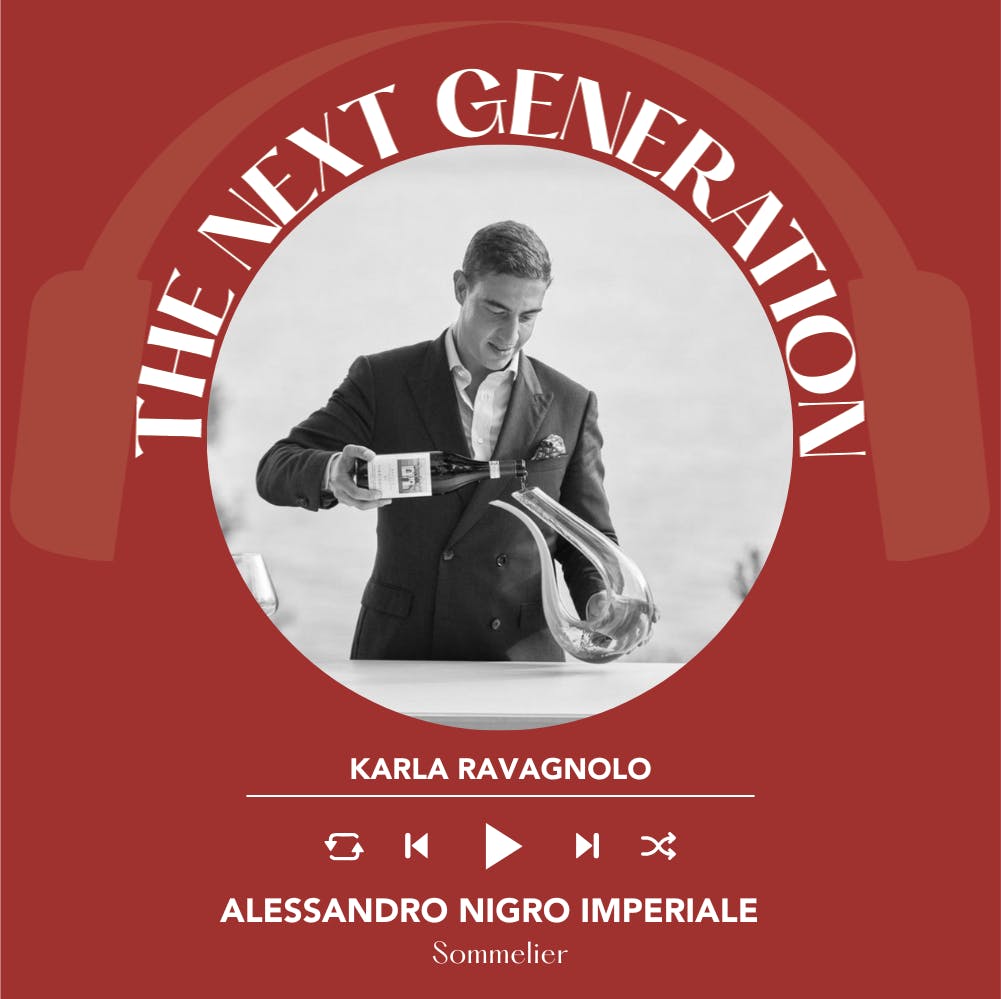
Ep 2320 Karla Ravagnolo interviews Alessandro Nigro Imperiale | Next Generation
The Next Generation
Episode Summary
Content Analysis Key Themes and Main Ideas 1. The unique career journey of Alessandro Nigro Imperiale as an award-winning sommelier in both Italy and France. 2. A comparative analysis of Italian and French wine cultures, highlighting their strengths and differences. 3. The comprehensive skill set and dedication required for sommelier competitions and professional success. 4. The evolving role of the sommelier to encompass a broader ""beverage vision"" beyond just wine. 5. Addressing misconceptions about wine among younger generations and the industry's responsibility in cultural education. Summary This episode of the Italian Wine Podcast features an insightful interview with Alessandro Nigro Imperiale, an acclaimed sommelier who has achieved top honors in both Italian and French sommelier challenges. Alessandro shares his extensive journey from his early days in Puglia to working for luxury hotel chains in the French Riviera, driven by a passion for wine since his youth. He offers a fascinating comparison between Italian and French wine cultures, noting France's pioneer role in organizing and classifying wines, contrasted with Italy's unparalleled regional and varietal diversity. Alessandro delves into the rigorous preparation required for sommelier competitions, emphasizing the importance of mentorship, unwavering focus, and significant personal sacrifice. He advocates for a more holistic ""beverage vision"" for sommeliers, encouraging knowledge of spirits, cocktails, and non-alcoholic options to cater to diverse guest preferences and boost business. Finally, he addresses the critical issue of declining wine consumption among young people, arguing that the wine industry and older generations bear the responsibility for educating them about wine's cultural significance and tradition. Takeaways - Alessandro Nigro Imperiale's career highlights the demanding yet rewarding path of a top-tier sommelier. - France is seen as a leader in wine organization and classification, while Italy boasts exceptional regional diversity. - Excelling in sommelier competitions requires comprehensive knowledge, practical skills, discipline, and a degree of luck. - Mentorship plays a crucial role in the development and success of aspiring sommeliers. - The future role of a sommelier involves expanding knowledge beyond wine to a ""beverage vision"" that includes cocktails and non-alcoholic options. - The wine industry should actively educate younger generations on wine's cultural and traditional value to counter declining consumption. - A sommelier's responsibilities include curating wine lists based on customer preferences, building relationships with growers, and discovering new trends. Notable Quotes - ""For us, Italian Sommelier, the big dream is to study and live in France. Why in France? Because it's the land of wine."
About This Episode
The speakers discuss their experience in the Italian wine industry and their desire to become a French chef. They emphasize the importance of learning and practicing in the field and finding one's own success in the industry. They also discuss the importance of social media and bringing people together to learn about their culture and wine experience. They suggest that young people should be trained and led by others, but emphasize the need for passionate individuals and finding happiness in life. They also mention a dish called ParTU melenzane that could be paired with a French wine with Italian recipe.
Transcript
We always compare Italian wines and French wines, which is good in one hand because we are the best boat. But I think that you can find a point of fusion about them. And, we can learn about the way of speaking in France in Italy. And in France, we can admire the diversity that we have. Welcome to another episode of the Italian wine podcast, the next generation series, where we aim to answer one simple question. What are the new generations up to when it comes to wine and food. My name is Karlaravagnolo. Join me as we dive into the latest trends in Italian wine. Hello, and welcome to another episode of the Italian wine podcast. My name is Carlaravagnolo. I'll be your host for this episode of the next generation series. Today with us is an award winning Samaliyah from Sanipulia, who is currently working for a luxury hotel chain in southern France. His name is Aleandro Nigro imperiale. How come he's in France and not in Italy anymore? We're going to discuss it pretty soon, but first, welcome, Alessandro. Thank you, Carla, to hosting me. Hello, everybody. Hi, Melissa. Yes. Coming from San Nepal and living in, San New French Riviera. Leaving the dream, actually, it sounds pretty, pretty beautiful. So tell us, who are you? I've touched already a little bit. I've mentioned you are an outward winning, Tamalee, and that you leave abroad. How come you're in France? How did you end up in wine? Would you like to tell us a bit about your background? Yes. You said well, leaving the French dream or for someone else, the American dream, but in France, because as a wine lover and passionate about wine, I think for us, Italian Samilla, the big dream is to study and live in France. Why in France? Because it's the land of wine. Because everyone speaks about wine because I always say that, French people have wine in the blood. They always speak about wine and gastroni. Since I was, sixteen, seventeen years old, I used to work in Atraturia in Pulia. Just, you know, to have a a few pocket money, let's say, at the weekend. And, at that time, started my passion about, resurrection, about, you know, the guest service and, award that today, you can hurt pretty much the empathy towards guests. Started working in Trathoria. I started as well studying wine. First, at the Enoological school in Pulia, in Foggia, universita Delisudy Foggia, about Viticulture and the Enologic, course. Same time, I started studying Sumeleri as well with the associate of Italian Samelier. And, you know, for me, it was like a wave on me because I spoke about wine. I studied about wine and the guest service as well. After this, path, let's say, I needed to discover something out of my region. And at that time, I thought was, out of my country. So I could study the, anologic course at for six months. And there, I could learn about French languages. So not only about wine, of course, but because, you know, when you study wine, andologic, dialectic is the same because it's scientific scientific words, scientific books, but I enjoyed their lifestyle, they say. Coming back in Italy, I finished my study, starting working as a winemaker or assistant winemaker in a winery in Italy, and bordeaux in the same time where I was, where I was in bordeaux. But finished the studying, I understood that, working in a cellar was a little bit, too close for me because you always taste your wine, and I needed more. I needed more. I needed speak with the other wine lovers, and, not to close my mind, only one kind of wine. So I had the the Sommelier Diploma, and with my wife, Rita, we decided in two thousand eighteen to prepare our luggages and leave Italy arriving in in Paris for some two thousand eighteen. We were hired by me was La Damique which is a chef, one of the most French and female talent chef, anchovy Pic, was, already my first one star mission restaurant. I used to work with the basil Lebinson, which is one of the best word samuelaire from Argentina. And already open minded about wine. My first class, let's say, was not with a French sommelier, which was very good, and my wife could have with the ducasse. After one year, two thousand nineteen, I was in touch with Gabrielle del Carlos. Best Italian Soniller two thousand eleven that used to work at Georges Inc. So four seasons group. And, so he hired me, and he was my first experience in a four seasons group. I stayed there three years at Georgesen. So I passed my lockdown at Georgesen. But in that time, I studied a lot about, the Italian best Sommelier challenge. And after let's say it was two thousand twenty two. Hyatt is opportunity always with the same group for seasons to come in the French Riviera and, have more responsibilities. Because at that time, twenty twenty two, I felt like, was no more to learn in that establishment, and I asked to the group, and they found me this great opportunity. So I'm here since two thousand twenty two. It's now three years. That's that I'm here. That's a lot. That's amazing. I'm extremely happy and proud of you, if I may say. But before, like, World War three starts again because of us, you mentioned at the beginning that for you, France, is the land of wine. Which is kind of funny because for many other people, Italy is the land of wine. How come that you are so interested and fond of the French scene? How how do they differ? That's a good question. You have two ways to see who is the land of wine? Italy no doubt because Romans started in Italy. Okay? This is proved and already written. Why I felt in love with the France because the way they speak about wine. They were the first, to organize wines. If you think, for example, burgundy, the priests were the first to say, okay, this parcel is Burgundivilage, Jebresham Burton, just to say. But this parcel is very special. The soil is different. The wine is different. The terroir is different, even if it's the same grape, which is could be pinot noir, chardonnay, but this land is special. For us, this is a premier crew. Okay. It was the seventeenth century. So they already understood the way to say that a wine is better than another. In Italy, we know despite best award wines as Barolo, BarBaresco, Supertuscans, Brunoo, we already know. But sometimes we forget that Italy is a wine country. We have twenty one regions, and each region has its culture, its traditions, its grapes that you cannot find everywhere. Despite the chardonnay, for example, I would say, Italy, I would say Australia, I would say America. Okay. It's a great grape that you can find everywhere. In Italy, if you go in, I'm gonna say Pulia because I'm from Pulia, If we speak about the narrow Detroit, you cannot find anywhere because it's from Guagan who's from San Severo where I come from, the northeast part of Pulia. If you speak about negromaro, you can only find around the lecture. It's unique. And I think that, Italian, because I am Italian. When we live in Italy, we cannot oversee the potential that we have. French people, they know how to do it. They can say to themselves, We are the best because we have a grand cru, burgundy, because we have a different terrace. I think we should learn about this. Italy, they starting to do this, but the way is not to copy. Out of country. Of course, you have to inspire by them, but find another way. That's extremely interesting. And I know that you've been you had the opportunity, basically, to step your food, to step your feet in both worlds, especially because you were awarded both best simile of Italy in twenty twenty two and best simile of France in twenty twenty three. How do you think these two titles kinda intertwined or helped one another, like, how is your experience about that? Good question. I won the Italian best, familiar challenge, which is a challenge, properly said. I studied for a few years. And, you know, every year you present with the other twenty best sampler of the country, and you have to win. Okay? You have more practical to do. French best sampler, I won the title. Thanks to go and meet you Gid, which is not a challenge. Go Emilio is like, to give you an example, is like, gamble Rosa for Italy, okay, which is very specific from the country. Today, I think that both happened me in my career and they still do it because they show that I'm, comfortable in both country. I know pretty well Italy vineyard and the French vineyard. And today, in my wine list, for example, I show both. Okay. I'm in France, of course. So between sixty and seventy percent of wines are French because we are in France. I don't have to forget this, but the rest of the party is Italy and very well present what they appreciate in Italy about my profile because I move a lot in Italy as well is my perception of Italian wines in France, and, of course, a French wine in France. Okay. Unfortunately or not, we always compare Italian wines and French wines, which is good in one hand because we are the best boat. Okay? Italian and French. We can say that or we are the first. It depends on point of view. That's why all over the world is peak about us, Americans, especially. But I think that you can find a point of fusion about them, and, we can learn about the way of speaking in France in Italy. And in France, we admire. I say we because I live here by in Italy, but we can admire the diversity that we have. And what people enjoy most in Italy, they go in a region, and they discover food culture, they discover dialect, they discover wines, they discovered wine pairing, which is great. That's why heavy here, they travel in a different region. So for me, both awards are important. I consider always them both, but I cannot say that I prefer one of each. They're different, and I'm, proud to have both. Since this is the first time I'm actually interviewing best family of Italy or best family of France, could you please help us understand how this type of competition are structured? What is their goal? What is the competition about? And how did you prepare for them? Starting from the beginning, my first challenge was what we call in Italy monotematic challenge. It was at that time, twenty eighteen. It was a narrow destroyer challenge. Okay? So you prepare only on one grape, okay, and see the shadows of this only grape. After that, I tried the original one in two thousand nineteen. So pull up best so many competition, and I won the first to hear. Of course, if you are a little bit ambitious and you won at the first time, first to try the original one, you want to grow up and try the national one. Which is totally different because you not only have to study and prepare about Italy. It's easy like that. You have to know everything. And, you have not, guide about the country competition. Okay? I say Italy, but could be, England could be French as well. You have to know about beers, about spirits, about service, about tea, about sake, about, so everything beverage, but not only about food as well. Deeply understand France wines, of course, in Spain and Germany and out of Europe as well. So for me, two thousand twenty was the important here about studying because of lockdown. At that time, I didn't work because everything was closed. I think we remember that period. And, I focused myself on studying wines. So I started about Italy. You have to know Italy. Like, we say in Italy, cumulative data is your fingers, okay, in your hand, but everything about beverage, specifically. Two thousand nineteen. The year where I won the regional competition, I wasn't ready. Okay. I was there, but I couldn't understand the Italian challenge. I studied for two years in two thousand twenty two. I don't know if I were ready, but as I always say, you need a little bit of luck. Okay? That's important in the life. You can study. You can be determined and disciplinary, but you need a chance. A little bit, and, the theoretically part was good for me. So I moved up to the next step. In that case, you are on the stage, and, is mainly testing, skills, service skills, but I was ready because I work in this domain. I do this every day. So it's a part of my life. And, after the the final, the b language testing as well, I won. And, I recognized the the wines, the blind tasting. The service was good. The wine pairing was good, but I was lucky. Nice. As you mentioned that luck is very much needed. But I'm sure we were also, like, extremely talented and knowledgeable. If you had to give a tip for anyone who's interested in trying or who is considering trying their first experience in this type of competition, what would you suggest? What would you recommend? First of all, find someone that can lead you, a mentor. Because if you have no one, you don't know how to do it. I always tried to find someone that, knew better than me. It was in that case was the challenge competition, but you can apply this in everything in your life. Learn from the best how they say. So that's the first step. Be focus in your goal. If you believe in it, you have to insist in one day it will come. And psychology, you know, I was ready that one day I win this competition. I didn't know when, but it was ready to this because I was very focused on this because when you study in this kind of challenge, you work as well. And, you know, that in our field is ten hours, twelve hours of service, So after this, you come back home, you say good night to your partner and you start studying every day for two, three or four hours. You sacrifice something. I sacrifice time. Okay? But I had the chance to have my actual wife that always believed in me and supporting me, but I sacrificed time, this, and weekends, and avoid, get out with friends, so a lot of things. So just, be conscientious and, focus on it. Don't think that, this goal is the final one. If you think about that could be the beginning of a new path. You don't stop. You don't stop it, but you continue following other goal. You know? Yeah. Totally agree. Also because I remember you told me you are a dreamer. Which is something that I really, really love. What I think that these actually defines or could be one of the many definitions of the dreamer. So my question for you is you've accomplished many things, including the title of basso Malier, But what is your next big goal? What is your next dream? I have one that I try to accomplish in a two or three years. I would like to, you know, I'm Italian. I'm in France. I'm proud of a what I do. I have a good team because I cannot do it alone. I have eight summers with me. I have a good boss that follow my ambitions and my dream. I would like to manage more people, more familiar teams around the Europe. So next step, I'm trying to improve myself in, wine and beverage vision. I would like to manage, more establishment. With the more leaders. Yeah. That's the next step. You mentioned wine and beverage and not just wine, and I'm sure that's not a random choice of or a random selection of words. Why do you think it's important to consider both wine and beverage, like, to expand the knowledge? If you see what happens today in the restaurant field, You have always floor team, familiar team, and the BARman team. They work with the only goal which is try to make happy customer. We don't forget this, but they work separately. We speak as a professional about, this fusion between floor and sommelier team, but it doesn't happen. I don't know why, because the first fusion has to be between the head sommelier and the headwaiter or Metro Hotel or director of the restaurant. I think beverage today could be the fusion between Barman team and familiar team. You could improve themselves with master class with specific trainings because when the guest is seated, and it doesn't want wine. What do you say today? Okay. The guest doesn't want wine. So I leave it alone, you know. You're taking charge of him. But if you knew about cocktails, if you knew about low alcohol drinks or no alcoholic drinks just to avoid the no alcoholic wines. That's another problem, but you can find a solution because your goal your objective is how we grow up in this kind of establishment is never say no. Okay. Found a solution. For me, today, the solution is not an alcoholic wine. Because with the creation in cocktail, you have something handmade. You have something crafted. So it takes something more, okay, in the creativity, in the technique as well. So next step for me is to train bar equip and the summary equip to work together. I think you can, boost the experience and the sales as well because we don't forget that we have goals. We are in the business, and which is important for the owners as well. Nice. In this vision, as you mentioned, the or the person serving and, like, supporting the client, is someone extremely knowledgeable about both wine, cocktails, Zaseake and other type of beverages, but my question for you is what is actually the role of a social media? In meaning, like, how should they communicate and better support and help the selection choice, the guidance of the client in what they should be drinking? Sumeli, I think, is a dream work because you basically is a relation work. Socially relation work because first of all, you create your wine list. And, to be honest, that was my first accomplishment in two thousand twenty two when I arrived here to see my wine list, my first wine list. Is my baby today, my first baby. And, how you do it. First of all, you analyze your customers. Because if you create a wine list that you love, but, you think about yourself and you are selfish in the decisions, but guests don't love. You lose. Guest don't follow you. First of all, analyze your guests. Your benchmark. Second thing, you have to keep relations with wine growers, with the vigneron, with the wineries. You have to go there. You have to travel. So it's a travel work for reported love trouble. And I am in France, so I travel both in Italy and France. When you travel, I don't have to say this, but you travel, you open your mind, you meet people, and you grow your mind. Okay. And third, you have to try to discover something new because people are always looking for something new. If we speak about Italy, let's say this is simple because the opportunity to find something new is great. In each region. In France, for example, what we do today, because the demand is, especially about burgundy and champagne. Okay? That's the mainly demand, and I think in Italy as well about the French wines. Try something new. Go to see the new generation winemaker. See what they do. See why they do it. Now, for example, the next generation burgundy winemaker. I think you already have heard about them, but there are people which are not locals, sometimes Japanese or Chinese that, go there. They buy some parcel everywhere in burgundy. Usually, the less expensive today because burgundy is so expensive, and they own the wine. Why not? If they have experience. Because if you know them, if you meet them, you discover that they learned about the best so they know how to do it. Burgundy today is too expensive for everyone. Okay? It's starting to be a one lovers or wine drinkers. Young generation do novice. They are not looking for hundred heroes bottles. They cannot, and I understand. But follow this new generation and see what they do. In Italy, in France, burgundy Champagne as well. This new generation about, thanks to Salos, you know, that founded the new vision of Champagne, and you have a lot of people, a lot of young white makers. They are doing something special. So I think your access are see your guests, your benchmark, and find something new, but this is not only this. You have to train your team. You have to lead your team because they have to follow you and follow your philosophy. You know, you cannot do it alone as always, as everything. You need people, you need confidence, you need the trustness. Coming to the last three questions that are the ritual ones, What do you think is the biggest misconception the wine industry has about young people? I'm gonna be rude in what I say, but, I don't know today if I am young or old. I think we should take this problem on ourselves. Because if young people, but, okay, let's say young, eighteen years old, twenty years old, they don't drink wine as a culture. Okay. It's our fault. Okay? Because we are not capable of teach them about our culture. We are Italian. Okay. We know that the Sunday lunch is important for us, okay, around the table with family. If we don't teach them that we drink a bottle of wine because first of all, it's good for the Santa for the health. Okay? This is already proved in a good quantity. If we don't explain them that wine is local and is traditional and is paired with the the lunch. I think that's our fault. So they grow with no sense of culture. Wine is culture. We cannot be scared today about wine. Wine consumption is decreasing lately. Okay? No alcohol wines. They prefer the cheapest cocktail because it's the same. You should have a good cocktail with a good products with a good spirits. And good, fresh, Jewish, or whatever. If we don't explain to them that this is a tradition, a culture, I think we should bring on us. Yeah. Totally. That's a very that's a very wise, I would say, analysis. I grow up in a family with the wine was nothing. Okay? My parents are in a different field. So I was the first in the family. Okay? When I was young, you know, I was younger. So eighteen years old, twenty years old. I when I began with the with the wines, my mother put water in the wine. Okay? And I was very nervous about this. I left the table. I said, mama, stop it. This is not possible. I study wine. I'm talking about culture. I'm doing my life about wine. Few years ago, so leaving my family, leaving Italy. Now I see my family. My parents one, two, or three times per year. And they come back. And I take a good bottle on the table. I ask you to my mother. Can I put some water? Yes. Thanks, Graceli Sandel. Because they didn't agree with this culture. But now after ten years of fifteen years that, I'm on this. I know my mother changed the perception. My father now drink with me a glass of wine, instead the Coca Cola, instead the sodas. For me, it is a change. So they accept this, but now in other hand, I accepted this. It take time, but, you know, you have to be constant and, you, you have to believe in it. Yeah. Hundred percent, hundred percent agree. So moving on, what is the biggest misconception that young people have about wine? We live, very difficult period about younger generation because they don't believe in their future. They don't want B has our parents that, engage the their own life to get retired with a good salary and live life after retired. My parents grown like this, okay, find your place. Stay more as you can. Today is different because young people can do a good videos on Instagram, have a good idea find an investor and have millions or billions dollar or heroes, with them. So they have no sense about money and sacrifice. They don't want to sacrifice their self to live. They prefer to do nothing instead to know that, one day maybe they will live their life, which is very difficult for when you speak with them. I see with my, with my soldiers, okay, they are lost. I think we should try to, explain that life is good. Life is wonderful. You have to live your days with people. So the human side that sometimes we forget meeting people, enjoy life, stay healthy, stay good, and, leave with emotions. I think that's the problem today. If you say them, what you want to do tomorrow, what's your goals in a three years, in five years, in a ten years, they are lost, if we can, and we like to spend time with people. I think in each moment of our day, we have to try to speak with them. And, find, harmony, find, happiness. That's the word I think. They have no happiness today, but because of who, maybe because of the whole generation. So, and sometimes, they cannot find passions. Job is something work hard is something, and passion is different. You can combine them. You can combine them. I always try to find passionate guys that, work with me. Because if you are passionate, if you have passion on what you do, it's easier. Now they always say work for what you love and will be easier in your life. I don't know how the the instructor, but that you know what I mean? Yeah. I think that's correct and try to not work because you have to do it. Yes. You have to do it. We know, but try to find something that you love. Those are some beautiful words. One last question, and this could award you the Nobel Prize for Peace or something like that, but if you had to make peace between Italy and France with a wine and food pairing, meaning like either an Italian wine an French recipe or a French wine with Italian recipe. What would your pairing be? Something very classic. Okay. One of my favorite dish for is simplicity. Something that I always ask when my wife say, what do you want to eat, Sunday? Parmigiana de melenzane? Okay. Something that you can eat everywhere in Italy. Every region has, his own recipe. But, you know, you have this fried, aubergines, eggplants, mozzarella, tomato, basilique, parmigiano reggiano, and a lot of love. Okay? This is a unique main. So it's a poor dish. Something that we it owns to us. We can pair because I already did it with a French wine. Pretty known, I won't say the winemaker, but, you know, beaujolais wine coming from the softest part of burgundy. It's not expensive. It's a grape, something that you can find today, but not the which is the novelo in Italy. The one of these crew because of his freshness, this crispness of a young wine, like, could be twenty one or twenty two. That's, red crispy wine. It's fruity, spicy sometimes. So I think it could be good with the parmigianade melanzani. Easier to prepare to cook and, easy one to find. I love it. The and the very caring for the piece. Come on. Like, that that sounds delicious and perfect, then it would bring so much love in this world. I'm sure of that. I'm thinking about, French recipe with Italian wine. If you Yeah. If you allow me, maybe you already taste it, but, the classic soup balonion, which is the onion soup It's very simple. It's a poor French dish as well. So you have this broth, this vegetable bouillon with, cooked the onions, gruyere, and the old bread. So it's one main is a poor dish. And, in France, we pair normally with the wines coming from Jura. But if you think in Italy, we have, of course, oxidating wines coming from Sicily, Marcella. So Marcella Vergine, which is the sec or the dry one with these Azelnut notes, this, oxidating sign, I think could match very well with the super. Yeah. My mouth's watery. Me too. I'm just craving for that pairing now. I would have never thought of it, but it makes completely sand. And I'm very I was looking for where to try it. So thank you, Alessandra. It's been a very pleasure having you here with us today. Hope to meet you in person soon to come to first visit you. Thank you so so much. I think this is a rep. Thank you Italian One podcast. Thank you, Carla. Thank you to everybody. I'm completely available. If someone wants to speak with me and, each change or ask me something or about wine or others will be very pleasure for me. So thank you so much. Thank you so much for joining us today. Let us know your thoughts on our social media at Italian wine podcast and follow us to keep up with the next generation of Italian wine people, tears.
Episode Details
Keywords
Related Episodes
Ep. 2725 Ep. 22: Tra Mare, Nuraghi e Vigneti | Pellegrinaggio Enoico con Attilio Scienza
Episode 2725

Ep. 2708 Opera in a wine bottle with Fulvia Tai IWA and Domenico Tappero Merlo | Clubhouse Ambassadors' Corner
Episode 2708

Ep. 2664 Ep. 12: La Via Romea Germanica Imperiale | Pellegrinaggio Enoico con Attilio Scienza
Episode 2664

Ep. 2654 Ep. 10: Vini, leggende e vitigni tra Romagna e Toscana | Pellegrinaggio Enoico con Attilio Scienza
Episode 2654
Ep. 2603 More Than Wine: Italy, Terroir, and Everyday Culture with Robert Camuto | #openbarstevie
Episode 2603

Ep. 2434 Giulia Stocchetti interviews Alberto Sabaini and Sara Piubelli from Cantina Sabaini | Next Generation
Episode 2434