

Ep 2349 Karla Ravagnolo interviews Elisa Rezzano | Next Generation
The Next Generation
Episode Summary
Content Analysis Key Themes and Main Ideas 1. The evolving role and perspective of young professionals in the hospitality and wine industries. 2. The dichotomy between traditional and modern approaches to customer service and professionalism in fine dining. 3. Gender dynamics and challenges faced by women in male-dominated areas of hospitality, particularly kitchens and sommelier roles. 4. Differences in wine education philosophies and their practical applications (AIS vs. WSET). 5. The personal journey and aspirations of a hospitality professional, driven by a passion for customer connection. Summary In this episode of the Italian Wine Podcast's ""Next Generation"" series, host Kat Laragnolo interviews Elisa Rizzio, a passionate certified Sommelier with extensive international experience, currently based in Switzerland. Elisa shares her professional journey, influenced by her sommelier father, and discusses her early entry into the industry at 16. The conversation delves into the generational shift in hospitality, highlighting how the ""customer is always right"" mentality has evolved, and how young professionals seek more personal expression. Elisa candidly addresses the underrepresentation of women in fine dining and kitchens, advocating for greater recognition of their attention to detail and natural ability to connect with customers. She shares anecdotes from her work in London, Italy, and Australia, noting regional differences in wine appreciation. A key discussion point is the comparison between Italian (AIS) and international (WSET) wine certifications, emphasizing their distinct approaches to teaching and communication. Elisa also challenges the misconception that the wine world is ""boring"" for young people and reveals her aspirations to become a flight attendant, driven by her core passion for customer service and travel. She concludes by sharing her comforting ""home"" wine and food pairing: Ligurian Pigato with pesto. Takeaways * Elisa Rizzio is a certified sommelier specializing in hospitality with international experience. * The hospitality industry is undergoing a generational shift, with younger professionals seeking more authenticity and personal expression. * Customer service and direct interaction are central to Elisa's passion for hospitality. * Significant gender imbalance persists in fine dining and professional kitchens, with women often facing barriers despite their skills. * Italian (AIS) and international (WSET) wine certifications offer different pedagogical approaches, catering to either deep passion or pragmatic international communication. * The idea that the wine industry is ""boring"" for young people is challenged, suggesting a lack of interest rather than inherent dullness. * Elisa's career aspirations demonstrate a continued focus on customer service, even in different industries like aviation. * Ligurian Pigato paired with pesto is a quintessential comfort food and wine combination for Elisa. Notable Quotes * ""The most positive thing of my job is the customer service. So the contact with the other people."
About This Episode
Speaker 1 introduces herself as a hospitality professional and explains her experience in the industry, including challenges and limitations. They discuss the negative perception of hospitality and the lack of professionalism. They also discuss the difficulty of finding the reasons why men are not present in the industry and the importance of understanding the needs of the people involved. They discuss the challenges of finding the reason why men are not present in the industry and the importance of being smart and passionate in a job. They also touch on the misconceptions of the hospitality industry and the importance of being smart and passionate in a job.
Transcript
You mentioned that you've been working in the hospitality industry since you were in nineteen. Yes. So I wonder what is your experience from a professional standpoint? The most positive thing of my job is the customer service. The only problem about this is, knowing every place. You have, I mean, the space to talk with the customers and, new other people and, share your opinions. Why? Because, sometimes, you can find some situation where the manager or the manager who just is the king about the restaurant and Yeah. Is the person in charge you can talk with the customers and the if you are chef Durang or comey, you have no space, I mean, to pour in evidence your personality. Welcome to another episode of the Italian wine podcast. The next generation series, where we aim to answer one simple question. What are the new generations up to when it comes to wine and food? My name is Kat Laragnolo. Join me as we dive into the latest trends in Italian wine. Hello, and welcome to another episode of the Italian wine podcast. My name is Carveravaniello. I'll be your host for this episode of the next generation series. Today, I'm very pleased to welcome Eliza Rizzano a passionate certified Sommelier who's collected multiple experiences around the globe and is now based in Switzerland. Welcome, Melissa. How's it going? Thank you to having me here today. All good. There is the sun today. So is everything fine? Oh, that's nice. So tell us what do you do in Switzerland? How did you end up in Switzerland? Tell us, we wanna know more about you. So I'm a hospitality professional, as you say. And, yes, I'm trying to work at the moment in hospitality here. Not very easy in Switzerland, but I'm trying. Why Switzerland? Because I'm here with my boyfriend who will receive just a big opportunity of job works in a kitchen. So, yeah, we just decided to move here for we don't know a long time. Got it. But as I mentioned, you are also a certified sommelier. So, of course, my question for you is Why wine? When did you start getting passionate about wine and when did you enter this whole industry of wine and hospitality? I start when it was nineteen because of my father. Because he's an important sommelier in Italy. He's the president of a Italian Sommelier Association in, Victoria. So in my region in Italy, so he just, give me his passion. So he just transmit me his passion. So when I was sixteen, I started my eyes, similar course, and I finished when I was nineteen. When I finished, I opened a restaurant with him, and I just started my career. Got it. Got it. Interesting. So I don't know if this is somewhat of, uncomfortable question, but as you mentioned, your father is the president of the Italian family association in liguria. So Northern Italy, for those who may not be familiar with the liguria, because it's such an under the rather region for some reason, not everybody's aware of, like, liguria, the great wines they have, where it is located, etcetera, etcetera. But how does this make you feel like to be the daughter of such a big personality and institutional personality in the hospitality and wine industry? I think in the first period, So in the first years of my career, I was feeling maybe a little under pressure, but not from him, from the other people because, of course, he's an important person and, you know, many, many simulators. So the expectation from them were very high. But after I took my way, so I moved them in London in other parts of Italy than in Australia. I'm feeling more sure about myself. So Yes. I think, at the moment, I don't feel any pressure from him. Also, because we do two different things. He made the career inside eyes, Danny as his activity, and, I'm around the world. So I think there is space for everyone. No? Oh, hundred percent. And also, we have a confident woman. We like confidence. So I guess one of the questions that you maybe have asked yourself, and I wonder about now is, does your idea of hospitality and wine differ from the one of your father, or, like, as a gen z, what is your definition and what is your idea of hospitality? If I have to compare the two ideas between my and my father, it grown up in a different ages. I mean, in a professionally way. So we are talking about the eighties, and the hospitality there was very different. So the customer was always right. Now it's not like that. Because, yes, so the people who work in hospitality just took more I would say consideration, but I don't know if it's the right word, consideration of their self, So it's become a proper job before was a bit different. Got it. But now, for example, if you, like, you are a customer in this scenario. You are a customer, you are a client, and you go to a restaurant. How would you like to be served in a way or pampered? Like, what is your idea of? If I'm a customer, I'm sure the people I have in front of is, professional and prepare the and he has some studies before it was not like that. So you mentioned that you've been working in the hospitality industry since you were in nineteen. Yes. So I wonder what is your experience from a professional standpoint? Meaning, what are the positive things you've experience and what do you consider to be the challenges and limitations of the case? The most positive thing of my job is the customer service. So the contact with the other people and, because, you can, exchange your opinion and your knowledge with other people that you don't know. The only problem about this is, knowing every place You have, I mean, this space, to talk with the customers and, new other people and, share your opinions. Why? Because, sometimes, or very often I would say you can find some situation where the restaurant is divided like in case. I don't know if, is an English terms. I would say case like in India. Oh, okay. Yeah. So there is the manager or the manager who just is the king about the restaurant and, yeah, is the person in charge who can talk with the customers and, if you are shoved around or commit, you have no space, I mean. So, yes, I think that this is one of the bad point about the hospitality. So you have I mean, no space to to read evidence your personality. Do you think that the fact that people cannot express themselves kinda influences the perception of wine, for example. Like, you know, if you have somebody that kinda feels almost robotic, you may feel a little I don't wanna say discouraged, but it makes you feel like you don't actually belong, maybe in that scenario, in that scene, in that, you know, you are not part of the community because it's one thing if somebody, you know, with a smile tells you and makes also sometimes easier associations in order to explain you the one in sauce. Yes. But if you lack the freedom of expression, you know, everything feels a little more stiff that I think is the word. Yes. Because, for me, this job is all about the customer service. So, you know, and some people has not cleared this point. So they put a lot of rules inside the restaurant. So the person that at least goes editable for sure to leave a plate will be also a commit if you put stress in that person, then, you know, in front of the customer is not very nice. I think the customer can feel the pressure that there is inside the restaurant. Even, like, I do recognize that that was a very nice, you know, restaurant, the service was impeccable. I do recognize, obviously, the professionalism behind it and the knowledge and everything. However, would I say that it was a relaxed dinner that I felt welcome I don't know. You know what I mean? Yeah. I understand your point of view because, of course, I go or so out for dinner in many different restaurants, in different type of restaurant as well. And sometimes I feel the same. I feel the same. So when yeah. Unfortunately, it's very common. It's very common, especially in, nine to target level of restaurant. Yes. Yes. Hundred percent. Talking about high level of the restaurants, talking about fine dining, since you are my first woman, there you're the first woman that I'm interviewing. Wonder, how is the experience of a woman in hospitality and fine dining, because I'm more used to seeing men when it comes to fine dining. And, like, you know, like, oh, this restaurant has been awarded and is usually a man. Most in most cases, it's it's a man. You mean on the floor, so in the front of us. Yes. So I wonder, like, how is your experience? That was my experience. You're right. You're right because I think we are in two thousand twenty five, and there are no enough gers in the restaurants as a professional. In the front of us, so in the floors, but in the kitchen, so in the back of us, it is much worse. So it's very uncommon to see a girl in the kitchen And, honestly, I honestly open this situation. It will change. It's gonna change just because, when I had the opportunity to work with Gersa, was much better the situation because we like to have everything under control, and we give attention to the details. And that it sounds, you know, weird thing about the the ters are everything in this job. May I ask you, what do you think could be the reason why this is the situation? Like, do you think there is any specific reason why men usually tend to be more present in the industry instead of. In the kitchens and the in the in the kitchens for sure, I'm sure because the job is a very hard. So for example, the pan are very heavy and, you have to do a lot of hours. So I'm pretty sure it's for these indications. And, on the floor, I see some girls working as a waiters, but almost never is a similar is art. Maybe is the one word which is, I mean, apparently for dissoci is more for the boys, but it's not true I don't know for the wine could be for dissoci. I don't know. That's a very hard question, anyway. Yes. Yes. We're gonna find the answer maybe in a few years. Who knows? Anyway, it's totally true. It's totally true. There are more boys than girls. Yeah. I mean, India's hospitality because then if you see all the job or whatever is around the wine, there are many many girls with this job in the wineries, for example, or, you know, as a teacher or yeah. No. I can definitely see a lot more women compared to the past. However, the majority or the feeling is still that the voices of the men are heard a little more. Yeah. Then the weird thing about this situation now that you tell me is that all the time I start, at work in a new place as a similar all the guys or the boys are very surprised because I'm a girl and the data is better if you are a girl because you are much better than us because you feel better, the smurfs in the wine, and that you have you're better. And I'm like, okay. So it's weird. It is. And it's actually interesting because also in my idea, and I obviously, you know, everybody's different, etcetera, etcetera. But if I have to think about somebody who's more a little more. I don't wanna say charismatic, but, you know, women kinda have that feeling of being able to understand who have a better sensibility or sensitivity to the person that usually stands in front of them. Like, if I had to pick somebody who has to pamper my customer and make them feel welcome and be able to sell the one and everything, I personally would get a woman. You're like, we're Yes. We just have that little that little thing. Also because I I I, for example, if I have to tell you, Benoit, I'm a girl, and I think, is about connection, maybe. So I can, understand more your point of view because we are two women. So, yeah. Yeah. Yeah. Hundred percent. Yeah. I understand what you want to say. And, yes, you're right. But at this point, I can't explain why there are no girls in hospitality. We'll here. We'll change this and we'll figure. Yeah. Yeah. I hope. I hope is going to change. As we mentioned, we wanna change this, but I'm also kinda sad to know that you are also considering changing your career path. Ask you why and what are you considering, like, what do you wanna do? Why? Why? Because, he always made hospitality in my life. And so he's almost an ear. I do it. So I'm considering to see something different. What you will say? What you like to do? I will try to become a flight attendant. So I'm already flight attendant. I I made the CCA, so I have this certificate. But to start is another mystery because it's very, very hard. So, yes, because you have to do a lot of tests and, so I'm flight attendant, but I would say I'm an aspirant flight attendant because I at the moment, I didn't start. So at the moment, I'm just checking what I can do at the same time I wait. While you saw this, this profession, you would ask I love questions. Yes. Because, I really like to travel. So traveling is my first passion and, yes. Start also before the wine. So, yes, I just decide to try it maybe for a couple of years to do something else, but I don't wanna stop, of course, totally with the wine. Then also because, you know, if you don't do hospitality, it doesn't mean you stop with everything, you know, then I'm very inside of this world because of my father. We have also a restaurant together. So, yeah, I think, I will spend my holidays working in my restaurant, but is fine. This is another story. But if we consider your career journey in a way, when you will become a flight attendant, because, of course, I want your dreams to come true. I can see that there's still the customer service, Phil Rouge, Yes. Sure. Sure. Sure. Sure. What is it about the customer service that makes you so passionate? Like, what do you like about it? As I tried to mention before is for sure the contact with people that you don't know. So try to add them sharing your point of view, your knowledge and everything that I think I guess in airplane will be a bit different because, you know, we are not talking about all the time. I mean, about food and everything. We I think, most of the time you talk about the security there, but, you know, the thing that I really like is, to talk with other people that, like, we are doing now. I think I am not a good person, I mean, to stay behind the computer. I totally understand. Yeah. I wonder, since you've traveled and, as I mentioned, at the beginning of this interview, you have collected multiple experiences internationally. Where have you been? First of all, what was your experience? And do you have any fun stories maybe about this customer service thing or a special connection you made or something? After a couple of years, I was working in my restaurant as I told you. I just decided to take my way. So I moved it to London. And, yeah, there I worked as a similar year for three years. Then, there were all the problems with the COVID. So I came back in Italy. And, yeah, I was spending a couple of years again in my, in my restaurant, then I moved to others region in Italy. So I moved the in Veneta. I spent, like, a couple of years there. And then, in Australia. Yeah. Where in Veneto? Just out of curiosity. I was living in Castel Franco. No way. I'm from Barcelona. Yeah. That's, like, no way. Amazing. I love bassano. It's like one of my favorite place to yeah. Okay. When you come back to Italy, your comments. Of course, of course, I will. I will. I will. Anyway, Venator is an amazing region for the wine and everything. So I learned a lot of things. So then I was very close to some most important wine areas. And so it was very, it was a very happy time there. And after that, I changed again my mind and I went to Australia for a year. So I spent a year in Sydney working as a restaurant manager. And then, because of the level of hospitality there was no amazing. I just decided to move back in Europe and now here I am. About some funny concept. You have time. Yes. We wanna know everything. Open your book of tell us, want a tea. No. Because I don't wanna talk behind the people. So I think I can tell you, like, one or two episodes for example, in Australia, as I try to mention that the level of hospitality is not a big thing. So I remember I had a colleague there. I can't tell you the name. She was around six and she had a lot of, master in wine marketing. So she was very inside of this world. And one day, we were talking about orange wines and, she was totally lost. And she told me orange wine. What are you talking about? Oh, and it was like, woah. And they start to laugh, of course. They start to laugh because she were very sad and she spent a lot of time in Italy, actually. I think. But, yeah, yeah, but she was, completely lost outside of yeah. Lost. Lost. Yes. It's funny from my point of view because I'm inside the world, but Probably the people who are listening this postcard. I don't know if they are laughing on or no just because, you know, it's not yeah. It's a big thing. I think because for one person because she wasn't from my same I'm twenty eight. She wasn't from my same age. She had like a life behind her. So inside, I mean, working in this world and, you know, Yeah. Yeah. It's funny, but a bit sadder also. Can I ask you how do wine approach changes between, you know, London, Australia, Europe, what is the feeling? How do people feel about wine? Okay. I think in Europe in general, the customers are more interested about, what they drink about the things, but they have more knowledge as well. For example, in Australia was like a big word. I take this bottle. Why you take that bottle or you like the wine? You know the wine because I know it's good. Nice. Yes. And, I think here in Europe is, a bit easier to have the conversation about the wines with the customers. Also, then it depends where you sell wines. So in London, for example, I saw the customers where not without knowledge because, as I remember, I made good conversations about wines with the customer customers, but they were choosing the labels. So the bottle to take, for example, for a dinner in base, to the trend of the moment. So I remember in that moment, we're very popular, drink, bordeaux and burgundy. And everyone, not everyone, but, like, the eighty percent of the people were choosing that bottles. Interesting. I wonder how did they learn about the trends or how did they know? Like, I don't know. I wonder where actually people who are not into the wine industry get information about wine. Do you know what I mean? Like, if it's because they see it on social media, is it because they just see it in the bars, and that's what they Where it be? Go. Will be could be. I don't know. I don't know, Dan, if, we can talk about, you know, the way of marketing that there is in France. Yeah. Because, it could be also this reason. I mean, they are very clear in the marketing strategies. And, maybe because when there are this situation is always with the wines from France, not never, but almost never with Italian wine. So so I think it's the marketing, the difference. One other question that I have for you is you studied wine through the ice courses, so Italianization of Malier. Yes. But in your experiences abroad, why professionals tend to attend WSTT? So I want to ask you, how do you think these two courses and approaches differ? And if they influence the individual experience people have with wine. First of all, I finished the ice course, so I'm similar. I made the exam and that thing. And about the WCTMA, the only the level two. So I can give you my opinion, but I don't know if, we can compare the two things. I think if you do the I scores, is because, you really love wine. So you are very passionate about this word and, maybe you want to do it as a job, yes, but or so no. I mean, then maybe the things are changed. Because, I finished my course in two thousand sixteen. So, yes, we have almost ten years. And as I know, some things are changed. So you can take my opinions about, you know, very far. So, yes, they give you a lot of, informations and that they properly teach you how to taste the wine. Yes, but also to understand every point of view that you have inside your glass. WRC. I think it's very focused that just if you want not just about if you want to work inside of this industry and if you want to sell. They teach you properly to be a good seller, I think. Yeah. Because, they give you the key informations. Everything is very clear, very schematic. So I loved my time when I studied in the WCT, but, yes, so the different is everything very schematic, and, this is the main difference. Got it. So you think the ice course. Maybe it's a little more Italian in a way, meaning that, you know, we are somewhat of points, and we love to, like Yes. Yes. It's right. Yes. Under the first time, the trainings, etcetera, etcetera, instead WSTT. Maybe it's a little more schematic, as you mentioned, pragmatic, but it gives you the tool to better communicate maybe wine when it comes to international audio. You if you study in WSTT, you are sure that people will understand what you mean? What do you go work? Yes. Exactly. Exactly. Completely. Completely. I agree with this. For example, one time I was working in London, and in that moment, I had only the similar course in Italy, so the eyes And I was talking with Maya Desomiller, and we were discussed about the wine. And he asked me to make a negotiation about one wine. And I start to talk and he told me your eyes. I can see you have to get out from this word and try to think, like the other people, you know. Got it. That could be challenging also, you know, because for us, it's all about it's a way of living. It's a way of communicating. So it it can be challenging. Interesting. Yes. So they think they are trying is just to find a way to communicate about the wine with people that don't know about the wines. And for that is Amazing. Yeah. Yeah. Because they teach you all the names that you should use also in another language. Just so for that WCT is I think that also, as you mentioned, WSTT since it's so schematic, can also be a good approach to people who are novice about one, you know, like somebody who doesn't know anything. And it's just easier. You know, it's just, like, one, two, three, four. It's just, like, given information and that you just have to learn it, and then you can actually communicate with others, which is I think it's great. You because a lot of people are just scared about the terminology of one, you know, with other guests in this podcast, we've discussed how people are actually scared to share their honest opinion or don't share their thoughts because, like, everybody, when it comes to tasting wine, everybody is like, oh, I smelled this, this, and that, I smelled that, and that, oh, this one is is good. And this reminded me of this. Oh, this cover is so annoying. And somebody who's new is never gonna tell you, like, oh, I smell this, you know? So there's always a little bit of pressure and fear when it Yes. But why? I would say why because we don't care no one. So I think in my opinion, In my opinion, the wine good is good. Like, that's the most important thing. Sometimes I do small tastings with my parents, you know, like, at home. And I can, like, I'm their daughter, and they are scared. They're just like, I don't know what I'm smelling right now. Just say it, you know. No. As you mentioned, we we never killed anybody, and it's I think it's somewhat highly subjective what you smell in a glass, you know, because also it really depends on our experience. You know, I may have never smelled some fruit, and maybe you get that fruit in the glass. You know, like, it's very subject, like, a common basis that WCT is trying to build, of course, into structure. Mhmm. But they're able to, you know, a little more subjective and emotional side to it. So coming to the final part of this interview, I have three questions for you that are my retool question now. What do you think is the biggest misconception? The wine and hospitality industry have about young So I think one of the biggest misconception from hospitality industry is that the young people have not the attitude that to work in this, in this sector. I think is completely wrong. And in this case, I just stay in the part of the young people because I'm still young. And, when I gather the occasion to work at with the people even younger than me, everything was very fine. I mean, I think if you start these, job is because, you have a little passion, of course. And, then there are the people who are better and it's the people who are worse, but, you know, is not about the attitude. It's not about the attitude. I think. I think everyone has the attitude that to make this job and, is not true that the young people don't want to make a career because they have no time because maybe for their education, completely wrong. I saw many, many young people very interested in this in this sector and in this job. Mm-mm. Yes. I think that maybe correct me if I'm wrong because, obviously, I'm not a hospitality professional, but maybe it also connects to the theme that you've touched on earlier that is the idea of hospitality of your dad or grandfather or whoever is different from the one that young people have. So that obviously, you know, can create some some friction. Could be by a, I'm a I told you. I mean, the young part, so my point of view is completely different from the point of view of my father or his colleagues, and we could work together. And I mean, the most important thing is to be smart and, share your opinions with educations. And, I mean, if the other person is, smart as well, you can, you know, find the solution. Hundred percent. Yes. So you have to be, you know, more open, I think. From one point of bug also from the other, you know. Yeah. So my other question is, what is the biggest misconception young people have about wine and hospitality. So about wine, they think that this word is, too boring. Not true. Now I make you one question. Do you like mathematicians? Oh. Do you like mathematics? No. Why you don't like mathematics? I'm not good at math because I think is not your subject. Maybe you're not interested in So it's not that the wine word is boring. Maybe the people are talking are not interested in this word because there is nothing boring. Of course, is hard, but you want to become a mathematician and is hard too, I think. You want to become a, I don't know, architect is hard too. And, I'm pretty sure at the beginning is boring. I'm pretty sure. But if you are really interested in that subject, you know, you're very focused and, you can make the things happen and at least at the end, you have the the work that you like. So you can't tell me the wine word is boring. Of course, sometimes you can read an article and, can be difficult of course, about if you are interested in, make a similar course first, try to study something, and then maybe the article or their interview become less boring, you know? No. It definitely need a little bit of, effort at the beginning, at least to understand a few key words or a few concept yet. That that there's no other way to do it. That's the thing. So I will say to the young people who say one word is boring, no. You're not interested in. True. As simple as that. Yeah. So wrapping up this interview, one final question for that is you leave abroad. You've lived abroad for a while and you are abroad now. So I guess you may have some moments where you miss home, your beautiful liguria. In those moments, what is the wine and food pairing? Your go to wine and food pairing in order to feel, you know, home? Maybe it's one pairing, which is very easy, very classic. I don't know. Tell me you're boring. In this case, you can tell me I'm boring. But it's the with the the So Pigato is, a grape variety from Ponentaria in, in the world. And, it goes very well with the pesto, which is another pragmatic social that we put in the past. My mouth is watery already. Oh, he's amazing. Well, thank you so much, Elise. I had so much fun during this interview. So I really hope to meet you in person. Yeah. Up to what when I will come to the side of the graph, I will call you. Yes. Hundred percent. Hundred percent. So, yes, good luck with your career. Hope you become a flight attendant soon. Hope you have the best wines, and that's it. Thank you so much. Thank you very much, Chow. Thank you so much for joining us today. Let us know your thoughts on our social media at Italian One podcast and follow us to keep up with the next generation of Italian wine people, tears.
Episode Details
Keywords
Related Episodes

Ep. 2434 Giulia Stocchetti interviews Alberto Sabaini and Sara Piubelli from Cantina Sabaini | Next Generation
Episode 2434

Ep. 2427 Margherita Andrenacci interviews Alejandro Fargosonini of Châteauneuf-du-Fargosonini | Next Generation
Episode 2427

Ep. 2415 Giulia Stocchetti interviews Claudia Bustos from Viña Raíz Criolla | Next Generation
Episode 2415
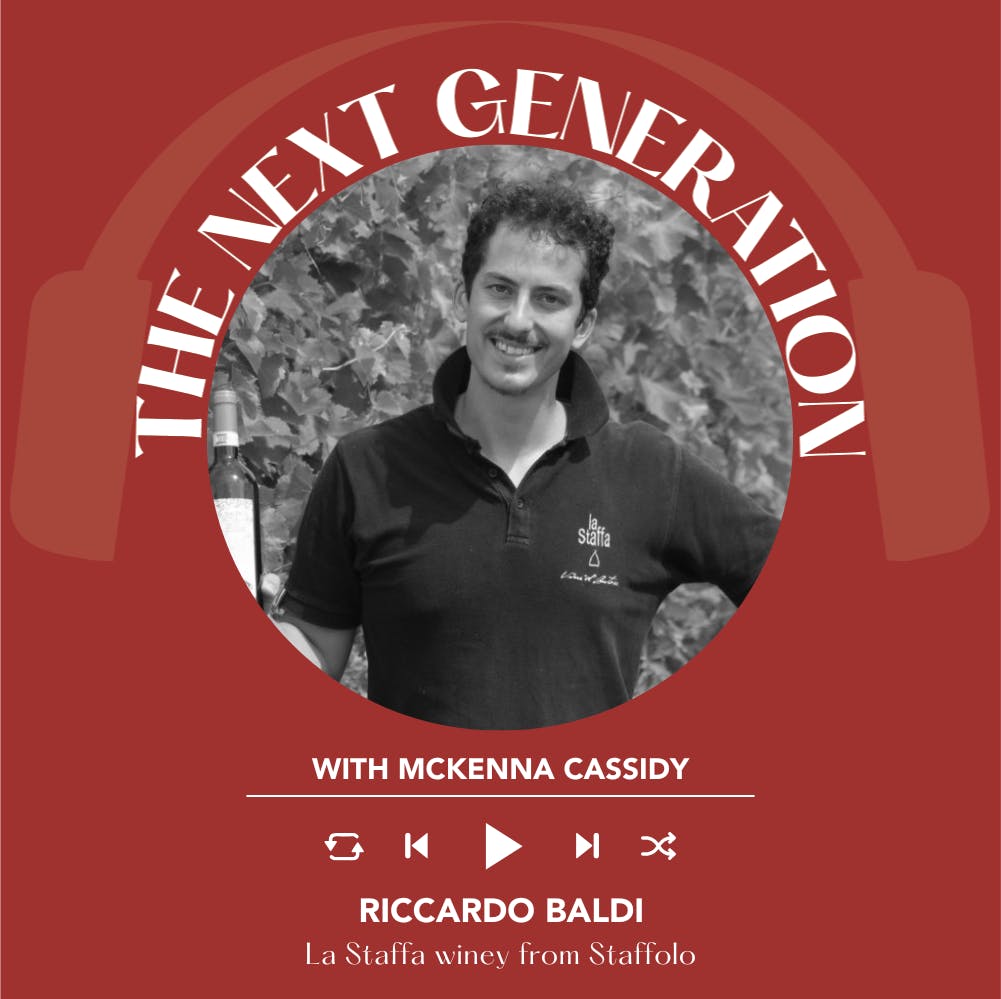
Ep. 2409 McKenna Cassidy interviews Riccardo Baldi of La Staffa | Next Generation
Episode 2409

Ep. 2402 Margherita Andrenacci interviews Erin Kirschenmann of Wine Business Monthly | Next Generation
Episode 2402

Ep 2396 McKenna Cassidy interviews Luca Paolo Virgilio of Caprera Winery in Abruzzo | Next Generation
Episode 2396