
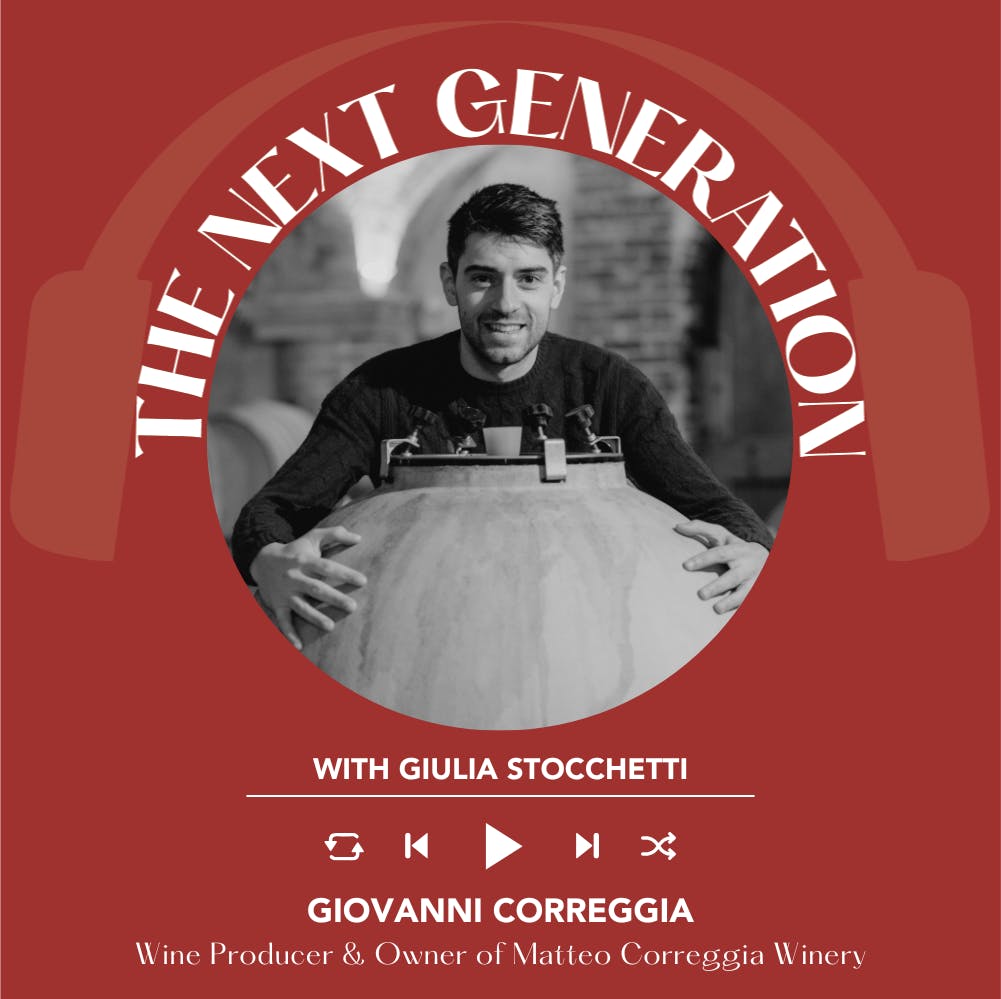
Ep 2356 Giulia Stocchetti interviews Giovanni Correggia | Next Generation
The Next Generation
Episode Summary
Content Analysis Key Themes and Main Ideas 1. The Power of Personal Branding in Wine Marketing: Giovanni Coretta's unconventional approach to using social media, focusing on personal life and behind-the-scenes content, to build engagement and promote his winery. 2. Community Building through Wine Clubs: The development and benefits of a direct-to-consumer wine club, especially its role during difficult times like the COVID-19 pandemic. 3. The Uniqueness of Roero Wine Region: Highlighting Roero as a diverse Italian wine region with distinct characteristics, wines (Nebbiolo, Arneis), and attractions, often overshadowed by more famous neighbors. 4. Balancing Tradition with Modernity in Winemaking: Giovanni's commitment to terroir-driven winemaking while adapting to market demands and leveraging contemporary communication tools. 5. The Winemaker's Lifestyle: Challenges and Rewards: Discussing the intensive travel, demanding work, and personal sacrifices involved in running a winery, alongside the joy of connecting with consumers and expressing terroir. Summary In this episode of The Next Generation, host Julia Stochetti interviews Giovanni Coretta from Mato Coretta winery in Roero, Piedmont. Giovanni shares his journey from growing up above the winery to becoming a winemaker, including a unique experience of three harvests in one year across hemispheres. The core of the discussion centers on his innovative use of social media, where he champions personal branding by sharing his daily life, including his dogs and family, alongside winemaking content. This approach, he explains, creates a more personal and engaging connection with consumers. He also details the creation of his wine club during the COVID-19 pandemic, designed to foster community and offer exclusive access to wines and updates. Giovanni highlights the Roero region's unique biodiversity, its signature Nebbiolo and Arneis wines, and local attractions like hiking trails and renowned truffles. He touches on the challenges of extensive travel and bureaucracy, balancing his professional life with his growing family, and his future aspirations, including potential collaborations with his girlfriend's winery. The interview concludes with a rapid-fire round, where Giovanni emphasizes the importance of social media for broad reach and chooses a personally significant bottle of wine. Takeaways * Authenticity and a personal touch on social media are highly effective for wine brand engagement. * Sharing behind-the-scenes content (e.g., pruning, harvest) educates consumers and creates deeper interest. * Wine clubs can serve as vital community-building tools, offering exclusive benefits and direct communication. * The Roero region, while less famous than Barolo or Barbaresco, offers significant biodiversity and unique terroir expression. * Winemakers face the challenge of balancing travel for market promotion with the desire to be present at the winery and with family. * The philosophy of winemaking should prioritize terroir and vintage characteristics over solely catering to market trends. * Overcoming bureaucracy is a significant, often unseen, challenge for Italian wineries. Notable Quotes * ""There's has always to be more personal. There has to be a personal touch somehow and, show that we're all human seats, we live in a real life."
About This Episode
The speakers discuss the importance of showing personality in various social media platforms and offer advice on finding the perfect balance between flavors and taste. They also discuss the challenges of shipping wine to private people and the importance of social media for engagement. They recommend finding the perfect balance between flavors and taste, finding the perfect balance based on flavors and taste, and finding the perfect balance based on personal and social experiences. They also discuss the benefits of their wine club and the importance of quality in making wines. They invite attendees to visit the winery and thank them for their time.
Transcript
I felt like, you know, people love for sure, see picture of the veneers of the seller, but it has always to be more personal. There's has to be a personal touch somehow and, show that we're all human seats, we live in a real life. So we have a good part of our characters, some clothes as well. We have dogs. We have family. And, I think it's really nice to show this. Ben Venuti, welcome to the next generation with me, your host, Julia Stochetti. Join me as I take you on a journey to discover young stars of the Italian food and wine world. Promdi and Yamu. Hello. Hi, everyone, and welcome back to a new episode of the next generation on the Italian win podcast. Today, the main topic will be wine and social media and wine and wine clubs. Because I have here as guest, Giovanni Coretta from, Mato Coretta winery, who's based in Royal. A pretty famous one region located in Piedmont. Actually, actually, I have to say I discovered him really online because I was, like, looking for some new young producers for the series, and I was so amazed about his social media activity, his social media a file with such an engagement, so many followers. And I was like, okay, I should definitely interview him because, of course, he makes good wine, but he is also into promotion, and he definitely knows how to address new generations. Welcome, Giovanni Nichao, Yeah. Thanks for having me. It's a pleasure. How are you today? I'm good. I'm good. The weather is a bit rainy outside, but I'm good. Can't complain. Yeah. We got the sun inside. So wherever we are, we bring the sun, and it's no problem. Some rain may be is good, but also for the vines. Exactly. Exactly. Absolutely. That's why I'm happy. So perfect. Nice. So you see when it rains, sometimes it's also good. Okay. But can you please tell us a little bit about your background? Of course. So first of all, I was born in alba here in Pimonte, and, I grew up literally upstairs the winery. And, that was something I think very important for my childhood because I remember many times watching outside the window, especially during the harvest period. I always saw these guys working hard, literally working hard, but at the same time, I was mining. So happy. They were happy about what they were doing. So that was probably the sparkle that made me do way making schools later on and, start this career. So when I was fourteen, I applied for the Waime Making School in Alba, which is a great school because they have a lot of, factors of vineyards and the seller as well. Therefore, beside theory and books, there's a lot of practice. And I really liked that. Back then, it was six years. So I finished when I was twenty. I was in twenty twelve. And, in June twenty twelve, I joined the winery full time straight away. I spent a lot of time in inconvenience, a lot of time in the cellar as well just to get my feet wet. And understand every single part of the winery. And in twenty fourteen, I spent some time in Australia a few months. I've been working in a winery down there in Barossa Valley, and I really enjoyed that life experience. I picked Australia because it was good in order to, learn English for sure, but on the other side, Australia is in the southern hemisphere. So they are picking grapes right now, which is the kind of a quiet time for us now. And therefore, I was already at the winery back then since twenty twelve, so being two years, and I just wanted to be away in a quiet period of the year instead of, the rush of the harvest. So, basically, from one harvest, the Italian harvest in the northern hemisphere, you moved to the southern hemisphere for another harvest, no rest for Giovanni who is eager to make wine. In one year, a bit more than one year, I did three harvests. So definitely, you know, much rest. But it was fun. We're the only one I know that actually made, like, three harvests in a year. That's unbelievable. If you count three hundred sixty five days, per year, it would be, like, if you start from September, it would be a harvest in Rio, then Australia, and then back starting a harvest in Royal. That's what it meant. It's a lot of harvesting, I'm short period of time. Yeah. And how was harvesting in Barraosa compared to Roweto? Was it so different? It was very, very different. Most of the harvesting was done by machines. So, actually, I was working in the cellar. Everything's huge. Down there when they do, even just test, trying, I don't know, different East, different fermentation. Thanks were huge. So the whole production of Mateca could fit it just one tank. So it was definitely very, very different, but it was great. I had the chance to learn a lot about different grapes. They were working, especially with Sierra, greenash, riesling that helped me, you know, to increase a little bit by knowledge in wine. Yeah. Definitely. They have more, like, international varieties there. They don't have so many indigenous grapes like in Italy. Definitely not. Yeah. And everything is bigger. What's your favorite thing to do in the winery? I'm a old runner. I do everything. I study what I'm making and the production part is what I like the best because that's what I studied for. But, for only, I have a good team and there's a guy. His name is Luca. He's been with us. Since twenty five years, and he's only forty seven now. He's been with us since the beginning. So, when I travel, which is, a big part of my time I'm traveling, I'm always, feel perfectly safe in very good hands. But I always try when it's possible to be there during the harvest during blending, during Boston because, I'd like to be part of the process as well. Therefore, I manage the winery, so we go towards, everyday kind of situation from, like, I don't know, ordering the courts, to labels or dealing to buy new tractors, you know, everything we have to do, I can do that. My mom is still, you know, working with us, but she's a little bit more to decide and takes care mainly about bureaucracy, and I'm very happy about that because I don't like Barroxen. You cannot imagine how much bureaucracy there is in the wine world and actually every kind of work in Italy, I would say. It's a pain, but It is. It is man. It's huge. Is huge. In the past few years, you know, we kind of keep a steady quantity of bottles, but we had to add more people, and those people were mainly in the office to face the bureaucracy. So that's a big signal. Where's your winery located? So we are at Roredo, as you said, Rrera's very close to BarBaresco and Barolo is, on the other side of a river called the Tanner. We are on the left side, you know, the Lando region is on the right. So, of course, we are talking about Kimonte. Moreno is a major place. I mean, since we are not super famous yet At least not as famous as Barolo. There's still a lot of biodiversity, which is something very important. In my opinion, it's the key organic and biodiversity in agriculture are definitely the best, to be very sustainable. And the most famous gray part, Nebula and Arnese as a white varietal. And beside that, we have a bunch of other grape. A bit less common, small, small production, talking about a sauvignon blanc, like, three, four thousand bottoms max, a very tiny production of international blend, the kind of Bordeaux style. We do some bubbles as well from the Altaanga region, that's a new project that we started a couple of years ago, and it's doing well. So we are wide in a rosette bubble under the Atlanta population. So it's exciting. Nice. So you told us what kind of wine you make basically, but what's your favorite wine you're making right now? So I was raised and bought in Pemonte soon to be always always in my heart, you know. I'm very open minded when it's not worked. I love to try someone else's wine, you know, to learn more and see what other people are doing in terms of style and different point of view on the wine itself. But I always say at the end of the day, if it's a group of people, the last bottle before going home, it's always Nebula. You know? So big fan, Nebula from Moreno because we have a lot of sand as a soil tends to be a bit more elegant than playing on finesse which is a site that I like a lot and I feel most of the people today especially young generation likes a lot too. Well, I think you should feel blessed because no one is so lucky to have a glass of Nebula every single day after work. Apart from wine, is there anything else that you do? Any other hobbies you have that people can't expect just watching at your social media profile? Yeah. I mean, I like, running. I do work out as well as sometimes and as especially these two things or something that is important for your body to be in a good shape, of course. But the main thing for us is a good chance to turn my brain off for, like, one hour and, really thinking about nothing, you know, flying with my mind. That's why music is a must. Is mandatory. If I have no music, I won't go around here because I would get bored after one kilometers probably. That's part of my routine that I I try to do more and more, but sometimes. It's a bit difficult to find the time. I like to read a big fan of, thrillers and, crime books So every every night before going to sleep, I always dedicate, like, fifteen, thirty minutes reading a book. I do training online. I do invest in different assets as well, which is not a hobby because I tried to do that in a very professional way since we're talking about money. But, yeah, that's something that I like to do as well on my free time. So sometimes being so young and running a winery means, like, you feel a bit the pressure and you need just to do something else to turn off the brain and just switched today thinking about something else or even not thinking just doing something. Exactly. Yeah. I found something you don't share on social media. I'm glad because I was like, oh my god. He's always sharing all the experiences, all the travels, all the wines, all the tastings, all the friends, the family. But I was like, it can be only about wine. So now we know you also have, like, your secret moments that you just like to share with your inner self to rehearsal from a long day of work. Talking about travels, I saw, like, a post. There was like a caption saying, how does it feel like taking more or less, like, forty planes a year. And I was like, oh, wow. So how does it feel like traveling so much? So it's, good and bad, of course, at the same time. And, traveling is good because I have the chance to meet always new people, make new friends. And anytime I go home, I feel like richer, like, my cultural knowledge is a bit bigger than before because of the friendship I made because of the knowledge that I have about that specific market, I kind of try always to understand what's the best wine I make in that specific market, what usually people drink, and what usually people know about my place. So next time I'd be there, more focused on specific wines, and I'll try to use a specific vocabulary that fits better, the market itself. So it's, quite enriching from that point of view, but, of course, it means a lot of, time at the airport, a lot of early flights, jet lag as well, so not much time to sleep as well. So sometimes it's very stressful. And I feel like there's, either people who love traveling or people who don't, and I feel like I'm in the middle, because, I like traveling, but there's sometimes when I'm in a very busy and intense period of the year, I would pay you know, someone has to go instead of me and stay more and more home, spend more time with the one, honey, spend more time with the family. And now I got a almost two years old baby daughter. So every time I go away, I always feel like I'm missing some pieces of her childhood, and it's sad. You know what I mean. So it's important to find the perfect balance for sure. My rule is I never do three, but, over two weeks, because over two weeks, it's too much for me. I don't wanna talk with people anymore. I don't wanna tell the same thing the whole day anymore, and so I might be rude as well. I might become rude And, that's definitely not good, especially when you're away and you're trying to sell wine. Yeah. Definitely makes sense. I got a kind of sneaky question for you now. You said that traveling, of course, you get in touch with new cultures and you understand the flavors the taste they prefer most. So when you're making wines, you have in mind first the market or the place where the vines are grown? Definitely a place from where the vines are growing because the philosophies from try to make the best we can depending on how's the vintage is and, how is the terroir. But I think it's very important to keep in mind the flavors that every market has. If we go back in the years at the end of the nineties, those wines, even our wines were super oaky, very big. You can cut them with a knife. They were so thick. That was, especially the US market one and there was, you know, Robert Parker as a journalist, and everyone was trying to make that kind of wine that's style. Now everything is different. So it's a good sign because we don't wanna be stuck in the past, but it's very important to see how the world is going, where is it going, and trying to keep up. Yeah. So, basically, you're making the wines depending on the terroir. I mean, your following the nature what the soil can give you. And then you just look for the right market for those flavors without being influenced too much from what they actually want. Exactly. That's the point. That's what we try to do every single vintage Well, that's why you travel so much. You said that. It's not really popular nowadays, but maybe it will be in the future, even if being famous is not always all pros. There are some cons, but if someone comes to visit Ruero for the first time, what do you recommend to do, to eat, to drink, to feel to see? In the past ten years, fifteen years, Roberto grew a lot. So for only now, there's a big choice. In terms of restaurant wine bars and stuff like this. We have, like, three Michelin stars in Rioo. The village where the one that is located is called canal. It's only a five thousand people village. It's quite small. One of those star Michelin restaurant run is there, and that at least other four, five, very good, more easygoing kind of restaurant. But anytime you go there, be always happy about the food, about the vibe as well. And then as I told you before, there's, a lot of biodiversity in Royal here, that is important. There's a lot of, paths to go hiking or for mountain bikes. It's pretty fun. Actually, there's a place in the area. It's called Rock. It's like a cliff. It's like a tiny canyon made of sand. And through this canyon, you can go from north or south Dorieto, and there's lots of very beautiful pets. Again, either IKE going with the dogs or just using mountain bikes. It's pretty fun. So today, there's a lot of things to do on the other side. I feel lucky because we are very close to the longer region as well, very close to Alba, like twenty, thirty minutes. So you can, you know, go back and forth and, have fun doing a lot of things. So it's a really nice spot where to go to have good food and a good experience immersing themselves in the nature and, of course, good wines and close to Alba. So there's truffle. Well, there's basically everything in Rioo. Everything. There's everything there. A lot of white truffle, exactly, because, you know, white truffle needs the Oaks needs, boots. Since we have a lot of it because of biodiversity, a lot of beautiful white truffles are coming actually from Roeroes. So there's really everything in here. You can find all you want. And so what's, like, the signature dish of the area? We have a particular prosciutto, which is cooked in the oven with some herbs as well, which is so difficult to find, but it's pretty much only made here in Arrowero. It's quite fun. It's a very tasty kind of prosciutto bit more rich than the classic one. I love it. What of your wine would you pair with that prosciutto? It depends on the season. So I don't mind a good Arneza, a good white wine, especially if it's summertime. We make a Rizabo over Arneza. The current vintage on that wine is a twenty eighteen. Now. So it just released the twenty eighteen. Quite amazing, still very fresh, amazing color. That will be a perfect fit, especially for summertime. Otherwise, maybe a nice, you know, either Barbara or a biolo. I like Barbara with prosciutto because, you know, there's always a tiny fat taste on the prosciutant and the acidity of Barbera goes so well with this, fat taste in many dish. Okay. Now I have a question of mine, like, barbera or nebbiolo. I have nebbiolo who runs in my vein in my blood. I am a big fan of Barbara as well. I gotta say, like, Barbara from Alba from us as well. But, again, at the end of the day, Nebula would be my pick. Okay. And why? Because it's so complex. I love the ten inch. I love the nose nebbiolo, which could be very different depending where you are. It's probably one of the grape, that changes the most depending on where you're planting, where you're growing the nebbiolo. So it's so fun to smell and trying to understand if it's from Royalo, from Barbara from barolo, certain areas are more fruity. Other are more balsamic, more minty on the nose, and so the tendons are different as well, more intense, more silky. So it's really intriguing. It takes as many in the field as you want. That is. So it's really terra expressive. Exactly. Talking about your, let's say, customers or people who reach out to you for your wines. What experiences do you offer at your winery? So we do a lot of resistant tasting. Is it the best way to place a face or a philosophy behind a glass of wine. Anything that's very helpful in order to remember you. We always, you know, prefer bookings just because there's some time of the year that we're so busy. We have so many visitors. I always get visitors if I have the time if myself or some coworker might have the time to do a proper full visit, because it has to be well done. And, if I put aside me being humble, I can tell we always have a very good feedbacks about how we do business and testing. Lots of people write us email once they get home, just saying thank you. So it's, a very important part of the business as well, but very important part of the marketing as well. Because, when people come every year and bring more and more friends, it means it's a good sign. Definitely. And maybe this is something that inspired you to found your own wine club because I was surprised when I found out that they actually founded a wine club, and it's not so common for wine originally to have one. Yeah. I found it open up wine club during the COVID, but not at the beginning. A bit after that. Let us tell you why. COVID period was tough for everyone. We work, mainly with Horeca, and with private people. All the restaurants were closed. Private people couldn't travel. So with stuff, we had to figure it out something. I took the tiny mailing list that we have, send sign emails, and I shipped some wine to private people. And all these people were always very happy, you know, to get by the door, the one in the order. It feels good with this thing, plus another thing that we always I always had a lot of requests, but on Instagram or emails from people asking about how was the vintage, how was the harvest, and I always, replying one by one. I was like, let's try to make a community. Let's try to make a website where people can subscribe. It's a free subscription. They can get wine if they want. They can get my newsletter. I send just like four fine newsletter per year, so not much where I, write about updates about how was the vintage, how was the harvest, and anytime I have some particular news that I feel like to share with our community. And, the community subscribed at this wine club as benefits. Because, from time to time, I send some special offers for them. And in the special offers, you always find some old vintage, usually, then it's, very difficult to find them, anywhere else because everyone is always focused on young vintages today. And, sometimes they send, new images in absolute preview. So the subscribers who get that box of wine would be the first in the word to taste that new vintage. So, you know, I try to awards these people who put faith in us and decided to join our wine club. So, basically, everyone from around the world can join the wine club. You don't have to be in Eastern, Italy, or in particular countries. Exactly. We have some country where it's a bit more difficult to ship, like, Asia for instance is quite difficult. Australia is possible. Sometimes is expensive, but at least just for the newsletter side, you know, everyone could subscribe and, stay up to date about what happens here at the winery. Yeah. Just to keep in touch, just like having a community, and it's always really important. And I guess you took inspiration for this from your social media maybe because everything started from there. You were responding one by one. To people texting you and asking you questions. So what's your secret to be so prolific, so active, and to have such a great engagement on your social media? So as you might have noticed, we didn't have a Matel Koreja Instagram account, and that was my choice since the beginning when I first subscribed to Instagram years ago because I thought about what I like. You know, I like, the backstage. I like to see what's behind the scenes and, like, gossip as well, and I feel like most of the people like that as well. So I thought I'm gonna do my page on myself where I could share everyday things about Matell Correj's wine, but even about my private life, you know, my dogs My dogs became famous. When I'm at the winery, they're always with me. And if you come here, visit the winery, they will visit the winery with you. So you gotta be a dog friendly person. If you come here, they became a mascot at some point, and I tell you this story a couple of years ago, it was in London. We were doing a portfolio tasting, so I bought a bunch of bottles waiting for people to come and taste. And this guy's approach. I've never seen him before. And he goes, like, hey, how is Mara? Mara is my chocolate lab. That is always going around here. They wanted it. I was like, really, we never met. You probably never had the ones before, but you know how my dog is called. One of my dogs is called because then we introduced a golden retriever as well called Leah a few couple of years later. And, I was pretty surprised. So I felt like, you know, people love for sure, see picture of the Venus of the seller, but it has always to be more personal. There has to be a personal touch somehow and, show that we're all humans. It's, we're living a real life. So we have a good part of our characters, some clothes as well. We have dogs. We have family. And, I think it's pretty nice to show this to people. I've never been a big fan of, some of, Instagram pages of important wineries as well that you go there, and you can tell the picture just perfect from a technical point of view, they're very well done by some professional photographer, but then there's no personal touch. So that specific picture, I could personally use it because there's not much personal touch on it. And, I don't like that much. Yeah. Definitely makes sense. So when it comes to content creation, What do you do? Like, there's just a moment you're leaving, and you're like, okay, this moment must be captured and posted on social media, or just you sometimes planned things to happen? Most of the time, it's just I like this. I need to take my phone out take a picture, take a video. So I tried before, but I have zero plans. I have no plans, about what I'm posting the following day or the following week. Zero tolls. It's more live like this, take a picture or something interesting. Like, let's say pruning is happening in the vineyards, and, it's something very interesting. Most of the people maybe don't know much about it. So I'm gonna make a a real. I'm gonna make a video about it. And, try to, you know, show to people who never seen that before because something that most of the time I think that my colleague forget is that we live here. We were born here. So for us pruning, harvest, everything that happens here is normal. But for someone living in New York in Tokyo, just in Torino, it's something completely new. And if you are a wine lover, you wanna see that. You want someone who explains what's happening now, why you prune and how you prune. Right? So that's very useful and I think is, what people most of the people want. So it is, like, a virtual diary. Exactly. Virtual diary. I like it. Happening in real life, I instead of, like, watching the big brother. It's actually what's happening at Matteo Coineri with Giovanni being like the main character director of all the social media contents and of all that happens, that's really, really interesting. Yes. That's the idea. The success is being yourself. That's it. Not seeking for perfection, but being Absolutely not. That you are. If you watch my videos and stuff, they are not perfectly taken. I make mistakes when I talk. But it's part of the game. That's how I am. I don't wanna do that video like a thousand times trying to reach perfection because, it's more a diary and, in that, there's some, mistakes sometimes, and that makes you human makes you real. Yeah. Definitely. And also build an experience that makes you better day by day. When I look at someone's profile, like Instagram, I stay there for just maybe two and a half seconds and escape and change. But when it came to your profile, I was like, oh, look, in the stories, in the highlights, there are all the harvests, all the different Greek varieties, and actually people can learn from your social media profile. Even if they don't know anything about the varieties, the place, the ones you're making. And, of course, it's about yourself, because I saw also your beautiful family, your dogs, and it's really interesting. And I was like, oh my god. I spent even more than two minutes on this profile. What's happening to me, I have to reach out to him and just interview him because he definitely has a lot to say. And what you have to say is something real is real life. So that's what I think is much appreciated. That's great. Thanks. Thanks for sharing it. That's the best feedback. Well, happy to hear that. But, yeah, now I'm curious to meet your dogs, so because I'm a dog lover. So It's lovely. Lovely. I should come to visit Rshedo, for sure. And it's Of course. I love Nayce. I love Nebiolo, Barb, Barb all the wines from Piero, are great. So And you love dogs too. So you're in the perfect spot. I got you. So, you know, they're, like, my best friends. Like, people say, oh, you're the owner, and I'm, like, no. We are friends. We are friends. There's no owner of course, there are rules. Otherwise, they're always, like, sticking to me, but, yeah, they're great. So, yeah, love animals. Amazing. That's it. How do you see yourself in the future? I see I'm assessing the future. Here, the winery, with more wisdom, with more experience, maybe with someone, who's helping me traveling a little bit, because, it's something that is getting more and more important today. There's lots one adults competition, so you really have to find a way to, be more known somehow. Of course, quality is always the base ground. That's, no matter a big fan of quality, we spend, you know, a lot of time studying every day, with your new techniques to use and, what could make our wines better. But still communication is getting more and more important. So maybe someone who has me could be a good thing. And, maybe my girlfriend and her family, they make wine in La Mora. It's called Agrico Brandini. I'd like some how to get more actively involved in that wine area as well, you know, is a different area, and some of the grape is different. Some others are the same, but the philosophy there, of course, it's a bit different. And it could be a good way, you know, to learn more and become more professional and more knowledgeable in wine as well. So you met your girlfriend, like, under a vine during a harvest, during a tasting, or, no, in a completely different situation. It's a different situation, but not the different. It was this is a fun story. We met, Master Chef, you know, the TV show. Sometimes they do episodes outside with the chef outside, and there was this episode where chefs had to cook for winemakers and truffle hunters, and we were both invited as winemakers. So that's where the sparkle started. No. Wait. That's fantastic. Yeah. Well, I could sit here asking you a bunch of questions for the rest of the day, I guess. But since we're running out of time, I just got last three rapid fire questions for you. So, Giovanni. Making wines or traveling promoting wines? If I think about the winery, I would say traveling because, again, quality is the best. And, finally, we're very in a very good hands today. So I can travel safely, and, that's a good way to make your brand more known. If I have to think more from a personal thing, I would be more, like, making more time physically at the wineries. So I have to find a balance between those Sorry. It doesn't reply to your question, but it's a difficult one. It's a tough one. Oh, yeah. I know. But you replied in a way. So in terms of social media and wine club, if you have to pick one and one only, what would it be? Social media. Social media because, wine club now is not big. I only have, like, five, six hundred subscriber, which is not bad, but there's still a lot of space. But especially, social media can do that kind of big brother we said before. It's something that you can, reach more people and you show them your life on a daily basis if you post enough. This is something that on a wine club, you can do that. But usually, when people love what you post, they will subscribe to the wine club as well. So it goes back to that. Right. Guys, I'm definitely gonna subscribe to Giovanni Swine Club right after this interview. Thank you. So I invite you the same because, remember, you're not just gonna be in touch with Giovanni and his family and the winery, but also you're gonna have some benefits and some premer wines and access to some culinary service that are not on the market anymore because Joanne is keeping them, like, in the winery hoping to enjoy all by himself, but he must share with us too. Okay. So last question, if you'll be on a desert island, what bottle of wine do you want with you? So if I have to pick a bottle of wine among my production, I would go with a wine called Apavan. Which is a good wine quality speaking, but there's, a lot of feelings in the air because it's the wine that my sister and I made a few years ago to honor how a dad who passed away long time ago. And, I took care about the wine making. It's, like, an albiolo made in a ceramic haphora. Navu do not standstill always in there since the beginning. My sister made the label, so it's a bit different than, any other label you would see from us because, this is my sister, why the classic line was made by painter. We still work with when we need new ideas on a graphic point of view. If it has to be from someone else, I'm definitely biased, but I don't care. I would pick from, my girlfriend, Altalanga six five five is a new Altalanga five five cents for meters above the sea level. So you're pretty high up as an elevation, and, it's a beautiful, blond, a lot of shards, bubbles, and, it's a new project, a new wine. And I love that a lot. Wow. That's fantastic. Nice. So I guess we've covered pretty much everything. It's time to wrap up the episode. If there's anything else you'd love to share with us before we close the episode. Otherwise, I thank you so very much. Thank you as well. And, I invite again everyone to come here at the winery because, again, it's a nice experience. We always try to spend one hour and a half time with people showing the winery vineyards sometimes as well. If the weather is good, and, taste a bunch of wine. So if you're a wine lover and especially if you've never been here in Rioo, it could be a good, point to start and get your feet wet about Royalo's wines. Nice. Grazimi. Thank you so much for your time and all the best. Thank you so much. All the best. Enjoy. Bye bye. Grazie for being with me today and listening to the next generation on the Italian Mind podcast.
Episode Details
Keywords
Related Episodes

Ep. 2769 The Younger Wines from the Volcano with Giulia Monteleone & Darya Nagornyak IWA | Clubhouse Ambassadors' Corner
Episode 2769

Ep. 2745 Discovering the "Rive" of Conegliano Valdobbiadene with Lucia Fragoso IWA & Alessandro Favaro of Rivaluce Winery | Clubhouse Ambassadors' Corner
Episode 2745

Ep. 2683 Alberto Rivera IWA interviews Andi Punter of Franz Haas winery in Alto Adige | Clubhouse Ambassadors' Corner
Episode 2683

Ep. 2660 Elena Barattini IWA interviews Ondine de La Feld of Tenuta di Tavignano in Marche | Clubhouse Ambassadors' Corner
Episode 2660

Ep. 2645 From Cheese to Wine: A Food Scientist’s Role in the Wine Industry — with Rebecca Siefring | Next Generation
Episode 2645
Ep. 2638 Ekaterina Vislinskaya IWA interviews Andrea Pieropan of Pieropan Winery in Soave, Part 2 | Clubhouse Ambassadors' Corner
Episode 2638