
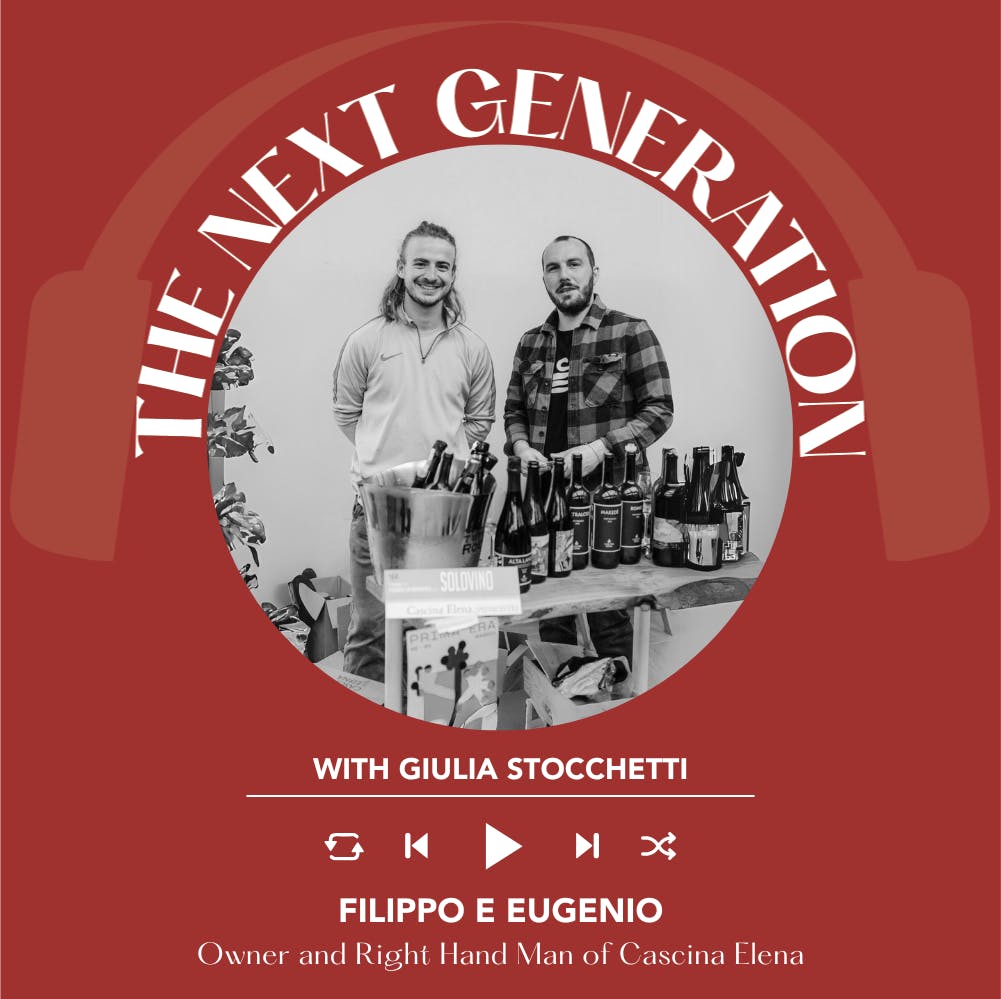
Ep 2384 Giulia Stocchetti interviews Filippo and Eugenio from Cascina Elena | Next Generation
The Next Generation
Episode Summary
Content Analysis Key Themes and Main Ideas 1. The journey and philosophy of new winemakers, Filippo and Eugenio, at Cascina Elena. 2. The establishment and focus of Cascina Elena, a young organic winery in Piedmont. 3. Winemaking practices, specific wines (Alta Langa, Moscato Pet Nat, Romeo), and grape varieties cultivated. 4. Challenges and opportunities presented by their vineyard location (altitude, terrain) and organic certification. 5. The dynamic between Filippo and Eugenio, and their approach to marketing and promoting their wines. 6. The visitor experience at Cascina Elena, including tastings, events, and local tourism. Summary In this episode of ""The Next Generation"" on the Italian Wine Podcast, host Julia Stochettie interviews Filippo Magagni and Eugenio, the founders of Cascina Elena, a relatively new organic winery in Piedmont, whose first vintage was in 2020. Filippo, with previous experience in Tuscany, moved to Piedmont for love, while Eugenio joined fresh from university, drawn by the enthusiasm and passion of the project. They discuss their small team of three, their commitment to organic viticulture despite the bureaucratic challenges, and the demanding but rewarding nature of working their steep, high-altitude vineyards. The conversation highlights their primary focus on Alta Langa sparkling wine, made from Chardonnay, and their unique Moscato Pet Nat. They share insights into managing a new winery, navigating the physical demands of winemaking, and the complementary differences in their personal and marketing styles. They emphasize that while promotion is necessary, they believe the wine's quality and expression of the terroir should ultimately speak for itself. The interview also covers the visitor experience at their winery, including tastings, hosting events, and offering unique activities like truffle hunting, recommending their area as a rich destination for wine, food, and culture. Takeaways * Cascina Elena is a new, small-scale organic winery in Piedmont established in 2020 by Filippo and Eugenio. * The winery focuses on Alta Langa sparkling wine, utilizing high-altitude vineyards that help mitigate climate change impacts. * They produce a diverse range of wines, including Chardonnay-based sparkling, Moscato Pet Nat, and an orange wine named ""Romeo."
About This Episode
Speaker 0 and Speaker 2 discuss their experience in wine production and their desire to expand their project. They talk about the challenges of growing crops in Italian wines, the importance of healthy farming, and the benefits of learning about wines. They also discuss the challenges of working in small winery during the pandemic and the benefits of organic production. Speaker 3 describes their love for plums and their interest in learning about wines, and they suggest trying Nabilo and the Petna. They also discuss the challenges of growing crops in Italian wines, the importance of healthy farming, and the importance of presentation and the number of ingredients used in the recipe for the wine. They suggest a combination of butter anchovies and a little grated lemon set, and they look forward to seeing everyone in front of a class of Kashina Elena.
Transcript
Always have to commit and I have to do my best because, such an hard work to make wines here in the Vineyard in the cellar. It's such an important thing to present it well and to give the best. But, yeah, I do agree completely with Filipo that sometimes the one is too much linked to the winemaker. The wine is also made by the weather, by the animals that decide to eat or not eat the grape to question, interacting them saying the winemaker is the only outer of this product. Ben Venuti, welcome to the next generation. With me, your host, Julia Stochettie. Join me as I take you on a journey to discover young stars of the Italian food and wine world. Broni and Yamu. Hello. Hello. It's our tutti, and welcome back to a new episode of the next generation. Today, I'm really excited and happy to have two guests, not just one, and they're both from Piedmont from a really famous wine region. But what's cool is that, basically, they are really, really brand new winery. Their first vintage was in twenty twenty. And so now I'm so excited to get to know better, Eugenio, and Philipo. Welcome to the show, guys. Hi. Nice to meet you. Ciao. Thank you so much. You're most welcome. So who is Eugenio and who is Felipo. Please introduce yourself guys. Well, Triple, it's, a young, let's say, young, one maker. I started the twenty fifteen. And after, you know, many months, I found out myself, in and now I'm running this, small operation in Antarctica. So where do you come from? I grew up in a small town close to Rome, and then, I moved to Tasali. I started to work in the wine production business, And then, I moved again in because my wife is from here. So it was a love choice. Oh, wow. Making wine and moving for love. Amazing. So now I would, Daniel, tell us something about you. Basically, I guess I'm, like, Filipos, part one, because I am much younger. And, this is my first winemaking experience. I came here fresh from university. Where I studied gastronomy Sciences, and it's, during that period that I met Filipo, because here we have a small, outside space that we use for events. And, I once came here for an event, and that's where we met. So you're from the area or you're from somewhere else? I'm actually from the big city of Vietnam. I'm from Toronto, but I moved, into Lange, for university, for the scientific astronomy university. So and how come you decided to join Philip Pointe's adventure building and giving birth to Casina Elena winery? Yeah. That's actually a quite brand new question. They asked me. I guess I started working here because of the enthusiasm here and the the truly occasion to put yourself into something, really nice and really pleasing. It's more, rewarding job. I guess it's not very common. It's not like, going into the office. And I've been to log in every day. I, this is a bit more passionate, I would say. It's not only a job, I would say. And that's why I decided to come here. And how many people work at Cashena Elena. Right now, we're, three. So it's me, Elgenio, and Marco. Marco, it's mostly working in the fields while, Virginia is, taking care of the administrative and marketing side. And I do a little bit of everything. Actually, everyone does a little bit of everything because that's the beauty of working in a small winery. So you get to, yes, work behind a computer, but at the same time, the same day, you may, you know, just cutting the grass outside. That's fantastic. You get to do a lot of different things. You never get bored, I guess. Yeah. You were saying that just right before the interview, you were just working altogether in the venue. Right? Taking care of some chardonnay. Yeah. Now it's quite the most busy time of the year. The plans need to be, you know, taken care of. Plus, you know, since it's the most busy time of the year is the time when you get the equipment broke. So you have to fix the equipment, work outside, work inside. So but it's nice. That's June. I would say this is June. This is joyful, June. Let's say, crazy, busy, but rewarding at the end. I'm sure. How's the weather now? This was a strange year because last two winters were very dry with the very rainy springs, and the this one was rainy as well. And now this summer is coming, but it's a a shy summer because we still not have that, you know, very hot sunny days, that we had in the last years. But at the same time, there's water in the soil, which is good. Plants are looking healthy. Even, there's lots of moisture. So now it looks like it's gonna be a nice vintage. How many hectares of vineyards you manage? Laura, right now, we have four point five hectares let's say three point five are planted. One actor is not productive right now. So there are some woods. There are some other cultures nearby. The total amount of land we have is twelve hectares or less So it's mostly woods and, these four point five vectors that, we want dialogue expander because, we don't want to, you know, remove woods, even because the woods are in places where the land is too steep. So that would be very hard to plant anyway. So what's the altitude of your vineyards? It's one big plot divided the in many small vineyards. The lower is four hundred eighty meters, the highest is five thirty. Oh, wow. That's fantastic. So you're not really suffering with climate change because you get altitude, you get the vines planted on the slopes, and seen the area, I guess you are making some sparkling wine, like Alta Lanka. Right? It's the most important point of our project. And, since we started in twenty twenty, we discussed the first Satanga last November, And for us, it's kind of a big, thing because after you wait for three years, and then you get to taste the the work you start in twenty twenty. And, when my personal feeling I was coming from Canti, so it was mostly San Juvez, red wines, coming year. My feeling is that we have the perfect reward for white sparklings. So was your first experience with sparkling wine? Yes. Oh, wow. Fantastic. And does this bottle have a special name? It's like a special conveyor, special vintage, or special name, or something. Don't actually if I have to be honest, this is a place, traditionally, the most important variety was Moscado to make Moscado Dasty, but we never made Moscado Dasty. We always, thought that Moscow needs more to be really expressive. And so we did the, orange wine, let's say, with this Moscow vineyards we have, and I gave to this first wine that I made, the name of my kid that was born the same year. So it's, Romeo. Oh, wow. So twenty twenty must be a really, really special moment for you. New baby, new wine, your first sparkling. That's exciting. Yeah. It is. It is. You should spare some bottles so so for the future. Maybe when your kid is going to be ready to have some and you're gonna have a story to tell him, you know. I don't know if they're gonna make it to Mikey the, you know, as in Bartegos, we usually drink before that. And then I'm so curious about how a muscato, you know, carnival during these, years, but I definitely keep one frame. But hold on. Is the sparkling named after your son or the Okay. Okay. And it's made with chardon, I guess, and some other grapes you use? The first one was made only with the chardonnay because it was the vineyard that we found. Because when we arrived, we had four actors planted. But with the old vines, the guy that was keeping, was managing the vineyard. The was selling grapes, so he didn't really care about, you know, keeping them healthy. And so we say to renew which I remake the vineyards. And so we started planting more in, you know, because we were planning to make more atalanga. But when we arrived, we had this zero point four actors of, chardonnay planted in the beginning of the two thousand. And we did one, we started making the first South Alanga. So our first, would say three beatages are made with the only chardonnay. Wow. Cool. You're mastering chardonnay and Altalanga. Fantastic. Then, Moscato, and then you have other varieties planted. Or We have some Faburita, which is, not very well known. At some white variety, right, for Valita? It is. It is. Basically, it's a Vermentino. We had Dolcito that we took off because, was, very, you know, few vines, and, Right now, we have Nibialo, Faberita, Moscato, Champlet, and pinot noir. Fantastic varieties you're growing there. Marco should be pretty easy working your land, I guess. It's not an easy land to work. Steep fields, even the director, it's really hard to find machines that works really well. Especially I can tell you the critical point here in these hills, not only for me, but, for the farmers is how to keep the grass under the vines that, you know, how to cut the grass. There's no machine that really works. And so sometimes you have to work by end. Yeah. It takes time. Yes. Takes time. Can imagine. So you don't use, like, herbicides or stuff like that in your vineyards? No. As soon as we arrived, we converted to organic. Fantastic. And it took a few years, right, to like, do the conversion or was quite easy? Two three years. I think the most painful stuff about being organic, to me, because when I was in county, I was coming from, Lechin Chole, which is a small winery in Pansano. The agronomone, the consolented, the adviser was a, which was one of the most important, organic consultant in Italy. So to me, when I came here, organic, it was not a choice. It was, you know, just, the way to go. The most painful thing about the organic production is the paperwork behind it. Well, like, everything in Italy, basically, when it comes to bureaucracy and stuff, it a never ending job. But there's a Virginia for this. Right? Yeah. Even though I try to do my best to put together all the papers for the organic, but, you know, the problem with the papers, I guess it's the time required and being small winery, even though we are full of work, so we don't have much time to spend to put papers together. So we're always a bit running behind this type of task. But this is, you know, where I had I guess, Philip put the most. Yeah. That's fantastic. Usually, you're at the winery every day, I guess, or you have some days off for yourself. We are always here. We are away usually on on Saturday and then Sunday because Philip doesn't live close and and me neither, even though I stay here during the week time and go back to the big city for the weekend. Oh, wow. So, turin, during the weekend, and then back to Altaanga. But it's cool. I mean, you can set the winery. You really leave the winery, and I guess it's so peaceful there without all the people bothering you and the traffic and cars and everything. Yeah. I'm doing, like, a machetic, life during the week. Everybody leaves after five when we are done working. I stop speaking, and I go back speaking at eight AM because I got nobody to speak to. That's therapeutic. That's that's helpful. I bet. That would be awesome. It's basically the same things I do most of the time during the week. Just go back to my little town and just don't talk to anyone until the day after, and that's something really, really nice sometimes. But don't you have any dog or any animal there with you? It's just you and yourself. No. I guess it's easier because I don't know how much I can look after another living being apart from my style. But maybe it could be the other living thing to take care of you. Who knows, you know? Yeah. Yeah. Yeah. That that's the point. Yeah. And, Philip, you also live at the winery or somewhere else, or do you drive back and forth? I live in Alba, and I'm, twenty five minutes away from here. So every day, I go back and forth. Okay. Cool. So you get to see your family, your wife, your kid, personal advice to someone that wants to start a new business in agriculture. If you live in the same place, you work is much better and easier. Oh, yeah. Sounds like it. And is your wife involved in the wine business or not Her family has a winery in Barolo. Oh, wow. But, she was never really into winemaking and win production. So now she's a yoga teacher. She started to become a yoga teacher, but right now, she's teaches, pilates. Yes, pilates. So a little different, you can organize some cool yoga and pilates classes, you know, with as a reward, some good wine. Well, could be an idea. We thought of it and Philip proposed a couple of times, but sometimes we are wondering if yoga people are also into wine. We think yes, but we don't know. Maybe they are too much strict on their, consumption and that they don't like wine or they don't appreciate it. Wine is culture is sharing is also good for your health. I mean, it's a nutrient. So I think intelligent wise yoga people would enjoy at least a sip of wine, but you know, you never know. But going back to wines, filippo, what's now your favorite wine you're making? Right now, the one that I like to drink most, especially when I, you know, at Fayer's event, where I'm displaying my wines, I usually drink, all day because it's, very refreshing, and, you know, I drink it, just to enjoy myself. And, I really like it. Otherwise, I would tell you probably the romeo it's true that the is something that, it's really becoming more popular, but, I don't think, it's right at the same time to abandon the Moscow. Because, you know, planting in Italy, yes, is something that I'm doing. I like doing it, but at the same time, I'm wondering myself, if this was the best choice, for, Italian DOCG to use to frame grapes, to make a sparkling. You know, they're already been used in Chobania in many other places, but since in the last thirty years, you know, the became so important. Why don't, you know, do some attempt with the Italian grapes, like, for example. Because you know, they have many problems, they're very sensitive to the to the to the Yeah. Powder and down emailed you. Flava sauce. Yeah. So I'm wondering, you know, why I am forced to use binds that I already know are not doing great and, you know, just, don't use Nabilo, for example. You can also make Nabilo's pumante. Right? Yeah. It's something that was already attempted by other pro users, and I think it makes sense. So we see, because in Nabilo, we've been anti deer was kind of a bad because as you said, it's true that the altitude is helping with the climate change, but at the same time, the Bialo needs, you know, heat to get to the best writing So in case we want to be able to get the perfect revenue for a red wine, you know, we already are experienced with sparkling. So why not? And, Evgenio, your favorite wine It's hard to tell because sometimes I feel like every one of them explains something different. I think in this particular moment of the year in my life, I really like the Petna, the Moscato based Petna we do because with the Moscato, we also do this Petna, which is a bit more fun, I would say, but it's very, very fresh for Urbacher's notes, and it's really nice during this part of the year. Of course, the Atlanta is more elegant, more classy, but after a day of work, which is better than a glass of bed net. Yeah. Sounds like that's an energy drink. I can picture like Eugenio at five PM, you know, done with work with nobody around just looking for the bottle of bed net and just popped it up and pour a glass and, like, wow, that's heaven. That's Nirvana. That's how I picture you. But do you also host, tastings sometimes, or events at Cassinalena? Yeah. We always open for tastings and, and we did a few events in the past years, hundred fifty people. Because we have a this, theater as of January already said. And, we hosted some, concerts, even, the other play. That's fantastic. And all those people also enjoyed your wines? Or Yeah. Yeah. We've been, collecting bottles the day after, you know, for old morning, of all the bottles that we used. What if people want to keep up with the events you're doing? Is there a website or social media page they can reach out to and take a look at? Yeah. Actually, yes, of course, they can, go on our website, and we also have a newsletter where we sent out new events we are planning Actually, as we are speaking, on the end of this month in the twenty one, we are hosting a dinner with some friends of us who cooks or cooks. And so we are focusing more, I guess, on smaller events. Because for now, it's a bit tougher for us to do bigger ones since the big work we have to do in the binders. But, of course, following us on social media and, looking at the website or, subscribing to the to the newsletter is a way to be informed of this type of event coming up. And people can come to the dinner on the twenty first of this month or is a private event? No. It's open to public. You have to book your spot. It's gonna be thirty five, I guess, maximum. We are going out with all the the materials of the communication. Fantastic. And if someone is visiting your area and they want to visit you, taste your wines, and enjoy the place, Is there anywhere you recommend to sleep, to eat, to go, you know, sightseeing? Actually, it's, it's a big, big question. We always love drawing out in the area. We have lots of, I would say clients that become friends that runs, either, hospitality places, either restaurants, or, or just wine bars. And I guess the best thing would be if you are coming in the area and you want to come to a taste We can also advise you a bit on where to go to sleep or to see the and also the language, very rich, very beautiful area. I guess doing them both in the same, journey, the same vacation, it's nice because you can really have a comparison between two very nearby wine territory. It's very interesting. But I guess it's a bit too long to release them all Oh, yeah. It's just to arise the curiosity in the listeners, you know, because when they know there's something cool to do, just wine, wineries, good food, nice places to go to. They just take some information. I mean, if they want to. Go on a journey or just for the weekend. I got a question now. Can sound kinda weird, but do you have also in your area, like, not trees? Cause Alanga is famous for Natalia. Right? It is. We never had, some in the last two years, the production of the North Chale fields was, very low for more reason. One was the weather. Actually, there's a big production of North Chale around us, but, we are not making them. Okay. It was just curiosity, you know, and discuss the famous, Charlie del Piamo. There's even the many producer of, haznuts, products, creams, and some of them, they really like to works with the last ingredients, so the products are very good. Amazing. So you have wines, you have, you have biodiversity, you have really nice places. It seems like really a fantastic place to go to. And do you think also a weekend would be enough to visit you? Yeah. I think it's much on the weather. If you have a good weekend of nice weather, it's enough because you can work outside. You can do a couple of wineries, a couple of restaurants. But even five days, wouldn't be wasted. Because the area is very big and there are a lot of places to see. Even coming, during the fall where we have truffle season also on our hill, there are some truffle, not the white ones, but the black one, the And it's really nice. Our neighbors is a truffle hunter, and we can go truffle hunting with deal with our visitors. I guess it's a nice experience. Yeah. It is. Something special and something unique because not everywhere people can go truffle hunting. So, wow, that's fantastic, guys. Back to the wine. How many bottles do you make a year for now? More or less? We go from fifteen thousand to twenty thousand depending on the harvest. Okay. Cool. And where do you mostly sell your wines? Since January, of January started the to sell in touring. And, right now, I would tell you probably fifty percent of our sales are in Italy. And fifty percent, mostly North Europe. Wow. Cool. So, like, in Scandinavia and places like that. Most of all, it's a Scandinavian and Belgium. Well done, Eugenio. You're doing a great job. Yeah. Yeah. But the Philippines, made some of the connection with our importer in the in Northern County. Come on. Who's the best in selling wines within the two of you? We have different styles, I guess. Eugenio is more a sales man. He's a very good one. All the I'm more, you know, if you like me, I can sell bottles to you. Otherwise, I won't do anything to like you. Alright. Fantastic. And now it's your journey's turn to insert. Filippo, it's more, authentic, you know, when you see Filipo, it's more like, the winemaker. Sometimes I feel like he's the one perceived as the winemaker, and it's actually right in perception. Because I'm more young, you know, that is the biggest gap that they have to feel when I go pitching business to let them try our wines that I'm not just a young kid going around, but I somehow know what I'm doing. Well, but it could be really, really good for the both of you, because you can talk to younger generations while Filipo basically has a little more experience, of course, because of his age. And that could be a perfect match. To cover more markets, maybe, you know, and more targets. I guess sometimes the way we perceive our market and our target, is that we have such a small winery, like doing segmentation doesn't really work for us. It's more the people that wants to drink good wines made with art. I guess it should be the wines speaking rather than us. Right? I mean, we do our best in the vineyard, the cellar to make good wines from our terroir, and that should be our effort. And people should buy our wine, not for us, but for the wine itself. Well, definitely. But in the wines, there's always also the winemaker's personality and the people behind it. So that's something I love about wines. It's not just a bottle. You are selling an experience. You are selling the fruit of your work. So it's true what you said is the wine that must be speaking. It's not us that have to convince the people, but, you know, on the other hand, the wine has no actual voice. And so you also have to reach out to public. You have to, I mean, let the people know you're making wines, you know, and present the wines. Otherwise, I'm not sure if you just stay in the winery if someone would come knocking at your door. You know what I mean? So it's important the one to be for really good quality and the people behind it to be able to promote it in a way. That's what I think. True. My effort is, since it started when I was young, when I was young, when I was twenty, the natural world, was started, you know, but when I got to know is why in reality I found the winemakers, to be too much Protegrooms. Yeah, too much protagonist. So, my, I'm okay if, Krishna is not, always, associates to me, My goal is that, people, field Cashiner as an entity that is, independent, that can go without me, without to Daniel, but it's always expressive and the wines are expressing a better what. That's the most important thing. And then if it's me presenting, if it's a general, if it's Marco, that is not really important. I want to add something on the top of it. Sometimes when I go around, like, last week, and there was in the Netherlands. Two weeks ago, I was in the Netherlands doing long fairs and then at nights, even with our business clients. And, it's hard even that, but I always have to commit and they have to do my best because, such an hard work to make wines. Here in the vineyard in the cellar. It's such an important thing to present it well and to give the best. But, yeah, I do agree completely with Filipo that sometimes the wine is too much linked to the wine maker. The wine is also made by the whether by the animals that decide to eat or not eat the grape, two question interacting and then saying the wine maker is the only outer of this product. And talking about, let's say wine pairings now. If you have to recommend fillipo a food and wine pairing with one of your wines and one of the typical dishes of your area, what would it be? I never made this Hello. I would probably say Rommel, which is a wine that, again, I like. And, I'm not gonna advise a a dish of my area, because I'm not from this area. And it's a very simple, the recipe pasta with the burro and Alicci? Yeah. I think we know pasta with butter and anchovies. Butter anchovies and a little grated the lemon set. It's beautiful because you have a disability of the anchovies, these, cyrus notes, and you have some nice ciders notes, even in the wine. So I think works well. Plus, it's a white wine, but with a little bit of tendons, And so even, the fact of the butter, it's well combined with the tendons. Now, it's always a very nice, refreshing sip at the end. That's a delicious pairing, really. Now I'm curious to know about Eugenio. It's not easy, but being at the penalties of the two, I have to go with pedantry side because, what is really characteristic about our wines is the refreshness, the acidity. So, like, with our bubbles, maybe the Alta Lanka, you know, like, suits very well to me with cheeses with like our cheese cheeses, like the the rubio dello Caberano, which is an operation of the area made with goat or or sheep milk. I would go with very easy French paradox wine, and cheese. Okay. But one of your wines? Delta for sure. Wine and cheese is among the best things in life. Even if it's a cliche also from the French, but come on. Wine and cheese is perfect. I like your pairing, guys. Really good idea. Well, so is there anything else you'd like to share with us? We look forward to seeing you and Beatrice a year at the winery, but also everyone who is listening is invited to come and meet us and to see the beautiness of our land and to see our work. Besides that, it was a beautiful interview. Thank you so much. Thank you for finding time. It's my pleasure to be here. But just to make sure, if someone wants to visit you, they better call you, email you. Is there any way they can reach out to you guys to schedule, why not revisit and testing? Yeah. We have, only website, actually, you can book online and something we need to prevent the no show phenomenon that, you know, sometimes people, they like to book, tastings Sunday morning and then do not show, but online is the the way to go. Okay. So on your website, we find all the information to book a one year return, visit with you. And if it's autumn, also truffle hunting experience, maybe. Yeah. Yeah. Yeah. It's already also listed on the website. You can book that as well just in a certain period of time. Okay. Fantastic. So, well, just last question for the two of you. If you are on a desert island and you have to take a bottle of wine with you. What would it be? Would be, twenty eighteen. Nice choice also with the vintage. Okay. Hey, Virginia. What about you? Hi. This one is hard. I don't know ifilippo's got his favorites. I don't know how much I have. I don't know, like, a very, very nice champagne, something to die for, I guess. Oh, interesting. I was expecting you were about to say the patented, but chomping is. It's always champagne. Well, so guys, I guess that's all. If there's anything else you'd like to add otherwise, we should wrap up the episode. And hopefully we'll see you soon in front of a good class of Kashina Elena. Yeah. We look forward to seeing you. Alright. Thank you so much. Bye bye. Thank you, Julia. Bye. Bye bye. Bye bye. Gracie for being with me today and listening to the next generation on the Italian Mind podcast. A la prosima changing.
Episode Details
Keywords
Related Episodes

Ep. 2434 Giulia Stocchetti interviews Alberto Sabaini and Sara Piubelli from Cantina Sabaini | Next Generation
Episode 2434

Ep. 2427 Margherita Andrenacci interviews Alejandro Fargosonini of Châteauneuf-du-Fargosonini | Next Generation
Episode 2427

Ep. 2415 Giulia Stocchetti interviews Claudia Bustos from Viña Raíz Criolla | Next Generation
Episode 2415
Ep. 2409 McKenna Cassidy interviews Riccardo Baldi of La Staffa | Next Generation
Episode 2409

Ep. 2402 Margherita Andrenacci interviews Erin Kirschenmann of Wine Business Monthly | Next Generation
Episode 2402

Ep 2396 McKenna Cassidy interviews Luca Paolo Virgilio of Caprera Winery in Abruzzo | Next Generation
Episode 2396