
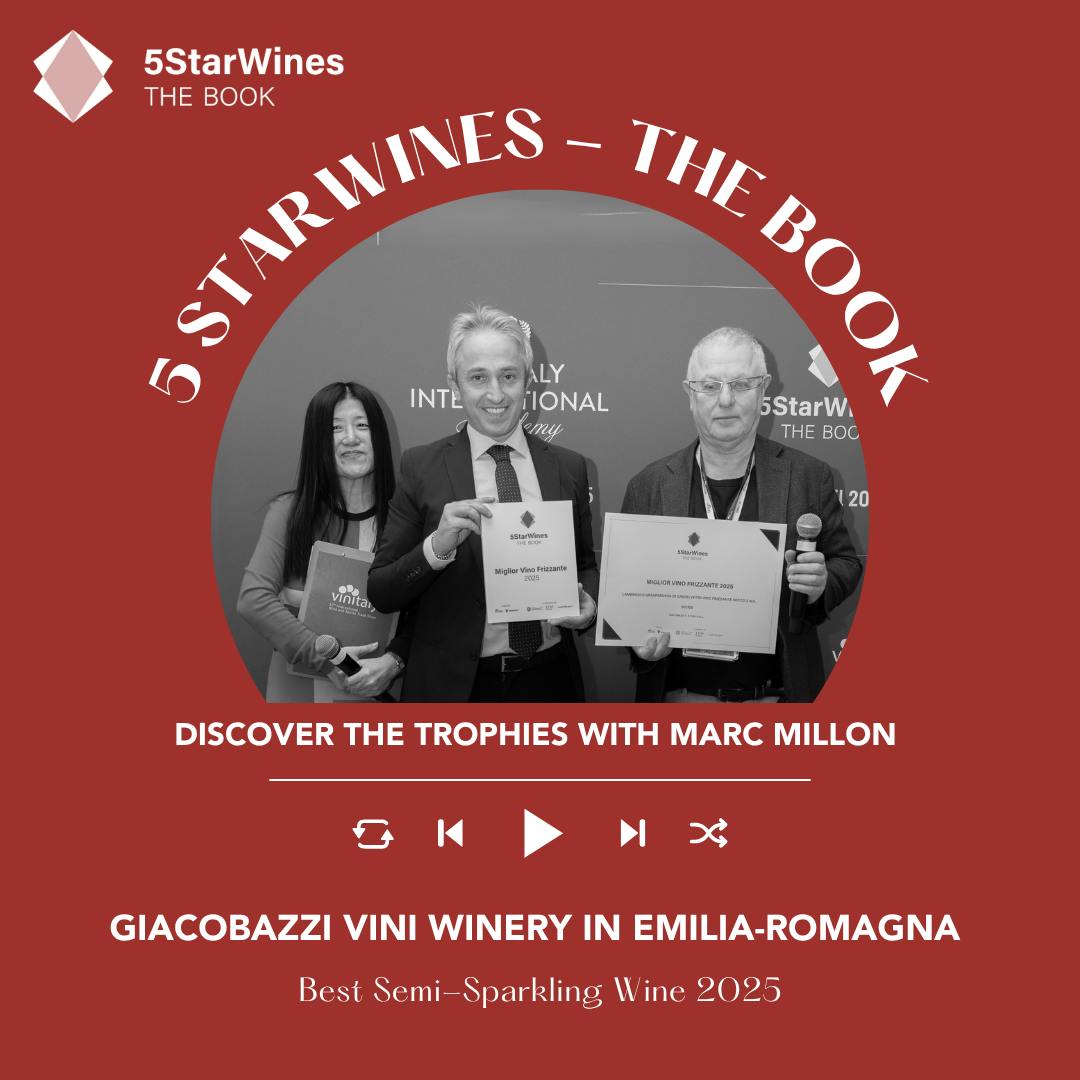
Ep. 2429 Giovanni Giacobazzi from Giacobazzi Vini Winery in Emilia - Romagna | Wine, Food & Travel with Marc Millon (5StarWines - the Book 2025 Series)
Wine, Food & Travel with Marc Millon (5StarWines - the Book 2025 Series)
Episode Summary
Content Analysis Key Themes and Main Ideas 1. The Jacobacci winery's history and its pioneering role in exporting Lambrusco. 2. The award-winning Lambrusco Grasparosa di Castelvetro DOC Frizzante Secco Numero Due. 3. The diverse varieties of Lambrusco (Sorbara, Grasparosa) and their distinct characteristics. 4. Different production methods for sparkling wines (Martinotti, Metodo Classico, ancestral method). 5. Modena and Emilia-Romagna's rich gastronomic heritage and its complementary relationship with Lambrusco. 6. The versatility of Lambrusco as a food-pairing wine with local and international cuisines. 7. Wine tourism and hospitality offerings at the Jacobacci winery, including its historical and motorsport museum. Summary In this episode of the Italian Wine Podcast, host Mark Millen speaks with Giovanni Jacobacci of the Jacobacci winery in Modena, Emilia-Romagna, celebrating their Lambrusco Grasparosa di Castelvetro DOC Frizzante Secco Numero Due, which won ""Best Semi Sparkling Wine"" with 93 points. Giovanni details the wine's production, from hand-picking grapes in a small four-acre plot to its soft crushing and second fermentation, emphasizing its elegant berry notes. The conversation then broadens to discuss the diversity of Lambrusco, contrasting the delicate Lambrusco di Sorbara with the more robust Grasparosa, and explaining various sparkling wine production methods. Giovanni highlights Modena's rich cultural and culinary landscape, known for balsamic vinegar, Parmigiano Reggiano, and fast cars. He emphasizes Lambrusco's exceptional pairing ability with the region's rich cuisine, also noting its surprising compatibility with international dishes like sushi and spicy ethnic foods. Finally, Giovanni shares the Jacobacci winery's long history, including being among the first to export Lambrusco to the US in the 1960s, and details their unique hospitality offerings, including a historical museum and a collection of motorsport vehicles. Takeaways * Lambrusco Grasparosa di Castelvetro DOC Frizzante Secco Numero Due by Jacobacci winery is an award-winning example of high-quality semi-sparkling Lambrusco. * Lambrusco encompasses diverse styles, notably Lambrusco di Sorbara (elegant, acidic, pale) and Lambrusco Grasparosa (darker, fruitier, more structured). * Traditional and modern sparkling wine methods (ancestral, Martinotti, Metodo Classico) are employed for Lambrusco, impacting its style. * Modena and Emilia-Romagna are epicenters of Italian gastronomy, with Lambrusco being an ideal pairing for its rich, flavorful cuisine. * Lambrusco's acidity and freshness make it surprisingly versatile for pairing with a wide range of international cuisines, including sushi and spicy foods. * The Jacobacci winery has a significant history, including being a pioneer in introducing Lambrusco to the US market in the 1960s. * Wineries like Jacobacci offer comprehensive visitor experiences, combining wine tasting with local history and culture (e.g., museums, food pairings). Notable Quotes * ""This wine... is a wine we, in which we put a lot of care and attention. So we basically do the hand picking... The idea of this line is, to get the most correctness of grape."
About This Episode
Speaker 1 and Speaker 0 visit a small town in Modena, where they visit a small winery called Lambrusco. They discuss the history and characteristics of traditional Italian words, such as Lambrusco and Marabou, and the potential of traditional methods for creating wines. They also visit a historical winery and tour options, including a partnership with Tavari and a collection of wines. Speaker 1 thanks their audience for their visit and offers future episodes.
Transcript
Let's, turn to your award winning wine, your best semi sparkling wine, Lambrusco Grasporosa de castel Vethro Frisante seco numero Duwe. Can you tell us about this wine, explain how you make it, and what it's characteristics are. So this wine that comes from, it's made out of grapes that are grown in, the area between, trusted trunk and nonancala, which is a doc area for, big And, it's a very small, block. It's, just around four acres. And, this block was planted back ten years ago. The chocolate is the name of the wine. It's a wine we, in which we put a lot of care and attention. So we basically do the hand picking. And once the grapes are picking into the one hurry, we we put them down, thanks to refrigeration. And then we do a soft crushing and a mapping of the second fermentation. Fascinating people with stories to share. Fabulous wines and the best local foods to accompany them and beautiful places to discover and visit. All of this and more on wine food and travel with me, Mark Millen, on the Italian wine podcast. Join me for a new episode every Tuesday. Welcome to wine food and travel with Me more Millan on Italian wine podcast. Today, I'm delighted to continue a special subseries that highlights the winners of the prestigious five star wines competition that took place in April just prior to Vinitalee twenty twenty five. Those wines that scored more than ninety points were awarded certificates and have been included in the five star wines book, while the very best wines in each category were singled out for special awards. Today, we traveled two emilia romagna to the vineyards of modena to Nona to meet my guest Giovanni Jacobati of the Jacobati winery, who's wine, Lambrusco Grasparos, Sadi Castel Betro, d o c, Frizante Saco Numeiro d o e, won the best semi sparkling wine award with a score of ninety three points. This is a great achievement. So many congratulations, Giovanni. How are you today? I'm guessing it's a pretty hot day in Modena? Yes. First of all, hello. Thank you for this opportunity. And yesterday is a very hot day. So we are back with a normal weather, and I think it should be summer. We had chilled out a bit last week and it's gonna rain again tomorrow. But so far, I don't see the weather is, very good for the, which is, coming out soon. Okay. So we are in the Po valley. And as you say, it's normally pretty steamy there in summer, I guess. Now, Giovanni Modena is known for many things for wonderful foods, of course, for a Cheeto bassamico. For fast cars like Ferrari and Maserati, for Luchano pavarotti and Mirlla Freni, and not least for a wonderful wine much loved around the world, Lambrusco. But our listeners who are located all around the world, may not know your area well. Can you tell us a little bit about Modena, about the wine country of Nanantola, where you're located? Just give us a visual description of where you are and of Modena. Sure. So moderna is located in the northern part of Italy. It's, basically, between the Alps and the Athens. So it's a valley that, is very well known as you said for very fine foods. So it's considered the most refined cuisine area of Italy. And, for business was fast cars. And you mentioned Navarati. I could mention also the figurine speakers, which, named Panini, Another, very iconic things that comes from the atmosphere. So it's a small city with a lot of things, that brings, by the way, a lot of tourists, the blocks. So we're gonna have to see, we're gonna have the mountain, but still we have considered one of the day. Interesting cities will be visible in Italy. Okay. And of course, the Po valley, as you say, it's, a broad fertile valley that is really the source of so many wonderful things to eat as well as drink, and we'll be discussing perhaps on the local gastronomy a little bit later in our chat. But first of all, can you share with us the story of the Jacobati winery? Yes. The Jacobati winery was established by my father and my grandfather together with my uncle back in nineteen fifty eight. It was, well, before, by the way, that the activity of great growers and farmers started in our family. In fact, we have been introducing also by Samid Wiliga, which we still do. And, Thomas and cheese, and we had some cattles, especially pizza. But then the wine became our main activity. And as I said, back in nineteen fifty eight, my card, my uncle and my grandfather decided establish a a proper winery that we changed to the, I can say when we're non winery or what on the world, especially very located to export. We were the first winery is exporting to US in, in the sixties. And, we try to make Lambrusco popular all over the world basically. So this is, what is moving us to to one. Okay. So that's interesting that you were one of the, you were the earliest to export. To the US, and in the sixties. And that was when the real Lambrusco boom began. Is that right? It was a very important for the wine growers in Baudana and Regio Media in in the areas where Lambrusco's produced, but you've been part of the this incredible story of Lambrusco really conquering the world. Honestly, yes. I I I think that that my dad was probably the first one bringing Lambrusco to US. It was back in the nineteen sixty four. When he flew to New York and went to the ICE office to the island trade agency, trying to see if there was any opportunity to the response from the board of, it wasn't very good, but my father has always been very stubborn and very determined to do what he was in in his head. So he always spent, like, the most with the one that people lost while he shouldn't have heard and love it as well. So he kept going no matter what they said, and they was able to really open a a market that then after a few years became a huge market where, most of them are multiple producers, were was selling their wines. Okay. So this incredible popularity of a wine that was really very traditional in your area, very traditional, very well suited to your great regional cuisine. But, of course, Lambruschko isn't one wine or one grape variety there. A number of different Lambruschke. Can you tell us about the two varieties that you specialize in, perhaps, beginning with, and then, what are the qualities that each have? And and and how do the wines differ? Yes. Basically comes from the valley, and nearby the city of Modena, and it's a female grape, which has a very thin skin, white pulpit, and is well known for the elegance of the wine for the acidity. In fact, is ideal also for butter fermenting lines, eventually even, qualification, the signal model. And, Mbrusco de Casa, mikastel Delta, which is the other BOC that you mentioned, comes basically from the his nearby moderna. Is, very different from La Musco de Solvara because it has a very dark color, a thick body, persistent foam, and it's very fruity, more powerful. It's, more rounded. So even though they are both from Bruceco, they are very different one to each other. Okay. So I think that's important for our listeners to understand. Lambrusco is not wine of one style at all, and the different varieties, are making completely different wines. Lambrusco di sorbara, this pale pink, Lambrusco, the acidity making it so such a good partner to foods, and then that deeper color, the the more fuller style of the Grasporosa di Castel Vethro. Giovanni, you mentioned that, the Sabara is suited to fermentation in the bottle. You make wines by both the Martinotti method as well as by the Mato classico. Tell us a little bit about secondary fermentation in the bottle. Lambrusco is almost always either a Fritzante or a fully sparkling wine. Is that correct? It is correct. And as you mentioned, obviously, back to the origin of Lambruschke was bottle fermented. And, as it was bottle fermented, the target to the ancestral method, which means, half of the the beasts and the settlements inside the bottle, so we had a cloudy wine or rust him or, eventually, authentic. And, the Metro market note is the one that we use the most, which is, basically, the same method that Proseco uses. It's from the auto class. So there's a second fermentation, none, after adding selected East, which is taken into these autoclots under controlled pressure and temperature. Why the Metoduo classical is the same the Chantinoise, the recording branch is, I would say the newest page of Lambrusco, especially we've been introducing this, technique back, I would say it now almost twenty years. And, we also, do a bottle fermented, Lamrozco, a method of classical, what we do like unification. What I think is important to say that for this bottle fermented, lambrusco, the Lambrusco de Solvara grape, according to our experience, is the one that has the highest potential. As you said, because of the acidity, because of, the low tournaments, because the thin skin, so it's very suitable for, long aging into the bottoms after the second presentation. Okay. Where is the Martinotti method keeps that freshness and, and the fruit more. Is that right? Is that right, then if you keep longer, make it not be method, you can also have, send some lists of bread crust the same as you may have, but it's been a higher notes in the bottom for the wines. But if you guys Okay. You go for crispy wines, fresh wines, friendly wine absorption. Let's, turn to your award winning wine, your best semi sparkling wine, Frisante seco numero Duwe. Can you tell us about this wine, explain how you make it, and what its characteristics are? So this wine that comes from, and it's made out of grapes. That they'll go in, the area between, past the trunk and nonancola, which is a DOC area for, Because Pawlsa. And, it's a very small plot. It's, just around for that And, this dog was planted back ten years ago. The chocolate is the name of the wine. It's a wine that, we, in which we put a lot of care and attention. So we hesitate with the hand picking. And once the grapes are picking into the winery, we we put them down, thanks to refrigeration. And then we do a soft crushing and a mapping of the second fermentation. So the idea of this line is, to get the most correctness of breath. That was, when you can get to typically, the the strawberry, the blue battery, a sour cherry also, which are typical notes of the and, we try not to have that much of the somehow, also very elegant and very refined because, we believe that does colorize also. A lot of things to tell beside the power beside the structure. So we we try to add a lot more than protein notes and Yeah. I'll just, read the judge's tasting note. This one, as I say, received ninety three points, which is a very high score, a decidedly serious Lambrusco. This beautiful deep ruby red wine has a very smooth, purlage, and typical notes of blackberries and black currant. Very well balanced structure and a long finish. Would you say that's a fair description? That's say it, just for a fact that it's, definitely. Okay. And as I as I mentioned at the beginning, Emilia Romania is truly one of Italy's greatest food regions and modena in particular is very much food city. A place people come to enjoy the local foods, paired with this wonderful fresh Lambrusco, which tastes so wonderful when you're actually in the region. Let's turn to the gastronomy of your area. And in particular, some of the local dishes or foods, you've mentioned parmigiano Regiano, of course, and there's so many salumi that pair particularly well with Lambrowski, and, in particular, with the Grasparosa de Castel that draw. Yes. It's correct. Then, it depends basically on what you are looking for and, what your path is used to I have friends that love the Salvara. I have friends that love the Rosparosa. And, especially I believe that both wines are ideal to be paired with local foods. Eventually, in the city of Modena, and in the valley of Modena, we're more used to the sovada, why if you go just a little bit towards south of the province nearby the hills, then the mood is more for drosparasha. In the end, again, both wines are ideal for R cuisine because they have this nice acidity which helps to clean the mouth after having, our food, which is typically a very flavorful food. Sometimes it's a pet food because it comes from the picture. You can imagine like Lazzane, and so this wine, which is very, very light, very gentle with this nice acidity, this nice, fruiting also helps me to keep a nice balance into the mouth while we're not having no other local food. By the way, we we drink Solvada also, and I said Solvada, even abroad, and we had it with so many kind of, you know, of food. So especially fishery, she wouldn't tell. But the like the salad that were out of, restaurants to Japan where they love it. We do it with sushi or with fish soups, because it's a very easy part. That's really interesting that, this style of wine pairs so well with many different types of cuisines. So sushi with sobarra, I can imagine that's very, a very, very good pairing. What about with the any other cuisines that are suited to pairing with Yes. For sure. Gracparosa, I see that it is very well appreciated even with, ethnic food, especially if it is a spicy food or sweet and sour, more structured food, are ideal to prepare with Drasparosa because it also has this body, this thickness that, supports this type of foods, but at the same time, has a very nice acidity. If you wouldn't tell me, but when the drink goes, I will say don't worry if you're gonna see this device there. And you find the very end of your tasting with this a rinsing that you have in your mouth. Okay. So this deeply colored foaming red wine with this beautiful backbone of acidity. Yes. I I think it's such a such a great great food wine. Whatever one is choosing to eat Giovanni finally, let's just turn to wine hospitality. I know, as you say, modern as a city that's very popular with tourists, can people visit the Jacobotsi winery, and what do you offer for wine visitors? Yeah. Sure. We have, now a historical winery that is located in the heart of New Antola. Our headquarter where, people can come. Obviously, visit the winery and see how we do this our wines, but most of all, we watch have a nice museum where we have, more of the tours ornaments. I would say the most important tours of our heritage, which goes back, almost one hundred years because that building was established in, nineteen twenty nine. So people can compare, the way of producing wine back, in the beginning of last centuries and nowadays. Besides that, we do have a nice part in our museum that belongs to motorsports because we have been partners of Tavari, especially for many, many years. So we have our collections of, both formula one cars and, streetcars are mostly from Tavari, but we also have a couple of maserati. And, some other nice things that that people can see when it comes to visit us. Obviously, the hospitality area where we can take our wines. We can serve some good food from the area. In order to give a three sixty idea of, what's, moderna. And is the family still making, H. H. To Balsamico Thradeets' unitedy moderna? Yes. We do. Yes. We still do that. So, again, that's something visitors could, taste and buy. Yes. For sure. We do sell our balsamic vinegar in our shop, and they can either, definitely taste it. And, in fact, one of the most appreciated tours, ends with, some bites of, parmesan cheese, a chance with, a stomach vinegar, obviously the traditional other one, which might be even the regular traditional that is twelve years old minimum or the extra active. That is made from twenty five years old. And, obviously, one. So Well, Giovanni, thank you very much for telling us about Modena, about the nonantel, and the the the joke about story of the family history of producing Lambruschke and sharing with us what the region has to offer. It's been a pleasure meeting you here this morning, and I hope you have a great summer Thank you so much, ma'am. The pleasure was mine. Thank you for giving me this opportunity, which is always a very important to us, you know, the family wanna rely. That covers us. It's very important to us being able to reach people and tell them hours or so. Thank you. Thank you. Thank you. Bye bye. We hope today's episode of wine food and travel with me, Mark Milum, on the Italian wine podcast, has transported you to somewhere special. Please remember to like share and subscribe, wherever you get your pods. Likewise, you can visit us at Italian wine podcast dot com. Until next time, Chincin.
Episode Details
Keywords
Related Episodes

Ep. 2791 Italian Wine in a Changing Climate: PIWI, Terroir & Tradition with Nicola Biasi | Wine, Food & Travel with Marc Millon
Episode 2791
Ep. 2767 Le Marche: Verdicchio and the Wines that Shape the Region with Gianluca Garofoli of Garofoli Vini | Wine, Food & Travel with Marc Millon
Episode 2767
Ep. 2755 The Longest Table: Honoring Nello Ghezzo’s legacy | Wine, Food & Travel with Marc Millon
Episode 2755

Ep. 2681 Giro d’Italia 2026 Special Episode 1: From Bulgaria to the Mezzogiorno in search of wine and cheese | Wine, Food & Travel with Marc Millon
Episode 2681

Ep. 2675 Tuscany Wine Revolution, Barolo Boys & the Rise of Etna Wines with Marco De Grazia | Wine, Food & Travel with Marc Millon
Episode 2675

Ep. 2658 Ferraro's Ristorante: Building an Italian Food & Wine Empire in Las Vegas with Gino Ferraro | Wine, Food & Travel with Marc Millon
Episode 2658