

Ep 2358 Giro D'Italia 2025 Between Wine And Food Part 2 | Wine, Food & Travel with Marc Millon
Wine, Food & Travel with Marc Millon
Episode Summary
Content Analysis Key Themes and Main Ideas 1. The intersection of professional cycling (Giro d'Italia) with Italian gastronomy, wine, and travel. 2. A detailed culinary and enological journey through various Italian regions, following the Giro d'Italia's route. 3. Highlighting specific regional foods, traditional dishes, and local wine pairings for each stage. 4. The diverse landscapes and cultural nuances of Italy, from its deep south to northern borders. 5. The excitement and challenges of the Giro d'Italia race, including rider performances and general classification changes. Summary In this episode of the Italian Wine Podcast, Mark Millen continues his ""gastronomic Giro d'Italia 2025,"" detailing his virtual journey through the second week of the renowned cycling race. Following the Giro's path from Albania across Italy's varied terrain, Millen uses each stage as an opportunity to explore the local food and wine of the regions it traverses. He vividly describes specific dishes like ""Anguilla in umido"" from Tuscany, Parmigiano Reggiano and Lambrusco from Reggio Emilia, pumpkin tortelli from Lombardy, ""Baccalà a la Vicentina"" from Veneto, and ""Jota"" soup from Friuli-Venezia Giulia. Millen also suggests precise wine pairings, often highlighting native grape varieties and regional producers. Beyond the culinary focus, he provides updates on the Giro's dramatic first week, discussing stage victories, jersey changes, and the general classification, illustrating how the race unfolds amidst Italy's rich cultural backdrop. The narrative emphasizes the intimate connection between Italy's geography, its people, its culinary traditions, and its wines, even touching upon ""borderless"" wine regions shared with neighboring countries. Takeaways * The Giro d'Italia provides a unique framework for exploring Italy's diverse regional cuisines and wines. * Many Italian regions boast distinct traditional dishes and local wine pairings. * Eel is a nutritious and versatile fish, often prepared in traditional Italian stews. * Modena and Reggio Emilia are epicenters for Italian culinary staples like Balsamic Vinegar, Parmigiano Reggiano, and Lambrusco. * The Alto Adige and Friuli-Venezia Giulia regions showcase unique wines and cuisines influenced by their border locations. * Grappa and digestivos are traditional Italian post-meal drinks, especially in mountain regions. Notable Quotes * ""Fascinating people with stories to share. Fabulous wines and the best local foods to accompany them. And beautiful places to discover and visit. All of this and more on wine, food, and travel with me, Mark Millen, on the Italian wine podcast."
About This Episode
The Italian wine tasting race for the Italian wine and food tasting race is a three-week race with a total of 2,250 meter long, including a total of 2,250 meters of climbing. The race is a cyclical and technical skills' race, and the race is still a bit of a course that requires great technical skill to shave mere seconds off by choosing the best line and the ability to ride the entire duration at the maximum power that can be sustained and still be able to stand up straight at the finish. The speaker discusses various climbs and wine stages in Italy, including a famous dish from Pal automatt, Valvopara Vespayolo, and a wine called Valvopara Vespayolo, as well as a route to a wine destination and a vintage restaurant called Valvopara Vespayolo. The speaker concludes by reminding viewers to subscribe to their podcast and visit their website.
Transcript
Today's ride finishes in Pisa's Piazza de Miracole, beside its famous leaning tower. Pisa is on the Tuscan Seaboard, and I'm looking forward to enjoying a piece and dish I first sampled many years ago, Anguella in Omido, eel from the arno, slow stewed in tomatoes and wine. Eel is actually a very delicious and easy fish to eat as it has cartilage rather than bones, and its oily richness is very nutritious, for the riders to prepare and fortify themselves for the immense challenges that still lie ahead. Fascinating people with stories to share. Fabulous wines and the best local foods to accompany them. And beautiful places to discover and visit. All of this and more on wine, food, and travel with me, Mark Millen, on the Italian wine podcast. Join me for a new episode every Tuesday. Welcome to wine food and travel with me Mark Minen on Italian wine podcast. My gastronomic Jira D' Italian twenty twenty five continues as the race recommences for its second week after yesterday's rest day. The stage race started nine days ago in the country of Albania, then crossed the Adriatic to Italy's deep south to Pulia, up through Vasiliicata, to Campania, across to ABruzzo, and into the central Italian regions of La Marque, Umbria, and Tuscany. This first week has already brought excitement, spills, and thrills. Who would have thought that the dane, mad Pedderson of the Little Trek team would have been wearing the Malia Rosa or Pink Jersey for much of the week, having won two stages. Primos Roglich briefly claimed it on the second day after the individual Tom trial Mads wasn't ready to relinquish it and snatched it back with his second victory in Albania holding on to it until the first mountain top finish in Obruso on the high slopes of Tania Kotso. Though the young Spaniard, Juan Ayuzo stretched his legs and won that climb to claim the stage victory, it was Roglice who grabbed back the pink jersey. He only kept it for another single day though for Diego Olisie an Italian from Tuscany managed to break away in Le Marque and hold out against a chasing Peloton to claim the coveted Jersey, bringing great joy to the home nation. And then there was a dramatic final stage of the week from Gubio to Sienna. Which saw just about everything, crashes and punctures to the leading GC contenders, skilled and bravery to take on the dry slippery and steeps, rade Bianke of Tuscany, finishing with a cruel, uphill Salita into the famous Piazza Delcampo. Wout Van Erritt, a Belgium rider known for his combativity, managed to just about hang on to the wheel of Isaac Deltoro, empting the tank completely then slipping out to snatch the stage victory in the most dramatic and exciting manner. But for Deltoro, the prize was to take the pink jersey. So after nine stages of racing, A look at the GC general classification leaderboard shows how much there is still to play for. Deltoro is in pink, one a yuzo at one thirteen back from the Malia Rosa. The Italian darling giulio Chicone at one minute forty one. The British Yates twins at one forty two, Simon, and two zero one, Adam, and Primos Roglich the favorite, now languishing back at two twenty five. All of this can and will change in the coming days, which is what makes this three week marathon that crosses all of Italy over all its glorious and varied terrain so very exciting. Med's pedersen, meanwhile, retains this cyclamen jersey while Lorenzo Fortonato is proudly wearing the blue jersey, the Malia Azura for the king of the mountains. So lots of excitement during the first week. And much, much more to come in the final two. I can't wait. Here's what I'll be eating and drinking. Day ten, Luca Topiza, twenty eight point six kilometers, one hundred and fifty meters of climbing. An individual time trial, the race against the clock, or race of truth as it is also called requires maximum effort. Nothing else will do. There is little altitude to negotiate on this short run from Luca to Piza. This is still a course that requires great technical skill to shave mere seconds off by choosing the best line, and the ability to ride the entire duration at the maximum power that can be sustained and still be able to stand up straight at the finish. Today's ride finishes in Pisa's Piazza de Miracole, beside its famous leaning tower. Pisa is on the Tuscan Seaboard, and I'm looking forward to enjoying a piece and dish I first sampled many years ago, Anguilla in umido, eel from the arno, slow stewed in tomatoes and wine. Eal is actually a very delicious and easy fish to eat as it has cartilage rather than bones, and its oily richness is very nutritious for the riders to prepare and fortify themselves for the immense challenges that still lie ahead. Eel is rich enough to stand up to pairing with red wine too. So I'm going to suggest that we share a bottle of badia de marronas, vigna Alta, Teri Pisa, DOC, a beautifully balanced one hundred percent Sangiovese, that is a flagship of this former monastic estate located in the wine hills between Tiese and volterra. Day eleven, Viergejo to Castellnuva Nemonte one hundred and eighty six kilometers with three thousand eight hundred fifty meters of climbing. The passage northwards from the Tusan seaboard at Virgo into the province of Regio Amelia in Aminia, entails crossing the Tuscan a million of pennines, which, by no means, the highest mountains in Italy, can nonetheless be absolutely brutal, with one category one ascent, a san pellegrino in Alpe that features a gradient that rears up to twenty percent or one in five, the steepest stretch of the entire judo. Once that mountain top summit has been breached, the route continues over twisting mountain roads and further up ups and downs before reaching Castel Nuevo Nementi, which, as its name suggests, is nestled in the folds of the foothills of the Appenini. After the rigors of yesterday's individual time trial, the major protagonists may well be content to let a breakaway form. Presenting no direct threat to GC leaders to escape from the main bunch. We will see. What to eat? What to drink then? Personally, I've always been someone who prefers savory to sweet for breakfast. So I might just slip in a sneaky bowl of the famous fish stew or soup of before jumping on my virtual bicycle to follow the Peloton over the mountains. Castelnuventi is a gateway to one of Italy's richest gastronomic provinces. Reggio Amelia, famous for Parmigiano, cured salumi, traditional at Cheto Baso. Yes. The real thing comes from here, as well as Modana. And one of the Italy's best loved if sometimes misunderstood wines, Lambrusco. I'm looking forward to snacking on chunks of fresh twenty four month old parmigiano regiano, a torta Fritea with prosciutto to eat with the hands. And then perhaps a big slice of Erbazone. A typical savory pie made here in the mountains with wild herbs, as well as with vegetables such as spinach and chard, washed down with a lightly foaming, raspingly bone dry, tumbler or two of Lambrusco Regiano from medici Armette, the lively and fresh acidity and deep blackberry fruit invigorating after a day spent crossing the mountains. And to finish, since we're in the mountains where the art of home distilling continues, I might just have a taut, but only one mind of homemade nochino made from green walnuts infused in alcohol and sugar, a traditional digestivo, after meals. Day twelve, Modena, to Viedana, one hundred and seventy two kilometers with one thousand seven hundred meters of ascent, a not entirely flat route, that leaves the ancient Roman via Emilia at Modana to head over the wine hills where different varieties of Lambroos could have cultivated before descending once again to the Pianora Padana. The broad and fertile Po valley that is a source of so many outstanding things to eat and drink. Today's final destination is actually on the northern side of the Po at Viedana, just into Lombardi. And it is a day that the sprinter's teams will be looking forward to. One of the few opportunities when they will be able to jockey for position in order to place their team leaders in the perfect position for the final eyeballs out sprint to the finish, a test of teamwork, technical precision, bravery, and sheer raw unadulterated power. Modena is, of course, one of the great food cities of Italy famous for its tortellini. Usually served in bravo. For its cured meats like prosciutto Dimodana and Zampone, a stuffed pig's foot. And for the genuine at Ceto Basamico Traditzianale Dimodana, D o p. The precious and very expensive condiment made simply by cooking down grape must then aging for years and even decades in a battery of barrels of decreasing size, each made from a different type of wood. Just a drop or two of this precious elixir on a nugget of age parmigiano arigiano, on Fior di latte gelato or on strawberries is a real treat indeed, something not to be missed. Regional boundaries, though sometimes seemingly arbitrary, do indeed mark transitions in cuisine too. When we cross the poem to Lombardi, the ricotta and spinach filling for the tortelli of Eminia Romania is in Vienna and Montua, replaced with a filling of cooked pumpkin, crumbled sweet amaretti biscuits, fruit mustard, and parmigiana Regiano. The stuffed pasta usually served bathed in melted butter and sage. I'm looking forward to talking into a big bowl of this favorite. Strangely sweet and savory at the same time, and will accompany him with a good few glasses of testarossa, me to do classical sparkling wine from the outstanding la versa cooperative winery in the Altripo paveze. It's produced from one hundred percent pinonero with secondary fermentation in the bottle with a minimum of sixty months aging on the lis prior to De Gore's mom, beautifully rich and complex and an ideal partner to the pumpkin ravioli. Day thirteen, Rodrigo to Vicenza, one hundred and eighty kilometers, worth one thousand six hundred meters of climbing. We are now in Veneto, the vast region that once was part of the Republic of Venice's terra firma Hinterland, where the gentle and mainly benign influence of the lion of Saint Mark is found in towns and cities across the region. Today's route appears flat, but it does have something of a sting in the tail, passing through the wine lands of Coli Barrici and through Vicenza, the beautiful city of Paladio, before making a further circuit that features a climb to Arcunyano, and a nasty finish that averages seven point one percent with a final ramp that rears up to twelve percent. The reward at the end, the plate of Vinchenza's most famous dish, Pakala a la vientina, Stockfish or air dried cod that has been reconstituted in several changes of water before slow cooking with onions, anchovies, and milk served always with a filling portion of polenta. The best wine to pair with Baqala, Olivia Chantina, my choice without doubt is Valvopara Vespayolo, from the acclaimed maculan winery in Bragance. The ripe yellow fruit balanced by a streak of fresh acidity that partners well with the richness of the baccala. Day fourteen, Treviso to Nova Corizio. One hundred and ninety five kilometers, one thousand one hundred meters of climbing. From the flat lowlands of vanita, the route now heads north into Frulivenezia, Julia, then crosses the border into Slovenia. Though mainly flat, there are a few bumps as it passes through the wine hills of Colio and Slovakia's Bernda before a fast, flat finish into Nova Gariza, which with Italian gorizia on the other side of the frontier is in two thousand twenty five, the combined European Cultural Capital Capital, the first transnational capital to receive this honor. Stage fourteen is they use designated wine stage, and it is fitting in a moment when the world should be taking down borders not constructing them that the route passes through the contiguous wine lands of Colio and Barda. Stunningly beautiful and both the store source of outstanding wines that pair with a richly complex and delicious cuisine that also reflects a cultural and historic crossroads where Italians, Levine, and Austro Hungarian influences all meet deliciously. I'm feasting this evening on a big bowl of Yota, usually considered mainly a winter dish But who cares? It's so delicious. I could eat it at any time of year. This thick and filling soup is made from beans, pork, sauerkraut, fermented turnips, and potatoes usually served with a Good dollar polenta alongside just to make sure it fills any gaps you might still have, an ideal restorative, to build strength for the mountain challenges that begin tomorrow. And in keeping with the borderless Europe on lands, not long ago divided, by an iron curtain, I'm heading to the Gradi Shouta winery where Robert Plincic has long understood and valued the deep affinities and relationships between Colio and Berna, where the Ebola and rebula Vines, reign supreme. His rebullion is a classic method sparkling wine made from ribula Jala, rebula grapes, grown on both sides of today's border between Italy and Slovenia. Truly a wine without frontiers. Day fifteen, from Fiume Veneto to Aziago, two hundred and nineteen kilometers, three thousand nine hundred meters of climbing. We're now on day fifteen. The last day of the second week before a rest day tomorrow, and at last, we have a proper mountain stage. The first half of the ride is mainly flat before reaching the charming town of bassano del grappa. And the twenty five kilometer ascent of the mighty Montegrappa. As often happens on reaching a summit, the road immediately plunges back down before a final second category ascent to Enego and Dori. And then a fine, well, mainly rolling twenty kilometers to the finish in Aziago. This is probably not a day that will give an opportunity for any of the leaders to put time between themselves and the competition. Rather a test of legs, a presage for the rigors of the mountains that will follow in week three. We are in the month of May, the brief season for one of the best annual treats that I always look out for if I find myself in Venator at this time, the Espargo Bianco Del bassano, D o p, the white asparagus that is cultivated on the sandy soils around bassano Del grandpa. The spears are thick, white, tender, and full of flavor, slightly bitter on the finish, and I think that they're absolutely unsurpassed. The classic local way to enjoy this seasonal treat is to gently boil asparagus, then serve with a thick sauce made from hard boiled eggs mashed by hand, sometimes table side theatrically with copious quantities of good local extra virgin olive oil. I'll pair this with a pinot bianco de Braganza from Bialto Bartolomeo. And after the asparagus, if I'm still feeling a bit peckish, I'll simply enjoy a slab of Aziago Mizzano, DOP cheese. One of my all time favorites, perhaps with a glass of pinot nero from the same winery. To finish, it would be rude not to have a taut of grappa from Basano del grappa. Maybe just a splash in my espresso to make a cafe Corletto. Stage fifteen marks the end of the second week with a rest day to follow. The race recommencing again on Tuesday, May twenty seventh. Stay tuned for my third, gastronomic in giro d'italia twenty twenty five installment that will give a preview to the final and often decisive week. We hope today's episode of wine, food, and travel with me, Mark Millen, on the Italian wine podcast, has transported you to somewhere special. Please remember to like, share, and subscribe, wherever you get your pods. Likewise, you can visit us at Italian wine podcast dot com. Until next time, Chincin.
Episode Details
Keywords
Related Episodes

Ep. 2791 Italian Wine in a Changing Climate: PIWI, Terroir & Tradition with Nicola Biasi | Wine, Food & Travel with Marc Millon
Episode 2791

Ep. 2784 The Other Side of Valpolicella: Volcanic Soils & Sparkling Wines with Francesca Marcato of Talestri Winery | Wine, Food & Travel with Marc Millon
Episode 2784

Ep. 2778 Bread of the Sea: The Story of the Anchovy with Sudi Pigott | Wine, Food & Travel with Marc Millon
Episode 2778

Ep. 2773 Trento DOC: one of Italy’s finest sparkling wines with Alessandra Caroni of Maso Martis | Wine, Food & Travel with Marc Millon
Episode 2773
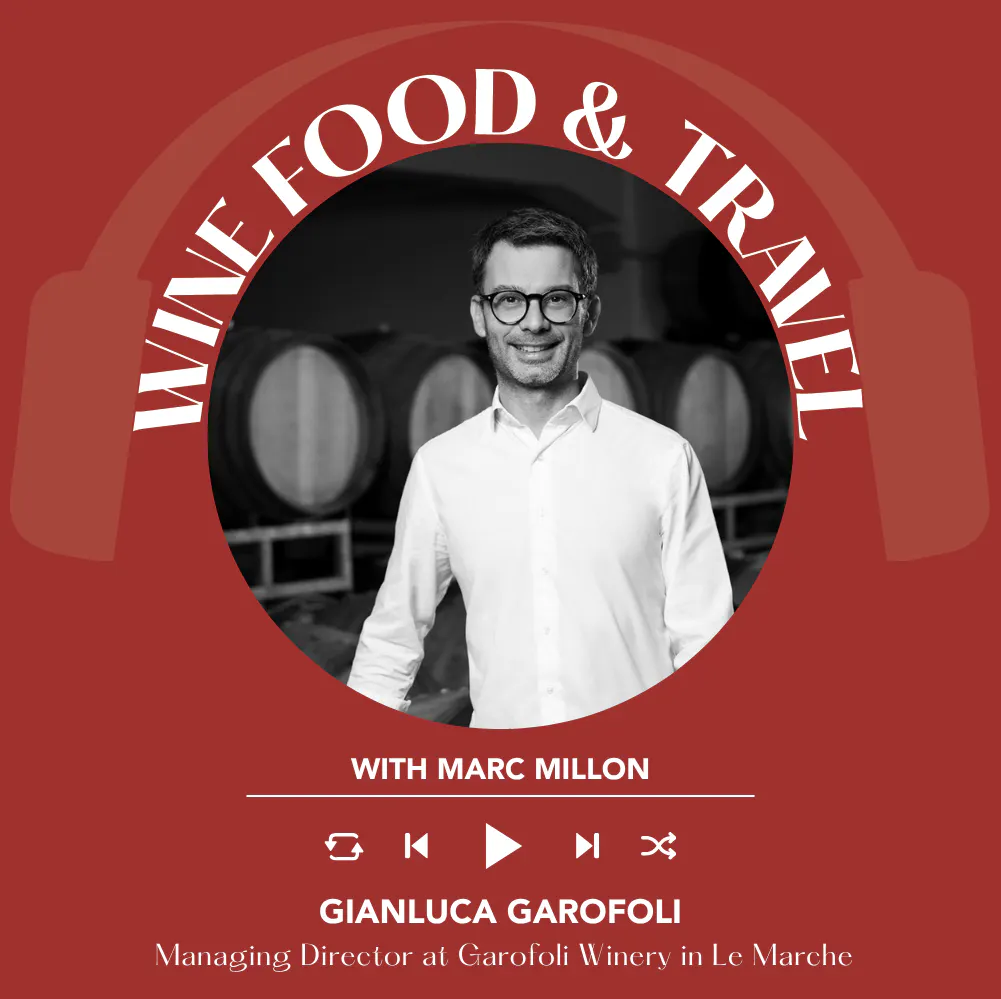
Ep. 2767 Le Marche: Verdicchio and the Wines that Shape the Region with Gianluca Garofoli of Garofoli Vini | Wine, Food & Travel with Marc Millon
Episode 2767
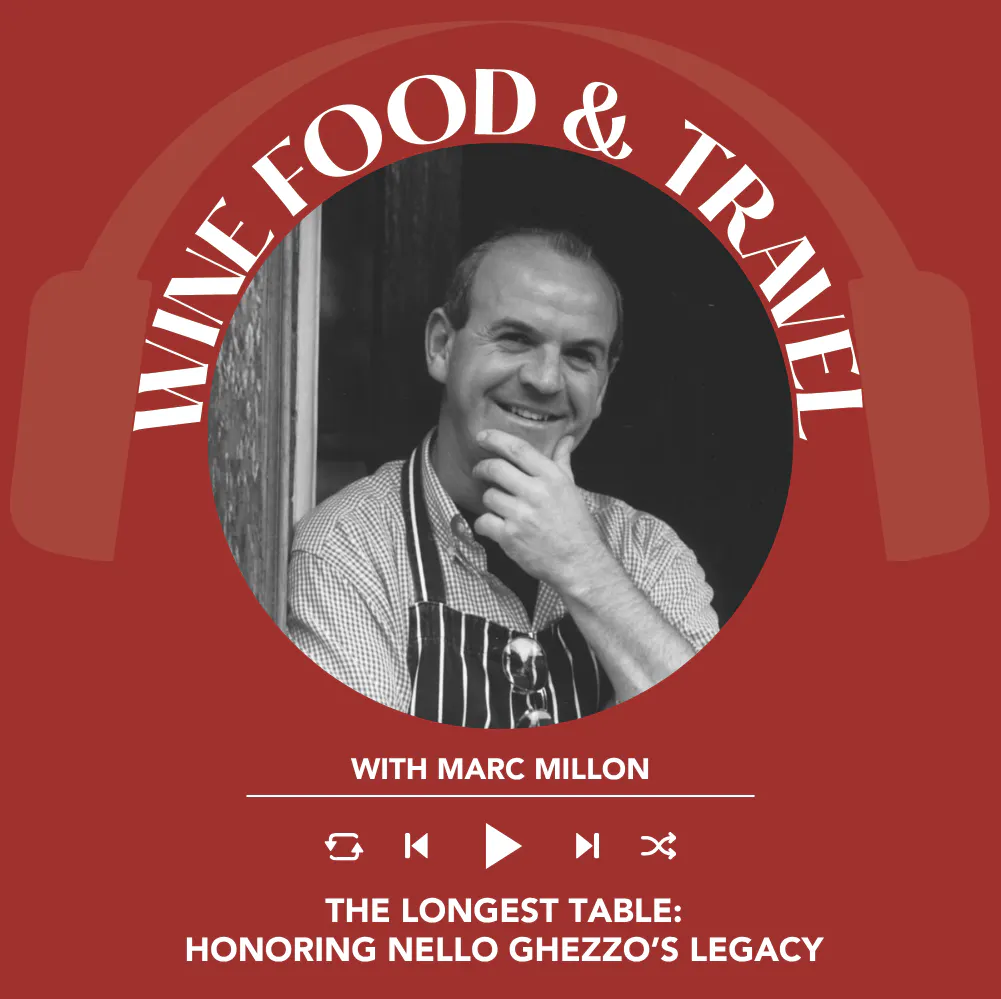
Ep. 2755 The Longest Table: Honoring Nello Ghezzo’s legacy | Wine, Food & Travel with Marc Millon
Episode 2755