
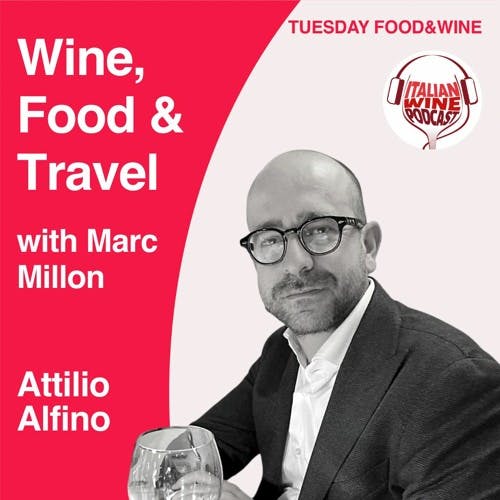
Ep. 1086 Attilio Alfino | Wine, Food & Travel With Marc Milon
Wine, Food & Travel
Episode Summary
Content Analysis Key Themes and Main Ideas 1. The unique geographical features and terroir of Abruzzo, Italy. 2. The pioneering role and growth of Macharelli winery in Abruzzo's wine industry. 3. The characteristics and versatility of Abruzzo's flagship wines: Trebiano d'Abruzzo and Montepulciano d'Abruzzo. 4. The challenges posed by climate change on viticulture in Abruzzo. 5. The rich culinary traditions and food-pairing culture of Abruzzo. 6. The cultural significance and evolving role of traditional structures like the Trabocchi. Summary In this episode of the Italian Wine Podcast, host Mark Millen interviews Artilio Alfino, the winemaker at Macharelli Tinut de Agriole in Abruzzo. The discussion begins with the challenges of the 2022 harvest, particularly due to climate change and rising temperatures, highlighting the importance of factors like snowfall and strategic rainfall. Alfino vividly describes Abruzzo's unique landscape, characterized by its close proximity of high mountains (Maiella, Gran Sasso) to the Adriatic Sea, creating distinct microclimates and beneficial sea breezes. He recounts the history of Macharelli winery, founded in 1981 by Jolarale, emphasizing its pioneering efforts in quality wine production, introducing techniques like high-density planting and barrel aging, and its subsequent growth to 300 hectares. The conversation delves into Abruzzo's two key wines: Trebiano d'Abruzzo, described as a ""shy"" wine with great longevity, and Montepulciano d'Abruzzo, hailed as the region's ""king,"" known for its versatility from easy-drinking to serious structured reds. Alfino also highlights Abruzzo's rich gastronomy, featuring dishes like *spaghetti alla chitarra*, the collective *minestrone* called *'scraparicce* for May 1st, and regional specialties like *Arrosticini* (lamb skewers) and *Brodetto* (fish soup), suggesting ideal wine pairings. He explains the traditional *Trabocchi*, old fishing machines now serving as tourist attractions and unique dining spots along the coast. The episode concludes with an invitation to listeners to visit Abruzzo and experience its wine, food, and culture firsthand. Takeaways * Abruzzo's unique geography, with mountains close to the sea, creates diverse microclimates ideal for viticulture. * Climate change significantly impacts viticulture in Abruzzo, necessitating adaptive strategies. * Macharelli winery was a pioneer in elevating the quality of Abruzzo wines since its founding in 1981. * Trebiano d'Abruzzo is a long-aging white wine with a ""shy"" character, distinct from other Trebiano varieties. * Montepulciano d'Abruzzo is a versatile red wine, considered the ""king"" of Abruzzo, capable of producing a wide range of styles. * Abruzzo boasts a rich gastronomic culture, including unique pasta (*spaghetti alla chitarra*), hearty stews, lamb dishes, and seafood, all pairing well with local wines. * Traditional fishing structures called *Trabocchi* have evolved into popular tourist and dining destinations along the Abruzzo coast. Notable Quotes * ""Every year gets more difficult and harder."
About This Episode
The Italian wine to wine business forum will feature all around wine communication, including challenges faced by vine growers due to climate change and increasing heat in the Italian wines industry. Speakers discuss their experiences with grapes, Northern Beech, Abruzzo reservations, and the history of their winery. They also talk about their vintage wines, including the Macharelli winery, which was one of the first to open a winery in Italy. The speakers explain the importance of theachian wines, pairing with other foods, and the use of artificial ingredients and fish brewing. They also mention a tour of the winery and encourage listeners to donate.
Transcript
Welcome to the Italian wine podcast. This episode has been brought to you by the wine to wine business forum twenty twenty two. This year, we'll mark the ninth edition of the forum to be held on November seventh and eighth of twenty twenty two. In Verona Italy, this year will be an explosively in person edition. The main theme of the event will be all around wine communication. And tickets are on sale now. The second early bird discount will be available until September eighteenth. For more information, please visit us at wine to wine dot net. Welcome to wine food and travel. With me, Mark Billen, on Italian wine podcast. Listen in as we journey to some of Italy's most beautiful places in the company of those who know them best. The families who grow grapes and make fabulous wines. Through their stories, we'll learn not just about their wines, but also about their ways of life, the local and regional foods and specialities that pair naturally with their wines. And the most beautiful places to visit. We have a wonderful journey of discovery ahead of us, and I hope you will join me. Welcome to wine food and travel with me, Mark Millen, on Italian wine podcast. Today, we travel to Abrutzel to Macharelli Tinut de Agriole, a company that has long been at the forefront of quality modern wine production in Abruso. My guest today is Artilio Alfino, the winemaker who joins me from the company headquarters. Thank you very much for meeting my guest today. How are you? Good morning, everyone. Thank you. Thank you. I'm really, really proud to to join you. And, we are good. We are good. We are, getting ready for this harvest. Twenty twenty two of vintage, which, looks as usual, more difficult than the last. Every year gets more difficult and harder. Well, I've always, big, big challenge. So, hang on. We move on. Yes. We were just talk chatting about that about how this climate change and the the increasing heat every year is making life very difficult for vine growers. That's, I mean, what's happening here, it's, it's really unique in in this, what we break all the records of, I think, Rachel on high altitude. So the biggest trouble we're having to start all the ice is, ice melting, and, actually working on a natural base. The situation is really, it's really bad as you can see, as we know, year, you know, talking about a person. What my experience is in this year, it's, it's not that bad because we were, we were quite lucky to have a little bit of rainfall. Talking for. I mean, one thing I really we really look forward just to know. Yeah. First week of March, we are in the San Martinez La Maruchina. One meter of snow. It was something was really was really a kind of a blessing for us because we had, that that's that's, that's something we we really want. That allows a moisture to penetrate deep into the land. Yeah. Yeah. It's a it's a kind of water. It's a kind of a nice storage of water for the for the soil. Plus during the growing season, we had a little bit of, we were lucky to have a little bit of, of rain. When all the region, they just saw the wind coming. I mean, they had a little bit of, the forecast said, yeah, and maybe it's gonna be a little bit more than they got nothing. Right. We were lucky to have some, some rain in the last week. We had, all over, but also, I mean, it's popped, it's popped a little bit, but something like thirty millimeters, which is, right now, for the multiple channels, something really, really remarkable on a vintage like this. Anyhow, we will see I mean, it's not. We we will back and say we, we are still a little bit lucky. Well, for our listeners, we're we're we're in a BRutso. I want them to have a picture of of the, brusso landscape. And you've mentioned the mountains, these great mountains, snow covered mountains, and, of course, the proximity of the Adriatic. It's a very special region in the south of Italy. Can you describe where you are and give our listeners a a picture of the Abruzzo countryside. What makes it unique as a wine growing area? Alright, man. Thank you. It's, Abruzzo is, what makes it unique is that it's my arrangement. So I love it. I've been traveling a lot. I've been, working overseas, for, for a few years. And then I when you go overseas, you realize how beautiful is our land, when you miss Yeah. And, and, that's that's the first figure I would say, but, this I mean, just traveling, you see how how how is it because it's really, it's a really hilly. They're the I mean, that they're talking about micros topically talking. It's a there are these big mountains, the Maiala, and the Grand SAS. So they are the highest some of the highest for sugar and such is the highest mountain in the Athens. And, the this mountains are really close to the scene. So talking about San Mateoza, which is just right above the Maiala range in thirty minutes, you are on top of the mountain. And then in twenty minutes, not even you are on the beach. Usually, may, for example, you can ski on the morning and then in the afternoon, you can be in the beach, on on a travel host, way, make, or fishing, you know. Amazing. It's a really concentrate, landscape, museum. Okay. Let's say it like this. It's, I mean, you you have everything you want. I mean, you you have a lot of years with different exposure, every year on the bottom as a as a creek. That's, really high richness of, in water because of the mountains. Then, one other thing that's really related with this vintage is that every I mean, we had this really long heat wave, but at night, we were lucky to have always twenty eighteen degrees. I mean, even if during the day, you have thirty five, thirty six degrees during the night, you you you you lower download the information. Is that because of the altitude or is that the the sea breezes? For sure. For sure because this convective, motion of the hair. It's all triggered by the sea and the month. This this is a sea breeze and, a herd breeze, you know. And then when they move, they they they they make, they they help a lot, they have a lot of the the wines and the agriculture. I mean, Abruse is a region. The agriculture in Abruse is really, it's, on demand, economy. And, just, I mean, I forgot to say, Abruse, is just on the other side of Rome. Okay? So it's we are in it it's in the center of Italy, and, it's a it's a it's a region where, Mashar Allen, the ninety eighty one founded this under the the winery. To show to the people what's what Abrusso is capable. Yes. It's a, it's forty years now since the Macharelli winery was founded, which is a, a, a, a huge amount has been done in that time. But it's interesting it's also relatively recent in a region where the vine has been cultivated for thousands of years. Tell us a story of the Macharale winery. Masharale founded in nineteen eighty one by Jolarale is a is a wire that is, for sure, make, Abruzzo known all over the world was one of the first, was one of the pioneer of, showing to the world what, what Abruzzo is capable of. And, oh, I mean, it started the first of all, believing in, in, in his region. And, as he stopped pushing, I really have the quality because, basically, I've also seen wine, these days were for the most based on, work fine. A lot of cooperative. Right now, about just still a land full of reaching cooperative that, you know, all these little mine rovers, been around, collaborate to work and, in discovery. But Johnny, said I want to I want to rise up the the quality and then start being a pioneer of this moment and, introducing a high density implantation for the vines I technology, the user of power, the use of a barrel for Montebuchan and Trebiano. And then, rising up the the quality in, the Willow ninety five was one of was the winder really made the change in the, in the panorama of Abuo and the center of Italy, Italy wine. There was a little bit of, flagship of the renaissance of, all the biodiversity. Of of the Italian wines because in Italy, we we all know how beautiful it is because it's it's so rich. A different variety, different wine, different land. So the idea is going to make to make as more as possible, the best. And, journey start, start with the villa Javerosa. Right now, the, right now, the the, that's Yanda, is, is guided by Harilas Vedish, our, she she's, she's, she's, she's, really, alive for us because she always have, great intuition. And, Marina, Maria's tradition, Miriam, Jara, and Moracadino, they're all working in the, in the, in the, in the, moved it forward. But, I mean, the the agenda in nineteen eighty one was two actors. Now it's three hundred actors, all over Abu. So Okay. In the four provinces. And the four provinces of Abruso. Plus, every provinces of winery where we crush the grapes as soon as possible from the picking. So that's, right now. And, that's, that's only the in few words, Are you enjoying this podcast? There's so much more high quality wine content available from mama jumbo shrimp. Check out our new wine study maps. Our books on Italian wine including Italian wine unplugged, the jumbo shrimp guy to Italian wine, sangiovese Lambrusco, and other stories, and much much more. On our website, mama jumbo shrimp dot com. Now back to the show. Well, let's talk about the jewels in the crown of a brusso wine. The two great wines and produced from the and, of course, a multi multiple chana da brusso from the multiple chana grapes. These are the jewels in the crown that have wines that are both white and red capable of achieving real greatness talk to us a little bit about about these two great wines. Well, Trebiano Trebiano is a is a great wine because it's a it's a really silent, wine. I mean, it's not really bullshit. It's, it's quite shy. Takes time to to show itself, and, has a really great longevity. This year, we we're celebrating the fifty year of the East to show up the DOC of Treviano da brusso. And, we, mister Ali. It makes, a lot of Treviano, the Treviano, the Charlie line plus we have the Turbiano Castalo, Desemivikoli, which is, which comes from the area close to the Castalo Desemivikoli, which is, in the town of Casa Canada, a really cold area. And we make this, Trebiano. It's really it's really pure. We'd, we make this wide from this, great. After our time of operation, we do a long pottery right now we're selling, two thousand nineteen. Is it primarily the Trebiano Abruczeze? Yes. Absolutely. Absolutely. Absolutely. So it's quite a different grape from, for example, Trebiano toscano, which people may have come across. It's, great with a massive character and potential for aging as well. Is, is a different attitude even on the ripening, on, in the minds that the Trebiano consists compared to the Trebiano Tostano. What the the the the the really, the eye difference, you see it on the future of what the Terbriana is capable of because this, freshness, this longevity comes more from the, from the, from that should offer the Trebana boots. We chose. It's a rare idea. It's it really holds their life a lot. The multiple channel is the head is, is, is the king. If the Trebiano is the queen, the multiple child is the king. Because In here, we have three other actors at eighty percent. Seventy percent is multiple channel. Is a is a variety that it's it's not really what's capable of. And, talking about our wines. I mean, we have the flagship, which is Villa Jamarosa. It comes from, San Martina from Davinia to Cabo. Plus, we have the Viscra, which is we come from the province of Teramo in the community of Concord. These are two examples of a premium multiple channel from the two different soil. We're talking about the clay sandy soil of Theramo compared to the majoring past of Samartino Salamoruchina, which is at four hundred meters of the sea level compared to the two hundred of, Tara. K. So a completely different character from the different terawatts. Two different things, two different artificial, the the multiple channel from, from, from Taramo. Usually, it's more spicy. The tannies are stronger, instead in, in a villa Chamaro. So as, is more grace. It's, it's, it's more, it's more I used to say more opulent. My I mean, it's more three-dimensional. It's a it's more fruity. It's more you know, it's a infrared expression more, more spicy on the animal in here. There is more food and more volume. I think it's really interesting to note for our listeners that, multiple channel, dubbed, can it's such a versatile line, and it can be you know, from an easy drinking wine to really serious full structured red wines that rank amongst the greatest in Italy. Yeah. Talking about the that down thing. Thanks. Because we're starting from the you know, a premium wine, we were talking about this, and we're talking about the the entry level wine, which is the linear class size that there is a is a kind of mind you're doing every day easily. It's, really approachable, satisfying. Plus there is, the the white version of, multiple channel, which is the Chera swallow, that is, is a is a wider. We, we, we, we, we believe a lot from here. I mean, the first in the age of, is a wine. He's a he's a wine. He's a he's a wine. He's a he's a wine that comes from multiple channel grapes. Then the juice is I mean, after the pandemic, we do a contact in, in the press to get more richness and color, and then we do the fermentation. And in, two months, three months, we bottle, I'm gonna release the villager much of as well. I'm gonna write. And he's a minor. It's you can pair it with anything. He's he's a really wonderful, he's a really wonderful way. Beautiful Rosato. Yeah. Cherra Swala, because he's a deep color. I mean, the color is more Deep deeper than, yep. Yeah. It's a it's a deep Chiller as well. It's a deep color. It's more close to the color. Chatter as well. It's closer to the cherry, to the ripe cherry. That's where the Chanos Wall name come from. But it's a it's a it's a one day. It's meaty, you know, when you when you when you when you drink it, you have a nice flash in the mouth. It's, it's, it's, it's, it's satisfying. I'm imagining that's a very all all all three wines are are very good food wines. Now I know at the Castelli, you offer, a range of wine, hospitality, as well as the vineyard around the Castillo, but also, lessons in cooking, and, and, the a which is a very rich cucina. Can we talk a little bit about the gastronomy of brusso and how it pairs well with your wines? Yeah. We have, up there, the approach, tradition on, on the kitchen. Really deep, just think that every house as is all the tradition on how to make the tomato sauce, you know, how to make the sauce. I mean, that's something really, really deep in the culture of, as of our roof season. Talk about the the the the pairing. In the in the Castalo de Semil, we usually do, we do this, kitchen session, cooking session with gas, they really enjoy, I really love making the pasta, which is, which is a pasta and made pasta. I mean, you have this dough, you foil it, and then when I roll in, you pass it. Through this guitar, which is a teacher tool. He used to make a, from this file on little spaghetti. That's why it's called spaghetti. Okay. So the the sheet of pastas rolled over the strings like a guitar, and it cuts it into the spaghetti. Exactly. That's that's a spaghetti. And that's something really, you know, with a with a fresh tomato sauce and basil is is something really simple. Nice for summer dining, like, now when it's hot. Yeah. Absolutely. Absolutely. Something. I mean, that's that's the one, that's, like, even though the other so region is also famous for their pasta culture as well. Another, another nice thing is, talking about removal of the beyond and off, we can talk about the which is, it's more, like, a moment on the life of a, you know, of a family in a group. So because at the end of, of the winter, you you checked on the, on the kitchen, you see what's left from the from the winter, you know, from what you stuck on the winter. So you get everything all the leftovers, like beans, like pasta, like everything, like tomato, you put everything, bread, and then you put everything inside this big minestrone that it's called, it's like how to use, correct, as more collective, the, let's say, leftovers, and he celebrated on the first of May. It's a really wonderful moment. It's a really wonderful dish because, you know, you can, you know, with a nice track piano. You're gonna you're gonna have fun. Sure. And I imagine there festivals like that throughout the region celebrating local produce, local wines. Yeah. Absolutely. Absolutely. And of course, this, link between in a brusso with the mountains. It's a region of of, of shepherds and sheep. Absolutely. I know that Shenan Zubaza still takes place up into the Grand Saazo. So the traditions of, of, the Arostichini, the the lamb ragu, these would be food to go beautifully with your multiple channel, the brutes. So Yeah. Absolutely. I mean, we move from the market. So we talk about the ship and, Rostigino, which is, maybe the whole ship and, for sure, the multiple channel. Is, is the is the king for this pairing. And, well, and then if we move to the coast, we reach, we reach the Atlantic Coast. We can talk about all the seafood we have on the coast. We can talk about the Prudetto, which is, more more mainly famous, the Prudetto La Vastezza, because they were, I mean, that's they have a long relationship. Even in San Vito, Marina, there is the Prudetto as it is about the still, the, actually, the the difference between the Broadetalabuses and the Broadetalazamides is more, close to what's in the soup or this Broadet, which is all different fish, cook, slow cook for a long time in, in a, you know, in a, like, it's a it's a really huge soap. You fit on the center of the table, and, I would wanna enjoy it. And then you can pair it, with a Chiraswala. Chiraswala in this situation is, is amazing. That sounds wonderful. And you mentioned, something earlier when we were talking. Can you explain what the tarabuki are? That's a, let's say, a way of, people living on the coast to get more fish as possible. Okay? I'm talking to the Traabuki family. They are they they come from, maybe, you know, in Sanrito, Maria. Okay. So they would be making these platforms that extend over the sea in order to fish. Exactly. So the people living on the coast, they couldn't get as more as fishes call because they work with it. They couldn't afford a boat or a fishing boat to get that. So, as of the confirmation of the coast, because it's really deep, they start building this trapokie. So the trapokka is a fishing machine, that goes towards the beach towards the sun, towards the sea. That's this to antenna this poles that with a net. So you lower down the net on the sea level, on the bottom of the sea. And the trouble can't, which is, the, the owner of, this, the trouble, the fisherman that, use the trouble can't stay in the rain wait for the school of fish to come through. Usually, they even put some bait inside the net, you know, to let the fish go inside. And, so they wait the the fish to come. And then when the school of fish comes, they rise this, they rise the net. And the fish days inside. And this was a really profitable way of, of fishing. Right now, you know, the stress also the sea, and it's not it's not, it's not really use as a fishing machine. It's more used for now right now. It's more a touristic, point. You know, it's used for a giant, the, the, the legacies of, of, you know, People loves it. Now it's rising a lot. So you can come in now and see how it was done, but just enjoy dining maybe on a trabuco. Exactly. You can have a you can buy what's available. It's it's really nice. Yeah. Yeah. Yeah. I've I've not seen it, but I've read about it, so it's something I really want to do. You must, Mark, please. It's a very strong demand. Yes. Well, Brutso is not a region. I know well. And it's one I've I I need to visit more and, and find out more. So I look forward very much to coming to Abruso and to coming to the Macharelli winery. Beautiful. It will be our pleasure to have you. Well, I tell you, it's been a great pleasure for me to to speak with you this morning. I think you've given our listeners a vivid picture of a wonderful region, the Macharale winery, and, the and, a small bit of information about a large range of wines at the Macharale winery, produces which are available around the world. So I urge our listeners to visit a brusso, and if they can't get here to seek out some bottles from the Macharale winery to enjoy a brusso in their glass. Thank you very much for being with us today, and I look forward to coming to a Bruce on meeting soon. Thank you. Thank you much. We're waiting for him. Thank you. We hope you enjoy today's episode brought to you by the wine to wine business forum twenty twenty two. This year, we'll mark the ninth edition of the forum to be held on November seventh and eighth twenty twenty two in verona Italy. Remember, the second early bird discount on tickets will be available until September eighteenth. For more information, please visit us at wine to wine dot net. Hi, guys. I'm Joy Livingston, and I am the producer of the Italian wine podcast. Thank you for listening. We are the only wine podcast that has been doing a daily show since the pandemic began. This is a labor of love and we are admitted to bringing you free content every day. Of course, this takes time and effort not to mention the cost of equipment, production, and editing. We would be grateful for your donations, suggestions, requests, and ideas. For more information on how to get in touch, go to Italian Wine s dot com.
Episode Details
Keywords
Related Episodes

Ep. 2791 Italian Wine in a Changing Climate: PIWI, Terroir & Tradition with Nicola Biasi | Wine, Food & Travel with Marc Millon
Episode 2791
Ep. 2767 Le Marche: Verdicchio and the Wines that Shape the Region with Gianluca Garofoli of Garofoli Vini | Wine, Food & Travel with Marc Millon
Episode 2767
Ep. 2755 The Longest Table: Honoring Nello Ghezzo’s legacy | Wine, Food & Travel with Marc Millon
Episode 2755

Ep. 2712 Exploring Brda: Exceptional Wines and Slovenia's Culinary Traditions with Lan Kristančič of Movia | Wine, Food & Travel with Marc Millon
Episode 2712

Ep. 2700 Sardinia Beyond the Coast: Agripunica, Basso Sulcis & the Legacy of Giacomo Tachis with Salvatore Santus | Wine, Food & Travel with Marc Millon
Episode 2700

Ep. 2681 Giro d’Italia 2026 Special Episode 1: From Bulgaria to the Mezzogiorno in search of wine and cheese | Wine, Food & Travel with Marc Millon
Episode 2681