
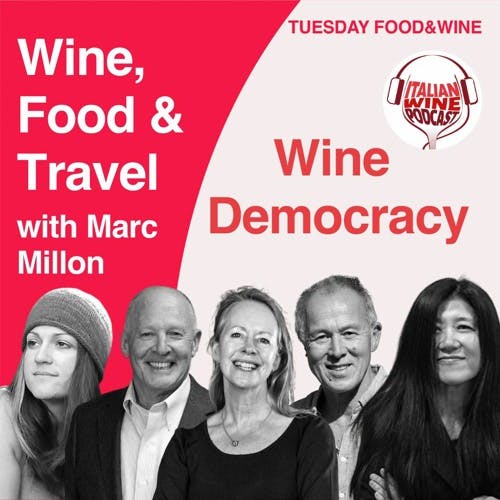
Ep. 1110 Podcasters Banter Session | Wine, Food & Travel With Marc Millon (Special Episode)
Wine, Food & Travel
Episode Summary
Content Analysis Key Themes and Main Ideas 1. The concept and definition of ""Wine Democracy"" as accessibility and inclusivity in the wine world. 2. The rationale behind publishing a physical book, ""Wine Democracy,"" in a predominantly digital content landscape. 3. The diverse and valuable content produced by the Italian Wine Podcast hosts. 4. Strategies for content distribution and audience engagement across various media platforms. 5. The role of technology, education, diversity, and tradition in democratizing the wine industry. Summary The Italian Wine Podcast team discusses their upcoming book, ""Wine Democracy,"" a compilation of insightful interviews from their various hosts. The core of the conversation revolves around the meaning of ""Wine Democracy,"" which they define as making the world of wine accessible to all, regardless of background, income, or status, and modernizing industry practices. Despite the digital nature of their podcast, the decision to publish a physical book is highlighted as a means to provide gravitas, showcase the hosts (""the mod squad""), and offer a tangible ""teaser"" of their extensive content. They emphasize that the podcast itself embodies ""wine democracy"" by providing free, valuable information. The discussion also touches upon how themes like technology, education, diversity, mentoring, and preserving traditions contribute to this democratization, aiming to break down barriers and open up discussions in a historically restrictive space. Takeaways - The Italian Wine Podcast is producing a book titled ""Wine Democracy,"" featuring selected interviews from its hosts. - ""Wine Democracy"" is fundamentally about making wine accessible and inclusive for everyone, irrespective of their background. - Publishing a physical book serves to add credibility and gravitas to the podcast's content and presenters. - The podcast itself is seen as a democratic tool, providing free, high-quality information and ideas. - Key areas contributing to ""wine democracy"" include technology, education, diversity, fostering mentorship, and preserving traditional wine-making cultures. - The book aims to serve as a comprehensive introduction and sampling of the broad topics covered by the Italian Wine Podcast. Notable Quotes - ""At its heart, it's a simple principle that the world of wine should accessible to all, regardless of income, status, background, or ethnicity."
About This Episode
The hosts of the Italian wine podcast discuss their upcoming edition, including a book on the topic of preserving vulnerable culture. They emphasize the importance of showing their face during the book and creating a lively experience. The podcast is a digital platform with a wide range of content, and the speakers emphasize the importance of protecting culture and language. The podcast is a chance for everyone to share ideas and tools, and it is a moment for everyone to acknowledge the team and everyone else.
Transcript
Welcome to the Italian wine podcast. This episode has been brought to you by the wine to wine business forum twenty twenty two. This year, we'll mark the ninth edition of the forum to be held on November seventh and eighth of twenty twenty two in Verona Italy. This year will be an exclusively in person edition. The main theme of the event will be all around wine communication. Tickets are on sale now. So for more information, please visit us at wine to wine dot net. Welcome to wine food and travel with Mark Milton. Today's episode is a little different in that it's a podcast banter session, introducing a new book, part of the mama jumbo shrimp series. It is called wine democker C, and it features all the Italian wine podcast hosts within its pages. Each host was asked to take some of their most thought provoking interviews and use them to talk about their understanding of democracy and wine. At its heart, it's a simple principle that the world of wine should accessible to all, regardless of income, status, background, or ethnicity. Often, it means the modernization of practices and habits as well. However, it is a concept that is also concerned with the preservation and protection of vulnerable ecosystems and fragile cultures. He will be available soon on Amazon or from our website. For more information, please visit italian wine podcast dot com. To be quite honest, I was thinking that every pod every podcast interview that you guys do can actually be a separate blog. Some of the interviews are unique, original, and terribly interesting, and there's a lot of value at. I thought why don't we actually get kind of the you know, the best of the best, from the top pods from each of you guys and turn them into a book. So at least the readers can have a kind of the looking feel of the different series that we present? I have one fundamental question. Why a book in my sense is people don't want physical things anymore, and we're talking about a digital platform and environment, which we're living. Why why are we printing a book? Why are you printing a book? Mean, I still believe in books. I write books, so it's what I do. But that was not meant as an insult mark. You know, I've I've kinda wondered myself why a book, but that's only because I look at it. I mean, I'm gonna just put on my marketing hat. This is great for the content that you're gonna put on the website, but I would probably not just do a book. I think that that's and maybe that's gonna I I would look at more as a digest. You know, like, how how could we actually create a digest of all of the awesome content that everyone's producing? That would be a teaser. Exactly that. It is kind of an excerpt of what you guys do. And, also, first of all, The readers' reading audience is a different audience from the podcast audience. The podcast audience is different from YouTube audience, and the YouTube audience is very different from also social media, like Instagram audience. Facebook audience instead. So let's not even go that. So, of course, there is some overlap, but what we want to do is use the book as a platform also to give more credibility a little bit of more gravitas in what you guys are doing as a teaser, you know, to present itself, you know, because I think also the grouping, you know, cementing the group in a way because we're it's all called Italian wine pot ask. And I think it's a good form to contextualize in a book form. Also, we can put the book out in an ebook format, which is a digital platform that you like very much Steve. It I think We want to give kind of the, you know, the vast, spectrum of what we're doing. We're called Italian Line podcast, but not, believe it or not. We have a lot of listens, but people don't understand why it's called Italian widen podcast at times. Oh, I get asked it every week. Just so you know, I don't know what it's like for anyone else, but I know more than I I get asked all the time. Why is is my stuff Italian podcasts? I'm like, because Stevie's the boss. That's why. And that's the name of that song. No. But I think, you know, to be quite honest, I mean, it is called Italian wine podcast because that's how it started. It has evolved into something, you know, something bigger and more important, more substantial. But what are we going to call ourselves? You know, the wine podcast? To be quite honest, anybody who deals with Italian wine or anybody who deals with other stuff, the Italian wine people can, you know, learn something from it. Whether it's called French wine podcast or Italian wine podcast has. I think the value that we bring to the audience is deep and wide to every wine professional in, in the realm of wine business. In general, but also wine promotion, wine education, and wine communication. So I think that's what it's all about. Where I'm going is talking about the book and why it was born. Like, It's called wine democracy. So first of all, this is what I'm thinking. This is the process. So let me just share with you my thought. Okay? So Richard, our dear friend will be transcribing. The interviews. Okay? We don't want the entire interview to be a literal, transcription. We're also going to, you know, insert, you know, like, anything, you know, like photos, and we're going to make it a little bit more lively, you know, because also one of the other reasons why I want to do a book is that I want also to show your faces because the pod does not show who you are. I want kind of the audience, the readers to get to know the the mod squad better. You know? So so basically, it's also like for us, it's also a tool of presentation. It's a book of presentation where we can say, when someone asks, what is Italian Line podcast? For us, it's important to kind of say, okay, this is the Mott squad, and these are kind of it's an example It's it's a sample of what they are capable and what they are interested in, delivering. You know? So that's why it's another it's another reason why I would like to, produce this book. It's your, interpretation of what wine democracy is, like traveling to different places, meeting different people, you know, pairing different types of food with different types of wine. I mean, like It's not. I I don't Yeah. I, you know, we are now trying to retrofit if you like the content to suit the team, but I think you'd be surprised probably so much from my point of view looking through the transcripts. How when you think in a kind of deep way about what wine democracy means, how broad that is and how can I open ended if you like? So a lot of the content, even if you don't think it's immediately relevant to the theme of wine democracy, I think it you know, it's still still a lot really interested in valid material in there. Yes. I mean, I was thinking that I think I picked about five pods that, you know, each one is relevant in a different way, but the transcripts themselves don't specifically address, but there are different aspects that I could see work with, say, those five bullets or however many. And so in a way, and it's the same, I think. But I remember the problem with the exception. Cynthia who seems that his pod podcast is maybe more directly. Right? But even, you know, even I mean, I'm looking at Steve's transcript today, and and there's a lot of really good stuff in there as well about you know, within the industry, o opening up accessibility in the industry and mentoring and moving barriers and new the use of technology. So all all that kind of stuff, although it doesn't allow the specific question about why democracy wasn't asked. There's still a lot of material in there that that could be relevant. You know, I I think you guys, you know, let me just tell you remind you that this is an instant book. For me, wine democracy means, like, we avail this type of interviews, information full of tools and ideas for free. It's a free podcast, and that alone itself, for me, it's very product in the way we deliver the pod news and the stories and ideas to, to the listeners. So I think, I mean, I think it's very broad the wine democracy, the way I had foreseen it. That's why I called it wine democracy. I mean, if you, mock or Steve or polly, if you have any other brilliant ideas in terms of how to encapsulate this you know, what we're doing into a different title. I am I am completely open. I wanted to present this at one to one. I'll jump in on this. So I don't have kind of the same mandate that everyone else has because I don't do Italian wine really at all. And mine is on marketing and communications, but I think I I'm assuming that all of us when we select guests for our podcast, we're doing it because we believe that they are imparting value or knowledge to an audience who may not receive that were we not the transmitters of that? Were we not facilitating that? And in doing it, we are opening the door. So, I mean, that's how I read wine democracy. I I certainly have had an array of people who fit, you know, sort of diversity or, just diversity of thought more than anything, but I think that would be true of any of us. You know, that that one of the reasons, one of the fundamentals of communication is that we are trying to, as you say, stevie, we're imparting it for free. We're trying to open the door and let people who have an interest learn more and embrace more. And that can be, you know, that's across the spectrum of all of our, all of our topics. So I just I feel like maybe we're overthinking the the the little bits, the minutiae of it instead of looking at it. Like, the whole reason it exists is to open discussion and and democratize a space that can be very restrictive and not always the most welcoming. And we're all pretty, you know, open, gregarious people. And that and that comes across in our podcast. I agree with Paulie. I mean Are you enjoying this podcast? Don't forget to visit our YouTube channel, mama jumbo shrimp. For fascinating videos covering Stevie Kim and her travels across Italy and beyond, meeting winemakers, eating local food, and taking in the scenery. Now back to the show. There's such rich amount of information and interviews and stories, you know, that you guys have done. I think we just need to share the stories, basically, share some ideas share some tools, you know, and and that's it. And and, you know, the packaging is wine democracy because it's let's just say it's for free. As some demographic, the way we don't out the information. And and there there's also the fact I'm just gonna interrupt Steve to say there's also the fact that there are all of us doing this. You know, like, it's seven days a week. We've caught all of the different pods that go out. And that in itself, you can you can turn that into a story. I'm sorry. I'm putting my marketer hat here. You could turn that into a story around even the democratization in a sense of something that started in this whole way. Like, one reason I've never changed the name, right, is because every time people are like, why are you on the Italian podcast. And I'm like, well, it started like that, but here's the saga of how it got to having all of us there. And I'm able to tell so much more of the story of the timeline podcast because they don't understand why I'm there and present in it. Right? And so that notion of Stevie and her team also democratized the spaces for us. I I wouldn't be running a podcast on my own, were it not for this because I don't have the capacity to take all of that on board. You know, we're all, as podcasters ourselves, we are all better able to get what is important to us out because we have each other covering all the other topics and all the other days. So to me, I I feel like it's kinda like, you know, journalists don't get to write their own headlines. And then so you never have an argument with a journalist about their headline. Like, I I kinda feel like just like I said earlier, if students call it wine democracy, And all it is for us is a chance to share the interviews that have most excited us or that we learn the most from, or that even if it's just what were the ones that we wish if everyone had to listen to one of our podcasts? Or two, what would it be? Yeah. That's kind of the approach that I I I would agree to. I would love to present this book at wine to wine. What are the some of the key recurring themes that I've emerged haven't heard everybody else's points of view on what democracy and loin is, and I frankly was very, I I mean, just in terms of some of the key dealings that have emerged, like, you say to me, some some of the conversation is more obvious. I think we'll find democracy than others, but it could take time of your recent or not recent podcasts, which some of the ones the transcripts I've been working on recently technology. I think is a huge topic and I think that's really relevant to the question of wind democracy about opening up markets about how the technology is moving to cope with in a post COVID environment, people's changing habits. And then also again from your scheme, like, this issue of mentor and and boardroom diversity. I think that's another good one that fits nicely with the the wind democracy under that heading. But then also other stuff, education event, innovation, whether that's packaging or How we how we do storytelling, moving barriers, whether that's physical barriers or or metaphorical barriers. So for people with disabilities, for example, with visual impairments, language, even other big one. How do we how do we talk about why the the words we use, the vocabulary we use, the labels, the descriptors, the exclusivity, if you like, of, language that's used within the wine industry. Cool. That that's good one. I've been asking that in a lot of my interviews. That's great. And then even, like, preserving tradition. So this is more probably in line with with some of the conversations that Mark has had about how do we preserve and how do we tell the stories of mold vignards, if you like with the deletion, the good one was one of the ones that remark identified. So, again, I think it's important to be able to tell the stories and to preserve some of these ancient traditions and cultures and habits. And I think we can tie that into the seat of white democracy as well. I like all those. That's great. Yeah. She's speaking about cultures. I was just reading over your introduction. You were talking about how in China, they don't have the word for acidic or sour. And that's a really good example for culturally how wine doesn't translate into every culture, like Yeah. The same way. Yeah. And and that that was from a recent article that Yeah. That was great. Sarah Ella Eller, isn't it? Yeah. Sayers Sayers article. And and I think that's the other interesting thing. It was quite a lot of conversations happening on this theme. So it's like a really of the moment topic because there was an article and there's there's one or other one or two other articles that I I referenced in that introductory article. So a lot of people aren't necessarily using the term white democracy I love this conversation. It's actually a conversation about when the market statement. It's just that they don't they don't call it such. Yeah. That's that's that's why I called it because, like, you know, If you, if you do wine democracy, if you Google wine democracy, there's like nothing. It's mostly about pricing. And I think, democracy, wine democracy is much it's way beyond that. I mean, it's and also, it's very, the You know, it's very, it's much wider in terms of the conversation. So I thought it's exactly exemplified what we're doing at the at Italian Mine podcast. And also, you know, I think sometimes when you have things in, ink, in writing. Also, it's a moment for us to, acknowledge, you know, thanks to those who have interviewed, who have, those who have participated, you know, those who have worked on this project, you know, etcetera, etcetera, because I do want to acknowledge the team and everybody else. So this is another reason why I I want to do it. Can we vote on that? I don't know. He's been hanging out with us too long. He used not to be he had no sense of humor when he got his. Which one needs to be shy. He got over it. Yeah. Alright. Okay. That's it, folks. Love you all. Okay. Good to chat with everybody. Okay. Bye bye. Bye. Bye. Good job, everyone. Okay. Hold on a minute. How the hell do I leave Zincaster? We hope you enjoy today's episode brought to you by the wine to wine business forum twenty twenty two. This year, we'll mark the ninth edition of the forum to be held on November seventh and eighth twenty twenty two in verona Italy. Remember, tickets are on sale now. So for more information, please visit us at wine to wine dot net. Hi, guys. I'm Joy Lamingston, and I am the producer of the Italian wine podcast. Thank you for listening. We are the only wine podcast that has been doing a daily show since the pandemic began. This is a labor of love and we are committed to bringing you free content every day. Of course, this takes time and effort not to mention the cost of equipment, production, and editing. We would be grateful for your donations, suggestions, requests, and ideas. For more information on how to get in touch, go to Italian wine podcast dot com.
Episode Details
Keywords
Related Episodes

Ep. 2791 Italian Wine in a Changing Climate: PIWI, Terroir & Tradition with Nicola Biasi | Wine, Food & Travel with Marc Millon
Episode 2791
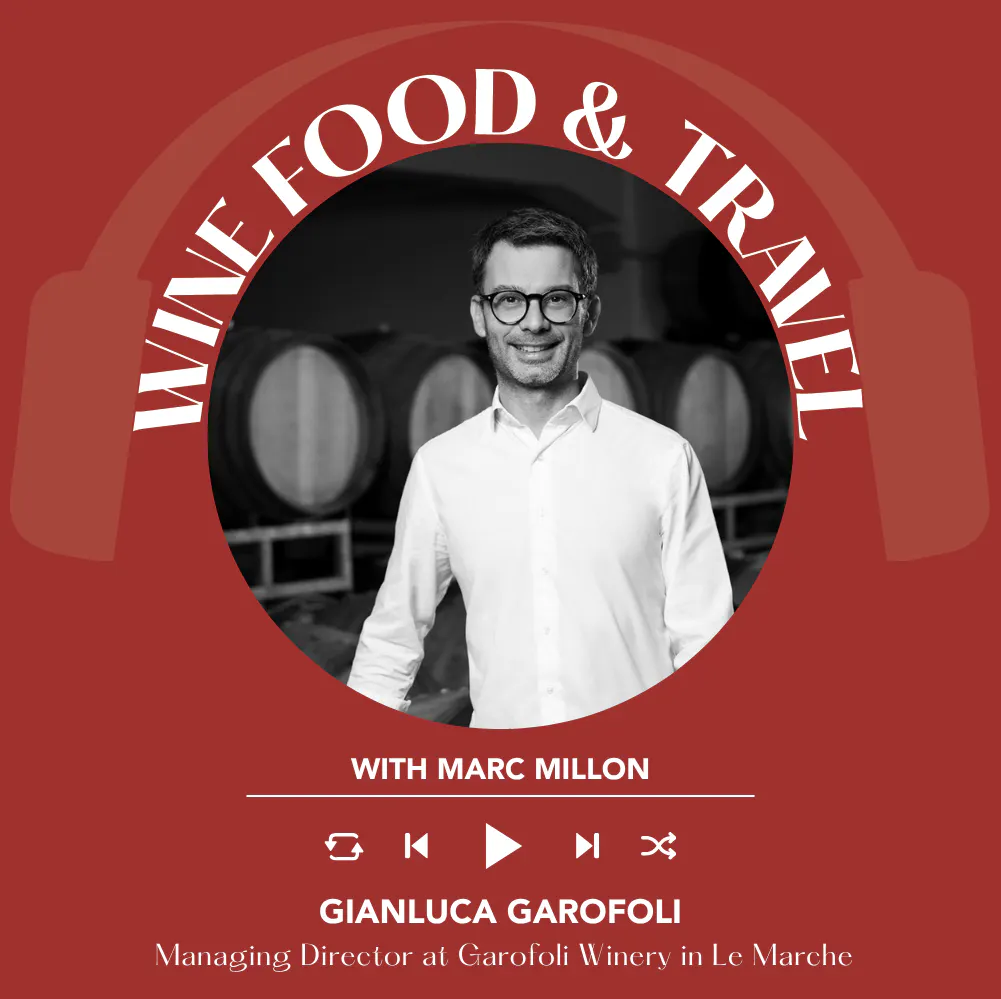
Ep. 2767 Le Marche: Verdicchio and the Wines that Shape the Region with Gianluca Garofoli of Garofoli Vini | Wine, Food & Travel with Marc Millon
Episode 2767
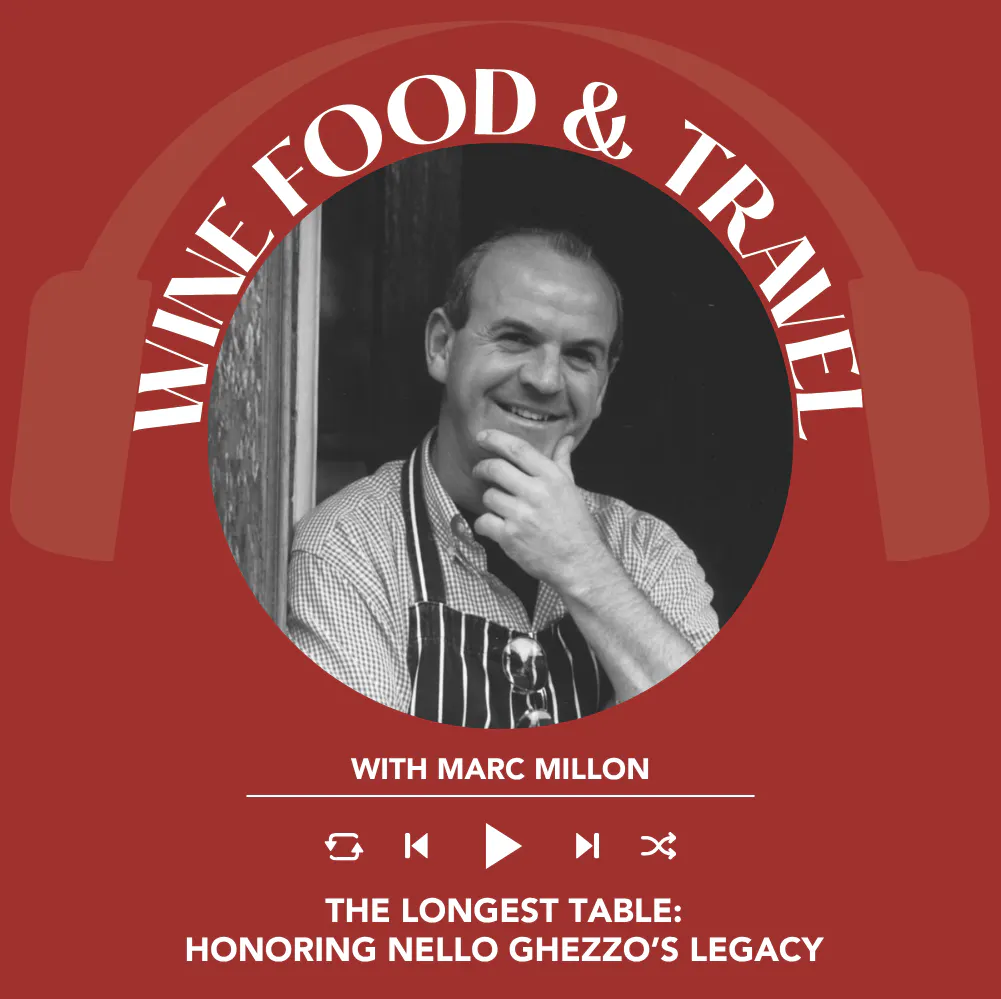
Ep. 2755 The Longest Table: Honoring Nello Ghezzo’s legacy | Wine, Food & Travel with Marc Millon
Episode 2755

Ep. 2712 Exploring Brda: Exceptional Wines and Slovenia's Culinary Traditions with Lan Kristančič of Movia | Wine, Food & Travel with Marc Millon
Episode 2712

Ep. 2700 Sardinia Beyond the Coast: Agripunica, Basso Sulcis & the Legacy of Giacomo Tachis with Salvatore Santus | Wine, Food & Travel with Marc Millon
Episode 2700

Ep. 2681 Giro d’Italia 2026 Special Episode 1: From Bulgaria to the Mezzogiorno in search of wine and cheese | Wine, Food & Travel with Marc Millon
Episode 2681