
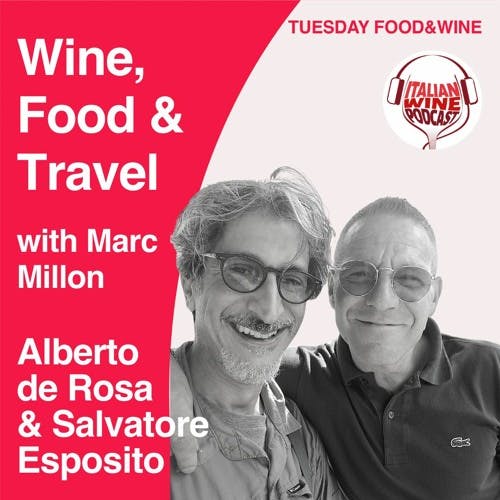
Ep. 1151 Alberto De Rosa & Salvatore Esposito | Wine, Food & Travel With Marc Millon
Wine, Food & Travel
Episode Summary
Content Analysis Key Themes and Main Ideas 1. The ancient history and cultural significance of Naples, Italy. 2. The unique geographical influence of volcanoes (Vesuvius, Campi Flegrei) on Naples' spirit, soil, and produce. 3. The distinct culinary traditions of Naples, including pizza, mozzarella di bufala, and Neapolitan ragù. 4. The characteristics and importance of Neapolitan volcanic wines, particularly Falangina and Pedirosso. 5. The role of local establishments like Enotecas in preserving and promoting regional food and wine culture. Summary In this episode of ""Wine, Food, and Travel"" on the Italian Wine Podcast, host Mark Millen journeys to Naples, Italy, to interview Alberto De Rosa, a filmmaker and tourism professional, and Salvatore Esposito, an Enoteca owner and wine expert. The discussion delves into Naples' rich and ancient history, highlighting its Greek origins and the enduring influence of its unique geography, particularly the active volcanoes of Vesuvius and Campi Flegrei. They explore how these geological features shape not only the Neapolitan spirit but also the distinctive volcanic soils that contribute to the region's produce and wines. The conversation also covers iconic Neapolitan foods like pizza, mozzarella di bufala, and the time-honored ragù. A significant portion of the segment is dedicated to the local wines, specifically Falangina and Pedirosso, discussing their ancient roots, versatility, and resistance to phylloxera due to the volcanic soil. Salvatore's Enoteca is presented as a vibrant hub for wine lovers and a testament to the passion for local products. The episode concludes with an invitation for listeners to experience Naples' unique culture, food, and wine firsthand. Takeaways * Naples is an ancient city, founded by Greek colonizers about 700 years before Christ, with deep historical and cultural roots. * The city's spirit is influenced by its proximity to active volcanoes (Vesuvius and Campi Flegrei), fostering a vibrant, energetic, and ""live for today"" attitude. * Volcanic soils in Naples (like Campi Flegrei) contribute unique flavor profiles and resistance to phylloxera in grapes. * Falangina and Pedirosso are significant ancient grape varieties in the region, known for their versatility and ability to age. * Neapolitan cuisine is characterized by its simplicity and quality ingredients, with pizza, mozzarella di bufala, and Neapolitan ragù being prime examples. * Local wine shops (Enotecas) play a crucial role in curating and sharing regional and international wines, often serving as community gathering spots. * Traditional Neapolitan ragù requires 8-12 hours of cooking and pairs perfectly with local wines like Aglianico or the sparkling Gragnano. Notable Quotes * ""It's a very belo giornata in Naples. There is a sun, clear sky. It seems like late spring or summer."" (Mark Millen) * ""It's Greek founded town... It's always been a, an arbor down for all his life, which made it, a town of exchange, human and, and cultural exchange."" (Alberto De Rosa on Naples' history) * ""It reflects on the spirits of the inhabitants of this town who are really an artist, and artistic and chaotic and, fun is a mouth, very alive."" (Alberto De Rosa on the influence of volcanoes) * ""The volcanic nature of the soil... makes the, our one yard very resistant to the fill up setup. So it makes, somehow our, our grapes stronger and health care."" (Alberto De Rosa translating Salvatore on volcanic soil) * ""To understand the spirit of pizza, you have to understand the spirit of a very popular food. It's very simple. It's flowers, it's tomato, and cheese, and basil, and oil, olive oil. It's cheap."" (Alberto De Rosa on pizza) * ""The Neapolitan Raghu takes from eight to twelve hours to be made. It's the Napolitan mamba mothers they wake up on Sunday very early to boil the meat into the sousa into the tomato sauce, over hours to be ready at lunchtime."" (Alberto De Rosa on Neapolitan Ragù) Related Topics or Follow-up Questions 1. How do modern tourism strategies in Naples balance preserving ancient authenticity with accommodating new visitors? 2. What are the ongoing challenges and opportunities for viticulture in active volcanic regions like Campi Flegrei? 3. Are there efforts to trademark or protect traditional Neapolitan food methodologies, similar to DOC/DOCG for wines? 4. How do local Enotecas contribute to sustainable tourism and community development in areas like Bagnoli? 5. What are some lesser-known Neapolitan culinary traditions or local grape varieties that deserve more attention?
About This Episode
The Italian wine podcast, YMI Fans, is a publicly funded sponsored fund-led enterprise that encourages individuals to donate to fund the podcast and receive a free IWP t-shirt. The podcast's founder, Alberto De Rosa, is a cyclist, traveler, filmmaker, and wine expert. The podcast's traditional foods, such as flowers, tomato, and cheese, are popular in Naples, where the influence of Spanish influence and the fruct Evering of people's lives is important. The podcast's excitement is also reflected in the success of the Italian wine industry, where wines can be produced with acidity, complexity, and wines that can age for long periods.
Transcript
The Italian wine podcast is introducing a new donation drive this month. It's called YMI fan. We are encouraging anyone who tunes on a regular basis to send us your ten second video on why you are a fan of our podcast network or a specific show. We will then share your thoughts with the world, with the goal of garnering support for our donation drive. Italian wine podcast is a publicly funded sponsored driven enterprise that needs you in order to continue to receive awesome pre wine edutainment. Seven days a week, we are asking our listeners to donate to the Italian wine podcast. By clicking either the go fund me link or the Patreon link found on Italian wine podcast dot com. Remember, if you sign up as a monthly donor on our Patreon, we will send you a free IWP t shirt. And a copy of the wine democracy book, the newest mama jumbo shrimp publication. Welcome to wine food and travel. With me, Mark Billen, on Italian wine podcast. Listen in as we journey to some of Italy's most beautiful places in the company of those who know them best. The families who grow grapes and make fabulous wine. Through their stories, we'll learn not just about their wines, but also about their ways of life, the local and regional foods and specialties that pair naturally with their wines, and the most beautiful places to visit. We have a wonderful journey of discovery ahead of us. And I hope you will join me. Welcome to wine food and travel with me, Mark Millen, on Italian wine podcast. Today, we travel to Naples to meet my guests, Alberto De Rosa, and Salvatore Esposito. Alberto is a cyclist, traveler, filmmaker, now also working in hospitality and tourism, and Salvatore is an Enotech owner and wine expert. Ciao Alberto. Ciao Salvatore. How are you today? Is it a belo giornata in Napoli? It's a very belo giornata in Naples. There is a sun clear sky. It seems like late spring or summer. Oh, that I can just imagine that. I was with you. I was with you just a few weeks ago, and I remember that Sunshine Alberto, we recently met in Naples. You introduced me to your city. Your beautiful city showed us around, knelt us to discover some really delicious things to eat and drink. Naples is a very beautiful city, but it's also a very ancient city. You tell us a little bit about its history? Oh, it's a long history because it started about seven hundred years before Christ. It's, Greek founded town. It's, founded by Greek colonizer. It still has this shape, this idea. It's all, has always been a, an arbor down for all his life, which made it, a town of exchange human and, and cultural exchange. Well, it's the sole longest story that, I mean, it's not easy to speak briefly, on a podcast about it. Yes. Of course. So, Greek city, Napolis. Greek city, Greek, it's, specials down. I mean, blessed by geography, an history because of many, many, many footprints and masterpiece are left by the history all around the town. It's better said by geography because being, seaside down with One volcano on its side, it's absolutely stunning for those who watch it pretty energetic because the volcanoes are two. One on the east side and one on the west side. One very clear, very volcano shape and like, like, the bazoo, you know, and one different, like, the flagrion fields, which we also visited together very briefly, which is a volcano with hasn't the shape of volcano. It's just lying under, under the soil, and it's constantly active. And it reflects on the spirits of the inhabitants of this town who are really an artist, and artistic and chaotic and, fun is a mouth, very alive. I should see. And, of course, there was a very strong Spanish influence in Naples and indeed in all of the south of Italy. And that reflects in the food and wines as well. Yes. The Spanish influence, we we have been for for three centuries under the domination or the control of the Spanish Kingdom, but I repeat probably the the Greek footprints. It's what is most evident all around the South Italy. The which is a Greek terms where we which indicate everything is common is typical of South Italy. We live in Acoine. It's common, the spirit we share, from Naples to S easily. So to say, it's common to love with four people, four good food, four, good life, good wine, good wines, and that's it's not coming from Spanish, but it's coming from wheat. Then we have a lot of influence in the architectural and the language and many, many things from the Spanish. But, what makes us unique or makes us altogether, it's the Greek root Okay. And you've mentioned as well how Naples is in the shadow of Vesuvius. This still active always smoking volcano looms over the city. I was amazed when we were staying in, that lovely B and B that you helped us find that from that rooftop terrace, we were just looking across to Visuvis. It seems to dominate the city. And it's interesting that you say that this active volcano that, of course, erupted in AD seventy nine to vary the cities of Pompeii and herculaneum, still contribute something to the spirit, the soul of the people of the city. There is a high awareness that life a short time and you have to take advantage of it and enjoy it as much you can as fast as you can. That's for sure. Then, for many, many people coming from abroad, or from outside the town, they cannot understand really how people does to live, so close to such, dangerous volcano. Last eruption of luxury was in nineteen forty four. And the next one accordingly to many volcanologists will be Pompeian. So we all keep our fingers crossed that we don't see in our lifetime. But, yes, it's a dangerous environment. And from another side, it's such a beautiful environment. The soil, the nature, the, the, the, the, the light, it's just, healing. So you don't mind so much about how will last your life, how much will last your life, but your mind, how good will be your life. That's a kind of, feelings, the neapolitan shares. Okay. I wonder if that's a wonderful way to describe it. Now I'd like to turn to Salvador because we're talking about volcanic soils. We're talking about soils that give wonderful richness to the produce, to the tomatoes, to the beautiful vegetables. But also to the grapes, to wines from vesuvius and from the Campi Fllegre volcanic wines. Salvatore, tell us a little bit about the wines that the people of Naples feel are their wines. The wines from these areas. Okay. The go? Malta and Tari San take place to discourse of Salvatorre. Alberto, translate some of this then about. Salvador is saying that there are two main, local grapes the. Into the Slager fields, there are. And then, you were asking me for influence from Spain, and in wine are pretty evidence. There is this grade called catalanesca from catalunya, which was imported during the Spanish age. And, it has become a a local, a local grape. Another interesting thing Salvatore was saying that, the the volcanic nature of the soil, either in, Vasvio, either in the flagram fields, makes the, our one yard very resistant to the fill up setup. So it makes, somehow our, our grapes stronger and health care. Yeah. As you know, the fill up, which attacks the, the the root of the plant. And, because of this reason, in we we just never had it. Yeah. That's very interesting because that's a that's a very interesting point, Alberto, because the, The Piedifranco, the ungrafted vines of Farangina, Pedro Oso planted on both Campiflegre and vissuvio. Our our vines that go back to antiquity. Both of these varieties were around in the time of the Romans. Correct Salvatore? Italian wine podcast. If you think you love wine as much as we do, then give us a like and a follow anywhere you get your pods. But Falangina and Guidirou, so were already founded on the soil by the Romans on the in this land. And, the name Falangina comes from which was, a kind of, comes from a military background. Yes. A phalanx. That's right. Yeah. Yeah. But it it indicate the steak, yeah, to put in the soil. To were to attach the wine yard in order to not let the grape, touching the soil where they can find parasite or a parasite or other, negative influence or will be? So, the names come from this technique, which was introduced to the Roman, but the wine yard is absolutely, original from this from this land, from this region. And, until the Roman was used to grow wildly, just, on the soil. Great. Well, that's a very good introduction to these very important, vines, farangina, for the whites and pediros. So for the reds, the typical wines, of Naples. Alberto, I'm going to return now to the city, to the food of the city. I'd like you to tell me share with our listeners just something about some of the really typical foods of Naples starting, of course, with pizza. Yeah. I think it's almost worldwide worldwide known that pizza, was invented in Naples. So it's the typical, popular food from this town. You can where nowadays there is a huge wide wide idea of pizzas. There are two, let's say it's divided into kind of pizza. The gourmet one, I think you you tried one, when you stayed in Naples, which is the newest, with a huge research by the pizza maker on flowers and any ingredients making this pizza. And the traditional pizza, which, is made, with less research, but very tasty. Both are very good. We I don't know, that are, but are very different from the average pizza you can find abroad. In spite in the la, over the last decade, there are many, pizzeria, many brands, opening spots in the main European capitals, opening pizzeria, where you can find almost a good pizza. But to understand the spirit of pizza, you have to understand the spirit of a very popular food. It's very simple. It's flowers, it's tomato, and cheese, and basil, and oil, olive oil. It's cheap. You can either sit that or walking. You can have it in a pizzeria at at your place as well. And it's part of our alimentation since since ever. Of course, then Naples is not only pizza. We can speak about many, many, many dishes, and about many, many cheese, overall, mozzarella cheese, which is typical from this area. Mozzarella di buffala. Also mozzarella di buffala's, strange in the history in the sense that Bufala, it's, type, it's a kind of cow, which arrived in this area. Probably with Annibal. It crossed the it comes from Egypt from and it probably crossed the Alps, with the Annibal Arms and found in the neighborhood of this town. I mean, in the area of Cabo, thirty kilometers north from the town, and in the area of Batipaya, which is thirty to fifty kilometers south. The right amount of humidity and ponds were to establish itself. And mozzarella, we have mozzarella, thanks to animals. It seems so the the Greek and the Roman have left a lot of footprints, on this land and market this land much more than everyone. I I feel. It's very personal, of course. Yes. Now let me return to Salvatore. We met at the Enotech, Vineopolis, on your your Enotech in Banioli, in the campy flagre. A really special place. To me, it seemed like it was very in a way like an English pub. A place where friends gather together to have a drink to spread out into the streets, to have a bite or something to eat. To watch Napoli, the football team doing so well in Saria this year. It was really a local place of friends, but also a very serious wine shop. Salvatorre, how many bottles of different types of wine do you have in your Anoteca? You had wines from all around the world. So he has about twenty no, ma'am. One thousand different choices of wine. Which are not only being said on. They come from different parts of the world, but they are mainly the wines he loves. He does a research on his own going around for exhibition, why Italy and and so on, and to continue to produce it directly to single producer local and not only. And that's how it makes is the Minneapolis selection. Okay. And, actually, I could see that. I could sense that with everything Salvatore does. It's done for Pacione. It's done out of love for doing the things that he really enjoys doing. I want to now turn return to the Falangina wines, and in particular, the Falangina from Campiflegre. Salvatore gave us a great tasting when we were there. Of farangina and showing the versatility of this ancient grape variety. We had a farangina made by the methodo classico, a sparkling farangina. We had, a very rich farangina, an orange wine with skin contact. We even had a farangina pacino. So a terrific variety and range from this great variety. What makes farangina such a special grape variety when planted, when cultivated in campiflegre. You know, So, the the following week, but it's pretty versatile. It depends from the amount of rains of the weather of the year, but basically, it adapts itself to a lot of views. Originally, couple of decades ago, it was, a great considerate for, been agar more than for wine. Then they started making wine out of it. And it results that it, it It's wine with huge versatility. It results that it's wine very, very wide going from Pasadena, which doesn't belong to our tradition. To the sparkle version to a very, still, version of it, as you had a chance to taste it's, very important to understand that the soil from, on which the the the the fall in Palangina grows. It's, volcanic soil full of sands, full of, minerals coming from the two for which is the typical stone of the flagriam fields. And it adds to the grapes, a lot of flavor and a lot of resistance over the years. So recently, the producer of Falangina understood that the the the wines voles during the year do do over the years, and it changed and adds, flower and taste. So, a wine, mhmm, following in a wine is knowing, kind of second weakness right now. And it's gaining day by day more, passionate people get in touch with, with this weight and start moving this wine. Yes. I think that's what I want our listeners to take from this. Campiflegre is very ancient wine, so known by the Romans, but now today, a handful of producers because there's not a big area. Are producing truly great wines with acidity, complexity, minerality, wines that can age for long periods as Salvatorre was saying. So it's really a wine zone to look out for. When you see that name on a label, Campie Fllegre, the Falangina and Pedro also both. It's, an ancient wine area, but also a new and exciting area. Just let me translate this. In since thirty years ago, thirty years ago, they were just still with two producers, selling, marketing, but we're changing the generation of more small producer normally selling their wine in, without any label, without any bottle, spouso, as we used to say in Italy, they changed their mind and they started working at Valentina and making, a brand, an, an established wine out of it. One of the characteristic of the Falangina is also that, it's produced very close to the sea. On eels which are mainly on the seat. So, the wind is bringing is adding to the grapes, a lot of, elements from the sea, which, hide helps the Valentina to grow up stronger and defend itself from any illness. And, of course, they add, taste and flavor to to the same wine, of course. Now I wanna return to food for just a minute because the Anoteca of Minneapolis also is somewhere that visitors can come and eat. And while we were there, Salvatore gave us a wonderful, tasting meal as we were sampling these amazing wines from the Campi Flegre. I can remember that exquisite mozzarella di Buffalo, which Salvatorre said had been made that morning. He said if it was the previous day, it was too old. But the other dish that I really enjoyed that is also typical, I think, is can tell us about. It's very different from. It's very different from so, first of all, The difference is in in the meat. It's used. The bolognese is made with the green the meat, while the Napoleon Regu is made out of sausage of Trakia, which is a really, local words to describe the kind of meat with, with the bone attached to it. And the main difference. Okay. So a big whole piece of meat. Yeah. Big piece of meat, variety of meat, cow, and pork, but mainly difference is in the time of cooking, the Neapolitan Raghu takes from eight to twelve hours to be made. It's the Napolitan mamba mothers they wake up on Sunday very early to boil the meat into the sousa into the tomato sauce, over hours to be ready at lunchtime. And, Oh, it was so delicious. And The real wine Salvatore is saying, related to Ragu, it's the. So because that's the power to remark the acidity, and to the Greece in Regu, well, to the Greece in Regu, So Another one, which match perfectly. It's, with with with me, Apologu, is the Granyano Granyano. It's a it's a village on the Vazillion area close to the Vazillion. On the hill of Feeto, known for its pasta makers traditionally. And it's different. The wine they make, it's pretty different from Peterosa because it's, sparkling wine. And it also the degrees, a lot for the the the the ragu. And it's very it's perfect. It matched perfectly with the ragu. And the local, the local matching for the Nepal traditional people is exactly Ragu and Granyana rather than Raghu and Okay. Okay. Well, thank you very much. Alberto and Salvatorre. You've taken our listeners on a wonderful, a brief visit to Naples and to the campy flagre. Thank you so much for being my guest today. I look forward to seeing you again soon. And thank you to you and to your listener. And I hope they know that we are waiting for them in vehicles to not only talk about this, but let them taste and let them see what this down in this area is. We hope you enjoyed today's episode of wine, food, and travel. With me, Mark Millen, on Italian wine podcast. Please remember to like share and subscribe right here or wherever you get your pods. Likewise, you can visit us at Italianwine podcast dot com. Until next time.
Episode Details
Keywords
Related Episodes

Ep. 2791 Italian Wine in a Changing Climate: PIWI, Terroir & Tradition with Nicola Biasi | Wine, Food & Travel with Marc Millon
Episode 2791
Ep. 2767 Le Marche: Verdicchio and the Wines that Shape the Region with Gianluca Garofoli of Garofoli Vini | Wine, Food & Travel with Marc Millon
Episode 2767
Ep. 2755 The Longest Table: Honoring Nello Ghezzo’s legacy | Wine, Food & Travel with Marc Millon
Episode 2755

Ep. 2712 Exploring Brda: Exceptional Wines and Slovenia's Culinary Traditions with Lan Kristančič of Movia | Wine, Food & Travel with Marc Millon
Episode 2712

Ep. 2700 Sardinia Beyond the Coast: Agripunica, Basso Sulcis & the Legacy of Giacomo Tachis with Salvatore Santus | Wine, Food & Travel with Marc Millon
Episode 2700

Ep. 2681 Giro d’Italia 2026 Special Episode 1: From Bulgaria to the Mezzogiorno in search of wine and cheese | Wine, Food & Travel with Marc Millon
Episode 2681