
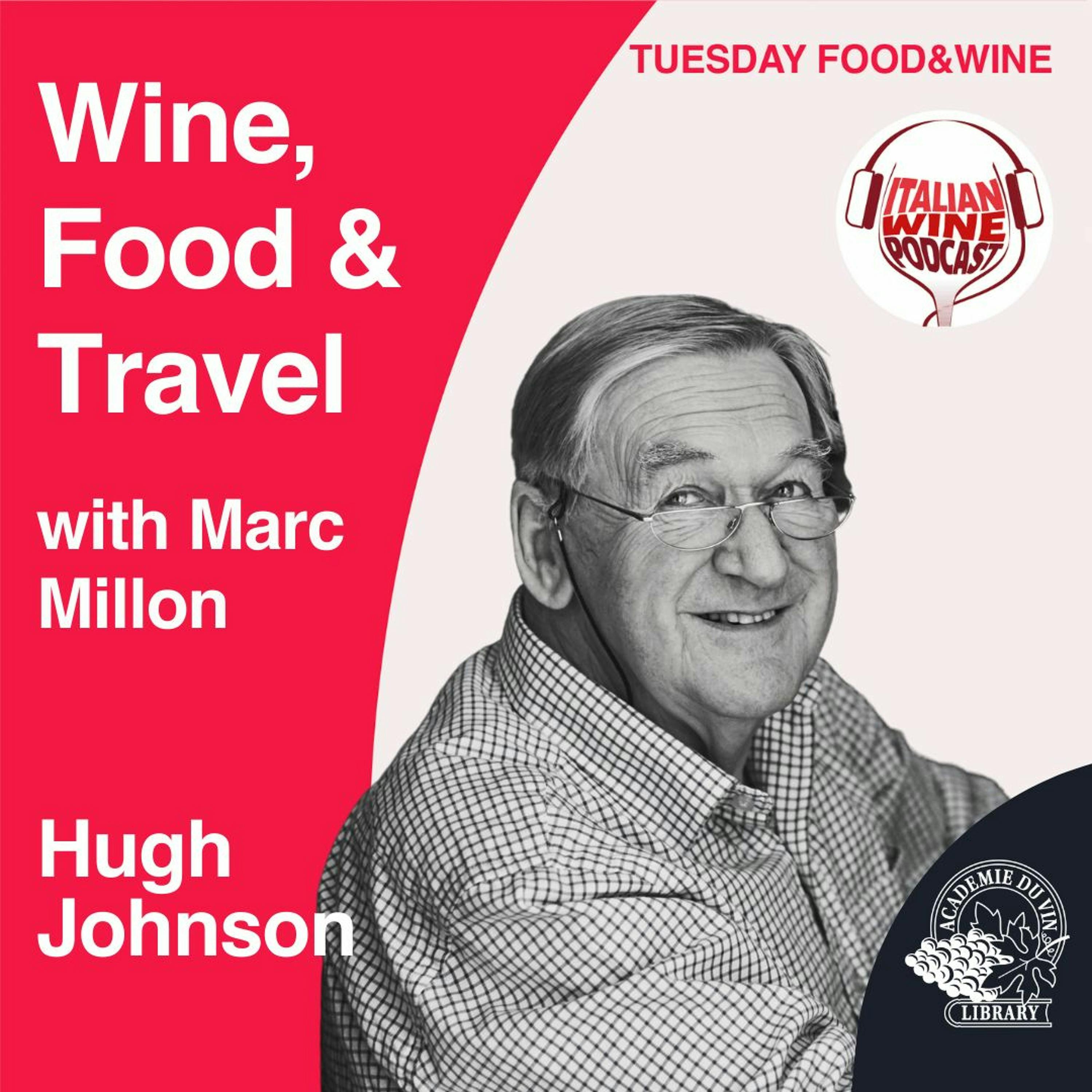
Ep. 1253 Hugh Johnson | Wine, Food & Travel With Marc Millon
Wine, Food & Travel
Episode Summary
Content Analysis Key Themes and Main Ideas 1. The Evolution of Wine Culture: How wine transformed from an exclusive, elite beverage to a global drink, spanning over 60 years of significant change. 2. Hugh Johnson's Influence and Philosophy: His pioneering role in popularizing wine through accessible writing, emphasizing the ""magic"" and ""mystique"" over dry technicalities. 3. Terroir and Grape Variety: The fundamental impact of location and soil on wine, and the evolving relationship between grape variety branding and regional identity. 4. Global Wine Regions and Their Development: The astonishing growth of wine production in new world regions (California, Australia, South America) and the unique complexity of Italian wine. 5. Climate Change and Wine Production: The observed and potential impacts of warmer climates on traditional wine regions, the rise of new wine-producing areas like England, and adaptation strategies. 6. Wine as a Cultural and Historical Artifact: The deep connection between wine, civilization, history, art, and human psychology, as explored in *The Story of Wine*. Summary In this episode of the Italian Wine Podcast, host Mark Millen engages in a captivating conversation with acclaimed wine writer Hugh Johnson. Johnson recounts his ""Damocene Moment"" at Cambridge, where a simple taste comparison ignited his lifelong passion for wine. They discuss the dramatic shift of wine from an elite British pastime to a widely accessible global phenomenon, paralleling the rise of new wine regions in the U.S., Australia, and South America. Johnson highlights his aim to popularize wine without stripping away its ""mystique,"" a philosophy evident in his influential works like *The Wine Atlas* and *The Story of Wine*. The conversation delves into the unique complexities and evolution of Italian wine, its provincial history, and the challenges of its DOC system. They also critically examine the pressing issue of climate change, its mixed effects on wine quality (producing riper grapes but shifting growing boundaries), and the exciting emergence of English sparkling wine. Johnson concludes by reflecting on wine's profound role in civilization and its unique ability to provide both stimulus and escape. Takeaways * Hugh Johnson's early encounter with terroir profoundly shaped his career, leading him to popularize wine writing. * Wine's social standing has significantly shifted, moving from a class-based, exclusive drink to a more mainstream beverage, influenced by increased travel and culinary interest. * The global wine landscape has expanded dramatically in the last half-century, with new world regions emerging as major producers. * Johnson advocates for explaining wine clearly while maintaining its inherent ""magic"" and ""mystique,"" rather than demystifying it. * Italian wine's complexity stems from its historical regionality and diverse ""terroirs,"" which initially posed challenges for official classifications. * Climate change is impacting wine production, generally leading to warmer vintages and pushing traditional growing margins, but also opening opportunities for new regions like England. * English sparkling wine is gaining international recognition for its quality, benefiting from ""marginal ripeness"" that contributes to refreshing acidity. * Wine holds a unique and central place in human civilization, interwoven with history, religion, and culture. Notable Quotes * ""I'm not for removing mystique. I have for explaining clearly why why it's different to why I prefer one to the other, and and and going on to be to enthuse about it..."
About This Episode
Speaker 1 promotes The Life and Wines of Hugh Johnson, a collaboration with Academy D realize Library, while Speaker 2 describes his interest in wine and its impact on his life and world. They discuss the shift from traditional wine to fashionable words like table wine, the importance of "we" in writing wine, and the shift from Italian wine culture to wine culture. They also touch on the future of wine, the success of C Busy, and the importance of good wine making techniques and managing harvesting. They end with thanks for their work and plans to meet again.
Transcript
Coming soon to a city near you, Vineita Lee Road Show. Have you ever wondered how to attend Vineita Lee for free? Are you a wine trade professional interested in a sponsored trip to Vienie to the International Academy, or Vien Italy, the wine and spirits exhibition. Coming soon to Princeton, New Jersey, Harlem, New York, and Chinatown in New York City, Cardiff in Wales, London, in England, and Roost in Austria. We'll be giving away our new textbook Italian Wine Unplug two point zero. Find out more about these exciting events, and for details on how to attend, go to liveshop. Vineitally dot com. Limited spots available. Sign up now. We'll see you soon. Welcome to wine, food, and travel with me, Mark Minute. On Italian Mind Partners. I'm delighted to announce an important collaboration with Academy Duvan Lieimer, one of the world's most important wine book publishers whose authors are amongst the most influential dental painting in the world of wine writing today. These are writers who I've long admired, so it'll be fascinating to chat with them and hear their stories. I hope you will join. Welcome to wine, food, and travel with me, Mark Millen, on Italian wine podcast. Today, I'm delighted to continue our new subseries in collaboration with Academy Duvan Library. One of the world's leading wine book publishers. And the publisher of two wonderful books by my illustrious guest, who I consider to be one of the world's greatest wine writers, who has inspired many, myself included, and who has brought the joy of wine. The appreciation of wine, the culture of wine, to countless people around the world. Welcome, Hugh Johnson. It's a great pleasure to meet you here. How are you today? I'm fine, Mark, and it's a pleasure to meet you. Well, I've I've feel as if I've been in your company over many, many years through your books. I'd like to actually begin, in your book, The Life and wines of Hugh Johnson, published by Academy De Van Library earlier this year, You described how you came to be interested in wine. Can you please tell us about this as you call it, Damocene Moment. It goes back to college days, when I was at at Cambridge University. And, I shared rooms with a guy who was already steeped in wine and belonged to one of these smart dining clubs. And, one evening, I was in, in, shared room, pretending to write an essay or something. And, he came in quite jolly after a dinner party wearing a dinner jacket, and he had two glasses of wine. And he said, Hugh, I want you to taste these. And I looked rather surprised. And I did, and I picked up one and then the other, and they both read wide. And they said, what do you think? And I said, well, this one is just amazing. The other one, I don't there's nothing special. He said that's interesting because they come from about hundred yards apart somewhere in Burgundy. And I'm he said I'm just fascinated in what difference the the location the soil, the difference in one vineyard another can make. And I said, well, yeah, I see. That's extraordinary. And he said this one is worth twenty five times as much for the other one, and it became more and more interesting. Yeah. In the end, that sort of seed led to my writing, the relentless of wine. That's absolutely fascinating. That actual taste of terroir that in two identical looking glasses of wine, it it opened up a whole new world for you. It did indeed. So you were going back some sixty years, the world of wine, and the people who drank and enjoyed wine were both very different then. Oh, yes. I mean, it was it was quite exclusive to use a fashionable word, really. It wasn't the people's drink, and I'm just talking about about Britain. It was it was a class matter as most things are in this country. You know, the upper classes drank wine, knew about wine, and the breasts Didn't well, it's not quite true because in pubs, ports was always very popular. Strong wine was what the people wanted, and Table wine was not interesting, but it definitely is not just in this country. I mean, if you look, for example, is Australia. Nearly all Australian wine was classified as either Port or Sherry, which, of course, it had no right for the names. And, the idea of Table wine was definitely a niche subject. Well, all that has changed, hasn't it? Oh, completely. Partly, through, the work you've done. I mean, you began writing about wine in this very different time and world. Was one of your aims to popularize wine? Who he is? Or to use the the French shoes which I which I'm very happy to use to vulgarize it. I guess, not only was wine, not a drink of the people. The world of wine, certainly here in the UK, was much, much smaller than it is today. For example, claret, burgundy, Vintage Port champagne, the wines of the Roan, and the great wines of Germany. Oh, not forgetting champagne. We're probably the mainstays. That's all changed completely now. Haven't it? Well, not only at the consuming end, but the production end too. Gotta remember that in the last past half century, the entire wine world of California, Australia, South America, everywhere has just grown. Astonishingly, and, of course, upsets, upsets game even more astonishingly. So we were talking about a much, much more limited supply, not just, of the consuming yet. Yes. Absolutely. In fact, it's very interesting. My, first copy of your wine atlas, I think was published in nineteen seventy eight. And it's very interesting. I it's it's well worn. The binding is broken. It was our literal road map when we were researching our books of our first book, which came out in nineteen eighty two, the wine and food of Europe. And so that that Atlas is now grown considerably and the world of wine. In the first edition, which was actually nineteen seventy one, There was no map of New Zealand. Fascinating. Well, there was a a sort of footnote with a little sketch showing where New Zealand is and saying, look out there might be one, one day from here. So it's a long period of time. Yeah. It is. And and and mass of massive changes. So interesting. You how do you think the UK changed from being wine, being a drink for the elite to a beverage of every man, every woman? Well, it it's not a question of disposable income, but it's Also, hugely a question of travel and people going abroad on their holidays and awareness of abroad. I mean, you know, we were an island race. And, the idea of even crossing this English channel was step too far for most people. So our whole mindset has just altered utterly, and we have become far more interested in food. English food used to be a bad joke. And then in the sixties, really, fifties sixties, we were led into the sunlit outlines of foreign food largely by, Elizabeth David, cookery writer, great writer in all ways who became a very good friend of mine and my wife's and I credit her with an enormous expansion of interest and an an increasing quality in in in the way that the British eat. Yes. Actually, I remember those really influential books, French country cooking, and, yeah, Italian, that cooking as well. And coming at the time as well, that as you say, Hugh, when people were beginning to travel abroad, package travel was introduced for the first time, and people discovered sunshine and wine and different flavors. But I think a great deal of credit also goes to to you and to other great wine communicators. Some of whom are also published by Academy Duvan Library, whom I will be talking with over the coming weeks. But I would say that for me, most importantly, what you're writing has been able to do is to entrans people with the sheer magic of wine. Would you say that's fair to say that the magic, the romance, the sheer beauty of wine is what most attracted you and still attracts you today. I would. I'd I'd agree with that. So many wine books are published that say this book finally removes the mystique of wine as though that was something that got in the way. Actually, that's just what people liked. So I I'm not for removing mystique. I have before explaining clearly why why it's different to why I prefer one to the other, and and and going on to be to enthuse about it, to the degree that it helps them appreciate and not sort of talk a lot of gobbledygook or use very hyperlutic language. We try try to avoid. Italian wine podcast. If you think you love wine as much as we do, then give us a like and a follow anywhere you get your pods. Yes. I I think that's right. I think it's your writing. It's so clear that that people can really understand and begin to feel flavors and and and and want to taste them. That moment you talk about, between tasting a a burgundy from one side of the road to a grand cru on on the other is, is an example of that. In life and wines, a few Johnson, the book is organized into sections such as bubbly, white, red, sweet, and digest teeth, allowing you to highlight favorite wines and recall pivotal wine tasting moments. I'd like to give our listeners a flavor of your wine experiences and your writing just by reading a short passage on tasting californian wines. This is, from, page two hundred and thirty two. I've tasted first attempt chardonnays that were like dizzy gillespie solos all over the place and the color of his trumpet too. On the other hand, the Stony Hill, Chardonay, recently had the subtle harmonies and lilting vitality of Bix Biederback. Robert Mondavi's reserve Cabonese are Duke Ellington numbers, mass talent and full cry. Benny Goodman is a riesling from Joseph Phelps. Lewis Martinez wines have the charm and good manners of Glen Miller. Joe Heights now is surely armstrong at the sunset cafe. Virtuoso, perverse, and glorious. Oh, that's just a beautiful, wonderful way to describe wines in a way that goes beyond dry tasting notes. And I think that's really your approach to drawing people into wine. Well, that was fine for people who are into jazz. Yeah. Yeah. Sure. I guess I guess there's a vocabulary that reaches everybody. Have your own taste reading reading that piece. Have your own tastes in wine as the world of wine as we've discussed evolved and changed so much over these years. Have your own tastes changed? Well, sadly not really. I mean, everything evolves. And but my favorites, what I call my default rights that I just reached for without a great deal of thought have remained pretty much the same. And, they are the classics. I'm afraid. I'm always keen to learn. I mean, all all the time I'm learning. Last night, I had a an Australian cabinet's opinion that was, a real eye opener, and I finished the bottle. And regretting it this morning. Yeah. I'm always keen to learn and, always return to base. My default white wire is Shamley, and I don't know why it is, but that that is a chardonnay grape in that northern part of of burgundy produces a wine with a I would call it a magic of its own. It's not very pronounced. It's not very obvious. It's just infinitely good to drink, and that really is. What we're looking for. Yes. Of course. I think that's what we're all looking for. Now here, we discussed briefly how the world of wine has changed immensely over these past decades. And nowhere more so than in a country like Italy, which paradoxically is one of the world's oldest wine producing countries yet also at this moment, one of its most exciting. Tell me about your your love for Italian wines and how this has evolved over the years and decades. Yes. Well, I think we're all learning. Hugely about Italian wine, when I say we all and includes the Italians. Yes. You've got to think of Italy, not really as one country, but a whole clutch of cultures it has only been one country since the late eighteen hundreds. It's a series of provinces, principalities, dukedoms, you know, little states, which had their own mysteries, traditions, and, of course, terawatts. So the Italian wine systems, which is was became official in the nineteen early seventies, I think, the Dominazionidorigine contrilazone, DOC, is almost well, it's not new, but to most Italians, it is, it's very official and not exactly doesn't exactly correspond with the action on the ground. Yes. That's that that does make it confusing, especially when in the seventies. For example, some of the best wines being produced chose to go outside of that system, such as Tignanello or Sasekaya. They didn't want the message to be defined by the government, they would make the best wine they could and give it their own name. And if it fell outside one of the official groups or sectors, too bad, and so the the table wines without official names. They have a sort of absurd, not value of their own. Yes. Super Vini Datavala that, was something of an absurdity, the lowest official classification for the, for the best, some of the best, and most expensive wines. And we well, price does it a lot, doesn't it? Yeah. It does. Yeah. And I guess, that was a defining error because I think, since the seventies, the systems have realized that and more and more really exciting wines are being produced as IGTs as well as the DOCs. Yes. Yep. Now here, the story of wine is one of my favorite books of yours. And I think the Academy Divan Library edition published in twenty twenty, is a really beautifully produced edition. I have various other editions over the years. But this one, I will treasure. I I like the feel of it, the binding. But above all, I like I love this book. It's an important work. And in this, you tell the story of wine from Noah to now. And it really demonstrates, I think, how wine is more so much more than a product. It's you're cataloging how wine is not just something that we drink, but it's part of our very civilization, our very humanity. Do you think wine is unique in all man's edible, drinkable creations, and having such a rich place in our culture, in our history, and why? Well, yes, I think it is unique, in being both a food and a drug at the same time having become, over time, almost, you know, no, it isn't universal. I mean, one of the themes that interested me most when I was writing that book was the people who don't drink wine. I e, the story of prohibition, above all the Muslims and the the, the Quran and the reason that's for the banning of wine by the prophet, you know, whether in fact it's even true if you banned wine. Because Islam has gone through all sorts of periods of more or less prohibition. In some cases, I'm actually encouraging wine drinking. So I've the the whole philosophy of that is interested in very much indeed. And other aspects of, you know, the worship of wine going back way way back to the ancient Greeks and Romans when wine was also god, the things that tells you about the human race and human psychology, human needs for stimulus and for escape. It's not just a it's it's not just a difference between born and burgundy. Is it? No. Absolutely not. That's what I love about the book. You're bringing in ancient myth, religion, history, science, art, and everything that encompasses our civilization itself. I mean, do you think civilization would have been evolved in the way it has without wine? Well, no. Not not really. I mean, it it's impossible to think of of an of evolving in a different way, but, there's no denying that wine has played a very large part in the way that Western civilization has evolved. Absolutely. Well, let's consider Briefly, the the future of wine. You write in the story of wine about the risk of wines becoming less varied, not more as producers are rushing to plant familiar grape varieties that consumers have come to love brands based on those classic wines of the world that that were part of your early wine world when we had a more limited world, cabernet sauvignon to imitate the great wines of bordeaux, pinot noir, chardonnay, from burgundy, Surath, and Villonier from the road or sauvignon blanc from Soncere. Reeslings from the Moza. But in a strange way, we're returning to that more limited palette as as great varieties replace terroir in a consumer's mind Is that something that you think is, risk that we're moving towards? Well, in a way, Mark, that's actually happened already. You know, that we've got beyond that stage, haven't we? There was a moment in the nineteen Fifties, really, when the whole idea of naming the great variety on the label was was new. In fact, it was really started by an American writer that I knew and loved called Frank Schoonmaker. Oh, yes. I remember his books. He was consultant to a winery called Almede in Central California, and, he was the first person to put on the back label. What you were just quoted, Cabanet sauvignon was the great Wines bought a hotel, and, people were astonished by that. Now it's gone way through all that. And we've had wines promoted on the basis that they are first and foremost for Cabanello shown me. And then after that where they come from. And that was a very, very useful and necessary stage in the introduction of new, great growing regions to the world because you didn't taste the wine that that's state because it was came from Argentina, but because it was a cabinet's overview, and then you learned about Argentina so that developments have worked in both directions. Now we're getting new and unfamiliar great priorities and just the fact that it's a cab is no longer enough. I mean, I just am tasting at the moment. A Spanish wine from a grape variety that I'd simply never heard of my life, and you'll find it quite hard to look up. And it's called Trippat, t r e p a t. And it comes from a region in Central Northern Spain, Castillo, and it's a very exciting new taste and style of wine. Now it's it's such good news to me that this can still happen. We think we'd think we know a lot about wine and then double just turn that. We hope you've enjoyed this special subseries in collaboration with Academy Duvan Library. If you visit their website academy devan Library dot com, they're offering a count of five pounds on the purchase of books by the authors we've interviewed, including Oz Clark, Hugh Johnson, Fiona Morrison, Peter Vending Deers, and Andrew Jafford. Just use the AD VL coupon code upon checkout, with the code Italian Wine. That's all caps. Yes. Absolutely. I've never heard of that one. My self. And actually, Hugh, another thing to consider, I guess, is how climate change will be affecting grape growing and wines. I mean, the the Bordeaux producers are actually adding new permitted grape varieties into the region out of necessity, and that's happening in other regions as well. Do you see that happening more and more? Oh, undoubtedly. Yes. I think people have rather exaggerated how borders change. I mean, with the warmer climate and the the greater chance of good weather at vintage time, the we're getting better wines, simply that. Not better in a different way, but better in the same way. Remember that a great vintage was a warm vintage. And now we're getting warmer vintages. So we're getting warmer wine, better wine. I mean, there are regions where the change I mean, take Germany, which was really a good vintage in Germany was a rarity, really, to get riesling really ripe. Now almost take it take it as red. So the greatest wine regions have always been on the margin where ripeness was a possibility of another certainty. Those margins are moving obviously, and the most enlightened grape growers and producers are making every sort of, every move they can to keep the marginal qualities of their wine because they know that it's the marginal qualities that that makes Airwine great rather than just good. The most fascinating example in a way is is the company Torres in Catalonia. Miguel Torres is the most switched on follower of these problems. And he is moving his great production in it's a cooler spot, which is particularly from the his region of production is is not far from Barcelona. And is going north towards the pyrenees where the where the land rises and planting and experimenting there. Other people are doing it. They're going, going higher or further north so the grapes don't get overripe. Has it really become a problem yet? No. I don't think it has become a problem. I think everybody basically welcomed ripe grapes. Overripe grapes has long been a much bigger problem. And in in in California, you know, dialing back the ripeness at which she used to and still does make sort of heavy sweet over alcohol, like, while dieting that back is more important than than, than increasing. So that's more a question of good wine making techniques and and carefully managing the harvest. Exactly. That's right. Now, Hugh, what about English wine then? Is this an opportunity because of this change? I just would like to touch on that. Absolutely. I touch on it, and I drink it all the time. It's no. It's very thrilling for us, in in England. To have a proper wine industry of our own and making sparkling wine in particular, which is challenging the world's best. And I would say that without any hesitation. So this has happened very recently. I remember when I was young writer, going to visit the the one vineyard in the whole of the country down near the south coast called Hamilton that that was producing a a a really addressable one. Well, that was sixteen years ago. Now our vineyards have multiplying, like, mad, and they're all basically down in the south of the country as you would expect, but they're creeping north as well. The great quality of English wine is that the grapes As I'm talking earlier about the importance of the margins, the grapevine's come from marginal brightness. Well, we've got marginal rangers in spades. And, in a good year, we can make a lot of very good wine. It keeps the acidity, which is the absolutely the foundation of fine wine. I know there's the word acidity is rather off putting, but believe me, a wine without it, is like, well, let's say, a fruit with no acidity would be totally boring. You know, what makes an apple a a crisp refreshing bite, worth taking a second and a third bite is because it is both sweet and sharp. Sharpness is vital. And that's what we have in in in England. We have the ability to make wines with a fundamental sharpness in the flavor that makes them freshing and repeatable. Yes. Absolutely. You've made me want to, have a glass right now even though it's only eleven in the morning here. Hugh, you've said your first love is Clarit, but if you were to have one glass of Italian wine to enjoy, what would it be? Oh, I've always discovered a new agenda at once, and getting enthused by new things. I mean, I've recently had red wines from from Sicily, which have been enthralling, especially. Yeah. Both from the Eastern end where Mount Aetna gives them the advantage of of altitude and other parts of Italy with it don't don't have mountains. So but my one last Italian white, will I be very tempted to have a glass of delicious, fizz that they make in Lombardy. Oh, the French Corta. Yes, from Franca Colte, poor dear me. There's so many totally different styles in Italian wine that you're really asking me what my taste is rather than. Yes. It's an unfair quest And I know there would be many glasses to have, and I would take great pleasure in sharing one with you. Hugh, it's been a real, delight to meet you here, to talk about your life and wines. These new additions of your books published by Academy Duvan Library are beautifully produced, and they will bring your writing to new audiences. I'm sure. Personally, I'd like to say that you've been a you've been a true inspiration to me and my work over many years and decades. And I thank you for that. And I wish you all the best. Well, thank you so much for this conversation, which I have thoroughly enjoyed. And I'm now just thinking about my cork's view and giving it a bit of work. Oh, very good idea. Thank you, Hugh. And I look forward to meeting again sometime. You bet. Thanks, Mark. Bye bye. Bye. We hope you enjoyed today's episode of wine, food, and travel. With me, Mark Millen, on Italian wine podcast. Please remember to like, share, and subscribe right here, or wherever you get your pods. Likewise, you can visit us at italian wine podcast dot com. Until next time.
Episode Details
Keywords
Related Episodes

Ep. 2791 Italian Wine in a Changing Climate: PIWI, Terroir & Tradition with Nicola Biasi | Wine, Food & Travel with Marc Millon
Episode 2791
Ep. 2767 Le Marche: Verdicchio and the Wines that Shape the Region with Gianluca Garofoli of Garofoli Vini | Wine, Food & Travel with Marc Millon
Episode 2767
Ep. 2755 The Longest Table: Honoring Nello Ghezzo’s legacy | Wine, Food & Travel with Marc Millon
Episode 2755

Ep. 2712 Exploring Brda: Exceptional Wines and Slovenia's Culinary Traditions with Lan Kristančič of Movia | Wine, Food & Travel with Marc Millon
Episode 2712

Ep. 2700 Sardinia Beyond the Coast: Agripunica, Basso Sulcis & the Legacy of Giacomo Tachis with Salvatore Santus | Wine, Food & Travel with Marc Millon
Episode 2700

Ep. 2681 Giro d’Italia 2026 Special Episode 1: From Bulgaria to the Mezzogiorno in search of wine and cheese | Wine, Food & Travel with Marc Millon
Episode 2681