
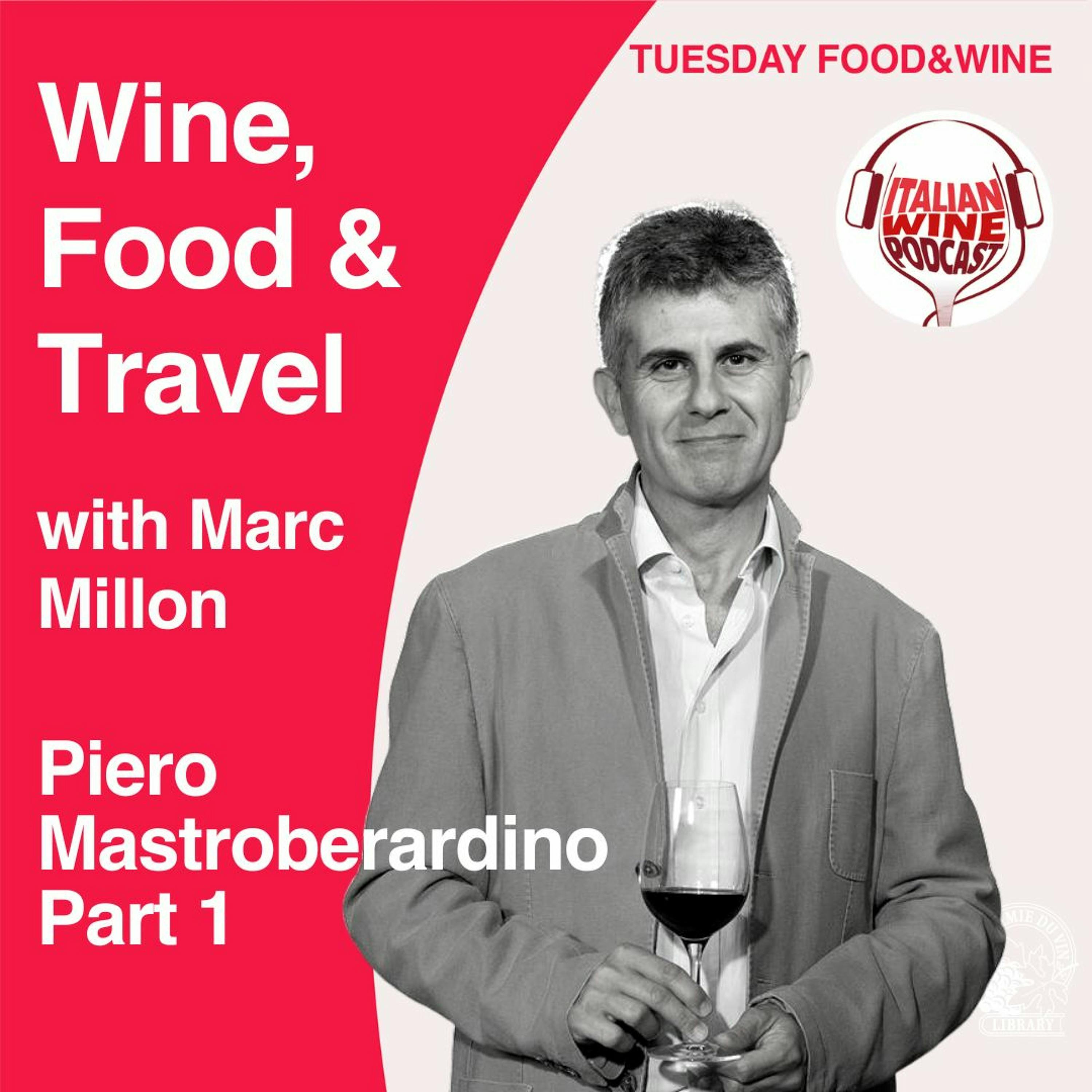
Ep. 1307 Dott. Piero Mastroberardino Pt. 1 | Wine, Food & Travel With Marc Millon
Wine, Food & Travel
Episode Summary
Content Analysis Key Themes and Main Ideas 1. The century-spanning history and pioneering role of the Mastroberardino family winery in Irpinia, Campania. 2. The unique microclimate and geographic factors of Irpinia that contribute to its distinctive wines. 3. The Mastroberardino family's crucial role in reviving and promoting native grape varieties of Southern Italy, particularly Aglianico (Taurasi), Greco, and Fiano, post-World War II. 4. Detailed characteristics and aging potential of Irpinia's signature white (Greco di Tufo, Fiano di Avellino) and red (Taurasi) wines. 5. The blend of tradition, innovation, and perseverance exemplified by the Mastroberardino family in winemaking and business development. Summary In this episode of the Italian Wine Podcast, host Mark Millen interviews Dr. Pietro Mastroberardino, president of Mastroberardino Società Agricola, one of Italy's most iconic wine estates in Irpinia, Campania. Pietro discusses the unique, high-altitude, and often challenging microclimate of Irpinia, which results in distinctive, age-worthy wines. The conversation delves into the Mastroberardino family's esteemed history, spanning ten generations, highlighting their early pioneering efforts in exporting Italian wines globally since the 18th century. A significant focus is placed on the family's resilience and commitment after World War II, particularly the efforts of Pietro's father, who, at a young age, spearheaded the replanting of vineyards and the revitalization of winemaking in Irpinia, dedicating themselves exclusively to native grape varieties. Pietro details the characteristics and aging potential of Irpinia's key grapes: Greco (powerful, versatile, almond finish), Fiano (elegant, delicate, pear, toasty notes), and the ""monarch"" Aglianico, which defines Taurasi (versatile, full-bodied, suitable for reds, rosés, and even white wines). He also touches upon the family's continuous investment in research and their ""Naturalis Historia"" project, paying homage to ancient winemaking. The interview establishes Mastroberardino's profound impact on elevating the perception and quality of wines from Southern Italy. Takeaways * Mastroberardino is a ten-generation family winery with a long history of agricultural innovation and global wine export, dating back to the 18th century. * Irpinia, Campania, possesses a unique microclimate characterized by high altitude, cold temperatures, and significant rainfall, which influences its distinct wine profiles. * The Mastroberardino family played a pivotal role in the post-WWII revival of winemaking in Irpinia, emphasizing the preservation and development of native grape varieties. * The three key native grapes championed by Mastroberardino are Aglianico (for Taurasi), Greco, and Fiano, each offering unique characteristics and significant aging potential. * Greco di Tufo is known for its power, structure, and aging capacity, while Fiano di Avellino offers elegance and finesse. * Aglianico, the ""monarch"" grape, is highly versatile, capable of producing complex red wines (Taurasi), rosés, and even unique white wines. * The family's commitment to research and understanding their grapes and terroir has been a continuous driver of their success. * Mastroberardino's dedication to native grapes and quality production significantly elevated the reputation of Southern Italian wines. Notable Quotes * ""Here, Urpina is the last wine region to harvest compared to any other wine region of Italy. So we finish harvesting in the first half of November."
About This Episode
The Italian wine industry is discussed, including the success of MEMAro Baradino family and their expansion into international markets. The devastation of the world war and the loss of important decisions by the German army have led to a tough period for the family. The success of their wines, including MEMAro Baradino and Sir Boennigth, is driven by their interest in learning about the history and culture of their wines and their efforts to improve their quality and value. The Grapes of Erpina are different from the Grapes of Agreco due to the finer grain, more on the beach, and more tender and aromas, and they have a history of wine in European history. They also discuss the importance of naturalist interpretations of wines and their plans for a podcast later.
Transcript
By now, you've all heard of Italian wine Unplugged two point o. The latest book published by Mamma jumbo shrimp. It's more than just another wine book. Fully updated second edition was inspired by students of the Vin Italy International Academy and painstakingly reviewed and revised by an expert panel of certified Italian wine ambassadors from across the globe. The book also includes an addition by professor Atilio Shenza. Italy's leading vine geneticist. The benchmark producers feature is a particularly important aspect of this revised edition. The selection makes it easier for our readers to get their hands on a bottle of wine that truly represents a particular grape or region to pick up a copy, just head to Amazon dot com, or visit us at mama jumbo shrimp dot com. Welcome to wine food and travel with me, Mark Binon on Italian wine podcast. Listen in as we journey to some of Italy's most beautiful places in the company of those who know them best, the families who grow grapes and make fabulous wines. Through their stories, we will learn not just about their wines, but also about their ways of life, the local and regional foods and specialties that pair naturally with their wines, and the most beautiful places to visit. We have a wonderful journey of discovery ahead of us, and I hope you will join me. Welcome to wine food and travel with me, Mark Millen, on Italian wine podcast. Today, it is my great pleasure to travel to the heart of Irpemia. To visit one of Italy's most iconic wine estates, Mastero Baradino, Societta, Agricola. And then to meet the president of the company, Doctor. Pietro Baradino. Juanjorno Pieto, thank you so much for being my guest. How are you today? It's my great pleasure. Yeah. We're fine. We are in the middle of our, winter yet, and, it's It's a little cloudy today here, but, it's typical of Filipina. As you know, we are in the middle of the mountains down here. Yeah. I think, you know, we we we can easily have, an idea in our minds of Southern Italy and the, and the sun always shining. But, of course, in in Albania is very different from the coast. Isn't it? Yeah. Definitely. It is different. Consider that, we are only thirty minutes drive, away from the MRC Coast in the inland on the mountains. But there is about seven to ten Celsius degrees of difference on the average. And, we've got snow all around even even now. We've got snow around in our mountains. And, so the the the the microclimate is completely different. It's good for wine, for grapes, and for wines, for sure. But, on the coast, probably, it's a little more pleasant. And the thirty minutes drive from my house on the other side, we've got a ski. Side. So Wow. I mean, yes. It's it's completely different. Yeah. I know that many people don't, have a perception of what happens at this latitude, but with this altitude. But, here, Urpina is the last wine region to harvest compared to any other wine region of Italy. So we finish harvesting in the first half of November. That's incredible. And I think that is important for our listeners to understand that, the inland country, the altitude of the vineyards, and all of these factors are are what make the wines great? Yes. Definitely. Because, the vineyards go up to seven hundred meters of elevation. This is very important because if you put together with the altitude and the cold environment, the soils and the grape varietals. At the end, you've got this beautiful freshness, the acidity that make these wines extremely clean on one sense, but also extremely ageable. That is another Yes. Very important characteristic for the wines of the region. Now, Piero, you lead one of Italy's best known and most important wine companies. You're also a professor of business and you curate the MEMAro Baradino family museum, as well as an art gallery. You're a poet, a published novelist, and an artist. And for twenty five years, you also oversaw an incredibly exciting project, Vila de Mistadi in which you were working with the archaeological authorities to actually plan to vineyard within Pompeii. Now that is the subject of a part two interview we'll be doing next month. And I'm very excited to learn more about that. But for today, I'd really like to focus on some of the most significant achievements and contributions that the master of Veradino family and winery have made to the wines of Irpena Campagne, and indeed all of Italy. Because I think you your family really changed the perception of wines from Southern Italy, certainly, and from Campania. So I know the family has a very long history year of the tenth generation. And I just let's begin with a little bit of background about the family in, Tripalda. Oh, yes. The company was established at the beginning of seventeen hundred, sir. Ten generations before me. And, this was a process in which, first of all, the family focused on agriculture and on the testimony approach. So they during the seventeen hundreds made a lot of investment buying land. And then in seventeen forty seven, they bought the, area in which the winery is located still today. So, from that moment, Atripalda, in this exact position where my house is, currently, became the headquarter of all the activities. And, then, in the beginning of eighteen hundreds, we have, the father of my Greek grandfather, that was, another guy that, gave gave him more structured organization to the company. And his son Angelo was the pioneer that, starting in mid eighteen hundreds decided to open the perspective of international markets. So these are the big, the most relevant changes during the last centuries. In eighteen seventy eight, the family starts exporting all around Europe and then opening a North American markets, United States first and then Canada. There's a part of the family that, sells, his part of the company that is, my great grandfather, brother. There was named Josepe, Celsius, and then he moves to New York. And, his house becomes our headquarters in North America by the end of eighteen hundreds where, so, side of the family starts going every year. For many months to develop the business there. And in our museum, we've got plenty of letters describing all these, processes of change in the organization and in the strategies of the company. Even if it's a small, of course, it's a small winery, but, the vision that they have in that period is unbelievable. I mean, they are capable to organize the activities to deal with the many parts of the world. Beginning of the nineteen hundreds, they start covering all the continents. They have a strong presence in Africa because the the colonies, the Italian colonies there, but not not only the Italian, also the French and the and the British colonies had many people buying our wines. And then, after North America, they opened Latin America in nineteen twenty in conjunction with the prohibition, act that is in, United States is on starting in nineteen twenty. So they open Argentina and then Brazil. And then they open Asia too. And also Australia becomes a a a destination for our wine. So in nineteen twenties, late twenties, they cover all the continents of the globe. So this is a very That's an that's an incredible story. I had no idea that the family, were one of the early pioneers of exporting Italian wines all around the world well before, you know, even even pre war. And also, I guess PR, it's interesting to note that this also follows the history of Italy with the family under the Spanish bourbons until unification. And then after unification, after the creation of the kingdom of Italy, that, the opportunities to, explore the world and find new markets. So we really were very early pioneers in in taking Italian wine around the world? Yes. Definitely. All the documents of the family starting in seventeen hundreds all the way to eighteen sixty are sealed with the seal of the reign of the two Sicilys. So the Burboli family. And then after eighteen sixty, we got the Savoya. And so we got all the papers from, the first king of Italy that was Victoria Manuel the second. And then the second king of Italy was named And then we told him that third, that was the third king of Italy of the unified Italy that gave to my great grandfather Angelo appointed him as the cavalier del rey night of the king in nineteen o five. And, Wow. Because it's he was really making a great job in exporting these wines from from European. And, if you look at, the letterhead of the family, nineteen eleven, you will see on the top a sill where my great grandfather writes that, he's not presenting his wines to the expo in Paris because in nineteen ten, it was in nineteen ten. Because it was the member of the Jew. It was judging the other wines. Wow. That's an incredible, incredible story. Now it was really after the devastation of World War two after Yeah. Fighting took place and the Germans were retreating, leaving the winery in in ruins that important decisions were made by the family that have really had a major impact on the wines of Astro Baradino, but more importantly, the wines of Campania, and, in terms of really raising the profile of all of Southern Italy. Tell us about this. Yes. That's another turning point. That's a very, very difficult and sad period for the family because, nineteen forty three in the middle of world war two is a turning point because, the war starts going bad for Italy, and for Germany a little later. But, Italy starts having a very bad time in San San Diego because when the allied army arrives, we have the bombings from the allied that are trying to, you know, to make the Germans escape from the area. And the Germans going out of the region that, you know, showed in the in the casts, that, devastated and the steal things and so on. So that moment is a very tough one. The family, is able to go on making the harvest. Even under under the bombs of forty three, they they do the harvest. My father writes a letter to his older brother that is under the Germans in Greece, on the war front, And, I mean, it's it's a very tough period. And, my grandfather, Mikaela, get gets sick in that period. So my father that was only fifteen years old becomes the leader of the family. And, this is, a period in which, he is he becomes stronger and stronger as a personality and, also awareness of what he wants to do and what he wants to be and where where he wants to bring the family, continually that that he was born in nineteen twenty eight. So he was born when he was a child, he had a very happy and rich condition in the family. So after world war two, he starts re planting the old vineyard. The piano was the most damaged during the war, but also Grego and Ayani go ahead and several damages. So he, tries to convince all the people around to do, like, the family, like, master Bellino family was doing. I mean, we have these very ancient graves, even if the markets are down, the markets won't be like this for a long time. We have to trust in our future. We have to invest in in the future of our children and so on. So e even if he's only seventeen years old in nineteen forty five, he's out there giving this message. And he, in some sense, catalyzes a process, a virtual process, of reinvestment in our Viticulture. And, from that point on, during the late forties and the beginning of the fifties, he starts working at recreating a platform of production that is, wide enough to face the international markets again. And this happens during the fifties. During the fifties, he starts working through Europe before first of all, in London, London is the first place where they start reexporting wines, and then from there, North America again. In the sixties, we have a full re legitimation of the wines from a sober adeno family and from European with the legendary vintages of Tarazie, fifty eight, then the sixty one, and then sixty eight will be the huge success. In the in the beginning of the seventies, when sixty eight comes to the market, it's it's such an extraordinary outcome for the company and for the family that at that point, this is really, again, what my father wanted to reach. So complete recovery of the positions of success of the family, from the twenties of the of last century. And and that success based entirely through faith in the native great varieties. Alianico for Torazi, Greco, for Greco Ditufo. And Fiano, a grape that was virtually an extinct, and the family helped to keep that that wonderful grape variety that, goes back to antiquity to keep that great variety from going extinct. Yeah. Definitely. Definitely. The focus, sir, from the family has always been on native grapes, sir, no contamination without the with other grapes coming from abroad, coming from other regions, and, the complete, the full trust for the characters of these wines and the possibility to improve the quality of our vehicle. This is something that, starts again from the sixties and goes all the way in the seventies, eighties and nineties with improvements with changes in techniques in the bin years, and then with improvements, of course, also in the sellers. So this is a this has been an extremely interesting period for me. You know, that, we've got a library of one century of bottles, of the family. So we have the chance to you know, analyze also the evolution of style and of techniques, in terms of, wine results, quality results in wine. So what we have seen is that my father has always been an innovator in in the sense that, he never stopped investing in research, trying to understand more and more about us grapes, trying to understand more and more about the territory and the soils, and the all the trajectories of, research that he established during his life are still are the drivers for our activities of research and development, even today. Italian wine podcast. Part of the mama jumbo shrimp family. Well, that's incredible. He really was an absolute visionary, in And this is one reason why the lines of Mastercardino are known around the world, but also how Erpini now, has really benefited And it has become one of the most dynamic and exciting wine regions in in Italy with fabulous wines being produced. Yes. That's true. Because, in European, at the beginning of nineteen hundred, so more than one century ago. We had a quite, interesting tool of producers that were about twenty or thirty, small companies that were trying, together with my family to develop, the business, and, then with the war, everything went down. And, my family remained the only winery after the war. Everybody, you know, just quit because there was there there were not economic conditions. And so the family went on even, you know, losing money, but they didn't want to stop the production. They don't want to stop the harvests and so on. So, sixties, seventies, eighties are decades in which my family has been, almost completely alone in this process of relaunch, Filipina wines. In the nineties, things start changing. And so we we start having, other people investing in agriculture and and in, in the sellers trying to produce, wines from the region. And now we have quite a wide presence of wineries. Luckily, we've got about two hundred small wineries, small and medium sized wineries. They are not yet on international markets, in a in a good amount because currently abroad, you can find probably ten or fifteen good wineries, sporting wines. But I think that in the future, the process, could be reinforced if all these people go on investing and also working on the knowledge base that is very tough in our business because as you know, we got only one harvest per year. So, it takes time to get an experience in the business and to, improve your level of awareness of your choices. Here, we are in a in an area in which, harvest can be very tough because the area of your opinion is very cold as we said, but also very wet. We can have a a very important, rainfalls during October. October is a very strategic month because we harvest in the late October beginning of November. So you must be very careful in approaching the fine training system in order to get results even in in difficult conditions. And sometimes, your opinion gives, its best when you got troubles because the interpretation of nature is the most interesting part in a situation like ours. We've got currently we we we have recently released the the sixteen vintage for our reserve of Taurasi. We've got three Taurasi reserve, stilemaradeshi and Astoria. And the sixteen has been quite complicated as a harvest, but the wines are extremely interesting, and it's a matter of interpretation. If you're able, you know, to work in the difficult conditions at the early opinion, we give back to you all the best of, its, natural contribution. So it's very misleading. I mean, to be here, I must say that, we don't want to easy things to face and to manage. We prefer, you know, that the contribution of creativity of man is really part of the management process of our vineyards. Yes. Absolutely. And wine. Great wine does always seem to come from that cusp of areas where it's almost at the limit of, that the vine has to struggle. And it certainly sounds to be the case. Let's briefly talk about these three important grape varieties, which do seem to find their greatest expression in Urpina. First, Greco. Oh, yes. Greco. Greco is very interesting. Is, among our whites, is the most powerful with structure and the body that, reminds a red wine more than a white wine. Greco, has a very thick skin, and this is a this can be a problem when the harvest is, warm and dry because, you have to to be very careful to separate the skin and to avoid any maturation that can be a problem in the following part of the process. We're making, but, Grego is extremely interesting. Power, a nice fruit, very long and persistent taste with this finish of almond that is very, very intriguing and, give an identity to the grape and wine. And the Greco traditionally was considered the less eligible than Fiano. I must say that in the recent years with some, research plan that we dedicated to these grapes, the project is called Stellama and covers, all the three appellations. There is a dilemma. Greco Dutu for a dilemma fiamo de avelino and the dilemma Taurasi. And we have seen that Greco has, a potential of aging that is very similar, close to the one of Fiano, we are now releasing, the twenty eighteen reserve of, Stella MacGrego, and Stella, yeah, not just to give, an idea of what is the potential of these wines. We keep the whites five years in the cellar, and then we release them, and they are extremely fresh. The color is one of a very young wine and with the the sense of matureness together with the freshness. The acidity is all there. So the potential of this grape, is, incredible and also the versatility compared to Fiano, probably the structure, of Greco makes this wine a little more versatile. So, I think that, Gregco has a huge potential yet of the Belvis, even if it's very well known and probably is, among our whites is the best known because, of its, approachability in terms of, of, tasting compared to a fiancee. It's a little more elegant, a little more austere. But, I I think that, Greco is giving us a lot of satisfaction on this new perspective that is, the aged, and refined, the rack only twofold. It was something that my father used to do in the past, in the seventies, Ola whites. To stay in the cellar longer and were released at least three years after the harvest. Now techniques allows us to, you know, to bring this process even longer and to release them, in the fifth year of refining. That is extremely, extremely interesting. And what about Fiano then? This is great. Great. Yeah. Fiano, Fiano is a little, different. The abolition area of Fiano is a little wider, but, the level of employment of territory is lower. So in in Greco, you got a smaller area, but with a with a higher percentage of coverage of vineyards on the total, territory. In Fiano, you can choose the best areas where you want to develop the grapes, And, Fiano is important to locate the vineyard in very particular conditions. Our best, properties in Santa Stefano del Sola where my family had the properties since, the beginning of seventeen hundreds. And in Santo's Stefano, the soil of the piano is, very unusual. It's very sandy and very rich in minerals. So there we do very interesting experiments also in organic protocol. But, coming to the grape, the grape is completely different from Greeco. It's, more delicate, as I was saying, a little more on elegance and finesse, a little less on body and structure. Beautiful evolution with the refining. And so in the case of Fianov, with the aging, you have this beautiful nuance of if you made smokiness, that is very, very, very fine. And, the fruit is different from Greco. The the fruit profile in Greco is more on a beach and apricot, in in Tiano is more on pear. And then the finish is the typical toasty does not, taste. The this is this makes this wine and the tasting extremely different from Agreco. I love the style of piano. Because of the finesse and elegance, as I said, but at the end, the in terms of food pairing, for Afiana, you must be a little more careful, a little cleaner approach to the food pairing. Less, sauces and creams. White fishes is better. I mean, than than crustace that is more typical of a crack or the the the the the seafood that is, you know, you know, the excellence for a gregory two four. So, I mean, what is interesting is that these two wines that are completely different give a beautiful representation of the potential of the whites of your opinion you know, allowing the consumer to experience some many different, things from the same macro area. K. Well, that's that's actually a very good, I think distinction and an important distinction for our listeners to really try to understand this different expressions from the two grapes within Erpina. No, Alianico, the great red grape of Irpina, one of the great red grapes of Italy, along with Nebula and and, where does the name Torazi come from? To, the other, wines are known by the grape name. What does the name Torazi come from? Torazi is the geographic name. Like, in in the appalachian Piancavelino have a name with the geographic name and Greg only two four two four is the geographic name. In the case of Taurasi, the name Taurasi today is the name of a village that is, in the middle of the appalachian area, but the origin of the abolition, Taurasi is the Taurasiya village that was not far from the current Taurasi, but not exactly in the same position and was, a village that was known in Roman times. So that's the origin of the name. In this case, we don't have the grape varietal in the appalachian name. Alyanico is the grape and Taurasi is the VOCG appalachian. Alyanico is considered the the monarch. Of our Viticulture. The the most important and also the grape that has, a huge versatility and give the winemaker the possibility to experiment a lot. Consider that Alanico has a huge battery of polyphenol in the skins, and this, makes the maceration strategy determinant on the results in wines that you want to have because of course, you can bring maseration to a longer period and have a a a bigger process of extraction from the skins. Then in that case, you will have a little more concentration in the in the eyes. But you can even approach the grade with a little shorter maturation enhancing more the finesse and elegance and, different style of Taurasi, but you also can reduce the maturation to lower level, to have a little lighter bread wines, and we also produce a Rosay that is called Latry Marosa with just a couple of hours of skin contact. That is extremely elegant, very pale, but we also produce from ideological, a white wine, a blonde that is called the narrow and meta zero skin contact with a beautiful gray color, and, with the a nose that, doesn't remind any of the characters of, of it, Arazi, has a beautiful, very delicate, and once of, wild strawberry. So it's extremely intriguing, extremely unusual. It's a very successful wine for us because it's completely out of scale and out of the perception of the consumer of a a wine coming from a Yali. Now I just want to mention as well, one of your top ranges, flagship ranges of wines is the naturalis Historia, that you mentioned. Of course, named after the great work by Cliny, the Elder. And that will, of course, lead us into our discussions the next time, when we look at your researches into ancient wine. But, again, it's an important way of recognizing and paying homage to the lengthy history of wine in European. Natoralis is a wine that, was born as a project, in the first half of the nineties. So quite recently, as a tribute from my father to Pliniti after, and, of course, naturalis Astoria was an experiment at the beginning. And, it came from, an old vineyard. So with a little, low density of plantation because it was more a traditional approach to agriculture. And with this very old, big, plants that are, like, sculptures, you know, leading sculpture, and I usually say, beautiful, but with a very, very low yield per plant with a very low production. So this tiny production became, at that point, a crew in the nineties, in the beginning, we used to join in the blend just a little presence of Pinerosa. In ninety seven, that was the first harvest that was released on the market that is wide. There was a ten to fifteen percent of Pinerosa. And we went on with this experiment until, two thousand and one. Then with the first aging process of these bottles, we realized that Pier de rosso didn't give any relevant contribution after some years. And it also was a little more on the on the food, but the food goes down and Alianico becomes predominant. So in two thousand and two, we did not produce any big reds in the area because two thousand and two was too rainy. Was a very bad harvest for the for the rents. And and in two thousand and three, we decided to put potatoes. So out of the blend, it did became just a hundred percent Alyanico from this ancient vineyard, and was reclassified, from your opinion to Taurasi DOCG. So starting in two thousand and three, natural history becomes a Taurasi DOCG. And, it's, an extremely interesting one because comes from Mirabela state that is not the coldest and not the highest part of the operation area. We produce the classical radichi in Montemarano that is very cold and higher elevation close to the mountains. While naturalistic story is produced in Mirabela state that is more hilly in the, in the, just to give an idea to the listeners that is more similar to the hills of, central and southern Tuscany. So the the harvest comes a little earlier one week earlier compared to Montemarano, and the the the character of this grapes is a little, softer, a little rounder. So it's a little more delicate as impression of Tarazep with a nice fruit with the beautiful spices with the coffee and the, dark chocolate, and, I mean, it's extremely interesting, the tasting. It's a wine that has a beautiful HAVDT. We do beautiful vertical tastings, back to the to the nineties, but to the beginning of the project. So it's a really exciting interpretation, different interpretation of Tarazi appellation. Taurus is not just one way. Taurus, it can be many, many different interpretations. Yes. Indeed. What I look forward to exploring this further with you when we next have an opportunity, to chat. I'm really looking forward to to actually coming out to visiting you soon, Piero. In the meantime, I think we'll wrap up this first podcast now and continue our discussions when we meet in Atripala, which, is in only a few weeks time. And I look forward to exploring in greater detail. Your wines, the story of the family and the many things that you are working on now, and in particular this fascinating story of ancient wine and your researches into, how wine was two thousand years ago. It's been my great pleasure. Well, thank you very much for being my guest today, Sierra, and I look forward to seeing you soon. But for now, We hope you enjoyed today's episode of wine, food, and travel with me, Mark Millen, on Italian wine podcast. Please remember to like, share, and subscribe right here, or wherever you get your pods. Likewise, you can visit us at Italianwine podcast dot com. Until next time.
Episode Details
Keywords
Related Episodes
Ep. 2767 Le Marche: Verdicchio and the Wines that Shape the Region with Gianluca Garofoli of Garofoli Vini | Wine, Food & Travel with Marc Millon
Episode 2767

Ep. 2712 Exploring Brda: Exceptional Wines and Slovenia's Culinary Traditions with Lan Kristančič of Movia | Wine, Food & Travel with Marc Millon
Episode 2712

Ep. 2700 Sardinia Beyond the Coast: Agripunica, Basso Sulcis & the Legacy of Giacomo Tachis with Salvatore Santus | Wine, Food & Travel with Marc Millon
Episode 2700

Ep. 2624 Friuli Cuisine & 2 Michelin Stars: Inside Agli Amici with Emanuele & Michela Scarello | Wine, Food & Travel with Marc Millon
Episode 2624

Ep. 2592 Cormòns: Austro-Hungarian Heritage, Slovenian Culture & Friulian Hospitality with Mitja Sirk | Wine, Food & Travel with Marc Millon
Episode 2592

Ep. 2510 Elena Penna of Cascina Penna-Currado | Wine, Food & Travel with Marc Millon
Episode 2510