

Ep. 2455 Orazio Rillo from the Fontanavecchia Winery in Benevento | Wine, Food & Travel with Marc Millon
Wine, Food & Travel
Episode Summary
**Content Analysis** **Key Themes and Main Ideas** 1. The history and geography of the Sannio wine region in Benevento, Italy. 2. The role of the Consorzio Tutela Vini Sannio in promoting the region's wines. 3. The historical significance of Benevento and its influence on the region's identity. 4. The characteristics of Sannio wines, particularly Aglianico and Falanghina. 5. The family history of the Rillo family and their winery, Fattoria Vecchia. **Summary** This podcast episode features an interview with Orazio Rillo of Fattoria Vecchia winery in Torraccia, Sannio. Orazio discusses the history and characteristics of the Sannio wine region, located in the northeast of Campania. He highlights Benevento's rich history, mentioning its significance as a crossroads for ancient civilizations (Egyptians, Romans, Lombards), evidenced by its archaeological sites. He explains the origins of the Sannio name, linking it to the Samnites, a pre-Roman people. Orazio details the work of the Consorzio Tutela Vini Sannio, established in 1999, in promoting the region's wines, particularly Aglianico and Falanghina. He also shares the long history of his family's winemaking, dating back to at least 1875. The conversation emphasizes the unique terroir of Sannio, influenced by significant temperature variations between day and night, creating ideal conditions for wine production. **Takeaways** - Sannio is a historically significant wine region in Benevento, Campania, with a rich past influenced by various civilizations. - The Consorzio Tutela Vini Sannio plays a crucial role in promoting Sannio wines globally. - Aglianico and Falanghina are key grape varietals of the region. - The Rillo family represents a long tradition of winemaking in Sannio. - The Sannio region benefits from a unique climate ideal for wine production. **Notable Quotes** - (No direct quotes are easily extractable from the provided text that stand out as particularly noteworthy in the same way as the example provided.) The interview is more descriptive and less quote-driven. **Related Topics or Follow-up Questions** 1. What are the specific soil types and microclimates that contribute to the unique character of Sannio wines? 2. How does the Consorzio Tutela Vini Sannio support its member wineries in terms of marketing and quality control? 3. What are the key differences between Aglianico and Falanghina wines from Sannio? 4. What are the future goals and challenges facing the Sannio wine region? 5. How does the historical legacy of Benevento influence the cultural tourism aspects of the Sannio region?
About This Episode
The Italian wine region of Benivento is rich in character and history, with a mix of historic and historic wines, including a crossroad for ancient civilizations and a historic area with a beautiful fruit called Sano. The S administration was the capital for a period of Longo BARia minor, and the consortium is a historic area where wine has been made for at least two thousand years. The Sano area is a value-creation company and uses natural ingredients and sustainability in their production. The wines they use are typically made with sweet tomatoes and mixed with different ingredients, and the traditional dish for pasta is called the spaghetti file. They also discuss traditional dishes like the spaghetti Texto and the spaghetti file, and the importance of finding local foods when traveling to Italian cities. The host suggests visiting wineries to try local foods and receive wines from their wineries.
Transcript
Our province is located in the northeast of Campania. Even though it is a small province compared to others, it is very rich of character and strong reasons to visit it. Starting from, of course, wines. That's why we are here. And food, but also, like, from historical perspective, it is a very important province, Benamento, which is provincial capital. It was a crossroad for ancient civilizations, for example, like the Egyptians left behind artifacts that are now, you know, a museum. Second most important Egyptian Museum in Italy, but actually the artifact that found in Benavento are from Benavento. Then, of course, there were the Romans who left behind a Roman theater and the arc of Triana, which is monumental and beautiful. And the lombards, of course, which left a very important footprint on the city with their walls and most famously, the Church of Santa Sophia, which is now UNESCO site. Fascinating people with stories to share, fabulous wines, and the best local foods to accompany them, and beautiful places to discover and visit. All of this and more on wine food and travel with me, Mark Millen, on the Italian wine podcast. Join me for a new episode every Tuesday. Welcome to wine food and travel with me, Mark Millen, on Italian wine podcast. Today, we traveled to Campania to continue my special subseries that focuses on this beautiful southern Italian region. It's wines, it's gastronomy, and things to see and do. Today, we traveled to inland Campania to the province of Benivento to learn about a beautiful wine region, Sano, with my guest, Orazio Rillo, who is speaking to us from the family, Fantana Vecio winery in Torracuso. Orazio's father Libro is the president of the consortio to Televini Sano. So we'll gain an impression of this territory of Sano and the wines produced. Good morning, Aracio. Many thanks for being my guest today. How are you? Good morning. It's a pleasure to be here. I'm good. How are you? Yeah. I'm very well. Thanks. Is it a nice hot day where you are? Yeah. It's definitely hot. Actually, you're you're speaking to me from Sicily. Are you on holiday now? Yeah. Exactly. But normally, yeah, even in turku, so it's very hot right now. Okay. But it's in Limpania. So the climate's a little bit different from, say, the Amalfi coast. Is that right? Yes. Our climate is actually very different because even though it's, it's hot during the day in summer, it is very cold during the night. I mean, actually, the temperature excursion is very high more than, cold in during the evening. So the climate is perfect actually to make wines because Okay. You have this big excursion. Now, Aracio, Sanio, as a wine region, is perhaps not yet well known to many Italian wine lovers. Our our listeners are located all around the world. So just to begin with, can you explain where the territory of Sano is located? Give us a visual description of your area and maybe something of a a little bit about that. I know it's a very historic land, going back more than two thousand years. So just a little overview of the territory of Samuel. Yeah. So our province is located in the northeast of Campania. Even though it is a small province compared to others, it is very rich of character and strong reasons to visit it starting from, of course, wines, that's why we are here and food, but also, like, from a historical perspective, is it is a very important province. Benamento, which is provincial capital. Is like steeped in history. It was a crossroad for ancient civilizations. For example, like the Egyptians who left behind, artifacts that are now, you know, a museum that is second most important Egyptian museum in Italy. But actually, the artifact that found in Benavento are from Benavento because we found out that it was hosting at the time. One of the most important ISIS is is temples. In Italy. Then, of course, there were the Romans who left behind, a Roman Theatre and the arc of Triana, which is monumental and beautiful. And, the lombards, of course, which left a very important footprint on the city. With their walls and most famously, the the church of Santa Sophia, which is now, UNESCO site. Okay. That's amazing. The Sono name, does that come from the Sam Knights, the a pre Roman people that lived in this area? Exactly. There were, of course, Italy at the time was was very crowded. There were a lot of people. There are a lot of different civilizations. I did just mention a few that maybe everyone knows, but when we study serious school, we see that in the, like, central and southern part of Italy, there were all sorts of different civilizations that came and, some nights were definitely one of them, and that's where we take our name from. We also have, like, some wines that use some names from this ancient populations in Italy. Okay. Well, that's really, really interesting. And and very interesting as well speaking of the lombards, these German tribe that descended into Italy in the sixth century through the Julian Alps in the northeast and almost succeeded in conquering the whole of the Italian Peninsula with the duchy of Benavento, a very important stronghold for them. So we don't tend to think that the lombards would have been so far south, but as you say this is a UNESCO heritage linking the different lombard sites across Northern Italy and also in umbrian and in in Benavento. So that's a a very interesting reminder that this is a very historic area. And, Orancio, it's an area where wine has certainly been made for at least two thousand years. Yeah. And, actually, not many people know, but Benavento was actually the capital for a period of Longo BARia minor, which is not minor for importance. It was just, called minor for its location, which was in the south, you know. Okay. And as you say, the Benavento itself is strategically located, which is why it's been important historically with roads from, Rome crossing through to go. I'm imagining two to bring this in in India. Yeah. Exactly. This wasn't the Via Appia, was it? Exactly. Precisely. Yeah. That's actually one of the reasons why the the arc of Tatrayana was made. Okay. So the Sanyo wine rinse in the consortio was founded relatively recently. Was it nineteen ninety nine? Because as I say, I think we're beginning and, you know, I I'm in England, but our listeners are located all around the world. I think we're beginning to see much more, you know, the name on wine labels, but it's still a relatively recent wine zone. Is that right? And tell us a little bit about this area and the work of the consortium. Yeah. So first of all, I'm happy to hear that more and more people are knowing it from all around the world. So, you know, the official part of it may be new to many, right? The consortium started working, as you said, in nineteen ninety nine, and my dad was there already, you know, in the early years of that. And it has been president for the past thirteen years. But actually, we, as a as a company, is way older than that, and as a family, we make wine way before that. But that has been, you know, present of the consortium for thirteen years. And in this time, the name of the wines both in Italy and in the world has grown for sure. Especially Ayanego and most importantly, Falangina. But we've been making wines with labels for forty years. And before that, we are a family of winemakers. There is a booklet from the Italian wine union from eighteen seventy five, which talks about Famillarillo, which made wine back in eighteen seventy five. It's it's a lot of years. He's just passed the the Constitution of the Italian Republic just a few years after that. That's amazing. And that's amazing that you were making wines in bottles, at a at a very early age. So, again, this link with the traditions of wine growing and growing grapes and making wine, I guess, have just always been in this area in Benavento and in the surrounding hills. Can we just briefly again looking at the work of the consortium? The wines tha
Episode Details
Keywords
Related Episodes
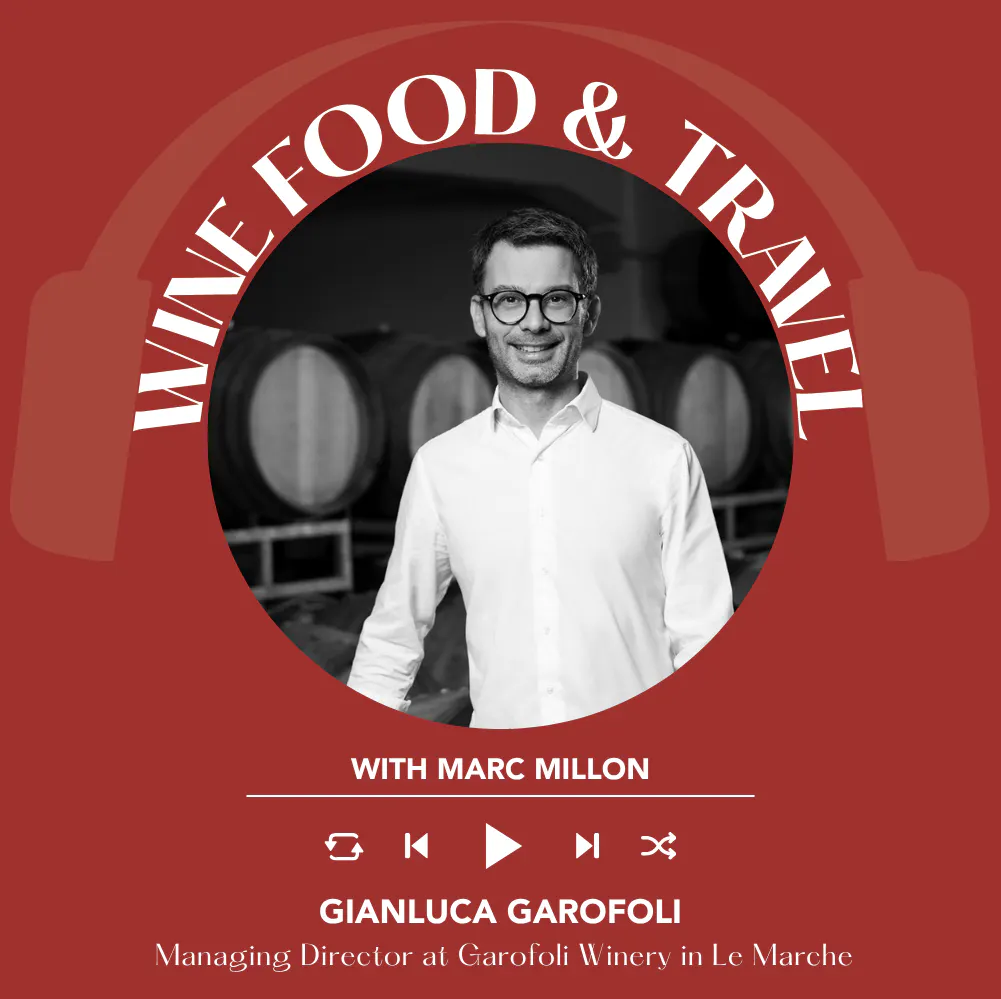
Ep. 2767 Le Marche: Verdicchio and the Wines that Shape the Region with Gianluca Garofoli of Garofoli Vini | Wine, Food & Travel with Marc Millon
Episode 2767

Ep. 2712 Exploring Brda: Exceptional Wines and Slovenia's Culinary Traditions with Lan Kristančič of Movia | Wine, Food & Travel with Marc Millon
Episode 2712

Ep. 2700 Sardinia Beyond the Coast: Agripunica, Basso Sulcis & the Legacy of Giacomo Tachis with Salvatore Santus | Wine, Food & Travel with Marc Millon
Episode 2700

Ep. 2624 Friuli Cuisine & 2 Michelin Stars: Inside Agli Amici with Emanuele & Michela Scarello | Wine, Food & Travel with Marc Millon
Episode 2624

Ep. 2592 Cormòns: Austro-Hungarian Heritage, Slovenian Culture & Friulian Hospitality with Mitja Sirk | Wine, Food & Travel with Marc Millon
Episode 2592

Ep. 2510 Elena Penna of Cascina Penna-Currado | Wine, Food & Travel with Marc Millon
Episode 2510