
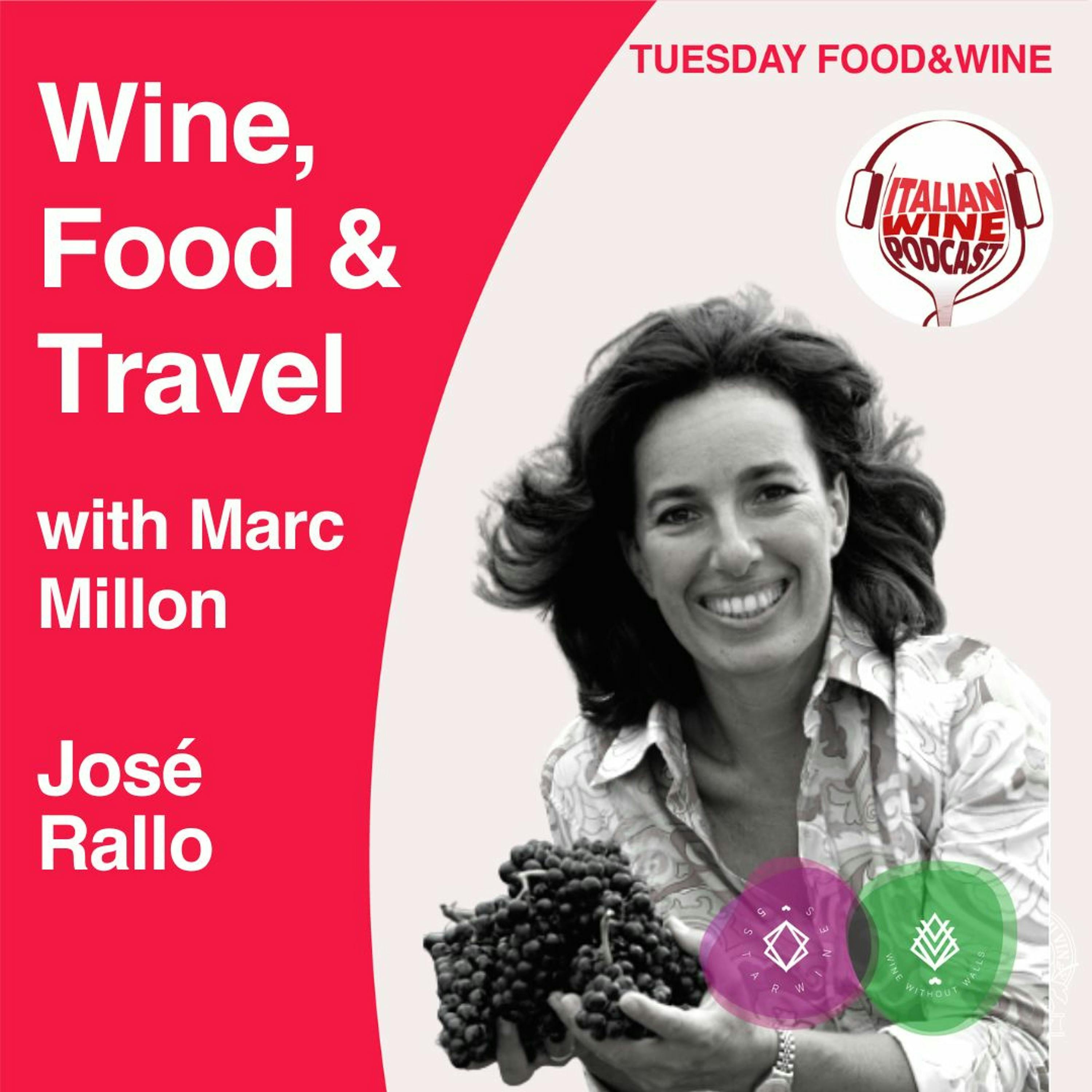
Ep. 1397 José Rallo | Wine, Food & Travel With Marc Millon
Wine, Food & Travel
Episode Summary
Content Analysis Key Themes and Main Ideas 1. The history, philosophy, and pioneering role of Donnafugata winery in Sicilian wine renaissance. 2. The unique terroir and traditional viticulture of Pantelleria, particularly for the Zibibbo grape and Ben Ryé. 3. The Rallo family's commitment to quality, innovation (cold technology), and sustainability in winemaking. 4. The intersection of art, literature, and wine, as exemplified by Donnafugata's artistic labels and name origin. 5. Sicilian gastronomy and food pairing, especially in relation to Ben Ryé and dishes unique to Pantelleria. Summary In this episode of the Italian Wine Podcast, host Mark Millen interviews José Rallo, CEO of Donnafugata winery in Sicily, following their Ben Ryé sweet wine winning the ""Best Sweet Wine"" award at the Five Star Wines competition. José recounts the founding of Donnafugata in 1983 by her parents, Giacomo and Gabriella, and their pioneering efforts to revolutionize Sicilian wine quality. She discusses the winery's unique artistic labels, inspired by Gabriella's vision and the collaboration with illustrator Stefano Vitale, and the origin of the ""Donnafugata"" name from Giuseppe Tomasi di Lampedusa's novel ""The Leopard,"" also linking it to her mother's ""escaping woman"" spirit. José details the harsh yet unique volcanic island of Pantelleria, the UNESCO heritage Zibibbo bush vines, and the intricate, labor-intensive process of producing Ben Ryé through sun-drying Zibibbo grapes and fermentation with fresh must. She also highlights Donnafugata's focus on native Sicilian grapes, use of cold technology, and commitment to clean energy. The conversation touches on food pairings for Ben Ryé and unique Pantellerian dishes, concluding with an invitation to visit Donnafugata's estates across Sicily for wine tourism. Takeaways * Donnafugata winery played a crucial role in the renaissance of quality Sicilian wines, founded by Giacomo and Gabriella Rallo. * Ben Ryé, Donnafugata's award-winning sweet wine, is produced on the volcanic island of Pantelleria from Zibibbo grapes using a unique, labor-intensive process involving sun-drying and specific fermentation techniques. * The Zibibbo bush vines on Pantelleria are UNESCO heritage, reflecting centuries of traditional viticulture adapted to the harsh climate. * Donnafugata integrates art and literature into its brand through distinctive artistic labels and its name, linked to ""The Leopard"" novel and a queen's refuge. * The winery combines tradition (native grapes, terroir) with innovation (cold technology, clean energy) to enhance wine quality and sustainability. * Ben Ryé is versatile, pairing well not only with desserts but also with strong cheeses and salted dishes. * Donnafugata offers wine tourism experiences at all its estates across Sicily, including Pantelleria, Marsala, Etna, and Vittoria. Notable Quotes * ""The project was to renovate totally the style of the Sicilian wine and the perception of Sicilian wine, in Italy and around the world."" (José Rallo on Donnafugata's founding mission) * ""We have a collection of thirty different, artistic labels since the last thirty years. We have been working together. So it's a really great, great, dialogue between art and wine that we have been approaching, along these years."" (José Rallo on their artistic labels) * ""Donna Fogata means escaping woman. And this woman, in my mind, is also my mother, who was, an English teacher when she inherited the vineyards, and she decided to change completely her life. And become a multiculturalist."" (José Rallo on the meaning behind the name) * ""Just think that we need four times human label cultivating, the vineyards in Pantelleria compared to a regular quality vineyard in Sicily."" (José Rallo on the labor intensity of Pantelleria viticulture) * ""What is really distinctive, is the acidity. It's very difficult to guess how much sugar there is in the wine because the acidity is really, a lot and it makes it very tricky."" (José Rallo on Ben Ryé's balance) Related Topics or Follow-up Questions 1. How has the recognition of Zibibbo bush vines as UNESCO heritage impacted viticulture and tourism on Pantelleria? 2. What specific challenges does Donnafugata face in maintaining sustainability considering Sicily's climate and the energy demands of cold technology? 3. Can you elaborate on the process of commissioning and designing new artistic labels for Donnafugata wines? 4. Beyond Ben Ryé, what other native Sicilian grape varieties does Donnafugata champion, and what are their unique characteristics? 5. How does Donnafugata balance tradition with modern innovation in its other wine production processes across its various estates? 6. What are some key trends José Rallo foresees for Sicilian wine in the global market over the next decade?
About This Episode
The owner and CEO of Donna Fugata winery in Sicily explains the success of their wine tasting and scoring, their world views, and the history of their name. They also discuss the use of energy to control the temperature of sellers and produce clean energy, the excitement of traditional wines in the eighties, and the importance of cultivating wines in a unique and special place. The passito de panteleria is a combination of traditional and innovative rules, and the complex production process takes 20-25 days to dry and distill. The importance of the acidity of the passito de panteleria is discussed, and the possibility of visiting the winery is also mentioned.
Transcript
Hey, guys. Check out Italian wine unplugged two point o brought to you by Mama jumbo shrimp, a fully updated second edition, reviewed and revised by an expert panel of certified Italian wine ambassadors from across the globe. The book also includes an addition by professoria Atilushienza. Italy's leading vine geneticist. To pick up a copy today, just head to Amazon dot com or visit us at mama jumbo shrimp dot com. Welcome to wine food and travel. With me, Mark Millen, on Italian wine podcast. Listen in as we journey to some of Italy's most beautiful places in the company of those who know them best. The families who grow grapes and make fabulous wines. Through their stories, we will learn not just about their wines, but also about their ways of life. The local and regional foods and specialities appear naturally with their wines. And the most beautiful places to visit. We have a wonderful journey of discovery ahead of us, and I hope you will join me. Welcome to wine, food, and travel with me, Mark Millen, on Italian wine podcast. Today, I'm delighted to begin a new mini series that highlights the winners of the prestigious five star wines and wines without walls, competition that took place earlier this year. Over the course of two long days, and they were long days because I was there at the end of March and early April, Actually, just before Vin Italy, more than two thousand two hundred wines were tasted by an international jury of wine professionals, including Italian winemakers, inologists, wine consultants, and international, journalists and professionals who all have our own different points of view. So we were all tasting and scoring this incredible array, and the wines that scored more than ninety points. Were both awarded certificates and also will be included in the five star wines and wine without walls two thousand twenty three book. Well, the very best wines in each category were singled out for special awards. So today, it's my great pleasure to welcome my guest, Jose Ralo, owner, the CEO of the Donna Fugata winery in Sicily, who's wine, Ben Rayer, won the best sweet wine award. Congratulations, Jose. And thank you very much for being my guest. How are you today? Yes. I'm here. Very fine. Thank you so much. I'm very happy to be with you. And you're in Marisala in the historic, headquarters of the Donna Fugato winery. Exactly. My family started in, in eighteen fifty one, and, we are now, we have renovated the sellers And we are now here, like, headquarters of our Donah Fogata winery. I know that the Donah Fogata winery is one of the most iconic wine estates in Sicily and the Ronald family, your family, is really considered one of the pioneering companies that helped to put quality wines in Sicily very much on the world wine map. And yet it's still a very much a family winery with strong family values. Can you tell us something of the Ralo family story and the history of the Donna who got the winery? Yes. Of course. Thank you very much for your words. Donna forgot the winery was founded in nineteen eighty three. So nearly forty years ago. The project was to renovate totally the style of the sicilian wine and the perception of sicilian wine, in Italy and around the world. My mother Gabriela and my father, Jacamo, were, beautiful couple. They were in love and they were passionate. So their energy was, right what it was necessary to do this great project. My mother inherited the vineyard in the center of Western Sicily in a region called and there she started cultivating vineyards and also making a lot of experimentation. First of all, with the international grape varieties, and then a little by little, also using the native grapes. Today, Sicily is very important for the biodiversity. We have, seventy native grapes, typically sicilian. So we have the opportunity of producing wines. Very different one from the other. And, we also have grapes that we can use in the future. So we can also hope that, something new is coming in the years, in the next years. Okay. Well, that's a a beautiful story about how your parents really wanted to revalue Sicily and its wine culture, this wine culture that goes back two thousand years. And indeed, I think from the outset, wine culture and the arts, have been very much at the heart of Donna Fugata. Yes. Very, very much because, Gabrielle, my mother was a, not only fond of a Viticulture, but also of, art. She was very creative, and she lunched the idea of, using artistic labels for our wines. She found, a very special person, Stefan of Italy, an illustrator, it was, illustrating books for children. And she found that these designs were perfect to realize to produce artistic labels for our wines. And so, She is briefing the, artist every time we produce a new wine, and we are sending him, some samples of the wine so that that he can, learn about the personality of the wine, and then he will design a woman that will be the main visual of our, of our label. We have a collection of thirty different, artistic labels since the last thirty years. We have been working together. So it's a really great, great, dialogue between art and wine that we have been approaching, along these years. Wow. Thirty years of collaboration. It's a beautiful collaboration. I really love the labels because they have such a vibrancy. They have the colors of Sicily in them, and they have this vibrancy that I think is also reflected in the wines. They're quite different and unusual. For wine labels with so much, you know, the illustrations and these beautiful colors. And so I think it's a wonderful collaboration. Now, of course, the name of the estate, Donna Fugata, the name of the country, a state of the noble aristocratic family of the Prince of Salina at the time of resorting men to in Giuseppe Tomazi Delampeduza's famous novel, the leopard. How did the name of the estate come to be? Why did your, your parents decide to name the estate Donna Fugata? Well, it was a great challenge because they studied a lot of different opportunities for this name. And my mother thought about, you know, something that was, very important for sicilian image, the novel of Thomasy de la pedusa, the leopard. It was very famous. And we discovered that it is the most translated Italian novel around the world. So very famous, the story of the novel. And, in this novel, we have, a special a state, which is called Donna Fugada Estate. And, in the state, a Donna Fugada Palace. In this palace, we can find some of the most important scenes. Of the of the novel. And it was called the Don of Gata Palace because, a queen took refuge in this palace. And it is a real story person. And and so my mother liked very much the name because of the re this reason because it was a positive image of Sicily. But, I like to think also something else about our name because Donna Fogata means escaping woman. And this woman, in my mind, is also my mother, who was, an English teacher when she inherited the vineyards, and she decided to change completely her life. And become a a multiculturalist. And so for me escaping woman is my mother looking forward always ready for new challenges. Okay. That's a that's a beautiful story both linking it to this great Cicilian novel, and and as well to your mother's own story and how she created this estate together with your father. To me as well, the name is also brings to mind what you're doing with your wines in combining tradition, the tradition of of Sicily as a as the prince of Selena, but also at this this time in Italy of risorgimento of new traditions coming in, and that it's sort of reflected in your wine, Tancrediv. To me because Tantreide is both modern looking ahead, but also has his foot in the tradition. And you do that with your wines, don't you? Yes. Of course. We, we are traditional because we We try to be very much, related to the territory, to what is it is typical of our soils, of our native grapes, but we are also innovative because, my father, Jacamo, brought the, cold technology from, California to Sicily. And so in the eighties, it was, really new to ferment, the master, under control of the temperature. And this was really, important to change the style of the wines. We, obtained the wines that are very much fruity with a big freshness with a greater aromatic potential. And that this was, thanks to the cold technologies. And cold technologies are also very important when we refine the wines, either in the tanks or either in, in the Barrick, or when they are bottled. So, in a in a in a region, which is quite a warm region like Sicily, cold technology can help, very much, maintaining quality and enhancing the quality of the wines. Of course, I must say, something else that we use energy. We consume consumer energy to, to control the temperature of our sellers of our tanks, but we produce also clean energy to, balance the consumption of energy. So since thirty years, we started producing clean energy with a solar power plant. Okay. Well, that's actually very important in the history of modern sicilian wines, the renaissance of wines, how, your father and other pioneering winemakers in Sicily began to harness modern technology to really change the style and character and potential of wines from Sicily, particularly perhaps in western Sicily where you are now, where We have the traditional marsalas, the oxidative style lines where the heat and that, cold fermentation is not so necessary. So it really was a revolution in wine. Now you've mentioned Contessa Antelina and that you're in Marcella, and you have an estate in Victoria as well as in Aetna. But I'd like now to focus on a Very special place in a state that is the source of Ben Rayer, the special sweet wine that won this prestigious five star best sweet wine award. So Jose, could you please take us to the island describe it and tell us what makes it such a special place to visit as well as such a special place to grow grapes and make wine. Well, it's a pleasure for me Teleria is really a very, very special place. Nobody can figure, how how it is displaced and until you get there. It's a volcanic island between Sicily and Africa. In terms of climate, probably is more African than European or a sicilian. It's very dry, very few water, rain. It's very, very windy. And these two specific characters of the climate guide the farmers to a specific, type of, vineyards. We need to cultivate the grapes, in a bush form So very, very low with branches that develop, horizontally compared to the soil. And, around the plant, you can see, like a hole And in this whole, we try to collect the humidity of the night. And this is the only water that can help the vine to survive. This small vines are called are very low, typical of Panteleria. They are UNESCO heritage, and this is very important for us. And they are cultivated in terraces because there is a mountain in the center of the island. And so most of the vineyards are in a steep slope. So the terraces and the small bush wines are obliged us to a lot of labor for cultivating the vineyards. Just think that we need four times human label cultivating, the vineyards in Pantilleria compared to a regular quality vineyard in Sicily. So it's really, really expensive. And it is also very important to motivate the people that are working, with us. But they know that they are working for Benriere production. So they know that they are working a very unique and very special wine like our Pascito de Panteleria. Okay. So you've painted a beautiful picture of this harsh, harsh volcanic island and, the heat and the wind and this UNESCO sighted, unique form of Viticulture that I suppose has been carried out in this traditional way for generations and centuries and maybe even millennia this growing of the vines in pits by the alberlo and that intense labor that it takes to to cultivate the vines compared to anywhere else. And a particular vine, the tell us about this. Italian wine podcast. If you think you love wine as much as we do, then give us a like and a follow anywhere you get your pods. Well, the Zhibbo, it's a type of muscat grape. So it is, a very special grape that, we cultivate on this volcanic soils because of this combination, special grape and special soils. So we have a very, very special masts from these grapes. The Zibbo is a is a grape with thick skin that it is perfect to dry. So if we are we wanted to produce our passido Di panteleria, we harvest the the best grapes, the most ripe grapes at the mid of August. And we lay them on the sun in the wind of the island. It takes about twenty to twenty five days to dry the grapes at the right point at the point that we need to, there to be. And at the end of August, we have a second harvest, and we collect the grapes that will be pressed to obtain the fresh mask to the raisins, and we need to distend the raisins by hand. That means bury after Berry. We distend the raisins. And these berries are plunged into into the must during fermentation. So we have, a fermentation, which is, a little bit like red wine, also emaceration. And this fermentation lasts at least thirty to forty days. So as I told you and you can understand the production process is very complicated. It's very long. It's very delicate. And I must say that this production process is a combination of traditional and, innovative, rules. And it has been, invented by Donna Fogata and especially by my father Jacquamo. Okay. So this is this is very interesting that the passito, the uva passita, this drying of the early harvested Zebibo, and then that careful de stemming those grapes, the dried grapes are then added to fresh must, and the fermentation carries on, with the with a rimontagio or a capelos, Amerso to keep the skins underneath the must? Exactly. Exactly. We need to keep the skins inside the must for a certain amount of time, then when we think that the raisins have given all the sugars and so all the aromas and all the assets, we take away the raisins, and we put another quantity of raisins. And this will be for three times. Okay. Three different times you add the Exactly. Three times. The two and the amount in the end is seventy kilos of dried grapes added into one hundred kilos of must. And the the total is for that we need four kilos of uh-uh grapes to produce one liter of passito de panteleria. Oh my goodness. Wow. So huge concentration. And an absolutely exquisite wine that results this this gorgeous dessert wine that still it's sweet certainly, but it has such complexity of flavors and aromas. And I think an acidity that remains in the wine that that keeps it very, very fresh. Exactly. What is really distinctive, is the acidity. It's very difficult to guess how much sugar there is in the wine because the acidity is really, a lot and it makes it very tricky. This wine is perfect as a dessert wine, as you said before, but it's also wine for, salted dishes. I like very much with for instance or, blue cheeses like rock four, like gorgonzola, seasonate cheeses. Oh, how interesting. I wouldn't have thought of trying that with the strong cheeses. The pecorino cheeses of sicily? Yes. Yes. The pecorino or I don't know if you know the caciocavallo, the cheese within the eastern part of sicily. Okay. Now while we're on Pantilleria and while we're talking about food, Are there any particular dishes that are unique to Panteleria, not that would be paired with Ben Rayer, but perhaps with some of your other Donna Fugata wines, something that dishes that anybody who visits Pantelleria or indeed that western part of Sicily should make sure and sample. Something very typical is called the Chaki Chuka. It's a kind of, mix of vegetables like peppers, aubergines, celery, and capers. It's a cookie in the oven and, onions and and many times they put also, bread crumble, all over. No? And this is Chaki chuka. So Oh, I've not heard of that. That sounds delicious. Yeah. It's like a side side dish. Right. And and, as for dessert, one very typical dessert of Pantelveria Island is the Vacho Pantesco. It's like, two biscuits, inside the two biscuits, you you find ricotta cheese, fresh ricotta cheese, season it with, sugar, and, lemon, skin. You know? Oh, okay. Yes. Yes. The lemon rind. Yes. Yes. Oh, that sounds delicious. Then there is fish of course. It's an island. So you can find a swordfish for instance. They can, they can cook it in the hub and, with capers, always, chile, genome, and the small around, tomato, this is also very, very, very nice feature. It is always fresh. Yes. Wonderful. Now finally, Jose, can you tell us about wine hospitality with Donna Fugata our listeners who are located around the world often like to visit the places they hear about and taste the wines at the source. What are the opportunities for visiting your estate's perhaps in Pantaleria, but mainly I'm thinking on the mainland of Sicily. Well, we are opened in all our wineries. So from Marsara to Aetna, Victoria, We are open all the year round. Is it possible to visit the winery and to choose among different, tastings with or without, food pairings with typical products of the territories. Then we have Panteleria and the contest in Delina, our main estate, in the middle of Western City, where is it possible to go from May till September so in the high season. And also there, is it possible to visit the vineyards and to, taste the typical products, match it with our wines? Okay. Well, we've talked about a little bit about your wines, but Donna Fugata produces very impressive range of wines from these various estates, and I urge our listeners to seek them out, notice these beautiful vibrant, colorful labels, and to taste the wines because they are really, really special. And especially this best sweet wine, the Benre that we've been talking about. Jose, thank you very much. It's been a real pleasure speaking with you this morning. Learning about the Ralo family and the Donna Fugata winery. Congratulations once more for winning this prestigious five star wines award for the best sweet wine. And, Grazier, a Riva Delci. Thank you so much. And enjoy wine and enjoy don't forget the wine. We hope you enjoy today's episode of wine, food, and travel. With me, Mark Millen, on Italian wine podcast. Please remember to like, share, and subscribe right here, or wherever you get your pods. Likewise, you can visit us at Italianwine podcast dot com. Until next time.
Episode Details
Keywords
Related Episodes

Ep. 2791 Italian Wine in a Changing Climate: PIWI, Terroir & Tradition with Nicola Biasi | Wine, Food & Travel with Marc Millon
Episode 2791
Ep. 2767 Le Marche: Verdicchio and the Wines that Shape the Region with Gianluca Garofoli of Garofoli Vini | Wine, Food & Travel with Marc Millon
Episode 2767
Ep. 2755 The Longest Table: Honoring Nello Ghezzo’s legacy | Wine, Food & Travel with Marc Millon
Episode 2755

Ep. 2712 Exploring Brda: Exceptional Wines and Slovenia's Culinary Traditions with Lan Kristančič of Movia | Wine, Food & Travel with Marc Millon
Episode 2712

Ep. 2700 Sardinia Beyond the Coast: Agripunica, Basso Sulcis & the Legacy of Giacomo Tachis with Salvatore Santus | Wine, Food & Travel with Marc Millon
Episode 2700

Ep. 2681 Giro d’Italia 2026 Special Episode 1: From Bulgaria to the Mezzogiorno in search of wine and cheese | Wine, Food & Travel with Marc Millon
Episode 2681