
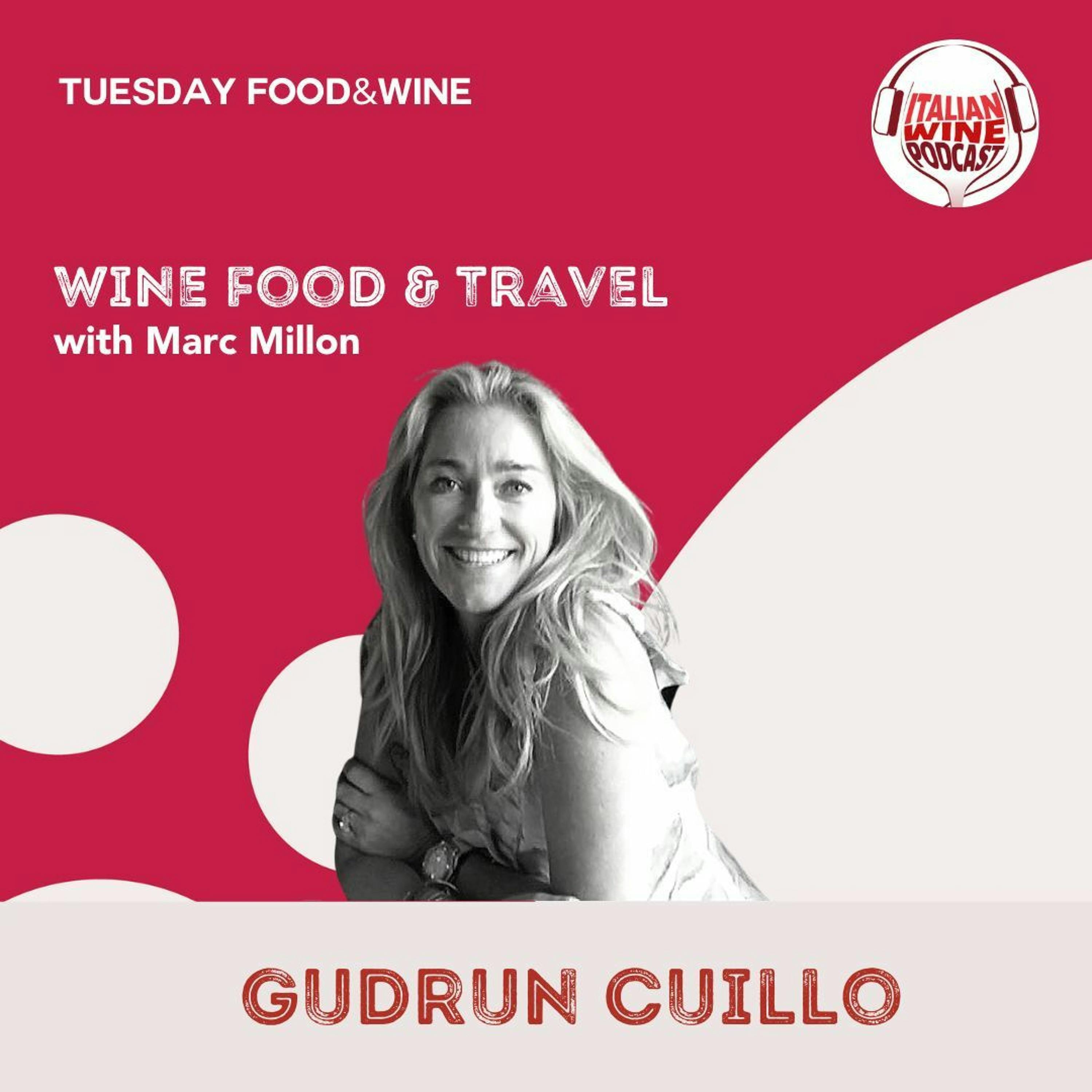
Ep. 1464 Gudrun Cuillo | Wine, Food & Travel With Marc Millon
Wine, Food & Travel
Episode Summary
Content Analysis Key Themes and Main Ideas 1. The multi-decade restoration of the ancient medieval Borgo Livernano in Tuscany. 2. Gudrun Quiloh's personal journey from an unexpected start to becoming an owner of a Tuscan wine estate and author. 3. The establishment and operation of Casalvento, an organic wine estate in the Chianti Classico region. 4. The unique blend of wine, food, and historical hospitality offered at Livernano. 5. The role of community, family, and shared vision in building a successful enterprise. 6. The impact of personal adversity on creative endeavors, leading to the writing of a novel. 7. The evolution of Tuscan winemaking and the challenges posed by climate change. Summary In this episode of the Italian Wine Podcast, host Mark Millen interviews Gudrun Quiloh, the owner of Borgo Livernano and Casalvento wine estate in Tuscany. Gudrun shares her fascinating and unexpected journey, which began when she married her husband, whose dream was to own property in Italy. This led them to discover and embark on the 23-year restoration of the abandoned medieval Borgo Livernano. Concurrently, they established the Casalvento wine estate, focusing on organic winemaking and adapting to the region's high altitude and changing climate. Gudrun delves into the challenges and rewards of living and working in Tuscany, highlighting the vital role of local masons and cultivating a close-knit team. She reveals how her husband’s battle with dementia became the unlikely catalyst for her to write a novel, which became a bestseller, drawing heavily from her own experiences and the magic of Tuscany. The discussion also covers the unique hospitality offered at Livernano, from bespoke wine tours and cooking classes to opera performances, emphasizing the immersive and tranquil experience guests receive. Takeaways * Restoring ancient Italian properties like Borgo Livernano requires immense dedication and long-term commitment. * Tuscan winemaking has significantly evolved, with high-altitude organic vineyards like Casalvento playing a key role in producing quality wines. * Personal challenges and adversity can serve as powerful inspiration for creative pursuits, such as writing a novel. * Building a strong, family-like community among employees is crucial for the success and authentic experience of a hospitality business. * Tuscany offers a unique blend of historical sites, culinary delights, and world-class wines, making it a highly desirable destination for travelers. * The blend of traditional methods (e.g., clay/concrete fermentation) with modern expertise defines the quality of modern Tuscan wines. * Embracing new passions and believing in oneself can lead to unexpected and fulfilling achievements later in life. Notable Quotes * ""It took the completion actually took twenty three years."
About This Episode
Representatives from Italian wine podcast speak with guest Goodrin about their experiences with Tuscany, a small town with vintage wineries and a chef. They discuss their desire to own a wine estate and hospitality business, their own story of finding a wine winery, and their love for creating wines and learning about wine. They also talk about their community and community that supports their personal growth, their success in creating wines, and their love for hospitality. They recommend Tuscany to listeners and offer to help with the process.
Transcript
Since twenty seventeen, the Italian One podcast has exploded and expects to hit six million listens by the end of July twenty twenty three. We're celebrating this success by recognizing those who have shared the journey with us and giving them the opportunity to contribute to the on the success of the shows. By buying a paper copy of the Italian wine unplugged two point o or making a donation to help the ongoing running costs, members of the international Italian wine community will be given the chance to nominate future guests and even enter a price draw to have lunch with Stevie Kim and Professor Atigioshenza. To find out more, visit us at Italian wine podcast dot com. Welcome to wine food and travel. With me, Mark Millen, on Italian wine podcast. Listen in as we journey to some of Italy's most beautiful places in the company of those who know them best. The families who grow grapes and make fabulous wines. Through their stories, we'll learn not just about their wines, but also about their ways of life, the local and regional foods and specialities that pair naturally with their wines, and the most beautiful places to visit. We have a wonderful journey of discovery ahead of us, and I hope you will join me. Welcome to wine, food, and travel with me, Mark in on Italian wine podcast. Today, we traveled to the heart of Tuscany's Cianti classico to the ancient now restored Borgo of livernano and to the Casal Vento wine estate to meet my guest, owner, proprietor, and author, Goodrin Quiloh. Thank you so much for being my guest today, Goodrin. How are you today? I'm doing absolutely wonderful behalf in the magazine weather, and the sun is out. And I'm very happy to be a part of your cast today. I'm looking forward to questions, and I hope I can answer them properly. Well, I'm sure you will because you have such a fascinating story. Now, Gudrun, first of all, for our listeners to gain a vivid impression of where you are, can you describe the Bordeaux of Libernano, please? Tell us, you know, where you are, what the landscape is like in this beautiful part of the Kianti classical. Okay. So, Lebanon is, medieval Borgo. It's one thousand five hundred years old. It sits in the rolling hills of Tuscany. We bought this in two thousand. It's the last the, family actually left Givenama in nineteen fifty three, and it was completely abandoned. And, we decided to try to restore the helmet So events today, I have seen Ziena, and, we were able to restore five of the buildings because we had to have adjacent, corners by law, and the church of, Evan Allen. And, as, you know, a lot of people don't know, Tuscum is still very remote in a sense of, especially Kianti because we have, like, seventy two percent of woods and only thirty, twenty eight percent is, actually, in habitats, we have, vine groves, olive trees, and, small little houses that, a lot of people, a lot of foreigners actually came and restored them, which is a positive thing for us. I believe. Oh, that sounds such such a beautiful place, Gujran. So I'm picturing this medieval, borgo, as you say, more than a thousand years old that had been abandoned, completely abandoned. As happened, as you say across Tuscany, when the Mesuderia finished and people moved to work in cities. And you came across this this completely abandoned border. And and you and your husband spent a long time restoring it. Is that right? Yes. It took the completion actually took twenty three years. Oh my goodness. Wow. That's okay. Yes. I mean, we were very much inclined of, using local masons. And, the facility really looks as it was, you know, one thousand five hundred years old, but with modern amenities. And, we now host, you know, guests. It's only for guests. We have a a chef on the property, And, our wineries are organics. Also, Dibana has to serve organic foods on Casa Grande, we have, two acres of, vegetable gardens, and, truffle trees, So everything is, like, we are completely self contained except, you know, poachery and things like that that we have to be. Sure. Sure. It sounds absolutely amazing. Now, Godran, I'm curious. Tell me your own story. You didn't ever expect, to necessarily be living in Tuscany and running a wine estate and a and a and a hospitality business as you're doing now. Tell me your background and how how all of this happened I also, I married my husband some twenty five years ago. He was the first born of Italian immigrants, immigrants, immigrants, and, very poor when he grew up. He was the second youngest of seven children. And actually got his first pairs of shoes when he rented a navy. And he always promised himself he would make it from the wreck to the riches. He would go and, buy himself a property in Italy. His family came from Naples in Venezuela, and our initial idea was should buy something in Calabrio. And, unfortunately, the deal did not go through. And, Bob made his money in the car industry, was one of the largest Toyota dealers, and, was the first one who had the first Texas dealership in his dates. And also many other dealerships and we are called closest friends, and they came to visit him in Tuscany and fell in love with the area. And, we bought a house in the heart of Kianti very fast in one week. And, we had no idea that the property came with county, Calcica rights. We found that all it's, six months into the process of restoring our home here. And, at that time, you were still able to sell the rights to different, estates, but then it would not you would not be able to later on make or, you know, build a winery and our vineyards. And, so we decided that we're gonna go and make our own minds in our own vineyards. And we started in nineteen ninety seven when we purchased Casalenta, in two thousand, the excavation work was done, and the first plans were planted in two thousand and four was our first vintage. And through the process, we decided that we would like to have something else that is adjacent and Levanano was coming up for sale. And we took that opportunity and bought Livanano. So Levanano and Caseland are actually actually adjacent to each other, but we cannot go directly to it. So you have to drive around one mountain into the second mountain to leave an unknown. Oh, I see. So they're actually separate, states, but I I know I know that area around Radeh and Kianti, and the hills are very steep, and you do have to go a long way sometimes to go very, very close to somewhere very close, but an absolutely beautiful area. And, of course, an area that, is the source of some of, the greatest county classical wines. That are produced? Yes. Absolutely now. Because of the climate changes, you know, the county Casico is, basically, from two hundred meters to six hundred and fifty meters. So Casalenti is one of the highest properties for six hundred and fifty meters, and Givenano is four hundred and fifty to five hundred meters high. And as you said before, yes, most of the areas, the helmets are really very far apart. And, when we go to Casa to Livinano, you actually have to ride for six kilometers on astrada bianca on an unpaved road that connects Rada De Ziena. And, customer service, like, oh my god. I hope to make the right decision. And then when they arrive, they have a saying they have a Oscar at Astra, it's a Latin phrase that says with the difficulties to the stars. And it's when they come up the hill and the gate opens up and they have the road's going up the hill and the Cypress trees following you up there to the top of the mountain, and then you enter the hamnet. It's just like you forget every horse, and you're just happy to be there. That most of our customers, when they make the reservations, they always tell the receptionist what they can do around the area throughout what place they should visit. But when they arrive in in Givenano, they don't wanna leave. We have an amazing chef there. And a great team, that speaks care of the customers. And they are they're going back in time. You know, they forget the hectic of their daily lives and just enjoy themselves at the pool or takes some poesy walks around, the banana sees the game. Yeah. It sounds absolutely idyllic. And also, as you mentioned, climate change, I'm sure that altitude also helps keep things a little bit cooler in these hot summers that we've had in recent years. Absolutely. Absolutely, especially in Casa. Casa then was the was the first property that you and your husband bought. Is that correct? And you be and you began then really very early on into the project to make your own lines. And you're making an extensive range of wines. You're making Cianti classical Tianti Classicco Reserve, Chianti Clasico, granza lazione, and also some Super Tuscan wines. Tell us about your wines. And did you did you ever envisage being a winemaker? And is this really a dream? No. We, you know, behind an analogist and agronomist. And with them together, the process was so intriguing of the planting part choosing the right weed stalks. And them seeing them growing, and they're right in front of my house. The cover of the book actually is the view of my of my house. And, I I was much younger than my husband. And, Ryan was always his passion. He was with the Shindra Wautisui. He was the Baye, the East Coast of of the United States and the Caribbean, which is one of the oldest gourmet societies in the world. And, then later on, I was just asking, miss Spaginald, I really would like to be much more involved, and it also will give me something to do. And with that sense, I worked with with the agronomists, with the technologists together, And my husband's saying was always in his day of age. He doesn't buy green bananas anymore. Everything has to be perfect. So we really put a a a lot of effort time, expertise, into the runways, into our vineyards. And, you know, we have to blend eighty percent, centuries, because it's the minimum of amount that they have to have. For a Cantic acid because you have to go off to the rules of the Cantic acid for consortium. And then twenty percent, you are able to use grapes that we have on the property growing. So Casalvento has, as I said, Sanjay, they have Malone, and we also have Alacante. So this is great to use for, just to enhance the color because of being organic. And Levanamel is, Cabello, mellow, Sanriza, and also we have a white wine. So we have planted, chardonnay, so we can look and give it to you now. Well, it's quite an extensive, a range of great varieties and and and an impressive selection of wines that you're making? Yes. And and quite honestly, the first vintage two thousand and four, the events, to the Gambo Rosa and to either borrow to, you know, submit our wines And when they were dazed in our wines, they did not believe that the wine was actually made in Tuscon. So they told us to come back next year again, and, with the same product and the dates, and then from that moment on, radix succeeded, everything that they ever thought. And, you know, always over ninety percent. The cancellation from Lebanon, the first vintage that we made was chosen as best wine of cancellation of Tuscany. And, we decided that we only make the wine if the year is too active. The year is not good. We don't make the wine. We sense to choose Octamodina and to make balsamic vinegar for us. That you use at the hotel. Yeah. The grandson, let's see on there, of course, being the top of the Kianti classical pyramid for wines from a single estate, of the very, very highest quality, longer aging discipline as well. So, that's a real achievement. Now on top of the Casal venta winery, you restored the borgo deliver Nano, as you said, which is now the hospitality complex, which we'll talk about in a minute. But I guess all of this, the the learning about wine, making wine, restoring the border. All of this was Griss to the mill for you as a writer. Did you always want to be a writer? Did you have the intention of writing a novel out of your experiences? I am a dreamer. And, I have so many things that always go through my heads. And, I write every single day, but it's not a novel. I write short stories. I write love stories or things for my friends when they have from universities and things like that. But, writing a book came, came to it because there's a sad part to this whole thing. My husband became very ill, and, he was diagnosed in a long time ago, with dementia, and then it went in the Alzheimer, and then he had Parkinson disease. So when people know that your spouse is ill and especially people who know who are who are in my situation, it is very difficult to kill those people become different people, and, they don't know themselves anymore. So he became in a part of, early on where he was not allowing people in the house and being a caretaker and being there twenty fourseven. I I honestly didn't know what to do with my time, and I was talking to my mother, and my mother said, put on, why don't you just go and write a novel? So, I was like, this is crazy. She says, you are good. You know, And I come from a family that has very much artistic background. They also have, a grandmother who was a novelist, but more in the Austrian part, you know, in in in that area. And so I started to create this character, Erica, and, living in New York, you know, having the escalates of the high society thinking she has everything. And then, just before she is getting married, she finds out that, she has had relatives in Italy in the generic properties. And then she have to come to Italy herself, and then she arrives, you know, everything She did not could not imagine what's what's, or had no expectations. And then she came and saw Are you enjoying this podcast? Don't forget to visit our YouTube channel, mama jumbo shrimp for fascinating videos covering Stevie Kim and her travels across Italy and beyond, meeting winemakers, eating local foods, and taking in the scenery. Now back to the show. The kaleidoscope of all of the different colors and the people friendly and and then she found out he was her grandfather And, there was a stimulation in the world that she had to stay there for five months to live the life of Italy and to learn about the history, to learn of what her father, her grandfather, had missed out on her, you know, grandfather created. And, so long behold she's decided to stay there and became a completely different person. And I think this is when I realized when I was writing, that after the tenth, chapter that I was not writing in in the way of Eric and what it I became Erica, and I put my, my, experiences in. Before I met my husband, I didn't even know how to boil an egg. And now I love to cook. I learned to cook. I learned, to smell the roses to wake up in the morning to take this area in, to breathe, and and we have so many different, places in in twenty minutes riding in a car, and the the scenery changes. And, it is just for me breathtaking. It's really truly a place where a lot of people can connect, if they, you know, time goes by so fast these days. And you don't even know where the weekend when Friday arrives. And here, I believe how it is with me, but, it really gives me. I can smell the roses, and I appreciate the day. And I love waking up, and I all of my employees, we are a b team, not I team to create everything together. And for me, this is my family. Well, that's that's a beautiful story to hear. I'm very sorry to hear the sad, the very sad story of your husband, but out of out of that sadness, you were able to create something very positive. And that love of an excitement of being an italy comes through in your book and that that that discovery of a new world where Everything was different or you're smelling things, tasting things. Just I'll just read a very tiny snippet from the book. Dorris poured a glass of wine for Erica once she had made herself comfortable on the patio. And invited Dorris to join her for the meal. Dorris, what wine is this? She asked. I brought up one of senior Jermolo's favorites Janice two thousand seven. Erica swirled the glass and held it up to the light. The wine was a deep red color with the aroma of black currant, a hint of wood, blackberry, and, yes, that grassy earthy smell. Tuscany is in this glass, thought Erica, how wonderful it must be to go home, and open a bottle of our wine and have the genie of Tuscany come out of the bottle. So that's very much what you've you yourself feel, what your character feels. But above all, what you felt when you were when you came to Casalvanto and and also when you wrote the novel. Yep. I am in it's everything that all of the different emotions that we have every single day because not not each day is the same. And there is a saying, from Hans Christian Anderson, I just living a butterfly once said living alone is not enough. One must have freedom sunshine and root of flower, and, some, that's coming. He gave me that. And it didn't matter how sad I was or or or how happy I was. You know, I'm, like, this this house, this this space, the people around me that give me freedom and peace. It sounds like you've really created something very special and put together a community, that supports it. Absolutely. All of our employees have been with us from the beginning. Some of them came later, but none of them ever, you know, left. And we have now a whole family living there. And the whole family is working. Robbie is now eleven years old in the name of my husband, Domenica is now twenty seven. And, Donathan Pascuali Deborah, which is now Doris, has been with me for twenty three years. It's like a mother and sister at the same time. And all the workers are living out with the same thing. We are all together. We think together. We create our labels together. We taste our wines together. So now we don't even have an agronomist or an allergist anymore. Everything is done in house. And, I for me, my vision was that I wanted to make or create a wine that's when you really open the bottle, it that it's not over oak that you know where the wine is coming from. They are all sitting on the other raised stone. So it's fresh, the minerals that are there. And, the grapes have such two booths, and we don't irrigate. And they have to work so hard throughout the year to make grapes. And then us us later, it's our job to handpick them and bring them into a divine cellar. And, then goes into the next step, the next phase with the fermentation and the electric. And, and so we we have to infer the, the clay we have, the concrete. So we're going really back into the old ways of how, Italy or Tuscule was making the wines. And as a lot of people know, Tuscany was known for the straw value for the inexpensive wine, but we became so sophisticated here and, experienced it with with new winemaking, ways of making wine, and that's where the ICT, the Supertaskin was created because the wine maker was able to express his creativity and his art, and he put he can put this in the bottle of wine. Yes. That's exactly right. That story of the evolution of Kianti, as you say, from that easy drinking wine in the straw covered Fiasco to some of the greatest wines in the world. Now and some of those greatest wines coming from that particular corner where you are. Yeah. Now, Gudrun, for our listeners who like to visit and travel, Livernano is a special place to come and actually stay. You gave a a little picture of some of the things they can do, but tell us what you have for hospitality in the border. What, what accommodation, and what people can do if they come visit you. Okay. So the one now only has twelve suites, but can sleep, twenty four to thirty people. And, everything is done inside the fatigues. What people usually do when they come, you know, they receive the welcome train to check-in. As I said before, you know, they can walk around, with the PoSE walks. Sometimes we have music, different stations, that people can listen to it, enjoy the glass of wine, and just enjoy the scenery in the patchwork, the list, a kaleidoscope that's the different colors that Tuscany gives us, because we are on top of the hill, so we have, like, the surroundings, any anywhere you look, you have something special that you see. Then we have wine tours with the cooking classes. Sometimes we have, painting classes there are pottery places around where people can go and, and experience how to make, you know, potteries. They have, opera playing two turns a year. In in Lebanon, so very complicated, transform the piazza where the people are. And, it's the center of of where the houses are around. And then the includes the homes, the windows, the things, and everything. And when they start singing, you know, they they they have the area coming out in one window, and then, you know, they continue on from the next to come down. And it's just a very romantic very, familiar atmosphere that you have. And it becomes very What sounds magical? It is. And and men don't think that they cry at the end, they cry because they're still naked by it. And, yeah, and then, you know, we have Santa nearby, which is a beautiful ancients, Rowan City. We have Florence to visit the Pepizios, and all of this is also in my book. So it gives you a little bit I wanted to have in the book a bit of the winemaking, a bit of Florence, a bit of the area, the trees, the, the flowers, the different grapes that are being grown. I have also recipes that are included at the end. And even if the buying making part, it's not like a chewing gum that it makes you tired just reading it. It's very short, very simple, but it's something that when people, want to go and travel to Tuscany. I think this is at work. That is very well recommended to read. And I could not, and never in my mind, never even entered that I would immediately after the release on the sixth of June become a best seller in Italian literature in the category. And the following publications became the new releases on Amazon in the categories of including romance literature, fiction, channel, Italy, travel guides, single woman's fiction, small town, and world fiction woman's adventure, adventure fiction, historical, Italian fiction, and travel adventure fiction. You know, all in best, y'all, as I was like, this is this is unreal. Amazing. Amazing. You know, what what I would say, Gujran, for our listeners, is that is that they're they're two ways to visit, they can actually come and stay with you and do all those wonderful things. Or that can, buy and read your book. Tell us who publishes it and where they can get it. Okay. I was I mean, I really am for for a first time now, we'll send a book in. I was taking in immediately by, Greenleaf Publishing House. And they are a hyper company, and it's amazing how they work and what the network they have. Very easy to work with them. Book came out on time, actually a month earlier because there was very little things that needed to be done with the editing part. So I guess I have my own style of writing, which is is a little bit of a new breeze I was told. And, it's, yeah, and it's available on Amazon and available on any bookstores. If it's a beer, you can ask for it and they will ship it to you or order it for you. You can go to hootering hurlough, dot com, to order the book, and, of course, the phenomenal, you just, put in w w w, livinano, l I v e r n a n o dot I t It takes you immediately to the backside, shows you the rooms, the wines we make, gives you the story on the background of Yu'Donnell, and the girl Adriana, who does the, the bookings for the customers is amazing. So, yeah, It's a very, very easy way. And most people fly into Florence, and then rent the car and drive out and see the countryside. Another airport to go in is, Rome, and be a two and a half hours driving from Rome. Okay. Well, it's a it's a beautiful area. I certainly know that on a beautiful drive, either way. Adrian, you've you've described a project that for many is an absolute dream. I know there has been deep sadness. But the restoration of the Borgo, the making of your own minds, and writing a novel, you have been living a dream, even if, as I say, there were there were perhaps elements of nightmare through the sadness. I just like to congratulate you for everything you've achieved for creating somewhere that sounds so personal and special and also congratulate you for the book, which I've enjoyed. Thank you. And I'm working on my second one. So I'm really excited. I'm I'm in the story as, you know, Erica will continue with, again, with some more intrigues, you know, jealousy of neighboring estates when they come out with good wines. And, it's, yeah, it's a it's a dream come true for me. I enjoy it. I love it. And, I I found a new passion in life, and I guess the wishful thinking, and I'm telling every to everybody, everything is possible in life. You just have to believe in it, and you have to believe in yourself. Never forget to say thank you, embrace the people who work for you, and, give them back what they give you, and you, and create an incredible environment for yourself. It makes you happy as well. Well, that's a very good thoughts to to end our talk on. Goodwin, I've really enjoyed meeting you, talking to you, and I hope we can meet, in person one day. I would love to visit Leverno myself. But, in the meantime, good luck with this growing season. Good luck with your writing. And I hope you have a great day and a great summer, and we'll meet soon. Mark, thank you so much for having me. And it was amazing. Also, to hear somebody else reading a part of my book. So thank you for that. It made me tear you up. Oh, it was a pleasure for me. And please, come to leave an hour anytime we are here. I'm here during the summer, the winter, of course, I have to go back to the United States. And, yes. So thank you so much for having me on this interview. Thank you. I get to you. Bye. Bye. Listen to the Italian wine podcast wherever you get your podcasts. We're on SoundCloud, Apple Podcasts, qualify, EmailIFM, and more. Don't forget to subscribe and rate the show. If you enjoy listening, please consider donating through Italian wine podcast dot com. Any amount helps cover equipment, production, and publication costs. Until next time, teaching.
Episode Details
Keywords
Related Episodes

Ep. 2791 Italian Wine in a Changing Climate: PIWI, Terroir & Tradition with Nicola Biasi | Wine, Food & Travel with Marc Millon
Episode 2791
Ep. 2767 Le Marche: Verdicchio and the Wines that Shape the Region with Gianluca Garofoli of Garofoli Vini | Wine, Food & Travel with Marc Millon
Episode 2767
Ep. 2755 The Longest Table: Honoring Nello Ghezzo’s legacy | Wine, Food & Travel with Marc Millon
Episode 2755

Ep. 2712 Exploring Brda: Exceptional Wines and Slovenia's Culinary Traditions with Lan Kristančič of Movia | Wine, Food & Travel with Marc Millon
Episode 2712

Ep. 2700 Sardinia Beyond the Coast: Agripunica, Basso Sulcis & the Legacy of Giacomo Tachis with Salvatore Santus | Wine, Food & Travel with Marc Millon
Episode 2700

Ep. 2681 Giro d’Italia 2026 Special Episode 1: From Bulgaria to the Mezzogiorno in search of wine and cheese | Wine, Food & Travel with Marc Millon
Episode 2681