
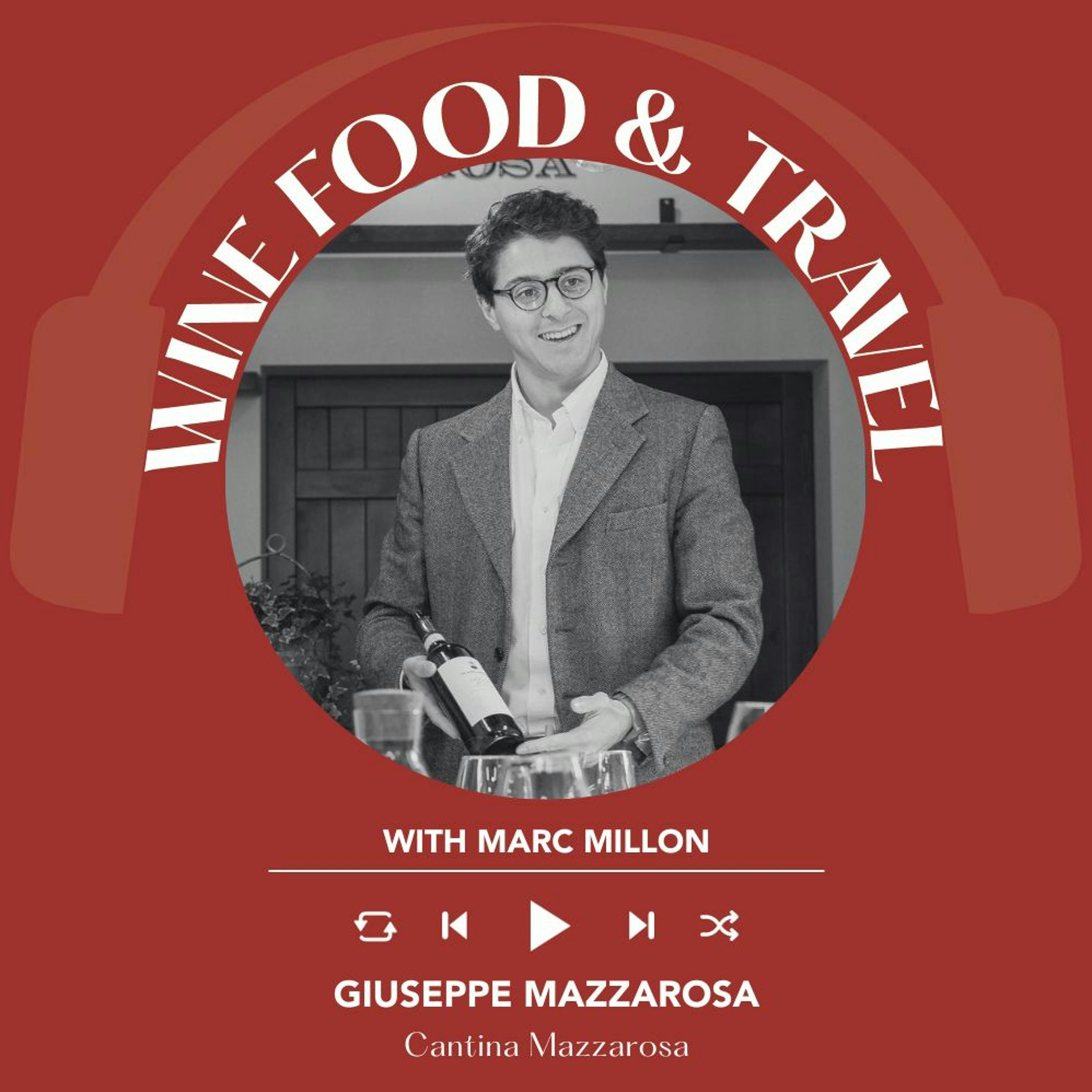
Ep. 1575 Giuseppe Mazzarosa | Wine, Food & Travel With Marc Millon
Wine, Food & Travel
Episode Summary
Content Analysis Key Themes and Main Ideas 1. The historical significance and pioneering spirit of Cantine Matserosa in Italian winemaking. 2. The unique terroir and geographical influences on Abruzzo wines, particularly at Cantine Matserosa. 3. Commitment to sustainable and environmentally respectful winemaking practices. 4. Challenges posed by climate change on viticulture and adaptation strategies. 5. Characteristics and production methods of key Abruzzo wines: Trebiano d'Abruzzo, Cerasuolo, and Montepulciano d'Abruzzo. 6. The rich culinary traditions of Abruzzo and their natural pairings with local wines. 7. The emerging potential and unique offerings of wine tourism in Abruzzo. Summary In this episode of ""Wine, Food, and Travel"" on the Italian Wine Podcast, host Mark Millen interviews Giuseppe Matserosa of Cantine Matserosa in Abruzzo. Giuseppe describes the winery's origins in 1861, founded by Senator Giuseppe de Riseis, who introduced modern viticulture techniques learned in Burgundy to Italy. He highlights the winery's deep-rooted commitment to sustainability, evidenced by its location within a national reserve and SQNPI certification, and discusses how sustainable practices influence their response to challenges like recent downy mildew outbreaks. Matserosa details their primary wines – Trebiano d'Abruzzo, Cerasuolo (a serious rosé from Montepulciano grapes), and Montepulciano d'Abruzzo (including a whole-bunch fermented version), emphasizing their goal to produce untouched, varietal-focused wines. The conversation also explores Abruzzo’s distinctive cuisine, such as arrosticini and 'chitarrina al teramana,' and how these dishes pair with their wines. Finally, Giuseppe promotes Abruzzo as an up-and-coming wine tourism destination, inviting listeners to visit Cantine Matserosa and experience its unique attractions, including vineyard safaris and Europe's second-largest wooden barrel. Takeaways - Cantine Matserosa, founded in 1861, is a pioneering winery in Abruzzo, notable for introducing modern winemaking to central Italy. - The winery operates with a strong commitment to sustainability, reflected in its practices and SQNPI certification. - Abruzzo's unique position between the Grand Sasso mountains and the Adriatic Sea creates distinctive terroir for winemaking. - Cantine Matserosa focuses on 100% varietal wines from indigenous grapes like Trebiano d'Abruzzo, Montepulciano d'Abruzzo, and Pecorino. - Climate change, specifically increased rainfall and downy mildew, presents significant challenges for winemakers in the region. - Abruzzo boasts a diverse and rich culinary scene, perfectly complemented by its regional wines. - The region is gaining recognition as a prime destination for wine tourism, offering unique historical and natural attractions. - Cantine Matserosa features the second-largest wooden barrel in Europe (100,000 liters), an impressive historical artifact on site. Notable Quotes - ""So we are in between the Grand Sasso Mountain, which is the highest peak from this center Italy and the sea. So we have this mixture of winds, the cold breezes that blew, from the grand sasso, and then the sea breezes that blew during the day from the sea, this affects in a particular way, the winery."
About This Episode
The hosts of the Italian wine podcast discuss their journey to Italian wines, highlighting their historic vines and local and regional foods. They also discuss the sustainability of their wines and their approach to sustainability, including their use of multiple varieties and treatments to ensure safety. They also discuss their love for traditional dishes and fish, and their love for traditional dishes and fish. They offer tours and remakes for tourists and emphasize their holistic approach to sustainability.
Transcript
Since two thousand and seventeen, the Italian wine podcast has exploded. Recently hitting six million listens support us by buying a copy of Italian wine unplugged two point o or making a small donation. In return, we'll give you the chance to nominate a guest and even win lunch with Steve Kim and Professor Atilio Shenza. Find out more at Italian One podcast dot com. Welcome to wine food and travel. With me, Mark Billen, on Italian wine podcast. Listen in as we journey to some of Italy's most beautiful places in the company of those who know them best. The families who grow grapes and make fabulous wines. Through their stories, we will learn not just about their wines, but also about their ways of life, the local and regional foods and specialities that pair naturally with their wines, and the most beautiful places to visit. We have a wonderful journey of discovery ahead of us, and I hope you will join me. Welcome to wine food and travel with me, Mark Millen, on Italian wine podcast. Today, we traveled to a brusso to meet Giuseppe Matserosa of Cantine Matserosa. An historic winery located Roseto Delia Broci. Giuseppe, many, many thanks for being my guest today. How are you today and how are things in Obrusso? Thank you so much, Mark. It's actually a hundred to be, I guess, but they tell me what cost podcast, which is a platform that truly celebrates the bridge tapestry of Italian White Culture. I'm doing very well speaking here from, from Roseto. And we are actually in a national reservoir located. Okay. Well, just, to give our listeners a vivid picture of where you are, the landscape, the terrain, describe a little bit about where you are. It's important, I think, for us to be able to visualize. So we are in the northern part of Abutsa, close to the Terrible city, and we are very close to the sea. And we are about one point five kilometers away from the sea. Divineyards are located around two hundred meters above sea level. They are on a hill facing southwards. The Vineyard, we're in a very interesting spot, because we are in between the Grand Sasso Mountain, which is the highest peak from this center Italy and the sea. So we have this mixture of winds, the cold breezes that blew, from the grand sasso, and then the sea breezes that blew during the day from the sea, this affects in a particular way, the winery. And also, we are very close to the Vominal rebirth We can actually see it from our vineyards. The river also adds an interesting effect on the white. Okay. That's a very good description, Giuseppe. I'm imagining this Grand Sasso, this mighty mountain sometimes covered in snow. Is that right? Exactly. That is right. And there are some ski slopes on top of it. Yes. And yet, you're still only a kilometer and a half from the sea. So that's such an interesting environment to be growing grapes. Now Mazarosa is an historic winery. You mentioned the date of its foundation right around the time of the unification of the Italian nation. So you go back a very long time. Tell us a little bit about the history of the wine estate. It's a pioneering winery. Isn't it? Yes. It is. Yes. It is. And, actually, the pioneer, the founder of the winery was a senator, so a politician in the first Italian kingdom. So we are in the very early days of the Italian kingdom just at the beginning. So around the unification of Italy, we are talking about eighteen sixty one. And, Josepe de Minchence, he was a politician, quite an interesting politician because he was let's say exiled from Italy because he had an argument with the previous king before the unification of Italy, there was a king of the southern Italy king of the two cities. He was reigning all of the Saudi region up until the center up until their roots up until where the pope was. And the senator had an argument with him, and he was exiled from Italy because he was against slavery. In contrast with the king who was pro slavery. When he was out, he had, the opportunity to travel a lot in France and in England. And from France, he stayed there a long time in the burgundy area. And that he was able to explore a lot, the advancement that they had done there with the verification process. And so when he was called back to Italy and to do the first minister of agriculture, in the Italian kingdom, he also decided to open a winery among many of the things that he did, and he brought back what he saw and studied in Burgundy. He brought it back to Italy. So it's a it's an example of modern verification, one of the first examples of modern verification that we find in center Italy. Well, that's a fascinating story going right back, as you say, the origins of the Italian nation, but bringing a modern outlook at that time. So it is a pioneering winery, and you're continuing that pioneering work today. Tell us a little bit about your operation, how you are cultivating the vines today. At the moment, I am representing the sixth generations after senator delinquency since the early days, we've always strived for a commitment to the environment and as well as respect for our workforce. Just to give you a couple of examples of this in terms of sustainability, the area that we are currently covering with the vineyard and with the winery, it's included now in a national reservoir. So they built a land national reservoir, just on the little piece of land that was not, let's say, constructed, and they took advantage of it's mostly all covering on our fields. And this is because we've been quite a few years we didn't want to build and overbuild the environment and preserve it the way it was. In terms of, respect, for the workforce, in the early days, senator Gizepeda Ingencic, he and vision, Azera, that will work with gravity. Now this is something that we see quite a lot and we're quite used to see in modern sellers, but it was not something common back in the days. And the way he did it in gravity, he had a water elevator that will bring up the grapes once they were freshly harvested. And then she had a system of, carriages, a system of rails, and probably to bring around the grape on the top floor and then they would be dropped down directly in the barrels. And this was made to avoid the hard work that would be required to bring the grapes up manually, which was the common way to do things, back in the days. Well, that's fascinating. So he was really an innovative thinker and looking at ways to work more efficiently as well as to produce better wine. Exactly. Exactly. So an approach to sustainability has been part of the winemaking philosophy work in the vineyard as well as in the cellar then from the outset. Exactly. Yes. Being nestled within the reserve at El Borsacchio, which is the HR reserve we have here, we feel the responsibility towards, nurturing and preserving the natural habitat. Iowa vineyards are tended with the utmost respect for the environment, and we try to avoid the use of added sulfites in the wine production. And the holistic approach coupled with sustainable multicultural practices has earned us the SQNPI certification, which is a recognition, from, the European Union of environmental and ability and integrate the agriculture. We can also see this in a way we work. Now, Giuseppe, you were telling me a little bit about some of the challenges of this particular year, this year when it's been so hot, and it's brought problems to the vineyards. But does this sustainable Viticulture actually allow you to cope with extreme conditions more successfully? Actually, it makes it more challenging. So it's, of course, when you go for a sustainability, you go for integrated agriculture, you have a less restricted area of operation. So you can use, let's say, less leverages to contrast the problems, for example, in Abruzzo we had this year a lot of downy mildew. We are talking in general in some regions, in some parts of the South of Abruzzo of around thirty to fifty percent loss in yield. And this is mostly because we are not used to a climate like the one that was this year, where there was lots of heat, together with lots of rains. And, actually, the problem was, because of the rains, because it rained so much in such a short period of time. Maybe there was also some floodings in many of their areas close by to us. The problem was that many producers were not able to enter the fields and, provide the treatment to the vineyards. Luckily for us, we were able to do it early enough. So we did the treatment, couple of days before the heavy rains, so that got us quite well saved from this downy mildew. And then, of course, as soon as we had the occasion to enter the fields, we would go in and and do some more treatments. And, I guess, this is the challenge in the sustainability of the product that you can use. You have to do, more control and more monitoring of the vineyards because they're not very powerful, of course. Wine to wine business forum. Everything you need to get ahead in the world of wine. Supercise your business network. Share business ideas with the biggest voices in the industry. Join us in Verona on November thirteen to fourteen twenty twenty three. Tickets available now at point wine dot net. Okay. So rather than spraying strong chemicals, you're doing more holistic treatments to control the problem, but it does mean more more attention and more work in the vineyards. Which is happy. Let's talk about the wines that mozzorosa produces, the most important wines. And I'm really thinking about the classic wines of Trebiano Debrutso, cera swallow, and multiple channel debrut so. So, but also winery, this is also another thing that distinguishes us. We try to use our top ten most varieties, and we only benefit with a hundred percent. Each wine is a hundred percent of that of our variety. We don't do a weak lens. We have three different main grapes. It's, the multiple channel, the pecorino, and the Treviano. And, of course, with the multiple channel, we are able to produce as well the chain as well. So overall, we produce three different types of multiple channel ones of jarrah's warlock, one Pecorino and one Cerviano. These are very historical varieties in our area. Except the pecorino, which had arrays at a quite a moment ten years ago, and and it became quite popular, but it's not as seen as one of the most historical varieties. Okay. Well, let's start with the Trebiano Debrut. So Tell us a little bit about this wine, how you produce it, and the style of wine you're looking to make. So our triviano, we try to leave the wine as untouched as possible. So one of our philosophies to cry not to amend the wine in the cellar, but to have the nature and the year and the vintage, make the difference in the wine, the weather, of course. And so what we try to do with the Trebiano is We have it quite cold. We put it in the stainless steel. It stays there for, six months, and then it stays, six months in the bottle. We don't do any woods. Our tribunal is quite elegant and structured and it has a touch of minerality. Then, again, it can be connected to the proximity with the sea and some lemon notes as well. Is this great variety that Treviano Abruz says? Yes. It's actually which is not to be confused with the Trebiano of Tuscany. Yes. Right. Okay. That's important. A much fuller style of wine, a wine that we'll be discussing in a minute that will go with food very well. The Charaswolo is an interesting wine as well. Tell us about your Charaswolo, just up there. Yes. So Charaswolo, it's a wine that it's made a hundred percent from the multiple channel rate. Sometimes we do a short laceration, which is around twelve hours on the skins. In some years, it's not even needed because with the crushing, the grape juice is already in contact with the skins enough time to give it its, nature and color, which is a very strong pink color, and very different from the rosette that are most commonly known that it prevents a rosette. The idea of the Charles rollo is that it's a rosette wine, that goes very well along with a full course not, typical Roset that it's usually used just for appetizers. Okay. So it's a much fuller in color, fuller in structure, fuller in body. It's a a serious rosato. Exactly. Exactly. Just to give you an idea, our, Sherazuolo of last year had fourteen point five degrees in alcohol. So you can imagine the structure that he had and the body as well. Okay. That sounds very powerful. It's a wine. I like very much when you come across, the good, well made example. So I look forward to tasting that. And the multiple channel debruso, would you say this is the flagship of your estate Yes. Indeed. The multiple channel is the grade that we have the most production of and, we have the highest, the most amount of hectares of multiple channel. We do it in three different versions. Two of them are POCG because Again, the area that I described earlier is a very small area, and it's called Colina Terramane, and they got the first EOCG in Abruzzo region. And so two of our wines are POCG. We have a regular multi functional and then a version that does wood and hs for very long, and it's the reservoir. And then we have a new, let's say, a new experiment that we did a couple of years ago, which was quite interesting, and it's the very novel multiple channel that is a POC, and we experiment for the first time, the whole bunch of unification with the multiple channel rate. Okay. What style does that give then? It gives a style. It's gentle. It's more gentle in penning that the regular multiple channel And it's actually an interesting effect because when we verify, we put thirty percent of full grapes of full bunches. This is together with the rasps as well inside of the stainless steel barrel. And what this does is, of course, the rasps, they have their own tonnage, which is quite strong, but it somehow balances out with the tonnage of the multiple channel, which, of course, is known as well as a quite a tonnage. Great. They kind of complement each other and the turned down, overall, the effect is of a more gentle tenant. And then, of course, it has some black notes of cherry on the pallet, and it's a very interesting expression of the moon the blue channel. It has touch of, I think, that the whole bunch gives a touch of, white pepper as well, of a bouquet, of dried raspberries, flowers. But it's not the common here that we have with whole bunches. It's something quite different Oh, that sounds very interesting. Now Giuseppe, all of these three lines that you've described so well, I'm imagining that this landscape that you're in with the sea nearby and the beautiful hills leading up to the saw. There's a range of cuisines from mountain, as well as from sea, and your range of wines would go very well with them. Tell us some of the typical dishes of both of a brusso. Maybe more specifically of where you are and how those dishes would pair with your wines. In Abrusso, it's a region where we are at, as I said, it's in between the sea and the mountains. It's very famous international now for the, Barostetrina, which is lamb meat that is cooked on kind of like barbecue, style. So lamb is one of the cuts of meat that is most famous for in a blue sauce. I'm just thinking of those Autosticini on skewers. Small pieces of lamb threaded on the skewers and cooked over charcoal. Is that right? That that is right. That is Yeah. It's a delicious one of my favorite things. And what wine would you enjoy with that? So for example, for the rosaccini, the red wine is very good. Our classical, multiple channel, or our whole bunch, multiple channel. Or, again, as well, the Charazolo, as I said, is an interesting Rosier, and it has quite a large spectrum of plates that it can be combined with. We can start from, slightly some vegetable soups, some, white meats, some fish soup. But again, it also gets to a spectrum where you can cover white meats. And in this case, we fried it with the lamba of Terostichini and it's a very, very good combination. So if you were getting together with your friends, would you fire up the grill and cook those Arostichini and stand around enjoying that within a parativo or would it be more as part of a meal? So the the rosichini, it is part of a meal. And we actually did it, a couple of weeks ago. We had the whole staff of the winery enjoying a night, and we did corporate event. And we just stayed in the space that we have in front of us. We are below the olive oil trees. And, we turned off in the fire, and we cooked some of the cecchini. We'll head them with Charazuolo, and it was a very, very good combination. But, yes, they are also treating. We had them as main course for dinner because it's quite a a strong blade to have, so definitely part of a very interesting dinner. For example, some people do it in the winter, especially. Uh-huh. That sounds very, very nice. What about the typical fish of a brusso? A typical fish dish to enjoy with your white wine or your ceteris wanna w wines that are quite powerful in character. So, for example, we have, there's a very typical fish broth. That is very common. There is another thing that it's given as an appetizer. It's called, they call it fish salad, but it's not actually, it has calamari and squid as cold cuts. With lemon. It's a very nature. All a plate doesn't have, much technique to it, but it's delicious. Trying to think, for example, between linguini or or the kitarina, which are some very common plates here. You can mix them with lots of types of fish, for example, shrimps or or some local, a small fish at the other fish in front of here. Okay. So it's a really rich and varied cuisine in a with the pasta dishes, as well as the meat and the fish. So it's quite a wonderful cuisine to enjoy with your range of wines. Yes. Yes. Indeed. What would be the most typical pasta then? So here in the area, we are in the Teramo area, and there is a pasta that is called the kitarina Alateramana. It's a little bit of where the spaghetti within those came from because it has Yes. This this very, very small meatballs, they are about the size of any or something like this. And then it has the hittarina, which is a handmade pasta sort of like a spaghetti but cut very thin, and it has egg as the main component as this fresh pasta. It just goes with the tomato sauce. And sometimes here, they put it on almost every plate, the chili pepper curve, and it's called Saipani in language and in Deborah. So dialing, I think the best combination for this place is just the total. It's red chili oil, virgin olive oil that makes with red chili, and it it makes up for a very good past That sounds wonderful. Again, that would then go with the multiple channel, Deborahzo? Yes. In that case, yes. Giuseppe is the area you are in. Is it an area of tourism? It's, growing it's an interesting area. I believe it's on the rise. It's not as well known for tourism as I believe the typical AButian tries to preserve its length and the common idea that it was. It's we need to keep it safe from tourists in some ways. And so, historically, it is not a a place where tourists develop a lot. If it did develop, it developed along the coast, but not in the beautiful insights where the marvelous views of the heels are. These are very different heels from the Tuscan one, for example, because the Tuscan one is a gentle heel where you can see very far away in view. And here that the hills, they tend to go up and down very sharp. It's different, but it's also a very beautiful view in my mind. I believe, there is a region very close to us. It it's Kuga, and the northern part of Kuga, which is that the closest one to us has developed very interestingly in tour because of tourism, and he was able to attract lots of tourists. And so I believe Abruzzo is following a similar path. Although it's a few steps behind, But I believe it could become one of the most interesting regions to visit. And there are two things to remember. Abruzzo was mentioned to be the greenest region in Europe last year. This was a very big win for the wine sector in Abuzzo. It was, mentioned by Wineentes as the wine region of the year, and I think that contributed to our trust, loss of interest, especially for wine tourism. Well, that is very interesting and particularly relevant to our listeners who do like to travel and visit some of the places that we talk about. So Giuseppe, if any of our listeners would like to visit Cantine Mazzo Rosa. What are the opportunities to do so? We offer lots of different attractions to tourists. We have three main experiences that we offer. And one of them is let's say, a regular tasting, but it's not the common tasting that you find in a one way. We are talking here about five different wines that are tasted, and it's a two hour tasting that goes where the acknowledges of the winery comes out and explains directly how you build a winery, how he does the wine. And as well, this is together with a winery tour, which is, again, our winery is a bit of an attraction because of its age. Inside of the cellar, we have the second largest wooden barrel in Europe Oh, my. How big? It's a hundred thousand liters. Wow. So that would be the equivalent of one thousand hectoliters. It's a giant. The room was built around the barrel just to make sure that it fits inside. And that's a funny story. The idea there was that in the past, because the wine would be delivered by many different producers. Every farmer did its swine in the backyard, and then it it will turn it into the wiring for verification. And what was difficult there was to have a homogeneous wine. Have a large quantity of homogeneous wine was very difficult. So, again, the genius of the Senate thought that the solution to this was just to have a very large wooden barrel. And so that's where where where it came from. So that large barrel dates back to the origins of the winery. Exactly. Except. Is it still used? No. Actually, not. Actually, not. It's not used. And now, I guess, for sanitary reasons, it's not of use. We cannot use it anymore. But it's still there. But still part of the history of the estate. Exactly. Exactly. And then just to complete on the tours, we also offer a safari tour where we bring people on a jeep, the tourists or visitors on a jeep, and we take them directly to our wineers, which are a couple of kilometers away from the cellar. And that we explained to them. For example, this year, we are explaining a bit on the down email deal. So it's a short master class on binary management. And then we have some picnics, so for people who just wanna come and relax, and we offer a picnic, in, Okay. Well, those sound like very, very interesting options. And your description of, brusso as a region to visit will have made our listeners wish to visit, I'm sure, because it's an area that is still so beautiful and majestic, much less visited than areas like Tuscany or maybe even up the coast in Maire, but which really deserves to be discovered not least for its wines and its wonderful foods. Juseppe, thank you so much for telling us the story of Cantine Matzerosa for explaining the wines you're producing today and sharing a little bit about life and food and wine in your corner of Italy. Thank you so much, and I hope the harvest goes well. And, I look forward to following your story and to meeting sometime in the future. Mark, I must say it has been a very pleasant conversation with you. And, thank you for having us. And we look forward for welcoming some wine enthusiasts to our historic winery. Thank you very much, We hope you enjoyed today's episode of wine, food, and travel with me, Mark Millen, on Italian wine podcast. Please remember to like, share, and subscribe right here, or wherever you get your pods. Likewise, you can visit us at italian wine podcast dot com. Until next time.
Episode Details
Keywords
Related Episodes
Ep. 2767 Le Marche: Verdicchio and the Wines that Shape the Region with Gianluca Garofoli of Garofoli Vini | Wine, Food & Travel with Marc Millon
Episode 2767

Ep. 2712 Exploring Brda: Exceptional Wines and Slovenia's Culinary Traditions with Lan Kristančič of Movia | Wine, Food & Travel with Marc Millon
Episode 2712

Ep. 2700 Sardinia Beyond the Coast: Agripunica, Basso Sulcis & the Legacy of Giacomo Tachis with Salvatore Santus | Wine, Food & Travel with Marc Millon
Episode 2700

Ep. 2624 Friuli Cuisine & 2 Michelin Stars: Inside Agli Amici with Emanuele & Michela Scarello | Wine, Food & Travel with Marc Millon
Episode 2624

Ep. 2592 Cormòns: Austro-Hungarian Heritage, Slovenian Culture & Friulian Hospitality with Mitja Sirk | Wine, Food & Travel with Marc Millon
Episode 2592

Ep. 2510 Elena Penna of Cascina Penna-Currado | Wine, Food & Travel with Marc Millon
Episode 2510