
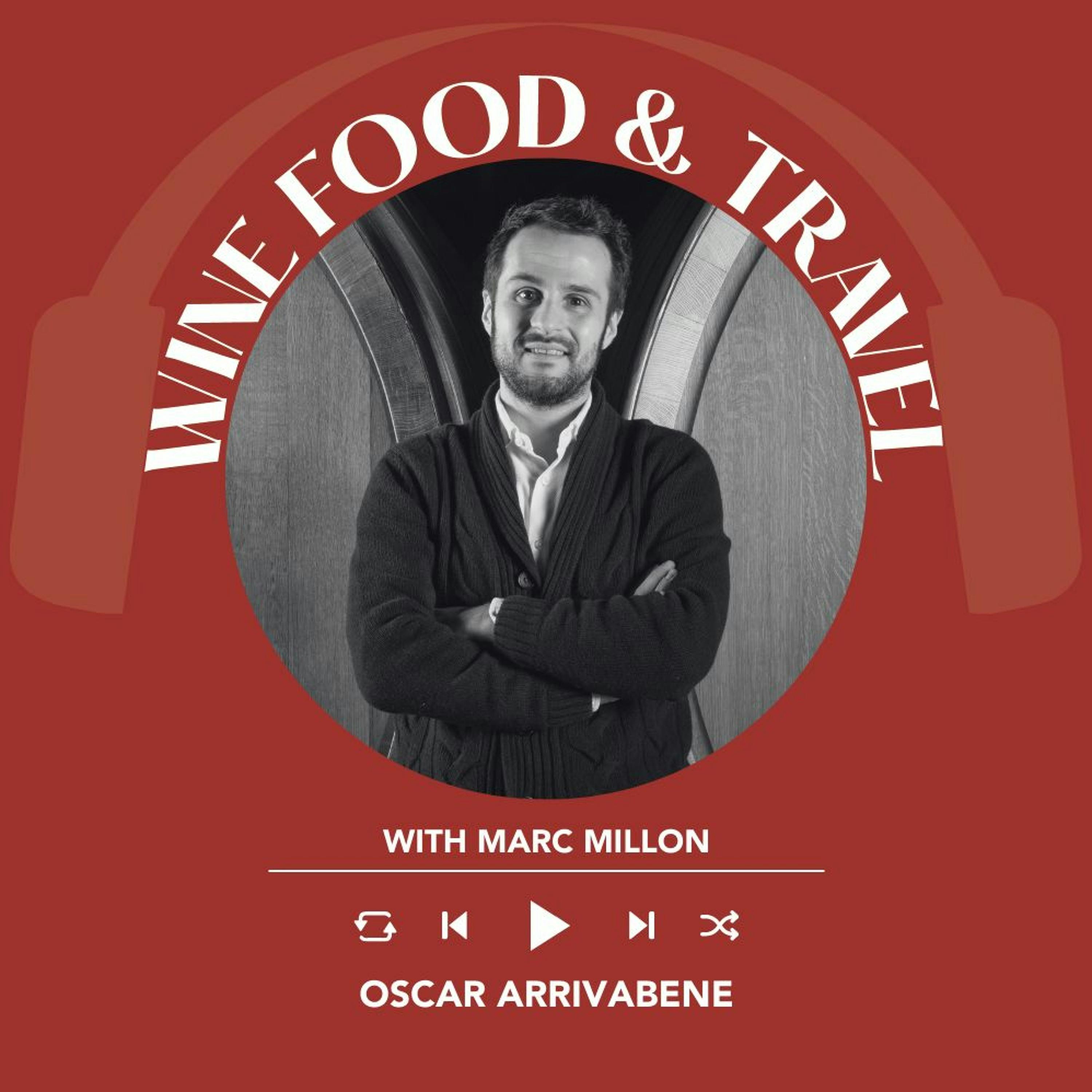
Ep. 1605 Oscar Arrivabene | Wine, Food & Travel With Marc Millon
Wine, Food & Travel
Episode Summary
Content Analysis Key Themes and Main Ideas 1. The history and philosophy of Domenico Clerico winery in Barolo. 2. Oscar Ariva Benet's role as winemaker and general manager, and his approach to winemaking. 3. The evolution of Barolo as a world-renowned wine region since the 1970s. 4. Detailed discussion of Domenico Clerico's wine range, including Dolcetto, Barbera, Nebbiolo, and the various Barolo MGA (single vineyard) wines. 5. The unique terroir and climate of Montforte d'Alba within the Barolo appellation. 6. The rich gastronomy of Piedmont (Langhe) and recommended wine pairings. 7. Wine hospitality and visits to the Domenico Clerico winery. Summary In this episode of ""Wine, Food, and Travel"" on the Italian Wine Podcast, host Mark Millen journeys to the Barolo wine hills in Piedmont to interview Oscar Ariva Benet, winemaker and general manager of Domenico Clerico winery. Oscar details the winery's origins, founded in 1976 by Domenico Clerico and his wife, Juliana, with the dream of producing world-class Barolo. He emphasizes Domenico's philosophy of uncompromising quality, focusing on making the best possible great grapes and gentle cellar practices, likening it to Italian food relying on great ingredients. Oscar describes the Barolo region's small scale, its unique alpine climate despite proximity to the sea, and the characteristic Nebbiolo grape. He provides a comprehensive overview of Domenico Clerico's wines, from their everyday Dolcetto and Barbera to the various Barolo MGA wines (Riccardo, Pajanà, Ciabot Mentin, Per Cristina, Aeroplanservaj), explaining the concept of single vineyards and their distinct personalities. The discussion also delves into the rich Piedmontese gastronomy, with Oscar suggesting traditional dishes like Bagna Càuda, Carne Cruda, Vitello Tonnato, and Tagliolini with truffles, along with ideal Domenico Clerico wine pairings. Finally, he invites listeners to visit the winery, highlighting their open-door policy for hospitality. Takeaways * Domenico Clerico winery, founded in 1976, played a significant role in elevating Barolo's global reputation. * The winery's philosophy emphasizes uncompromising quality, focusing on exceptional grapes and minimal intervention in the cellar. * Barolo is a relatively small wine-producing area, characterized by many small family-owned wineries. * The Barolo region experiences a unique alpine climate with significant day-night temperature drops. * Domenico Clerico produces a range of wines, including Dolcetto (""humble variety""), Barbera (""the queen"" with aging potential), and Nebbiolo-based wines like Langhe Nebbiolo and various Barolo MGAs. * MGA (Menzioni Geografiche Aggiuntive) represent specific single vineyards, similar to ""crus"" in France, expressing unique terroir differences. * Piedmontese cuisine is rich and diverse, with specific dishes like Bagna Càuda, Carne Cruda, and truffle-based pasta pairing excellently with local wines. * Domenico Clerico winery is open for visits year-round by appointment, offering a true winery experience without accommodation or restaurant services. Notable Quotes * ""Making the wine, there was no idea about, really make money from the business. It was absolutely not that the mentality... The idea was just to try to realize the best one in the world."
About This Episode
The Italian wine podcast, Olo, has been selling for six million listeners and has hit six million listens support. The podcast discusses local and regional foods and specialities that pair with wines, and provides information on the natural landscape and small towns in the Barolo area. The success of the Barolo winery and the importance of creating a great wine in the Italian wines industry is also discussed. The success of the Olo brand is due to its unique terroir and ability to demonstrate its potential, and the traditional approach to traditional wine production involves grapes and grapes, a blend of different villages and wines, and the importance of hotels and wineries in Italy's wine hospitality. The importance of visiting the area in the upcoming summer is emphasized, and the need for luck in finding the right wineries is emphasized.
Transcript
Since two thousand and seventeen, the Italian wine podcast has exploded. Recently hitting six million listens support us by buying a copy of Italian wine unplugged two point o or making a small donation. In return, we'll give you the chance to nominate a guest and even win lunch with Steven Kim and professor Atilio Shenza. Find out more at Italian One podcast dot com. Welcome to wine food and travel. With me, Mark Billen, on Italian wine podcast. Listen in as we journey to some of Italy's most beautiful places in the company of those who know them best. The families who grow grapes and make fabulous wines. Through their stories, we'll learn not just about their wines, but also about their ways of life. The local and regional foods and specialities that pair naturally with their wines. And the most beautiful places to visit. We have a wonderful journey of discovery ahead of us, and I hope you will join me. Welcome to wine food and travel with me, Mark Millen, on Italian wine podcast. Today, it is my great pleasure to travel to the wine hills of Barolo in Piedmont's Leilenge. To meet my guest, Oscar Ariva Benet, who is the winemaker and general manager of the domenico Clerca winery in one fourteen, Alabama. Welcome, Oscar. Thank you so much for being my guest today. How are you? Pretty good. Thank you. It's been a busy time. I'm sure that I appreciate you taking time out. The Harvest is still going on. It's still going on. We just, start the yesterday with the barolo grapes. Actually, we work with three different varieties, and the cheddar usually is the first part of September. So it's already a month more or less that we are thinking about barolo, but obviously, barolo takes more time on the plant to have, the full ripening. So with the barolo grapes, we just started. And we'll go ahead for that and waste. You've got some busy weeks ahead of you then. You're right. Now, Oscar, first of all, for our listeners who maybe have never been to the barolo area before. You mentioned that one forty dollars in the southern part of the de no may not see on a one of eleven comune in the barolo zone. Can you describe the landscape, describe where you are so they can gain a picture of this beautiful majestic landscape. So living in Barolo is not so easy for me to describe the area because I'm living like a a mini cider. So but trying to give you a bigger scheme of where we are. We are in the southern part of PMonte, forty minutes roughly to the liguria seaside, one hour, you can say. But in the middle, that divide us to the seaside, there is a chain of alps that are called alp liguria. So, the climate, despite the situation, despite how much we are close to the seaside, it's alpine. It can be a really muggy during the summer, but it gets incredibly fresh during September, October. Like, think about to stay in the mountain. It's a kind of climate like that. So you can have a thirty two degrees or thirty three degrees Celsius during the day. And then maybe ten or or fifteen degrees during the night. So there is a big drop of temperature from day to night. And then it's all, it's it's on the yield side. Move forty is in the southern part of the ablation barolo that is not so big. You have to think more or less it's twenty minutes driving from the extreme north that is La Mora to the extreme south that is us. So it's a tiny population that is able to make altogether thirteen millions bottles, one three millions bottles per year. That is absolutely not so much. If you don't use the accounts in winery, but in general, if you think about, three big wineries that make prosecco, they are able to make the entire production of borol in one vintage. And we are in two hundred and fifty. So the medium average size of a wine and borol, it's really familiar. It's really tiny. And we make up We like the medical clinic. We make ten thousand cases, altogether from Dolceto, Barbara, and obviously Barlamo, everything. Okay. That's a very helpful, very helpful to place on Barolo both geographically, but also in terms of the size of a very famous name known around the world, but it's still a very small area, as you say, with lots of small to medium size grower producers, growing your own grapes and producing your own wines. Now tell us about, the done medical, clerical winery and about domenico. So, Domino, by himself, with the wife, Julianna, they started in, nineteen seventy six from a three actors of, Dolceto, that is the, everyday wine from us and no barolo. So they started in seventy six with this big dream to build up a winery and be more focused on about, one of the most precious grape that we have that is the piolo. So when you think about Barolo, you have always to to remember that it's under percent of the biolo. So the grade is called in the biolo, and then if you've identified the biolo inside of the border of the ablation baroque and with a specific, aging program, then that Nebula gets Barolo. So, they had this dream to, don't think just about a wine for every day but to, build up a winery that was able to create one of the most important wine in the world. But it was just a dream because Barolo was neither famous at that time. So they had this dream to create a great barolo bots. The rest of the world in the seventy seventy eighty had no idea where the amount that was on the map. It's been a pretty interesting journey in the last, forty years from dreams to to where we are right now, reality that it is, twenty five vectors only cultivated on three varieties, three red varieties, We can say fifty percent. It's what we call classic wine. So dulceto Barbera, and I'm gonna be all. And then fifty percent of the production is for the, obviously, from the best slopes. And the best crew in the area, we can make, barolo. So always in the barolo, but from the best position and according by law, it gets barolo. So eighteen months of work. And then after that, more or less one year in the bottom. And, we make a communal that is the, the blend of all the vineyard inside of the village of Mount, and then, Pariana. It's a crew. It's a single vineyard. Chubbock, mid Dean, another single vineyard, both from Genestra Crew. And then we make auto plant survive. It's the only project that we have outside of our village. It's in Sarangada. And in the end, Christina, it's, another single beer is the most important beer that we have that we own. It's from the sixty five. So it's an already old one. From that wine in Moscow we can make the best wine that we try to make the best wine that we can every year, and we release it after ten years, this specific label. All the others after three years are released. Wine to wine business forum. Everything you need to get ahead in the world of wine, supersize your business network. Share business ideas with the biggest voices in the industry. Join us in Verona on November thirteen to fourteen twenty twenty three. Tickets available now at point blind dot net. Okay, Oscar. Thank you for that. That's a a very good overview. And you said something very important I'd like to pick up on that in nineteen seventy six, when Dominican and his wife, Jignana, began this beautiful project, this dream to create great wine. It's important for our listeners to understand that Barolo now so famous, their name, the wine, so famous around the world. In that period of time, as you say, it was not recognized as a wine on the level of the greatest burgundies, the great bordeaux, the great wines of the world. But over this period of I guess it's nearly fifty years through the efforts of small wineries, family wineries, like Dominican Medical, and many others. Barolo has really been able to demonstrate to the world that from this unique terroir, this landscape of steep slopes and complex geology that's reflected in the crew wines, but Olo now stands proudly alongside the greatest wines in the world. And yet it is a recent I can recall visiting the area in the nineteen eighties, and producers were again hoping to be able to achieve great things, and they have now done that. But it is quite recent. And Domenico was very much part of that story. Yeah. On the situation, it's changed so much in the last period. You are right. So this project begun in nineteen seventy six. And I think Domenico stated that the aim was to express territory as faithfully as possible. How would you describe the philosophy of the domenico clerical winery? I'm joined to the winery in two thousand fourteen. So a metadomenico that was already late fifty years old. And what they found in, in himself, that was really different from all the other wineries where they're working before. There was no compromising in his mind. Making the wine, there was no idea about, really make money from the business. It was absolutely not that the mentality. Obviously, things was going great. He already been the sixth best one in the world for for one spectator, for example, in that at that moment, at that time. But the mentality was not the idea was not to make a profit. The idea was just to try to realize the best one in the world. His goal was, always has been that one in my opinion. Most of the winery that were in Italy, but also in France, in what we call the old world of the white making. Most of the time, if you speak with the young generation, the last one, and you ask, why are you are you making wine? The answer is because my grandfather. And with Dominican was, why are you making wine? It's because they want to make the best wine in the world. It was absolutely a different point of view. And probably has been that that was able to move in a couple of steps forward than than all the others. The philosophy of the winery always been that to try to achieve an higher goal. So try to do something more. Push a little bit farther the limit and understand which is the real potential and try to investigate better new crew. Try to work with different different philosophy in winemaking different I mean, it's not about philosophy. It's a it's really empirical. It's a wine in the end is food, and so it's not so complicated. You you just have to make the best grape possible and try to to be a really kind and gentle in in the cellar. It's more or less the same secret of Italian food as great ingredients and try to manipulate as less as you can. And that is the recipe that we use, but then the ingredient must be great. So the fluid must be great. If you want to make a great kind of quality of fluid, you need to never think about compromises. If it's a if for one method, you have to drop fifty percent of the quantity, you have to do it. So no options. If you start to think with the mentality, but maybe with that bunch that I'm that I'm cutting right now and then dropping in in the underground, maybe you can make a a rosato, a rosier, or maybe you can make a sparkling, then all the quality mentality is gone. So if you want to make wine like the philosophy of tomato has been was was about try always to have, no gray, just black and white. No shades. Absolute dedication to quality beginning in the vineyard. Now Oscar, you said you joined the winery in two thousand fourteen, and you spent formative periods working in a range of different places and styles of wine in the Vautellina. Also Nebula, of course, in Southern Australia and Frulio, and in Tuscany, how did these experiences impact on what you brought and continue to bring to achieve this really, direct and simple goal of growing the best fruit and expressing it in the wines as faithfully as possible. It's really difficult to understand. Probably, I'm going to discover the bigger scheme in, in some more years. I I just jumped and run from, one place to another because, obviously, it was much younger, I can say any as younger than now when I joined to clerical. So I tried to make more experience that they could try to work abroad and, in a certain way, it's it's, necessary to remove the fear. Otherwise, you are always you are always afraid about every experience. And what I tried to do before of clerical was that. And, and luckily in the moment that they turned to clerical in in two thousand fourteen, Domenico gave me so much responsibility with the right moment, the right moment to work together. His mentality was exactly what I was looking for. So try to express in the best possible way, production. And try to make wine and not just to think about the balance in the end of the year works. And, here we are. And I I never know how to I should see the things from outside to really understand it, but I'm insect. No. It's it's interesting, Oscar, because a lot of producers, as you say, will say they're making wines like their grandfather's dead or their their continuing tradition, but to be able to come to a traditional area like Barolo, having worked in Australia, having worked in Fruliovenetia, Julia with totally different wine traditions. Obviously, it brings a different approach and perhaps, it allows you to as we've said, take a, a wider picture of what is a a very, very traditional land. Now let's talk a little bit about the range of domenico, clerico wines. We'll talk about the borollos in a minute. But you mentioned that domenico began with a vineyard planted with Dolceto. And Dolceto and barbata are really important, wines in Leila and gave important for people who live there, but increasingly important as well in export markets. So can we just say just a few words about Dolceto and Barbera? Those are what we call classic wine because also, it may be always traditional. Dulceto probably it's more traditional than the biolo. So if you go in in the house of every farmer who makes, another kind of crop and they have a row of, of grapes, for sure that grapes will be it's a productive variety, more than an easy variety. It's able to make a wine that is really, approachable and simple, but in the other side, it's, it's really something that you can really enjoy. It's fruity and floral. And you can start to drink it after just after the the winter. So it's able to match with everything. So it's it's simple, but not in a stupid way. It's humble. It's an humble variety that that makes in my opinion fantastic wine for every day. Barbara, it's, if Barolo is the is the king, Barbara for sure is the queen. So there is, it's difficult to choose which is the best one. Obviously, we are in Barolo. So you choose your bottle and then we choose that in Abiola. Badera is absolutely on the same level of of the Biola. So he's able to age in the same way. It's a different kind of profile. It's richer, bigger, but acid. So it's always able to create wines really drinkable without two gets too easy. So also if if there's a rich and and no point in variety, it never gets fat or boring. And then then I'm gonna be all over again. It's it's exactly the same variety of butter, all over from different slopes. So if it's a young vineyard, for example, or if it's, in a position that the the grapes get right, but not exactly in in the way that you want for a wine that should age for three years. We make Lange and Abiodo. Okay. So that's a very good overview of from Dolcshedo, Barbara and Let's turn now to the domenico Claricom Barolo wines. Now you mentioned that you make Barolo in that classic way as was probably done certainly in the seventies, eighties, nineties. Blending grapes from the different vineyards, but a very interesting, more recent developments have been the MGA's, I mean, ciona, geogrape, the name, single crew vineyards. And that's very important to what what you are doing. Can you tell us a little bit about the MGAs and the differences in personality and style from the different but Sure. So I try always to explain the things a little bit farther. So thinking about the barolo production in general, it's it's like a reverse pyramid. So on the higher part, and also in the bigger part in quantity, we have barolo, what we call classic barolo. And it's a blend of different villages. It can be a blend of older villages. We, like clerical we make, we go one step a little bit more deeper. So in a lower quantity, and we make a village barolo. So the village barolo, it's only from one village. And we are from Fort Adalba. All the vineyards that we own are in Fort Adalba. For that reason, our barolo It's a village bar or from Fortetawa. So it's it talks about our specific terroir, that, it's closer to the Alps than all the others. So it said, and is a little bit higher in altitude. So, Montforte usually represent the shoulder of of the barolo, appalachian. So it's bigger, a little bit more muscular, more organic. But in the fluid in the other side is always really fresh. We are not the elegance, but the richness. And in our work, Barolo Kumunale, we try to give the best example of what bar what comforted Talba represents. And then we go a little bit deeper again and we're finishing the MGA. So inside of every village is divided in different MGA. It's it's the same concept of crew in France. We work in different MGA. We work in Genesta, Musconi Busia. In Busia, we make Ricardo. So it's a barolo. MGA Busia, and the name of the vineyard, it's Brecote. Then we have at the name of the vineyard, it's Piana in MGA Genestra. Then we have Chabotmentin, another barolo from the same MGA, but another vineyard, Chabov maintaining is east face at Bayami's southeast face at Biami. It's a little bit more sandy and lower innovation. And Chabov maintenance is higher and, based on Mars, it's a kind of clay and limestone. Then we have Per Christina, that is from, Muscholi Group. It's another MGA. Just in front of, of the Hill of Genesta, there is this other Hill with a different kind of soil, a little bit lighter, but much warmer than Genesta. And from there, we have this old video. We make it per Christina. Then we are kind of spin off because the entire production of clerical, it's even for the dolce. So, also, the dolce de bandera, then I'm gonna deal. Everything that we make is in move for the dolce. The only one that is outside is this, Ira plan servai is the name of the vineyard. Ira plan servai means, free spirit has been a project and domenico started in two thousand and six. In order of the father, we just pass it away. And the father used to call him out of class and buy when he was young because of this free spirit mentality. And, so he choose to go a little bit farther from one forty seven kilometers from one forty seven kilometers. And you have to think that if you are in Barolo and you go seven kilometers far away from your village, it's much farther than go and take a plane and go to New York. So the mentality from a village to village are pretty different. And if you always grew up in Fort Alba, it's like if you're leaving a stake, not in village. So also take the decision to move and go and pass that border and go in another village. It's been a pretty strong decision for him. So for that reason, we still call it kind of different project because we feel ourselves like part of move for the number. And, Sarah Longa, Sarah Longa is a completely different story, a fantastic different story. Okay. Well, that is a wonderful overview of the wines and the, the MGAs. Of domenico Clercode. I think for our listeners, who maybe don't know these names in the MJAs, I think it's important for for wine lovers to understand that they give an added tier of enjoyment to wines as one explores and becomes more familiar with the wine and a wine region begin to familiarize ourselves with tasting individual crew wines that come from different elevations, different areas with different soils. And that expresses itself very well in the wines as you've described. Now Oscar, I'd like to turn now to the gastronomy of Leilonge because this area, this beautiful area is not only the source of some of Italy's very greatest lines, but it can also boast in my opinion one of Italy's greatest cuisines. And I particularly love to visit the area, especially at this time of year. You highlight some of the traditional dishes that no visitor to the Barolo winehills should miss out. And also perhaps mention the domenico classical wines that would pair best with them. Yeah. Monte, it's really interesting region about about the food because it's different from all the others. Dolceto, in my opinion, it's one of those wine that works with everything. And it's the only one you can, that you can drink with Bana Cada. Bana Cada, it means, warm soup warm cream or the soup. It's a cream of garlic anchovies and, olive oil. And so obviously it's really strong and the flavor, it's fifty percent garlic. So it's incredibly strong. And you dip inside the vegetables, all the vegetables that usually you find during fall. So the last carrots, some pepper pepperoni, some salads, that is a kind of artichoke. So all that deepened inside of this sauce. And the only wine that is able to resist and to be so strong and and aromatic to still be present with this kind of dish is the chatto. So the best pairing is that on my opinion. Then It's a big topic in this one because most of the time that I see, that I'm not hosting Italy, it's wines are buried by price. So expensive wines, expensive food. Cheese usually is expensive, so it's always paired with the most expensive wine that you have. Marola and cheese doesn't match so well, except parmigiano or, there are no banana or the those kind of cheese. Marola is not the right the right pairing for them. Especially if it's blue cheese, it's it's it gets really complicated preparing. Barbara fits perfectly with also blue cheese because Barbara has no talents. So also if you have some spiciness from the cheese, Barbara is able to goes around to that kind of taste and be able to cuddle it really, really, really gentle. Then we have the, our Capizement. It's a fresh and fluid in the biolo. That in my opinion works perfectly with, Karli Cruda. Karli Cruda is a raw meat. It's kind of tartar, chopping more more tin. Usually with some, pepper, salt, and olive oil, nothing else. A little bit of lemon for some. And it's incredibly incredibly typical. If you are in a in Piamonte, you have a Vitellutonato, carbonicroda everywhere. Vitellutonato is a kind of braised and meat, a roast kind of roast beef. With on top, a source of, it's kind of mayonnaise with, tuna and and capers. That is the reason why it's called Patel, that means Ville with tuna because it's a roast of veal plus the sauce that is more fishy and the lime gonna be all of its purpose for that. Then obviously in this period, it's about truffles. It's about white truffles from alba. So we make, a special kind of, really, really team with so many eggs inside yolks. So they get really, really yellow. Butter and, and some truffle on top. And for that, for sure, the barrel is the king for that kind of, of, of, of, of, that's a great description of some of the beautiful classic foods. Of Nelange, in particular, I'm imagining bubbling part of Banyakauda, which I particularly love at this time of year, perhaps with the new adult chapter, the wine that's only just finished fermenting. The truffle season, of course, is just beginning, I guess, now, or maybe about to begin, but that's something very special. And many, I would urge our listeners to visit the area in this time of year when this very special mix of wine and food and particularly the the rare white truffles can be sampled. Now speaking about visiting Oscar, Wine Hospitality is increasingly important all across Italy, and our listeners often travel to areas and seek out producers they listen to. Can our listeners visit domenico Clerco and what sort of wine hospitality do you offer? We are absolutely open for visits. Everyone who wants to come and visit us will be welcome. It's it's easy. You just have to go on our website. That is domenico clerical dot com and check for the visit. And you'll make an appointment directly through the website. And we are more than happy to have as many people as we can. We are only a winery. So for the same reason, offered that off the winemaking. The same philosophy for the winemaking, you have to think that we only offer the the winery visit. We don't have any restaurants or accommodation, but, we are really good in that. So I'm pretty sure that, someone who wants to have a truly experience of what a winery is, clinical can be a a good spot to visit. We are open all the year, except a couple of weeks, one in December, one in August. So every moment could be the the right one. Okay. Well, thank you for that. And I'm sure our listeners will find a way to seek you out and to learn in more detail about the wines you're producing. Oscar, you've taken us deep into the heart of the wine hills in Barolo and beautifully describe the wines and the philosophy of domenico clerico, as well as wetted our appetite to taste some of these wonderful foods, Leilonge. I hope the twenty twenty three vintage will be a good one for you, and I'd like to thank you for being my guest today. It's been a real pleasure talking with you. Thank you, Mark. Pleasure has made mine. And, crossing finger for the for this harvest. We just started. So we need some luck. Thank you. We hope you enjoyed today's episode of wine, food, and travel. With me, Mark Millen, on Italian wine podcast. Please remember to like, share, and subscribe right here, or wherever you get your pods. Likewise, you can visit us at Italian wine podcast dot com. Until next time.
Episode Details
Keywords
Related Episodes

Ep. 2791 Italian Wine in a Changing Climate: PIWI, Terroir & Tradition with Nicola Biasi | Wine, Food & Travel with Marc Millon
Episode 2791
Ep. 2767 Le Marche: Verdicchio and the Wines that Shape the Region with Gianluca Garofoli of Garofoli Vini | Wine, Food & Travel with Marc Millon
Episode 2767
Ep. 2755 The Longest Table: Honoring Nello Ghezzo’s legacy | Wine, Food & Travel with Marc Millon
Episode 2755

Ep. 2712 Exploring Brda: Exceptional Wines and Slovenia's Culinary Traditions with Lan Kristančič of Movia | Wine, Food & Travel with Marc Millon
Episode 2712

Ep. 2700 Sardinia Beyond the Coast: Agripunica, Basso Sulcis & the Legacy of Giacomo Tachis with Salvatore Santus | Wine, Food & Travel with Marc Millon
Episode 2700

Ep. 2681 Giro d’Italia 2026 Special Episode 1: From Bulgaria to the Mezzogiorno in search of wine and cheese | Wine, Food & Travel with Marc Millon
Episode 2681