
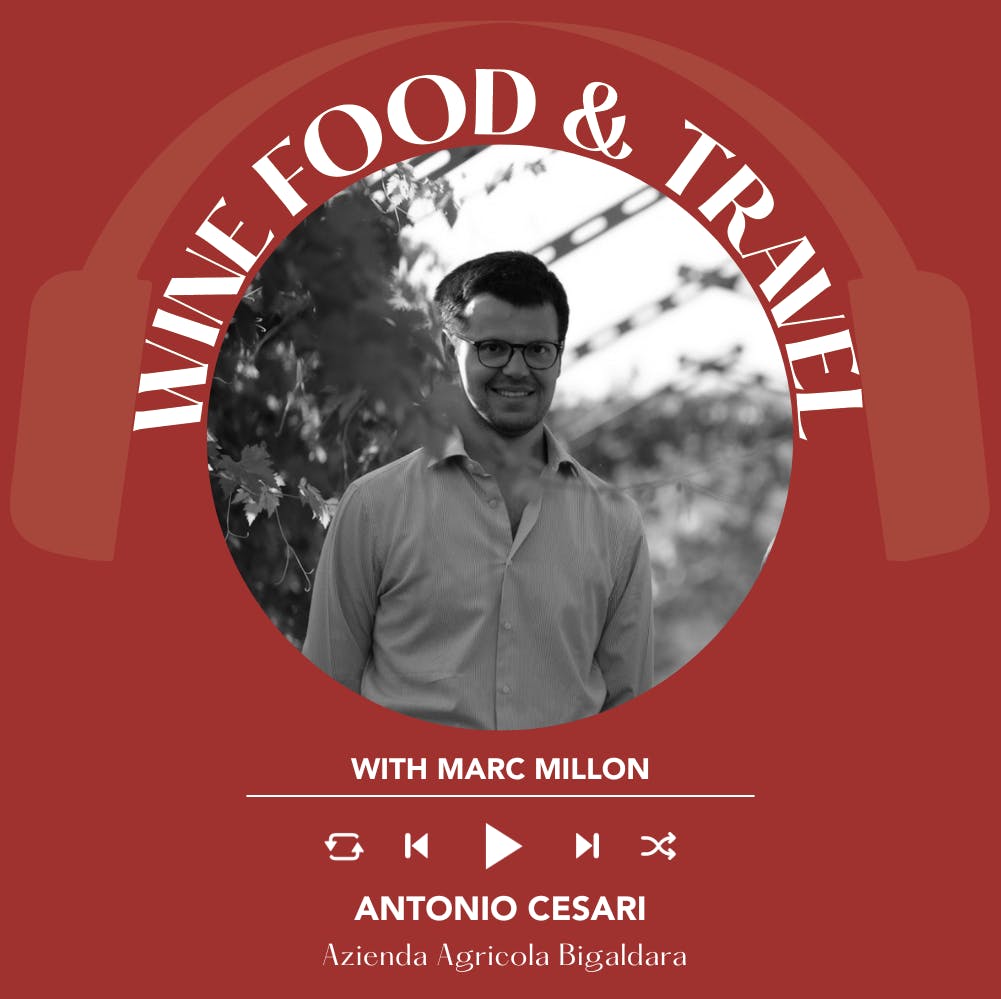
Ep. 1711 Antonio Cesari | Wine, Food & Travel With Marc Millon
Wine, Food & Travel
Episode Summary
Content Analysis Key Themes and Main Ideas 1. The historical evolution and family legacy of Azienda Agricola Brigaldara in Valpolicella. 2. The unique terroir and viticultural landscape of Valpolicella, including the role of dry stone walls (Marogna). 3. The significance of the ""Famiglie Storiche"" in promoting Valpolicella wines globally. 4. The impact of climate change on viticulture and how Brigaldara adapts its vineyard management. 5. Brigaldara's winemaking philosophy, emphasizing traditional styles, ""drinkability,"" and showcasing single-vineyard expressions. 6. The intricate and patient Appassimento process for producing Amarone and Recioto. 7. The rich gastronomy of Valpolicella and innovative food pairings for its wines, challenging traditional perceptions of Recioto. 8. Brigaldara's commitment to wine tourism and hospitality, highlighted by their agritourism project at Casavecce. Summary In this episode of the Italian Wine Podcast, host Mark Millen talks with Antonio Chezeria of Azienda Agricola Brigaldara, a prominent winery in Valpolicella. Antonio recounts Brigaldara's journey from a family summer house to a significant wine producer, starting commercial operations in the 1980s. He describes the distinctive Valpolicella landscape, shaped by ancient dry stone walls, and discusses the collective efforts of the ""Famiglie Storiche"" in elevating the region's wines on the world stage. Antonio explains how Brigaldara manages its diverse vineyard plots across Valpolicella to mitigate the effects of climate change, such as hail. He delves into their winemaking philosophy, which prioritizes traditional, approachable wines, including Valpolicella, Superiore, Ripasso, and unique single-vineyard Amarone. The conversation sheds light on the precise and time-consuming Appassimento drying process essential for these wines. Antonio also explores local gastronomy, offering traditional and surprising food pairings, notably Recioto with savory dishes. The interview concludes with a discussion of Brigaldara's expanding hospitality, including their new agritourism project at the high-altitude Casavecce vineyard, designed for wine lovers and outdoor enthusiasts alike. Takeaways * Brigaldara's history as a winery is relatively recent (since the 1980s), but the family's connection to the land and viticulture is centuries old. * The Valpolicella region's unique terraced landscape, supported by ""Marogna"" dry stone walls, is crucial to its viticulture. * The ""Famiglie Storiche"" played a vital role in elevating Valpolicella's reputation globally through collaborative promotion. * Spreading vineyards across different sites is Brigaldara's strategy to minimize the impact of increasingly extreme weather events. * Brigaldara focuses on producing traditional, ""easy-drinking"" wines, emphasizing their suitability for food pairing. * The winery produces distinct single-vineyard Amarone, highlighting the importance of terroir in Valpolicella. * Appassimento is a long, precise process involving not just water loss but complex biochemical changes that define the character of Amarone and Recioto. * Recioto, often perceived as a dessert wine, can be a versatile pairing with savory dishes due to its acidity and body. * Brigaldara is expanding its wine tourism offerings, with a new agritourism at Casavecce designed to integrate wine with outdoor activities. Notable Quotes * ""Valpolicella is a special place because, mainly because of the terraces."
About This Episode
The speakers discuss the success of their Val opinion Chica Casica wine estate, including their own story of growing up and learning about wine. They also discuss the importance of drinkability and the impact of climate change on the wine industry, particularly on the loss of everything and the potential damage to vines. They touch on the importance of waiting for the fruit tie to give the taste of the dry grapes and the excitement of the risotto in the afternoon. They also discuss the importance of pairing different foods and the excitement of the risotto in the afternoon. They express their excitement for the Val Pollicella, a beautiful and special place in the winery, and discuss the possibility of visiting the KazeQuadeth, a wine winery, and the love of cycling.
Transcript
The Italian wine podcast is the community driven platform for Italian winegeeks around the world. Support the show by donating at italian wine podcast dot com. Donate five or more Euros, and we'll send you a copy of our latest book, my Italian Great Geek journal. Absolutely free. To get your free copy of my Italian GradeGeek journal, click support us at Italianpodcast dot com, or wherever you get your pods. Welcome to wine food and travel. With me, Mark Billen, on Italian wine podcast. Listen in as we journey to some of Italy's most beautiful places in the company of those who know them best. The families who grow grapes and make fabulous wines. Through their stories, we will learn not just about their wines, but also about their ways of life, the local and regional foods and specialities that pair naturally with their wines, and the most beautiful places to visit. We have a wonderful journey of discovery ahead of us, and I hope you will join me. Welcome to wine food and travel with me, Mark Millen, on Italian wine podcast. Today, it is my great pleasure to travel to the wine hills of the Valpoli Chala Casica to meet my guest today Antonio Chezzeria from Azienda Acricola Brigaldara. Antonio is a fourth generation of the Chesady family to be involved in the running of this historic wine estate, where vines have been cultivated for at least a thousand years. Thanks for being my guest today, Antonio. I look forward to our conversation. How are you? Thank you so much. Today is a very cloudy morning in in Balpolicella, but it's always nice to get the chance to to chat and to discuss about wine in front of a five. Yes. That sounds very nice. Ideally, with a glass of your amarone. You know, every time, every every moment of the day is a perfect timing for a glass of amarone. Oh, that's true. So Why not? Why not? Let's talk about for our listeners Antoni, can you give us a picture of this beautiful vine scape, in the heart of the Valpoli Chana classical where your winery is located? Just so that our listeners can imagine themselves there with you. You know, Valpolicella is a special place because, mainly because of the terraces. The heels are pretty deep, pretty high. And the only way we found out to cultivate them has been to build this wall of stone called Maronya in a Verona dialect in order to to get the chance to get the heal, work it in horizontal way instead of vertical. It's a big terrace that is going up to the hill full of vineyards and olive trees and cherry trees. Actually, that's a really, really good description, Antonio. And I think it is important for our listeners to understand these these dry stone walls that have been constructed over centuries to, as you say, shape the land so that the vines can be implanted. And it is so beautiful. It gives such a beautiful suggestive wine scape for people that visit and so different from vineyards that are on the Peaonora, which of course is also why the wine is so different, why the wine is so good. El Antonio, tell us now about the story of Brigaldara, of your family's story. You know, my family's story starts for pretty far away, because my great grandfather was originally from Tuscany. Between the two war, he moved to Verona and he bought Brigaldara as a summer house. So they used to make wine just for hobby, just for a family. I've never tasted, obviously, the wines of my great grandfather. I tasted the wine of my grandfather, and he was a very good point maker. I need to admit that the the seventies are pretty nice. Then in the eighties, my father was really bored about the other job. So he decided to rent the land of the family and to start making wine for business. So technically, Brigal, that is in the market, since the eighties. So since my father, which is still the boss. Absolutely. One hundred percent the boss. Since, about fifteen years ago, more or less, me and my brother, we started working with him, trying to improve, trying to grow up, with him and to give a a future to this business. Uh-huh. It's not a long story. Well, that's really interesting, that it began as a summer house from your great grandfather coming from Tuscany, and I am I'm assuming he wasn't a wine grower in Tuscany then. Yeah. No. He he was absolutely not a farmer. There's there's always been, a passion of farming and motivating vineyards. And soil in the family. We also have, my, my grandfather also bought another property in the southern part of Verona, which is corn production. Completely different kind of farming. But it's all it has been always part of, of the family to be part of the agriculture. Actually, that's really interesting. And and it's interesting that as you say, it's a relatively recent story, But also I think what's important to note is that the story of quality, Val Pollichana, and Amaroni, is also relatively recent. Even though this is a wine that can antecedents going back to the Roman times the monastery on your own vineyards, which you say would would have been producing wine a thousand years ago. But this new renaissance of Val Pollicella is relatively recent and your family have been very much a part of In fact, your family are part of the prestigious familiar story k of the Valpoli cello. The original families had helped to put the wines of this area on the world wine map tell us about the family story card and what it represents to your family. Yeah. So, as you said, I totally agree. The, Divalicella became Divalicella that we know in the late eighties early nineties because of a group of young producer that were part of the consortium in that period that they started the, working, for a promotion of Albertolla. And I'm not talking about the Balpolicella's death of the, the familiar. I'm talking about, the the consortium. In the nineties, the president were, were, Emilio Pasco, where where my and my father has been the president of the consortium. And in that period, the word the discover that evil policella was part of the wine world map, and everybody started looking for the marijuana. Then in two thousand nine, with other historical wineries, we decided to cooperate either if we are in competition to promote the wines of the region all around the world. Everything started, about fifteen years ago more or less, with Masie, Alegreens, Vanato, and we're thirteen in total. I'm not gonna try to nominate all of them because I'm sure I will I will forget somebody. That's the idea. It's a group of friends that since thirty years ago, they are working together. And now we are part of the same association in order to promote, the wines of the region, all around the world. Well, that's actually a very good explanation of the Famelier store K. And I think it is very important for consumers for wine drinkers to understand the companies, the families, the individuals who have worked so hard to raise the reputation of Val Pollicello, which is one of the great wines of Italy. Well, let's turn to wine. Let's turn to your estates because you have vineyards in different parts of the Valpoli channel and the Valpantena. So tell us a little bit briefly about the estates and about the most important wines that you're producing. You know, the story of Brigal Dara is not that long as we were talking about. My my great grandfather bought, the house, and five actors in, around the house. Since the nineties, because of the success of the region, and because of the job that my father was making, we grew up. And it was almost impossible to grow one hundred percent around the Brigal Dara or in Valpolice area. So we started thinking about, growing up all around the regions looking for new vineyards. A new production. So brigaldata, the de brigaldata, a single vineyard, single parcel is now an actor, but then we planted the in my grandmother properties. So still part of the family, but the other side of the family, Cabolo, and Casavecce, which are in Valentina, and which are the other two, single vineyard amarone that we are making. And then we we got also some vineyard in, in Marcelliza. So the Easter side, Farris, and another facility, very close to downtown the road. The idea is that it's in valpolicella. It's not just valpolicella classica that makes quality. Is the heel. And the heels are all around the Balpolicella classica, the Valentana, and the oriental part of the Valicella. So we are looking for quality. And the quality is up to the hill. I guess as well, Antonio, in an area such as Valpulichana, where the risk of hail is ever present. And I know that that this year, there has been some hail damage in, for some producers. Having vineyards in different sites is one way to help safeguard against that. Yeah. It's a way to technically is a way to be sure that every year you will have some damages, but on the other way is a way to be sure that you will not destroy everything. This. Yeah. So, you know, it's it's kind of a balance. Sure. And, unfortunately, it's something we need to we need to to to think about because climate change is it's it's it's absolutely going to, to increase the the temperature of the world, but it's also the the first thing that we are facing in the last decade is that Everything is gonna become extreme. So, Antonio, with the extreme weather we've been experiencing all around the world, but particularly in Italy over the last summers, how is climate change? How is global warming affecting you as a wine producer? We need to work with it, and we cannot control it. So we just need to to hope, and try to be as ready as possible anytime we need to go on the field. Obviously, as We were talking about, all the different vineyards of Brigal Dara. We are sure that if that storm is coming, we're not gonna lose everything. On the other side, it's really possible that we will have some damages every year. Because we have the vineyard spreaded out all around the range. Okay. I can see that, yeah, that's a double edged sword. It it it means damage, almost guaranteed, but also a guarantee that you'll have a good harvest in other vineyards. Yeah. It's it's kind of an insurance, sir. You need to pay something to get something back. That's the idea. Yeah. Sure. Antonio, can you tell us and share with our listeners the range of wines that you make from starting from the straight valpolicella up to the Amarrone and Ricciotto. Just so our listeners can understand the styles of wine that Brigal Dara is producing. We, we decided many years ago. That we we wanted to follow the tradition. We wanted to make traditional style wine. So we decided to make only traditional style wine. So we make a the four kinds of amarone and the ricciardo. And we do not make any, a pastimento style wine or IGT or whatever you wanna call it. We want the wine to be easy drinking. We want the wine to be enjoyed by the people with because the wine has born to be on the table, has born to be drinked with food. So that's the philosophy that cover the full production of Priscilla. It's fresh. It's crispy. It's easy drinking. Is is the wine that you if you don't know what to drink, is always a fantastic choice. Then we have the superior, which is gonna became a grand group, the idea is to make that kind of wine. So the same idea of drinkability of the Valpo, much more complexity. And this is a win that we make in a in in CasaVecia. That's our most important single vineyard, and it's gonna became probably our business currently in the white world. That's very interesting that the Valpolicella superiore, it's such an important wine and such a a drinkability. It's such a an important word, I think, in describing these beautiful wines that are so approachable and so friendly with food, which we'll talk about in a minute as well. Then you were mentioning the Repaso. Tell us about this style. Repaso is, you know, Repaso is probably the most it's gonna became the most drink wine of the region because everybody is looking for a kind of a more, less big, less strong than the amarone. We are still thinking that the repasson need to be, not a younger maroona. So we are looking for the city and the freshness of the Valpa, obviously, with this touch. Of taste of dry grapes is that gives you the, the idea of sweetness because there's no sugar in this wines. We we want absolutely to make wine completely without sugar. My nutritionist is very happy about it. Okay. And so finally, let's talk then about your amerone. Yeah. The amerone is the amerone. It's the king of or the queen. I think it's more a queen than a king. Of this region. And as I said before, we have many different vineyards. Many different special vineyards. They're all crew, and we decided not to make an entry. And Ari server, but to show up the differences between the vineyards because the wine is coming from us from the soil, from the spot, from the parcel. And this is why we make three different crew. We do the Amerona classical of Brigal Dara from the single vineyard of Brigaladara. We make Cabolo in Gretana, and then we have Cazevage. That's our high altitude vineyard above Gretana in the middle of a forest. So three very different styles of wines. Three different vineyard. One is Brigalada is, west exposed. Tableau is east exposed, in a different valley, Caservez is high altitude. And all of them, they have something to give to the wine and to the table and to the food. So it doesn't make sense to blend them. It's it's really interesting and really really funny. To show up that different vineyard make a different wine, which is something that is really common if you talk about Piedmont or burgundy. It's not that common if you talk about people think that in Balpolicella, we make the wine in the cellar, because of the pastimento that can change everything because of the aging that is pretty long. But it's not true. It's not true. The wine is coming from the vineyard. And there's a such a huge difference between Vineyard and Vineyard. Okay. That is really in interesting and very important for, listeners to understand about this concept of crew and terroir in both the wines made from the fresh grapes as well as the wines that are made from the dried grapes. Italian wine podcast. If you think you love wine as much as we do, then give us a like, and a follow. Anywhere you get your pods. Tell us a little bit about the appassamento because I'm imagining right now that you have, your fruit tie full of grapes. And this is a very critical period for you as well. Is critical in its own way as the when the grapes are still on the vine? You know, the Apacamento is, is waiting. It's the same as with every great glass of wine. You need the way you need to wait the wine to be ready as you need to grade need the grape to be ready. This year has been pretty challenging. You know, the tradition of the pastimento talks about the the famous one hundred days of waiting. You know, this year, we had us a very hot September and October. So the percentage of water that you lost in the first period has been pretty strong, but you need to wait. You need to wait because the grape, the the a pastimento is not just a concentration of choice. Is not just the losing water, but if all of those macerations and biochemical things that happen to the skin, in order to give the taste of the dry grapes. So if you press the grape in October, you will make a high alcohol policella because you need the maceration of the skin to give the taste of the fragrances to the wine. So you need to wait. Either if the grape is high sugar, either if the grape is, is ready, and either if you're going to lose the quantity that you need need to wait. You need to wait the to chill the grape. You need to wait until January in order to get the best quality amaran as possible. Okay. That's fascinating. That's a really good description as well. And an indication for our listeners that it is that this process of a is a very precise and skilled one. And as you say, with vintage variations because of the state that the grapes come into the drying process depending on how the season has gone. Antonio, you mentioned something very important. You said that wine is is meant for the table and the wines that you are producing. It's this drinkability that's so important. Can we turn now to the gastronomy of the Val Pollicella and of the typical PiateTPchi of the area? Some of the dishes and foods that pair really well with your wines, maybe also even looking to more international flavors that match well with the wines of brigade. So I don't need to say I I don't have to say to anybody that the main dish for the Marona, and in Valpolicella is the horse. We will be listening to those in United States, or I can talk about it. No. You can speak about that. It's it's it's very difficult. It's something I eat when I when I visit, Leval Pollicella. I'm in England, and it's not something that is very popular here. But nonetheless, it's important because it's a traditional dish in the region. Yeah. You know, it's, Northern Italy, as now is a very wealthy and rich area, but until the the explosion of economy of the sixties, this used to be a very poor area of agriculture. And just remember that until nineteen forty five, we're being pretty strongly destroyed by the biggest world of the of our history till now. So the the tradition of Balicella and the tradition of of this region is a tradition of, very poor food. So we used to eat what they used to be. So polenta, pork, and suppressa, and all of those kind of dishes. So for sure, the the wide has always been fainted with with the foot for the table as I was talking about before. The one as is a wide pairing. As I said before, we have the tradition of the braised meat that could be either pork, horse, or cow, that is a phenomenal way to drink the marijuana. That is pretty powerful, but we also have a huge and strong tradition of charcuterie. With the suppressor from verona. We have some ham from verona. We have some cheeses that are pretty important, up to the up to our mountains, which are a nominal pairing for the Freshvalicella for the Superiorre, but also for the retro twins that it's this that everybody used to consider just for after dinner or for for dessert but the ratio to either if it's pretty sweet has got a very strong acidity and body. So it's phenomenal also to be paired with with the pork, which is sweet because of the fat but also salty because of the meat. Wow. That's a fascinating pairing. I never would have considered. As you say most people think of the to have perhaps with a lightly sweet dessert. Or even just on its own as a wine to sip in front of the fire as you were suggesting earlier. Yeah. It's because I am in front of a fire in the in this moment. You know, the yes. People think about it, but Rachel is not just a casino. You know, the apartment or if you think about the apartment in southern Italy, that's just losing water because it's a twenty days of striation, up to the sun because they got a strong sun up to September. The risotto is different. The risotto is a longer way of drying, which give them oscillation as is the same way as the amarone. And the result is that the wine is sweet, but not that sweet, still with a good acidity and, a little more body that balance everything. So by the recoto with the suppressor. Mainly, you know, the suppressor from Verona's got a lot of white side so the the piece that is sweet. But there are some restaurant in Barpulicella that also makes the risotto with the recoto. Yes. Yes. So a salty dish, which is obviously a little bit sweeter, than the average. Sometimes it could be pulled after the main course before the dessert. So it's kind of a second name, but it's really interesting. Wow. That's that's really, really fascinating. That's a really good overview of some of the typical foods of the area that all our listeners should try when they visit. Now speaking of visiting Antonio, tell us about hospitality at Briggle Dara of Can our listeners come and visit you? Absolutely. We're always open. We have been always open at the at the wine shop at the winery, but since July this year, we finally opened at our hospitality project in Cazevich where we make the amaronecazevich and developed Polycala superioncazevich. We finally have now also the chance to offer a nice lunch in the vineyard, the chance to sleep. In the vineyard because we have a couple of apartments. That that sounds absolutely fabulous. This is the Kazevirtieth, which is at the high altitude. Is that right? Yes. We want Kazevirtieth to become a point in the map of every sport that is coming to verona. Because as I mentioned, it's not just a senior. It's a forest. One hundred actor forest, very close to verona. It's like ten kilometer north, five hundred meter above the sea level in the middle of the forest. So is the paradise of the outdoor for people, hiking, biking, biking, you know, around the the soil, it it's crazy. So we want the Locanda, the agreed tourism to became the place where every sport man of verona want to come up at food every last. That sounds absolutely fabulous. That's just the sort of way that I like to enjoy the wine country living in the midst of the vines, being able to enjoy the beauty of this special landscape and of course at the same time to be able to sample the wines produced on the estate from vineyards around, where one is staying. Antoni, it's been a great pleasure chatting with you this morning. You've taken us directly into the world of the Val Pollicella, which is such a beautiful and special place. Thank you so much for being my guest today. I've already enjoyed our conversation. Thank you so much, Mark. Absolutely. I'm waiting for all of you guys, to visit us, to get, a chair of, and a glass of armor on it together, Delocanda or in Bregasara. Maybe we can go up biking. To get. Oh, I I love cycling. So that would be fun. Yeah. Cyclinging from one side to the other of regular. I'm waiting for you. That sounds wonderful. And I'm gonna certainly take you up on that, and I'm sure our listeners will too. But in the meantime, I hope, you have a great holiday season, and I'll look forward to seeing you sometime next year. Thank you, everyone. I hope you enjoy today's episode of wine, food, and travel. With me, Mark Millen, on Italian wine podcast. Please remember to like, share, and subscribe right here, or wherever you get your pods. Likewise, you can visit us at Italianwine podcast dot com. Until next time.
Episode Details
Keywords
Related Episodes

Ep. 2791 Italian Wine in a Changing Climate: PIWI, Terroir & Tradition with Nicola Biasi | Wine, Food & Travel with Marc Millon
Episode 2791
Ep. 2767 Le Marche: Verdicchio and the Wines that Shape the Region with Gianluca Garofoli of Garofoli Vini | Wine, Food & Travel with Marc Millon
Episode 2767
Ep. 2755 The Longest Table: Honoring Nello Ghezzo’s legacy | Wine, Food & Travel with Marc Millon
Episode 2755

Ep. 2712 Exploring Brda: Exceptional Wines and Slovenia's Culinary Traditions with Lan Kristančič of Movia | Wine, Food & Travel with Marc Millon
Episode 2712

Ep. 2700 Sardinia Beyond the Coast: Agripunica, Basso Sulcis & the Legacy of Giacomo Tachis with Salvatore Santus | Wine, Food & Travel with Marc Millon
Episode 2700

Ep. 2681 Giro d’Italia 2026 Special Episode 1: From Bulgaria to the Mezzogiorno in search of wine and cheese | Wine, Food & Travel with Marc Millon
Episode 2681