
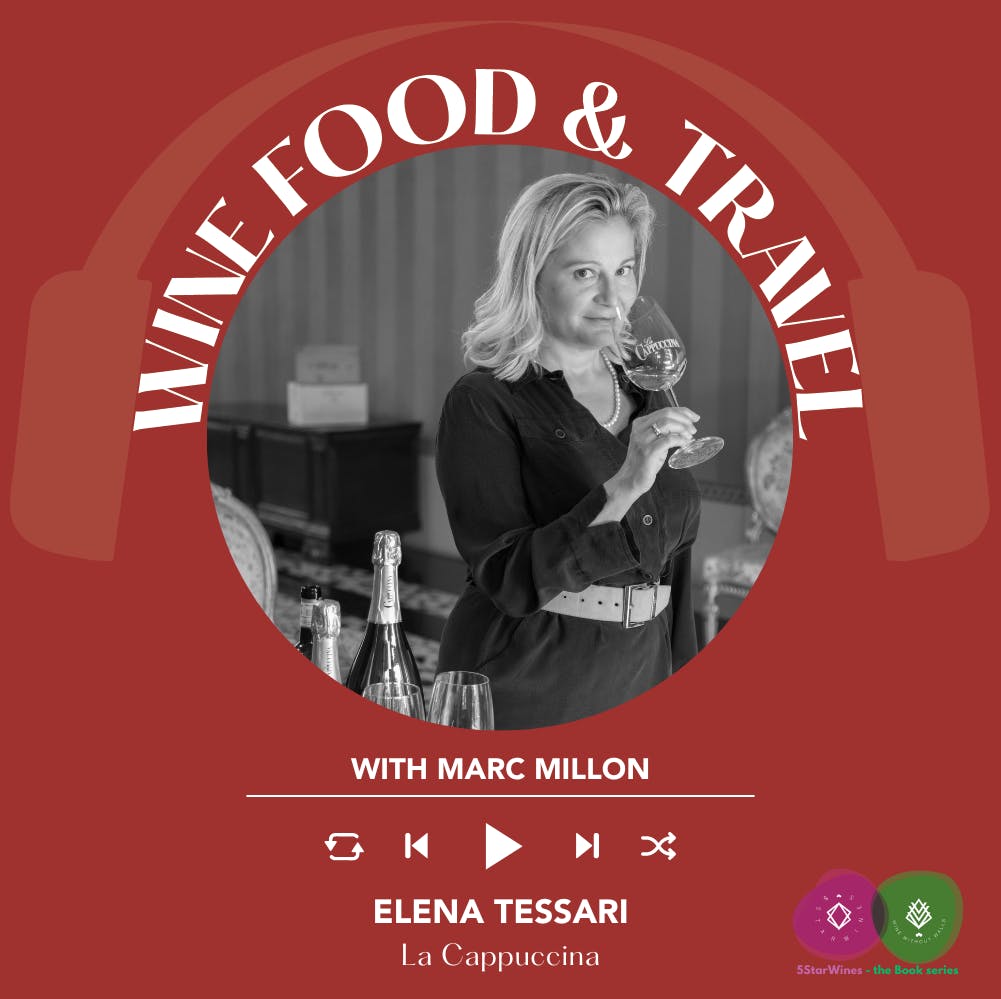
Ep. 2030 Elena Tessari La Cappuccina | Wine, Food & Travel With Marc Millon
Wine, Food & Travel
Episode Summary
Content Analysis Key Themes and Main Ideas 1. Pioneering Biodynamic and Organic Viticulture: La Capuccina's long-standing commitment to sustainable farming practices since 1985, driven by resilience and quality. 2. Terroir Expression in Soave: The unique volcanic soils of the Soave region and how they are reflected in the wines, particularly La Capuccina's San Brizio. 3. Family Heritage and Winemaking Philosophy: The multi-generational family's passion for winemaking, their approach to quality over quantity, and their desire to produce ""happy"" wines. 4. Diversity of Italian Wines and Food Pairings: La Capuccina's range of wines (whites, reds, sparkling, dessert) and the integral role of regional Italian food and local produce. 5. Wine Tourism and Historical Estate Experience: The unique hospitality offerings at La Capuccina, blending wine tasting with visits to a historical villa, chapel, and ancient vineyards. Summary In this episode of ""Wine, Food, and Travel"" on the Italian Wine Podcast, host Mark Millen interviews Elena Tesari from La Capuccina winery, a recent award winner at the Five Star Wines competition. Elena shares La Capuccina's pioneering journey into organic and biodynamic farming, which began in 1985 out of necessity after a frost, aiming for resilient vines and pure, headache-free wines. She highlights their multi-generational family ownership and the unique volcanic terroir of their Soave vineyards. Elena details their award-winning San Brizio Soave DOC 2022, an oak-aged 100% Garganega wine, and discusses their flagship red, Campoburi, a blend of Carmenere and the local Oseleta, named after the villa's historical owners and the Capuchin monks who once resided there. She also describes their traditional Recioto dessert wine and offers food pairing suggestions for their Soave, emphasizing its versatility with local Italian cuisine. Finally, Elena invites listeners to experience La Capuccina's unique hospitality, which includes exploring their historical villa, a 17th-century chapel, ancient underground cellars with basalt columns, and a 300-year-old mulberry tree. Takeaways - La Capuccina winery has been a pioneer in organic and biodynamic farming in Italy for over 40 years, focusing on resilience and wine purity. - Their San Brizio Soave DOC 2022 recently won ""Best Biodynamic White Wine"" at the Five Star Wines competition. - The volcanic soils of Soave are crucial to the distinct minerality and character of La Capuccina's wines. - The winery produces a diverse range, including whites (100% Garganega), reds (Carmenere/Oseleta blend), sparkling, and traditional Recioto dessert wines. - Italian wine culture is deeply intertwined with local food, and La Capuccina's wines pair well with a variety of regional dishes. - La Capuccina offers unique wine tourism experiences, blending historical sites like a Venetian villa and chapel with vineyard tours and tastings. - The family's philosophy emphasizes quality over quantity, aiming for wines that bring ""happiness"" to consumers. Notable Quotes - ""we have been working for a greener agriculture beyond beyond organic since nineteen eighty five, so is a very, very long history. We started at least forty years ago. We were one of the first winery in the zone, but not only in the zone, but also in Italy."
About This Episode
Speaker 1 and Speaker 2 discuss their Italian wine tasting show and share their experiences with organic andutive farming, including their own family experience with biomass farming and the challenges of organic andutive farming. They also discuss their award-winning wine, San Br scene, which is made with a single vineyard in Costaalonga. They discuss their success with their flagship Red wine, Campoburi, made from a hybrid of French and international varieties, and their love for traditional Italian foods and hospitality at the Capital of Guadalajara. They also mention their love for traditional Italian dishes and their love for wild wines and organic wines. They thank Speaker 2 for their time and invite them to visit the hotel.
Transcript
Who wants to be the next Italian wine Ambassador? Join an exclusive network of four hundred Italian wine ambassadors across forty eight countries. Vineetly International Academy is coming to Chicago on October nineteenth is twenty first. And Walmatikazakhstan from November sixteenth to eighteenth. Don't miss out. Register now at Vineetri dot com. Welcome to wine food and travel with me, Mark Binin, on Italian wine podcast. Listen in as we journey to some of Italy's most beautiful places in the company of those who know them best. The families who grow grapes and make fabulous wines. Through their stories, we will learn not just about their wines. But also about their ways of life, the local and regional foods and specialities that pair naturally with their wines, and the most beautiful places to visit. We have a wonderful journey of discovery ahead of us, and I hope you will join me. Welcome to wine food and travel with me, Mark Millen, on Italian wine podcast. Today, I'm delighted to continue a special subseries that highlights the winners of the prestigious five star wines and wines without walls competition that took place in April just prior to Vin Italy two thousand twenty four. Over the course of three long days, more than two thousand two hundred wines were carefully tasted and evaluated by an international jury of wine professionals that included Italian winemakers, so many a's, Italian and international journalists, as well as Italian wine ambassadors and Italian wine experts. Those wines had scored more than ninety points where awarded certificates and have been included in the five star wines and wines without walls two thousand and twenty five book, where the very best wines in each category were singled out for special awards. My guest today Elena Tesari is from the La Capuccina winery, which received an award for the best biodynamic white wine for its suave d o c Sanbricio two thousand twenty two. In the wines without walls category that highlights wines produced by sustainable organic or biodynamic methods. Many congratulations, Alan, to you and your family, How are you today? Oh, thank you so much. I'm very well today, and I'm very happy to be here with you. For us, was a very big surprise that is, a word, a new award, in our collection. It's a trophy. I'm very proud for this, big trophy for us because, we have been working for a greener agriculture beyond beyond organic since nineteen eighty five, so is a very, very long history. We started at least forty years ago. We were one of the first winery in the zone, but not only in the zone, but also in Italy. And people said that we were a bit crazy. At that time, we were very young. Yeah. We studied. They say that that we studied a lot. But, unfortunately, in nineteen eighty five, we had a frost So a part of our wine site. So we had, to think something better way of agriculture. And we thought that, we could start with organic agriculture, agriculture farming. Because, as our, life's, the vines need more power to survive to any disease. And so that's why we started with organic farming. That's a very interesting story, Anna, that you began organic farming out of miss out of necessity after the big frost and the feeling that a more resilient Viticulture could be done by these methods. But before we talk about the organic elements of your activities in more detail, tell us a little bit about your family story and the history of the estate. Because it's been in the family for a very long time. A very long time is a history of over a century. We represent me with my two brothers. My my twin brother is the sister. Is, the agronomist. And, also, he's the export manager. Then Pietro, he is an analogist and the the winemaker. And, me, with a degree in business, economics. I am in charge with financial, marketing, and public relation. And, we represent the first generation of our family. We can say we we were born under divine. Yes. Of course. Very, very fine. So our grandfather, their grandfather, were our influencer teaching us the culture of wine. So for us, it was, a a good chance to continue with this fantastic, adventure, you know, in wine culture. Okay. And and you're located right in the heart of the Swave wine zone. Describe the Swave wine hills where you are. So our listeners can get a picture in their minds of a quite beautiful, vine skate, wine land, not far from verona. Not that we are not verified from verona only half an hour by car. And, we are in the eastern part of Verona, on the way to Venice. We are in the middle between Venice and Milan. Very, very, very strategic place, and here in Swave. Swave is the name of our village, but, is the name of the wine. But it's also an adjective Meaning General kind, La Capicina, our family winery, in particular, is located in Costa Langa. Costa Langa is a small village of, Montefort and Alcona. You know that, they are the two principal musicality are Slav and Montefort. And here we are in Costa Longa, North Montefort, a very, very small village. More, vines then, inhabitants. Count cats and dogs. That sounds a very beautiful place to be. And is that on the eastern side? Is that the volcanic soil of Swannae? Soy. The, particularly of our zone that we have, that is black, basalta box, with a volcanic origin. Okay. Over fifty, sixty miles a year more or less. In the past, we had the tropical island in our zone. It's incredible to to to say tropical island, like Arabia. Caribbean Island, but after the glaciation and, a reduction of the cans and, after the glaciation and the reduction of the tank, The hills were created, and that's why we have this type of basalt rock, black rock reaching minerals that gives, the to the wine, stupidity sold, this, character initiation, and this style, this is soave. And, these, basil blocks are are regionless. And, when you taste our soave, so while we wind, you can feel the power of Recano inside the that your glass because it's so minor. Elena, that's an absolutely beautiful description. Your your English is excellent, and you've just described for our listeners. You know, we're going back sixty million years to an era of when a sea covered this area and volcanoes maybe were underwater and erupted and formed these beautiful hills of suave, and now we can taste the power of the volcano in your wines. You're you're explaining it really beautifully. Now, Alan, I guess when you were talking about tasting the volcano in your in your wines. Your approach to organic and indeed to biodynamic farming is one way that you can most fully express the terroir taste that you can bring that that that landscape into your wines. Tell us a little bit more about your organic and indeed your biodynamic farming because as you said, you were pioneers beginning this road forty years ago. So what, what are some of the biodynamic procedures that you carry out which are fundamental to the quality of your wines? Forty years ago, we did nothing about organic or biodynamic. We just improve, along the way, and, we experiment, because nature has, it's a time in Harry. And every every vintage is a challenge. At the beginning, we didn't know nothing, but, we were young and, very, very, very how could you say maybe with a lot of courage? And, we wanted to create, a wine with no chemical, no chemicals because, when you drink a very good quality glass of wine, you must be very well and not with the honey, headache, or stomachache. If you have a choice to drink a glass of wine, you want to be happy. And so for us, as a wine growers, we are very happy because we can follow all the phase from the vines to the portal. So we know everything about our wines and, we can guarantee also the quality because, we we know what is what is inside the glass in our wines. And we put our face, and, we don't cultivate the the grape to have a big quantity of grape, but we cultivate our grapes to have a fantastic wines. And, for us, organic is, it was a challenge. It is every day is a challenge. But our focus is, of course, organic, with, no pesticides, not, no, not chemical, but Remember, we are focused on quality wine. That's that's actually a very good description, Ellen. And I think you've made two important points about the way you are growing grapes. First of all, you said that when you began, it was a way to grow grapes more naturally to give resilience to the vines. And forty years ago, that was important, but it's even more important today with all the challenges of climate change. And, the the global warming. But secondly, you said that you wanted to make wines that are very pure that don't give people a headache or a stomachache, and which make people happy. And so that approach to a more natural style of winemaking, is also to to result in wines that taste more vivid and alive and give goodness to the people that drink them. Elena, let's discuss you mentioned your suave wines and began to give us some descriptions of This beautiful wine. Let's let's discuss your award winning wine, San Brizio two thousand and twenty two. Can you tell us how this wine is made and a little bit about it? What it tastes like? In Sanbridge. So it's our iconic, soave, is the name from the single vineyard, and, it is located in Costaalonga. But some breeds are difficult to pronounce because it's the name of a saint, saint Britzer. Sorry. There is this. I've done so for difficult for to pronounce in English. But, some Britzer for us is, our How could I say the the the wine of our family? Because this vineyard is located, in Casa, where we live, some data is also the patron saint of our village costa longa. And so we have dedicated to send to decent, our iconic sandwich because, we can do our best in the vineyards as one growers. But as you know, and we can do the all the best, but we can't do the impossible. So for us, it's very important to have the protection of a saint, like simply Cio, which is our patron. In fact, Sanbrizio is, is made with the one hundred percent of Karganaga. Karganaga is our traditional grape for soave. It is, for us, because, we produce twelve type of wines. We have five white wines, two reds, to dessert wine and to sparkling. And some breeds for us is the maximum expression of, suave. Not the the the first version stainless silk tank, but some bits of romance, energies in Oak. So it's very opulent, a transverse on white wine, full bodied, with mineral notes, course, typical of the denomination, a great longevity in the years. Now we have the the the vintage two thousand and two. It was, a challenging vintage because the summer was very hot. But, we have enough, experience also to managing all these crazy vintages. Yes. A real challenge in these recent years. So a real achievement to to get that award, the best biodynamic white wine. I'd look forward to tasting that. It's interesting that as you say, you produce suave fermented in stainless steel, but this is fermented. And aged in oak. Is that French oak barrels or large barrels? Of course, are French, but medium size, not the large one, because we want to maintain the freshness of soaven. Okay. I'd like to, learn a little bit about your flagship red wine, Campoburi. It's from an unusual blend of great varieties, isn't it? No. No. Camoburi, when we're when we're the first, we think to replend the Gabbana for it because the seventy percent of our production is, organic, a grape. But then, we thought to plant also international varieties, such, bit of, sovignon, a bit of Pino Grico, a bit of, carbonate, a bit of, carminer, and Oseleta. Oseleta, we wanted also our this oscillator is a local variety, to blend with carmen air. Carmelaire, please don't confuse carmen air because, this is completely different from carmen air of, South South America, our carbonara, in which we produce campo glory in similar to Cabo, Africa. So we thought that to have this particular red wine not because we are not in the area of our Polycala. So we can't reduce the Cocacala wines. So, is the opposite of our Warrison BRIxia, because we have, old cages, for soave, San Rizzo. And then we have occasion for bread for campo Buri because campo, campo Buri is a blend with eighty percent of carmen air and twenty percent of Zelita. Oseleka, Oseleka, you can find also in Varkoli China. It's a fantastic grape, not so productive because in the years, Oseleka was abandoned because it is very lot less productive, but, gives the wine a fantastic color and a fantastic, aroma. It is, Ozuleta is a very small bunch like a little bird. And if you have the chance to taste the grape, you you you feel only the the the skins and the seeds, a very little quantity of juice. And Campu Buri is a sing is our single vineyard composed with carbonara, and we call Campu Buri because, our house, it's a villa, a British villa, once, was, was built by the noble family of of Bori Buri was, a very noble family in our territory. And, in fact, our Grand Grandfather at the end of the gen is the best this thing. No. That's mister in Paparatta. The Burry family had no inheritance. No. How could you be? No hairs too. No hairs at the end of their destiny. And my Grand grandfather, Lorenzo, took the chance to, to buy this property with this Venetian villa. And, when, well, well, there is also a chapel, which was built on, in seventeen twenty five, were once, the Capuchin monks officiated. That's why the, the name of our one, winery, black capuchin. Oh, okay. The Capuchin monks. It's quite easy to to find the monks where the where they be screwed, the wines. Oh, yes. Yes. They need the wines for their fest. In fact, the the chapel is dedicated to San John, the Baptist and every year, we celebrated a mass on the twenty first of June to celebrate the nativity of some drum, the Baptist, Farase is a tradition, a family tradition. Okay. And that was just last week then. Last week, It's a summer solstice. Yeah. And, we need to pray to have a good harvest. So a special protection from above. Yes. Of course. Of course. Of course. Now, Anna, the family produces, a range of white wines, red the two red wines, sparkling wines, and also the dessert wines. Are those a passito wines? Yes. We have also reached out to the soave. Rachoto. This is Mave. Rachoto, the right some of the ears, because, the the shape of theagon is, a central body with two ears Okay. In the in our dialect that we call Rich mac ears. But, we call our, richardo at Ximo, so another another difficult to to pronounce. Arzema, because, Arzema means in our dialect, bunch of Gerganiga. So before harvest, we we choose the best buncheses, Gerganiga buncheses, And then we put it to drive for about five months until mid of February. Then we press when we put it to ferment, you know, barrels. And then until they reaches the the degree of fifth fourteen, then we put it to to a temperature in our oak barrels and then stay in bottle for another year. And this is our because he's called the number, sweet, but not too sweet and, not too sticky. He's, our traditional pacifico pacifico dessert line every Christmas, every Easter, every birthday. We celebrate it with a bottle of our water chapter. Because we match with the cake or with cookies at the Easter, We had the columba at Christmas. We we, we, we match, while I'm reaching out to this with the Panettone and Pandora de Verona, our traditional cakes. So so a great, a great, a great, could you say it's very important to us. Okay. A beautiful sound. I love the sound of your your the jewel of, of your family wines, are they? Is this special? Now tell me, Elena, for your Swave, what would you say is the most typical Piateo typical of your area to enjoy with Swave? This is a very difficult question mark. Because the swabber one is so good food friendly, you can, mix with a lot of food But, we can say that, every food, except, braised, red meat, so you can enjoy as an imperative but also all over your meal. And, we we can suggest to try with, seafood, but, you know, that in Italy, we have the great tradition for pasta and risotto. And, we make a lot of risotto. Have you ever prepared risotto, Mark? Yes. Often prepare risotto. Yes. I know it's difficult to prepare a result, but, of course, I'm quite a good, I love cooking. My mother, my mother and my sister are better than me. But, I can prepare a good result with our soave and the bit of cheese. But there are so many, so many traditional types, because in our family, My mom represent the food and my dad, the wine. So I'm very special much. Okay. Okay. A very good partnership. And, of course, you have a special rice from below verona, from isolo Del Escana. We have a lot of or, rice, but also vegetables, like, red chikori, asparagus, Sandra, salary, Veronica. Fantastic, very refreshing. But that's also a lot of, fruit, the cherries, and strawberries, but a lot of cheese, from our listening mountain, we have Monte Veronese, in the different ages. We have faith in, the age version of monte veronese. So a lot of love of good food. A lot of cakes. I mentioned before Panetone, a pandora was, very, very, very, very, very, very famous pandora. The Panetone is more linked to Milan, but pandora for verona. Then we have Espritolona. A cake made with almonds. Okay. Animal notes, you can you can feel also the the almonds in the soil. Oh, interesting. So that's would be perfect with a small glass of your ricciotto. Ricciotto. Okay. You can feel the volcano, but also you can have, some in the glass. For a glass of return. Oh, lovely. You you must try, Mark. You must come to visit? You've made us all all our listeners want to come to visit. I would love to come to visit, and I do come to Verona. So next time I'm there, I will come and see you But tell me about hospitality at la cappuccino, can our listeners find you go into the wine hills of Swave and visit you? What do you offer for wine hospitality? Of course, we offer, you know, touristic, visiting, tasting, but, besides this, when you are like a poochina, you can visit the chapel and also the old underground cellar we call Canada, where you can see the basalt columns. Is that very difficult to to see a basalt column? Because lava as, horizontally. Oh. It's very difficult to find the column of lava. And in our in our, old seller in Villa, we have this, this type of, columns. This amazing because, you can see what is, underground, and, the vines of our of Gaganigar are very happy to have this type of rock because they can, they can get stronger and stronger with minerals and vitamins. So that the the roots of the vine go go go go go, underground over ten meters or more. And then can, nourish through these these buzzards. So when you come to La Capcci, of course, you can taste all the range of wild wines from the sparkling to the white, to the red, and the dessert wine. But also, you can have a work in the garden because We have also a historical garden with all the trees, like, suppress, beanie, mulberry tree. Mark, we have a mulberry tree. Which is three hundred years old. It's like, our our antenna is our tree because it's very old. And, in spring Beautiful. In springtime. No. So it's a sort of museum open air. And, of course, you can walk in the vineyard, in organic, vineyards. Enjoy the the grass, the the panorama, the hillsides, and you can relax and, breath. And it's just, sort of a jam a jump in the past, because, in the the chapel was, built more than three centuries ago. You can feel like, definition. Elena, you've made me want to pack my bags and get on the next plane and come visit you. And I think our listeners as well who are located all around the world have been enchanted by your story. You've taken us really into the heart of the suave classico. You've taken us into the heart of your home through your beautiful descriptions. So it's been a real pleasure having you as my guest today and learning the La cappuccina story. Thank you so much. So kind of you, Mark. Thank you. And, we want you to come. I will. Thank you. Thank you. Thank you. Thank you. Thank you for listening. We hope you enjoy today's episode of wine, food, and travel. With me, Mark Millen on Italian wine podcast. Please remember to like, share, and subscribe right here, or wherever you get your pods. Likewise, you can visit us at Italianwinepodcast dot com. Until next time.
Episode Details
Keywords
Related Episodes

Ep. 2791 Italian Wine in a Changing Climate: PIWI, Terroir & Tradition with Nicola Biasi | Wine, Food & Travel with Marc Millon
Episode 2791
Ep. 2767 Le Marche: Verdicchio and the Wines that Shape the Region with Gianluca Garofoli of Garofoli Vini | Wine, Food & Travel with Marc Millon
Episode 2767
Ep. 2755 The Longest Table: Honoring Nello Ghezzo’s legacy | Wine, Food & Travel with Marc Millon
Episode 2755

Ep. 2712 Exploring Brda: Exceptional Wines and Slovenia's Culinary Traditions with Lan Kristančič of Movia | Wine, Food & Travel with Marc Millon
Episode 2712

Ep. 2700 Sardinia Beyond the Coast: Agripunica, Basso Sulcis & the Legacy of Giacomo Tachis with Salvatore Santus | Wine, Food & Travel with Marc Millon
Episode 2700

Ep. 2681 Giro d’Italia 2026 Special Episode 1: From Bulgaria to the Mezzogiorno in search of wine and cheese | Wine, Food & Travel with Marc Millon
Episode 2681