
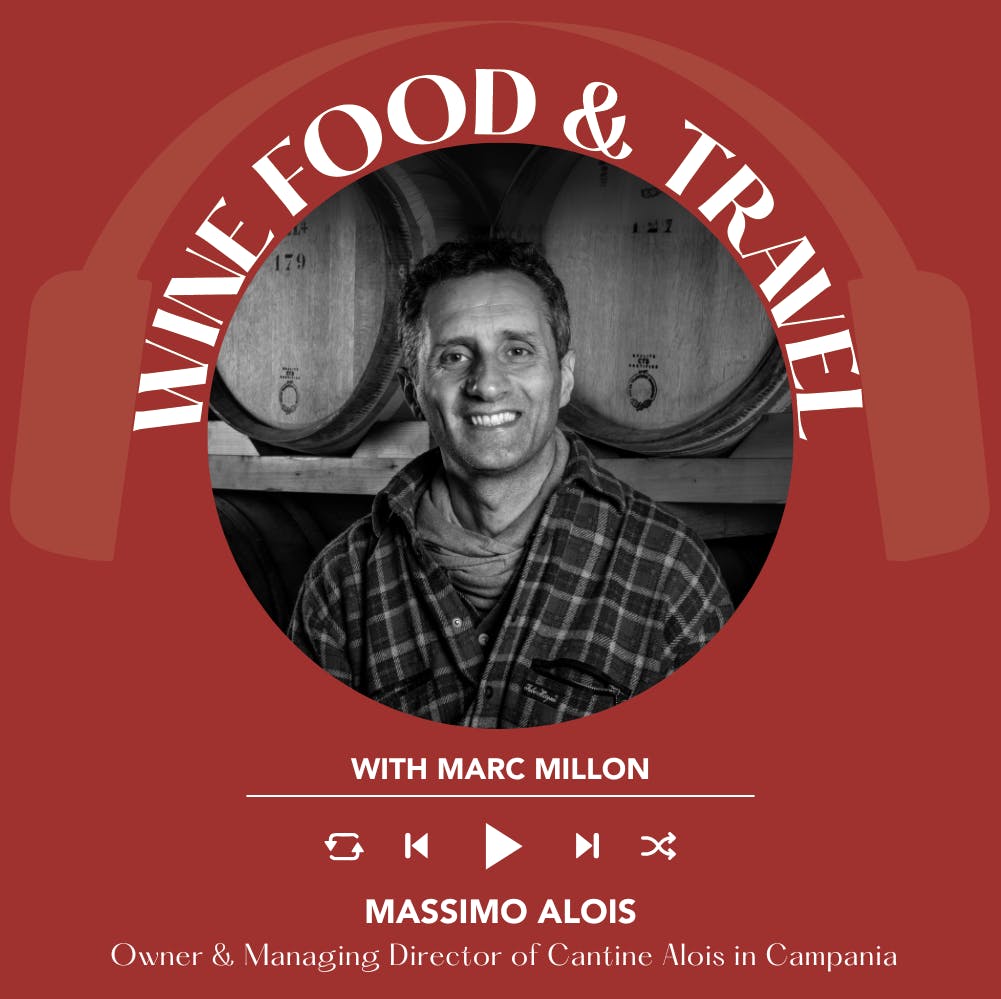
Ep. 2436 Massimo Alois of Cantine Alois in Campania | Wine, Food & Travel with Marc Millon
Wine, Food & Travel
Episode Summary
Content Analysis Key Themes and Main Ideas 1. The historical and cultural significance of Campania, particularly Alta Campania (Caserta and Benevento). 2. The deep-rooted history of the Alois family, spanning from the silk industry to wine production. 3. The revival and unique characteristics of indigenous grape varietals from Campania, such as Palagrello Bianco, Palagrello Nero, and Casavecchia. 4. The strong connection between Campania's unique wines and its rich gastronomy, including specific local dishes like Mozzarella di Bufala and Laticouda Lamb. 5. The historical context of the Kingdom of Naples, the Royal Palace of Caserta, and their influence on the region's heritage, including winemaking. Summary In this episode of the Italian Wine Podcast, host Mark Millen explores Campania, focusing on Alta Campania with guest Massimo Alois of Cantine Alois. Massimo delves into the rich history of Caserta, highlighting its Roman origins, the grandeur of the Royal Palace of Caserta (compared to Versailles), and the historical vineyards cultivated by the Kings of Naples. He shares his family's multi-generational story, from their involvement in the silk industry (which outfitted the White House and Vatican) to their pioneering efforts in reviving indigenous grape varietals like Palagrello Bianco, Palagrello Nero, and Casavecchia, which were almost extinct. Massimo discusses the unique profiles of these wines, their suitability as ""gastronomic wines,"" and ideal pairings with local Campania cuisine such as fresh Mozzarella di Bufala, Laticouda Lamb, and the traditional Genovese pasta dish. The conversation emphasizes the uniqueness of Campania's native grapes, their resistance to global varietals, and the regional differences in local products like mozzarella. Takeaways - Caserta, Campania, holds significant historical importance, evidenced by its Roman amphitheater and the Royal Palace of Caserta. - The Kings of Naples cultivated extensive vineyards near their palace, competing with French winemaking. - The Alois family has a long history in Caserta, initially in the silk industry, known for producing fabrics for international landmarks like the White House. - Cantine Alois played a pivotal role in reviving indigenous Campania grape varietals like Palagrello Bianco, Palagrello Nero, and Casavecchia. - Campania wines, particularly those from native grapes, offer unique flavor profiles distinct from more common international varietals. - Campania's cuisine is characterized by freshness and specific local delicacies, with Mozzarella di Bufala having distinct regional variations (Caserta vs. Salerno). - Cantine Alois offers hospitality for visitors interested in experiencing their wines and the region's history firsthand. Notable Quotes - ""The amphitheatre is the second biggest amphitheatre, second just to the Colosseum in Rome."" (referring to the amphitheater in Santa Maria Capua Vetere historically known as Capua) - ""The Royal Palace of Caserta, which is as big and as important as Versailles."
About This Episode
The speakers discuss the history and characteristics of the wines and alcohol in Campania, including the success of traditional vines in improving palayades and the importance of freshness in one's palate. They also talk about the history of their family's involvement in crafting, including the creation of a European clothing brand and the construction of a European clothing factory. The speakers also discuss the success of their safety industry and the importance of their own safety industry. They mention the importance of traditional vines in improving one's palate and recommend a Genovese dish called Lami Calda, which is made with cow meat and onions. They also discuss the differences between Caserta and Campania, with the possibility of visiting a wine hotel during the harvest.
Transcript
And the kings of Naples, close to the palace, they developed their vineyards. They actually were buying grapes from their subjects, but then they ended up cultivating their own because as I told you, they were always competing with their cousins in Paris, and they wanted to show off. And they wanted to demonstrate it, you know, that they were doing a good job. They could not stand the fact that those guys were coming down south, you know, with their own barrels. So they started developing their own vineyards, and they built actually eleven vineyards just close to the palace. And, they planted a bunch of different, varietals, typical of Southern Italy. Fascinating people with stories to share, fabulous wines, and the best local foods to accompany them, and beautiful places to discover and visit. All of this and more on wine, food, and travel with me, Mark Millen, on the Italian wine podcast. Join me for a new episode every Tuesday. Welcome to wine, food, and travel with me, Mark Millen, on Italian wine podcast. Today, we travel to Campania for a special subseries that focuses on this beautiful southern Italian region. It's wines, gastronomy, and things to see and do. Campania has five provinces, Naples, Sallerno, Caserta, Avilino, and Benavento. And we'll be dipping into all of them. We begin this morning in the province of Caserta, with my guest, Massimo alloys, of Cantina alloys. We last met it in Italy in April. How are you today? And is it a beautiful day in? Yeah. And, actually, it's pretty hot today. So, Mark, thank you for inviting me. It's a real pleasure. To talk to you guys. So our winery is in what we call Alta Campania, which actually includes, two of the provinces you were mentioning, which are up north. On the board with lazio. Latio is the region where Rome is the capital. So one is Caserta and the other one is Benavento. We call it Delta Campania because, of course, he's above. Naples is above avelino. And, we have our winery there. Yep. Okay. So as you said, you're straddling the two provinces of Caserta and Benaventa. Tell us a little bit about the province of Caserta. Historically, it's so important, not only for the history of Campania, but all of the south of Italy. And I know it's a very special place that's linked to your family history as well. Exactly. So I would say just two things about history. Number one, it, dates back to the Roman republic because Capua was one of the main cities maintowns during the Roman Republic and Empire as well. And, just to mention, the amphitheatre is the second biggest amphitheatre second just to the Colosseum in Rome. And, I encourage everybody to go visit this, coliseum in, Santa Maria Capaway that it that actually was the former Capwa. And then number two, would mention the Kings, of Naples, you know, the Spanish kings, which, belonged to the French, you know, so these guys came down south in the seventeen thirty four. And they set up, their own residential area in Caserta. So Caserta was, an ancient city built by the Longbirds in the ninth century. You know, the ancient city was up on a hill, but by the time the city was moved down to the valley and the bourbon kings bought an entire area because they wanted to move the capital of Naples inland because they fear that the English, especially the the British could, you know, invade. They were always on, you know, the capri, you know, the island was their headquarter. So they fear that those guys could attack the gulf And in order to defend themselves, they were thinking to move the capital inland, you know, just thirty miles inland. But then they ended up just, building their residential area because this project was, not achieved, but the building was built, you know, and, I don't know, I know you, Mark, you know, exactly what I'm talking about. But I encourage you guys to come and visit the Royal Palace of Caserta, which is, as big and as important as Versiles. And, it's a huge palace. It's a huge, park. There's an English garden as well because at the time, there was this kind of competition between the Italian philosophy or the European philosophy and the the British philosophy. So the Italian one was squared, you know, and the the English one was irregular. So they were those two main ways to approach the gardens. And the kings of Naples close to the palace, they developed their vineyards. They actually were buying grapes from their subjects, but then they ended up cultivating their own because as I told you, they were always competing with their cousins in Paris, and they wanted to show off. And they wanted to demonstrate it, you know, that they were doing a good job. They could not stand the fact that those guys were coming down south, you know, with their own barrels. So they started developing their own vineyards, and they built actually eleven vineyards just close to the palace. And, they planted a bunch of different, varietals, typical of Southern Italy. Okay. That's a really fascinating story and a really important piece of Italian history, the kingdom of Naples with this magnificent royal palace at Caserta de Rega de Caserta that, as you say it was is big, if not bigger than the Palace of Versailles. And Campania and the Kingdom of Naples in that era, Massima, was, fabulous, encompassed all of Southern Italy, including and Sicily too, didn't it? So it was all of Southern Italy under the Spanish bourbons, and Naples, I think I've read, was a glittering city, one of the most beautiful and fabulous cities in Europe at that time. Eclipsing many, other capitals. So this was a really important part of Italian history, but Massimo, your family's history also links with this time. I know your family can trace its history in this area back until at least the sixteenth century. And you've told me that they were originally very important in an important part of the economy, the silk business. Tell us about silk and your area. Yeah. Let me just give you an aside, a short aside about the origin. So the family most likely has a a lombard origin. That's why it's called Deloitte's because aloesis was a typical, Roman German name. That's why in a hero as well, you find, you know, many people whose name is, alloys as a as a Christian name. So now throughout the years, alloys became our last name, and the family used to live up on the hills, you know, the ancient town. I was telling you about Casa Ierta was called. That's why it's called today, Casa. Okay? Just let me just tell you one more thing about the family. In the sixteenth century, one of the members of the family was executed by the only inquisition because, he embraced with a bunch of other intellectuals and, noble families in the area. And I'm talking about Naples and Caserta. They embraced the lutheran reformation. So those guys, they were found reading, a bunch of, text, a bunch of, pamphlets, which were coming from a German through a missionary called the. That's why the movement, you know, was that community, that fellowship was called the Baldesian evaluations. So long story short, this member of the family was executed, in the main square in Naples because that was the area where all the executions were held. And, there was we're dating back to the fifteen sixty four. And since then, they confiscated all their properties, and, part of it was then released in the following, century. But anyway, for a couple of centuries, they strive with the economy, you know, to make their living. You know? Anyway, the family got involved, during the bourbon, rain in the silica manufacturing, industry. Because as I was telling you, the kings of Naples, you know, the bourbon kings were connected to the French. And so they wanted to kind of imitate what they were doing, you know, in, in Paris, and they set up their silk plant to make silks, you know, for the garments of the ladies of the court. And, the alloys family has always been involved in that kind of industry taking care of the vineyards as well because as I told you, all around this meal, there were the vineyards, which were all besides the Royal Palace that you mentioned, and this small, Borgo village was called and is called the So my family moved from up the hill down to, and we have always lived here. We still live here. And we have, always, looked after the manufacturing plant and always been involved in the silk industry, just to give you an example, all those fabrics, which are long scale designs, which are not a print, they are called, which means the design is the result of the intersection between the warp and the weft, which means the vertical and the horizontal threads. So that intersection gives bird, you know, develops the designs. And, bunch of these designs and bunch of these fabrics and tapestries, you can find now in the White House, for example, or at the Vatican, you know, in the in a bunch of, main, palaces and buildings all around the world just because there were just a few looms which could replicate, reproduce, big scale designs. M. Family has always been involved in the, safety industry. Well, that's amazing. That's an amazing story, Massimo. And that's sophistication of the technology of those days to be able to make those designs using the different silks. Was the whole area around Caserta planted with the mulberry trees from which the silk would be derived as well as vineyards. And are there still large plantations of mulberry trees? Yeah. Let let me just tell you. So thirty years ago, we decided to split with part of the family, and there are two of my cousins. Main cousins who are still in the silk industry. And, this is how we revived all the ancient vines of the kings of Naples because we decided to take over all the vineyards. And so thirty more than thirty years ago, actually, was in nineteen ninety two, we decided to focus on the wine industry. Just going back to what you were asking me, so, yeah, this is a tradition that, a bunch of, producers are still continuing. And, the reason why we actually became, pretty well known in the States is due to the interest that William Hurst showed towards our fabrics because he was refurbishing. He was renewing his big house in San Simen You know? Oh, yes. What would you call it? Sansimien? Yes. I think. Yes. I I know in California, this which is now the museum. It's in a museum. Exactly. So when he became, member of the of the house, he got in touch with a guy. He was a producer here in Salletto in Caserta, but we had to escape because he was, amazed and mussolini, we still keep the letter you know, where Mussolini told him just to leave Italy. But this guy was a very well known producer, and, he ended up reproducing a bunch of fabrics that William Hurst showed him because he knew that he was working for a pretty important, meal in, New Jersey. So he visited him, this guy did a good job and introduced him to the White House. So since the nineteen forty eight with Truman, most of the fabrics which I've, refurbished, you know, the white house came from this small village called, just because you know, they and we had and have those special looms which can, weave big designs, which can easily, you know, be part of a house as curtains or, you know, established trees on the walls. That's amazing. Yep. Amazing. Amazing story. So this this via Delaseta, this silk road lay is linked closely to the via Delvino, and the via Delvino, of course, leads directly to Cantine Alois. Was it your father, Massimo, that decided to leave or to come pine the world of Sild, but also develop the wine side of the family business. Yes. It did. It was my father who had this dream to revive all those, inchumbines, all these, those indigenous varietals that his father was, cultivating in one of the hills close to Sallejo, which is called the San Silvester, which is now a WWFF resort. So this hill was, home of two of the eleven vineyards of the Kings of Naples. And, we have, always, even after Italy was united and after, you know, the Kings of Naples said to a skate because of the Italian unification, we were still there taking care of the crops. And, so my father has always heard his father saying that there were a bunch of different, varietals, which were almost extinct. And he decided in the nineteen ninety two to buy a piece of land and set up an experimental vineyard in order to identify the right clones of those varieties, which were supposed to be indigenous. And then he planted nine different varietals, and he ended up discovering that three out of nine were really indigenous. And we're talking about Palagrelobianco, Palagreloniro, and Casave. Yeah. So is this the period where he decided to take over all the vineyards from the family. So he left the the silk industry, and he started focusing, on the wine industry trying to replanting those varietals, which were originally grafted on, a wild, rootstock trying to develop them on the American rootstock because as you surely know, was pretty tough at the time and today as well. To develop a a decent vineyard, you know, on a wild rootstock. So, the the Peter Franco rootstock. So what he did, he transformed a bunch of the crops that we had into vineyard. And so at the end of the nineties, he started developing vineyards, planting those, indigenous varietals, which were part of his, experimental vineyard. Who That's a really fascinating story. And again, also linked to history, as you say, because the bourbon kings had, I know one of those eleven vineyards you've mentioned was Avinia Delventario. Exactly. Beautiful vineyard near San Lucio. Is it in San Lucio where some of these native grape varieties you've mentioned were cultivated. Now I think what's particularly interesting, Massimo, about what you've just told us, but also about the story of wine in Campania as a whole region, is how great varieties, native grape varieties remain very local. These are varieties you only find in your area. Is that right? I haven't come across them in any other part of Campania. Let alone anywhere. Else in Italy. They're quite local to you. Yeah. I would say for two main reasons. Number one, after the French Revolution, you know, the Kings and Naples cut off any ties with the rest of the world because they feared, especially the queen who was, the sister of Marian Poinette was executed. In seventeen ninety three. Yeah. Exactly. In seventeen ninety three. Exactly. So they feared that those, new ideas about the conception of republic could invade the southern Italy as well. And this is the reason why cutting off any ties with the rest of the world was a kind of a hindrance, in order to develop what they were doing, down south. And this is one of the main reasons why all our indigenous arrivals just remained in the south versus the French varietals which invaded the entire world. And second, I would say, they've just been revived. You know? So it's pretty it's a pretty recent revival that occurred in Southern Italy. And, it's actually something which was, subsidized by the ministry as well because they realized that they were making a mistake in acknowledging a DOP, you know, a police recognition to those areas whose varietals were not indigenous. In the nineties, they changed, their policy and they started, sustaining, supporting those areas, who's, you know, producers were interested in reviving all these indigenous for Alice, and that's what we did. Okay. That's a really important, point for our listeners to understand that and what makes the wines of Campania so exciting. I think is that, you know, you can come to Campania or I know you export your wines all over too and really taste wines made from grape varieties that come from nowhere else that really have flavors and textures that are totally unique. I would say it's pretty difficult to compare these varietals with, the varietals that we we know, you know, which have been planted all around the world, especially with the French varietals. We don't find any comparisons. So the Palageno, for example, it's always pretty citrus, forward. You know, most of the times, the aromas, brings you to the grapefruit, The Casavecchka, for example, is very simple. The tannins are always silky, but it's a pretty tannic, wines and pala grille oneiro as well. They are both tannic forward. The pala grille oneiro, it's spicy versus the Casavecch, which is always, silky. But they're both, I would say, wines which, helps your palate to be cleansed after you eat something, you know, effect. So they encourage you to drink more and eat more because they play this role, you know, I would say in order to to cleanse the palate because of those, pretty technique, profile. Yep. Okay. I tasted wines with you at Vin Italy, and I was really, really impressed with what you're doing. I just wanna single out the three alloys crew wines, the for the The Trebulanum from Casa Vecia, which I absolutely loved, and the morella for the Panagrillo. Can you just say a few words about each of these three wines? And then we'll move on to talk about the gastronomy. Okay. So let me tell you we were really astonished, a few years ago when we finally discovered that, up on a hill where we planted the we could, bring grapes into the cellar with b h, which was below three point one. I mean, just to give you an idea to our listeners, a wine with a pH under three point one, is a wine, which is already healthy. You know, you bring grapes into the cellar, which is ready to be vinified without any human intervention. So that for us was, good achievement. Because we wanted to produce a white from the south, which could last for a pretty decent, period of time. So just to give you an idea, now we still open bottles which are fourteen, fifteen years old, and they are still green. So they are not oxidated at all. They haven't lost their pale yell of color. So they are still there, you know, and they are in a pretty good shape. And, instead is a piece of crop that has been, developed on, one of the best rootstocks that we have, experimented because just to let you know when we first started, you know, in the nineties, we didn't know which restock was suitable for those kind of, brand new varietals. So what we did, we just chose a bunch of different risk talks, and just, you know, randomly, we started planting them, trying to discover which one was doing its best job. It was doing a good job. And then we ended up discovering that, this Roostaka, which is a millet Cheno three thousand, anyway, was giving us the best results. So we have, identified that piece of land and we decided to make our reserve wine out of it. And the same thing we did up on the hill at a twelve hundred feet on the sea level in, calcareous kind of soil. With the Muarella, which is one hundred percent Palagrelo, harvested at the beginning of October and, aged, for a couple of years, like the Trebleonum as well in large format casks. We don't use barrels. We just use a large format cask mainly Italian wood from up north. Okay. I remember particularly loving the Trebulanum when I tasted that with you. I think I tasted it at previous year with you at Ven Italy as well. And what I recall was it was, yes, a big red wine, powerful. The tannins were there, but it was opulent, and it had that silkiness that I think you've mentioned, the town ends were very smooth and well knit, and perhaps that's another link of the Via Delasette and the Via Delino. Massimo, let's talk about the gastronomy of Cacerte. Your wines, as you say, these are gastronomic wines or wines to enjoy with food. Tell us a little bit about the foods of your areas and what everyone listening to this podcast when they visit the province of Caserta. When they visit Alta Campania, what should they be eating and what which of your wines pair with? A few of the. So as you said, our wines are gastronomic wines, and company cuisine is very well recognized, for its freshness. So most of our dishes are fresh. For example, crudy, you know, when it comes to fish, oh, just a little bit steamed or, you know, the spaghetti with, fresh tomatoes, cherry tomatoes, or sometimes summer just with a little basil. So or, for example, mozzarella. So if I just, I have to mention the mozzarella, which is, as you surely know, comes from Caserta. So we just have two main dops in our region. One is down south in Salerno area where they produce the twenty percent of the entire production and up north where we are in Caserta. We produce the other eighty percent. So the mozzarella is made out of, water buffalo milk. You cannot use any cow milk. And, I would surely pair a pala grillo bianco. Might be, an old morrone or, an old coyote. And I think they would pair pretty well because those wines have got a pretty high acidic, which, could easily cleanse your palate after, you know, you bite the mozzarella And, usually, you buy the mozzarella, taking the bowl with your hand, and trying to make the milk, leaking all around your lips, you know, that's what we typically do once we we visit, one of those dairies. Masimo, this is mozzarella like we never taste outside of your area. We're talking about mozzarella that's incredibly fresh, maybe made the same day. Is that right? Yeah. Exactly. I mean, you won't find any Casertano or Napolitano is gonna eat the mozzarella the day after. It needs to be fresh. It needs to be chewy. You know, it needs to be crunchy. You need us to hear the sound once you bite it. You know? So we are obsessed about all the different areas, you know. It's like, drinking, you know, about all or coming from different, the different areas from central, you know, with the it's different, ins, of ten ins. So same price for mozzarella here. Yeah. What about the difference between the mozzarella de caserta, the caserta dop and the mozzarella from near Pestum in the province of Salerno? Are they different? I would say yes. They are different because ours is a saltier than theirs. And, it has to everything has to do with the brine, you know, with the The the salt the the yeah. Because the curds are in a hot Brian. Exactly. I think I think it's on one side, the the way you add the the Renette to the earth, and the other thing is the salty water that you use. So we use more salty water. So that is more tender. Hours is chewier. It's, I would say it's slightly harder than theirs. I don't wanna say that theirs is more delicate, but for sure ours is, more dense. He's more or he's chewier. Is a saltier for sure. So, yeah, there's a huge difference between Okay. Fascinating. And as you say, we think of the the food of Campania is fresh and vibrant and, a wonderful seafood from the Bay of Naples. What about, with these beautiful, big red wines? Because inland company is another world from the sea. Isn't it? What would you say some of the best pairings would be for, for sure, I would say the Laticouda Lamb, Aniello Laticouda. So this is a special, breed that we have here in Caserta. And, there are a bunch of places who are doing a pretty fantastic, and tremendous job when it comes to slaughtering those, limbs. I don't wanna call them suckling limbs, but, you know, the meat is so tender that, you know, we tend to grill them in order to give a little acidic, you know, to the lamb. And they pair pretty well with the Artribulanum for sure because it's something which come from the area. And it's as though, you know, the wine and that breed, they found a way to look at each other and, you know, and, try to be a good compromise, you know, between, the wine and, and food. For sure What is the name of that breed again? Yeah. Lati calda. Lati calda. You know, we stand for, you know, lamb Lami calda. And what about with the Yeah. So with Paula Gallonero, I would recommend a good genovese. So I think genovese is one of those dishes that every body thing comes from genovese, but it has nothing to do with the Genova region, which is up north, you know, underneath Piamonte. Genovese, it looks like was a a captain who was on one of the vessels of the kings of Naples who was asked by the queen to cook, a special dish made out with the onions, and that's what he did. So he took a big piece of, cow, meat, and he started, cooking those onions for five, six hours in order just to make them melt and, trying to balance their sweetness with the meat. Anyway, the genovese is our main pasta dish And, I think, the palagreloniro will be a good, good pairing. Okay. That's wonderful. And actually, genovese, when I'm in Naples is one of my favorite things to eat. It really is so wonderful. This slow cooked of sweetness of the onions and the meat. Usually over pasta. Is that right, Masimo? Yeah. Exactly. Usually, what we use, we use the, you know, the candela. Candela is a special shape, which is, kind of, I don't know how to say. It may help me. A kind of piping, you know, Okay. Yeah. Yeah. And we just yeah. We cut them off, with our hands. This is the reason why, you know, on the pan where we cook for as you said, for five, six hours, the onions, and then we put the pasta inside at the very end, you find all those, I would say smaller cuts of pasta, you know, that they Yeah. You take them with your spoon and with the onions, I can promise you. It's a it's a delicious dish, you know. Yeah. Absolutely wonderful. Massimo, let's just finally talk about hospitality at Cantini Alloys. Can our listeners visit you? Yeah. Yes. Of course. They can. Of course, sending us an email at info at v nie alloys dot I t. So we are mentioned is, located in, in the, you know, is located in, in the winery as well. And all around, we have, ten hectares, you know, thirty acres and people can, easily reach us, and they can reach us out. So we are more than welcome to give, you know, hospitality to the wine lovers and, you know, our friends and our clients are coming from, all over the world. Okay. That's fabulous. I think it's been a a really good introduction to this special subseries, Massimo, because you've not only taken us to Campania, but you've also taken us to a particular corner, your corner, of Alta Campania. And I think that's what's going to be very interesting as we have some further conversations around this beautiful region to see how wines, foods, life is very unique in each area. So thank you very much for being our guest today. I've really enjoyed our conversation. And most of all, I look forward to meeting up with you again to visiting you. Please do it. We're waiting for you, okay, during the harvest. And we will put you at work. Okay? Okay. I'd love that. That'd be wonderful. Okay. We hope today's episode of wine food and travel with me, Mark Millen, on the Italian wine podcast, has transported you to somewhere special. Please remember to like share and subscribe, wherever you get your pods. Likewise, you can visit us at Italian wine podcast dot com. Until next time, Chincin.
Episode Details
Keywords
Related Episodes

Ep. 2791 Italian Wine in a Changing Climate: PIWI, Terroir & Tradition with Nicola Biasi | Wine, Food & Travel with Marc Millon
Episode 2791
Ep. 2767 Le Marche: Verdicchio and the Wines that Shape the Region with Gianluca Garofoli of Garofoli Vini | Wine, Food & Travel with Marc Millon
Episode 2767
Ep. 2755 The Longest Table: Honoring Nello Ghezzo’s legacy | Wine, Food & Travel with Marc Millon
Episode 2755

Ep. 2712 Exploring Brda: Exceptional Wines and Slovenia's Culinary Traditions with Lan Kristančič of Movia | Wine, Food & Travel with Marc Millon
Episode 2712

Ep. 2700 Sardinia Beyond the Coast: Agripunica, Basso Sulcis & the Legacy of Giacomo Tachis with Salvatore Santus | Wine, Food & Travel with Marc Millon
Episode 2700

Ep. 2681 Giro d’Italia 2026 Special Episode 1: From Bulgaria to the Mezzogiorno in search of wine and cheese | Wine, Food & Travel with Marc Millon
Episode 2681