
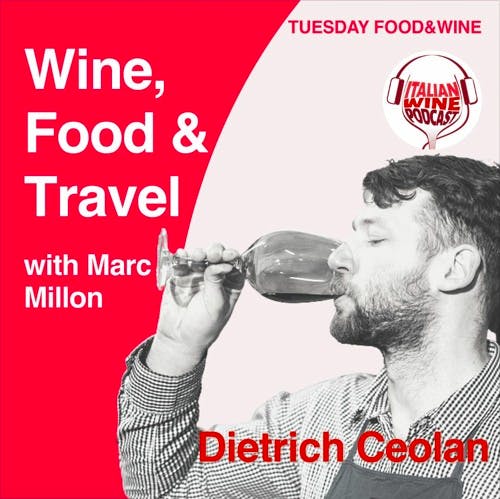
Ep. 675 Dietrich Ceolan | Wine, Food & Travel With Marc Millon
Wine, Food & Travel
Episode Summary
Content Analysis Key Themes and Main Ideas 1. The legacy and evolution of Anzits Tenut Taseo, a family winery in Trentino Alto Adige. 2. Dietrich Siolan's journey as a third-generation winemaker, combining traditional practices with international insights. 3. The unique terroir and microclimate of the Bassa Atesina (Unterland) region, particularly its fluvial soils. 4. Detailed discussion and distinction of key grape varietals: Rulander (Pinot Grigio) and Lagrein, highlighting their distinct styles and regional significance. 5. The integration of local culture, traditional gastronomy, and historical connections into the wine tourism experience, exemplified by the Dürerschank Vinothek and the ""Bush'n Schank"" tradition. Summary In this episode of the Italian Wine Podcast, host Mark Millen interviews Dietrich Siolan, owner and winemaker of Anzits Tenut Taseo, located in Salorno, Trentino Alto Adige. Recorded during the busy harvest season, Dietrich, a third-generation winemaker, recounts the history of his family's winery, which he took over in 2016. He describes the distinctive terroir of the Bassa Atesina, emphasizing the rich, fertile fluvial soils deposited by the Adige River. Dietrich elaborates on their approach to winemaking, contrasting typical quantity production with their focus on quality-driven Rulander (Pinot Grigio) and a uniquely lighter style of Lagrein, an indigenous red grape. He also shares how his experiences in ""New World"" wineries in Australia and New Zealand broadened his winemaking perspective. The discussion extends to the Anzits Tenut Taseo's Dürerschank Vinothek, a welcoming cellar named after the painter Albrecht Dürer, where visitors can enjoy their wines alongside local delicacies like homemade speck and traditional Knödel (dumplings). Dietrich further highlights the ""Bush'n Schank"" tradition, temporary, family-run taverns serving local food and wine, showcasing the deep-rooted connection between wine, food, and culture in South Tyrol. Takeaways - Anzits Tenut Taseo is a third-generation family winery located in Salorno, within Trentino Alto Adige. - The Bassa Atesina/Unterland region boasts unique terroir, particularly fertile fluvial soils from the Adige River. - Dietrich Siolan focuses on producing high-quality Rulander (Pinot Grigio) and a distinct, lighter-bodied Lagrein. - International winemaking experiences in Australia and New Zealand influenced Dietrich's professional development. - The Dürerschank Vinothek is a wine cellar and tasting room, named after Albrecht Dürer, reflecting local history. - Local culinary traditions like homemade speck, various types of Knödel (dumplings), and the ""Bush'n Schank"" (temporary taverns) are central to the region's cultural experience. Notable Quotes - ""In the seller, you can express yourself. You can do some experiments. You can do something new, which is not such a process like outside in the vineyard."
About This Episode
The hosts of wine and food podcasts discuss their love for wine and their passion for growing grapes. They share their past experiences in vineyards and cellar, and ask guests to share pictures of their wine country and the beautiful aspects of the Adworks' valley. They also discuss their partnership with Michael and their favorite aspects of working in a winemaker, while sharing their experiences with the challenges of growing wines in a winter weather region and the characteristics of their terroir and regions. They also discuss the excitement and cultural influence of Sutturo, a place located in Austria, and recommend a local restaurant that serves typical cuisine. They express interest in visiting the Dura Shanka Vino tech and mention their commitment to bringing free content every day.
Transcript
Welcome to wine food and travel with me, Mark Billen, on Italian wine podcast. Listen in as we journey to some of Italy's most beautiful places in the company of those who know them best. The families who grow grapes and make fabulous wines. Through their stories, we'll learn not just about their wines, but also about their ways of life, the local and regional foods and specialities that pair naturally with their wines. And the most beautiful places to visit. We have a wonderful journey of discovery ahead of us, and I hope you will join me. This episode is proudly sponsored by Vivino, the world's largest online wine marketplace. The Vivino app makes it easy to choose wine. Enjoy expert team support, door to door delivery, and honest wine reviews to help you choose the perfect wine for every occasion. Vivino, download the app on Apple or Android and discover an easier way to choose wine. Welcome to another episode of wine, food, and travel. With me, Mark Millen, on Italian wine podcast. Today, we are in Trrentino Alto Adige, also known as Trrentino Soutaro, and more precisely in the, the bassa Atezina, the most southerly part of South Terrell, to meet our guest, Dietrich Siolan, of the Anzits tenuta Seo in Salur or Salorno in this trilingual region. Good morning, Dietrich. How are you today? Hey. Good morning. Mark, happy to be here with you. I'm pretty fine. We are actually harvesting today. So it's a great opportunity to skip some hard work and do some nice work. Oh, good. Well, I'm we're really delighted you can be here. I know it's the busiest moment of the year, but also the most exciting moment of the year, it must be hard and and and really difficult, but also a very happy time. Yeah. Exactly. It's really satisfying. After a whole year of hot and intensive work, you see the result of this work, and you get all the fruit, all the grapes, you get in the seller, you get the new aromas, the exciting colors in the cellar from the vineyard. So it's really, really exciting. Yeah. I bet. Dietra, can you share with us this story of Anset's Tenut Taseo, how how your winery came about. And, I know you have a deep passion for wine. Is this always been what you knew you were going to do? Yeah. Exactly. So just a short recap of the history. So my Grandfather already started with winemaking in the ninety fifties, and then my father came into the wine business as well. And Yeah. So he started with his own winery. And two thousand and sixteen, it was my turn to take over the winery that I started completely from the beginning. So I made Brent or the seller or the name of the winery unsets to know the sale just to have completely my own business there. So I'm responsible for almost everything. My father is in the background helping me what he wants to do or what he can to do. Then I have my colleague, Mikhail, who is helping me in the administration and in the marketing. And in the winery, in the vineyard, in the cellar, I can do whatever I want. So I can express myself. Well, that sounds a wonderful, wonderful partnership you and Michael having your different activities, but you being able to, oversee work in the vineyard and in the cellar. Dietrich, we are in the Unterland, the Alta Tsina. Can you give our listeners something of a picture of of of your wine country, the beauty of it, the aspect, the soils. And why it's such a great place to be growing grapes? Is this where you're from? Have you always lived in this area? Yeah. So I grew up in Suttal, Artoghev all my life. I had my few experiences outside of of my region. So I did some internship in Australia, New Zealand, and even here in some wineries and some bigger wineries just to get my horse and bigger and see new aspects of winemaking. I I had a lot of passion always from the beginning. Since I was a little boy, I grew up in the vine business. I was outside with my dad in the vineyard, in the cellar. So I have four, like, wine and my blood. Yeah. Here in Saloom, in the in the so called Basathesina, we have a really particular place. Like, we have the Saluna Clousa. It's passage where the mountains are coming together, and we have a really tiny, like, path through through the valley. Because usually, the UNtalent is really wide open. You can see really wide and far from my place, but the place, saloon is, you know, where the mountains come together, and the valley gets closer. That's the so called it's kind of a door, like, gate. From the German speaking path to the Italian speaking path. Okay. Sabasa. Yum. And so this is the Adijay. The Edge the Adijay descending down from the mountains. And in this narrow valley, you're surrounded by mountains. Yeah. That's that's really nice. So, I mean, you you have here almost everything from from the low situated vineyards and apple fields. You can go up to the mountains and from up there. You have a beautiful overview of all the landscape, and it's really, really enjoyable. It sounds absolutely stunning. And I guess this whole valley then would have been carved out by the glaciers. And and it and resulting in a in a mix of marine soils and stone. And what what is the main feature of of the terroir that makes it so good for growing grapes? Yeah. Just imagine, like, almost two hundred years ago, there was the river, the edge, and it was not a straight river going down the valley. It was like a query one. It went from other side from one side to the valley to the other side. And a few times a year, they were the the flu, and it was like everywhere was water. And then they came the from the can't care monarchy, the the princess or the kaiser, the chief of the campground. He decided to to stop this madness, and she began to make the edge the river straight down to the valley. So there were no more diseases, no more blocks in the valley. And the soil from the edge river went, actually on our fee on our future fields. So we planted all our fruits, grapes, and, apple trees, on this very fertility, nutritious soil. Oh, I see. So from the flooding of the river, you've got this rich fluvial soil that's perfect for growing growing fruit of all sorts. Exactly. Correct. Now you dedicate yourself to working both in the vineyard and and you're the winemaker. They're two very different activities. Which aspect of your work do you enjoy the most? Yeah. That's a tricky question. But let's say it's nice to work during the year outside in the vineyard, but when it's server, when it's coming to harvest season, then it's the best part of the year. Like, you get all the results of the heart that it's getting work outside in the vineyard, and you you can make something. Like in the vineyard outside, you are just cultivating. You are watching that everything goes right and the fruits are growing well. But in the seller, you can express yourself. You can do some experiments. You can do something new, which is not such a process like outside in the vineyard. In the vineyard, you have a fixed, schema where you can work in. And in the seller, you are completely free by yourself. Sure. Yeah. And, you mentioned that you went, abroad to get different experiences in winemaking different attitudes to to an approach as to winemaking New Zealand. And where else did you say you went? In Australia. In Australia. And a few other wineries here around. What did you learn from those so called new world wineries that you brought back to a very ancient and traditional wine land. Yeah. It just opened my eyes for a completely order style of winemaking. So, for example, in New Zealand, I was in a winery who produced so much wine like my whole region here. If it was insane, like, hundred fifty laborers workers in the winery in the cellar, and people from all over the world coming together and we had a really, really good time together, but also in the aspect of winemaking was really interesting how they produce the wine, how they keep up the high quality of wine even they are producing tons and tons of wine. Wow. That's fascinating. So you grow five great varieties. Mhmm. Can you tell us a little bit about what qualities your terroir gives to these varietals? Maybe maybe concentrate on Rulander and La Grane. Yeah. Like, Rulander, you said that also correctly, it's called Pinoguija, but we call it on purpose ruleender, because that's the typical name for the region here. And it's mostly associated also with quality wines, while other side order on the other hand, Pinogrizo, it's can be like a burnt name in the wine industry. Some people may be connected with just, quantity wine and not so high quality wine. Our ruler, it's in the in the So it's a name of the field. It's called, it's a twenty years old, Guyo system. Also, growing on the Guyo system, and it's a perfect age for making a great quality wine. So the harvest season for the rule ended starts, in the beginning of September, depends on the year, but roundabout beginning of September. And it's really, really good for the microclima. We have in this area so we can keep going with the maturity on the in the vineyard and to pick the fruits, the latest possible period. You're getting a more ripe or more structured style, then as you say, the the the lighter pinogrios that perhaps are are flooding the market, and affecting the name of pinogrios. That's correct. And so we we are really glad to have the really ripe rulander in the winery where we have a really it's a really fruity, fresh acid, live with a low acid ruler, and it's also really nice, floral bouquet and, really nice fruit like honey melon, but also kind of, typical local fruits like beer or apple. And the Lagrange? Yeah. The Lagrange. It's, really special wine. Like, it's, almost exclusively for suitable. It's a so called auto tune variety. And for my place in Saloom, it's not really typical. So then typical, growing places, up to boats in the Mcdalena area, but, lagrange was always cultivated here in this area. So my father decided to plant lagrange too and to give our best, and I think we did really, really well with a lagrange here. So it's not like the heavy, high alcoholic lagrange from the other regions. Here in the area. So it's it's if you know the guide, you you see always this dark ruben reds color, And our logang is, like, not so dark, not so heavy in the color. It's a middle cherry red. Also from the tenons, they are softly gentle, and not so dry on the on the tang. So the it's a really drinkable, fresh, red, like, line. Oh, that sounds a beautiful style. I love that lighter style of red, still that deep, because Lagrine always has a a a lot of color. Doesn't it even if it's yours is is is lighter? You should watch my hands with just how is the yesterday, the Lagrine? Is that right? Yeah. And the they get the dark straight away. That's that's insane. And then you're also growing some so called international varieties, but these are grapes that have been grown in Sothraro for a very long time as well. Yeah. Yeah. The chardonnay Merlo in Cabernet. Yeah. Just imagine Salum is the fifth biggest community in South Terrell producing grapes, and the biggest one producing white grapes. So just imagine we have here a lot of chardonnay, white burgundy, and, And we have, also, the chardonnay in our, winery. And to add that, we are doing two types of chardonnay, one classic. So it's, measured in the classic stainless steel tank. And the other one, we have a selection, which is, how is it almost ten or two ten days or two weeks later than the classic chardonnay. And there we have, a third part we have in the new Oak barrel, and the other part stays in the stainless steel tanks for almost ten months. Right. And then you do the assembly. Exactly. So that's more of the international chardonnail, like you can compare with, maybe, California and the US. Now let's turn to to tasting wine, and you have a particularly welcoming wine cellar attached to the winery, the Dureshank vinyltech or Anotaka named after when the painter Elbrecht Duer passed through center. And tell us about this. Yeah. Exactly. That's a nice story. So many tourists, they came here to this place, and they're asking about the name. How does it come? Famous artist from the Renaissance in Germany, renaming our Venotec after him. So many doesn't know that, in the mid, a little recap in history. Iberteria went in the mid of the sixteenth century from Neomberg down to Venice, And on his way down to Venice, he stopped in Saluh and he was really fascinated by the landscape here. And so many pictures from him came many pictures from him, showing the area here. So it's, really famous, and so we decided to to name the winery or the divino deck after him. And we have some pictures not originally from him, but some friends of mine are painters. So they draw a nice, potret from him and talk to the root he did in in And it's a it's a nice point of view while having a good sip of wine. It sounds perfect, actually. It sounds a a very nice way to To enjoy your wines as they're meant to be enjoyed with food, with friends? Yeah. Exactly. It's a really nice place. It's a little bit hidden. It's in the middle of the village. So you have to be clever and smart to find it, but the most beautiful places are always hidden. A little bit. And when you when you come down the stairs, you see a nice garden with a lot of people having a chat, having a full glass of wine, and also the typical, marinne, you know, the, we have the our own spec and cheese and bread and You you actually produce a spec? Yeah. Yeah. We do some spec. Oh, fabulous. So not the in the village, not down in the center. We have friend of us who is, a farmer up in the mountains, and there we are growing our, our pork. And then when it's time, we are going to harvest the pork. Okay. Well, speck is very much a very typical flavor of Always smoked. Always a smoked cured. What part of the pig does the speck come from? It's coming from the back, but don't ask me too much because that's the passion for my dad now. Oh, okay. Okay. So when he retired from the winery, he had to do something else. So he started making them big. That's a very nice partnership if he's looking after that side of things and those foods can be enjoyed. In your wine tavern. And you also have some local cheeses. Yeah. Exactly. So we have everything what your heart needs. Not good. Now, I think for visitors, for listeners, to Sutturo. It's such an exciting and different place for for many of us to come to because of, you know, this, profound Austrian influence with Austria, with the region being part of Austria for hundreds and hundreds of years. And that's, of course, had a profound influence on the cuisine of the region. Would you say there are any foods particular to the Unterland that you can describe? And what would you say would be the most typical sud tiroleza meal that you would eat and, you know, what lines of yours would you pair with this? Yeah. That if you hear and you think about food, the there's, straight in your mind, the knurled with goulash. That those are those are the dumplings. Yeah. I I I don't know if there's, English term for that cuisine, but I think we would probably say dumpling. I love I love the knurled and various types of knurled. Correct? Yeah. Exactly. We have the speck knurled and steinitz canal, cheese canals. So also for the dessert, we have the prune knadal. Okay. So a sweet dumpling with made with plums. Yeah. So yeah. Yeah. Exactly. So we have almost everything. And now in autumn, the, maybe most, special food is the, what's that? So called, derklin. Mhmm. Derklin, it's a typical food you get in different pushing chunks. So that does not restaurants. Those are just open restaurants for a few months in the year. It's mostly run by by families, and they are doing their own wine, their own food. And it's really, really good. And there you can eat, from the schlootscrapfen in the beginning, then you get a huge plate of meat, like sausages, the blood sausages. You get I don't know if your listeners likes giblets or, you know, Inots? Yeah. We like everything on Italian Line podcast. Okay. So I'm curious if if someone going to Oakland and disordering some giblets. Actually, the Bush Shank, that's a very interesting tradition. Again, something that comes from the Austrian heritage. It is, it's true still that the branch of fur is put over to say when the bush and tanker open, it's only permitted for certain months of the year. Is that right? Exactly. So that's, kind of a law in the Italian system. Because they don't get the license for a restaurant, but they can get the license for the portion chunk. And then they are not allowed to open the whole year. So just I'm not sure now, but I think, like, six or seven months per year they allowed to serve, drinks and food. Right. And it has to be their own produced wines and and local foods from either they produce or around them. Exactly. Exactly. You already had once out, Brooklyn. Yes. Yes. Yeah. No. That's, that's just a sort of place. I think it's really lovely when one is find yourself in an area, and it's a time when these places are open that I would be making a beeline to. I'm sure our listeners would too. So you're having experienced Well, not as much as I'd like to be. I would love to come back because, it it is such a beautiful area. And I'd like to come to, sample your wines too and and meet in person. You are more than welcome it'll be a pleasure. Now finally for our listeners, if they find themselves in your area, can you recommend a local restaurant that serves very typical cuisine? And maybe perhaps one also that's doing things a little more creatively? Let's say we have a high standard of, restaurants here. And it's it's hard to pick one restaurant where you should have to go, but, we have a nice little restaurant of high quality food in the Trentino. So the village, next to us, it's called, Vekia Sorni. It's a good client of us, and he's producing really typical Trentino suitable food. And, of course, he serves good wine. And it's a little bit above the piano Rotagiana. So the the valley of the Trentino. And you have a really nice overview. You see the Brenda Mountain I would recommend to go there. Oh, wonderful. That sounds a beautiful spot. Well, Dietrich, thank you so much for taking some time away from your harvest. I know you'll be going straight from the microphone. To On the tractor. To on to the tractor. I have to pick up the boxes. Health braids. Good. Well, it's been a real pleasure learning the story of Anseits to new to Sail. And I really enjoyed talking to you. I look forward to meeting, and I particularly want to visit your Dura Shanka Vino tech to try your wines over a plate of the speck that your father has made. So best of luck for the twenty, twenty one harvest, and I hope to meet soon. Thank you very much, and good day, everyone. Bye bye for now. We hope you enjoyed today's episode of wine, food, and travel with me, Mark Millen, on Italian wine podcast. Please remember to like, share, and subscribe right here, or wherever you get your pods. Likewise, you can visit us at italian wine podcast dot com. Until next time. Hi, guys. I'm Joy Livingston, and I am the producer of the Italian wine podcast. Thank you for listening. We are the only wine podcast that has been doing a daily show since the pandemic began. This is a labor of love and we are committed to bringing you free content every day. Of course, this takes time and effort not to mention the cost of equipment, production, and editing. We would be grateful for your donations, suggestions, requests, and ideas. For more information on how to get in touch, go to Italianwine podcast dot com.
Episode Details
Keywords
Related Episodes

Ep. 2791 Italian Wine in a Changing Climate: PIWI, Terroir & Tradition with Nicola Biasi | Wine, Food & Travel with Marc Millon
Episode 2791
Ep. 2767 Le Marche: Verdicchio and the Wines that Shape the Region with Gianluca Garofoli of Garofoli Vini | Wine, Food & Travel with Marc Millon
Episode 2767
Ep. 2755 The Longest Table: Honoring Nello Ghezzo’s legacy | Wine, Food & Travel with Marc Millon
Episode 2755

Ep. 2712 Exploring Brda: Exceptional Wines and Slovenia's Culinary Traditions with Lan Kristančič of Movia | Wine, Food & Travel with Marc Millon
Episode 2712

Ep. 2700 Sardinia Beyond the Coast: Agripunica, Basso Sulcis & the Legacy of Giacomo Tachis with Salvatore Santus | Wine, Food & Travel with Marc Millon
Episode 2700

Ep. 2681 Giro d’Italia 2026 Special Episode 1: From Bulgaria to the Mezzogiorno in search of wine and cheese | Wine, Food & Travel with Marc Millon
Episode 2681