

Ep. 680 Gottfried Pollinger | Wine, Food & Travel With Marc Millon
Wine, Food & Travel
Episode Summary
Content Analysis Key Themes and Main Ideas 1. The unique geographical, historical, and linguistic identity of the Alto Adige (South Tyrol) wine region. 2. The history, structure, and winemaking philosophy of Nals Margreid, a prominent cooperative winery. 3. The distinct terroir and diverse microclimates within Alto Adige, shaping its wine production. 4. The emphasis on high-quality white wines in Alto Adige, particularly the age-worthy Pinot Bianco. 5. The fascinating fusion of Austrian and Italian culinary traditions in South Tyrolean gastronomy. 6. The versatility and elegance of Alto Adige wines in food pairing, including with international cuisines. Summary In this episode of the Italian Wine Podcast, host Mark Millen interviews Godfrey Polanger, the managing director of Nals Margreid winery in Alto Adige. Polanger delves into the region's fascinating history as a German-speaking area in northern Italy, showcasing its unique blend of Alpine and Mediterranean influences. He details Nals Margreid's origins as a cooperative founded in 1932, highlighting its 138 winegrower families and 160 hectares of vineyards spread across four distinct microclimates at altitudes ranging from 200 to 900 meters. The winery primarily produces elegant white wines (70%), known for their freshness, minerality, and aging potential, with Pinot Bianco Silmian as a prominent example. Polanger describes their winemaking approach, which combines traditional vineyard management with modern, gravity-fed winery techniques. The conversation also explores Alto Adige's rich culinary scene, a harmonious blend of Austrian and Italian flavors, and how Nals Margreid's versatile wines complement both local and international dishes. The interview concludes with recommendations for local restaurants and a preview of their innovative new wine project, Nama. Takeaways * Alto Adige (South Tyrol) is a distinct Italian wine region characterized by its Alpine geography, diverse microclimates, and strong Austrian cultural influence. * Nals Margreid is a large cooperative winery formed through a historical merger, representing 138 winegrower families with extensive and varied vineyard holdings. * The region's unique terroirs, including varying altitudes and soil types, allow for the cultivation of diverse grape varieties and styles. * Alto Adige, and Nals Margreid specifically, is renowned for its high-quality white wines, which make up 70% of their production and are known for their freshness, minerality, and ageability. * Winemaking at Nals Margreid employs a blend of traditional hand-work in the vineyards and modern, gravity-fed winery processes to achieve optimal quality. * South Tyrolean cuisine offers an exciting fusion of Austrian (Tyrolean) and Italian culinary traditions, providing a rich gastronomic experience. * Nals Margreid wines are characterized as fruity, elegant, and easy to drink, making them suitable for pairing with a wide range of international and local dishes. Notable Quotes * ""My home is Alto Adige. It's in the north part from Italy, near the Alps, and in the south, near the sea."
About This Episode
The Naltzmabright winery is producing white wine from every region and culture, with a mix of traditional and modern styles. They are protected by mountains and have a unique strategy to produce white wine from every region. The winery is protected by nature and accident-related factors, and is a mix of natural and accident-related factors. They are developing new wineries and creating a wine country. They are also exploring the Nals Magrade winery and recommend the use of state-of-the-art winemaking techniques, with a focus on traditional dishes and foods. They discuss the importance of fresh, mineralized wines and the use of algae in wines, and offer a donation to show their love to hosts.
Transcript
Welcome to wine food and travel with me, Mark Millen, on Italian wine podcast. Listen in as we journey to some of Italy's most beautiful places in the company of those who know them best. The families who grow grapes and make fabulous wines. Through their stories, we'll learn not just about their wines, but also about their ways of life, the local and regional foods and specialities that pair naturally with their wines. And the most beautiful places to visit. We have a wonderful journey of discovery ahead of us, and I hope you will join me. This episode is proudly sponsored by Vivino, the world's largest online wine marketplace. The Vivino app makes it easy to choose wine. Enjoy expert team support door to door delivery and honest wine reviews to help you choose the perfect wine for every occasion. Vivino download the app on Apple or Android and cover an easier way to choose wine. Welcome to another episode of wine, food, and travel with me, Mark Millen, on Italian wine podcast. Today, our deep dive into Sutturo, or an Italian Alto adige continues as we head through beautiful Bosen or Bolzano to Nals to meet Godfrey Polanger, who is the managing director of the highly acclaimed Nals Magride winery. Good morning, godfrey. Thank you so much for joining me today as our guest on Italian wine podcast. I know this is a beautiful time of the year, but it's also the busiest time as the grapes are coming into the winery at this moment as we speak. How are you today? Yes. I'm fine. It's a beautiful weather now in Adrij. And it's a very important time for us because we are in the middle of the house. Then my home is, alto adige. It's in the north part from Italy, near the Alps, and in the south, near the sea. And in our region, we speak German because before the first world, we were Ausjang, hungarian imperium. And so in our region, we speak to German, and my name is Godfries Polinger. It's a it is such a fascinating history. This history has soot Tiddall, which was part of Austria for for literally century. And wine has grapes have been grown, in Suttidorol for, well, I guess since Roman times or maybe even earlier. It's certainly, I consider it one of the most beautiful wine regions, not just in Italy, but in the world. Can you describe for our listeners where you are and tell us something of the history of the Nalsmograd winery? Yes. The history Nalsmograd was founded in nineteen thirty two and before was a private winery from the was the campy estate. And, the history is back right back in two to seventy, sixty four. And so we have a history for four hundred years. In in the nineteen thirty two, twenty eight Roma has founded the winery mass and since nineteen eighty five, we work. We have a cooperation with the winery from Magrite, and so it's founded the name of the brand of our winery Nals Magrite. Today, actually, we have, one hundred thirty eight Wangroghman family could debate around one hundred sixty hectares of vineyards. I think our vineyards are unique. In terms of variety, location, and climate. They are located in four different wine growing eras in South Dakota, at attituting from two hundred to nine hundred meters. And each era has, the soils and the micro climates. And so is the focus for Naltzmabright to produce wine from terra, character from the region. We produce, seventy percent white wine and thirty percent red wine. And this is very important to say that national rights have a history for white wine, and I think our region is very famous for white wine producing. Well, that's really interesting to know the lengthy history of the winery and also the two wineries combining Noss and Magrai. These are separate valleys. Is that correct? Yes. The the is the brand is unique now it's my ride, but the vinification and the heat quarter is wetted. It's wetted in nice. We have, ten years ago, we have make a new winery very modern winery, all in gravity. And so, all the grapes come here for unification in asthma right. We have a small, small, you know, taken in my right. In, the building from, in the tenuta Bar on Salvador, but no verification. We have, in four different region, our winners. This unique in our strategy, we start in the north near Mirano, and near the alps, very high mountains, but I think, to four thousand meters. And then, during the, the wind road on the right part of the window. We have our winners. So you mentioned the wine road. This is one of the most beautiful wine roads in the country, the Sutturolo Vainstrasse. That's extending up the valleys. Is that right? I Many of our listeners will want to come to the area and follow the wine road to see this beautiful wine country. Yes. I think the the country, I'd rather say it's very famous for wine producing And, especially now, in this time, it's very warm and all over the around the world. And so, it's very good for wine producing we go on the hill from two hundred, and now we arrive just nine hundred meters. My goodness. That's quite a range. And I guess, you know, we've got different soils in the different vineyards. We're talking about the fourteen Yes. We have a folk in region, and the focus is to produce in every the right grape have the right terra. An example in the city of Bolzano, we produce our La Grien. It's very hot region. And the soils is sandy, porphyry. It is the best region for the for the the Grandray. Fuller, Richard style, Lagrange. Yes. The other part in around the winery, we are on the hill of Nals. It's separated to binary. We produce, the Soviet block. The Soviet block, we have here the seventy percent, limestone. And, from the dollar mites, and thirty percent partially, and this is the best region. And, also the climate. We are, it's a continental climate with the fresh wind, from the Alps when the sun in the afternoon go down quickly account the the fresh wind and give the wine, the acidity in it. And overall, the hill on the mountains from seven hundred to nine hundred meters, we produce our, you know, Bianco. Pino bianco, Silmian, bizarre flagship, is, a single vineyard, monopole region fromasma Wright, and this is one of the best. I think it is the best, region for to producing the pino bianco. Okay. And grown it at very high altitude then. So the vineyards are quite protected by the mountains? Yes. It's the mountains, it's the ausrat. It's the auto path, and it's more of the continent, continent, that climate. And in our region, we have also the influence from the south, the maritime climate. And so is a mix, and this, is the best climate for producing our white wines. So that maritime climate is the warmth coming up from Lago de garda? Yes. This is a we have an example in Maggrade in the south. We have we produced the chardonnay, the pinot burrito, also Malo and carbonate. And this is a very different climate. In behalf in Lake Digada, the wind is coming. The name is Ola in the afternoon. And and bring the wind, not the cold drink more than warm water. This is good for the grave of chardonnay and in a region. It's very different climate from Niles to my brightness with the continent I planted with the fresh wind with the high acidity with the with the very, the crispy grapes. And the other side in the south, It's more the warm climate, larger design. We have, limestone. We have sandy soils. And so we have very different terra for both variety. That's fascinating because within a very small distance, you're able to make white wines that are completely different in style, both from the great variety, but also primarily from this difference in terroir. Yes. It's a very different, but, Mark, you must say that Everything ten kilometers, we have a different climate, different terrain, different soils, different climate. This is Adwadia. It's just a garden, very small, region, very small, cruise. And so it's possible to produce the the different wine in the best, quality. Nals McGrawide is is known, for an approach that respects tradition yet you're not also not afraid of innovation and utilizing state of the art winemaking. Tell us about how you produce your wines and perhaps identify One or two more that are most representative of the Nals Magrade winery. Yes, sir. We start just outside, with the Groma individuals. We we we work very hard, outside during the years. Overhand work and, the philosophy go out, with, agronomy, and, the agronomy is, very close contact with the And so, he bring the best quality, the material from, from outside. And then when the grape arrives in the winery, very important is also the moment of the harvest. This is now in this time. It's have assignment then. It's just one day before or when, when the after is just a a a bit different. This now, the wine groomer received the message An example for the Pinomianco, we must bring the grave tomorrow at ten o'clock. No later and not before. And then, we we we we have us in the morning because them is in the grave it's, cold. It's not too hot, and then stop at, at lunch. And in the afternoon, we start to we start the fermentation and, the, the unification of the grapes. And so, in, it's all in gravity. The grape go down from different half steps and then enter into the press. Slow, very soft, crisp, and then the wild enter in the steel tanks. We have one wine, mister Shabalilaro in Salvador, fermentation in oak, but the other style of anti algae is fresh and mineralic guaygo. And for that, you don't want algae. You want the stainless steel and the freshness. That holds a little bit with after the fermentation for aging with a small time. The big bowels. And so this, powerful food body wise, but the focus is the freshness and the more, you know, Alec, also to drink after five, ten years. No problem. But I suggest that the Paladism is every freshness mineralic, long wine. And, the wine from the Terah, the wine from we speak, the wine from the wines from the alps, fresh mineralic wines, from the herbs. So that that acidity in your wines does allow even the white wines to have a lengthy aging upwards of ten years. I think that's very interesting. I like wines that can evolve in the bottle when they have that freshness to keep them, exciting. Yes. An example, the, our flagship is the pin of Bianco, silmian. Silmian is, very famous brands. It's a crew. It's a single inbuilt in total fifteen hectares of the region, sir. I mean, we have a history for two hundred years. Just, we start to to plant the the pinot bianco, on the hill of of Silmian, and, they have us very late. We start an example with the shaman in my right in in twenty five of August and the senior in the end of October. It's more than one month later. And, so the climate It's correct. This is with the outcomes with the warm days, like twenty five degrees, but in the night, go down degrees, we have only eight maximum, ten degrees. And so the grapes is very concentration very fruitly with the good smell just, and then the wine, the silvia, have the correct top for the Terra, for the region silvia. And so we have grabbed a very famous print. And the first involved was, nineteen seventy one, and we have also old bottles for all three in Dutch, but we taste an example, nineteen seventy six. Wonderful. Wintach. Wonderful wine. Easy to drink, very fresh and with a good, with no match, but a good acidity. And, yeah, you can feel the terror. You can feel the mountains, the alps, the smell of the alps. And so, we, we, we can, sales also all doing Dutch, in actuary, we sells, two thousand and twelve. Wind Dutch is, just eight, nine years old. So the connoisseurs who love your wines will come to because it's it's very difficult to get mature vintages of white wine. That's amazing. The nineteen seventy six still fresh and expressing itself. Can we, just, consider the that's the I the the range of vines. I know you make a very large range of vines, but there are a huge number of different names that you market the mines under. You mentioned the Sermian, which was a terroir. Are all of the names linked primarily to terroir? Yes. We we have had two, different quality. We have the tablets on the traditional one, like wind touch and then the selection. And every one for a winery has, we have to give a name. The name is coming from the the grill, next thing we have four gos. Sonya, grease, panel, and, and, boom, and, and the other is coming from the sides. Example, calc is Calki or sand from the La Grange is Sunday. And, for the sovignon stony, the name is Stein. It's the German name. And so we we use, name of the size for the for the region, for the group, or we have also, a brand, an example, and this is a brand, or Gallia is a brand. But every wine has a norm. And so is Adradeje is, we have a different, different grape. This is, history from our region. We have, fourteen different grapes, and then total, we have, I think now thirty labels. Wow. That's a that's a It's a lot better for it to add. We have, we have, for example, three chardonnay, three different chardonnay. We have the chardonnay, investigation in steel, easy to drink, to drink after after two years and three, twenty five years. It's no problem. Then on the hill, the Margaret is coming from Magright from from the village Magric, and then the top, chardonnay, Barron Sabadore, Vineification in Barric, and, then we make this as a blush. We have, for us in launching the rebals for one year. And then we model the bank into remain for other two years in the bottle. Now, we start to say, they're in touch two thousand and eighteen. So we have some for the different variety, we have three, two, three different quality, different quality style. Can we turn our focus now to the foods of and perhaps what you consider some of the most typical and iconic foods in the area and foods that also pair particularly with this large range of wines that you produce. And are there any of these foods particularly linked to Nals or Magai? Yes. You know, that Adrija, we saw the first pair of Alstiran, barium, and so is the inference for the cushing was for the outcome. Like me, like, also the Canadian or, Spect, and so. But then it's changing when, after the the second a lot of Italian people. Now in Adrada, it's, seventy percent, German, and thirty percent is, italian, languages. In ex, especially in the captain, Bolzano, with more Italian people. And so it's coming also for the, the, the, the, the food the experience, the influence from the Italian cuisine, and this is, very, very good and very positive also. So the Dorris is coming in Altra literature to visit us because the cuisine is in the high, high level and highest level. And a lot of influence of, Italian Italian flair That's actually really fascinating because we think of Suttirole as primarily the Austrian Foods. But I think what I've traveled in the area, it is that exciting blend of of the Austrian flavors with the Italian cooking methods, some of the pasta, but with the ingredients, and it does make for a really, really exciting cuisine. It's one of the things that I would urge our listeners to discover when they visit the area I think I think I confirmed this. We have very, good restaurant with high levels and, and you, young, cook up, and very, very go to the quality, not the quantity, but the quality, small restaurants, and, and every restaurant is different. But in general, we can speak for good Italian cuisine with in France from Austria for for the tradition for the history. And I think it's also also the wine. It's it's similar. It's not. We are the oldest but from Italy, and the sources of Germany. See, I think, I say that it is the nervous city of Italy and the south from from Germany from Germany. German speaking. Yeah. That's really interesting thinking of that thoroughfare that goes up to the Brenner pass to innsbrook and Bavaria. And reminding our listeners that it's only a few hours to Australia, Germany, and indeed many people are traveling down that corridor, both tourists, as well as business. And so, you asked me for the for the dishes, for the the wine and example for the Pinobian, I can use it with with pasta, also with first dishes, and, with, yeah, and also with with a fish on the duck, an example. And you can use it. And then the the is the other wine people who's in the, in the near the city, the region, Sanquepath, Madalina, the is, adopt on grape. We use it with beef, with, also with, when you consider to drink fresh with fish, you can fish from the river. You can use the sierra kalea. And so the sauvignon blood, the nampelettes. In the Indian Montelet, you have plant around the winery, with, result of it mushroom, or the La Grange is, with the game dishes. So it's, our wine is actually the because our wines is not strong. We are not barolo. Yeah. But, It's the focus is fruity, elegant, easy to drink, and so it's very trendy for also for the international cuisine, not only for the local machine, but also with the Asian cuisine, he like, this style of wire because it's powerful, but not too strong and very soft round with the threshes, with the crispies, with salad, this is, this is, is very interesting for the consumer. And I don't want no too much oak, no no powerful wine, no too soft wine, soft round wine, also the the albino mayo or or the lagrang or also the carbonates. And mellow that is soft and round. This is the style of more winery. That's it's wonderful with this large range that you can have a wine to accompany virtually anything. Now finally for our listeners, Could you perhaps recommend a local restaurant? Yes. We have a lot of restaurant. My favorite is, there is two restaurant. It's overnight in the region of sylgnion, and the name is Jegah Both. Yagerhof, Yagerhof, and the other is, is sank is Apologna. It's, it's, and the name is coming from the church. It's on the hill. It's a small church. Is a history for four hundred years. And two, very close to restaurant and both have a different cuisine. The the Apolonia more that the location cuisine the dishes from, from, from the location. He need also the, for the neighbor, the vegetables, every day. And the other is more the international style, more the international cuisine, the high level, and both very famous to consider both first land in big with two different Gucci. Perfect. That's wonderful. I'm sure our listeners will be trying to find them and and sample the the foods, as well as the wines of Nelson Magrai. Godfried, it's been a real pleasure talking to you. I I look forward to visiting. Yes. And I hope, Mark, you'll visit me the next time, and we taste, new wines. We have a new, a big, top, our gratitude, and the name is Nama. It's a new project. It's a a sense from Nalsman Wright. Small production, only two thousand bottles. It's a blend of, the of Niles. The name is Niles and Niles Maguaide. And, it's, a big project and also, I think, is, the philosophy is, the wine style for the future for for morning for the alto average wine producing. Wonderful. It would be a real pleasure to taste that with you. Thank you, Mike. Also, for your time, and, thank you for always. If you have questions, please let me know. I I will do. And thank you very much, Godfrey. And let me wish you all the best for the two thousand twenty one harvest. Thank you. Thank you. Now it's perfectly. I I think also in the next day, we have a good weather, and, the winemaker is very happy for this, with Dutch and we need this and, we hope you can taste the wine and you can drink the wine. Thank you. Thank you very much. And bye bye for now. Right, right. Thank you. Thank you. We hope you enjoyed today's episode of wine, food, and travel. With me, Mark Millen, on Italian wine podcast. Please remember to like, share, and subscribe Right here, or wherever you get your pods. Likewise, you can visit us at Italianwine podcast dot com. Until next time. Hi, everybody. Italian wine podcast celebrates its fourth anniversary this year, and we all love the great content they put out every day. Changing with Italian wine people has become a big part of our day, and the team in Verona needs to feel our love. Producing the show is not easy folks, hurting all those hosts, getting the interviews, dropping the clubhouse recordings, not to mention editing all the material. Let's give them a tangible fan hug with a contribution to all their costs, head to Italian wine podcast dot com, and click donate to show your love.
Episode Details
Keywords
Related Episodes
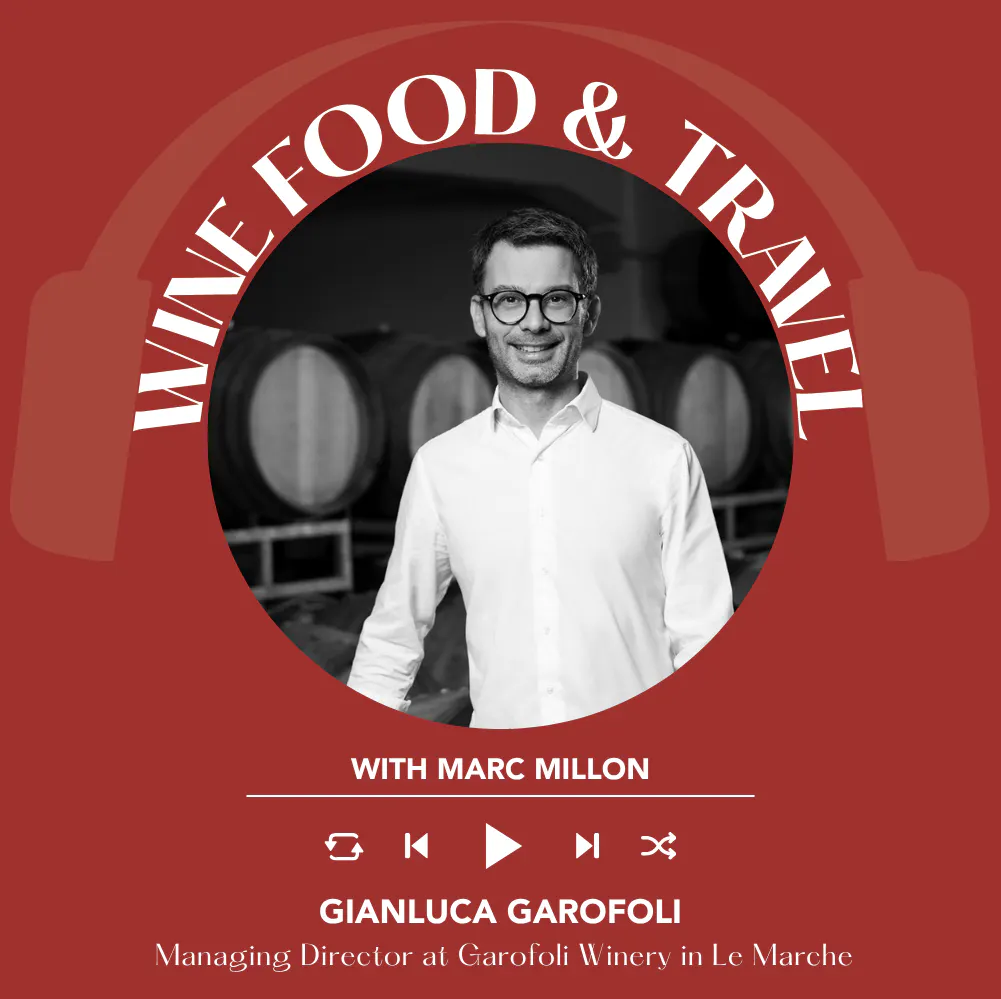
Ep. 2767 Le Marche: Verdicchio and the Wines that Shape the Region with Gianluca Garofoli of Garofoli Vini | Wine, Food & Travel with Marc Millon
Episode 2767

Ep. 2712 Exploring Brda: Exceptional Wines and Slovenia's Culinary Traditions with Lan Kristančič of Movia | Wine, Food & Travel with Marc Millon
Episode 2712

Ep. 2700 Sardinia Beyond the Coast: Agripunica, Basso Sulcis & the Legacy of Giacomo Tachis with Salvatore Santus | Wine, Food & Travel with Marc Millon
Episode 2700

Ep. 2624 Friuli Cuisine & 2 Michelin Stars: Inside Agli Amici with Emanuele & Michela Scarello | Wine, Food & Travel with Marc Millon
Episode 2624

Ep. 2592 Cormòns: Austro-Hungarian Heritage, Slovenian Culture & Friulian Hospitality with Mitja Sirk | Wine, Food & Travel with Marc Millon
Episode 2592

Ep. 2510 Elena Penna of Cascina Penna-Currado | Wine, Food & Travel with Marc Millon
Episode 2510