
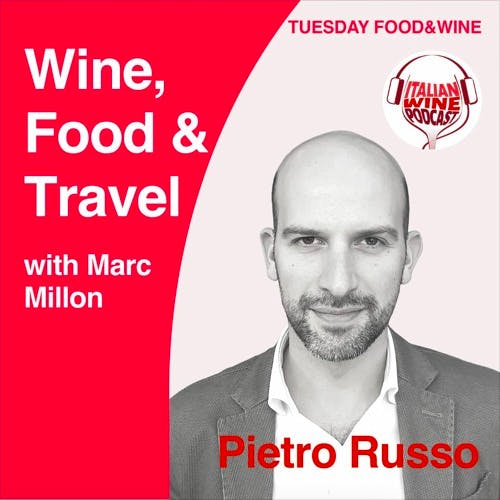
Ep. 700 Pietro Russo | Wine, Food & Travel With Marc Millon
Wine, Food & Travel
Episode Summary
Content Analysis Key Themes and Main Ideas 1. The unique geography, climate, and ""heroic viticulture"" of the volcanic island of Pantelleria. 2. The cultivation of the Zibibbo grape (Muscat of Alexandria) and the UNESCO-recognized Albarello Pantesco training system on Pantelleria. 3. The production of Donnafugata's flagship Passito di Pantelleria, Ben Ryé, highlighting its intricate process and balance. 4. The diverse estates of Donnafugata across Sicily and their historical significance. 5. The regional variations and expressions of Nero D'Avola and other iconic wines (e.g., Tancredi) from different Sicilian terroirs. 6. The challenges and complexities of managing winemaking across a geographically vast and diverse region like Sicily. Summary This episode of the Italian Wine Podcast features host Mark Millen interviewing Pietro Russo, the winemaker for Donnafugata. The conversation begins with a deep dive into Pantelleria, a small, volcanic island closer to Tunisia than Sicily, where Donnafugata produces its renowned Ben Ryé Passito. Pietro vividly describes the island's extreme conditions, including its strong winds, arid climate, and the unique ""heroic viticulture"" of the Zibibbo grape, specifically mentioning the UNESCO-protected Albarello Pantesco training system. He elaborates on the meticulous process of crafting Ben Ryé, which involves sun-drying grapes and later combining them with fresh must to achieve a balanced sweet wine. The discussion then broadens to Donnafugata's other estates across Sicily, including Contrada in Delia, Etna, and Agade. Pietro explains how the indigenous Nero D'Avola grape expresses itself differently across these diverse terroirs, from powerful in the west to more delicate in the southeast, and touches on other emblematic wines like Tancredi. He also highlights the logistical challenges of managing harvests across such varied regions, sometimes spanning over 100 days. Takeaways - Pantelleria is a volcanic island known for its extreme conditions and proximity to North Africa. - ""Heroic viticulture"" is practiced on Pantelleria, including the UNESCO-recognized Albarello Pantesco training system for Zibibbo (Muscat of Alexandria). - Donnafugata's Ben Ryé Passito di Pantelleria is a highly acclaimed wine, produced using a blend of sun-dried and fresh Zibibbo grapes to achieve balance. - Donnafugata is a family-run business (Rallo family, 6th generation) with significant land holdings across diverse Sicilian terroirs. - The Nero D'Avola grape exhibits distinct regional characteristics across Sicily, influenced by soil and climate. - Managing harvests for Donnafugata's geographically dispersed estates can take up to 100 days due to varying ripening periods. - Iconic Donnafugata red wines like Tancredi represent a blend of Sicilian tradition and international varieties. Notable Quotes - ""Pietros, thank you so much for being here today. Thank you, Mark. It's my pleasure. Really, it's a great pleasure to be here when talking with you about this this island in my highlands."" (Pietro Russo) - ""It's a land of extreme. It's a bit like CCD but really concentrated in such a small island."" (Pietro Russo on Pantelleria) - ""The Viti culture is unique because it's a single variety. It's a dibbo. It's what we call, Moscow, alessandria."" (Pietro Russo on Zibibbo) - ""You have a very particular method of growing that's actually a UNESCO heritage."" (Mark Millen) - ""So we're really talking about and heroic form of Viticulture..."" (Mark Millen) - ""Ben Maria, so our passido de Fantelari, it's, our flagship one. It's, that ship was with one from from Italy nowadays."" (Pietro Russo) - ""The harvest, you know, in Don't have to go that takes, up to one hundred days."" (Pietro Russo) Related Topics or Follow-up Questions 1. How do changing global climate patterns specifically impact the ""heroic viticulture"" of Pantelleria, and what adaptive strategies are being considered? 2. Beyond Zibibbo and Nero D'Avola, what other indigenous Sicilian grape varieties does Donnafugata cultivate, and what unique expressions do they offer? 3. What are the logistical and technical challenges of managing winemaking across such diverse and geographically dispersed estates like Donnafugata's, especially during harvest? 4. How does Donnafugata balance tradition with innovation in its winemaking practices across its different terroirs? 5. What impact has international recognition, such as the UNESCO heritage status for Albarello Pantesco, had on Pantelleria's wine tourism and local economy?
About This Episode
The hosts of the wine to wine twenty twenty one clubhouse marathon discuss the unusual nature of the volcanic landscape on the island of Pant relevance, where the Viti culture and Donofugata winemaker produce unique wines. They also talk about the unique trolley system used to grow vines in the island, and the unique characteristics of their own wines, including the sweetness and acidity of Donna Fugata Ben Rayer, a mix of dry grapes and fresh grapes. They also discuss the challenges of finding the right wines and the potential for a more modern and relaxed approach to their own wine Tanc trouble, a new wine from the Italian wine to wine clubhouse.
Transcript
Welcome to wine food and travel with me, Mark Millen, on Italian wine podcast. Listen in as we journey to some of Italy's most beautiful places in the company of those who know them best. The families who grow grapes and make fabulous wines. Through their stories, we will learn not just about their wines, but also about their ways of life, the local and regional foods and specialities that pair naturally with their wines. And the most beautiful places to visit. We have a wonderful journey of discovery ahead of us, and I hope you will join me. This episode is proudly sponsored by Vivino, the world's largest online wine marketplace. The Vivino makes it easy to choose wine. Enjoy expert team support, door to door delivery, and honest wine reviews to help you choose the perfect wine for every occasion, Vivino, download the app on Apple or Android and discover an easier way to choose wine. Welcome to wine food and travel with me, Mark Millen, on the Italian wine podcast. Today, we'd like to welcome you to the wine to wine twenty twenty one clubhouse marathon in collaboration with the UK wine show, interpreting wine and Bevology Inc. I am delighted to be actually in Italy for the first time in a very long time in Verona And I am so happy to have as my guest today Pietro Russo, who is joining us from a very special place, the island of Pantelaria, one of the most far flung of all of Italy many line regions. Pietros, thank you so much for being here today. Thank you, Mark. It's my pleasure. Really, it's a great pleasure to be here when talking with you about this this island in my highlands. Your island, and I am a great fan of the wines of Donofugata, which you are the winemaker for. So, I'm really looking forward to, to talking about the range of wines that that you produce, but first of all, tell us, tell let our listeners know a little bit about this special island, your island, where you are right now, this volcano that's closer to the north coast of Africa that it is to the sicilian mainland let alone the Italian mainland. You know, it's really, for me, it's a dream. It's, it's a land of extreme. It's a bit like CCD but really concentrated in such a small island. So the place is unique. It's, in the middle of the Mediterranean channel. And, once you arrive, you can really perceive its distinctiveness and, its peculiarities. First of all, we should, remember that it's, the the highland is closer to it's more closer to tunis than, than, than Sicily. So it gives you an idea of how unique can meet these conditions. And, then once you arrive, the architecture is unique because of the typical damuso, the landscape, it's, it's a very wild. It's, it's a volcanic landscape that that moves from the seaside, to the top of the Montana Grande that to, as, it's, over eight hundred meters above sea level. So the the landscape can really change, a lot. And it's our it's an island that is dominated by the wind. For this reason, people, needed to grow vines in some very distinctive conditions. The Viti culture is unique because it's a single variety. It's a dibbo. It's what we call, Moscow, alessandria. And also the name of dibbo came from this place because we the Bibbo means in the Arabic means, Zabiib, it comes from Zabiib, but that it's, dried grapes. And this comes from the old domination, of the the highland that was, over three hundred years, by the, by the morse. Okay. So we have this, this small island closer to Tunisia than to Sicily, rising as a, as an extinct volcano. Is that right? And it's really this volcanic terrain that is the most important feature in Pantelleria. Yeah. Absolutely. This is, as you said, it's an it's an antique volcano for sure. It's not not anymore active at least for the moment. But it's, it has, build the landscape of this, of this island. It's completely volcanic sand. For sure, volcanic, it's, it's a very complex word word because this doesn't translate such a high diversity of soil depending on the shire, depending on the lava flows, depending on the altitude. So the volcano has has depicted all this, this wide scenario. And, this diversity, you can imagine it's, even, more variated by the multitude of the vineyards. You can find vineyards, really close to the close to the sea, and then hop to the volcano at six hundred meters. Oh, okay. Then, for should orientate? The wind that you were mentioning. Is that a hot wind that comes from Africa? What is that wind called? Yeah. We have two main winds. One is the, the shirok, what do we call shirok, so the south, the wind from, the Sahara desert. Okay. That it's, it's southeast. Coming from Southeast. It can be very warm and dry, and it can, and blow for three to four or even a week in very it can be very heavy, let's say. And then the the other the other win, the main winners, the mistral comes from the north, and it's complete it's definitely cooler than, than they say. And both can make, designated, where to grow and how to grow in this island. And it's for this reason that you have a very particular method of growing that's actually a UNESCO heritage Can you tell us about this? Yes. We have we have the chance to, preserve this unique, trolley system. That is a alberlo Bantesco. Okay. Alberto Bantesco, it's a trolley system that was developed by the narratives of Antelaria and, according to the climatic condition that are extreme. So it's, it's a bush wine. It's a very low bush wine that, is standing no more than forty to fifty centimeters from the, from the soil. And, and there, this, this bush one with, three to five branches of all the tree stand protected by by the wind, thanks to some holes. So growers, dig some hole, close to the, these bushes, these, these vines to protect from the wind, and, to and try to collect the humidity of the night because, we don't have any stable water to irrigate for irrigation. And so the And very low rainfall. Yeah. They all rainfall, so mean rainfall, are lower than four hundred millimeters, per year. So three hundred and seventy something millimeters per year. So it's very low and concentrated only in the, autumn and, and wind. So these are even extremely very arid conditions for, for vine growing. And this, a a trellis system and this multicultural, of system. It's, health lines to, to grow and, concentrate the humidity And, it's a low expansion, trellis system that helps to, keep the vehicle and keeps and make the grades really concentrated. Okay. So we're really talking about and heroic form of Viticulture, this traditional labor intensive, a single vine in its own pit so that it can capture this moisture and protect from the wind. And through this, this grape Zibibo ripens to this high degree of sweetness, the aromatic, Muscar, the Alexandria, is ripening to make an extraordinary wine. Let's talk about the Donna Fugata Ben Rayer. It's one of my favorite Pasito wines in the world. I think, you make a really stunning wine. And when I do wine tastings, I've never had anybody not fall in love with this one. So, complimenti. Thank you. So, Maria, so our passido de Fantelari, it's, our flagship one. It's, that ship was with one from from Italy nowadays. So we are very happy from this. But this is very the result of, of the terroir. The result of this, all this unique condition, and we try that we try to convert in this in this wine. It's quite a special, process because, we have, not only dried grapes, but also, some percentage of, of fresh grapes, for the production. Okay. So we start the production for we start the harvest, by picking the grapes for sand grind. We start, at the second, after the, the second half of August. So so we start for drying, for the drying process that takes place, that requires two to three weeks. And, at the end of August, then we, we pick the grapes for for, for the production of a fresh mask. And once, we start to ferment the fresh mask, we we add gradually, the dried grapes at the same time, with the stem manually. Okay. So it's a kind of a verification with the with the pomace. Vineification with these, dried grapes to extract all the is concentrated aromas, concentrated, flavors, sugars, and acidity. While I'm keeping that freshness from the fresh grapes. Yes. Absolutely. If you just to give you an idea of the numbers, we have, we have, at the end, around two hundred grams of residual sugar, with around eight grams of total activity. Okay. That means that you don't know, you not only extract shoe worth, but you only concentrate, the acidity and this serveriness and saltiness, like, that that is the, the true, element for the balance of the one. Right. It's that balance. I think that is so so attractive in in this wine, this as you say, the sweetness that isn't cloying, balanced, you know, by the acidity. I I can also tell that that it's a very difficult fermentation because, at the end, it can be very sticky. It can be very concentrated for yeast to ferment. And the fermentation takes up to, so for several weeks. So now we are fermenting our facility ventileria, and we are still, disturbing our, our dried grapes manually because it's the process that takes really a lot of time. And, So, just beyond your account, or you add the the dried grapes when you feel it's, it's the right time. Yeah. And, yeah, it takes so long, but, it's really, and then it this is the reflection of the, of this unique condition of the sign, and also this, peculiar characteristics of this, such a romantic variety that is the, that is the, deliver from a volcanic area. And just one other question about this Benrai ID. It takes place in the directly in the sunshine. The grapes are outside or they're covered. Yeah. The grapes are outside. We only put the grapes into, greenhouses for the night. Just to protect from the humidity. Okay. Because, the island during the night can be very humid, and this will will affect the drying process. So it's, it's a sun drying process. So Well, let's cross over to the mainland of Sicily where Donna Fugata has a number of estates all around the island. Donna Fugata, the name, of course, recalling the country estate, the Prince of Selena in, Tomazidilampedusa's famous novel, Elogato Pardo, the leopard. Your estates are, across the country, perhaps not unlike the type of estate that the Prince of Selena would have had when he would travel from Palermo out to his estate. Tell us about some of where where your estates are located and the wines you produce. I know you have a very large range of wines, but just some of the most, characteristic and iconic wines of Donna Fugada. Okay. First of all, I wanted to just to make a, an idea what is this, Donna Fugada. It's a family business. Okay. Business from the Ralo family, that today is the sixth generation run-in the winery. And this started at the beginning of the 80s, in the western side of the high land. So in the place of the gutten tanks to to visionary person that, had the ambition to grow the reputation of sicilian wine. It was, Jago Morales with his wife. With, and the idea, at this at this time, the high the image of, sizzling was, not, the same most today. We're famous for, but when production So the this process started in the middle of, season in the hill and the, contest in Delina. Okay. This is now now there is the core of our, Viticulture production where we produce the, Milo Anaut, Anton Credi as a flagship, red wines. And then in the eighty nine, Jagomo and Gabriela Aralho built, a few shares of the land, in in Pennsylvania. So, and started the first harvest of, Pasadena, Maria. And then, this, adventure continues because in the two thousand and sixteen, We have, you've shared some other pieces of land in the most compelling areas of of Sicily that are Aetna. Aetna where we are, where we are, now. Other iconic production from this, this, this, area. And, at the south southeast of Sicily, in, in Agada, which is the land of the Charaswalle, we thought of, unique to the OCG order. So, across these areas, we produce so we produce iconic wines of wines from contrada, in Atlanta, Montelaguardia, Entegorra, Montelaguardia, and Margerta, we produce and the Charasolo Debitoria from from Macada that are very distinctive red that it's, completely unique and and different from the the reds from the inland of Kentucky. So, for yes. That's actually a very interesting, challenge for you as a winemaker because you're making so many Having almost a number of wine regions of to work from from Anteneria, which is unique to the different styles of red wines from throughout Sicily working with Nero Davala in different areas. For example, in the southeast, that would be the Nero Davala with Frapato for the cetera swallow. Tell us about the wines, how Nero Davala changes across the island. You say challenging and I can say it's true because, the harvest, you know, in Don't have to go that takes, up to one hundred days. Okay. So it's quite, quite unique to And then you must have flying winemaker then overseeing the production, in all the different states. We need an helicopter. Sure. It will be the best, condition, and I'm joking. Can really can transmit the sense of the place, so the sense of origin. It's typical variety that it's that can transmit the the depth and concentration of the of the clays, incontestantelina. So a richer style of nato, Davala? Yeah. The soil in Conestantelina are quite heavy and, Kalkaros. Nero davala, becomes a very dark in color, with some, powerful hue and then very concentrated and, and powerful on the nose or in dark cherry, and, and black, black fluid tower in the house with high, rich and powerful tennis too. And then we produce, the middle of an octa, which is our, our iconic, red that is, made for the time for for aging. Oh, and that's one hundred percent. Nero Davala. It's, it's not all it's not the pure Nero Davala. There are some, smaller percentage of, to complete and make something more complex at the end and trying to have something more approachable since the beginning, because Nava, as a native variety, sicily, and therefore can have quite a higher CD, that can make, tonnage a bit, bit chunky. But, at the end of this way, we can have something really solved and and refined. While at the extreme, south southeast of Sicily, you can have a really different, expression out of the tower because we are in the sand in Sandier soil, sand that comes from the Altopiano yblello sand and Tupro. In electrical cars. And here, the aromas, definitely more perfume is the the no the first of all, the color is lighter. And then you have a lighter style of red, a much more perfume that plays with aromas of strawberry and, red cherry has much more delicate, and some, wild rose are, scents too. What in the palette, it is definitely lighter. With the smooth tonings already resolved and, and run it. So completely. It's a different. It's a different style that we we also proposed as, slightly cold, slightly chilled, red to pair with, even with the with the with the fish. It's a tuna, red tuna present. It's sizzil is. I think it's really important, for, listeners to understand how NATO Davala, this great nature, great, but Sicily can have so much local and regional character as it moves around the island. And I guess that sort of delicacy is why it blends well with Frabato. Yes. Oh, absolutely. Frapato is another quite, delicate variety, but Nurdau is not that delicate, but for Prapato, yes, it's a delicate variety that plays more in the floral side. And, tells to be, more centered, nuanced and, in our territory. Okay. And one final read I'd like to discuss with you, which is one of my favorites is Tom Crady. Tancredi, again, the name that comes from Elgato Pardo. A wine that I suppose, links the tradition of Sicily, with a more modern style. Tell us a little bit about Tancredi. It's, you know, as I said, this one of our flagship wines from, our range. It's first vintaj was a ninety. In nineteen ninety, it was the first service to tank the first, production tank very, so you can understand, it's, it's our traditionally, historical, wine. And as the name, Tancredi, if you, if you know the character of the Gepard, it's, the result of, it's a combination of ambition and, elegance at the same time. Okay. For Jago and Gabriela started like Tibet because, we have heard not often as a variety, that was not that, family at the at this time, with an international variety so that, trying to boost the perception of Sicilia ceasily at this time. I think this bet was, was absolutely win was, was good and with and the results are nowadays in front of us because we can still open these bottles and, from all the vintage and, they still look beautifully. So it's a blend of, the structure at Cabernet sauvignon structure because, even this terroir, it's very can be very heavy, give some rich and bold wines, and blended with the more, delicate and, fresher in, in this context, Nero Davala. Okay. So, giving its acidity, and giving the, depth and, and the lens. So it it can be approachable since it's used, but then it can really improve in the in bottle with age. Okay. Well, it's a wonderful range of wines you produce. I've been a big fan for a long time, and it's great to actually be able to be in conversation with you. I'm looking forward to my next trip to Sicily I'll be going there soon and enjoying your wines when I'm there. So thank you very much for being a guest with us today. I've got a much better picture of Pentivity and Island. I've always wanted to visit. I hope I will get there soon, and you've made me want to go to Pantaneda in even more. So, Pietro, it's been a real pleasure meeting you, and I look forward to actually meeting sometime soon. Thank you very much. My pleasure, and thank you, Mark. So that is all we have time for today. I'd like to thank Pietro for joining us and thank you for joining us on this wine to wine twenty twenty one clubhouse marathon. Listen to the Italian wine podcast wherever you get your podcasts. We're on SoundCloud, Apple Podcasts, Spotify, email ifm, and more. Don't forget to subscribe and rate the show. If you enjoy listening, please consider donating through Italianwine podcast dot com. Any amount helps cover equipment, production, and publication costs. Until next time. Hi, everybody. Italian wine podcast celebrates its fourth anniversary this year, and we all love the great content they put out every day. Changing with Italian wine people has become a big part of our day, and the team in verona needs to feel our love. Producing the show is not easy folks, hurting all those hosts, getting the interviews, dropping the clubhouse recordings, not to mention editing all the material. Let's give them a tangible fan hug with a contribution to all their costs, head to Italian wine podcast dot com, and click donate to show your love.
Episode Details
Keywords
Related Episodes

Ep. 2791 Italian Wine in a Changing Climate: PIWI, Terroir & Tradition with Nicola Biasi | Wine, Food & Travel with Marc Millon
Episode 2791
Ep. 2767 Le Marche: Verdicchio and the Wines that Shape the Region with Gianluca Garofoli of Garofoli Vini | Wine, Food & Travel with Marc Millon
Episode 2767
Ep. 2755 The Longest Table: Honoring Nello Ghezzo’s legacy | Wine, Food & Travel with Marc Millon
Episode 2755

Ep. 2712 Exploring Brda: Exceptional Wines and Slovenia's Culinary Traditions with Lan Kristančič of Movia | Wine, Food & Travel with Marc Millon
Episode 2712

Ep. 2700 Sardinia Beyond the Coast: Agripunica, Basso Sulcis & the Legacy of Giacomo Tachis with Salvatore Santus | Wine, Food & Travel with Marc Millon
Episode 2700

Ep. 2681 Giro d’Italia 2026 Special Episode 1: From Bulgaria to the Mezzogiorno in search of wine and cheese | Wine, Food & Travel with Marc Millon
Episode 2681