
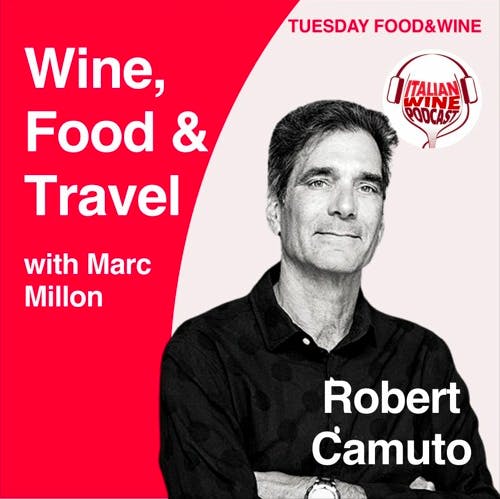
Ep. 712 Robert Camuto | Wine, Food & Travel With Marc Millon
Wine, Food & Travel
Episode Summary
Content Analysis Key Themes and Main Ideas 1. Exploring the unique wine, food, and culture of Southern Italy through Robert Camuto's book. 2. The deep connection between food, wine, memory, and personal identity. 3. The significance of ""people"" and local characters in shaping Italy's wine culture, especially in the South. 4. The authenticity and ""kitchen table"" experience of wine tasting in Southern Italy. 5. The ongoing renaissance and rediscovery of Southern Italian wines and native grape varieties. 6. The complex ""north-south divide"" and Italy's diverse regional identities. 7. The ""soul of Italy"" found in its beauty, time, family, and community values, particularly in the South. 8. The potential and hope for young generations to valorize their ancestral lands in the South. Summary In this episode of the Italian Wine Podcast, host Mark Millen interviews American award-winning author and journalist Robert Camuto about his latest book, ""South of Somewhere: Wine, Food, and the Soul of Italy."" Robert shares his personal journey of discovering Southern Italy, starting with his childhood experiences in Vico Equense, and how the region's food and aromas profoundly shaped his connection to the culture. He emphasizes how wine, when paired with local foods, serves as a powerful key to understanding the distinct way of life in the South, where the table experience is richer and more varied. Camuto highlights the importance of the people he encounters—winemakers, chefs, and locals—in bringing the narrative to life, noting that wine is deeply intertwined with culture and community, often experienced around a simple kitchen table rather than a formal tasting room. The discussion also touches on the exciting renaissance of Southern Italian wines, the complex historical and cultural nuances of Italy's north-south dynamic, and the enduring values of family, community, and ""time"" that define the South. Robert expresses hope for young people returning to these areas, valorizing their territories and helping them reach their full potential. Takeaways - Robert Camuto's ""South of Somewhere"" delves into the rich wine, food, and cultural tapestry of Southern Italy. - Wine and food are presented as intrinsic elements that reveal the unique ""way of life"" in Southern Italy. - Authentic wine experiences in the South often occur informally at kitchen tables, integrated with local cuisine. - Southern Italy is experiencing a ""wine renaissance,"" with increasing focus on native grape varieties and small producers. - The concept of a singular ""north-south divide"" is oversimplified; Italy is fragmented into many diverse local cultures. - The ""soul"" of Italy, particularly in the South, is characterized by its beauty, the value placed on ""time,"" and strong family and community ties. - There is growing optimism for young people returning to and economically developing their ancestral lands in Southern Italian wine regions. Notable Quotes - ""it was in Vico Aquente that I really discovered a way of life and, a way of living and really those Mediterranean flavors and aromas that have stuck with me throughout my life."
About This Episode
The importance of learning from family members' stories and local foods and specialities in Italian wine is discussed, along with the diversity of the experience at the table and the importance of creating artwork for the wine and wine industry. Speakers discuss the importance of finding great and emerging lion scenes in the wine industry, the importance of pictures and characters, and the importance of community and confidence in maintaining the south's potential. They also emphasize the importance of returning to family and community for values and family, and offer a donation to show love.
Transcript
Welcome to wine food and travel with me, Mark Miller on Italian wine podcast. Listen in as we journey to some of Italy's most beautiful places in the company of those who know them best. The families who grow grapes and make fabulous wines. Through their stories, we'll learn not just about their wines, but also about their ways of life, the local and regional foods and specialities that pair naturally with their wines. And the most beautiful places to visit. We have a wonderful journey of discovery ahead of us, and I hope you will join me. This episode is proudly sponsored by Vivino, the world's largest online wine marketplace. The Vivino app makes it easy to choose wine. Enjoy expert team support door to door delivery and honest wine reviews to help you choose the perfect wine for every occasion. Vivino download the app on Apple or Android and discover an easier way to choose wine. Welcome to wine, food, and travel with me, Mark Minon, on Italian wine podcast. This week, my guest, American award winning author and journalist, Robert Camuto, will take us to the south of Italy as we discuss his latest book, south of somewhere, wine, food, and the soul of Italy. Published by the University of Nebraska Press. Welcome, Robert. Thanks for joining me. How are you today? Great. Great. Thanks for having me, Mark. Well, it's really nice to meet you. I've enjoyed your your book so much. I love Palmento. And I've really and really enjoyed immersing myself in, the pages of south of somewhere. It's a really fascinating book and a compelling book. I couldn't put it down. Thank you. Your book your book starts and finishes, and Vico Iquence, south of Naples on the amalfi coast. Tell us about this special place and and what it is meant for you. Well, Vico is the hometown of my mother's family And it's actually on the other side of the mouth because some of the Sirento Peninsula facing Naples and Mount Vasuvius. So incredible views, seafront, the town itself is perched on this, very dramatic seaside cliff, and there's a marina down below. And this was the place where I really discovered the south of Italy. When I went with my grandmother, in nineteen sixty eight. I was, ten years old. And, I grew up in the northeast of the United States, you know, a very continental sort of, place with, cold winters and deciduous trees. And, it was in Vico Aquente that I really discovered a way of life and, a way of living and really those Mediterranean flavors and aromas that have stuck with me throughout my life. You know, I remember, you know, to go to the sea walking through the olive groves, picking figs off the trees, the smell of an ants, you know, mocha on the stove top with these little sweet breads she would have at the table. And those were all things that really, really have, stuck with me before I appreciated wine, I really appreciated all those flavors and smells at the Italian table. Wow. That's a, that's a wonderful description. And in a way, these smells and tastes are your sort of equivalent to proust's Madeline, that brings you back to your childhood. I love a phrase you have in the book where you say it was in Vico Aquensei where you first learned that food could alchemize into emotion and that a meal could be an intoxicating adventure accompanying it all was wine. I guess for you, in this book and as well as in Palmetto, wine is that tea to discovering, not just, not just a liquid beverage that we can all sometimes encounter and enjoy, but when wine is paired with local foods, it opens up and reveals that entire way of life that you're just suggesting there. And and a way of life that is so different to life in Northern Italy, in Northern Europe, or indeed in North America. Yeah. Is that really the main subject, the interest for you in this book? Do you mean the wine aspect or the? No. I think it's this whole way of life and wine as a way into that way of life. Yes. Yes. Absolutely. And, you know, what's really interesting about I think the further south you go in Italy, the richer, the more varied, and I would say the more almost baroque the experience at the table is. And as a result of that, You know, I think that wine was one component of a meal. You know, it wasn't the main necessarily thing, but it was something that went with that on, you know, at on meal times where you had such an incredible range of flavors and spices and, you know, you've got things like in the south we can think about in the summertime. You know, the fresh mozzarella that's never been refrigerated and ricotta and those, you know, tomatoes that grow in the volcanic soils. I have a theory that a lot of these great wine regions that, you know, we think about whether it's in the Piedmont in Italy or burgundy in France, you know, they they don't have the same varied table that the south did. So, you know, they got most of, you know, a lot of fruit in character, through wine, whereas I think in, you know, the south of Italy, there's just so much competition at the table. That said, what's really exciting about the south of Italy now is that this Italian wine renaissance that we all have been watching and experiencing with a lot of passion is spreading south. So I think that people are putting a little more focus or actually a lot more focus on how to make these wines something great and really find their potential. So, you know, it's, it's really a bit of both from the food side and also this new emerging lion scene. Yeah. And I think that's actually what's, so compelling for me about your narrative and about your storytelling because you're taking us on journeys across Calabria, And we're discovering wines in some cases. We're almost forgotten just thirty years ago, but which today are becoming, you know, well known around the world and and making us want to learn about the areas were there produced, and of course, in Fiano de Avelino and Greco Ditufo. So there are all these wonderful names and wines, but you bring them to life through the winemakers themselves and the many characters that you encounter along the way. And what I really love about your books is the descriptions of the people you meet who are, I think, are the real focus and subject, more even than the wines themselves. You've got a real gift for creating portraits of people precisely through, you know, through their appearances, how they look, what shoes they're wearing, the way they speak, And actually, that gives us an insight into the way they think. Almost literally warts and all. I'm interested in a writer. How do you achieve this with such vivid precision? I've always been interested did in writing about people way back in the day, many, many years ago, and another in my earlier career, I wrote about politics in Texas, for example. And I've always been interested did in writing about the people, the characters. You know, whether you're talking about a, you know, it could be a leader or a company executive. What's always interesting to know about What I'm always interested to know is what makes the people tick, what motivates them. And in the wine world, people are so important because wine is culture, and grape wines come from grape cultures, and those cultures are made of people. So I think that, you know, if it weren't for five families in Burgundy, Burgundy wouldn't be what it, you know, is today. If it weren't for Angelo Goya and some other producers in the Piedmont, we wouldn't know you know, Petemont as it is today. So so so people are just so so important. And I think also when you talk about the south of Italy, you have such rich, rich characters. I mean, I've written about wine and, food and travel, you know, all over Europe. And, you know, in some cases, the characters are so great in Italy. You know, you love them so much. You can just almost, leave your pad and pen on the table and her, you know, the the story writes itself. Yeah. Actually, I I've, I've met some of the people that you've described, and you're you are very, very laser like in your precision of of your encounters. And actually, I think most of the, or or many of the really interesting and revealing encounters take place around the table. Enjoying simple foods often crooked directly in front of you. Somebody taking down off a shelf, a frying pan and putting in a glug of their own extra virgin olive oil. And you can smell the garlic beginning to sizzle, and you know, I could taste that creamy oozing mozzarella debuffalo that had been made just a few hours earlier when you were in Caserta. So these foods and wines. As you say, the wine is often just an element of the overall experience, but it's there that we really learn the most about about the people, about a way of life. Through the foods and wines. Tell us about some of, some of these iconic food experiences that you have in the book. Well, one of the things I wanted to mention there too, when you talk about, like, the preparation of the meal, you know, in our brains, I mean, smell is so linked, you know, to memory. And I think that's one thing that's come out in the last year or two, you know, through the pandemic and people losing smell and learning about all of that. And, you know, I think that's why this kind of storytelling is so, important because I think it connects with people in, in real ways that embeds, you know, in their own memories. And, like, when you just talked about garlic sizzling in a pan, I mean, that's, like, a unique precursor of you know, great things that are to, you know, great things that are to come. But, one of the things that I love about traveling through the south, and there were so many meals. I can't enumerate them all, but one of the things I love about traveling and visiting wineries there is the, you know, the wine tasting room is often the kitchen table. I mean, it's not some fancy remote place where you go taste wine and spit, you know, but it's like, right there with the homemade cheeses, the salumi, and, you know, and, paired with the wines. So You know, I think in the south of Italy, you still have more of this kind of original authentic closeness of wine as a family product, even though it's a little more than that. And to me, you know, that's you know, that's super important. I mean, you know, you see families, you know, they they make their own prosciutto and cutting the first slices off of that is, is a great experience. Yeah. I sense it. For you, these simple meals enjoyed around a kitchen table are far more, are what you enjoy far more than perhaps dining in fancy restaurants or Michelin Star restaurants. It's this genuineness that you're experiencing here in the south? Yeah. Yeah. And one thing I wanted to talk about that too, I write a little bit about, you know, some of the chefs, some of my experiences, and some Michelin starred restaurants, which I often do find to be a little sad, you know, this kind of, like, dot cuisine, you know, that resembles a fine art painting, and, you know, that you have this color dot and that color dot. And You know, for me, it's really important that cooking and a chef recall something of the territory. I mean, there's gotta be a link, you know, like a meeting and a purpose. Otherwise, it's just kind of like you know, showmanship and fireworks. You know, I think even at the high levels, I mean, you do have that. You do have it in the south. Chef like Genaro Esposito who I think, you know, his flavors and his sense are really linked to that territory to the memories, of his childhood. And, you know, you have, Pino Kutaiya, Lamadia, and Sicily, who I think is another great chef who really brings you back to the essence of the territory rather than, you know, riffing on some recipe of a friend in, Denmark or some other part of the world. Yeah. I guess that link to territories is really the key both in food and wine. It seems At the same time, at times your taste, your enjoyment of wine also follows this approach to food. Your time seems to almost betray something of a disdain for the precision of winemakers who want to control everything. Maybe winemakers primarily from wealthiest States in the North compared to a more natural approach where wines are more rustic and more genuine and that the south is uniquely able to deliver. Is that a fair assessment? I think that I mean, I love variety of wine. I mean, we all love Italian wine because it's it's so varied. The biodiversity is incredible. You can drink a different wine every night of the year and not repeat yourself. And I think that's a difference, from, for example, from drinking French. And I know, you know, many of us have spoken of that. Like, you're not looking towards one goal, but different expressions of that. I'll give you an example. Last week, I was in, Campania, focusing mostly on Fiano. And, I went to a dinner at Feodie San Gregory where they you know, we drank, like, seven or eight Fianos. And I was just blown away by just the amazing diversity of these wines. I couldn't even map them in my head. There was late harvest ones that were very rich. There was, minimally elegant, very fresh fianos, and the expressions were just all over the place. And I love one of the things that Antonio Capaldo said about Fiano from this one area. He said it can it can smell like Sfoliatele. And if you know Sfoliatele, it's that, Neapolitan pastry with this crunchy outer shell and inside this a groom flavored whipped ricotta. I mean, it's so baroque. Now I had one just a few days ago when I was coming through flying back from Palermo. Yeah. And if you think about it, I mean, the fact that you could have this one that over time, And in the bottle starts revealing all these crazy different flavors. It's just it's absolutely, thrilling. So I think to try to fit some of these wines into a category or, you know, one style is kind of a mistake. And, you know, I think you wanna go with the variety that you have and not try to fit them into a, you know, a niche. Now one thing that is very interesting when you talk about some of these southern wines, many of them are bottled up north, and I think that that in a way has held them back. Like, you have many sparkling fianos, for example, that are not very well made, that are may that are made for, you know, mass produced supermarket shelves up north. And On the other side of Italy, you have, like, Montipuliano, Davruzzo, forty five percent of it is bottled in, like, Lombardy, Piedmont, and Venito, by huge bottlers. So I think there's still enormous potential for rediscovery for more small producers getting involved and giving local expression to these wines. I guess they're, you know, part of what the subject of the book is is this great wealth of native grape varieties that there there were grapes that I hadn't heard of, in your book from, you know, obviously we knew some of the major grape varieties from the south, but there's still so much to discover. Part of the, subject of your book, I think it was something that's ever present is this north south divide that exists in Italy. Historically, politically, culturally, socially, of course, gastronomically. But it's been a historic exclusion of the south, a denigration of the south with racist attitudes to so called stoked up by the Lego and other far right political parties. But yet, wine is a way of people elevating themselves and bringing some worth and dignity to lands that had been forgotten. Do you think that this north south chasm is as deep as ever or Italians learning to respect and appreciate those from other areas, sp especially the south. Well, I call the book south of somewhere because, you know, I think Italy defines itself in that way. It's never really been a unified country. And rather than just a north south divide, I would say, you know, like dividing the country into two pieces. I think it's many, many, many more pieces than that divided by mountains and local cultures. And as I say in the book, every everywhere is south of somewhere else. And I think that's how Italy defines itself. And I think in the last couple of years, you have had reminders of you know, different personalities in, Italy saying, remember there's always someone, you know, more north of you or more south of you. And I saw I think it's a very you know, relative thing. If you look at the north of Italy, I mean, look at, Alto Adige, it used to be the south of Austria. Now it's the north of Italy. So I think at some deep level, people understand that. And, you know, but once again, Italy, I think is not so much organized around a north south divide, but is, populations tend to be loyal to the local bell tower. And, you know, the best oil is the oil from over there. And, you know, the wine we drink here is the wine my father made. Or Yeah. Yeah. That comes. I mean, your your subject is the south. But you're certainly not looking at it through rose tinted glasses. Through you, you know, we also we see the unfinished houses that light the countryside. The the chaos, the the sometimes danger. Yet in spite of it all, there's something here in the south that has vanished from other parts of Italy, indeed, the rest of Europe. And would you say that something is the elusive soul of Italy that your book is in search for? And if so, how would you in a few words define that soul of Italy. Well, I think there's just kind of a naturalness around I think the family is a big part of it, the table, a way, a idea of community. And I think that's what has really held the south back from reaching its potential has been, you know, many years of corruption of, you know, various mafia's, lack of opportunity, frustration, immigration from the area. But I think if you were to look back, say, in the chapter where I revisit Aetna, what's very encouraging there is, from the beginning of the Aetna boom in the early zeros, I mean, you've seen that area really take off, and there's a real wine culture. And as Andrea Fronkenti says, you know, now young people can stay here. They they can choose not to leave. And that's what's so important because these cultures are so rich. And it's just so important for young people to not have to leave to go to Milan or London or New York, you know, to be able to really valorize their territory. And that takes a lot of things. It takes a certain amount of confidence, vision, investment, and you know, little by little, it happens. There are areas of hope. It's not, you know, like a wave that's suddenly sweeping over Italy, but it's shown that it can work and that people can make a living. They can valorize their territories and promote it to the rest of the world. Yeah. And actually, I think what's so interesting in your book is that we gain gain an understanding of why young people want to to return to the land for those reasons, you said, for the values, for the family, for those simple pleasures around the table that if you were if you had had a career elsewhere, you, you know, people are missing that, and that's why they're returning. And doing great things now. Yes. Yeah. Well, at one point as I, speak about in the book, I think the two greatest riches of the south are it's beauty and time, and that people still do have time there, which is something that it seems that maybe in modern life has become a more precious commodity. And so when you even think about the word mezzo Jordan, you know, for the south, you just think of these long and terminable afternoons. I mean, it just says it perfectly. And I think you know, Metzo Jordan, as a way of life, has kind of, shrunken in other parts of the world. Yeah. Yeah. That's true. Well, Robert, it's been it's been great to have a chance to meet to have a chance to talk to you about all of this. I would prefer if we were doing it over a glass of wine and perhaps seated around a kitchen table with the smell of sizzling garlic in the background and sharing a meal, but perhaps we can meet sometime soon. South or somewhere is a is a brilliant book. It's an important book, and it's one that anyone who loves Italian wine, food, and travel will want to purchase and read. Bravo Robert Thanks for joining us this morning. Thank you, Mark. Thank you so much. Salute. Salute. We hope you enjoy today's episode of wine, food, and travel. With me, Mark Millen on Italian wine podcast. Please remember to like, share, and subscribe right here, or wherever you get your pods. Likewise, you can visit us at Italian podcast dot com. Until next time. Hi everybody. Italian wine podcast celebrates its fourth anniversary this year, and we all love the great content they put out every day. Changing with Italian wine people has become a big part of our day, and the team in Verona needs to feel our love. Reducing the show is not easy folks, hurting all those hosts, getting the interviews, dropping the clubhouse recordings, not to mention editing all the material. Let's give them a tangible fan hug with a contribution to all their costs, head to Italian wine podcast dot com, and click donate to show your love.
Episode Details
Keywords
Related Episodes

Ep. 2791 Italian Wine in a Changing Climate: PIWI, Terroir & Tradition with Nicola Biasi | Wine, Food & Travel with Marc Millon
Episode 2791
Ep. 2767 Le Marche: Verdicchio and the Wines that Shape the Region with Gianluca Garofoli of Garofoli Vini | Wine, Food & Travel with Marc Millon
Episode 2767
Ep. 2755 The Longest Table: Honoring Nello Ghezzo’s legacy | Wine, Food & Travel with Marc Millon
Episode 2755

Ep. 2712 Exploring Brda: Exceptional Wines and Slovenia's Culinary Traditions with Lan Kristančič of Movia | Wine, Food & Travel with Marc Millon
Episode 2712

Ep. 2700 Sardinia Beyond the Coast: Agripunica, Basso Sulcis & the Legacy of Giacomo Tachis with Salvatore Santus | Wine, Food & Travel with Marc Millon
Episode 2700

Ep. 2681 Giro d’Italia 2026 Special Episode 1: From Bulgaria to the Mezzogiorno in search of wine and cheese | Wine, Food & Travel with Marc Millon
Episode 2681