
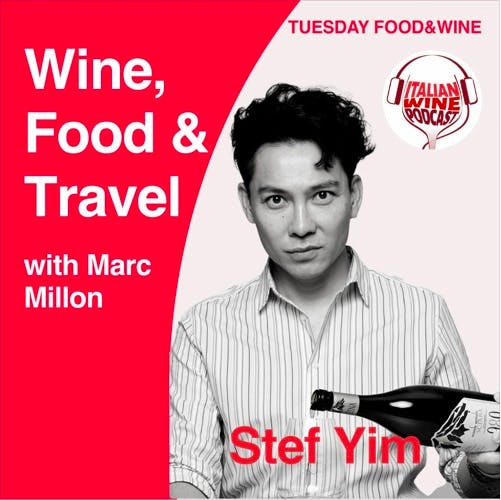
Ep. 718 Stef Yim | Wine, Food & Travel With Marc Millon
Wine, Food & Travel
Episode Summary
Content Analysis Key Themes and Main Ideas 1. The ""Ambassador's Corner"" segment format of the Italian Wine Podcast, connecting international wine lovers with Italian producers. 2. The personal journey and unique winemaking philosophy of Steph, a Hong Kong-born winemaker who established Shawa winery on Mount Etna. 3. The significant influence of volcanic soil and high-altitude viticulture on the characteristics of Etna wines. 4. Steph's commitment to natural, ""honest"" winemaking that reflects the vintage and terroir, rather than market trends. 5. Specific details about Shawa winery's reds (named by altitude) and Steph's approach to white wine blending. 6. The challenges and experiences of cultural integration for a foreign winemaker setting up business in Italy. Summary The Italian Wine Podcast presents a Clubhouse session as part of its ""Ambassador's Corner"" series, where Alice Wong and Ellen Quach interview Steph, an Asian winemaker based on Mount Etna. Steph recounts his transition from sommelier to winery owner, driven by a fascination with volcanic soils and a desire to make wine with creative freedom. He elaborates on his philosophy of producing ""honest"" and natural wines that genuinely reflect the vintage and terroir, rather than adhering to market demands. Steph details his red wines, uniquely named after their vineyard altitudes (e.g., 760, 980, 1200 meters), and his deliberate blending strategy for his white wine, Apa de Luna, prioritizing complexity over single-varietal purity. The discussion also covers the initial challenges of learning Italian and integrating into the local culture, though Steph praises the welcoming nature of the community. He concludes by offering advice that success in Italian winemaking demands deep dedication beyond mere financial investment. Takeaways - The ""Ambassador's Corner"" series on the Italian Wine Podcast connects international wine enthusiasts with Italian producers through interviews. - Steph, a Hong Kong-born winemaker, founded Shawa winery on Mount Etna, Sicily, driven by a passion for volcanic soils. - His winemaking philosophy emphasizes natural processes, honesty to the vintage, and reflecting the terroir. - Shawa's red wines are uniquely labeled by the altitude of their vineyards (e.g., 760, 980, 1200 meters). - Steph prefers blending white grape varieties like Carricante and Catarratto on Etna to achieve greater complexity and dimension in his wines. - High-altitude vineyards tend to produce more elegant wines with greater freshness and lower tannins due to cooler temperatures. - Despite initial language barriers and cultural differences, Steph found the Sicilian community welcoming. - His advice for aspiring winemakers in Italy stresses the importance of genuine devotion and active participation over treating a winery as a mere investment. Notable Quotes - ""I wanna make a wine that'd be honest to the weather that particular year, the vintage, and everything."
About This Episode
The hosts of the Italian wine podcast discuss their upcoming installments and new moderator, Ellen Quach, who is a former co- moderator and a food and beverage expert. They also introduce new moderators, Steph Yum, who is a winemaker and a former headliner. They discuss their approach to wine making, their love for natural wines, and their desire to create their own wine. They also discuss their preference for natural wines and their desire to try new ones in the future. They emphasize the importance of pruning in making good wines and emphasize the importance of letting consumers know about their taste. They also remind customers of their upcoming podcasts and encourage them to donate through Italian wine podcast dot com.
Transcript
Welcome to this special Italian wine podcast broadcast. This episode is a recording off Clubhouse, the popular drop in audio chat. This clubhouse session was taken from the wine business club and Italian wine club. Listen in as wine lovers and experts alike engage in some great conversation on a range of topics in wine. And remember to subscribe and rate our show wherever you tune in. Hi, guys. I'm Joy Livingston, and I am the producer of the Italian wine podcast. Thank you for listening. We are the only wine podcast that has been doing a daily show since the pandemic began. This is a labor of love and we are committed to bringing you free content every day. Of course, this takes time and effort not to mention the cost of equipment, production, and editing. We would be grateful for your donations, suggestions, requests, and ideas. For more information on how to get in touch, go to Italian wine podcast dot com. Now back to the show. Welcome to your Italian wine club. This is a weekly slot to seven PM central European time today as we are connected with Hong Kong, as well as Italy. I'm actually calling in from New York today, but I love the fact that we can actually do this, connecting the world literally. Next week, we will be back on our Thursday slot on eight PM central European time. Today, we are back with what I believe is the fourth installment of this series, Ambassador Escona. Where Italian wine ambassadors and wine lovers get a chance to interview their favorite Italian wine producer. It all star Cynthia interviewing Albertotaska a few weeks back. Then Shawwan interviewed Elena Fucci, her inspirational wine maker. By the way, if you missed that, we we've just dropped the episode on Italian wine podcast today. So check that out. It was a hotwarming in Tivia. I was in the podcast booth with Shawan. It was very moving. So check that out. You'll you'll learn a great deal. Not just about Elena Fucci, but also Then last week, I was more or less the absent moderator. My apologies to everyone. I was actually trying to multitask, and something had to give. Thank you, Joy, for filling in for me, last week. And as you know, Joyce are super duper, wonder woman producer for Italian wine podcast. We'll give her some slack this week as she's somewhere in Croatia, I believe, I think. As you know, the entire month of August is practically on pause button for the holidays in Italy, but not us. I drive everybody crazy. We will still be bringing to you weekly calls on Italian wine club here at Clubhouse. After having listened to our call today, if you'd like to nominate and interview a favorite Italian wine producer, please ping me on Insta reach out to Leica. She's our backstage club manager. She can see her on the first row, which she's been doing a great job on Italian Wine Podcast Insta, Instagram account as well. So let me just do the housekeeping quickly. As usual, our gentle reminder, is that this one, this room will be recorded and maybe replayed on Italian wine podcast, or let's hope so, unless there are some snafus. While you're at it, we'd really appreciate your support if you can give a thumbs up and rate our podcast wherever you get your pods, whether it's, you know, podcasts on your iPhone or Spotify or Sound Cloud, whatever, any and if you like to make a small donation because this is a labor of love. It's everyone is working very hard for this, even better. We've got two moderators today, or shall I say two ambassadors I'm very pleased to present to you our guest moderators. For our call today, Alice Wong, our what I call Fedelisima, Vineitel International Academy Ambassador from Hong Kong. She's an incredibly talented and smart woman, in the wine world. Alice is a wine educator, wine writer, judge, and consultant, and a brief soul. She even managed to get herself to Italy in June. Of course, there was a small snafu with the with the tests, etcetera. She was quarantined when she was back. Just very, very dedicated to the Italian wine community, and we are really grateful for that. She also manages, wine events. Now she has become an, she became an ambassador in two thousand eighteen, And she is primarily based in Hong Kong, so she works with many Italian government bodies to promote Italian mines in Hong Kong, and she I I believe she had worked for, the consortium of she was their ambassador as well. And also, she received the Hong Kong Living influence award in two thousand twenty for her achievement in the food and beverage industry very lucky to have her in our community and our call today. Ellen Quach, her co moderator, has a doctorate in chemistry, but on his bio, he prefers to drink wines with little chemical additives. I don't know what that means. I I I suppose he will explain that to us later as we get it into the conversation. He's currently the master of knights of Alba of Hong Kong delegation. So the, I guess, does this mean you've taken over for JC? I I suppose. Yes. It is yeah. Okay. Great. Congratulations. And the latest addition to the Italian wine Ambassador certification certified voted ambassador in from Hong Kong. So, okay, on to you, Allison Allen, and I will now shut up. Hello, Steve. Good to hear from you. We are having a good time in New York. Let me get started. I'm in isolation because I, saw my nephew Monday, and they were both vaccinated. They're twins, and they tested positive. So, on day three, I actually will go do my PCR because on day you're supposed to do it. I'm asymptomatic, but I've been isolated. So I'm in New York and doing a lot of Zoom calls. Oh, I'm goodness. I hope you're feeling okay, and I hope the vaccination helped. I'm fine, but it's crazy. This Delta variant. So take it away, Alice. Alright, Stevie. So when I let me get started. When we first, hear that the Italian White House is doing this ambassadors corner, and asked us to, invite us to choose a producer to interview, and Alan and I both first think about Steph. So, we thought that, Steph Yum, had a very interesting story to tell. Let me share my story first with with staff a couple of years ago, not well, maybe four years ago. My dad came home one day and told me that, well, I had a dinner tonight, and I met with a wine producer, and we became friends, and he invited me to his wine ring in Italy. And I was like, no way that I'm the one in the wine industry. You're not. How would you meet a wine producer that I've never heard of? And, and he went on and added extra information as foreign Hong Kong. He's a Chinese wine maker. I said, no way. I've never heard of that. He must be joking with you. And then I left my and left that conversation. And a few months later, I met through other, went through other friends who told me the same story, and that when that's when I realized it was true And I found it interesting because over the over the years when I know Steph, every so often, it will come across the same story that, people wouldn't believe that there is a, Chinese winemaker in Italy. And so I thought it was quite a brave thing to do. And I imagine how the things he had to come across and overcome to be successful in promoting his winery, just like when I teach time wise, sometimes I would come across, in Spanish students, And I got a feeling that they must be thinking, who am I to teach them Italian wise when I'm Chinese and very Italian. So we thought it must be a very interesting story to listen to from staff having overcome the cultural differences, being a, foreigner so to speak, in Italy and become so successful these days with all his wine portfolio in Italy. I don't think I don't think he understands or speak attorney that much. When he first moved to Sicily. So that was the reason that we chose staff today to be our guest, because we want to listen not only to his, his, philosophy and winemaking, but also also the interesting story of how he overcome all these things and differences, to do well in his business. And, let's, Alan introduce more detail about Steph's winery. So, hi, everyone. On sale. So, Steph, actually, was born in Hong Kong, and then he moved to LA to work as a souvenir. And then he never imagined to do this online until, two thousand and nine. And then I think he was in a blind tasting. And then out of ten wines he tastes, two of them, it went first and second up all from the volcanic soil. So he starts to look for, like, volcanic soil around LA, and then he found that in, Lake Lake County. And he started to make wine part time in Lake County. Before we moved, to Europe. And he made wine in France and also in the Canaway Island. And then he was looking for volcanic soil in Italy. And, of course, as we know, there's not, there's only a few places with, leaving volcano. And so he finally settled on a month, Edna. And it was very brave of him to purchase his own vineyard in two thousand and, I think, fourteen, and he starts to make the wines. And, the potential of it captured his heart And the ideal to make wine, I think, in a natural way is, really the core in is wine making. So as Steve mentioned before, that I have a doctorate in chemistry, but I'm very sensitive to chemical addition to the wines. Like, I get really headaches, if there's too much, too much sulfates in the wine, we care a lot about the vineyard, how they work with it, with, pesticides and herbicides. And I think, Steph will tell you more about this, regarding his, winemaking and so on. So I think let's hear the story from staff. Hi there. Okay. Hi, guys. I'm Steph. I don't know where to begin. So, basically, I am a winemaker. I'm making wine for the last twelve years, California, Southwest of France. And and now I'm in Syslidge. I was Esamalie some ten years ago. I started to ask Asalie back in LA. I worked my ass off, so I got burned thinking, you know, making wise a lot more fun instead of waiting tables. Here I am. You feel free to ask me any question. I don't know where where do I begin. Yes, Steph. Why don't you tell us? I think Ela mentioned two thousand fourteen is the was the year when you started the winery. That's right. As a matter of fact, fourteen, I haven't really started buying buying the vineyards at that time. I bought some grapes and I started at the trial as a trial. I wanna see how's what's gonna happen. Test drive it a little bit. So this is how I got started. I was, actually, I was working at that time in Matihon. Matihon is the place, is the region where I worked in France. Southwest, the France that I mentioned to, since twenty twelve. And I stayed up with three vintages. And but then when I was when I got a chance coming over to Aetna, and I bought some grapes, and I started to, meet some wines and let's see just to see how it goes. And I I always been fascinated by organic soil. So volcanic soil is very special to me. I I think it's the most interesting soil, the most diverse, the most in in the sense that I'm I'm talking about diversity of minerals compounds. So, well, Ellen knows what I'm talking about. So in in in the soil, you'll find a lot of different mineralities. So so the minerals they kind of play a very important part. So a lot of times that I I believe I, like, mentioned before that when I was a family, I take blind taste a lot of wines. And, there are a couple of times because I I belong the court of master Somme at that time. So we had a lot of blind tasting meetings and stuff like that. And then a couple of times that I thought I was for certain that was, Umo Musini or is Shabh shambachan, and and it turned out to be, a wine from Tenerife or from Aetna. So it was, like, I was totally intrigued. I would never imagined about anything, like, like that. In that time, of course, I didn't have chance expose myself to a lot of Evocan points. So but I always fascinated since then. And not until two thousand nine, when I got a chance to visit my I fell in love with that more, And the person that I first met was, Frank Conouts, Belgian guy, Nickywine on my end. So that that was, that was a turning page for me. It really opened my eyes. Yeah. So, and then, a few years later, I was working in France just for, winery. I wasn't I wasn't the owner. I wasn't the person in control. I was just working there, and, people tell me what to do. I'm out at that tiles to learning a lot of stuff, and I'll just try to, you know, pick up, like, gain more experience and into winemaking. So a couple of years later, in France, I decided, you know what, instead of, I kinda know a lot a debt. I thought I'd know a lot, but, of course, I'm still, like, learning and, understanding a lot of things. But at that a lot at that time, I I I I had that moment, like, I really wanna have my have a vineyard for myself where I can do whatever experiments that I want. So because when I was working there, I was not allowed to, like, experiment a lot of stuff. I was just doing the stuff I was told. So having a vineyard by myself, it gives gives me the, it gives me the freedom of making a lot of a lot of experiment that really, a lot of trials and errors that I I I believe that that's what I wanted at that time. So once after I I finished the job, I decided this is so I I got to find my own vineyard. So, Steph, obviously, Alan and I have tried your wines, but I'm not sure. If the audience here have tried your wines. So why don't you talk a bit about your wines, so we understand, and then you can, as you explain your your wines, so we know what trinary you have done? Well, I, I met a lot of people here. At the beginning, just to understand the place and just to understand soil, the the grapes, the grapes he's called Nero Mascaleza. So the wife is called, Caracante, and cataracto, and there there are a lot of, a lot for white indigenous register. I pick up from people who have been here for a long time. I try to listen to what, I want I try to observe what what they're doing. And, first couple of years, first two, three years. Because making wine in France is totally different than where making wine in the climate and everything. Soils, the practice, the the traditions, it's different. The training is different. So, basically, I have to learn a lot from scratch. For me, the the wine that I make, my my philosophies to make a a a from the beginning, is to make a wine as natural as possible. I don't want to put too much of chemical influence, interventions, and wine. That's my idea, like, until now. You know, I wanna make a wine that'd be honest to the weather that particular year, the vintage, and everything. So I don't believe you can, meet the same one year after year, unless there's some certain kind of inventions. So, basically, I I work with the nature. I don't, like, I don't like to, to to make a wine just to cater, certain market, a certain palette for, certain people, certain critics. This is not my, my thing. It's not my, my intention. So, and that's why I was better off at the beginning. I was thinking is better off that I make my own thing. I do my own game. This is what I do. So, Steph, so for those who do not know, then, your win away is called Shawa. There's, located at the northern source loop of a month's Edna. It's situated. The reason why I named it Shala, Shala means, it actually is just sitting dialogue. It means the love of road is a lot of love of text is kinda like after the eruption, the lava kinda runs down the hill and forms the road. So that's shocked. And how many, bottles do you make a year? And more or more or less twelve to fourteen thousand dollars a year. Depends on the year. I, like I said, I work with the nature. It depends what nature gives me. For example, for twenty twenty one, I have no idea how many kilograms of grades I'm gonna harvest. Because the weather could could change, like, all of a sudden, last minute. So I couldn't tell you, but the the thing that I could tell you is we spent a lot of time to nurture the vines, the land, and we'd do everything we could to make the best out of the land, the vines. So with a lot of effort, I believe in order to make a good with a good wine, it starts from the sword. It starts from the vineyard, not in the wine making process. That that's what I believe. Yeah. Can you tell us, how many, white wine do you make and how many red wine do you make? Sure. I make, one white and four reds. And the the white is basically nine crews. Ninth isn't contrade. I didn't tell you no satyama contrade. Contrade means is almost like it kinda like the French color crew, but not as like, not as tiny as, not as definitely for, not as small as approved, but a little bit bigger. It's more there's more like a cleanup. It's like a climate. So each contrada has a different claim. If you want to me, so to me, I think most intriguing thing for me is part of one of the reasons why I I decided by a vineyard here at first place because of the diversity of the microclimate that are a microclimate. So, I got nine of that. Nine of the because one of them is actually is kinda the same right next to each other. So nine to ten things that I got, and, they're all from a different location. So you have, some of the most famous contractor on Aetna, like, Sharpenova, Fred, Master, MonteDocha, and so on. But you decide to label your wines not according to to Contrade, but according to the elder tree, isn't it? And then, when I first start to drink, like, my Edler wines, then I have, the bottles from, like, Gotcha. And then he labeled his wine, like, over six hundred or for the meal there, but he stopped to do that, and then he went back to the single, like, on try the bottle. Is there a reason why you decide not to nail the wines, like, Edna Ross or the, according to the contractor? Okay. Yeah. It's a good question. That's a very good question because my vision, because different people they have different focus. I think, got you more focused on the vineyard, a single vineyard, but I think that's maybe a little more easy to understand for a lot of people because the single vineyard is a general practice. In Barolo, burgundy, and all these places. But to me, as a matter of fact, up until two thousand seventeen, I do make all the wise class in the Philippines. It's just that I acquired over the years, for the last six years. I acquired more vineyards. And I decided, like, you know, I'm gonna make a wine with balance based on the same altitude. You see what I mean? The microclimate. Even though, okay, let me put it this way. Even though the the graves are are harvested from different venues, for example, my, seven sixty meters. By the way, I I name my wife so the audience understand what I'm talking about. I name my wife based on the altitude of the venue. So, for example, the basic level of wines called Send sixty. So, send sixty, basically, we make a I make a wine, around the seven sixty meters above sea level. So we we talk about meters. Not feet. Okay? Because they're definitely a little bit different from states. They, I think you you use feet there. So but in Europe, we use meters. So, my entry level one is call center sixty. So the thing they're they're blind since two thousand eighteen, I do a blend from two of the needs, one is called Cruta Chona, and the other one named Shauna Noah, is the name of it. That means it's new lava. There's nothing to do with my name of the wine list that you just heard. My wine is Kasha, but this this vine is Kashauna Noah. Shauna Nova means a new vine. It's just just just a name. So since two thousand eighteen, I blend two plots together during the final blending because, I think the soil is almost identical. It's exactly the same as a matter of fact. They they're about forty to fifty percent of rocks. And thirty some percent is sand, sandy soil, and the rest are ashes on the top soil. So the channel that they discard out. For kind of passions. So these, so this conversation, pretty much the same amount of this tubing. So I decided to blend together because the microclimate, they're very close to each other. They're only like three minutes away. And they're almost in the same altitude. One is seven thirty. The other one's set from seven fifty to seven seventy show. And, when it rains, in touch, for example, if you get the humidity, the rain, that happened and touch on it, then you'll you'll have to you certainly got the rain in in Chicago. But prior to two thousand and eighteen, like, two hundred fifteen, six fifteen, sixteen, seventeen, I only make a single video. There's another one, a little bit higher. It's called nine eighty. Name or wise for nine eighty, as you can tell, that is, videos are situated at a much higher level. It's nine eighty meters. So, since two thousand eighteen, the line is blend the same proximities, from three different location within the same proximity. One is called Tarana, MonteDore and Bababakh. Again, they're they're they're pretty much the same same microclients. So and the same type of soil. It becomes more sandy. The color changes a little bit, and you find a little bit darker color, among all these weaving beads. So it's quite interesting. So it is along the strip of Quata mille. Quata mille means a thousand mille. So there's a row, the mid level of the mountain where, you see off Phoenix, along the way. So that's called the court for this. Yes. So, Steph, is that the highest accurate one that you have, or you have something? No. No. So I got, like, from seven sixty, consider the lowest book is not not definitely not the least quality. It is just that the venue that I named it. It's just a little it's just an altitude of venue. So we have nine eighty, and then we have another one's twelve thousand two hundred meters. And the thousand two hundred meters point that actually coming from a single vineyard is called Contravanabe, and that's the highest on Mount Avenue right now. As a matter of fact, there's the highest I believe is the highest vineyard in Italy or even in Switzerland. I'm pretty sure. For for red varieties, I don't call me back on that. I'm talking about, red varieties, commercially, red variety wine that consider the highest. It's a thousand two hundred meters. Yes. So that goes into the bottle's name thousand two hundred meters. So it's a single vineyard. Yes. So, Steph, can you tell us as you go up in the altitude? Like, what is the main taste difference? To main taste. Okay. The higher you get, the more elegant one, the less tenants, just to make it more simple to understand. But it doesn't jeopardize away. We're not saying throwing away the other complexity and all that. It's just that you got more freshness in the end of the wind when you have a high altitude rates. And speaking about, the one of the reason why I came here in the first place is because of global warming. And I faced a lot of problems when I was working in France, so they're they're lots of heat. And, device, the the plans are shutting down, in some years. So it was pretty bad from what I observed over the years. And I decided I don't want to make a whammy like that. It's not my spot. It's just personal opinion. So, I, it is, for me, is that I love a wine have, they have the fashions. The fashions, the that got just transparency of to tase the structure like, so I, most of the time, to my experience, it's pretty hard for me to find that in the lower ground, in the lower lower altitude needs. So to speak. So and that's why I reach out to a higher altitude. So so you mentioned earlier. Right? The reason that you started your own winery is so that you can do some trial and error and find a way that you you really can show the wine without interventions, but showing reflecting that that vintage in the tour. So could you tell us, something that you have done or some of the problems that you've, come with over time and What mixture wine different based on the natural wine making that you've employed? Exactly what I just mentioned. The altitude really helps me to make the wine that I want to make. The the style that I always stuck in my my arm, I gotta make a wine more delicate. But without sacrificing the structure, the complexity of the wine, because a lot of times, well, if if some of you, some of the audience, why make the exactly know what I'm saying. Because, it's pretty hard to juggle the weight, the body of the wine, the purity, the structure, and the transparency when you're in the wrong place. You know what? So in in order to get that, you have to have the ideal condition. And for my ideal condition will be to have a place situated in the high ground, in order to achieve that. So that's the trial and error, that I was talking about that because I wouldn't be able to find out until I actually have a vineyard in the high ground. You know, additionally, without, like, having my neighbors spraying on the vineyard with chemicals. And this is one of the few places that I could find in the world where in general in the neighborhood, people are not much into toxic chemicals. Like, herbicide, pesticides, and all that. So I fundamentally, that really gives me, something to start with. And I'm able to ex experiment the fermentation from a different, altitude I got to learn about the East because I work with Natural. I don't work with laboratories. So for me, I I always be wanted to make a line with more indigenous microbes. So, Steph, can we say that, your wine, natural wines? Then how would you define, these wines? Oh, yeah. Yeah. Yeah. Yeah. You can you can say whatever you watch as the name. I just ride. I hate to give it a name, a name tag to a a product or a thing, you know. It's like, I don't want to, like, to be too cliche. Like, everybody is trying to say, oh, I'm organic. I'm bill. I'm natural because there's there's been a natural wine movement for the last fifteen years and since like the natural wine things become more and more popular and a lot of people like it take advantage of that and use it as, selling them. But I that's why I don't wanna cut any. You know, natural. You can say it's natural. This is this is like that. This is this is a wine from Edna. Isn't it is a better word for it. Is coming from me. I would say it's an honest wine. It's the wine that doesn't give you a habit. If you have two bottles of my wine, it definitely won't give you, it won't give you a hangout the next day. That that's for sure. I think that's that's how you and Alan became best friends, right, because he could hit and accept that wine while the teacher yours would be fine. So, Steph, can you also tell us about your white wine? Cause I know it is not made, the usual way, but you, you, Asia in a different way with a little bit of different intervention? Yes. Yes. There's almost no interventions at all. And, basically, I like, like I said, I like to play around with things and, experiment quite a lot. And, the white one was was my very first attempt. As a matter of fact, for the last twelve years, I only been making red wines. I never I never made a white wine in my life until two thousand eighteen, believe it or not. And I it's a shame to say that. But it's just that I don't want to make a white wine until when I was ready. When I first settled down here, I got a lot of chance to pick the white grapes, but instead, I decided not to do it in the early stage because I knew that at that time I wasn't ready. I don't wanna just make a y because I have to make a white y because everybody else got a white y. I wanna make a white y on what I'm sure when I know what when I kinda know what I'm doing, when I kinda know which direction I'm going, when I kinda know the blueprint of of the white that I want to make. So this is the way that I I do things. So, that's why I didn't make any white wine. But your white wine is a blend of, cavalcanti and, Colorado. But then, you can see in the markets like a lot. People market, pure one hundred percent cavalcanti. There's almost, always more expensive than, plan. And then, you're always like, what is your take on that? Well, I'm more like, program guy in terms of the Adnebianco. I I don't like just just Martin Halllet. It should reward us each quick variety of gifts, to the wine. So please explain what is in your plan, sir. Sure. Sure. Sure. Okay. I'm not very good at explaining things, but I I do my best. So like I said, I'm a pro blank guy on on the behind call. And I don't believe just my personal opinion for a single, a hundred percent katakante will do will will end up the a wine that I like. You know, it's just my personal taste. It's nothing more than that. Just my personal opinion. And I liked when I when I make a white wine, like I said, I wasn't ready yet when I'm I went, I don't want to make any white wine to, as ready, because I taste a lot of Singapore, cheddar bud chen, or a hundred and Calicante wine is I would say very few of them that impressed. Just impressed my just my own palette. I'm not just representing the whole, you know, wine industry. Okay. It's just my own just my own opinion. And to me, I think the one has more it gained more complexity, from the beginning, from the nose to all the way to the finish. When it is blank. It's kinda like the one that the character is the character is kinda a bit light, recently in a way. That's spiky acidity at the beginning. Is the the greatest, don't get me wrong, though, is a fantastic grape. It is amazing the grapes. You say it has a very lovable character and the longevity is impeccable. And, well, there's just personally I love to blend it to give it a little more color to it. It's like a painter out of the way I wanna go just monotone. I believe this grade we're gonna gain more dimensions when I blend it with the low some other local varieties. For example And what are the controllers, of, where you source, the white webs? Okay. The controller is coming from four controllers. They're mostly, touch on it and, and there's some other local varieties around the other two of them. They monkey dog. And how old are the white? They are they range from, like, seventeen, eighteen years all the way to, like, geez, some of them are, like, over eighty years. Yes. And some of them are close to a hundred. Few few of them close close to a hundred. So the blend that I that, like, for example, in two thousand eighteen, the my white wine is called the apa de luna means the water from the moon or blue water out if you wanna face it. These are the blend of sixty to sixty four percent of Karacante. And then twenty five to twenty eight, I I can't really give you exactly because we do talking sometimes. So it it will be alive to tell you, like, what exactly the with the percentage of folks. Like, from a outsider, then we always think of, the best white wine from Aetna would come from the Eastern local, like, from Iranville. It's not true. What to me is not true? Right? Where people can say whatever they want? It's just that to me, it's a, you know, on the inside is in general, you get a lot more more humid humidity. It's it's more more rain there most of the time, and it's a cooler, some hours during the day. And and has a lot of people have been cultivating white breaks there because white breaks, as you know, it doesn't they don't require as much as sun exposure as the break. So it will be more ideal to have, to plan white varieties over on the East explosion. You know, that's not, rocket science, not because of the soles are more suitable for for white grapes. It's just the weather tends to be this way, intrinsically. So that's why, people from way, way back when they decided that this is more this part of Aetna facing the east is more suitable for white brands. Okay? And I was speaking about, like, the the wine. I I just wanna finish talking about the, the white wine that I'm in, like, that I'm in. And so, the rest of the blend, so I do, like, sixty seven percent of, and twenty seven percent of and not indigenous grape. And then there's some, gaganica, like, just Colorado, again. And there's some Manila, Bianco, and other local grapes, and Sicily. You find a lot on the northern part at Sicily. So, so is it it it's by blending all these breaks together, I kinda get the the the chemistry that I looked. So this week. So, Seth, obviously, L and I have tried your wines. How can, where else do you have, several wines? Do you can you try in do you sell them locally in Italy and also overseas in the US? Yes. We do. Okay. In in Sicily, mainly, or all over Italy? All over Italy now. Yes. It's just that we just started. At the beginning, we only got market, Japan, on comms. A little bit in Germany. So now we kind of branch out to the whole Italy. And, hopefully, in, hopefully, in a few weeks, it's gonna be all over in Switzerland. Yes. So how how how is it like when you first went there, you didn't speak much Italian. What's the environment welcoming, supportive, or was it skeptical about what you're doing there? Yes. Yes. Mhmm. Zero. Well, I just learned along the way. I didn't go to school. I didn't read a book about it. I just talked to the workers. I think that's the best best way. When you're the little kid, you don't speak any language. Right? So it's just like, you know, when people speak to you, you speak to them, you try to, you know, you try to pick out whatever you can. I'm not trying to be a linguist or anything. Yeah. As as as far as as far as the work goes, it's enough for me to to, you know, my body language is pretty good. So it it kinda helps a lot. But, you know, italian would do a lot of body language. So it kinda understand what I mean. Even though I don't see it. I didn't see it in Italian at that time. But, yeah, yeah, no, they're very welcoming. The people here very friendly and enjoyed. They're very frank. Yes. So that helps a lot. And I was, like, I met some people who speak some a little bit English, so it helps a lot too. And, yeah, I I don't think it's that, that difficult as long as, you know, you you you just tag along, you know, you you do whatever you need to do. And, And, this is not the but sometimes it could get quite, frustrating when you try to explain people what you want and, but even now even now, not to not just wanna begin you know, we we have we have we're coming from different culture, the it's totally the opposite end. So, I grew up in the States. So, you know, we we I grew up in California, so there there's lots of like, we'll, you know, we would pretty, you know, up to the task. Most of the time, we we we we do think based on our gender and very systematically. That's what at least this is what I was raised. The way that I was raised, but then here is the opposite. Alright, Steph. Let me ask you one more question before we open up, to the audience. So in turn, if if we have other people in the audience, in the future that want to do business in Italy and want to start a winery, and someone come from Asia with the same similar background. What would be the one piece of advice you give based on your own, experience? Well, well, first of all, I don't know what kind of advice to give. Is this just it depends on the person. I wouldn't what what there's something I wouldn't recommend is if people are coming here. Didn't make a wine because because this is just for an act of show. It's just an act of show, just for business, just to, you know, just to import people that wanna buy wine or because it it it looks good or sound or sounds good, you know, something. Like, I wouldn't recommend it because if you run into people wanna invest in the vineyard, they should, you know, really devote themselves into it. Like, not just the investment, not just, a toy, so to speak. And So, Steph, if I want to buy a vina at, like, Shaffanova, how much is it now? Oh, no. I right now is nothing available as far as I know. And, I I don't know what's the price right now, to be honest with you. I bought it five years ago, and it was a relatively cheap at that at that time, but maybe right now is all over two hundred two hundred fifty two hundred fifty thousand a hectare, more or less two hundred two hundred two hundred two hundred fifty thousand a hectare right now. Yeah. Okay. Let's, take some questions from the audience if there's any. We, we have two guests who like to ask questions. So, Ajiro, why don't you start? Ajiro, good to hear from you. I'm from well, I live in Boston, but I'm from Sanerno. Oh, okay. So, yeah, so, Campania. But, anyway, two points, I found very fascinating. One, the fact I love the fact that you're not tagging yourself with one word to describe the way you make your wines. Secondly, the fact that the whites you blend, which I, in my opinion, at least in my experience, same thing. I feel like when the hundred percent Karicanda is something missing there, Yes. But, again, that's my basic experience. But my question actually is about the contrade because, as we draw parallel with, you know, like, Barolo, Barbara, any any of these other areas, yes, obviously, some are more relevant in yours than others. Mhmm. But The point is I feel like at the end of the day, when you talk to Barolo producers on that end, they always feel like, the ones that are blended, they tend to be always the most balanced rather than the single vineyard expressions. Yes. You know, it can be green. Okay? Is that something you feel the same way in the Yes. Although, you make the team will be in your mind? No. As a matter of fact, yes. To me, there's a, How how am I gonna put it? It it there's a certain aspect to it. Okay? There's a yes and no. Alright. As long as, why I blend them together? And why do people some of the producer and Barolo did rather blend the wine together instead of having a single opinion. And I believed based on my experience because we have this as long as the same sort, as long you're able to find that the whatever, how many videos, you know, any particular, any parcel from different area you're gonna plant together. And as long as the soil are the same, to me, because if the if your soil is different, like, for example, let me point out, a very good example. For the seven sixty vineyard, it's called touch on. This piece of land has a lot of rocks. It contained like almost fifty percent of rocks in soil. And the rocks in general, it helps the the the the water, with less retention. So after the rain in general, the the land tends to be more dry. And it tends that, and the rocks symbol can rocks act as as a heater as a absorbent, during the day from the heat, and it releases the heat during the night. So it is kinda like, like a heater like a vector, to absorb the heat during the day. And this kind of soil, kind of similar to the rocks that we've been checking up the pot. And I wouldn't like to blend this kind of wine because this kind of this kind of wine in general will you you will have more supplements or you it tends to develop more tannins into wine. So I wouldn't want to blend this wine with, a wine with the more, that are more sandy soil. It's because the sandy soil has more, water retention and is more moisture in the land. And the the the grapes that tends to be more elegant in a way. So if you blend that, it's like a a a a crash. It doesn't really work. It's like a gang or ying. Like, the two things doesn't really collide together, you, you know, what I mean? Like, like, they they don't really, really have has the harmony when they're together. That that's just my trial and error. That's what I what I understand. I'm Leica. Alright. So for me, I have a question. First of all, I'm so happy to, be able to talk to you. Yeah. So I wanted to I'm kind of curious, like, what have you learned about the change in consumer taste in in wine? And are you developing better wines to adapt to, to their taste? Well, first of all, I already making a very good wine. So I wouldn't say I'm gonna go any better. It just depends on the year. And like I said, I'm making an honest wine, and I just do whatever I can to make the best out of the year. Well, Scott has been given, in that particular. So sometimes, to me, I I I already started in a very, like, very advanced, like, I I didn't just come here to to making wine to this to learn about, like, you know, how to make a better one. It it's just that I already got a boot blueprint in my mind what what oh, what's think how things gonna go. It's just that I have to adapt to that that dish the way they work here, the way they work in Vineyard, because, like, most of nine percent of my eighty, eighty to eighty five wouldn't say ninety. Let me rephrase that. So eighty to eighty five percent of my, vineyards. They are all arborrillo. So arborrillo is the type of a training system, in France, they I think they call it the group late. To go play. And and in here, some in America, I think that's it's, like, a standalone, piece of vines. There are no line training. Nothing. It's not like, dawn or, you know, like, you know, so it's a coyote. And it's basically a stand alone, vines. We call it the albirello. So these, I have to learn the pruning from scratch. That's the only thing that I have to really to pick up, you know, to to to learn how am I going to prune? Cause pruning is a is is the most important work. It's one of the most important works. In in in winemaking in Victor coaching because this is the time how you control your yield. It's the time how you control, a lot of things. I don't wanna go deep into tankers. But, so to answer your question, like, I I'm not catering a certain market, so I wouldn't say I'm gonna, you know, I'm not trying to make a wide that you know, the market's not an underscore this way. The market's not gonna change how I'm gonna make it. This is the way I know I'm gonna the rate that I'm gonna make it wrong. I knew it right from the beginning. I just have to prove it. I just have the experiment this is the way that I I do think it's not because I could sell a lot more in China or in in the nation, Singapore or in Germany or in England. So I have to make a wine to taste for certain critics. You know, you see what I'm you know, that's I will leave that job to someone else. It's just not me. And it's not my gig. It it's just that I'm doing a a wine that will speak for itself. The originality is very important. Every single year, I'm thinking about how am I gonna tell the story of this particular year of the vintage? This is what I care for. I don't care anybody else. I don't care if the score, I don't care what people as long as you taste my wine, you know, the wines from it. It's not from from toscana. It doesn't taste like, Pianti or or Supertuscant because a lot of people enjoy that that that kind of that kind of palette that may be for a certain reach for a certain market, but it's just that I I would rather do, like, what I wanna tell this story. I will introduce to people what really and taste. So, thank you. Stay, Steph. So I think, let's call you at night and really thank you. And, it's a really fascinating story. And we look forward to drinking, more wind pages and see how your wines develop. Yeah. Thank you very much guys. Happy to hear. It's my honor and, to hear from you again. Thank you, Stev. I appreciate your your your your job and, your efforts put into that. And thank you very much for like or, for me to, go through all that technical trouble earlier. Good. That's it. I I have the diehards online. So I just want to remind you that I've published, the next few episodes of the Italian One Club, especially the ambassador spawner. So coming up, I see Paul. I I I did see Paul Bologna. He's he's up next week, Massimigiano Brambilla. And then the week after that on the nineteenth, we have Jankuka Queroi with Stefano Kiaro. The week after that, on the twenty sixth, we have Jody Hallman with Enrico de la Piano. And then we have Cynthia Chaplin, Iliya Takis. Of course Iliya is the daughter of the Jakamatakis. She actually has a wine, so Cindy will be talking about that. And then Hugh priest comes with the big name Ariana Okeypinky, and that's on the ninth of September. Wow. They got a lot a lot of nice stuff going on at a plant line. Yeah. Cool. So that's it for now. That's wonderful. Sniff. Listen to the Italian wine podcast wherever you get your podcasts. We're on SoundCloud, Apple Podcasts, Spotify, EmLISM, and more. Don't forget to subscribe and rate the show. If you enjoy listening, please consider donating through Italian wine podcast dot com. Any amount helps cover equipment, production, and publication costs. Until next time, Teaching.
Episode Details
Keywords
Related Episodes

Ep. 2791 Italian Wine in a Changing Climate: PIWI, Terroir & Tradition with Nicola Biasi | Wine, Food & Travel with Marc Millon
Episode 2791
Ep. 2767 Le Marche: Verdicchio and the Wines that Shape the Region with Gianluca Garofoli of Garofoli Vini | Wine, Food & Travel with Marc Millon
Episode 2767
Ep. 2755 The Longest Table: Honoring Nello Ghezzo’s legacy | Wine, Food & Travel with Marc Millon
Episode 2755

Ep. 2712 Exploring Brda: Exceptional Wines and Slovenia's Culinary Traditions with Lan Kristančič of Movia | Wine, Food & Travel with Marc Millon
Episode 2712

Ep. 2700 Sardinia Beyond the Coast: Agripunica, Basso Sulcis & the Legacy of Giacomo Tachis with Salvatore Santus | Wine, Food & Travel with Marc Millon
Episode 2700

Ep. 2681 Giro d’Italia 2026 Special Episode 1: From Bulgaria to the Mezzogiorno in search of wine and cheese | Wine, Food & Travel with Marc Millon
Episode 2681