
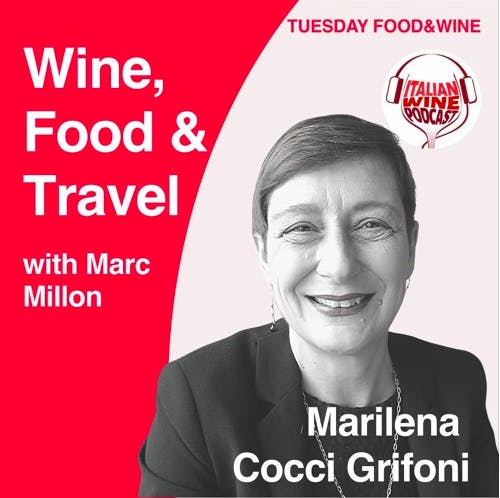
Ep. 730 Marilena Cocci Grifoni | Wine, Food & Travel With Marc Millon
Wine, Food & Travel
Episode Summary
Content Analysis Key Themes and Main Ideas 1. The unique natural beauty and diverse landscape of the Le Marche region. 2. The historical contribution and pioneering spirit of the Cocci Grifoni family, particularly Mr. Guido Cocci Grifoni, to Italian viticulture. 3. The remarkable story of the rediscovery, propagation, and recognition of the Pecorino grape. 4. The rich and distinctive gastronomic culture of Southern Le Marche, emphasizing seasonal, local ingredients and traditional pairings. 5. The integration of sustainability practices and the development of wine tourism hospitality at Tenuta Cocci Grifoni. Summary In this episode of the Italian Wine Podcast, host Mark Millen interviews Marilena Cocci Grifoni from Tenuta Cocci Grifoni, nestled in the southern part of Le Marche. Marilena paints a vivid picture of her region's diverse landscape, from seaside to mountains, and its genuine, low-impact agricultural practices. She delves into her family's long history in winemaking, detailing how her grandfather established the estate in the 1930s and how her father, Guido, became a pivotal figure in modern Italian viticulture. A central narrative is the incredible journey of the Pecorino grape, which, thanks to Guido's persistence from the 1970s and 80s, was rediscovered, cultivated, and eventually achieved DOCG status. Beyond wine, Marilena enthusiastically shares Le Marche's rich culinary traditions, highlighting dishes like the famous deep-fried Oliva Ascolana and the integral role of olive oil. The conversation concludes with discussions on the estate's recent investments in sustainable farming and wine tourism, aimed at offering visitors an authentic and immersive experience of Le Marche's food, wine, and culture. Takeaways - Le Marche is a diverse and naturally preserved Italian region, distinct for its blend of hills, mountains, and coastal areas accessible within a short distance. - The Cocci Grifoni family boasts a deep-rooted history in Le Marche winemaking, dating back to the 1930s. - Guido Cocci Grifoni, Marilena's father, played a crucial role in rediscovering and popularizing the Pecorino grape, a varietal nearly forgotten globally. - The Pecorino grape's ascent from an obscure ""table wine"" to a recognized DOCG (Ofida Pecorino DOCG) involved decades of dedicated effort by the family. - Southern Le Marche gastronomy is characterized by a blend of sea and land flavors, strict seasonality, and signature dishes with strong regional identity. - The estate has invested significantly in sustainable practices, including solar power, rainwater collection, and replanting original grape clones. - Tenuta Cocci Grifoni is expanding its wine tourism offerings to provide visitors with an authentic, immersive experience of Le Marche's wine, food, and culture. Notable Quotes - ""Le Marche is a very, it's a smaller region. Where, fortunately and, unfortunately, there is just a five percent of a flat that is maybe the shore. And we are, it's, there are just hills and mounting."
About This Episode
A wine food and travel podcast host discusses the importance of learning about local and regional foods and specialities in Italian wine production. Speakers discuss their experiences visiting small town areas in Italy, including their own wine estate and success selling their own wine. They also discuss their love for the pecorino culture, the importance of sharing wines, and their investment in a hybrid sandwich, solar panels, and wines. They express excitement about revisiting the topic and hope to see more visitors.
Transcript
Welcome to wine food and travel. With me, Mark Millen, on Italian wine podcast. Listen in as we journey to some of Italy's most beautiful places in the company of those who know them best. The families who grow grapes and make fabulous wines. Through their stories, we will learn not just about their wines, but also about their ways of life, the local and regional foods and specialities that pair naturally with their wines. And the most beautiful places to visit. We have a wonderful journey of discovery ahead of us, and I hope you will join me. Welcome to wine food and travel with me, Mark Millen, on Italian wine podcast. Today, we journey to one of Italy's most beautiful and still undiscovered regions to meet wine producer, Marilena Kochi grifani, of tenuta Corti grifani, to learn about wine, food, and life in La Marque. Welcome, Marilena. It's great to Be with you today. Thank you for being my guest. How are you? I'm a very good. Thank you very much for inviting me and all our staff because, I always think, and we never in a eye. And thank you very much for inviting, and all, its values and, projects for the future. Well, I look forward to hearing about this. And, I know that your work is so much in your heart, and that's what I really want to discuss today. Now you're located in the southern part of Le Marque. We'll we'll write down near the border with a not far from the sea at San Benadetto, Deltranto, with the beautiful mountains behind us. Tell us about this special corner of La Marque. What's so special and what should attract people to visit? Well, thank you for this question. We are located in the southern of the market, in a Escalipichano province. Market is a very, it's a smaller region. Where, fortunately and, unfortunately, there is just a five percent of a flat that is maybe the shore. And we are, it's, there are just hills and mounting. The hills are very interesting because we have, the vineyard. We have mainly agriculture vocated to Viticulture and, to olive growth and cereal. It's a very special area because in one hour by car, driving, slow from, the sea to, from east to west, we can meet, we can stay after the beach. We can have, an imperative in the, in the, in the, in our heels. So in our, in our winery, and maybe to spend one night in the mountain at the full, at the feet of, so we are, and we can go back from the passing us through the hills and getting a a dive in, in the pediatric sea in the afternoon. So it's an exciting area where people can, refill, the positivity because it's, totally wild. It's a very, it's still a green, but the green for thinking, where there are there is no impact that so the the agriculture is still natural. And, we have, per ninety percent, low impact agriculture and the biology and the organic agriculture. And, people are very, are very gentle. People are very, smile, but not for because they have a cliche to respect because it comes from our heart. And also, it's know a very expansive behavior. Everything is very balanced. And it's why, we are still true and, real. Yeah. So I think that's that's my feeling, on the times I visited. It's such a genuine place, and people are so glad to to to meet, curious and friendly And I love Ascolipicino. I think it's one of the most beautiful small towns, small cities in all of Italy with that magnificent Piazza, Piazza del Piazza del Piazza del Piazza del Pia. I always say that is the best square in, is it the second best square in Italy after San Marco Square in Venice. After San Marco. Yes. Yes. Exactly. And it's a, it's a, it's a, we say that is a sitting is a fitting room where there is a sofa and, and that there are only, there is a museum under the sky. Yes. It's exactly like that sitting out in that beautiful square. Perhaps with a glass of wine or an anisetta. Or anisetta, and, the pairing with the. Of course. It's wonderful. Well, we'll talk about the food a little bit later, but that is one of my favorite things. From Lane Marque on the Escalane. Now, Mary Elena, tell us a little bit about your family story and your wine estate. Well, my family story starts from between the two words. So we went back to our, origins to our roots, and, my family, so being changed. So, established in, in a San Sabrina, around the beginning of thirty. After, after coming back, from, some years, in, Philadelphia and, in the east coast of America in the mines, they got the enough money for building up, reliable, a serious, a better roof to their family. In nineteen thirty six, my father, mister Willow, was born in the house of clothes, to the winery, because in the farm family, the integration of a new house came from a new life. And my father was the new life for for, my grandparents, family. My, my grandfather, Domino, started, by purchasing, actors and actors around us, and, he developed it, the, the, the, you know, the system of sharing, the share the sharecropping a system that is called an Italian meds Adriya. And, during the second war, unfortunately, the agriculture and all that the, the, the business, was a little, was stopped. But after the second war, so in nineteen forty six, non domenico, started again, buying, actors and doctors. And he built the first one hundred fixed the hectoliters in, in a task of cement, that we have still as roots, as a milestone for our origins. Unfortunately, it passed away very young nineteen fifty one. And, our father, we do had to quit the gymnasium, and, to, to care his mom because, my grandmother, nonna Maria, remained alone, and he started the, the, the, the caring over all of these properties, because he is, sister was already got married. His brother was in Rome for studying a pharmacy, and he had to remain a tomb as a third son. In nineteen sixty three because my father was a total involved in the in his heart in his brain for Viticulture. And it's why nineteen sixty three, he wanted to buy is a first estate, twenty three actors, and is our main estate that is, named as the colored Sanbaso estate. He got married. I am the, the first daughter, And there is a second daughter who was born in nineteen me in nineteen sixty five. I don't hide my, my age and, my sister in nineteen seventy. Now, the, so we, in nineteen seventy, we do, butcheled the first super europe nineteen sixty nine as vintage. Why in that time. He, took the the possibility, took the the the chance to bottle at the first because our agricultural ministry in Rome released the the doc, in nineteen sixty eight. He registered the is filled San Luis and the in the chamber of commerce of Kolipichannel. And in nineteen sixty nine, got the first rostopichano super europe crop and he bottled in nineteen seventy. It's why our milestone dates are nineteen thirty three where more or less my original family established in San Sabino, in nineteen seventy when my father or better, my parents, Diana and the widow battled the first of sopeciano, superiore. Okay. So it's, it's, really part of the history of the wine from, from Le Marque, because this is one of the important red wines. Now there's a particular story linked to your family And, again, to your father who's considered one of the pioneers of Italian modern wine, Viticulture through the discovery of a special grape, the pecorino. Thank you, Vic. We are so close, of a pecorino story. During the seventy, we had, in our, vita culture in our vineyards, we had, mostly Treviano, Pasadena, manvasilla. So we were more focused through, red wines, in term of, Montepulciano and San Jose. We had so weak for white wines. In nineteen seventy five, everything as an origin. In nineteen seventy five, the agriculture ministry, releases the, the, and they were mentioned several white grape varieties like, Trebiano, like, here, but nobody knew that grape and it was not, planted in our local and pornography. And for a widow, it became a a trick for him. So why the lower has written this strange grape that, has the same name of the cheese but it's not, here, it's not, we didn't, we don't find, some, raw at Pequarino. And it's why as a young man, and, as a very passion by the culture guy. He wanted to know more about the pecorino. It's why he had several meetings with some friends of him and they said that the Picquarie not definitely was, totally relegated in an hour mountain area that is around six, seven hundred meters above sea level in, on the road from a sculipi channel to Rome that is called And, he went with, a friend, a friend of him in nineteen eighty two, that is a very small, small village of Quata del trundle, and unfortunately, it they were they were they it was completely destroyed by the earthquake of twenty sixteen, twenty seventeen. The recent one exactly. And, he found in, he found in, in, in, in, in Pescara del Tronto. Some a small, vineyard at the pre fillocera. And what what they they what did they do in, in September of nineteen eighty two. He is an, with Ococcie, said, one morning in September nineteen eighty two before the harvest, myself and others drove to a Cara. And all the pecorino vineyards was reported to exist there. When we arrive at the scene, Mr. Kathleen is, we haven't met, is, son is a son, but his son now is, more seventy five years old. The land owner showed me some vines that were obsolete two or three generation old. We didn't take any cuttings that morning, but merely market them with tape. The following February, so means nineteen eighty three, I returned to pick up The bots took them to the farm, so means in San Cerrino, and made the first graphs. My idea No, mister Guido said, was to produce it as a single barreotide. I know it was a crazy idea. Everyone said so. My friends always repeated the heat to me on winter evenings in front of the fire, but I wanted that wine. I knew it was possible, and I never adapted. In February nineteen eighty three, the first grafts were made onto a few rows of vines with a different geographical exposure, twenty north, twenty south, twenty east, twenty west. In nineteen eighty four, eighty five, eighty six, the harvested grapes were made into wine in dungeons, a maximum of five ten liters per each different geographical extra. Every subsequent winter spring with Ococcie and the other friends of him tasted these wines and concluded that the best wine came from north facing grapes. South facing grapes produced an unblanched wine, which was not suitable for market. Having verified that this grape variety had a great potential. We decided to remove one veteran alpha at the picture orchard and to commit the rooted, the graphic divine to the and in nineteen eighty seven, he planted the first vineyard at Pecorino that is called from our region Vigna Madre, Madel Vignard of TECurino. Sorry. Sorry for this long story. No, no. It's a very important story. I wanted to read you what our father said, and we have, registry. We have recorded this interview to him before he's passing away. Oh, okay. It's a very important story, and I'm glad that you've shared that with us because Now Peccarino is a grape that is being widely planted outside of La Marqueena, and people are seeing the name on labels, but it's important to know where it came from. And it's also important to know that pecorino in OFida, in your vineyards, in your area, produces a wine that's very, very special. So and it's a we added the first the first vintager at the pecorino one hundred percent that we are still now under the OCG in nineteen ninety. And it was, as a table wine marker. Why? Because our region, market region didn't have pecorino as white grape variety in our in the register because there is a register A virtual register of white and red grape varieties that are admitted and we can produce IGT and the DOC or DOCG. It nobody knew this grape and we add two bottles under the lowest level of the wine perception from the consumer. So it's a table wine. Being on the table are correct. And, we, when we had, to work for seven years, in, nineteen ninety seven, we, the Peccorino became IGT. Then the career was very fast because in two thousand and one, we got the DOC. And ten years later, we got the debut CG. Okay. So, really, the, the world of wine is, is much richer for this variety that was unknown just twenty years ago, and it's thanks to your family. Thank you. So, thanks to our father. And we have just the the commitment to manage this area, this culture heritage, these values. Irritage. Yes. This patrimony that came from the Cibilini mountains. Exactly. Because the heritage is not only money, but it's more and more difficult to manage the value heritage. Of course. And I know that for you as well, sharing your wines. It's also important to share the gastronomic culture of your region. The foods of La Marque that are so delicious and so unique, and which pairs so well with with pecorino from the OFID, do is it a DOCG now? DOCG? No. Yes. Since the twenty eleven, Mark. Uh-huh. Tell us a little bit about the gastronomy of La Marque, of the Southern lemarque. And of some of the special dishes and foods that I've enjoyed with you in your wonderful tasting room and foods that are very typical that any visitor to your area should make sure that they taste and sample and enjoy. Thank you for reminding of the taste of the tasting. We met two years ago, if I remember. Yes. That's right. So for, we have we have a mixed, a mixed cuisine. So we have the fishing culture because we are so close to the Adriatic sea. And then we have a chicken lamb pork. Less, for cow. And, we, for us to pitchano superiore, we generally pair with our, with our, with our, chicken, with our land, tech to come from a Sibilini, area from, Aquasanta, Eltranto, from Aquata deltranto. And, we also pair with our, vegetables, that we always respect the season. For us, it's impossible. It's strange. It's crazy to buy now zucchini. And now we have only the cauliflower. And, so they need zucchini in, in a summertime. And, so for a pecorino, pecorino is is a white is a white is a very powerful, white wine that can be paired with the seafood, with the pasta, rich of olive oil, we never think, to use butter as condiment. We always think for olive oil. O olive oil is a very important ingredient in our, in our regular eating, daily eating, and in our diet. Diet not in, in term to, to reduce the kilo, but in term of daily, meals. And, we, for the it's typical for my mom to cook the the rabbit, the the rabbit, browned in pan. With olive oil, with olive oil, black olives, and a sum square of white wine. It's a very old recipe. That, of course, the, chef, has a lot of chef, everybody said because it's, it's their job. But my, if, I go back, to, my, to, to my, remind, my grandmother, nonna Maria, and my mother, Diana, that is close to eighty one. They usually cook it, the, this rabbit in that way. Also the Olivascolane, but we mostly now pair Olivascolane with the, the Bolicina, with the deposit in a sparkling wine. Oh, yes. But we have And the the Olivier Escolani, please explain these to people who haven't had them because they're so delicious. It's a very complicated to explain, so it's a very long procedure. That start from sorting out the best, the best kind of meat from white pork and red. They are browned. They are, Then they they we had we had the the parmigiano and the and then we produce a small round bowl And we, then we roll olive green that has to be, have to be tener escalana is a DOP product from Ascolipiciano. And then we So this is a very large green, all of this special, special variety of all of. Exactly. But unfortunately, no very, generous. So some years, we have enough quantity. Some years, we have just a few a few tons. So this year, it's a year very, very weak. No generous. Because of for so it's, because we, it's a normal for the Oliva harvester. It's a more normal than the, gray part Vista. But this here, unfortunately, the olive grove had the impact of this, so extremely hot summer. Yes. But extremely because we add without any interrupt for three months, Sierra, like a sizzling. Oh, that hot wind that comes from Africa. Exactly. And it has been dangerous. It has been dangerous for the for the for some, for some part of our, our farm that have more exposition to south and the zero, the the south wind a, dried, the leaves. And they, unfortunately, that there that it has been a conflict between crop, prost prospective crop, and the leaves. So mother and and child if we wanted to go to the to human being a word. To protect the trees, you had to reduce the crop. Exactly. This is the nature. Now, so this special olive, just to be clear to our listeners, it's a large green olive, which this beautiful, delicious savory meat mixture is stuffed into, and then it's deep fried. Be fried. Correct. Then, we pride and the the date belongs at our very typical, that is called the Frritas Colano that come from Easter easter, culture, and it was, served as a second meal after the pasta during the big the big lunch, big Easter lunch. Here for here, They'll live as colonial and the fritos colonial not included the lamb, the fried lamb has become an imperative. And it's why we pair with the glass of spumante that has to be definitely not dry or semi dry or semi because otherwise, there is no, we disappear the tasty of the of the fried, olives and or white wine that has to be rich, textured, powerful, like pecorino. Okay. Because the pecorino cleans the fat part of a fried, the meal. Yes. Absolutely delicious. You're making me hungry right now. Madylina, let's, we have a little bit of time left. Let's briefly talk about a new development, your Relay, your, your expansion of hospitality and of welcoming people to learn about your wines, but also just about life in Lei Marque. This is very exciting. Thank you for, placing this question, Mark, in this last, ten years after the, my father is passing away. We have invested a lot in several, in several assets. Firstly, for, getting a very, sustainable premises. So we have invested in solar panel. We have it in a two in twenty ten. We have invested, in, for we have invested for protecting, and for guaranteeing, balance it, and, stable temperature inside the, the, the, the winery, especially in the oak barrel area. And, we have invested, for, replanting, the original, gray, a diploma in our, vineyards for, Pekorino, for, we are now for San Giovanni and for Monte Pucciano. We have, invested, in a very important practices, that is, to collect the rainwater, and it's why we have a tree small, we say, lakes, and we collect, especially now the rain. And then we reuse for, watering when, during the summertime, like, this year, for avoiding adapted the wines going suffer. They they can suffer. And, we have a now a range of twelve wines that are, that we have, divided into main, group, two main, range, historical vineyards and the state vineyards. Historical historical means why, crop that come from vineyards that are over twenty eight years old. Like, I'll give you a message. That is more, is a single vineyard, is pecorino, and our last, but it is, the back, is our favorite in term of heart with Ocochi, Gricone, or Fida pecorino, DOCG, that is a small crop from mother vineyard. And then we have the estate wines from that start from that is a late harvest in November. And, the, rosato, the rosato, some, the rosato Tara. And, they Tara. To add this important asset that is the wine business, we have been investing since twenty fifteen in a wine tourism. WIN TURISMA means the possibility to, guarantee to host the people that wanted to enjoy landscape, nature, silence, wines, and food. Well, that's very exciting. And I know it's something that, is increasingly of interest for, for visitors, both Italians, but also for those of us from other countries. It's a, it's a beautiful way to experience a place because we're actually gives us a chance to meet people to taste the real foods. It's not the same as going to restaurants. It's more genuine. And I'm really, excited to see what you've done. You have a very welcoming winery already. And so I think this is a very exciting development that people can come and stay. Marilena, it's been, it's been wonderful meeting you again, speaking with you, learning about new things but also about this rich family history and the important things that you and your family have achieved. I'm really looking forward to revisiting you. I think I'm coming to your area in May next year. Thank you very much for being my guest. With my our great pleasure. We hope you enjoy today's episode of wine, food, and travel with me, Mark Millen, on Italian wine podcast. Please remember to like, share, and subscribe right here or wherever you get your pods. Likewise, you can visit us at Italianwine podcast dot com. Until next time. Hi, everybody. Italian wine podcast celebrates its fourth anniversary this year, and we all love the great content they put out every day. Cheching with Italian wine people has become a big part of our day, and the team in Verona needs to feel our love. Producing the show is not easy folks, hurting all those hosts, getting the interviews, dropping the clubhouse recordings, not to mention editing all the material. Let's give them a tangible fan hug with a contribution to all their costs, head to Italian wine podcast dot com and click donate to show your love.
Episode Details
Keywords
Related Episodes

Ep. 2791 Italian Wine in a Changing Climate: PIWI, Terroir & Tradition with Nicola Biasi | Wine, Food & Travel with Marc Millon
Episode 2791
Ep. 2767 Le Marche: Verdicchio and the Wines that Shape the Region with Gianluca Garofoli of Garofoli Vini | Wine, Food & Travel with Marc Millon
Episode 2767
Ep. 2755 The Longest Table: Honoring Nello Ghezzo’s legacy | Wine, Food & Travel with Marc Millon
Episode 2755

Ep. 2712 Exploring Brda: Exceptional Wines and Slovenia's Culinary Traditions with Lan Kristančič of Movia | Wine, Food & Travel with Marc Millon
Episode 2712

Ep. 2700 Sardinia Beyond the Coast: Agripunica, Basso Sulcis & the Legacy of Giacomo Tachis with Salvatore Santus | Wine, Food & Travel with Marc Millon
Episode 2700

Ep. 2681 Giro d’Italia 2026 Special Episode 1: From Bulgaria to the Mezzogiorno in search of wine and cheese | Wine, Food & Travel with Marc Millon
Episode 2681