
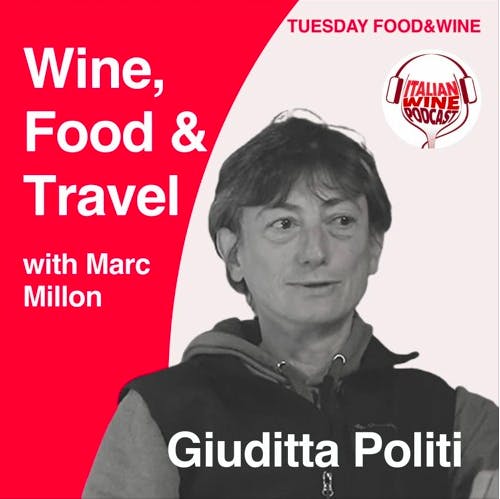
Ep. 748 Giuditta Politi | Wine, Food & Travel With Marc Millon
Wine, Food & Travel
Episode Summary
Content Analysis Key Themes and Main Ideas 1. The unique geography and diverse agricultural landscape of La Marche, Italy. 2. The personal journey of Judita Poletti from scientist to winemaker, embracing family legacy. 3. The winemaking philosophy and specific wines of Cantine Poletti (Verdicchio Loretello, Caseditera). 4. The deep connection between wine, local food traditions, and cultural heritage in La Marche. 5. The immersive experience offered by agriturismo in fostering understanding of the territory. Summary In this episode of the Italian Wine Podcast, host Mark Millen speaks with Judita Poletti of Cantine Poletti in La Marche, Italy. Judita vividly describes the region's diverse landscape, featuring the Adriatic Sea, the Apennine mountains, and rolling hills with a ""patchwork blanket"" of varied crops. She shares her personal story of leaving a career in evolutionary genetics in Rome to return to her family's historic estate, which dates back over 200 years, and take over winemaking. Judita emphasizes her commitment to producing healthy, high-quality wines, highlighting their flagship Verdicchio, Loretello, a structured wine she believes pairs wonderfully with traditional Marchese dishes like rabbit. The conversation also delves into La Marche's rich culinary traditions, characterized by a blend of sea and land ingredients, with each town (and even each family) having its unique recipe variations. Judita discusses their red wine, Caseditera, and its connection to the region's historical architecture. Finally, she elaborates on the agriturismo experience at Montefiore, inviting visitors to engage directly with the winemaking and olive oil production processes, fostering a deeper appreciation for the products and the land. Takeaways * La Marche offers a unique blend of Adriatic coastline, mountains, and hills, creating a diverse agricultural and culinary environment. * Judita Poletti's background as a scientist informs her meticulous and health-conscious approach to winemaking. * Cantine Poletti, a historic family estate, produces wines that reflect the specific characteristics of the La Marche ""territory."
About This Episode
Speaker 1 and Speaker 2 discuss their plans to visit La Marque where they meet Judita Poleti and discuss the beautiful valley and its views. They also talk about the importance of luck and the structure of their wine, Lorentello, which is a more structured, versatile, and natural antioxidant than other wines. They discuss their experience with their favorite fruit, Lorentello, and their traditional dish at Christmas, which is a peppery stew with a mix of fish and wild herbs. They emphasize the importance of maintaining the characteristics of their grapes used and attend their wine wines and booths. The production of their Italian wine podcast thanks listeners for listening and offers a free content.
Transcript
Welcome to wine food and travel with me, Mark Millen, on Italian wine podcast. Listen in as we journey to some of Italy's most beautiful places in the company of those who know them best. The families who grow grapes and make fabulous wines. Through their stories, we all learn not just about their wines, but also about their ways of life, the local and regional foods and specialities that pair naturally with their wines. And the most beautiful places to visit. We have a wonderful journey of discovery ahead of us, and I hope you will join me. Welcome to wine, food, and travel with me, Mark Millen, on Italian wine podcast. Today, we're traveling to a beautiful region, La Marque, to meet my guest, Judita Poleti. Of the Cantinee policy in Nida store. It's wonderful to be in contact with you again, Judith. How are you today? Well, I'm fine. You know, there is a wonderful sunshine outside, and, that's, so nice. And nice, hearing from you again. Thank you, Mark. Oh, it's really nice to hear from you again. And I'm imagining that beautiful sunshine on the rolling hills of the Castelli Dadesi. Can you, perhaps to give our listeners, a picture of your beautiful area. Explain a little bit about where you are, where the Castelli Diosi is located. Well, actually, we are in the middle of Lemar k. And, Lamar is the region with, which is on the Adriatic sea. And in the middle of Italy, almost at the same height of, touscany. And, actually, probably you are so used, hearing about Tuscany, but it's, you know, according to me, at least, much better. Just because, for example, our beautiful hills are between the apinines, which are, which are mountains. And right now, there is, they are all covered with the snow, but, at thirty kilometers from our state, there is a seaside So during summer, especially summer, you can have a such a wonderful time, making, bath and things like that on the beach. Between the upper nines and, the, the seaside, there are our beautiful heels. And, you know, right now, if you, look at them, you can see almost a patchwork blanket. And that's, the wonderful thing of our heels. Just because of every morning when I go out of my house, AND I look around. The collars are so changing, daily, really daily, day by day. Just because, our heels are characterized with small units which are, which are cultivated. And the cultivations are so different and different in colors. That, for example, in autumn, the colors are very different, in winter, in spring, in summer, and within each season, the the the color are changing again. And, it's so beautiful and so relaxing coming here and look around, and, of course, just try our wonderful products, just like wines and food. Oh, you've given us a beautiful picture of Le Monique because it is, as you say, a region that is less well known perhaps and other central Italian regions like, like Tuscany. But this mix of the Adriatic sea that you can actually almost see from the estate and the high mountains with the snow is a very, very beautiful mix. Also, I think what you're saying about the colors is interesting, Judita, because the agriculture is not just specialized, is it? It's very mixed with olives and vines and other crops as well, which makes a more interesting landscape. Yeah. Yeah. That that's that's that's what I wanted to say. And, you know, that, the the real thing is that, we have, such as small units, and the owners of the units are different, one from the other. So the crops are different and different are the colors. That's why. That's really interesting. And, the Castelli Diazis, these are hilltop towns. Is that right? A number of them within the area of Yazy itself? Yeah. There are so, so many castles around and, around Yeezy and, of course, around La Marque, especially in the inner part of La Marque. And, for example, in my area, which is, which is a little bit farther from Yezid, there are such beautiful castles like, for example, Loretello, which is a medieval, very small castle, but very nice one. And, around this castle, Loretello, there are my vineyards. Yes. The wonderful loratello wine, which, I'm looking forward to talking about, but more importantly to tasting again when I'm able to. It's a wine I love. Now, Judita, you're the winemaker at Tantina Polity, but that wasn't your background originally. Tell us a little bit about how you came into wine. Well, actually, you know, I was a, researcher in evolutionary genetics, actually. And, I was a researcher for about, fifteen years at university in Rome, but, you know, we had, this family estate, for, let's say, two hundred six years or something like that, that just think that, for example, our vineyards, that the first ones are, are were planted in nineteen fifty five. So, they were the the first vineyards of the whole region here around. And, you know, I was, of course, I was a very wine lover since, let's say, eighteen years, not before than that, of course. But, and, you know, I, I was so close and so tight, to my roots. My, you know, this countryside was in my blood, I guess, from ever, since ever after a while when my father hadn't happened to die, well, someone had to decide, to run the old thing again. Or else we we had to sell everything. But, you know, it was according to me, it would have been such a pity to sell everything. And, my roots came out very strongly, and I came back. And, of course, I had to study a little bit about, wine and how to make it, and, these kind of things. So I had a master and, after my PhD, of course. And, then I came back and, starting to take care of my vineyards. And, that's a very, how would I say a very touching thing every morning when I when I wake up, I'm very happy. I'm very happy to be here and to try to make, things going on well. And that's it. Well, that's a it's a beautiful story because, you were a scientist in Rome, but the roots of your family history and your the land you were attached to pulled you back, you I'm imagining that That scientific background that, inquiring way of solve problem solving has helped you on the farm where you are cultivating the traditional grapes of le Marque verdicchio, San Jose, Montipulciano, also making a wonderful olive oil that I recall well as well. Can you talk to us a little bit about your activities and particularly about this very special wine? Lorentello. Lorentello is a Verdicchio, and, the Verdicchio grape is, I would say the most, most typical of La Marque and, of our area, Castelli, Dier, our, I am. Verdicchio is a very interesting, interesting grape. And, for example, this year, if Verdicchio won the best wine wine, world best wine prize, which, can you make understand the potentiality of this grape. Our grape, of course, first of all, our grape, grown with, so much love. Not only mine. Mine, but also the level of all our collaborators. We are such a, a tight, a crew, you know, and, we we work very well together. And, every year, we, of course, all the things we make are made by hand. Let's say pruning and harvesting. Just because according to me, it's very important to look directly at what you do and what you see so that you can, choose every year at a harvesting time the best grapes, to, to get, into the cantina and to make wine. Our wine is, the fermentation is, run at low temperature. And after the fermentation, we, leave our wine. I decided to leave our, the loratello wine on yeast until the end of April. That makes, enrich the wine of a natural antioxidant, which are called nano proteins, and that makes me add just the few amount of chemical antioxidant when I bottle the the wine, and that's very important according to me just because, I the first thing I want to make, of course, is making a good wine, but also also a healthy wine. Those two things are the most important things in making wine, Agolly. And I guess that, every year until right now, with a hard work and, of course, also a little bit, let's say, of fortuna, fortuna in English is, luck. That's it. Thank you, Mark. Thank you, Mark. Just because, you know, luck helps people who works hard. Sure. That's true. And every year, we're able to make, our. And I'm very, very happy about the quality of this wine. Well, it's a beautiful wine, and I know what you're saying about the Vadicchio being such a characterful grape. I think it's one of the great white grapes of Italy and indeed the world. But what's interesting is that Vadicchio is very versatile. Sometimes it can be a simple wine to enjoy on the beach. But your l'oratello is a much bigger wine, a more structured wine. A wine that I remember well is I used to say it was a wine for red wine lovers who don't necessarily like white wines, but they would always love Loretella because it has so much structure, and it's a wine that goes so well with the foods of Le Marque. Yep. Yep. Definitely. You know, usually, we, we think about, white twines, just, to be matched with, let's say, fish or something like that, very light dishes, I would say, not verricchio, and not my verricchio, not Loretello, just because as you said, it's very structured. And, he's characterized by a very high minerality, which makes it perfect. For example, with some typical dishes of La Marque, just like, rabbit, okay. Probably, you you know what I'm talking about, and you will be much better than me in describing this kind of dish. Well, would that normally be disosato? Would it be a bone to rabbit? Yep. So the rabbit would be boned, and then it would be stuffed with the wild fennel, and garlic, and other herbs like that, Judita, and then cooked, cooked in the oven. Yeah. Perfectly. Perfectly described, and it's so delicious. Oh, yes, I remember that. Especially if you eat this kind of dish and, on your side, you have a glass of loratello. That's a wonderful, really. Actually, one of the most interesting things I think about the food in Le Marque is as you were describing the landscape, we have this beautiful mix of of the hills leading up to the mountains and the sea. So the food reflects that as well. Doesn't it? This mix of sea and sea and land, Maritara? See, yes. Yes. Perfectly. Yes. You know, just because within, let's say, forty kilometers, which in in miles, it would be almost thirty miles if I, you know, so a a very small, territory. You can, you have such, a big numbers of different dishes, which are so typical. So you have a wonderful fish dishes, like, for example, bravo. Of course. The bravo being a a really rich, full flavored, sort of soupy stew. Yep. Yeah. With the with the with the fish caught in landed in Ancona and in the other ports of Le Marque. And and for example, just, to make you understand, the difference within, such a small territory, For example, if you go to fano, which is a a town in the northern part of La Marque, you have, one Broadeto, which is, a little bit different from the one in Sanigalia, and, again, is a little bit different than the one in Encona and whatever. So each town has his own recipe, and that's very interesting. Just because going around, you can have so, such difference in, in tasting the same dish. That's that's very interesting, really, really. That is really interesting. And also I imagine not just in each town, but in each family. Yeah. Yeah. You are right. Perfectly right. And, you know, the, the mother of the family, has his own recipe, and she's so jealous about it. Yes. Yes. And do you think with the next generation, are those food traditions going to be maintained? Well, for sure in the countryside, just because family is, you know, a a very big matter, still. You know, for example, at Christmas time, family, the family reunion, during the family reunion, it's very important to cook the traditional dish of the family. And, you know, that's a condition. I mean, something that it's so necessary to maintain those kind of dishes and traditions within generations. Absolutely. And what would be your, traditional dish of the family at Christmas. Capillity, of course. Capillity, the small stuff pasta. Now is that different in La Marque than the in, Emilia Romagna? Yes. Yes. They are, well, that, yirepiano. This feeling? Yeah. The feeling is a little bit different. Usually in they use the ham ham. Mhmm. Instead, we use just meat, normal meat. And usually, this meat is mixed. So you have some, some chicken, some cows, some, you know, it's mixed, oh, interesting. And would you have that in Of course. Of course. Okay. So a Capon broth, a rich, richly flavored broth. And then, of course, after that, well, the the, on the twenty fourth, for dinner. We have a Stocafiso. Okay. The the dried, is called the air dried or is the Stocafiso air dried or salted? No. Air dried. Air dried. Yes. That's different from the bakala. Yep. Okay. And that's in in cooked, in umido or In umido in umido with, some, small tomatoes, and potatoes. Okay. So very traditional. And with this, you would also be enjoying your Casa, Casa Ditare, the the red wine made with San Jose Montipuliano and a little bit of Sierra? Well, actually, it it would sounds strange in La Marque Sierra, but I I will under I will explain you why. So when I came here, when I came back here, our red wine was a little bit too aggressive just because, multiple chamels Angelissa, which are the typical grapes of La Marque, bread grapes of La Marque, in the inner part of La Marque, we are, you know, almost at, four hundred, meters of altitude. You know, towards the Appenines. So multiple channel tends to remain a little bit progressive. So I decided to implant a new vineyard, a small vineyard of Sierra just, to make our red wine, you know, more smooth. Right. Just to round it a little bit. Yeah. Yep. And that's why. And that's why it it's not a DOC, but it's a an IGT. An IGT in the That's it. So, still, a very high quality wine. And, about this red wine, usually we, age this wine before the bottling six months into a big oak which is not a barrique. Just because, I think that barrique is a little bit too aggressive on the tasting of wine. And instead, it's very important, to maintain into the wine, the own, the characteristic of, the grapes that you use. Yes. Yes. To really express the territory. Yeah. That's it. That's it. And, the name Caseditera, which may, which means, a house made out of clay. It's, you know, it tried to bind this wine to the territory just because let's say a hundred years ago here around most of the houses were made out of clay, and that's why in the name of the of our wine. And you've really given us a, a beautiful picture of, of, the Marqueen of the Casteli Diaz where you're located I know as well that you are very welcoming to visitors through the Agriturismo Montefiore that you have. So if any of our listeners are coming to the area, and would like to visit, they can find the Agriturismo, Montefiore. Tell us a little bit about this, Judith. Well, our Agriturismo, it's, something like, bed and breakfast. Since, you know, I, I really don't have, time to cook for our guests, but, you know, I really take care of our guests. It's very important for me to, to go with a guest, around the territory and explain to them what they are looking at just because each territory has, his own history, his own conditions. And, the best way to to to see and to getting to know a territory is, looking at the, at it and, leaving the territory with someone who knows it very well. And that's why, you know, I go with them into the vineyards and it's very fun for some of them, to go during the harvesting time and to try to harvest their own grapes and make their own a bottle of wine or something like that, or else, to come during the harvesting of olives, and, to go home with their, they run a bottle of, fresh olive oil. And, to to really get to know, what is the work here around and what's behind a bottle of wine or a bottle of olive oil which is very important just because, you know, I guess that, you feel after this kind of experience, you would feel completely different in respect to the product that you use. Yes. That's a wonderful opportunity and a wonderful way for for people to really experience an area, your area in your company. I hope that, some of our listeners will be knocking on your door and coming to Montefiore to just stay with you. But, Mark, anyhow, even if they don't stay, in my, Greekismo, don't worry. Just come along, and I will be so happy to make you taste our product. And, to make you taste it in such a wonderful landscape, especially during summer on the garden and outside in the garden, doing, for example, downtime I guess that would be a very, very nice experience for all of you. A wonderful experience. And I can't wait to return myself, Judith. It's been really wonderful meeting you again and having a chance to talk and find out about your story and the story of your wonderful wines. Thank you, Mark. Thank you very much. And, you know, I, I really want to see you again here around and so please, please come as soon as possible. I will. Thank you, Judita. Bye bye for now. Thank you very much. Thank you, everybody. New you enjoyed today's episode of wine, food, and travel. With me, Mark Millen, on Italian wine podcast, please remember to like, share, and subscribe right here, or wherever you get your pods. Likewise, you can visit us at Italian podcast dot com. Until next time. Hi, guys. I'm Joy Livingston, and I am the producer of the Italian wine podcast. Thank you for listening. We are the only wine podcast that has been doing a daily show since the pandemic began. This is a labor of love and we are committed to bringing you free content every day. Of course, this takes time and effort not to mention the cost of equipment, production, and editing. We would be grateful for your donations, suggestions, requests, and ideas. For more information on how to get in touch, go to Italianwine podcast dot com.
Episode Details
Keywords
Related Episodes

Ep. 2791 Italian Wine in a Changing Climate: PIWI, Terroir & Tradition with Nicola Biasi | Wine, Food & Travel with Marc Millon
Episode 2791
Ep. 2767 Le Marche: Verdicchio and the Wines that Shape the Region with Gianluca Garofoli of Garofoli Vini | Wine, Food & Travel with Marc Millon
Episode 2767
Ep. 2755 The Longest Table: Honoring Nello Ghezzo’s legacy | Wine, Food & Travel with Marc Millon
Episode 2755

Ep. 2712 Exploring Brda: Exceptional Wines and Slovenia's Culinary Traditions with Lan Kristančič of Movia | Wine, Food & Travel with Marc Millon
Episode 2712

Ep. 2700 Sardinia Beyond the Coast: Agripunica, Basso Sulcis & the Legacy of Giacomo Tachis with Salvatore Santus | Wine, Food & Travel with Marc Millon
Episode 2700

Ep. 2681 Giro d’Italia 2026 Special Episode 1: From Bulgaria to the Mezzogiorno in search of wine and cheese | Wine, Food & Travel with Marc Millon
Episode 2681