
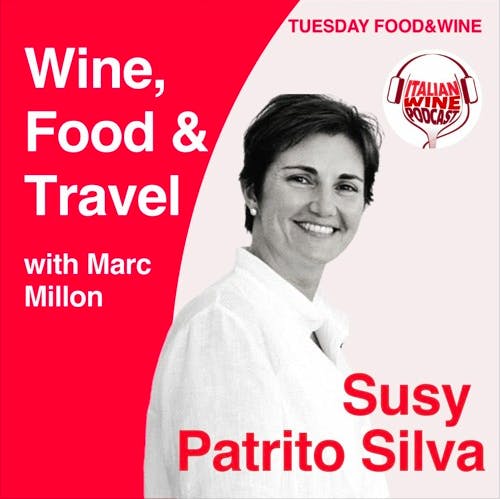
Ep. 779 Susy Silva | Wine, Food & Travel With Marc Millon
Wine, Food & Travel
Episode Summary
Content Analysis Key Themes and Main Ideas 1. The life and pivotal role of Pellegrino Artusi in shaping Italian gastronomy. 2. The historical and cultural significance of Artusi's cookbook, ""Science in the Kitchen and the Art of Eating Well."
About This Episode
The hosts of a wine and food podcast discuss the beautiful Italian wines and wines of various countries, including the Italian wines of the heart of Italy and the flat area of the VME. They also discuss a former businessman who used to travel and collect recipes for Italian dishes and how he became a chef and eventually published a cookbook. They discuss the importance of learning about the region and the success of Art volumes and the book The First National Italian, which was used to collect recipes for business trips and eventually considered recipes lab. They also discuss their commitment to spread Italian cuisine and their love for Italian food culture. They mention their three libraries, including cookers, conference halls, and restaurant, wine cellars, and their involvement in a local community, Marco Marco. They thank their listeners for their attendance and their efforts to bring affordable food to their listeners.
Transcript
This episode is brought to you by the Italy International Academy, the toughest Italian wine program. One thousand candidates have produced two hundred and sixty two Italian wine ambassadors to date. Next courses in Hong Kong Russia, New York, and verona. Thank you, make the cut. Apply now at viniti international dot com. Welcome to wine food and travel. With me, Mark Billin, on Italian wine podcast. Listen in as we journey to some of Italy's most beautiful places in the company of those who know them best. The families who grow grapes and make fabulous wines. Through their stories, we all learn not just about their wines, but also about their ways of life, the local and regional foods and specialties that pair naturally with their wines, and the most beautiful places to visit. We have a wonderful journey of discovery ahead of us, and I hope you will join me. Welcome to wine, food, and travel on Italian wine podcast with me, Mark Millen. Today, we travel to in Aminia Romania to meet my guest, Susie Partrito Silva, who is a managing director of Casa Artuzzi, a fascinating foundation dedicated to Italian home cooking. Challa Susie. Thank you so much for being our guest today. How are you today? Charles, my pleasure. Just fine. Thank you. I hope the sun is shining for you in four Limpopoli. It's a little bit dull here. It's cold, but it's pleasant. Good. Now many people may not know where a four limpopo is. So before we begin talking about Pelegrino Artuzzi, why don't you let our listeners know where you are and perhaps describe your beautiful town? We are lucky, Mark, because as you know, we are in the heart of Italy. Johnny Mila Romagna is just in the middle of Tuscany, Embriya, Marque. So the very part of the main town is, Bologna, where the airport is. And, the other town, nowaday, worldwide, and we are in four lane properly on the VME. Yeah. That street will turn into Roman Empire two thousand and two hundred years ago. Okay. And there's a beautiful medieval castle dominating the town as well. Yeah. There is, these beautiful castle, welcoming people when they arrive here. You know, it's a flat area. So they needed walls and castle to protect the town. And, that is still there, like, a a single It's a it's a nice landscape. Yes. It's a beautiful landscape, and a beautiful town. I've really enjoyed my visits to you. Now, of course, Casa Artuzzi is in for Limpopoli. For a particular reason for being the home of pellegrino Artuzzi. Tell us about this fascinating individual. This gentleman was a businessman and he was born in for immokally in eighteen twenty. And it will become father of Italian gastronomy. He was a businessman, and because of this business, he used to travel along the peninsula, Italy from no to center. To South, he was in the business of spices and silk. Let's say, white, on fashion foods at that time, you know. And, near the chance to taste different typical dishes. And you know that in Italy, when we talk about typical dishes will become quite serious. It was curious enough to look for the recipes. And so during his work in life, he will collect recipes. In the different eras of Italy. And, finally, when he retired in eighteen ninety one, he will decide to publish a cookbook. Wow. That's a fascinating story. So a businessman, traveling around Italy at a time before it was a nation when it was still made up of different areas, the kingdom of the two Sicilys, the kingdom of Sardinia, the northeast ruled under the Austro Hungarians, and the Papel States, of course, as well as the various duchies. These different countries as they were then were, were the area that he did business in and began to taste the foods and enjoy the foods his whole working life. Exactly, Mark. You got it. We are, I already named, I already mentioned our moment origin, but we are always to remind that it's a Italy as a country. It's very young. We became a country, so he had the reunification of it, and only in eighteen sixty one. We said Pelegrino, Tuesday was born in eighteen twenty. So before unification of it, it's a and I confirmed what you said before unification, we had a deeply different, languages, uses, habit in, in in Italy, mister Kelly, had a kind of intuition. He understood that, when we travel, not in, like, only in the past, right nowaday, and not only in Italy everywhere. It were when we travel and we taste typical dishes, we get in touch. With one of the most anti expression of the culture in the place. And he got curious about this. He was lucky because he used to be cast in the house of people. So what he had a chance to experience was the really home cooking the very local dishes. He decided to, let's say, to take no, not only of the recipe, but about, you know, information about the area, about the family used to visit, it's a kind of picture of Italy at that time. Oh, that's really, really fascinating. So Italy became a unified nation in eighteen sixty one. And just thirty years later, pellegrino Artuzzi was self publishing his book with a rather grandiose title. Yeah. The book is, we, you know, in Italy, as you know, Mark, we always call it simply artusis. You know, we call the book with the name of his author. Okay. But the title of the book is science, in the kitchen, and heart of eating. Well, do not get impressed by the word science is not so scientific. It simply wanted to underline, that he was trying to give a practical manual with, with advices, with a few notes, to really to help people to book. And honed of eating well because as you know, we are Italian. Eating for us is never only a matter of feeding. It's always a way to spend time together as, is our lifestyle. And, mister Kelly Greenarduzzi, with this book, really, as I already said, made a picture of Italy at that time. When you read these recipes, it's on not only ingredient and how to make it, but there are no stories. It's a book that is pleasant to read. Like, all the most Italian and same with, literature book. Yes. It's a fascinating and delightful book beginning with that first opening. Can you tell us the opening words from that first opening page is about cooking Yeah. Mister Pelegrini, something that that it helps to understand how he wrote this book, considered that he couldn't find any editor to freed the book. He had to pay himself to get his book published. Nobody trusted him. Nobody actually was, let's say, a businessman, a rich businessman. The answer that got to where, like, we don't think there is such an interesting dust on him. Try to guess nowaday Mark saying something like that. Okay? But he believed in this project and so he decided to pay to print it. And, of course, we are here talking about this. So it's clearly that it's exceeded in this. And in the preface, of the book, at the end of the preface, the preface, the book, he wrote, I should not like my interest in gastronomy to give me the reputation of a coupon or a glutton. I object to any such a dishonorable invitation for I am neither. I love the good and the beautiful wherever I find them and I hate to see anyone's squander as they say. Gout's bounty. This gives you an idea of the man of the book of how Italian face should. Yes. Of course. Now, presumably, this man who was more than seventy years old when he decided to publish his book. He must have been a wonderful cook himself. Is that right? Well, the information we have is Let's say historical information, I mean, confirmed by food historian, okay, is that mister Kelly Garcia for sure used to spend time in the kitchen. So he was there and as you know, you know, seven and eighteen, nineteenth century, this was not so common, Mark. Okay, for, for a, a rich businessman for a man of the Italian bourgeoisie, but he used to spend time in Britain. But it was not alone. There were his two servants with him. They were Francesco. He was, he was the cool. He was the the gentleman who used to go to the market to get the raw materials an Amber. And this great lady, Maria Marietta, she was her maid. She was also a book, and what is even more interesting, Mark, I don't know if you remember this, mister Kelly, had the trouble trying to find a lady, a maid, like, because he wanted somebody to be able to wrong it and to read. He wanted to find somebody to help him with his book. So try to figure out maybe so this is not evidence. It's my personal thought, but, professor manz momotanari and Professor Alberto Kaparti were members of our scientific committee. Confirmed this, it was a kind of a laboratory with the political opportunity and his two servant trying recipes several times because something that we didn't say is that, the first edition of the book that he published in eighteen ninety one, he collected the recipes doing his let's say, business trips. Okay? But after the first edition, in eighteen ninety one, something really, incredible happened, mister Pellegrin Ortiz started receiving letters from his readers. You know, at that time, if you wanted to get in touch on the letters. Now they if you are a feed blogger, you know, you have followers, you know, have social at that time, letters, so it used to receive thousand letters with recipes and so on. Because people wanted to get in touch with him, wanted to say compliments, wanted to ask for advices, but, you know, we are resilient. So we are always something to complain about. And so they say, oh, mister Plegrin Martusi what a great book, but you forget the stress in our family. So in the letters, there were recipe. So mister Plegrin Martusi, together with his servant, Francesco and Margieta, the use to receive the letter, go in the kitchen, test and taste the recipes in order to be able to edit in the next edition of the book. And the book kept growing and growing with each new edition. Yes. He went to Missy. He went through fifteen edition of the book. First edition eighteen ninety one, four hundred and seventy five recipes. Fifteen edition, the last one, nineteen eleven is a collection of seven hundred and ninety recipes. The fifteen edition is is the last one because in nineteen eleven when he was ninety one years old, mister Kelly. He died. He passed away. And, you know, he was ninety one years old. We love thinking that he did well could be the reason of this phone line. Of course. Of course. Yes. Well, that is really fascinating how it evolved and may and became a, of a book of the moment with each new addition from all of the different corners, but it's also interesting the language of the book. Artuzzi was writing in Florentine Italian, the Tuscan Italian, the language of Dante. And in a way, that was bringing together people from all over the country too. That's correct, Mark. That is the, probably, one of the most important things of this book and our friends of Aqualemia Delakhustin Florence. They love this aspect of the book. Because, you know, technically speaking, this is The first national Italian notebook is the national first national one because it's the first after unification of Italy. Okay? And it's the first written in Italian language because after unification of Italy, we with all the dialect that we used to speak in, in Italy, we had, to choose for a common language, and we decided to choose the language of that, the one of the divine comedy, So for the first time in Italy in in our history, we have a couple written in italian. Fascinating. Absolutely fascinating. And it's a book. What strikes me about Artuzi Susi, is that He was very, very modern in his concerns. You know, the sort of things we're interested in food today, about seasonality, about buying the best ingredients. His ideas are really is relevant today as they were in his time. Yes. Probably, this is one of the reason why this will keep itself so popular because, you know, Mark that we are not talking about the past we are talking about the book that the most important Italian editor still print. And if they print it, it's because they send it, of course. And when you read the book, it's not the importance, not the single recipe. It's, let's say, the whole book, which represents Italian lifestyle, which represents the way, we approach food in the in the pre phase that the group that we already had a chance to mention, hero, if you do not aspire to become a premier cook, you need not to have been born with a pen on your head to become. A good one because we have to underline that we are dealing with Italian own booking. Okay? So this is not a professional reason. Then we go ahead suggesting ashen tier procedures of method, but then we will, of course, you must choose the finest ingredient as your raw materials for these will make you shine the importance of choosing good seasonal local raw materials. Nowadays, we have all the, let's say, the scientific opinion of the experts. So we are quite conscious about food. In the past, they weren't also, now let's about food. But, you know, those smart ladies were working in our kitchen, which means our grandmothers or grandmothers, they were really smart. With poor, simple food. But nowadays, we know that poor and simple means great food. They were able to create great dishes, and those dishes still part of our life nowadays. Maybe now we use, I don't know, refrigerator. We use a blender when we cook, but, the the important, it's it's still the same. Okay? The raw materials are always the protagonist of Italian. Oh, okay. Yes. Absolutely. Now Susie, pellegrino Artuzzi also liked the wines. He liked the wines from Bertinoro from where his family lived, and the wines of Romania are but he, he also believed that drinking should be in moderation. What do you think of, he, he, his attitude to the importance of pairing Italian wines and foods? Well, in our Tuesday's book, he mentions wine several time. For example, every time he mentions, like, livers or, you know, kind of meat like that, he always suggested to drink it with wine wine or two use white wine to cook it. When he He mentions few, wine like Marcela or Muscato. He suggested in the recipe, polo a la Chatura chicken Chatura. He suggested to and the half glass of sangiovese or other red wine, which must to be chosen among the best. So at that time, as you know, Mark, the Italian, the custom of the Italian food was, was not to do wine and food matching out as we do nowadays. Okay. The it was a custom to serve to offer the wine of the host, which means the local wine. And, it's It happened quite often. The the best match with wine and food is, the local wine. You have, a nice dish of Calatele, a recipe number seventy one of our Tuesday's book with a great sangiovese one. Or if you taste, with cheese, with cooked, with broth recipe number seven, they are perfectly albana de romagna. Of course. Yes. The local minds. Now I'd like to our listeners to learn about the Casa Artuzzi and the work of the foundation and this great center that you are overseeing, which is really celebrating our Tuesday, but also celebrating Italian cuisine, home cooking in, in a wonderful way. Yeah. Casa Luzzi foundation aim to spread, Artelie R enthusiasm. We call it they call it the founders, of course, which are the municipality of foreign public, and few other ins local institutions. And together with a bank foundation, which is Casa will respond initially. They decided to create the Casa Artuzzi. You know, Mark, when we translate it, Casa Artuzzi's should be translated like our Tuzi's home. But the reason why they choose Casa is not because this was our Tuzi's home. Of course, our Tuzi was more info than properly to very few steps work from where Casa's Tuzi is, but It's called Casa Tuzi because, we are a culture center dedicated to gaston, but we are entirely devoted to Italian foam. Okay. This is the reason why we choose Casa Tuzi. So, you know, that, we work in a beautiful three thousand, meters per building with the three different libraries, which, are divided into the historical library, collection of gastronomy, and, of course, the public library. Because when Artuzzi died in his will, he left a lot amount of money to his net if done. And one of the things he asked for, he mentioned in his will is was to have public library. This gives you an idea of the man, of course. So we have three different libraries. We have a cooker school with twenty fully keep individual station to cook. We have conference halls. We have a restaurant, wine cellars, and, of course, we receive tourists for all over the world. So we have I'd say rooms, for seminaries. We have, a bookshop. But most of what we do, I have to confess, it's not here. It's our commitment to spread this, legacy. So we work with, most famous Italian institutions, like the mean stories of foreign affairs, like the mean story of culture. For example, every year, we joined the city, man, we used to be guests of, Italian embassies in foreigner countries. So let's say, always present Italian food culture. It's not only Italian food. It's Italian food culture. Now, this is what we do. And, of course, we also welcome people here to have simply to visit Casa or to, cooking class from couple of hours to a week. Since our cook's response is they're both set to people who are fond of cuisine. So for food lovers, our schedule between classes are for lovers. Of course, we also have a master classes for people who are already professional cook, but this we do meter, upon request as you. In fact, I one of the most interesting things I've done with you, Susie, is to attend one of your cooking classes. And it's absolutely wonderful because I was learning to make the, the, the hand rolled sheet of pasta with eggs as is done in Amelia Romagna. And you had brought in to assist myself and our group, the Mariete, the local women of Fort Limpopoli, who were teaching us individually how to make this wonderful magical sheet of pasta from such simple ingredients. And that's really at the heart of the stool, isn't it? Pasta is a must. We are in the heart of Italy. So in this year, it's fresh and made pasta with eggs rolled it out as as as you said. And you know, it's thanks to our Tuesday spoken that Italian people became conscious of the huge number of pasta recipes that we had in Italy. You know, before Pelegrini always, I mean, historically speaking of code, pasta was not so popular. It became the most popular first course, from Plegrini on. And so past has always been one of the highlights, one of the most important expert of the hazardous to the foundation. This is the reason why when the founders create the, casual association of Malgette. Malgette is the name of Artuzzi's made. I had a chance to mention that, So the cultural association of Mariete and Casaruzzi were born at the same time. Okay? What we wanted to offer is, you know, if you were lucky in your life, you had a chance to learn how to meet pastor with your grandmother, grandmother. Okay? It's not only a matter of technique. It's, as, I mean, I'm repeating myself I know, but this this is really important for Italian food culture is, is is a matter of our lifestyle. Okay? So if you were not so lucky or as quite often happen, we don't have any more time to spend, you know, with our grannies. The mariette, they represent this, our French friends will say, Is is is a matter or is a kind of a knowledge that goes through experience? Mr. Penegin Martusi in the preface of the book wrote the best of all teacher. Yes. Experience. You can read. You can study. You can look videos. But then if you really want to have an authentic Italian experience, you have to come to live to spend some time here with these ladies to talk with them. It's not only a matter of ingredient and technique. It's the way they they touch the food is the way that they talk with you. I mean, thank you. You have been here. So you can you can tell people how this involves all your senses. And we are lucky to have a chance to propose to offer this experience to our visitors. And the best bit after all, of course, is that we were able to enjoy and eat the foods that we had helped prepare. Susie, I can't wait to return to come back to Fortline Popoli to see you again. It's been really wonderful. Catching up with you, and, I'm sure our listeners will be fascinated to know the story of this extraordinary gentleman, pellegrino Artuzzi, and the importance he has in Italian gastronomy even today. So thank you so much for joining me today and sharing your the story of Plegrino Artuzzi and the work of the foundation Casa Artuzzi. It has been a pleasure, Mark, and I really hope that people will, come to visit, to discover, to have the cooking experience. And please don't be afraid. If you do not succeed in the cooking school, We have nice wine. Wonderful. Thank you, Susie. And I hope to see you soon. Ciao. Ciao. Thank you, Mark. Bye. Bye. Bye bye. We hope you enjoyed today's episode of wine, food, and travel with me, Mark Millan, on Italian wine podcast. Please remember to like, share, and subscribe right here, or wherever you get your pods. Likewise, you can visit us at Italianwine podcast dot com. Until next time. Hi, guys. I'm Joy LIVings Denon. I am the producer of the Italian wine podcast. Thank you for listening. We are the only wine podcast that has been doing a daily show since the pandemic began. This is a labor of love and we are committed to bringing you free content every day. Of course, this takes time and effort not to mention the cost of equipment, production, and editing. We would be grateful for your donations, suggestions, requests, and ideas. For more information on how to get in touch, go to Italian wine podcast dot com.
Episode Details
Keywords
Related Episodes

Ep. 2791 Italian Wine in a Changing Climate: PIWI, Terroir & Tradition with Nicola Biasi | Wine, Food & Travel with Marc Millon
Episode 2791
Ep. 2767 Le Marche: Verdicchio and the Wines that Shape the Region with Gianluca Garofoli of Garofoli Vini | Wine, Food & Travel with Marc Millon
Episode 2767
Ep. 2755 The Longest Table: Honoring Nello Ghezzo’s legacy | Wine, Food & Travel with Marc Millon
Episode 2755

Ep. 2712 Exploring Brda: Exceptional Wines and Slovenia's Culinary Traditions with Lan Kristančič of Movia | Wine, Food & Travel with Marc Millon
Episode 2712

Ep. 2700 Sardinia Beyond the Coast: Agripunica, Basso Sulcis & the Legacy of Giacomo Tachis with Salvatore Santus | Wine, Food & Travel with Marc Millon
Episode 2700

Ep. 2681 Giro d’Italia 2026 Special Episode 1: From Bulgaria to the Mezzogiorno in search of wine and cheese | Wine, Food & Travel with Marc Millon
Episode 2681