
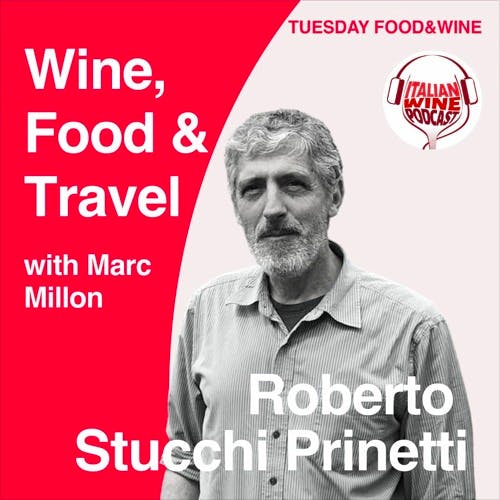
Ep. 806 Roberto Stucchi Prinetti | Wine, Food & Travel With Marc Millon
Wine, Food & Travel
Episode Summary
Content Analysis Key Themes and Main Ideas 1. The rich history and monastic origins of Badia a Coltibuono in Chianti Classico. 2. The historical evolution and present-day practice of sustainable and organic agriculture in Tuscany. 3. Roberto Stucci Prinetti's pioneering role in organic viticulture within Chianti Classico. 4. The diverse hospitality offerings at Badia a Coltibuono, including agriturismo, restaurant, and cooking courses. 5. The integration of Tuscan food, local produce, and the food-friendly nature of Chianti Classico wines. 6. Current challenges facing agriculture in Chianti, such as climate change and wild animal populations. Summary In this episode of the Italian Wine Podcast, host Mark Millen interviews Roberto Stucci Prinetti, General Manager and Winemaker at Badia a Coltibuono, a historic estate in the Chianti Classico region. Roberto describes the estate's origins as a monastery founded in 1051 and its long family history since 1846. He details the monastic order's significant contribution to early sustainable agricultural practices in Tuscany, including terracing and crop rotation. Roberto discusses his own pioneering efforts in organic viticulture, noting that over 50% of Chianti Classico vineyards are now certified organic. The conversation covers the agriturismo and hospitality offered at Badia a Coltibuono, highlighting the unique experience of staying in a historic monastery, enjoying local Tuscan cuisine (often sourced from their gardens or local farms), and participating in cooking classes. He also touches on challenges such as climate change, which has significantly altered grape maturation, and the impact of wild animals on local agriculture, emphasizing the region's efforts to diversify food production beyond wine and olive oil. Takeaways * Badia a Coltibuono is a historic Chianti Classico estate with monastic roots dating back to 1051 AD. * Medieval monks played a crucial role in developing early sustainable agricultural techniques in Tuscany. * Roberto Stucci Prinetti was an early adopter and pioneer of organic viticulture in Chianti Classico. * Over 50% of vineyards in Chianti Classico are now certified organic, indicating a strong community adoption. * The estate offers a unique ""sleeping in history"" agriturismo experience, complemented by cooking classes and a restaurant focused on local, seasonal produce. * Chianti Classico wines, particularly Sangiovese, are highlighted for their food-friendly elegance and versatility. * Climate change has led to earlier grape ripening and higher alcohol levels in Chianti, requiring adaptation from winemakers. * Challenges in the region include managing wild animal populations and the ongoing effort to diversify agricultural production beyond wine and olive oil. Notable Quotes * ""It's an amazing place. This was a monastery founded by a San Giovanniualberto, protector of the foresters in ten fifty one..."
About This Episode
The hosts of a wine and food podcast discuss the history and cultural and social reforms of Tuscany, a historic winery property with a cultural and social revolution in farm workers. They also discuss the success of the podetti and the productivity of the estate, which is a productive farm for centuries. The challenges of the agricultural system in Kianti, Mexico, where many people are certified, and the importance of organic farming and the community of people doing it. The speakers express their commitment to providing free content and suggest attendees visit their podcast.
Transcript
This episode is brought to you by the Italy International Academy, the toughest Italian wine program. One thousand candidates have produced two hundred and sixty two Italian wine ambassadors to date. Next courses in Hong Kong Russia, New York, and Verona. Thank you, make the cut. Apply now at viniti international dot com. Welcome to wine food and travel with me, Mark Millen, on Italian wine podcast. Listen in as we journey to some of Italy's most beautiful places in the company of those who know them best. The families who grow grapes and make fabulous wines. Through their stories, we will learn not just about their wines. But also about their ways of life, the local and regional foods and specialities that pair naturally with their wines, and the most beautiful places to visit. We have a wonderful journey of discovery ahead of us, and I hope you will join me. Welcome to wine food and travel with me, Mark Millen, on Italian wine podcast. Today, we travel into the wine hills of the Kianti classical, to visit one of Italy's historic wineries, Adia Acotibono, in the company of my guests this morning, Roberto Stucci Prinetti. He was a general manager and winemaker, on his family wine estate. Buongiorno Roberto. How are you today? Is it a beautiful day in Tuscany? Hello, Mark. Very nice to be here. Thank you for the invitation. It's, a little bit foggy. I'm At the moment in Florence, but, in Ferrence, but, not sunny, but nice, not too cold. Finally. Not too cold. So we're beginning to come out of winter then. Roberto I have very fond memories of visiting the Badia Cortibona. Can you please describe for our listeners your wonderful property and the surrounding countryside so so that they can gain a visual impression and image of, of where your estate is located. Yes, Mark. So we are, I mean, yes, as you said, a very historical, winery property, we are on the hills of Canti, Monteidil Canti on the south eastern edge of the Monteville County. So overlooking the Ironau Valley, we're at about six hundred and thirty meters of altitude right in the forest, close to the top of the Monteville County. And as I said, we overlook, we look north into the iron valley. So the value of the river that goes to Florence facing the Apenini. So we're in the higher part of Kanti, but the state is developed in two parts. So our vineyards are actually a little bit fire fire away also in Goyola, but, at lower altitude in the zone of Monte at the southern edge of Goyola. So the state is really two different parts where the monastery What was the monastery is, we have the Agriturismo, the aging, seller, the restaurant, and it's up high altitude. And then we have the winery and vineyards in Monti at the opposite edge of Gallola. So you see two very different parts of candy. And candy is very diverse. So, we, we embrace two sides of it. Yes. Of course. Roberto, the badia has a long, in their last history, going back many centuries. Can you tell us something of the history of your estate? Yes. It's an amazing place. This was a a monastery founded by a San Giovanniualberto, protector of the foresters in ten fifty one, or around those years anyways. He had founded a monastery on the opinion called Valombrosa, which gives a name to the order, the Valombrosian order, So there were a spin off of the benedictines. Let's say, every four more of the benedictine order. They were looking for the, you know, more pure, monastic expressions. They were very involved in agriculture and forestry, which is why the founder is now San Giovanni is the protector of forecasters. So they had a very important role in the medieval agricultural evolution, which I always like to remember, remind. It's when For the first time in this part of the world, the the the not only the monks, but the coherent system of, what we would call sustainable agriculture was developed. They started terracing. They started using cover crop, rotation of cultures. They created what defined the Tuscan landscape for a century is up till recently. And so the monks right there, up till, eighteen ten. That's when, Tuscany, of course, Italy wasn't unified yet. In Tuscany was annexed by Napoleon and the monastery was secularized. So, from that point on, it was a private estate. It had different donors and our family acquired in eighteen forty six. This was our Junini ancestors. And it's been in the families with lots of ups and downs, since, so for seven generations now. Large state, still, the monastery was converted to first to a Ville and then to a Agriturismo farm holidays. We have restaurant and rooms and cooking courses. And that way, we also try to maintain and preserve, this beautiful place, the building, but also the forest around it, and We needed the olive groves and everything else. Yes. It is a truly, truly beautiful place. It's very interesting what you're saying about sustainable agriculture really dating back to the origins of, of the, of the monastery. I guess that would have been the mix promiscuous culture as opposed to monoculture that we find today under the Metsudrilla. Is that what, you're talking about when Tuscany, the landscape itself, was very different from what we see today. Right. Exactly. So, Mitsatilia was also a a kind of a social revolution because the farm workers were basically serves slaves before that. And the monks advised the system where the family who found the land had control of half of the cup. So half the cup went to the owners of the land and half to the people that worked. And so this was, a very, socially advanced system for the time and a big evolution. And that paired with, more better techniques of farming, which the monks introduced also because they had access to the Roman manuscript. So they reconnected the classic culture and built on that. And so, yes, the podetti was the farm unit with all those are parcels of forest that was farm forest and was used to to graze the animals, part of the year, but also, you know, yeah, mix, mix crop. Very similar to what interestingly the most we what I would call post modern agriculture, like permaculture is looks very similar to what a Permese potoscano was, and has been for centuries. So three crops, alternated with ground crops, integrated with animals that would graze and, you know, keep clean and fertilize very productive system. The land produced a lot. Interesting. We think of modern industrial agriculture, high yielding, but, if you look at how much food was produced in a small person of land with that system, it, you know, we can tell it had something to say. Obviously, a very very system that kind of, didn't hold on to didn't, survive modernity. But now some parts of it are being rediscovered, I think. Oh, that's really, really interesting. And actually, the productivity goes to the actual name of the estate, Adia, the abbey of the Good Harvest, Cortibona. So it's been a productive farm for all of these centuries. Yes. Absolutely. The at the peak, it had, about forty podetti, forty farm units within the property. And we're still on a good part of the land, but, most of the farm houses were sold in the early twentieth century or mid twentieth century when times are very difficult. So some of them are, nowadays independent in the states, nearby, like, Reetchen or Capanel, that, of course, have their own brand name. But But, yeah, I'll so a lot of land, a lot of, you know, County had a much higher population than it has now in the fifties and sixties, a lot of people left, but, these five units were, you know, hosted, very abundant, families, large families, and, we had about twice as much population in Kianti before second world war than we have now. And this is after thirty years when there's been a people moving back in the area. At the lowest point, we were down to one quarter of the population in the seventies. So big changes in Canti. That's really interesting to hear how social changes happened as that a that ancient agricultural system was phased out. Now, Badia Coltebono also has this long history of hospitality. The monks used to offer hospitality to travelers to pilgrims. Are you actually located on the Frinciigina? The important medieval pilgrims route? That went from Northern Europe to Rome? No. We're not. So the French is lower. It's more west of our, in the lower area, closer to Vienna, let's say. We the Monty del Kian, we were actually a secondary route. It was quite important. It's named, Camino Mica Elico, and, that's why there were a series of monasteries on this path. Basically, the road that that from Florence, goes south. It's actually a beautiful walking path. You know, if you have a good stamina in seven, eight hours, you can walk to Coltebono from Florence, all on the top of the Monte del Chanti. And along, you'll you'll you'll pass near Padia Pasciano, which is still a monastery, Malambrosian, and then the remnants of, Monte Scalia, and then, by the Ajamontemura. So there was a thing of monasteries. As I've heard, and I haven't found a very strong historical evidence. Apparently, this was a route that was used quite a bit in the summer. In the winter, there was too much snow and the Frenchigiana was more viable. But in the summer, it was actually healthier up on the hills because some of the lower areas had, you know, swamps and so malaria also. And so sometimes this was quite, walked to doing the summer months. Now, Roberto, go going back to the, sustainability of the, of this ancient system, but also of the farm today. You were, you yourself were one of the pioneers in the county classico, in conversion to organic Viticulture. Can you tell us a little bit about this and what challenges it posed you and indeed the state of organic Viticulture in the Kianti classico today. Yes. You could say that we were early adopters of organic practices. I, I grew up in Milan, studied agriculture, while I was studying agriculture, this was in late seventies, I did a course in Biodynamic agriculture. I had no idea what I was getting into, but the oldest Biodynamic farm is near Milano in Italy. And so I never really embraced the whole spiritual side of Biodynamic, but it taught me a lot about, complexity and how to, you know, learn about the health of a of a farming system, which starts, of course, soil, biodiversity, and everything. And I studied in California for a few years in Davis where I also this was eighty two eighty five, and I learned a lot from local farmers that were beginning to embrace organic. So not so much winemakers. Wine, joined the organic movement a lot later. But so when I came and I started that badia in eighty five, I immediately, went in that direction. The big challenge back then was little information, little support from, you know, academia or science, the agricultural science was still very much what I say inorganic. You know, there was no tension on microbes in the soil or biodiversity. So it was more like, treated like an industrial system where you put inputs and you get things out. Now, of course, it has evolved. So the the the challenge was to break ground with, not much, support around. Now the situation has changed a lot. There's a lot of people that are doing organic, anticlassical today is over fifty percent certified organic with a lot of, you know, biodynamic and other, advanced forms of organic, so permaculture and whatnot. So it's it's developing really fast, which is nice. Now there's a community. I'm also president of the business trade, which is specific in an association of organic producers. So it's nice to be working together on this, and it's much less lonely, and it's, of course, a lot more you can do a lot more when you can work on it together, and I think that's the recent development. Oh, that's very encouraging to hear. And, an extraordinary high proportion, fifty percent. I'm, surprised to hear that. Is, is, Chianti Classico an area that lends itself to organic in terms of not having the risk of some of the maladies that would happen in moisture or more varied climatic areas? Well, up to a point, yes, but, I also think that, organic works better either way even when you have difficult conditions now. If you're trying to grow grapes in an area, let's see it not well suited. You're always gonna go it's only gonna be uphill whether you use organic or conventional. Techniques, you still will have a hard time. So one of the concepts behind the agroecology, which is the basis of organic and biodynamic and everything else is also to grow things where it makes sense to grow them. So, you know, and in that sense, yes. Canty is very well suited for for vines. But I I would argue that even if you're growing a crop where it's not well suited, you're still better off using organic practices because healthy soil means the plants are gonna be healthier. And easier to protect. Of course. Well, you certainly are getting successful results because you make some beautiful wines, which I've enjoyed. Roberto, can we turn to hospitality at Padia Cortibono. You mentioned that you have an Agri tourismo. Visitors can come and stay with you. What do you offer? Please tell us about what the visitor will find. Well, first of all, you get to stay if you stay there in rooms and apartments, that are inside the, what was the monastery. The monastery has still a medieval part, but most of it was expanded in the renaissance and then in the seventeen hundreds. For one part added in early nineteen hundreds, so there's many different, epics, in the building. In the last forty years, we've, you know, added, bathrooms and made it, more comfortable, obviously, but you still have this very unique, flavor of staying there. Because it's you are within a medieval renaissance monastery that has been re adapted into a villa in the eighteen hundreds and then converted to our Grita recently. And so, whether you rent a room or you rent an apartment with your family, it's just a beautiful place to stay. We obviously don't have a pool and a really nice, you know, Italian garden. There's many reasons why people come to stay with us. We have a lot of reason. We have a lot of bikers and hikers, for example, just because we're in the middle of this network of trails, where you can hike or mountain bike. And there's a lot of also road biking. But then we do, we have a restaurant. We do cooking courses, which we've had for a long time. It used to be our mother who taught them starting in the early eighties. And so the program has been continued and it's quite, it's a fun program. You can come for a day course or three days and learn about local cuisine and hands on. And then we do a lot of tastings. Mine tastings, of course. So we have groups or that come over for wine tastings, and then the restaurants, it's open, to both guests and people from outside. So a variety of, things, and people come to just hang and, you know, just have a nice time at the pool and enjoy also the beauty of the place, and, it's nice and cool because it's up at a fairly high altitude in the summer. Or people will, base there and we're only an hour from Florence and CN, and I hate to, so you can stay there and still do the you know, the cities, the museums, and whatever, and just come back there in the evening. Some variety of, but the flavor of it is quite unique just because you are sleeping in in history, really. Yeah. Sleeping in history. I love the sound of that. And of course, the abbey of the good harvest thing, badia Coltebono has it it is famous for its food, the food in your restaurant, and your cooking courses. As you say, made famous by your mother, Lorenzo Demedichy, who wrote some beautiful books. I've I've seen her beautiful books. They inspired me when I was beginning some of my work and travel in Tuscany, and it's a real wonderful, legacy that she's created that is carrying on. I know many of the ingredients served in your restaurant used in the kitchen are actually grown on your estate or sourced from from local farms. Tell us about some of the wonderful things to eat, in your restaurant, some of the wonderful produce and products of your area. Yeah. We do. We do have a garden of his albadea, so we do some of our own special herbs and some of the, you know, salads and vegetables, but, both for the restaurants and for the cooking choruses. But then we also tie and develop and have developed a good network of local growers. Now that's one of the issues in Kianti that is, but it's coming back, let's say, the production of food in the area, which is nice. Up till, while ago, there wasn't told that much because of the changes in the last thirty four years, but now there's a comeback and in fact, if the British state that we're pushing to promote the idea of, new crop. So we have some very nice, producers of, local cheeses, both goat and sheep. For example, we have, local grains, vegetables. We have, growers that, that provide, you know, both greens and, beans and other, you know, classic legumes that are a big part of Tus and cuisine. Some of the meats are local. So but it's still building up. I think the future for Canti is gonna be producing a lot more than just wine and olive oil. Are there younger people returning to the land then? Yeah. Yeah. Yeah. At least trying. It's not easy. We have an issue, for example, with, too many wild boars and deers. That's a real problem these days and, hard to manage. But, yes, there is certainly a lot of, people coming back. And, again, not just for, you know, for decades, can't develop pretty much I unwind, and that was good, be because, you know, it brought it back from a very difficult period. But now more and more other food crops are being grown again for local consumption, and that's really nice. It's very important. I think for the future, to give more, and for the health of agriculture. There's a lot of space to do that if you can, manage somehow the wild animals. That's a real difficult part. Can you just maybe say one or two of the iconic classic dishes that that a visitor to your restaurant should definitely try, just to give a flavor of this wonderful Tuscan cuisine is celebrated in the restaurant. Well, the menu changes all the time. So I'm not sure that I would quote the things that are, necessarily on the current menu when we reopen. And right now, we're actually closed for the winter, we reopen in March. But there's, We do things with some of the local wild meat, for example, the, both the deer and the boar, and that have become, classics now. Even they're recent because there wasn't that much of these animals fifty years ago, but they have become a classic now. I also, well, of course, things like the classic bistec is, is also, a a nice, nice thing. I would say one of the things that is, less it may be explored of tuscan cuisine is the non meat part. So a lot of nice bean dishes. We don't do so much the classics. Occasionally, we do like the bolita, you know, the tuscan bread soups with beans and things like that. But but beans as the sides in many ways. Also, we we also propose food that's not necessarily totally local. For example, resort owners, but part of our family has roots in Lombardia. And so, resulting with local ingredients. For example, are also a classic at the restaurant. So, you know, lots to choose from. But the menu is always in evolution. Wonderful. And always foods that go well with your beautiful range of wines. Well, the beautiful thing of Canti and sangiovese made classically, which means not over extracted, but with Medi maintains its elegance, like in a Canti Classic. For example, it's, it's very food friendly. So it's not overly tannic. It's not overly rich. It says this freshness elegance and acidity and nice, crispness that makes it go with a variety of food. I mean, traditionally, you'd have a lighter can't even own seafood. For example. That's how, flexibility it is with, with food. Obviously, as you get into the reserve or the IGT, like the San Jovito, then it's, you know, the bigger wines, and then they like the, you know, the at meat pairing or the cheese, they need something rich. And one of the things that we've have always maintained in, in the state was the traditional genetic mix of sangiovese. So we use a massive selection, very wide diversity of clones. Which means that, style is very classic, but also that it maintains more elegance even in the very warm climate. Now the challenge is very much with, the climate that's pushed so much the maturation We are harvesting more than a month further than we used to with much richer. We used to harvest late October, even early November, and alcohol levels were barely thirteen percent in the best years. Now usually by early October, we're at fourteen percent alcohol. So, you know, earlier and earlier. And so that has also changed a lot how you have to handle the the wines. And in that sense, having the all the clonal mix helps to maintain the freshness. There's more genetic diversity in the Sander Basin that definitely helps. And we also like to work with the other local varieties. A complimentary like canna yolo, colorene, chile, chile, chile, and nice spices in the blend, that was traditional and unique to Kianti. So Sanjay is not alone, but always blended with other vehicles. Ma'am, we like to still maintain that. Yes. Well, Roberto, you've given us a wonderful overview of a very special place, Ibadia, Alco Tibona. I know that you described how travelers, pilgrims traveled along the spine of the Monte de Kiente, and would stop down at the badia centuries past. And today's travelers people who may be listening to us today, anyone who wishes to immerse completely in the county genre, learning about foods, wine, and life can discover all of this and more with you. It's been a real pleasure talking with you, Roberto. I'm personally looking forward to returning to Badia Akolteibono sometime in the future, and I hope our listeners will too. Thank you very much for being my guest today. Thank you, Mark. It's been a pleasure, yes, I hope you do come and visit soon. And, and, of course, extend this invitation to anybody who's listening. And, hopefully, we'll have, free time of traveling from now on soon. So Yes. Let's hope we do. We hope you enjoyed today's episode of wine, food, and travel. With me, Mark Millen, on Italian wine podcast. Please remember to like, share, and subscribe right here, or wherever you get your pods. Likewise, you can visit us at Italianwine podcast dot com. Until next time. Hi, guys. I'm Joy Livingston, and I am the producer of the Italian wine podcast. Thank you for listening. We are the only wine podcast that has been doing a daily show since the pandemic began. This is a labor of love and we are committed to bringing you free content every day. Of course, this takes time and effort not to mention the cost of equipment, production, and editing. We would be grateful for your donations, suggestions, requests, and ideas. For more information on how to get in touch, go to Italian wine podcast dot com.
Episode Details
Keywords
Related Episodes

Ep. 2791 Italian Wine in a Changing Climate: PIWI, Terroir & Tradition with Nicola Biasi | Wine, Food & Travel with Marc Millon
Episode 2791
Ep. 2767 Le Marche: Verdicchio and the Wines that Shape the Region with Gianluca Garofoli of Garofoli Vini | Wine, Food & Travel with Marc Millon
Episode 2767
Ep. 2755 The Longest Table: Honoring Nello Ghezzo’s legacy | Wine, Food & Travel with Marc Millon
Episode 2755

Ep. 2712 Exploring Brda: Exceptional Wines and Slovenia's Culinary Traditions with Lan Kristančič of Movia | Wine, Food & Travel with Marc Millon
Episode 2712

Ep. 2700 Sardinia Beyond the Coast: Agripunica, Basso Sulcis & the Legacy of Giacomo Tachis with Salvatore Santus | Wine, Food & Travel with Marc Millon
Episode 2700

Ep. 2681 Giro d’Italia 2026 Special Episode 1: From Bulgaria to the Mezzogiorno in search of wine and cheese | Wine, Food & Travel with Marc Millon
Episode 2681