
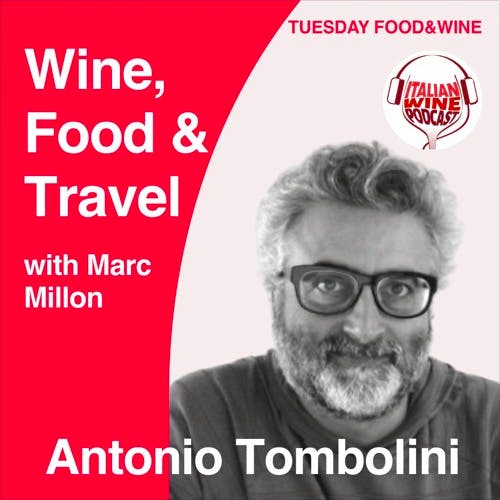
Ep. 824 Antonio Tombolini | Wine, Food & Travel With Marc Millon
Wine, Food & Travel
Episode Summary
Content Analysis Key Themes and Main Ideas 1. The pioneering role of early e-commerce in making authentic regional Italian food and wine accessible globally. 2. Antonio Tombolini's journey, influenced by personal passions (food, wine, chess, coffee) and early internet technology. 3. The logistical challenges and innovations required to ship perishable goods like fresh mozzarella across continents in the late 1990s. 4. Food and wine as integral expressions of Italian local culture, history, and identity. 5. The concept of community building online, from early newsgroups to connecting people with their culinary heritage. 6. The impact of e-commerce on traditional Italian ""Campanilismo"" (parochialism) and internal exploration of regional specialties. 7. The evolution of the internet from a niche tool for digital goods to a ubiquitous platform for ""real stuff."
About This Episode
Speaker 1 describes their experience creating their own food and wine business through the internet and social media platforms, as well as their experience with the transition from traditional shops to digital services. They discuss their experiences with Italian e commerce and the cultural and political differences between cities and departments, as well as their new venture, Asrow, which offers coffee in a different way with a focus on transparency and ethics. They also mention their involvement in the Italian coffee culture community and their upcoming plans to expand operations in Europe.
Transcript
Welcome to wine food and travel. With me, Mark Millen, on Italian wine podcast. Listen in as we journey to some of Italy's most beautiful places in the company of those who know them best. The families who grow grapes and make fabulous wines. Through their stories, we will learn not just about their wines, but also about their ways of life, the local and regional foods and specialities that pair naturally with their wines. And the most beautiful places to visit. We have a wonderful journey of discovery ahead of us, and I hope you will join me. Welcome to wine, food, and travel with me, Mark Millen. Today, we are traveling to Le Marque to meet a good friend of mine, Antonio Tom Bolini, who is rightly considered one of Italy's visionary pioneers of the internet. In the late nineteen nineties, Antonio was able to find a way to bring together two great passions. His technical and technological expertise about the then still just emerging internet and his deep love and knowledge about local and regional food and wine through the creation of an exciting startup, aspedia dot com. It's a really fascinating story. One I remember well being part of as a customer, and I'm looking forward to hearing more about how this came about. Well, you all know, Antonio. How are you today? Good morning, Mark. Good morning, everybody. I'm very good. Very good today. Nice day, sunny day. So quite happy. Well, it's not a very nice day here. We're in the middle of a giant storm. So I'm imagining the sunshine in in your beautiful region. Tell us about where you are. I'd like to give our listeners a sense of place. So tell us a little bit about your home. Well, so my currently, in at my desk, in Castell Fidal, which is a small, village in the market region, very famous for inventing the physar Monica, the accordion at my desk in in in my busy and my new venture in the coffee market, but maybe something later on that. We are, let's say, five or six kilometers from the sea. Wonderful beach. You know, where the the the the region, and I think one cannot exaggerate how good it is to live here, to be honest. Yes. Le Marque is, one of my favorite regions, and I love that that mix of the beautiful rolling hills where you are leading up to the mountains. And then the proximity of the sea, it seems to be a region that has a bit of everything, and certainly in terms of food and wine, wonderful foods, and wonderful wine. Also, which is very important too. Yes. Now I'm going to turn back the clock and remind our listeners, some of whom may not even have been born yet, but in the late nineteen nineties, the internet was incredibly young and exciting and new and and slow. We had to connect with things like dial up modems, and e commerce was incredibly new. People didn't even all have mobile phones yet if if one can imagine such a world. And it was at that time that you began to develop some exciting ideas. Tell us a little bit about about how these passions came about. Well, so, about food and wine, I I would say it's completely to my family because I used to stay with my mother hours and hours in in, our, kitchen, looking to my mother, cooking, everything, and, and, testing a learnings since I was at not know, maybe five years old or so. And then regarding the internet, it's a little bit less fascinating if you want because, when I started to think about launching a website selling, food and wine through the internet. It was because it was, short of money, and it was the only way. Yeah. It covered to open up my my food and wine business. And so to be honest, the the the this has been the the real reason at the beginning. Of course, I was already in the internet because another passion of mine, which I I used to play chess, and I love to play chess. And, thanks to the internet, I discovered a way to play chess in my lunchtime, while working as a manager in a local company in a completely different industry. And so when I discovered the internet, I realized that it was Another place, a completely new word where you could be able to, transform the concept of space and time. We were a customer with, at the age. And so, at lunchtime, I was able to play chess with with some guy from the Australia or the United Kingdom or whatever. And This is my my initial story with the internet, and then it became also my business. Well, that's that's really fascinating that out of a completely separate passion, your passion for chess, you gained a sense of I guess the power of community of being able to connect with people all around the world, because that was also part of the essence of what you were doing with Betty dot com. Tell us about Asperia dot com. What it was how you developed it and and how it grew because it was such an exciting concept at the time. Yes. So, let's say this way, I was continuously traveling for for business in different places and regions in Italy. And I I always I was always looking for local products. And and apart from my job, I was spending my dinner time and and and some spare time from the the work time in in looking for local producers of food and wine. And then I stood with the with the the internet. I started to think on the possibility to make my friends part of my experience. So the real the real interesting part of the, first steps I did, it was before this period with the news group. The news groups were the first form of community in, in the internet, And the the I was part of a news group named named the IT dot, hobby dot cochina. Okay. And so in this new news group, we we we were let's say a bunch of friends like one hundred maximum. And I started to, tell the stories of my discoveries, and and they pushed me step by step in doing something to share with them, not just the stories, but the real products with them. So I started to distribute samples and to collect orders in in in a very naive way until also with the with the this group of friends continuously pushing me to the decision of launching it as a proper business. And this is the the way stereo was born. Well, that's that's really fascinating. It reminds me almost of the story of pellegrino Artuzzi, who has also for business traveled all around Italy through his passion and his love of food eventually wrote this great book science in the kitchen and the art of eating well, and it was through your love of eating whenever you were traveling that eventually led to sharing these products with your friends. And that's interesting. The news groups, because many people will not have heard of newsgroups, but this was before the worldwide web with a visual interface through Netscape and all of that had yet even become a mainstream. So it was a very, very different way of communicating. Really, it was would have been tech only. Is that right? Is it? Is it? And and this is also an interesting part. I always thought that, you can leave limitations in in in two ways. The the ordinary ways that you hate limitations. And and with with reason, of course. But I I tend to see a limitation sense as a as a spark for creativity. So when you are forced to use just text, I think it's good training to tell stories and and to make people feeling what you are saying, feeling for the food you are trying to describe and everything. So it has been a real good experience. Well, actually, I that is something I remember very much about, especially, the stories of these wonderful and strange and products that, you know, I had traveled around, every region of Italy for a book that came out in ninety six, the Food lovers companion Italy. So a lot of these areas were Fominyu and some of the products, but suddenly you created a way to bring these to I guess it would have been first your friends, an Italian audience, and eventually a global audience. Yes. And this is where I terminated the experience with with the Espperia in two thousand and two. When we were already selling stuff to continue to Europe, we were starting to sell some to the UK and to the USA. And I'm sure it could They have been a a great success, but, for several reasons, it is not worthy to to, tell now I decided to sell the business and In in the moment may be where we were in the phase of completing my idea because my idea was that, thanks to the internet, I can be able to literally ship to your house a piece of, this region of this village through the food, through the wine they produce. And the the the other step to complete the experience was the idea to bring you together with a bunch of friends to and and visit the region, the village, the, producer, and together with the nature and the art and everything. We have practical practically everywhere, and to discover, to experience the way they are connected. This is my firm belief. I think that also food and wine when they are authentic are one of the expressions of the culture and the spirit of the local area as the art has been, and it still is in several areas in Italy. But everywhere, if you want, I think. Yes. Yes. Very much that link of food as an integral element of the culture. But, you know, it was quite a magical time for your customers for people like me because I remember you know, we we have much more availability of quality Italian products today than we did twenty five years ago. But I remember that I could, for example, go on to your website and order mozzarella debuffa on a Sunday evening. On the Monday, I knew that the buffalo milk was being transformed by hand, that mozzare, the torn, made by hand on the Monday. By Monday night, it had probably been sent to you in Loreto to be dispatched by whatever means so that by Wednesday morning, I was able to have that for lunch. And it was just incredible because it was as fresh a mozzarella as you would get if you were in Campania, and it was quite a miracle to me. And one of the great, great, excitements of in commerce. You know, this is probably another part of me continuously looking for new challenges if you want, very, very simple challenges. Because it's all about simple things like mozzarella or or wine or mozzarella. But, yes, at at at the at the time, it was practically impossible to get a proper mozzarella real and authentic mozzarella debuffala let's say, in London, because there nobody was selling directly to private people. It was simply not possible. So we started to think way on how to do that. And it was quite complicated because mainly of the logistics parts of of of the business. And I realized now that it's very difficult to to understand what the situation was, but the situation was the one where the the DHL or UPS, they their business was to transfer documents from one office to another. They were completely out of the of the idea of of delivering a a a pack of ten kilos to private house at at two private people. So we started to discuss with them and to look for a cooperation and to look for solutions about how to grant the proper temperature while transferring the package and and and and how to connect the logistics with the producer and the producers of authentic food are often, very small business and and family business. And so you have to cooperate with them to make it possible and so on. But to me, it, I mean, I'm very proud of what we have been able to do, and I I was very happy for my cast customers, of course, appreciating this experience. But to me, the real enjoyment was in setting up the process, to be honest, to to to do it. It was my my real satisfaction. Wow. That that's so interesting. I'm also thinking that, you know, in, in Italy itself, I know probably your biggest market was to Italians. Now Italians Italians are notoriously parochial, the famous Campani Lismo. Italian's unwilling to try versions of dishes from neighboring towns, let alone regions. In a way, do you think that what you did helped Italians to discover their own country a bit more. Yeah. So this is a good point. And because it's true because it's true, we we we'll let's say, of course, it's different, and it was already different from from the past. It was no more about fighting in actually fighting each other because we we had in the history phase where every single village may be at ten kilometers from the other one was in war between them. But Nowadays, it is kind of a joke if you want when it's at least at its best expression. But the the you can compare that to to the mood of supporters of a football team against another one. And and you can apply approximately the same when you speak about the pecorino cheese of Montecibility compared to the pecorino cheese of, let's say, grandsasso in a brusso. It's always a pecorino cheese. They are both wonderful and there is no more than maybe fifty five zero kilometers of distance from the producers, but they are two completely different expressions of of of the cheese culture, and you can perceive it when you taste it. And and every single Bequerino cheese as a group of supporters. But what, I think I realized in a certain way, the fact that people in Italy were already mixed in different regions because we had, in the sixties and seventies of the last century, a great phenomenon of internal migrations mainly from south to north. And I thought to leverage also on the nostalgic part of, I do not know, sicilian people living in to ring because working at, the theater industry or many others or or the, lemarque, people live in in Milan or whatever. So I I remember that our communication was often about saying, if you want a piece of c or sicily with you, we can ship it to you through this product or the the the tuna fish. We select, in in Fabignana and and and so on. Well, that's really, really interesting that, how how you were reaching out through the stories to connect people with their homes, to connect people's hearts, through their stomach. Yeah. This is basically so. Okay. And having been one of the pioneers of e commerce, because e commerce was very, very new when you began this business. Today, when you're looking at how it's almost replaced traditional shops in the center of towns and cities. Have you been amazed at how the things have developed, or do you think that, you know, this is, natural way things will go? And, you know, we've lost something as well, haven't we? Well, so the cost of of seeming, not not not so humble as I should be, but I would say, no, I'm not surprised. And I still remember in the asperia days, We were in the middle of the of the of the web craze, and maybe you know this very smart guy founding Tiscally. Tiscally was a provider, a new provider, a new generation provider, launching a big, business and quoted at the at the at the Milan Stock has changed and everything. And in Italy, we have the main financial newspaper, which is in Solventi Cortrore. And and they published in a Sunday, a double page, asking to this guy and and to me separately the same question. And the same question was, do you think that in the internet, could be possible in the future to sell real stuff like objects and food or, furniture or whatever? Or do you think the internet is to sell just, digital goods like this career was doing? And I was selling real stuff, of course, with this area. And and this guy was saying that, no, forget it. The the internet is not the solution to sell actively and, in a sustainable manner, real goods and objects and so on, because the future is just about digital, services, and everything. I was saying that to me, the trend should be could be the one where digital goods would become, more and more difficult to sell in the internet because of the price. They tend to be for free. While the real staff has a space because you can sell to people you can reach thanks to the internet, willing, this kind of product, and so on. Well, all in all, I think that reality is that nowadays, everyone take it for granted, that you can sell whatever you want through the internet. This is not necessarily, and always a good thing. I agree with you on that. And what I see now as a challenge is to try to connect to the aligners experience with the offline experience. If you can name it this way. Finally, Antonio, let's turn now to your latest venture because in a sense having created a global e commerce business with Asperia, you're returning to being from from from selling wonderful artisan products and conduce, you are now a producer yourself through your latest venture. Tell us about the smoking tiger. Well, very good. And and, so let's say this way, I will reveal something that you do not know about this perrier mark. Even if you know everything about this perrier may be more than me in several last and and the fact is my initial idea was to launch Esperia with the claim, espresso experience because my first idea was all about coffee. Being so passionate as I am about food and wine and everything, coffee is into my veins while my father, was producing until the eighties was producing, particular local liquor made from coffee, and I used to stay there smelling and sniffing coffee all the day when it was maybe ten years old or so. And and I started to study the story of coffee, the story of the economy of coffee, and and and everything. It it's a really fascinating. Then, reflecting exactly on the fact that e commerce is transforming the way we buy things and looking for a new challenge in in how to make it better the the experience of buy things apart from the supermarket approach with the with Amazon and and the kind. I started to think that, I was willing to challenge the Italian coffee culture. Coffee is a very interesting product in the fact that the production of the raw materials, is is in tropical regions, while the transformation and the roasting part is in the destination countries. So it means that you are forced to make a choice, in terms also of ethics and and sourcing the coffee in a certain way or another way. And the other part is that, yes, you can source the best coffee. You can in the best way you can. But you have to transform it in a certain way with a certain style. And the Italian coffee culture is, with reason, very proud of the espresso discovery at the end of the nineteenth century, it was invented in Italy and and now spreading everywhere all over the world. But the fact is that as it happens, sometimes we tend to stay and and stop with what we have already achieved. And I I think that the coffee culture is growing since probably, twenty or thirty years more abroad than in Italy. So I decided to launch this new venture apart from my main business since the Selling of Esperia. My main business is a small consultancy firm for food and wine industries. And I'm still involved in that, but luckily enough, I have a bunch of friends, partners of of of this company doing a great job, and I have also my son doing a good job with it. So I decided to in my sixties, I I am now almost sixty two years old. I decided it was time enough to try, to become a roster. And I made my choices. I started in in, when when the COVID was already there. So it's not an excuse for me, and I have to to do good to do the best I can in a very difficult situation. But I'm quite happy because we I I sold the first bag of of roasted coffee with our brand, the smoking tiger in November twenty twenty. And so it's a little bit more than one year. But, we are doing quite good. Quite good both online and offline, both directly to private people and through selected restaurants and and coffee shops and so on. For the moment, merely, in Italy, I think there is a potential a huge potential, to expand operations, at least in Europe, and we are really selling coffee to Austria and Germany. I would like to serve coffee in a place where the coffee culture is something boiling like London and and the UK, but unfortunately, the Brexit is not developed in this respect. But, anyway, I will find a way to be there sooner or later. I and I hope very soon. Well, that's, that's a really interesting development. And I know that everything that that drives you is done through passion, and, it's very interesting to hear this passion developing from when you were a young boy either cooking beside your mother or selling that wonderful coffee and finding a way to create a sense of community through this shared interest. Antonio, it's been a real pleasure meeting up again this morning and, finding a little bit more about your story. I look forward even more to sharing a glass of wine with you or a coffee when I'm next in Le Marque. Or both? I hope so. Or both. Yes. Definitely. Thank you very much for being our guest. Okay. It has been a real pleasure. Thank you for inviting me. And you are doing a very, very, very good job. Thank you. We hope you enjoyed today's episode of wine, food, and travel. With me, Mark Millen, on Italian wine podcast. Please remember to like, share, and subscribe right here, or wherever you get your pods. Likewise, you can visit us at Italian podcast dot com. Until next time. Hi, guys. I'm Joy Livingston, and I am the producer of the Italian wine podcast. Thank you for listening. We are the only wine podcast that has been doing a daily show since the pandemic began. This is a labor of love and we are committed to bringing you free content every day. Of course, this takes time and effort not to mention the cost of equipment, production, and editing. We would be grateful for your donations, suggestions, requests, and ideas. For more information on how to get in touch, go to Italianwine podcast dot com.
Episode Details
Keywords
Related Episodes

Ep. 2791 Italian Wine in a Changing Climate: PIWI, Terroir & Tradition with Nicola Biasi | Wine, Food & Travel with Marc Millon
Episode 2791
Ep. 2767 Le Marche: Verdicchio and the Wines that Shape the Region with Gianluca Garofoli of Garofoli Vini | Wine, Food & Travel with Marc Millon
Episode 2767
Ep. 2755 The Longest Table: Honoring Nello Ghezzo’s legacy | Wine, Food & Travel with Marc Millon
Episode 2755

Ep. 2712 Exploring Brda: Exceptional Wines and Slovenia's Culinary Traditions with Lan Kristančič of Movia | Wine, Food & Travel with Marc Millon
Episode 2712

Ep. 2700 Sardinia Beyond the Coast: Agripunica, Basso Sulcis & the Legacy of Giacomo Tachis with Salvatore Santus | Wine, Food & Travel with Marc Millon
Episode 2700

Ep. 2681 Giro d’Italia 2026 Special Episode 1: From Bulgaria to the Mezzogiorno in search of wine and cheese | Wine, Food & Travel with Marc Millon
Episode 2681