
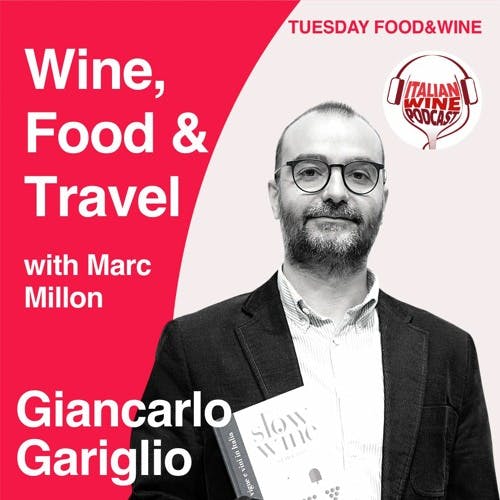
Ep. 833 Giancarlo Gariglio | Wine, Food & Travel With Marc Millon
Wine, Food & Travel
Episode Summary
Content Analysis Key Themes and Main Ideas 1. The origins and core philosophy of the Slow Food movement. 2. The application of Slow Food's ""good, clean, and fair"" principles to wine through the Slow Wine initiative. 3. The significant growth and increasing consumer interest in organic, natural, and minimal-intervention winemaking. 4. The global expansion of the Slow Wine guide and its efforts to document diverse wine regions worldwide. 5. The significance of the Sana Slow Wine Fair as a major event promoting the movement's values. Summary In this episode of the Italian Wine Podcast, host Mark Millen interviews Giancarlo Gariglio, editor of the Slow Wine guide and coordinator for the Slow Wine Coalition. Giancarlo explains the origins of Slow Food, founded in 1986 by Carlo Petrini in Bra, Italy, as a response to the opening of McDonald's in Rome. The movement aims to preserve traditional food, ensure access to ""good, clean, and fair"" food, and created projects like ""Presidia"" to save endangered foods. Giancarlo then details how these ""good, clean, and fair"" principles are applied to wine through the Slow Wine guide. He highlights that quality in wine isn't just about taste but also about production methods (e.g., no herbicides, natural yeasts), fair labor practices, and community engagement. Over the past 12 years, the Slow Wine guide has seen a significant increase in certified organic wineries reviewed. He also discusses the guide's international expansion into regions like Slovenia, California, and notably, China, where they are producing a guide for over 1600 wineries. The conversation concludes with details about the upcoming Sana Slow Wine Fair in Bologna, a major event bringing together producers and wine lovers committed to these values, and a discussion on the evolving consumer tastes towards natural wines. Takeaways * Slow Food was founded in response to the rise of fast food, advocating for the preservation of traditional food cultures. * The core philosophy of Slow Food focuses on ""good, clean, and fair"" food for everyone. * The Slow Wine guide extends these principles to wine, evaluating not just taste but also environmental and social sustainability. * There has been a substantial increase in organic and sustainably produced wines featured in the Slow Wine guide (over 50% now). * The Slow Wine guide has expanded globally, with editions covering regions like California, Oregon, and even China. * The Sana Slow Wine Fair serves as a key event for the Slow Wine movement, connecting producers, industry professionals, and consumers. * Consumer preferences are increasingly shifting towards natural, minimal-intervention wines, reflecting a growing alignment with Slow Wine values. Notable Quotes * ""Slow Food is not a moment against something, but the food propose a different way to, to save and preserve the food, to, to give the right food to every people."
About This Episode
The coordinator for the Italian wine guide and coordinator for Fair will take place in 2021, with the focus on protecting traditional foods and creating a network of restaurant chains to support community. The importance of slow food is emphasized, and the green revolution in winemaking is gaining strength. The upcoming Fine N draft wine fair in Chinese city of Chinese city of Chinese city of Chinese city of Chinese city of Chinese city of Chinese city of Chinese city of Chinese city of Chinese city of Chinese city of Chinese city of Chinese city of Chinese city of Chinese city of Chinese city of Chinese city of Chinese city of Chinese city of Chinese city of Chinese city of Chinese city of Chinese city of Chinese city of Chinese city of Chinese city of Chinese city of Chinese city of Chinese city of Chinese city of Chinese city of Chinese city of Chinese city of Chinese city of Chinese city of Chinese city of Chinese city of Chinese city of Chinese city of Chinese city of Chinese city of Chinese city of Chinese city of Chinese city of Chinese city of
Transcript
Welcome to wine food and travel. With me, Mark Millen, on Italian wine podcast. Listen in as we journey to some of Italy's most beautiful places in the company of those who know them best. The families who grow grapes and make fabulous wines. Through their stories, we all learn not just about their wines, but also about their ways of life, the local and regional foods and specialities that pair naturally with their wines. And the most beautiful places to visit. We have a wonderful journey of discovery ahead of us, and I hope you will join me. Welcome to wine food and travel with me, Mark Millen, on Italian wine podcast. Today, my guest is Jancarlo Garillo, the editor of the annual and important slow wine guide. He's also the coordinator for the slow wine Coalition and the organizer of the Sana slow wine fair that will be taking place in Bologna from March twenty seventh to March twenty ninth. Bonguro, John Carlo. How are you today? Very well. Thanks, thanks, Mark. Good. So You're you're joining me today from bra where you live. Bra, of course, is the home of slow food, an organization you've been involved with for for quite a long time. It's an organization I've supported for for many years as well. But I'm I'm aware that not all of our listeners know about slow food. So can you give us a little bit of a background, an explanation about what slow food is how it was born, how it has grown and evolved, and what its aims are today. Zrofudo was born in, nineteen eighty six in Italy, in, in this multan, the, the name is a bra in a pigment, and, was born here here, simply because the, the founder is, it's come from, he was born in bra, and the name is, carlo Petrini. And, when, Mcdonald's open in a Gatsa di Spania in Rome, a flagship store and, and a restaurant in, in Rome for the some Italian people was the enormous, things and, they decide to create a moment that, preserve and talk about the, traditional food, not only from Italy, but also when we are in the US or another part of the world. We we talk about the traditional food of, these countries. So we we try to to preserve the traditional food and in from the two thousand, we create also a project. The name was Precidia to save the the food that, is, in course of a disappear. So the, the traditional food some seeds, some, fruits, some, vegetables, some also different animals, like, goat, cow, pig, And, we try to to save this, this kind of, of, food or, type of animals in, in two thousand, and after, in two thousand and four, We create an event. The name was Taramada. That is a union of a more than five thousand food producer of all over the world. And, this, big event is, organized in a tooling that is, the, the capital of, Piedmont every two years. And, this is, our most important event, for Zulu food. And we create also a network. The name of the network is the same of the event. So, and, we organized also some, another appointments, in other part of the world in Africa or in, Latin America or also US. Yes. So so many activities, so many, inspiring, things have been created, but it's fascinating that out of outrage, out of outrage at fast food on the Spanish steps of Rome, this immense and very important organization was born, really sitting around almost around the kitchen table or perhaps around the dining table in the, which I've been to many times in bra to discuss why it is important to safeguard local food cultures and traditions. And really at the heart of slow food is this basic belief, isn't it? That the enjoyment of food is a fundamental human right for everybody. And then we need to protect the foods that are traditional, the foods that are good. Yes. It's very it's very important. And I think the the most important thing is that, the slow food is not a moment against something, but, the food propose a different way to, to save and preserve the food, to, to give the right food to every people. And, this is our mission. It's not, moment against McDonald's, but is a moment that proposed something very simple, but, quite revolutionary. Yes. It is revolutionary, and it's quite inspiring, especially when the Taramadre communities come together from all over the world, from the developed world, but also from the developing world, slow food, finding a way with, simultaneous translators on hand and people sharing networks of fishermen or or beekeepers or Apple growers from around the world will discuss similar problems and, and find a way to, maintain traditional ways of life. So it's, I, I find slow food very inspiring, and I'm also fascinated to know how this whole philosophy of slow food, of supporting food that is good, that is clean, and that is fair. How this translates into the world of wine, which is where you've been involved with the slow wine, with the, and and with the guides. Yes, our guide was born, only twelve years ago. And we decide to, to put the same words that, you told before. So good clean and fair with, with the wines. So, we decline the, the, the same, words in the, to, to the wines. Because, for, in our opinion, the quality is not only the quality of the taste. For sure, the wines are ever, a bit, to be very, very good. And, also close to the in which, they are produced. But it's not the, the only thing to to declare the quality of our wine. For us, it's very important. Also, the way in which was grown the the grapes. So, we declare on our guide the method of produce, the, the, the grape. And, like, if the winery use, herbicides chemical herbicides or not, what kind of Easter they use. So we, we try to give a lot of information to our reader to, to the people that buy our guide And, in our opinion, it's very important. Also, the relationship between the winery and, the people that work in the, in the fields, in the vineyard. So also, if they use, people that, they pay the right salary. And, this is very important. Also, another thing for us is very important to the relationship between, the, the winery and the people that live in the, in the village close to the winery. So in our opinion, the quality is that, defined by, the free, words that, we we told you before good clean and fair. And for this, this reason, we create a a manifesto with ten points, different points, a manifesto of, the good clean and fair wine. And we presented this manifesto two years ago in Bologna during the summer we started the, the first failure after the, COVID pandemia. And, we we present in this, in this moment, the manifesto, and after, the presentation of the manifesto, we create a network, and the name of the network was, is a solution. Okay. So you're really taking those concepts of, of slow food, which lies at the heart of slow food, and bringing that into the whole world of wine, not just what is in the glass, but but what it represents supporting, for example, the use of preserving biodiversity with native grape varieties, making wines that are clean with minimal use of sulfites, for example, or, using indigenous yeasts rather than cultured yeasts And then the fair side, of course, as you say, the importance of of wine in the local economy of paying people a fair wage and, of supporting communities. So it's a quite an all embracing concept, and I think a very important one. It's too easy to look at wine simply as something that's in the glass. The guide book itself, slow wine. I know that slow food originally was co published, with Gamarroso, the Vinid Italian guide with its famous Trebicieri, rating to the best wines. And what I particularly like about slow wine is, the snail, the symbol of slow food, which is a coveted accolade is coveted as a for the producers that really represent the soul of of slow food. Tell us a little bit about this accolade, the the snail? Yes. Well, the the snail is, the symbol of our movement. And so we decide to give this symbol the winery that, in our opinion, they they work in the, in the best way, both in the vineyard and both in the in the cellar. For the reason that you told before, so for our, in our opinion, it's not important only what we can find in the glass, but, we try to, first of all, to visit every year, every winery that, we decided to review is a longer, job, but is the only way to know better, the way in which the winers work, during all the process that, all the process to, to produce the, the wine that we can find in the glass. So we have a lot of collaborators that, visit, and they are mapping all the, the region of Italy. And from, twenty seventeen, we decided also to create a a guide in, Slovenia, that is a small country on the border of free living in Sejulia. And, in twenty eighteen, we, we create, the, the guide in California, and after Oregon finger lakes and, Washington State, And, the last, the two last guys that we create are in Macedonia that has a small, country in the east part of, Europe, and the last that, we will present in, bologna, in March, at the end of the March, during the slow wine fail. It will be the guide, about China wines. Wow. Gosh. You have really expanded the publishing side of slow whine. I'm really impressed to hear that it must have been a very arduous and busy time for you. Yes. But, it's very for me, it's very it's very nice. It's, like, a dream that is possible to, to make real. Yeah. Because, to, to create also, a guide in China for me is very strange, but it's very important because nobody or a few few people in the west side of the world know something about the China wines and, there are a lot, a lot of wineries. More than sixteen hundred wineries in China. And we decide to create very small, selection because, yeah, it's not easy to map all the China. Sure. Yeah. It's easy also to to find what we can try to to find in the wineries, in a lot of different winery in China because Also, for the, Zrowein China, we decide to put, our ideas. So the good clean and fair also for the, this, this kind of guide. And, yeah, and for this reason, the selection in, for the first edition, it's not so big. It's like, forty wineries, review. Okay. But it's really interesting to be talking about slow foods values of good, clean, and fair. At the same time of this, in the past two decades, we've seen this green revolution in winemaking that seems to be gaining strength considerably year on and year with more and more producers choosing to become either certified organic or simply to follow more natural rhythms with minimal intervention. And, yeah, I'm I'm sure you're finding that more and more producers are going down this path. Is that the case? For example, what percentage of producers in the current slow wine guide in Italy? Would you say follow something of this approach, whether or not certified? Well, we we saw in last twelve years, we we start with a percentage of, I think, no more than fifteen percent of a certificated one race at the beginning. And now we are appet than fifty percent. So it's growing a lot. The number. And, if we see if you if we consider the, the wineries that, we gave some awards. There are more than seventy, eighty percent of certificated wineries. So, in our guide, we, we have a lot of certificated wineries. And we try also to inform the wineries to, to take the certification because, for us, it's very important to, the number containing growing because, it's not easy because they change a loss, also some rules for the use of copper in, in Europe. And, now is is more difficult than, three years ago to, to make the biologic product on in in Italy and Europe because, you have to use no more than four kilos of copper, every year. The copper sulfide. Yeah. In the vineyard, no more four kilos for Hector. So it's, now, a European number, but, to understand how now is difficult for the Vignaron to, to make the the biologic now in, in Europe. But we try to to to inform the produ the producer to take this kind of, way. Well, let's look at the Salaslouff wine fair that will be taking place in Bologna at the end of this month from Sunday, March twenty seventh until Tuesday, March twenty ninth. You're one of the organizers. Tell us what will be happening. For us, it's the most important event organized by his law food in the history with the wines. Because we organize a terrace around a Guusto, cheese, but, in, in the wine, and this is the, the most important event that, never gonna organize it by by Zulu food. Because, in Bologna, there will be more than five hundred wineries from eighteen count, different countries. The, the more percentage is from Italy because also thanks to the COVID. It's not so easy to take some foreigners from the other countries, but we have also a lot of different countries from, Latin America, from, US, from Eastern Europe. Yeah. It's, a big event and it's not a simple failure because we decide to organize events similar to to match the part of the fair so the people and the producer that, they can, learn from each other? Yeah. They learn from each other, but they they can meet some professional trade people and to but there are also other part that that we organize, like, a free conference. There's a line arena in in which the, the people can, meet each other. The, the producer can meet each other and talk about, like, there are some problems, some goals, some mission of the, some different way to, to produce the wines, some different method in the vineyard. So it's a fair, but it's also a meeting between the producer and, the free different protagonist of our network because our network is not a network created only by the producer. But we think that, our goal is to, to match producer, wine lovers, and also the, the people that are in the wine industry. So maybe any subjects together to with the goal to promote the wine good clean and fair only with these free subjects. We can, we can promote and a different way to produce the wines. Okay. So, just to be clear on that, it's both for the trade, for professional, to professional, but also for consumers, for wine lovers to come and taste and discover this range of of mines made in a more natural way. Is, is it open to the public then? Yes. It's open on Sunday and on, Monday and Tuesday are open only to the wine industry. So we can to involve all the free subjects, but, on, on only on Sunday for the the wine lovers. Okay. So wine lovers should head to bologna on Sunday, March the twenty seventh. I'm interested in, you know, the fact that consumer tastes have changed just as winemaking has changed, and people I find, are more and more interested in trying wines made in a more natural way, much more so than even, say, ten years ago when people were maybe a little bit suspicious of so called natural wines made with minimal sulfites, for example. Have you found that the consumer tastes have changed? Yes. The change a lot in, this last, I think, more than ten years because at the beginning, I start to, to work with Zro food in two thousand. And, yeah, in two thousand and two, two thousand and four, I I saw the the first different in, in the judgment of the wines also between the journalist And after this first beginning in two thousand and four, two thousand and five, also some wine lovers start to taste different wines and, to to try to find also different wines. And so at the beginning, not too much, natural wine. So wine producers, not so man manipulated in, in the cellar. But, yeah, we, we, we see a lot of growing, that that this moment grow a lot in the, in the last, ten years. Yes. I think so. And I think it's only going to get stronger and stronger. It seems, that this, you know, people really want to get back to a more basic way of winemaking without chemistry in the sellers and chemicals in the vineyard. So I'm sure that, and also I'm really delighted to hear how the publishing side is expanding, you're expanding your reach to highlight this type of wine making this type of approach to wine, not just in Italy, but in, around the world. So I'm looking forward to seeing some of these guides and indeed to visiting some of the places that you have visited. John Carlos, it's been a really fascinating discussion with you this morning. I think it's a very important this link between slow food, its ideals, and, it's, it's perhaps easy to understand that in relation to artisan foods, but now we have a much better understanding of slow food and slow wine, which is very important and very enjoyable. These are wines that are good to drink. They taste good. So, I'm really glad we've been able to share our conversation, and I look forward to meeting. Unfortunately, I can't be in Bologna this year, but I look forward to meeting you on another occasion. Thank you very much for being my guest today. Thanks a lot, Mark. I appreciate also. I love your interview. Thanks a lot. Thank you. You enjoyed today's episode of wine, food, and travel. With me, Mark Millen on Italian wine podcast. Please remember to like, share, and subscribe right here, or wherever you get your pods. Likewise, you can visit us at Italian podcast dot com. Until next time. Hi, guys. I'm Joy Livingston, and I am the producer of the Italian wine podcast. Thank you for listening. We are the only wine podcast that has been doing a daily show since the pandemic began. This is a labor of love and we are committed to bringing you free content every day. Of course, this takes time and effort not to mention the cost of equipment, production, and editing. We would be grateful for your donations, suggestions, requests, and ideas. For more information on how to get in touch, go to Italian wine podcast dot com.
Episode Details
Keywords
Related Episodes

Ep. 2791 Italian Wine in a Changing Climate: PIWI, Terroir & Tradition with Nicola Biasi | Wine, Food & Travel with Marc Millon
Episode 2791
Ep. 2767 Le Marche: Verdicchio and the Wines that Shape the Region with Gianluca Garofoli of Garofoli Vini | Wine, Food & Travel with Marc Millon
Episode 2767
Ep. 2755 The Longest Table: Honoring Nello Ghezzo’s legacy | Wine, Food & Travel with Marc Millon
Episode 2755

Ep. 2712 Exploring Brda: Exceptional Wines and Slovenia's Culinary Traditions with Lan Kristančič of Movia | Wine, Food & Travel with Marc Millon
Episode 2712

Ep. 2700 Sardinia Beyond the Coast: Agripunica, Basso Sulcis & the Legacy of Giacomo Tachis with Salvatore Santus | Wine, Food & Travel with Marc Millon
Episode 2700

Ep. 2681 Giro d’Italia 2026 Special Episode 1: From Bulgaria to the Mezzogiorno in search of wine and cheese | Wine, Food & Travel with Marc Millon
Episode 2681