
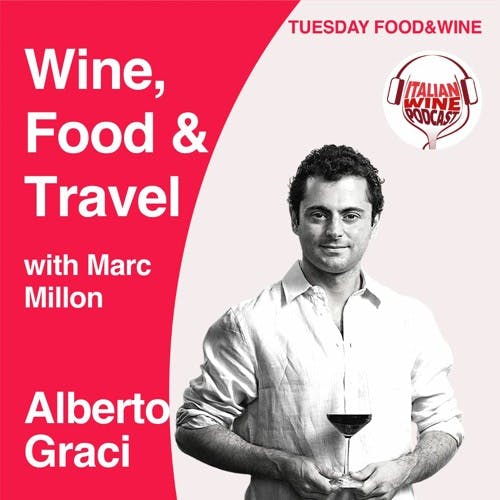
Ep. 860 Alberto Graci | Wine, Food & Travel With Marc Millon
Wine, Food & Travel
Episode Summary
Content Analysis Key Themes and Main Ideas 1. The unique geological and climatic characteristics of the Etna wine region, shaped by an active volcano. 2. The historical trajectory of viticulture on Mount Etna, from ancient origins to its modern revival. 3. Alberto Graci's personal journey and pivotal role as a pioneer in modern Etna winemaking. 4. The distinguishing features, grape varieties (Nerello Mascalese, Carricante), and diversity of Etna's red, white, and rosato wines. 5. The symbiotic relationship between Etna wines, the local gastronomy, and the region's cultural heritage. 6. The concept of a ""complex ecosystem"" and its contribution to sustainable viticulture on Etna. Summary In this episode of the Italian Wine Podcast, host Mark Millen interviews Alberto Graci, a significant figure in the revitalization of the Etna wine region in Sicily. Graci shares his unique path from a banking career in Milan to becoming a winemaker on Mount Etna in 2004. He elaborates on Etna's status as an active volcano, explaining how continuous eruptions contribute ""contemporary"" black arch and stone to the soil, creating a paradoxical terroir of hot and cold, fire and ice. Graci recounts the region's long but fluctuating history of viticulture, noting its peak in the late 19th century with over 50,000 hectares of vineyard, followed by a decline due to market shifts and rising labor costs. He highlights the resilience of ancient, often ungrafted, vineyards that survived. Graci emphasizes Etna's ""complex ecosystem,"" where forests and birds contribute to a balanced and sustainable winemaking environment. He describes the elegance and purity of Etna's signature wines – Etna Rosso (from Nerello Mascalese), Etna Bianco (from Carricante), and Etna Rosato – and their adaptability, particularly in pairing with local gastronomy like sausage and seafood. The conversation concludes with Graci inviting listeners to visit Etna to truly grasp the profound connection between the land, its people, and its distinctive wines. Takeaways - Mount Etna's status as an active volcano directly contributes to a unique and ""contemporary"" soil composition that defines its wines. - Alberto Graci, transitioning from finance, played a pioneering role in the modern revival of Etna's ancient viticulture, which had experienced significant decline. - Etna's terroir benefits from a ""paradox between hot and cold, fire and ice,"" resulting in wines known for their complexity, vibrancy, and elegance. - The region's ""complex ecosystem,"" including extensive forests, is vital for maintaining natural balance and fostering sustainable viticultural practices. - Etna produces distinctive red (Nerello Mascalese), white (Carricante), and rosato wines that uniquely express their diverse sub-regions and indigenous grape varieties. - Etna wines are highly versatile and pair exceptionally well with the rich and varied local Sicilian gastronomy. - Visiting Mount Etna is presented as the most effective way to truly comprehend and appreciate the region's unique winemaking environment and cultural identity. Notable Quotes - ""Aetna is always erupting. If you consider that technically, an active volcano is a volcano where there was an eruption, in the last ten thousand years. But, last year, we had something like sixty eruption. So it's a super, super, super active volcano."
About This Episode
A wine and food podcast on Italian wine and travel features speakers discussing their experiences with the volcano and Aetna. They also discuss the unique characteristics of the Aetna wine region, including its active volcano zone and diverse natural ecosystem. The speakers emphasize the importance of sustainability and being a single wine region, while also acknowledging the challenges of creating sustainable wines. They also discuss Aetna's approach to creating a wine from the wine garden, including their unique approach to sustainability and their commitment to bringing free content every day.
Transcript
Welcome to the Italian wine podcast. This episode is brought to you by Vineetili International Wine and Spirits. The fifty fourth edition of Vineetili was held from the tenth to the thirteenth of April. If you missed it, don't worry, go to benitely plus dot com for on demand recordings of all the sessions from the exhibition. Welcome to wine food and travel. With me, Mark Millen, on Italian wine podcast, listen in as we journey to some of Italy's most beautiful places in the company of those who know them best. The families who grow grapes and make fabulous wines through their stories we will learn not just about their wines, but also about their ways of life, the local and regional foods and specialties that pair naturally with their wines, and the most beautiful places to visit. We have a wonderful journey of discovery ahead of us, and I hope you will join me. Welcome to wine, food, and travel with me, Mark Millen, on Italian wine podcast. Today, we return to Sicily. And more specifically to the slopes of Mount Aetna, Europe's most active volcano, to meet wine producer Alberto Grashi, who is considered one of the pioneers of the revival of Viticulture on Aetna. Thank you for being my guest today, Alberto. How are you today? Thank you. It's my pleasure. I'm fine. And what about your volcano? Is it erupting? Well, you know, Aetna is always erupting. If you consider that technically, an active volcano is a volcano where there was an eruption, in the last ten thousand years. But, last year, we had something like sixty eruption. So it's a super, super, super active volcano. So we we can say that it's always in in activity. And someone said that this is our, the lucky part of it, you know, because it's, all the energy goes out and, avoid the other possible disaster. Sure. Yeah. I was with you in September, and it was very active then. And I remember when you came down off the volcano to Taromina, and, of course, the streets and everything, it was just raining, the black grit that falls on the slopes. So we had a real understanding, I think, of what it's like to live and work on a volcano, where you've made your life. Yes. Sometimes it's, also a problem, not for the daily life, like, to move, sometimes they close the airport, but we like to take the positive part of that. This is energy. This is, let's say, a natural fertilizer for, for our soil. And, this is unique for this, what we can say. Now Alberto, you started your wine activity in, I think, two thousand four. Correct. So just just eighteen years ago. And in that short time, you've achieved an immense amount. Are you originally from Aetna? And did your family already have vineyards here? I was born in Catania. And Catania is, is at Aetna province, let's say. My family is from Sizily, my father, from, Tatania, my mother, from Agrigento, beautiful place, famous for the Greek temples. But, my grandfather, he was a farmer, and he he had a farmer in the center of Sicily in another place. So I am from Sicily and deeply connected to the agriculture. Let's say. But then you decided to transfer to Aetna, and, I guess, in two thousand and four, the state of Viticulture was very different than what we're finding now. So it was quite a Brave move. Yes. You know, at first, I decided to go to study in Rome, the the we say the Internal City. I studied the business administration economics, And then I went to work in Milan, which is the most financial city in Italy, to work in a bank. But then I wanted to come back to my roots to sicily and to agriculture. But with with a new approach with, let's say, new point of view, because my grandfather, he was producing mainly cereals, and also vineyard, but with a quantity approach, selling the wine in bulk. I decided to sell the farm there and to restart on ethanol. Because I was, inspired by the great classic wines of the world, like, traditional barolo, one from burgundy, and I thought it was possible to make a great classic wine on Aetna. From Narello. When I, speak about the classic fine wine, I think about the wine that has everything in the glass. Let's say the universe. So complexity, deepness, generosity, but without any excess, always maintaining the elegance and the finesse, magically intact. So I thought that, Aetna, that is a place of paradox between hot and cold between fire and ice because it is a mountain, but it's an active volcano with the sun of Africa. I thought that Aetna was a place to make, a wine with this, magic balance and, able to express this magic paradox. Okay. So you went from being a banker in Milan to, to believing in planting vineyards or growing vines, finding ancient vineyards on this volcano. Now Hetna is one of the most ancient wine regions in Italy. They say that the vine was cultivated here centuries before Christ that perhaps in Homer's Odyssey, the cyclops polyphemus grew vines on Aetna that he tended. And when Odysseus came to meet the cyclops on what most scholars believe was Aetna. And Viticulture continued over the centuries. Tell us a little bit about maybe in the last century, the history of that vine and how it came to be lost and needed to be rediscovered. Yes. You know, Aetna is, of course, a place where a Viticulture is part of our blood because it's so ancient, the the the the activity of the Viticulture. But also it was always continuously practiced, because, even, in a very difficult moment and period, it never stopped. And, of course, especially in the last two hundred years that we can focus our attention on on this period. There was a a period because, you know, when we speak about the great zone of wine, there is also the market aspect, you know, because wine is a product that is made for people, for the market. And, if we focus our attention on the last two, three centuries, at the end of seven, seven hundred, the the the eighteenth century, there was already a great international market of of, wine from Estna. There is a beautiful, book from, Sestini. He was a scientist in the end of, of, seven hundred that, speak about this, possibility and this vocation of Nerello to travel. The fact that the wine was already produced for other places, other market. What is magic about wine is this vocation, this capacity to go around, to travel, to speak about a land gate. And then in the nineteenth century, especially at the end of eight hundreds, it was, in, in the same period of the explosion of the Philoxera all around Europe, the ethanol region became more and more and more important. So we arrived at at fifty two thousand hectares of vineyard, and it is a lot. If you think that, in my daughter, there are something like one hundred twenty thousand hectares. All seasonally today is one hundred thousand hectares. A small region like Aetna was so big. My goodness. That's incredible. Yeah. Because because all this wine it was, they used to send to the port of Riposto. That was an important port that became important because of the wine market. And through the port of Riposto, the ethanol producer, they used to send this wine to general, well, where the merchant, they used to sell the wine everywhere. So in South America, in Europe, because you know that in that period, was more, let's say, convenient. And, this was the practice to use the wine from another zone to balance some, let's say, problems of the vintage. Instead of doing the sugar addiction that was practiced later, that is also that is also allowed in a lot of states of Europe, but not in Italy because you know that in Italy is not allowed to add sugar in the wine. So in that period, they used to, they used the elegant and the vibrant wine from Estna, that they also were really able to travel, to, let's say compensate some problem of cold vintages. So we had this great vineyard, fifty two thousand hectares on Aetna. And yet gradually, people left the mountain, people found work elsewhere. These old vines some cases, ungrafted, were abandoned. And when you came in two thousand and four, many of these old vineyards were no longer in production. Correct. This, this vineyard, they were this big quantity of dinner, we are talking about, like, the eighteen, eighty, eighteen, ninety three, eighteen ninety five. But then year by year, when it stopped this market of the of the blend, let's say, because, we time the possibility to add sugar of the wine from other countries, of Europe, and also the increasing of labor cost. And, the, let's say logistically, approach that here in CCi, you know, there was it was not yet ready to make what bottled wine. But, you know, the bottle of wine is something more recent, also in other important zone from, of Italy, but also runs, the the the the market, the the of the bulk wine was very important. So the increasing cost, the change of the of the market and the, the reduced capacity of give value in term of the market. Made this activity less sustainable, and a lot of vineyard, they were abandoned. But what is really special is the fact that a lot of small incredible and unique vineyard, they survived it. Because the attention of the of the owner of this vineyard and, let's say, passion for this activity was what, gave them the energy to to cultivate the vineyard, always losing money or, or without any gain, and so there are beautiful old and also on grafted vineyard that they survive. And the vineyard they survive it, they are the vineyard in the best places. Like, where we are in Pashopixaro, some vineyard that very high altitude vineyard, the majority of the vineyard, they survived it. They are in the north side of Etona. Okay. And these would be the Palmetto Is that correct? What is a Palmetto? A Palmetto is, let's say, like, a winery, but with the very old system that also was used by the Roman. Thousand years ago. So with a a press that is made with a big tree, with the leverage system, you know, there is a big tree. At the end of the tree, there is like a big stone, and they used to, to use this leverage with the, with the weight of the stone to press the grape. And, it was used in the past, especially in the last centuries. Of course, now the the production is a modern production, generally with the traditional respect, but trying to make elegant vibrant and, let's say, wine with integrity and purity. So, Alberto, what are the what what makes the Aetna wine region completely unique? And unlike any other in the world, able to to produce wines, that can express themselves with this power and elegance. So, you know, I think that there are three very important characters that they make, a unique in the world. So one of these is of the most evident probably is the fact that we are in an active volcano. Because you know that, we always talk about volcanic wines, you know, but when we speak about good organic wine, we also speak about, a lot of time region that they have a soil with, volcanic region, but it is not from, super active volcano like Aetna. So, Aetna is a place I already was talking about that, is, super active with a lot of eruption, explosive eruption, every year. So it means that this black arch that we have exploded from the volcano with the with the small stone, it goes on the top of the soil. The soil, the soil is, of course, partially, is, soil with the period that is related to, the geological region of the lava flow, but part of the top of the soil is contemporary. So it's incredible to make, to the idea to make wine in where a part of the soil is contemporary. So it's not from one thousand years ago or of ten thousand or one hundred thousand years ago, but it's from yesterday or today. So this is unique. So it it is something that influenced the exchange capacity of the soil, the texture of the soil, and every aspect of the soil. And this is the, let's say, soil aspect. And a lot of time, we ask, to ourselves, what is important? The soil or the weather, but, of course, the weather is probably the most important thing for a vineyard, but the soil make also the climber identity of the place because the influence also the weather, the soil. So the soil is very important. So first, the volcanic soil. Second, of course, the paradox between hot and cold. So we have the son of Sicily. And because of that, we can do we can't cultivate the VINa, the very, very high altitude vineyard. So this incredible weather with the great variation, we wait day and night. Sometimes also twenty five degrees Celsius or more, or variation between day and night. The possibility to compensate, are not, and drive in touch, thanks to the night, temperature, and humidity. And third, Aetna is a very weak place because it's a complex ecosystem. When we speak about sustainability, today is very trendy to speak about organic and, sustainability, natural agriculture, and a lot of people, they speak about an estate, but these make no sense because we are the leaves of a forest. So we can speak about sustainability we can be we can speak about the certain approach of making media culture and wine only if we live in a complex ecosystem, and that is a complex ecosystem. We have thirteen hundred hectares of vineyard, but we have sixteen thousand hectares of woods. It's not possible to make sustainable bidigata if you don't have trees because trees mean birds and birds mean the the possibility to have, a balance at ecosystem because they eat parses. They they complexity of ecosystem means, bees means a butterfly, means winds. So Aetna is a a special place for that. We live in a protected park of fifty thousand hectares. So, one thousand three hundred hectares of vineyard, sixteen thousand hectares of woods, fifty thousand hectares of productive park. So that's why Aetna is a unique place and can be a place to make and unique wine able to express the, the motion of the landscape. And what's interesting as well, Alberto, is that we are talking about Aetna as the single wine region, but you have many subregions from the north, the east, the south. And in this, unique wine region, great white rosato, and red wines are produced. I know in your winery, You produce all three. Can you tell us about these wines the grapes are produced from and why they are special? You know, I think that, this, wine they they are the classic and historical, appolation, from the original disciplinary of Betna DOC that was, published and established in nineteen sixty eight. So it's one of the most historical in Italy. They are, for me, unique because they are able to express the great identity of this place and this vineyard. Thanks also to these two typical grapes that are for red and for white. And, that are, for me, really adapt for this weather because of their very long moderation cycle, adapt because they are able to express the diversities of this unique place you were talking about the zone of Aetna. In effect, another unique aspect of Megan Wine on Aetna is the fact that Aetna has a variation in altitude between five hundred and one thousand miller above sea level for the vineyard because Aetna is also a volcanic cone. So when you go around the the volcano, there is a change of his position, sun is positioned, humidity, quantity of rain, and, of course, the the aspect of the different tech star and composition of the soil. Always will panic, but sometimes coming from a lava flow and an eruption of fifty thousand years ago, and some other time from five hundred years ago. So all these diversities, they make also Aetna a place with, diversification. So that, some places, some vineyard, they are more probably located to make a great, so a white wine from Carigante, or, vibrant and the deep retinal also for some time, some vineyard that because of the position or the altitude or, the different humidity, they have the application to make a beautiful wine from, Nerelomascaleza that is less about tannins, but more about choose. And this in this case, we talk about Edna Rosado. In my case, I think that all this wine, they must, maintain, and protect the the purity of, this fruit. So that's why we try to have a full moderation in the in the vineyard. And this is the place where to look for the deepness and the complexity but we try to be very of sterile in the winery, not too much wood, not too much, intervention, trying to maintain the the essence, and, and, let's say, elegant that, come from this vineyard. Now, Alberto, we're talking about wine, but life on Aetna is unique, and life on Aetna has its own traditions and culture, not least of which, is the gastronomy. Can we talk a little bit about with this range of white rosato and red wines? Some of the foods of Aetna that naturally pairs so well and that are equally important and a part of the culture of Aetna. Yeah. You know, this wine, they thanks to this, vibrant let's say, suppression coming from, an electric acidity, thanks to the the mountain influence, and, the salinity, thanks to this Mediterranean expression. They are perfect wine for gastronomy. And they're very flexible sometimes. For example, Latiner also, you can easily pair and successfully pair with for example, on Aetna, Aetna is famous for the sausage, you know, this, Salcichal Chapo, so from, black pig from nebrity, and, this, this fact taste of, the sausage is perfect with tangent of Nerello. But Nerello, Etonarosa also, changing the service temperature is very, flexible. So you can also pair with the grille tuna with the fish because, it's at the same time complex, but light. So it's possible to be very flexible also for white, you know, etna Bianco is, as this, typical smells and times of citrus, like, or, like, remind me a lot of time, the the the sea smell, and so is is perfect with fish, with fried fish, that, thanks to this acidity, this, seboring acidity. Is perfect with, fried stream, for example. They are they have this sweet tender. So it's, this, astronomical, capacity to to pair with food is, something very interesting for this wine. Well, Alberto, it's a fascinating story you shared with us. How in such a short period of time. In your case, less than twenty years, you have been able to revive Viticulture in this ancient wine land, in this land that is one of the oldest in Italy for the vocation of growing grapes. And yet for wine lovers, it's also one of the most exciting to discover because twenty, twenty five years ago, there were very few bottles of good Aetna wine on the market. And now, other producers have come. Aetna wine is finding its way around the world. At tastings, it is it is ranking with with the great wines like Barolo and Bruno. I was at a very interesting tasting with you in Tarmina gourmet with the blind tasting of Aetna rosso. Barolo and Bruno de Montalcino that was fascinating to see the levels that Aetna wines are rightfully taking now. So it's a very exciting region. It's been a real pleasure meeting you today and talking and learning about what makes Aetna so special and about life on this volcano. So thank you very much for being my guest today. And my very best wishes to your work continuing on the volcano. And I hope to see you soon. Thank you, Mark. It was a great pleasure for me and, a few words about etna. They I think that the most, incredible way to understand Aetna and Aetna wine and to fell in love with Aetna is to come here. And, this is the only way to understand what it means, to be an active volcano and to make wine in an active volcano. Yes. I'm I'm sure you're right on that. And I hope that our listeners who are all around the world will be inspired to visit Aetna to discover your wines and to enjoy the local foods, especially that wonderful Salcichal Chapo, which I certainly enjoyed when I was there with you. So thank you, Alberto. I hope to see you again soon. A presto. Thank you so much. Thanks for listening to this episode of the Italian wine podcast brought to you by Vineitley International Wine and Spirit Exhibition, the biggest drinks trade fair in the world. Remember to subscribe to Italian wine podcast and catch us on SoundCloud, Spotify, and wherever you get your pods. You can also find us at italian wine podcast dot com. Hi, guys. I'm Joy Livingston, and I am the producer of the Italian wine podcast. Thank you for listening. We are the only wine podcast that has been doing a daily show since the pandemic began. This is a labor of love and we are committed to bringing you free content every day. Of course, this takes time and effort not to mention the cost of equipment, production, and editing. We would be grateful for your donations, suggestions, requests, and ideas. For more information on how to get in touch, go to Italian wine podcast dot com.
Episode Details
Keywords
Related Episodes

Ep. 2791 Italian Wine in a Changing Climate: PIWI, Terroir & Tradition with Nicola Biasi | Wine, Food & Travel with Marc Millon
Episode 2791
Ep. 2767 Le Marche: Verdicchio and the Wines that Shape the Region with Gianluca Garofoli of Garofoli Vini | Wine, Food & Travel with Marc Millon
Episode 2767
Ep. 2755 The Longest Table: Honoring Nello Ghezzo’s legacy | Wine, Food & Travel with Marc Millon
Episode 2755

Ep. 2712 Exploring Brda: Exceptional Wines and Slovenia's Culinary Traditions with Lan Kristančič of Movia | Wine, Food & Travel with Marc Millon
Episode 2712

Ep. 2700 Sardinia Beyond the Coast: Agripunica, Basso Sulcis & the Legacy of Giacomo Tachis with Salvatore Santus | Wine, Food & Travel with Marc Millon
Episode 2700

Ep. 2681 Giro d’Italia 2026 Special Episode 1: From Bulgaria to the Mezzogiorno in search of wine and cheese | Wine, Food & Travel with Marc Millon
Episode 2681