
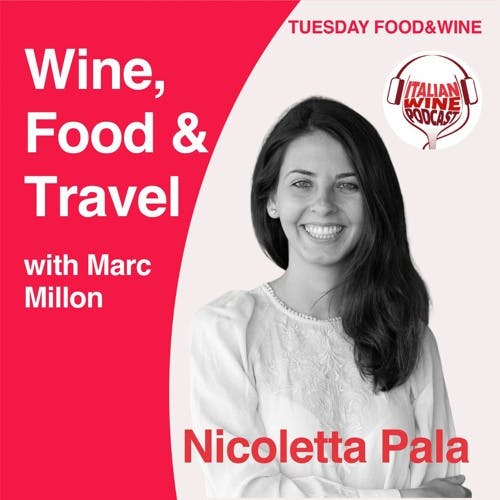
Ep. 870 Nicoletta Pala | Wine, Food & Travel With Marc Millon
Wine, Food & Travel
Episode Summary
Content Analysis Key Themes and Main Ideas 1. The unique geography, culture, and ""Blue Zone"" lifestyle of Sardinia. 2. Odaria winery's history, philosophy, and intergenerational approach to winemaking. 3. The cultivation and characteristics of native Sardinian grape varieties (Vermentino, Cannonau, Nuragus). 4. The deep connection between Sardinian wine, traditional gastronomy, and local culture. 5. The immersive wine tourism experience offered at Odaria winery. Summary In this episode of the Italian Wine Podcast, host Mark Millen interviews Nicoletta Pala from Odaria winery, located in Sardinia. Nicoletta vividly describes Sardinia as a ""dream"" island with diverse landscapes, a unique ""Blue Zone"" slow lifestyle, and rich traditions. She shares the history of Odaria, a family winery established in 1948 by her grandfather, highlighting its blend of tradition and innovation under the current young generation. Pala emphasizes their commitment to cultivating native Sardinian grape varieties across their four estates, each with distinct terroirs. She discusses the characteristics of Vermentino and Cannonau, comparing them to other regions and explaining their traditional pairings with Sardinian dishes like fregola with seafood, suckling pig, and pecorino cheese. The conversation concludes with a description of Odaria's comprehensive wine hospitality, which includes vineyard tours, farm visits, and unique cooking classes, aiming to provide visitors with an authentic and immersive Sardinian cultural experience. Takeaways * Sardinia is characterized by its unique geography, ""Blue Zone"" lifestyle, and strong local traditions deeply intertwined with its wine culture. * Odaria winery represents a blend of long-standing tradition and modern innovation, led by a young, locally-rooted team. * The winery champions native Sardinian grape varieties, believing they best express the island's unique terroir. * Sardinian wines like Vermentino and Cannonau possess distinct characteristics influenced by the island's windy climate and diverse soils. * Traditional Sardinian foods such as fregola, suckling pig, culurgiones, and panacarazau are integral to the local wine experience. * Odaria offers an immersive wine tourism experience, connecting visitors with the land, the animals, the winemaking process, and local culinary traditions through tours and cooking classes. Notable Quotes * ""Life in Sardinia is maybe the best that a man can offer."
About This Episode
The speakers discuss their journey to the second largest island in the Mediterranean, cluster of small towns in the Italian city of Carrefouria. They visit a small village called Surbiana, where they are a family of 24,000 people and vines. They discuss their pride and respect for the wines and surrounding forest, their love for wines and the surrounding forest, and their desire to preserve the wines' culture and work with local grapes and wines. They also discuss the importance of preserving the wine culture and working with local grapes and wines, highlighting the need for hard work and obtaining a good understanding of the natural characteristics of their wines. They also discuss the differences between their own grapes and their native grapes, including the salinity and different weather characteristics. They emphasize the importance of preserving the wine culture and working with local grapes and wines, highlighting their own winery and wine tour, and their traditional hospitality and offer a wine tour. They also
Transcript
Welcome to the Italian wine podcast. This episode is brought to you by Vineetili International Wine and Spirits. The fifty fourth edition of Vineetili was held from the tenth to the thirteenth of April. If you missed it, don't worry, go to benitely plus dot com for on demand recordings of all the sessions from the exhibition. Welcome to wine food and travel. With me, Mark Millen, on Italian wine podcast. Listen in as we journey to some of Italy's most beautiful places in the company of those who know them best. The families who grow grapes and make fabulous wines. Through their stories, we all learn not just about their wines, but also about their ways of life, the local and regional foods and specialities that pair naturally with their wines. And the most beautiful places to visit. We have a wonderful journey of discovery ahead of us, and I hope you will join me. Welcome to wine, food, and travel with me. Mark Millen on Italian wine podcast. Today, we head to the second largest island in the Mediterranean, Sardinia, to meet my guest, Nikollettepala, of the Odaria winery. Chao nikolata. How are you today? Tamara, I'm fine. And you? I'm very well. The sun is shining here in Southern England in my home in Devon. What's the weather like with you in in your home? Here today looks like usually in England. So it's cloudy. It's not normal for us. Oh, that's a that's a change. Yes. Now, Nicola, I want our listeners to really under stand where you are and to really sense and get a picture of where you are. Sardinia is a big island with huge contrast between inland and coastline and north and south. So tell us a little bit about where you are. Sure. Okay. We are in the center part of Italy, and, Sardinia is, one of the biggest island of the Italian country. And, usually, when I think about my highland, I think about, like, a dream because life in Sardinia is maybe the best that a man can offer. And we have twenty four thousand kilometers of forest, countryside, and coast immersed in an amazing see. So it looks like a paradise. And, of course, Sabine is not only a sea, is a land of shepherds because, are here six millions of sheeps, and, we are just one million in the non inhabitants. Wow. Gosh. So we are also on Blue Island, Blue Zone Island, one of the five areas of the world, in which there is an eager concentration of a centurion is because of our lifestyle, so slow lifestyle. In contact with nature, animals, and, vegetables, of course, for our food, traditions, a lot of carbs. She's, suckling pig, and why of course, so Edwin, Kanona. And, our family is, based in the outer part of the island, in a little village named Surbiana. Surbiana is two thousand people and thousands of hectares of vines are in our area. The white area is born in a little hill of the village surrounded by fineyards and close to a little salt lake who are flaming those leaves and a small church built in the seventeenth century where the Benedict team monks lived. So it's an amazing area where we love to grow the most important grape varieties of Sardinia. Just local grapes that, we love to share with our visitors together with the farm, the vegetable garden, the production area of the winery. And, of course, the sunset landscape, where we love to share our wines with our customers. I've seen some photographs. I haven't had, the chance to visit you yet. But I hope to, but I've seen some beautiful pictures, and you've just given us a very vivid description. So we're we're north of Caliari in the south of Sardinia, and you've you've explained something of this beautiful landscape that is really a paradise. And also the those harsher elements of Sardinia where the shepherds, the pastorae live with these millions of sheep. I didn't realize there were six million sheep in Sardinia and just Did you say a million and a half inhabitants? It's this beautiful contrast of, of the interior, the lusher coast, and this small village of yours, Cerpiana, which sounds absolutely idealic. Is that where your family has always been from? Our story started here in Sirdiana Label Village long years ago in nineteen forty eight when, my grandfather Salvatore, the senior one, decide to plant the first vines in the valley. Then when in the seventies, the Italian government gave the opportunity to remove the vines because, in the return of money, because there was an overproduction in the country. My grandfather, differently unlike the other people of Sardinia, and thanks to his, four sites, decide to continue his work and to stay in the wine world. So thanks to him today, together with my brother Salvatorre, the union one, outdoor. I represent the third generation of the family, and, was born when my father in Eureka in two thousand and fourteen decide to about the generational shift. And together with my brother's laboratory will look to the tradition with a new look. So I would argue the name of the company means nobility, nobility of the spirit in an ancient or inter language, and it's the name of the company because at the center of what we are, there is the respect, respect for the land, and then for the grapes and for the bottles of wine finally. So we are farmers, and our goal is to respect everything, give us everything we need. So, firstly, the land, of course. So, Nickolletta, you're on one hand an old established winery, your grandfather planted the vines. The vines are well established and mature, but on the other hand, you're also a young, exciting company because of this transition of the generations. I've seen the pictures of your winery, which looks very modern. And so you you're able to combine this tradition and and a new outlook. Would you say that's correct? Yeah. Yeah. Of course. So we are a mix between innovation and tradition. So I think that we are pretty young because now I am, like, twenty eight, and my brother is thirty two. So in two thousand and fourteen, we we were like babies. So it's great because, you know, the wine word is completely different compared to, like, some years ago. I think that marketing is changing everything, but also selling every part of our work is different. So it's very important to work with a young team. We are sixteen people. And, we work, like, we are one hundred thirty team, and it's fine because we are all from Sardinia, Surdiana, Little Village. So, that's very important. Well, you're all from the same village. Wow. That that's amazing. So these are people you've grown up with and known pretty well your whole life. Yeah. Yeah. Yeah. Yeah. Sure. And, you know, that, you sometimes, it's not easy to find workers from your land, especially in, like winemaking process or similar. But Suriana Villa area lives about wines, and so there is an important connection with the land and with this work. So all of our employees know perfectly the soil, the wind, the plants, the terroir. And, ninety percent of our workers are working with my family from generation to generation. So for sure they have, like, long standing slings to these lens. And that's great because in most years of Italy, it is difficult to find local families and local workers. Yeah. That that is a really important part of your story. So these are people that have an intimate knowledge of the land and of these grapes that they've worked for themselves for generations. Yeah. And, because in Serena, we love to preserve the tradition. And, in our village, the most important tradition is wine culture. So, of course, now it's important to work just Italians and Salvinean for us employees now. So it's a great work. Okay. And so this is really an expression of your terroir, your particular corner, Sardinia, and the wines are expressing the area you're in. Tell us about you've got four different estates, and you're cultivating the native grapes of Sardinia. Let's talk a little bit about your wines. Sure. We are working in forty hectares of vineyards divided in four different states. The first one is the audio state, and, it's the heart of the company because right here is located, our seller, and, above two hundred meters above the sea level, and surrounded by a fantastic landscape. And in this state, we have the canonical grape, bovale grape, fermentino grape, Muragos, and Noscock in a limestone solient, And, it's great. We are working just with local grapes, and this is our goal because I think that Sardinia has a lot of great varieties to share and is, important to work with the law as native grapes and not the international grapes. The second estate is, named the in Sabina language because it's family. We have the Italian language, but also the Salina language that is a language, not a dialect, and, is named the Aquasas and, is composed from, clay limestone soil and, one hundred and sixty meters above the sea level where we mainly grow the Norago's grape. Norago's is, the most important grape for the southern part of Sardinia from the Calgary area. And, in the past, was, like, common to grow it. And so we are proud of this grape. Is, the most important for the for the family. The third estate is, sustani. Susani means, like, a Salt Lake because it's close to the Salt Lake where are the flamingoes, and he is amazing because the soil there is sandy, and the microclimate is perfect also for the minerality and the saltiness that are in all of our wines. Particular, the white ones. And the last, estate is named the it's probably Scrabilis, and is, a Calcareo, Cindy Hill, one of the oldest one, one of the first that my grandfather planted, And, it's, interesting because it's where the canon upgrade is growing. And we have also a fifty year sold vines there. So it's an interesting area. Tarvina microclimate is completely different compared to the most important areas of the male end. So our climate is usually warm, warm, windy, and so perfect for the wine growing And we are in a project named Integra. The Integra is not organic, but it's just a respect of the nature. And our limestone lens help in the production area to have mineral wines, sometimes like salty wines. Just just to be clear on this, so over these four states, all within quite close area, you've got really different, terroir from the limestone to the chalky sand and the clay and the sandy areas around the Salt Lake. And this is really affecting the character and the personality of the wines grown in that come from each area. Yeah. Of course. That's very important because, for example, where the the soil and the terrier is, like, more calcareous or semi is better for the canon algorithm, for example, or in other parts where it's climb, we prefer to plant the fermentino. So, of course, all of all of the different terrace, are important for the different grapes that we are growing. And that's like, amazing, you know, because, in Sardinia, we work with the the traditional, sardinian tree that is like a little plant similar to Sabinean people because we are usually pretty. And, that's because our weather is windy. And so the mistral is coming daily, and the plant need to be strong. So when the tiny sites, it's easier, of course. And that's so important because the terroir and the method of growing of motivation together, and the different areas, the different, exposition are, important for our work, of course. And also for our grapes, because we have like ten different grape varieties. And, of course, each one, need a different terrace. So in the early states, we are working, like, with different grapes and, like, around ten extra forty states. So, like, different varieties, three or four in everyone. So it's a great work. Hard work. Yeah. It is a it is a, a lot of work I can imagine. Now let's talk a little bit about these native grape varieties, not all of them, but the most important because, I think it's important for our listeners to gain an impression of what these grapes have to offer. Some are better known than others. Others will be wines that people haven't perhaps had a chance to taste yet. New August, for example, isn't that widely found outside of Sardinia and some of the bovale and some of these. So let's start with Vermentino, which people may know, but of course Vermentino from Sardinia is very different from Vermentino from say liguria or Tuscany. Sure. Okay. So, of course, when you talk about Sardinia, the most important grapes that are known maybe all over the world are Verintino for the white grapes and kinda know about the red grapes. That, of course, as you told, we have more different grapes, native grapes of Sardinia that are very important for us. Vermont, the most famous grape of Sardinia is, of course, cultivate all over the island, in particular, north and south, more than in the center of the island, and, is also diffusing on the region. So, Italy, like, of course, liguria and Tuscany, and the the common characteristic of, the Vermont everywhere in the different areas, different regions is given by the land that is so close to the sea and the breeze of the coast because also the courier and the scanning are close to the the sea. And, where are, the vines usually about Vermontino are close to the sea. So, of course, Sappeared is the distinctive character of this wine, in the three regions, but the difference is, so important because it's in soil and microclimate characteristics that are bringing out different aromas and the aromas that depending on the soil that feed them. Usually, selenium wines are more full bodied and aromatic with, a reference at mediterranean scrub. In the tuscan ones, for example, freshness minerality and citrus and animal aroma are more like at the end of the wine. In the laborian Vermentini, for example, are like more fruity and the notes of white flowers, fish melons, so completely different. And that's because the soil, the land that is completely different because Sardinia is like, another terroir comp compared to the other part of the mainland. That's because our weather, as I told you, that is very windy, windy a lot compared to the other regions. And, also, the soil that is unique because, the claim limestone is unique in, in Sabimia. So I think that that are the most important difference between the Vermentino grade. And, Nicole, that, this, wonderful Vermentino from Sardinia, which, as you say, is a usually a more structured wine with, with this wonderful salinity running through at this minerality. This, of course, is one of the great wines to go with Sardinian foods. This wonderful array of dishes that are quite unique at and different from the cuisine of the mainland as well. Tell us some of the foods that Vermentino goes best with. Okay. Usually Vermentino, is common in particular in Sardinia. We suggest distaring also to our visitors, to our tourists, because we work a lot with tourists that are coming to see the vines, the winery, the family, and everything, without any award. And usually, we suggest the the Frigula. Frigula is, type of typical sevenium pasta obtained from a mixture of wet and warm water. And it looks like semolina because, they are like small square formed, thanks to a particular movement of the hands, and, it's common in Sardinia in the legal villages, to work and to have a handmade, fresh pasta. So the Frigula would be made in the home still taking the semolina and dampening it with water to make it come together. Is that right? To make these little balls of quite hard pasta. Yeah. And then at the end, we toast that in the oven for about fifteen minutes. So this roast process guarantees, the characteristic that is the golden color of, the regular. And, usually, we pair it with the seafood like plants or similar. And that's one of the best, like, learning about Verintino. But, of course, Verintino is good also with the raw fish because, you know, that, we love to make aperitivo always in particular in summertime. And so, our culture, our tradition is to taste it with a raw fish, like on the beach, in summertime or when we are, like, with friends or similar. So one of the most important painting is also this one. Ropish. Okay. Those both sound delicious. I love the idea of the Fregola with the clams and pairing that with with the Vermentina. Now let's talk about, as you said, the most famous red, great variety in Sardinia, the wine itself, your wine, and also some of the foods that it pairs best with. Yeah. The most famous red yeah. The most famous red is, of course, the Canal, and the Canal is also cultivated all over Sard. In particular, he's one in the center of Sardinia. The heart of Canada is in the center of Sardinia. And, it is the same family. It is great. It is the same family of Granash or Garnatcha, okay, same roots. And, when we talk about Canada, of course, we are talking about a part of Sabinean history in a very particular grape because also to work on the vines is not so easy. We are trying to respect this grape, but, it grows a little bit more compared to other varieties, but it's fine. And, usually, we have the idea about Canal, like a stronger red wine, but that's not Canal, because Canal, in particular, in our area, in the southern part of Sardinia, is, like, particular color that is, not so strong, not ruby red, not intense. And, also, our can now, the audio can now is, elegant. And so is a different style because it's a hundred percent of the grape. Usually it's common in Sardinia to try Canal and uh-uh to make like blends with other grapes like Kariniano, for example, or similar just for the color, and, also, like, to have more value, but it's not our work. We love just to make a hundred percent still wines. So the can now is usually pairing with, another traditional dish of Sabinia that is, the suckling pig. Suckling pig roasted And together with, little bit of Merkel is one of our, traditional dish. And, like, every Sunday, like, because, you know, that in Sabigna, we have tradition. And on Sunday, we are doing, like, a traditional dish with all of the famous, like, we are twenty or similar. So it's a funny moment. And, there is common to taste like Ulorjones. That is the traditional Sandian Pass staff and together with Canal is one, two, or Monica defense, and together with, for a second course, that's suckling pig. And, so that's our most important tradition. And that is would be cooked over a fire on a spit, the suckling pig. Is that right? Yeah. Right. Yeah. I've had that in Sargdanya. It's really, really special. Yeah. And also with the the bread as well, the special flat breads that are typical of Sardinia. We have, a traditional bread that is named the Panacarazal. Panacarazal is like a bread that, is very particular because, is made also this one and made in the small villages and, someone in the mainland know it, like, Karta Musica, but it's completely different in Sardinia. And, the bread is, made in the five in the open, but, it's particular because we call, like, a ball and then, the traditional men's divided this bowl. And, we have our, like, toast bread. It looks like toast bread, and it's amazing because it's like a snack for us sometimes. So we use it, like, in a second gig, but sometimes also, for example, in the wine tastings or when, like, after lunch or seminar, you want to, like, have a little snack So this is, another important part of our tradition in our culture. May maybe with the wonderful, sardinian pecorino cheese. Yeah. Yeah. Yeah. Yeah. It it's funny because close to our winery, like, two kilometers per from our wire. Right? Our friends, are running a company about cheese, so a cheese factory. And so we are working just with local food. And when, like, visitors, or people come to see the winery to visit us. We usually, serve the wines together with, a bit of, like, salami, salumi, from that area. And, of course, the pecorino cheese that's, the pecorino cheese of Sabmina, a meat fresh is my favorite one. Yes. Yes. But I guess that that is the real way to discover and taste wines alongside these these foods that are producing the same territory from the same lands. And so if visitors come to the Odario winery, what can they expect in terms of wine hospitality? Okay. We are as, as you know, in a special area, near to the biggest city of the island, it is Cali. And, in Cali, of course, there is the fourth and the hard part. So, also, we are close to the most beautiful coast of the south of the island. So a lot of visitors are coming, like, every year from March to October because, of course, we are a seasonal island. And when they come to twelve area, they get, like, our welcome because, they come to know our vineyards. And so our tour usually started from the vineyards. We go to see the different grape varieties and the different pines. Then, we say hello to our farm because we have, a little farm with the traditional Sardinian donkey, with the goats, and the horse and different animals that are part of our family now. And then we are going in a production area to know where the wines were. And we finished with, wine tasting in front of the sunset or in front of the vines depends about morning or evening. And, I think that now after pandemic sick situation, more than yesterday, these trees are looking for places like vineyards. So, they love to touch the branches to know everything and, easily to enjoy life, of course, you know. And, you know, our winery also is possible to try the Sabinean food because we love to work with cooking class. We are not a restaurant. Oh, wonderful. Yeah. We are not a restaurant, but we love to share traditions, together with the Sanian, hold We must usually that are working. And so you can, like, enjoy the traditional Sabignon pasta and to learn about it or Sabignon bread. So sometimes after the tour, the wine tour is possible to make that cooking class and to finish tasting, what, you produce. It's not the food. And, that's amazing because you enjoy our traditions. And, also, you'll leave a different experience because when you come back home, you'll now like to make cooler, Jonas, traditional Selining and past are similar. So our area, if We think, like, about other parts of Italy is go is growing slowly, of course, but, offer a lot to the visitors because Sardvania is not just see, of course, is known about sea, but we have a lot of, tradition in the center of the island to share, and that's so important for our visitors. When you certainly made me want to visit Nikolletta, you've painted a really wonderful, full experience that visitors to Odaria and to Sardinia will experience when they come. And I'm just imagining watching that sunset tasting your wines while the sun is going down. It sounds just idyllic. Nicola, to thank you so much for being my guest today. It's been a real pleasure learning about where you are, learning about your wines, and your life and foods. It's, I hope to see you soon, and I hope our visitors will find you too. Thank you very much. Thank you, Mark. I hope to see you soon and to have you in our winery. So Thanks for listening to this episode of the Italian wine podcast brought to you by Vineitley International Wine, the biggest drinks trade fair in the world. Remember to subscribe to Italian wine podcast and catch us on SoundCloud, Spotify, and wherever you get your pods. You can also find us at Italian wine podcast dot com. Hi, guys. I'm Joy Livingston, and I am the producer of the Italian wine podcast. Thank you for listening. We are the only wine podcast that has been doing a daily show since the pandemic began. This is a labor of love and we are committed to bringing you free content every day. Of course, this takes time and effort not to mention the cost of equipment, production, and editing. We would be grateful for your donations, suggestions, requests, and ideas. For more information on how to get in touch, go to italian wine podcast dot com.
Episode Details
Keywords
Related Episodes

Ep. 2791 Italian Wine in a Changing Climate: PIWI, Terroir & Tradition with Nicola Biasi | Wine, Food & Travel with Marc Millon
Episode 2791
Ep. 2767 Le Marche: Verdicchio and the Wines that Shape the Region with Gianluca Garofoli of Garofoli Vini | Wine, Food & Travel with Marc Millon
Episode 2767
Ep. 2755 The Longest Table: Honoring Nello Ghezzo’s legacy | Wine, Food & Travel with Marc Millon
Episode 2755

Ep. 2712 Exploring Brda: Exceptional Wines and Slovenia's Culinary Traditions with Lan Kristančič of Movia | Wine, Food & Travel with Marc Millon
Episode 2712

Ep. 2700 Sardinia Beyond the Coast: Agripunica, Basso Sulcis & the Legacy of Giacomo Tachis with Salvatore Santus | Wine, Food & Travel with Marc Millon
Episode 2700

Ep. 2681 Giro d’Italia 2026 Special Episode 1: From Bulgaria to the Mezzogiorno in search of wine and cheese | Wine, Food & Travel with Marc Millon
Episode 2681