
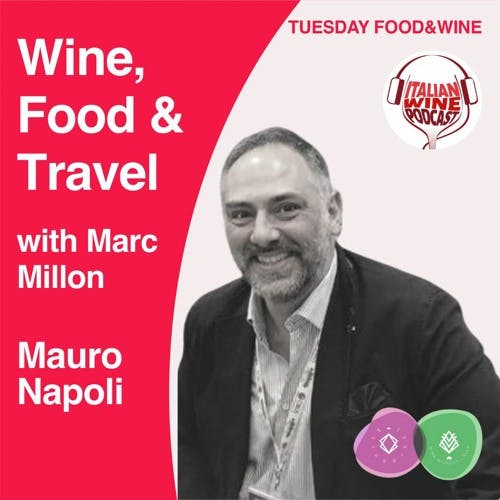
Ep. 983 Mauro Napoli | Wine, Food & Travel With Marc Millon
Wine, Food & Travel
Episode Summary
Content Analysis Key Themes and Main Ideas 1. The unique terroir and viticulture of Castelli di Jesi in the Marche region, Central Italy. 2. The history, philosophy, and practices of Montecapone and Merizzi wineries, focusing on their Verdicchio production. 3. The concept and challenges of ""heroic viticulture"" and biodynamic farming on steep slopes. 4. The versatility and aging potential of Verdicchio wine, specifically the award-winning Ergo. 5. The rich and authentic gastronomy of the Marche region and its ideal pairings with local Verdicchio wines. 6. The appeal of Marche as an ""undiscovered"" and tranquil destination for wine and food tourism. Summary In this episode of the Italian Wine Podcast, host Mark Millen interviews Mauro Napoli, representing Montecapone and Merizzi wineries in the Castelli di Jesi area of Italy's Marche region. Mauro describes the region's unique geography, nestled between the Adriatic Sea and the Apennine mountains, which significantly influences its wines and cuisine. He discusses the history of Montecapone, founded in the 1960s, and the newer Merizzi estate, which is certified organic and practices ""heroic viticulture"" on extremely steep slopes (up to 45% incline) using biodynamic methods. The conversation highlights their award-winning Verdicchio wine, Ergo, detailing its late harvest, manual selection, temperature-controlled vinification, and partial aging in amphora, which contributes to its complexity and aging potential. Mauro also delves into the authentic Marchean cuisine, such as ""Bincis grassi"" (a layered pasta dish similar to lasagna) and local seafood, emphasizing how these dishes perfectly complement Verdicchio. He concludes by passionately inviting listeners to visit Marche, portraying it as a serene, historical, and ""undiscovered"" region ideal for immersing oneself in nature, culture, and gastronomic delights. Takeaways - Montecapone and Merizzi are prominent wineries in the Castelli di Jesi area of Marche, known for their Verdicchio. - Merizzi specifically practices ""heroic viticulture"" on challenging, steep vineyards and is certified organic, moving towards biodynamic practices. - The Verdicchio grape, particularly from this region, is highly versatile and capable of evolving and aging significantly, challenging common perceptions of Italian white wines. - The Marche region offers a diverse and authentic culinary experience, drawing from both the sea and mountains, with dishes that pair exceptionally well with Verdicchio. - Verdicchio Ergo from Merizzi is unique for its production methods, including partial aging in amphora, which contributes to its distinct profile. - Marche is presented as a less-crowded, authentic, and beautiful wine tourism destination offering a peaceful and enriching experience. Notable Quotes - ""The Castale de Yee, it's, somehow a special place, because, the market region where the Castale de Yee, are located is it the Central Italy?"
About This Episode
The Italian wine podcast host and representatives discuss the Italian wine wines and wineries, highlighting the importance of the Italian wine estate and the small and interesting winery called v wines of the Elite. They also discuss the importance of tenacity and perseverance in achieving the goal of elevating the quality of grapes and the traditional methods used to develop the old Aromas. The wines are made with a hybrid of grapes, fruit, and citrus, and are a classic Italian cuisine with a richer taste and a long history of traditional and authentic dishes. The wines are thought to be easy to drink and enjoy, and are seen as a great place to visit.
Transcript
Welcome to the Italian wine podcast. This episode is brought to you by Vinitally International Academy, announcing the twenty fourth of our Italian wine Ambassador courses to be held in London, Austria, and Hong Kong. From the twenty seventh to the twenty ninth of July. Are you up for the challenge of this demanding force? Do you want to be the next Italian wine ambassador? Learn more and apply now at vunitly International dot com. Welcome to this special five star wide and wine without walls series on wine food and travel with me, Mark Millen, on Italian wine podcast. For the next weeks, we will be focusing on a dozen trophy winning wineries from the competitions that took place in verona. The start of Vin Italy in early April. The winning wines are without doubt some of the very best that Italy has to offer. What I'm most interested in discovering are the stories behind the bottles, learning about the wines themselves, of course, and also about people who make them. Where they're from, what they eat, how they live. It's a fascinating journey that will take us all across Italy, and I hope you will join me. Welcome to wine food and travel with me, Mark Millen, on Italian wine podcast. In this special five star wines and wine without walls edition, I'm delighted to shine a spotlight on the wine estate of Montecapone. In the heart of La Marque's beautiful Castelli daisy. Montecapone is just one in Milio Vio de Namico for its Verdicchio de Castelli daisy ergo at the prestigious competition that just took place in Vinitally in April. My guest today is Mauro Napoli, who joins me from Yeezy to tell me about the estate and the area. Chowaro, many congratulations on this wonderful award, and thanks for being my guest today. Welcome to the show. Thank you, Mark. Thank you for, for having me. Hello, everybody. We are delighted to achieve this award, and, thank you for an invitation. This competition was really an important, challenge and we are glad to be part of, of this with you all guys. They are, wine lovers and wine professionals. Thank you. Great. Thanks. It's great to have you here. Now the aim of this podcast, what I really like to do is to share with our listeners the stories behind the award winning bottles. So first of all, I'd like our listeners to gain an impression of of where you are. What's so special about the Castelli DAs and and its wine hills. The Castale de Yee, it's, somehow a special place, because, the market region where the Castale de Yee, are located is it the Central Italy? They're, the this region is overlooking the Adratic Sea, to the Easta, and, the central alpen mines to the west. Thirty percent of the territory is, made by mountains, and the remaining is divided between eels that are stretching, gently towards the the coastline. There's a lot of story there since the pre Roman age, including for the the betty culture there are a lot of beautiful, cities, with, full of, history from the medieval period, the renaissance, the baroque. So there's really a lot of spots, a lot of places where you're going. It is really amazing. There are also wonderful coastlines, including, Sierra and Humana. Really beautiful, beautiful. And then, in addition to that, it is very less crowded. So it is, really authentic and enjoyable anytime of the year. Yeah. It's a beautiful area. An area, I really love myself. These Castelli Dies, these small hilltop towns often topped by a castle or a fortress. As you say, going back to the medieval period, And everything sort of within hand, you can get up to the mountains for where it's cooler in the summer for walking and then that beautiful atriatic coastline. And both of those come into gastronomy as well, which we'll discuss a little bit later. Yeah. Yeah. Yeah. Now, Mario, can you tell me a little bit about the Montecapone wine estate? A little bit about the history and the background of this, family estate. The Montecapone winery, was, started in the sixties. In, in in Yazee. And, since ninety seven, nineteen ninety seven, it was, brought back from the family, Bomprazi Mirizi, that they started to, to, enlarged the, the winery that was pre exist thing. Then, now it now, it passes to distinct realities, both developed, on the market. Yes, just outside Yeezy, and both with a very high quality wine products that focused mainly on Verdicchio, and it's incredible variations. On the one end, the production with the historic Munta Capone that was dated dates back to the sixties. In twenty fifteen, they had, a newborn company that is Miritzi, that is a a smaller winery, certified organic, that with tenacity per severance and a innovative spirit have been successfully carrying on the family business for years. And was the first company in the market region to be counted among the heroic, Viticulture pro producers. So, mainly, that the motto is by limiting human intervention, we let, we let Nature talk. So, basically, the the place where the winery is, is, in particular, for, regarding, winery, is in Monteroberto. That is, one of the villages that makes up the castle of Yeezy. So it is a a medieval town with a world center. You know, it is a in a particular place also because, it is in the Vallezina Valley. So there's this river that, the the name is Isino River. So Vallezina is the the valley where this, river is flowing, and this valley extends from the mountains towards the sea And the result for for winemaking is, incredible because, it is it has a mathematical marine influence, a very good ventilation. And, brings also with the quality of the soil, to a constant stupidity. So it is, really a a perfect place to make better culture. I mean. So it's a quite a distinct a state within the Montecapone estate. It's a a small privileged area with unique characteristics. Yes. It is very close because it didn't take me just a few kilometers away from the Montecapone estate. Where there are some fifty actors. And, the Merizi one is around, six, seven actors. Okay. So very small. Yeah. It is very small. And it is also in a very interesting place because it is on, almost on the top of the hill. And, since it is an heroic video culture, I have in mind that, it is very well exposed to, to, for for the sound race, an average slope that is, thirty three percent. There are some points that we we reach up to forty five percent. So it is really something that is it's not ordinary. Okay? While the the remaining part of the, the de state of Monte Capona is, okay, it is always on, on the heels. So, yeah, you have a a slope, but it is not that that big slow bells for, Maritzi. Well, that's really, really interesting now, though. And I just wanna explain to our listeners what heroic Viticulture really comprises because we're really talking about about unique, vineyards located all around Italy, but those that are deemed heroic are heroic for many, many reasons. Often, the altitude may be the the the steepness of the slope, but places where it it takes huge effort and will and dedication to carry on cultivating grapes because it's so labor intensive. So I'm imagining a slope of forty percent. That's almost impossible even to walk up, that must be incredibly labor intensive to work this special midi t vineyard. Yes. I can confirm you that I can have the the the slope is not that easy. But it is a wonderful experience because, you, you see how, healthy is the quality of, the, the the the wines, you know, is really impressive. For sure it has a really an, it is an art labor for, for experiences such a kind of, viticulture. But it is something that requires really a lot of tenacity and perseverance because, otherwise, you know, it is much more comfortable and relaxing in some, you know, some some ways to, let the the one divine pro in a in a different place but this is really an, astonishing place. And the quality itself, speaks, for this kind of effort that, Miritz is doing. Well, yes, that's That's that's the interesting point. Actually ten tenacity is a good word to use for this type of Viticulture because it it requires that belief, but it's it's wonderful then when that belief is rewarded with by, you know, a recognition such as the the best biodynamic wine at the wine without walls competition. You mentioned earlier that The aim at medici is to have as little intervention as possible in order to let nature, to let the terroir express itself. Tell us a little bit about biodynamic farming in in the Merizzi vineyard and what is involved? Because again, that's a whole different system that even goes beyond organic farming. Yes. It is. In fact, the the company, the the Merizzi winery is, certified organic. Okay. So, basically, what is the intervention on the soil is really minimum. I mean, in terms of using particular, instruments, you know, for agriculture. But in addition to that, there are some practices that have been, that have been introduced to convert into biodynamic vita culture This is not a complete passage to, full and, biodynamic agriculture, but we are going towards this. So by adding, year after year, some, additional steps, because, It is very important on one side, to get the best quality possible for the quality of the grapes, but at the same time, also in terms of, final taste. Know, also the rematicity of the of the wine. So it is not being, completely done the passage to biodynamic agriculture, but there are a lot of practices that have been done. And, the result, it is a production of crew or grand crew that is really, really impressive, assist because of, also the place, as I was telling you earlier, that the, Eroika, organic agriculture, and the slopes, up to forty five percent of three hundred meters above the sea level with a great ventilation. Terminal, terminal changes, during the old year, and finally, but So that's the contrast between night and day temperature. Right. And then last but not least, it is a very little unsupervised place. So this is a, an, a sort of additional guarantee of, what the tenacity in developing such a experimentation during during through the year. So for reaching such a very high level, of quality of the wines. It has really, it has developed not only a pleasantness, in, in the final results, but also recognize ability. So this is very, very interesting, practice that has been done. Also Monte Capone is, however, is not an organic certified producer, but the, the quality of the agriculture practices that have been done with a continuous soil cultivation, fertilization, irrigation, and letting also the, the vines, develop a large leaf walls in order to maximize the sap. So this is an attention, a continuous attention to the the quality of the, not only the practices for letting the vine grows, but also the final aim is to get the best possible product, for making them the wines. Thank you for listening to Italian wine podcast. We know there are many of you listening out there, so we just want to interrupt for a small ask. Italian wine podcast is in the running for an award, the best podcast listening platform. Through the podcast awards, the people's choice. Lister nominations is from July first to the thirty first, and we would really appreciate your vote. We are hoping our listeners will come through for us. So if you have a second and could do this small thing for us, just head to Italian wine podcast dot com from July first to the thirty first and click the link. We thank you and back to the show. Well, let's talk about this special award winning wine. Verdicchio de Castelli Diego. This wine from the Merizia state that, has won this important award. Tell us about this wine. Now you've explained that the fruit, the radicchio grapes grown on this steep vineyard will have their own unique character after the harvest, and I'm imagining that it's quite a low yield. After the grapes must be, of course, manually harvested. They come into the cantina. Tell us a little bit how the wine's made, what makes the wine so expressive of its terroir. Well, I would I would start by, saying that Verticchio Ergo is a sort of primordial product that brings us back to the concept of bees and wine where, finance and acidity are combined with, all the warmth of the grapes, loaded with the aromatic baggage. There are typical of a suitable territory, such as this one that is dedicated to Virdicchio. It, basically, all starts with, okay, with an intensive attention to, to the growth, of the of the of the rates. And these, they they are late or vested. So this is, to bring the best possible condition to the, to the grapes, for, to develop the the old aromas, starting with that. And then the end selection also helps to, to get the very best from what is being produced by the, by the, by the plants. And then the vinification is being carried out in the in the cellar with traditional methods. And, the final result, it is, is really an, an impressible, an impressive, pleasantness and recognized ability of this wine, because it has the older features, in terms of bouquet, in terms of taste of, of the Verdicchio, but it is, also rich tropical fruit and citrus lashes that are sweetened by hints of honey and dried fruit. So, yeah, the old result is, carried out while, starting the vilification also with temperature control. This is needed in order to reduce the shock because during the the period of our our vesting, usually this operation starts, very early morning between six thirty and seven AM, and it goes up to eleven AM. So there's a very short time for making this kind of activity for at the end selection and the end of our listing. And, to bring the, the the grapes to the winery, we used this kind of, a process that is, that is bringing sort of stabilization, and and reducing the shock, the chemical shock, to the grapes. So this is really an, an interesting It is also interesting to see, what it has been done because there's a you see you see all the care and the love that is into this our best thing. It is really something that is, lovely. Lovely. What I think I find particularly interesting model is that, at at the medicia state and Montecapone, and you're using modern technology, you know, utmost modern technology to produce very natural wines And in the case of Ergo, is it right that this wine, afterwards ages for some time in Amfora? Yes. It is correct. In fact, the the the VINification is a traditional open air VINification, and then using the indigenous lists the partial temperature control that I was turning you earlier, and the fermentation and aging also needs some yeast. And the part of that has been done in amphora for a year, and then into no. So this helps to develop such a round, complexity. But it is also an, the final result. It is also an happy wine. You know, it is, this lively, and persistent time the activity and it's a really perfect companion for, for the cuisine. And I know that this is a topic that is, interesting. The most of the people that is, is, here in our conversation. Well, let's turn to the cuisine to the gastronomy of of La Marque and of the Castelli Diazian and how it, goes so well with the wines of the region of the area. Well, by, by starting from the situation that Marque is between the sea and the mountains. So, basically, the cuisine, it is usually, it is always an authentic cuisine from the most robust one with, meat to, all the, the savers and, and the tasters of the of the sea. And then it is combined with the tradition and, one of, probably one of the most, relevant, traditional and authentic cuisine, it is the Binchy's grassy. Okay. That is a sort of lasagna. But it would not say, okay, just just a an objective to explain to the people what is DaVinci's grass, what DaVinci's graciar, because it is similar to a lasagna. Okay? To a layered pastas. Yeah. Yeah. A layered pastas with five or six different kind of meat And it is a very varied, proportion and, everywhere, every family, has its own variation. They're also safeguarding it because sometimes there are people that will say, okay, I will add also the Deshamela, some others say, no. No. No. This is not the right way. Get out the month, Behamela, and, proceed with the different sum matters. It has happened once that I have, I was really, surprised of this, to find also some eggs, in DaVinci's glasses. So everybody is adjusting and using the the the the family the family tradition of this recipe. So it is, but it is really an authentic and robust dish. It is really wonderful. And with that, the verdicchio is, one of from from my point of view is one of the the most interesting pairing that you can get. That's really interesting because, as you say, every family has their own recipe and every family will say theirs is the best verdicchio verdicchio. We're really thinking with something rich like the Vincis gracie of that this fuller style of verdicchio that you're talking about because verdicchio is such a versatile grape. You mentioned that in the beginning of our talk. There's so many different styles of Verdeque. With the lighter styles, for example, they would pair very well without beautiful seafood from the Adriatic coast. Right. Right. Right. And in fact, there's, this this kind of wine, it is also one of the, most important white wines in Italy, because it has, a feature of great intensity and structure, that is also able to develop, with an evolutionary perspective. So during the years, we have discovered that this wine, the Verdicchio, can bring also longevity. In fact, in the, in the in the in the merits, production, you have Ergo that is something really enjoyable, anytime of the year, but you have also Ergo swum. That is something that is much more complex, much more rounded due to this able, to go during the years even bottled. So it is, something really, interesting. And, this is really a pleasant, a pleasant, tasting. Actually, I think that's a very good point you make, Marl, the that, we don't tend to think of Italian whites generally as white wines to, that improve or evolve with age. Although there, of course, some very notable exceptions. And Verdicchio is one of those when it's made in this more concentrated form that has extract and concentration of flavor, good acidity, of course, being important for white wines at age. And I think, you know, we've certainly outside of Italy are more familiar with drinking Verdicchio as a fresher style of wine. And it's very important to appreciate and enjoy this this more important style perhaps we shall say and a style that goes really well with this cuisine, Da vinci strasse or with the seafood or perhaps with dishes such as for example. Or Right. Or or coninja coninja with pistachio. This is an another Oh, I've not had that. Tell me about that. An additional one that is really it is it is a it is a sort of role, of rabbit meat, with some spices in it, and then the additional, part is the pistachio that is creating a sort of crust outside the. Oh my goodness. That sounds fabulous. The rabbit roll that is cooked in, in Albany. It is amazing. Really, really, it is a because it it it it has, you know, it brings a, from one side, the taste of the, the animal, you know, for, for the rabbit, but it is also delicate meat. It is not a, a tough and important taste of meat. And at the same time, the the features and the, the characteristics of Yeah. Pistachio are marrying in a fantastic way together. It is really impressive. So, you know, that this is one of the characteristics of Italy because there are so many, preparations, dishes that, comes from the tradition. And some other times, it is also the the homemade cuisine but it is always a wonderful experience because you can taste a lot of other, varieties. For example, for the Verdicchio, at the very beginning, we were we were saying, you were talking about the fish protector. It is something unbelievable. But it is, made with the with the fish. So with cuttlefish mullet, monkfish, called, squid, and there are so many others, mussels, weavers. There are so many other kind of fishes that I'm, used for preparing such a, fantastic dish, with tomato sauce, with, garlic. So it is really, you should you should try them all. Actually, that's good advice. I think for people to really appreciate how wonderful name is in the area of castelli DAs going down to Hancona. This important fishing port. It's important to visit and to really settle into an area and and eat and drink as a way of understanding a culture and a place. Yes. Exactly. And, in addition to that, just to to add a sort of poetic, topic, the Valizine, the the the valley where the Merizi state is, is being cultivated is, a valid that is a secluded, a sort of reserved or hidden land, and it is an area that means that there is a very little enterprise I was telling you earlier, it is a place where soul and nature are really closely re related. So you can get into this wonderful place, and, you just have to, take out all your all your stress So it is also a way to regenerate yourself, then there are the the landscape is, really fantastic because it is so sweet. So all these eels start, I'm going to work, gently going towards the sea, you see also the sea, from the top of this hill. So it is, really a poetic landscape, and it has a lot of beauty, a lot of story. Even the people is, so so unique, and then be slanted unfolds between ancient villages, fortresses, mountains of the sea, cultivated fields, and rolling in else and so forth. This is really, a fantastic place Italy, as well as a lot of other places are all are also other regions that are, such a, you know, features of combining the beautiful landscape and the history, and the traditions, also for for the cuisine and tradition. So, you will never, get enough of, experiencing, our way and our gastronomic culture. Well, I think that's right. I think, And you've, certainly made us all wanna pack our bags and and come over to La Marque and to immediately. It sounds like just a magical place, where magical wines are being made. Mount, you've been a great, ambassador for Montecapone and Merizi, but also for Le Marquez, and giving us a real picture of of where this special award winning wine ergo. Comes from. So thank you very much for being my guest today. It's been a real pleasure talking to you. Thank you, Mark. There are so many other things to, to to say about the the Montecapone winery because of its wines. There are so many others that are really super enjoyable from the Utopia that is, a Liselema Classicco, Verdicchio. There's also a blend that is, amazing. That is the Tabano. It is, made with Verdicchio, partially, and partially with Muscarrot. It's another really masterpiece. Oh, I'm going to have to come over and and sample these wines with you myself, and I look forward to it. You should. Because And also that, our, our listeners, are invited to because there are so many interesting, pro products to to taste, and also a green ash that is amazing. It is really amazing. That's a that's a good point then that visitors are invited to visit Monte capone and discover all of these wonderful things for themselves. And I urge people to visit Le Marche. It's a part of Italy that is still undiscovered in many ways, and these small hidden valleys that are so unique and have so much to offer are really, really special. So thank you very much, Mado. I hope to meet you and visit myself and see this wonderful estate. Thank you very much for being my guest. Yeah. You're you are very welcome. Thank you. And everybody is very welcoming because there's such a a wonderful place, where spend a few hours or, a day while it takes them down. Great. Our wines. Thank you very much for your invitation. Thank you very much, Chow. Bye. Thanks for listening to this episode of Italian wine podcast. Brought to you by Vineetli Academy, home of the gold standard of Italian wine education. Do you want to be the next ambassador? Apply online at benetli international dot com. For courses in London, Austria, and Hong Kong, the twenty seventh to the twenty ninth of July. Remember to subscribe and like Italian wine podcast and catch us on SoundLab, Spotify, and wherever you get your pods. You can also find our entire back catalog of episodes at italian wine podcast dot com. Hi, guys. I'm Joy Living's Denon. I am the producer of the Italian wine podcast. Thank you for listening. We are the only wine podcast that has been doing a daily show since the pandemic began. This is a labor of love and we are committed to bringing you free content every day. Of course, this takes time and effort not to mention the cost of equipment, production, and editing. We would be grateful for your donations, suggestions quests and ideas. For more information on how to get in touch, go to Italian wine podcast dot com.
Episode Details
Keywords
Related Episodes

Ep. 2791 Italian Wine in a Changing Climate: PIWI, Terroir & Tradition with Nicola Biasi | Wine, Food & Travel with Marc Millon
Episode 2791
Ep. 2767 Le Marche: Verdicchio and the Wines that Shape the Region with Gianluca Garofoli of Garofoli Vini | Wine, Food & Travel with Marc Millon
Episode 2767
Ep. 2755 The Longest Table: Honoring Nello Ghezzo’s legacy | Wine, Food & Travel with Marc Millon
Episode 2755

Ep. 2712 Exploring Brda: Exceptional Wines and Slovenia's Culinary Traditions with Lan Kristančič of Movia | Wine, Food & Travel with Marc Millon
Episode 2712

Ep. 2700 Sardinia Beyond the Coast: Agripunica, Basso Sulcis & the Legacy of Giacomo Tachis with Salvatore Santus | Wine, Food & Travel with Marc Millon
Episode 2700

Ep. 2681 Giro d’Italia 2026 Special Episode 1: From Bulgaria to the Mezzogiorno in search of wine and cheese | Wine, Food & Travel with Marc Millon
Episode 2681