

Ep. 993 Marco Volpi | Wine, Food & Travel With Marc Millon
Wine, Food & Travel
Episode Summary
Content Analysis Key Themes and Main Ideas 1. The history and evolution of Cantina Volpi, a fifth-generation family winery in Piedmont. 2. The unique characteristics and growing importance of the Colli Tortonesi wine region. 3. The remarkable rediscovery and distinctive qualities of the Timorasso white grape variety. 4. Cantina Volpi's strong commitment to organic winemaking and its adaptation to climate change. 5. The regional specialty of Barbera from Colli Tortonesi and its differences from other Barbera wines. 6. The rich local gastronomy of Colli Tortonesi, including unique cheeses and truffles. 7. The developing potential for wine tourism and outdoor activities in the Colli Tortonesi area. Summary In this episode of the Italian Wine Podcast, host Mark Millen interviews Marco Volpi, the fifth-generation owner of Cantina Volpi, a winery located in the Colli Tortonesi region of Piedmont. The conversation centers around Cantina Volpi's recent win of ""Best Organic Wine"" at Vinitaly for their Timorasso. Marco provides a historical overview of the winery, which started in 1914, and details their shift towards organic production in the early 2000s, noting how drier summers due to climate change have paradoxically made organic farming easier in the region. He passionately discusses the Timorasso grape, an indigenous variety that was nearly extinct but has seen a remarkable resurgence, known for its unique structure, complexity, and exceptional aging potential, differentiating it from typical Italian white wines. Marco also touches upon the local Barbera, which offers a warmer and milder profile than its counterparts from Asti, and highlights the region's rich gastronomy, including Montebore cheese and truffles. The interview concludes with a discussion of the growing tourism opportunities in Colli Tortonesi, including hiking, mountain biking, and Cantina Volpi's upcoming new tasting room. Takeaways - Cantina Volpi's Timorasso ""La Zerba"" won ""Best Organic Wine"" at the Five Star Wines and Wine Without Walls competition at Vinitaly. - Colli Tortonesi is a historic but lesser-known wine region in southeastern Piedmont, whose soil shares geological similarities with Langhe. - Timorasso is a unique indigenous white grape from Colli Tortonesi, almost extinct twenty years ago, now highly valued for its structure, complexity, and longevity. - Cantina Volpi has been dedicated to organic farming since the early 2000s, with all their Piedmont vineyards now certified organic. - Barbera from Colli Tortonesi tends to be warmer and have a milder acidity compared to Barbera d'Asti, often benefiting from old vines. - The region offers distinctive gastronomy, including the unique Montebore cheese (made from cow and goat milk) and both black and white truffles. - Colli Tortonesi is developing as a wine tourism destination, offering winery visits, hiking, mountain biking, and cultural attractions like the Museum of Divisionism. - Timorasso wines are typically released significantly later than other Italian whites (e.g., 2021 vintage in early 2023) due to extended aging on lees and in bottle. Notable Quotes - ""The aim of my show is really to give our listeners the story behind the award-winning bottles."
About This Episode
The Italian wine industry has been successful in various ways, including organic farming, with a focus on local vineyards and organic certification. The decline of Italian wine consumption is due to stress on the plant, and the industry is missing quality and has had problems with grain. The industry is missing quality and has had problems with grain, and the success of organic farming in Pianstica, where grapes are planted organically and certification is difficult. The decline of Italian wine consumption is due to a focus on indigenous varieties and quality, and the industry is now being reversed. The wines are made to go with the expected quality and structure of the area, and the industry has a niche production of their own vines and a unique style of cheese. They discuss the importance of the biotic structure of the river and its potential for attracting visitors to its main attractions. The wines are made to go with the expected quality and structure of the area, and the new tasting room is being
Transcript
Welcome to the Italian wine podcast. This episode is brought to you by Vinitally International Academy, announcing the twenty fourth of our Italian wine Ambassador courses to be held in London, Austria, and Hong Kong. From the twenty seventh to the twenty ninth of July. Are you up for the challenge of this demanding force? Do you want to be the next Italian wine ambassador? Learn more and apply now at vunitly International dot com. Welcome to this special five star y and wine without walls series on wine food and travel with me, Mark Millen, on Italian wine podcast. For the next weeks, we will be focusing on a dozen trophy winning wineries from the competitions that took place in verona. The start of Vin Italy in early April. The winning wines are without doubt some of the very best that Italy has to offer. What I'm most interested in discovering are the stories behind the bottles, learning about the wines themselves, of course, and also about people who make them. Where they're from, what they eat, how they live. It's a fascinating journey that will take us all across Italy, and I hope you will join me. Welcome to wine food and travel with me, Mark Millen, on Italian wine podcast. In this special five star wines and wine without walls edition, I'm delighted to shine a spotlight on the wine estate of Cantina Volpi. In Piedmont in the province of Alexandria. Cantina volpe is just one. The best organic wine for its At the prestigious five star wines, wine without walls competition that took place in Vinitally recently in April. My guest today is Marco Volpi who joins me from near tortona. Chow Marco, Many, congratulations on this important award, and thanks for being my guest today. How are you? John Mark, so thank you. Thank you a lot for, for inviting me at at at this podcast at this interview. It's really really nice to be here. So I'm good. I'm good. Really wanting to to to hear about what you want to know about my winery and my wines and my my place where we live where we make wine since now more than a hundred Well, that's great. That's exactly what I want to know about. The aim of my show is really to give our listeners the story behind the award winning bottles. So first of all, to help our listeners know where you are, Can you tell us about the Coli tortonese? I think many people who have visited Piedmont are maybe more familiar with Leilangue or the wine hills of the Asquiana, the Montei tortonese less so tell us a little bit about where you are. Yes. So, first of all, geographically, we are in, south of Pemont, southeast of Pemont, to be, to be accurate. It's true. Many, many people don't know a lot about, this production area, even if it is a very historical wine production grape and wine production area. There are many historical, writings, telling the, production of wine in tortona has always been very big, very huge. Think that in the duomo construction builders back five hundred, six hundred years ago, were being paid also with some wine coming exactly from Turtona Hill. So we are talking about, very historical production here. Well, that's amazing. Yeah. We are close to the most, famous area. So we are, like, twenty minutes far from Gallferrat. To give you an idea about about the, also about the area. We've been, producing them. The most typical grapes of quality or tonese are Barbera, timorazo. Of course, we're gonna talk about timorazo a bit more. Throughout this, this interview, I guess, and then Cortez, and El Chapo. Those are remain, the main, the most important grape and the most important wines of, of the area. Okay. Marco. Now you said that this your family wine estate has been going for more than a hundred years. Tell us a little bit about your state itself, the history of Cantina Volpi. Yes. Yes. So, basically, in nineteen fourteen, I am the fifth generation of the company. Okay? So in nineteen fourteen, my family started producing wine, in order to sell it in their restaurant. So they had, really, a small restaurant here in Turtona. And they started to produce wine from their own vineyards to sell it only at the restaurant. Then a few, a few years later, the focus started to be more on the grape growing and on the wine producing it. Business instead of the restaurant business. So they started to produce more. They started to buy also grain from other growers here around Dortona. And and then in thirty, forty years, they start they decided to create to build, a big winery right, right outside of Tortona to winificate from the call it Torton Easy area. The company grew a lot in the, in the fifties and in the sixties. And then in the seventies, had a very big, increase in production, thanks to Cortese, Cortese grapes. Continiivolpi has been the first producer of a, naturally fermented, sparkling Cortese wine, that was huge in Italy in the seventies and then in the eighties. It was, really, revolution in that sector, and continue will be started to produce, a few, a few hundred bottles of that product at the beginning of the seventies. And at the end of the eighties, we were producing around a million bottoms. Oh my goodness. Of course. Yes. So it was, it was the moment when container will be started to really grow. If compared to other wineries, in the in the area. Cortese, of course, being the grape of of Gave. Exactly. So more familiar, perhaps, for still wines, but a sparkling Cortese, wash. That's a that's interesting in a huge number of bottles. I assume that was a Martinotti method. Correct. Correct. That's correct. So, we've been one of the first, producers to to to to put Cortesa into into these tanks to to create the to create a sparkling wine. And, it's been a it's been a success back, back in the back in the days. Then, of course, you know, after after a few years, end of the nineties and beginning of two thousands, Of course, we had this huge phenomenon of prosecco that's, that really, arrived and changed a lot of the market, changed the consumption of the wine. So since then Cortez started to decrease a bit. So basically, my father decided to change a bit the focus on, of the winery in two different, two different direction. So at the beginning of two thousand, he decided to have one focus on the, local vineyards and on Octonous, grapes, so timorasso and Barbera, and on the other hand, on organic production. So At first, at the beginning, so at the beginning of two thousands, to farm organically in tortonia, it was not that easy. So in order to have organic wines, organic certified wines, He started to go a bit around other production areas, with his analogist also to look for growers of grape that that were able to produce organically easier. So I'm talking about other production areas in Italy. So, for example, Sisi and Pulia. And they started to source grapes from those those areas to produce wines here in Turtona to save that wine in all over the world. And organic certified wine. Then, a few years after that, the they've been able also thanks to the expertise they had throughout those years to also go organic, Kiri Gimonte. So now we have also organic vineyards here, family owned vineyards here in Pemonte, Farmed organic. And I'm talking about Barbara and Timorazo, vineyards. One of them is is the one that give the name to the wine that won as best organic wine that's been Italy. So, timorasso is the name of the grape, and La Zerba is the name of the state of the family owned the state close to Turtona, where we have the vineyards. Okay. So it's been a real commitment then for the last two decades to really focusing on organic wines. And I guess, so it must have been very, very satisfying when at the wine without walls competition This wine that we'll talk about, the Kimorazo won the best organic wine award, which is a huge achievement. So many congratulations for that. Yes. This is it's not easy cultivating organically in Piamonte. I would imagine far more difficult than perhaps in drier areas such as Sicily or Pulia. Yeah. We have to say that, this climate change it is a bit helping on the organic, on the organic side. I think it's the only the only positive, side of this kind of change is that, you know, we have drier seasons, drier summers, This year, I think it's the driest season we're having in seventy years. We have we're having huge problems with, with, we're missing grain. So we're having huge problems. But on the other hand, of course, it makes organic farming easier. You know, you have less less diseases, less, less, less problems, in the vineyards. So it's getting easier because summers are getting drier. But, but it changed. It really changed the thing in the last five, five to ten years. Not more than that. Not more than that. Okay. It made organic farming more possible in in in a consistent way rather than just in unusual years. Now let's talk about timorazo. It's a great variety that many people won't be familiar with yet, which has emerged as one of the most exciting and interesting and characterful of all Gaymon's white grape varieties. Tell us about Timorasso, because it's really only found in the Coletortonese. Is that right? Correct. That's correct. It's an indigenous variety of, of Coletortonese. And, yes, it is, it is still surprising. You know, every time they talk about Timorasso, I have a surprised face, let's say, because, you know, until twenty years ago, nobody, but really nobody, not even not even one critics, knew about about this great variety And, we had, I think, around ten actors left of Timorazo at the beginning of two thousands. And I'm talking not as the actor of Cantini Volpi. I'm talking about the old producers of the area, only ten actors. At the beginning of two thousand. So it was almost disappeared. Why? Why was it disappeared? Because, you know, it's not an easy, great variety to cultivate if you want to have volumes, you you do not get, quality and also you do not get volumes because the plant is producing a lot of weight. But if the plant is stressed with too much grape, All the grape you have will go will not get to the, right amount of sugar. It will not get, healthy at the end, at the end of the harvest. So really, really hard to calculate. So if you if we go back to the eighties, to the seventies, When the market really needed a lot of wine, the market was asking for huge quantities of Italian wine, of course, all the growers, they didn't want to go with a hard, variety to cultivate. So they started to replant maybe other varieties like Barbera and Cortez instead of timber also. And so it it was almost almost disappeared. Then, at the beginning of two thousand, you know, the consumption a bit changed. The focus on indigenous varieties and on quality, was more and more important. And so it was rediscovered a bit. Thank you for listening to Italian wine podcast. We know there are many of you listening out there, so we just want to interrupt for a small ask. Italian wine podcast is in the running for an award, the best podcast listening platform through the podcast award the people's choice. Lister nominations is from July first to the thirty first, and we would really appreciate your vote. We are hoping our listeners will come through for us. So if you have a second and could do this small thing for us. Just head to Italian wine podcast dot com from July first to the thirty first and click the link. We thank you and back to the show. We planted the first actor in two thousand and four. And, we are we have now around five actors in our in our state. And, yes, it is a very, a typical wine. The wine you get from timorasa grape is really a typical. It's not the classic, it's not the classic, white. It's not the classic Italian white wine, for sure. It has a very way more structured and, and then contrast, if compared to a normal, a classic white wine. Also, for example, the main characteristic of timorazo is that you can have timorazo after many years after the harvest. So the longevity of tim Marasso is another very peculiar characteristic of the wine and really, really appreciated by by the market now. So, yes, it was, it it really is right now a huge what is happening? It's really, you know, it's It's even strange at some point for us because we are having, Barolo producers coming from Lange to tortona to buy the grape or to buy vineyards, to plants, new vineyards. We are now we we do have around three hundred and fifty hectares of the morassional, if compared to the ten we had twenty years. Wow. All in the Coli Turonesi. Correct. Exactly. Exactly. All in the Coli Turonesi. So really, really surprising what's going on. We need to, we need to, of course, to to still still a lot to do, of course, to make this wine known to, to, to make this wine, spread the word about this wine. And, and, you know, also this kind of initiative, like, like, like, what what we are doing now, it's important, you know, to understand, to understand and to to know a bit more about, this great, grave and wine variety. I think it's important what you said, Marco, that it's not, timorasso is not a wine like we think of as a classic Italian white, which I think gavi at its best really is a really classic Italian dry white wine with that steeliness and the and the minerality. And, you know, it's a beautiful wine with food on a lot of people love gavi. No gavi, but timorazo has this greater structure concentration. And as you say, that ability to age well, gavi, I don't think we think of really so much as a line to lay down an age, we want to keep that that freshness even in the bigger styles, but quimorazo is unusual. And I think, I think people now, our listeners, certainly, are seeking minds with real character and flavors that you simply don't find elsewhere. You know, there's so many wines that taste the same around the world, but these wines such as timorazo are unique, and they need to be safeguarded. So gravo to you and your family for for continuing, the the belief in a grape such as timorazo. Tell us a little bit about, how you produce this wine. Is it a classic unification? Yes. So, So Lazzerba is the name of the state where we have the vineyards. We have two vineyards at Lazzerba. We have one Barbera vineyards around four actors, five actors, actually, and we have, other four actors of Kemorraso. We do, for both Barbera and timorasso, we do manual harvest. Basically, Timorasso normally is the first half of September. Last year, it was for it was around the tenth of September, while Berbera is around the end of September. So, manual harvest, a hundred percent of the grapes are used for the same batch, let's say. So the wine is composed only by a grape coming from the same vineyard. We do a classic white verification for the first, so pressing machine, we go to the pressing machine. We first, we crush the grape, then we go to the pressing machine, and then we go to the fermentation. Fermentation happens in steel tanks. After that, we go to concrete tanks, We do have, most of the tanks we have for a stabilization and aging are concrete tanks. We stay with, with Timorazo, we stay for around from ten to twelve months in concrete tanks. On, on its lease. Okay? And, after that, after only after twelve or thirteen months, we bottle the timorazo. So then what happens is that, we we keep the timorazo inside the bottle for at least four months before going to the market. And then we have actually, we have our fresher vintage, you know. With the with the fresher vintage, for example, if we if we think about the twenty twenty first, arvest that we did last year. The twenty twenty first vintage will be available on the market on, around February, March twenty twenty three. So we begin already already after the humidification and the aging, when we go on the market, we already have a pretty aged white wine. So, normally, for Agave, for example, like you said before, to keep the comparison, if we we are now already we as producers are already already selling the twenty twenty first vintage of Gali. And in a few months from now, they will be asking for for a new vintage. So this, already at the beginning of the of the stage of Timber. So we have a a huge difference if compared to other to other white varieties. Yes. That that's a that's a very important point. It's really, different style, a different type of line completely. Yes. And and, and, also, I think that what is very important for Timarasso is the bottle aging. The bottle aging, we should I think that we should be even braver, let's say, and we should always keep the wine a bit more before releasing to the market, even a few months more inside the bottle. Because we have, we have a reserva, a reserva label of the Marasso, when we age for two more years inside the bottle, the wine, And, ten months more so first, ten months more on on its lease, and then two years more in the bottom. So we go on the market. We are now on the market with the twenty seventeen vintage. We do only six hundred bottles of that wine. So it's really a niche production. But it really you can really see how the the potential of timorazo and why timorazo is so, it has this aging evolution that is really extraordinary. Which is is not usual with Italian white wines, actually. I'm thinking of perhaps the, Aetna Bianco with its high acidity from Karicante ages beautifully and some verdicchio wines have that characteristic, but but a lot of Italian whites are meant to be drunk when young and fresh. So this is a rarity and something very special. Now it's a wine I'm sure that goes very well with the guest astronomy of the area. But before we turn to that, I just want to, briefly speak about your barbera because, you know, we're, again, our listeners are familiar, perhaps, with barbera, or with the wines from. How does the barbera from the differ? From wines from these other areas? What makes it unique? Well, you you asked, you asked the right question. I I have to say because normally when we think, when when normal people, let's say, we think about Barbara, we think about the Barbara Dosti. So really high security, sometimes a hard line to to drink, let's say. Well, call it tortonese Barbera are pretty different from from Barbara Asti, for example. So they are way warmer. So let's say more work in your mouth, more or less, with, with acidity, of course, but in a in a more mild acidity, let's say. Then all of our verberas, they make the also the malolactic fermentation, of course. So also that helps with this, this worm in your in your month. But, but, Barbara of Colitertones is really, really particular for that reason. So, also, our Barbera coming from La Salvador State, it's, it's it's it's also somehow different from norm from Barbera of Coletortonese because it is a very, very old vineyards. We, we estimate the average age of the plants to be around now to be around seventy five, eighty years old, the average. So we have more than a hundred years, vines, plants in a vineyard. Of course, the productivity of the vineyards is really, really low. We we are around seventy, seventy Quintos by by Hector. So I'm talking about a really low productivity, but still, we don't want productivity out of that vineyard. We want, let's say, a really quality and and particularity out of that vineyard. So that that really that the age of the vines really helps a lot. Sure. That low, low yields from older vines, but greater concentration, greater quality. Exactly. Exactly. Marco, let's turn now because, your Barbata as well as the timorra. So these are wines that are really made to go with the gastronomy of the area. Tell us a little bit about the gastronomy of the holy tortonese. So, we have, the variety of of the gastronomy is really Like in our Italian regions, I have to say it's really huge. We have, very, very niche producers of cheese. We have, our indigenous variety of cheese. We could say indigenous variety. Because it's a very, it's a cheese that is produced only here in Tatona. It's called Montebore. Oh, I haven't had that. And it's, meets the variety of cheese. So it has, milk, coming, boat from goat, and, cows. And, so it's a very it seems like, a wedding cake. It is, if you look for pictures on the web, you will find those cheeses that they look like a wedding cake, and it's really it's really particular as a as a product. And it goes perfectly both with Timorasso and with Barbero. Because I have to say that Timorasso due to to its concentration, to its contrast, complexity, and stability. It goes really well, not only with very light products, but also with, heavier, let's say, products. So, for example, ham, for example, cheese, and, and also light meat, fruit based. So, like, really also not not only the the the fish, you know, normally we to entwine you, you normally suggest the fish based, dishes, but this goes actually very well with wide category category of of products. Okay. So that robust structure of timorazo, I would imagine with the result, the earliest result, the mushrooms, of course. Mus, mushrooms, the result, the that that would be that that is also You know, we have, in autumn, in our, in our places, you can find both mushrooms, but also truffles. You can find white truffles also in, in, in the College or Tunisia area. Both black and white truffles. But it's one of, you know, our territory, the soil, the soil of turtona is actually the same, soil of language. The the soil of language is called tortoniano in a in the technical in the tech the technical names, Tortoniano, coming from Tortona. So, also the products that you can find that grows in in the area, are similar sometimes. And truffle is is one, one example of that. Truffle of alba. You can also find truffle of torto nine colored or crazy. I didn't know that. I've not heard that before. That's really interesting. And this is soil that derived from an ancient sea. Yeah. Exactly. Correct. Final final question, Marco. As we say, the are not so well known for visitors. If people want to visit the what are the main attractions? What should they do? Can they visit the cantina Voltby, for example? But what other things would be an attraction for visitors to come? Well, first of all, I have to say that thanks to Timarasso, there's in the last few years, there has been a more movement if, if I'm talking about hospitality, hospitality structures. So a lot of new tasting rooms being created, a lot of new wineries creating winery tour, vineyards tour, and so on. Also, we are an example of that. We are building the new tasting room with wine shop also, at La Zerba. So in the vineyards, exactly. And we, starting from March twenty twenty three, we will start with the tours and guided tours of the of the vineyards with with the tasting at the end. Tour. Our territory is not really small as you as you could think. It did it's four different valleys of, of, of, of hills. So it's really wide and spread. There is a lot of hiking that you can do in our in our places because the hills, then they become the mountains that they separate liguria and PMonte. So we are talking about, a thousand, a thousand and eight hundred height mountains. So nice, nice peaks to go to go hiking and also mountain biking. So, these these kind of, activities, if maybe combined also with some some winery tours, those are an example of what you can do. And I imagine also some very good local restaurants. Yeah. That's for sure. That's for sure. We we do have, really wide variety of that. Starting from, let's say, more normal, restaurants, but, also going very to very, really fine and really a high, high, high, really high level, let's say, and fine restaurants. So we have, we have everything that you that you can get, that you can have. And, also if you are an art, person, let's say, in Tortona, there is a very, very nice museum of divisionism. Divisionism is is an important, art movement that started in Italy at the beginning of the last century. And, it's really nice to visit. You can visit it, every day. So it's also an another very nice thing to do in tortora. Okay. Well, you've really given a very good overview of both Cantina Volpi of this special great variety and also of the kuli tortonese. So, it's been a real pleasure. Talking to you today, Marco. Thank you very much for being my guest. I look forward to visiting myself as soon as I can. Yes. For sure. Thanks a lot for the interview, and, I'm waiting for you to to come here in Toronto, of course. Okay. Thanks for listening to this episode of Italian wine podcast brought to you by Vineetli Academy. Home of the gold standard of Italian wine education. Do you want to be the next ambassador? Apply online at benito international dot com for courses in London, Austria, and Hong Kong, the twenty seventh to the twenty ninth of July. Remember to subscribe and like Italian wine podcast and catch us on SoundCloud, Spotify, and wherever you get your pods. You can also find our entire back catalog of episodes at Italian wine podcast dot com. Hi, guys. I'm Joy Livingston, and I am the producer of the Italian wine podcast. Thank you for listening. We are the only wine podcast that has been doing a daily show since the pandemic began. This is a labor of love and we are committed to bringing you free content every day. Of course, this takes time and effort not to mention the cost of equipment, production, and editing. We would be grateful for your donations, suggestions, requests, and ideas. For more information on how to get in touch, go to Italian podcast dot com.
Episode Details
Keywords
Related Episodes

Ep. 2791 Italian Wine in a Changing Climate: PIWI, Terroir & Tradition with Nicola Biasi | Wine, Food & Travel with Marc Millon
Episode 2791
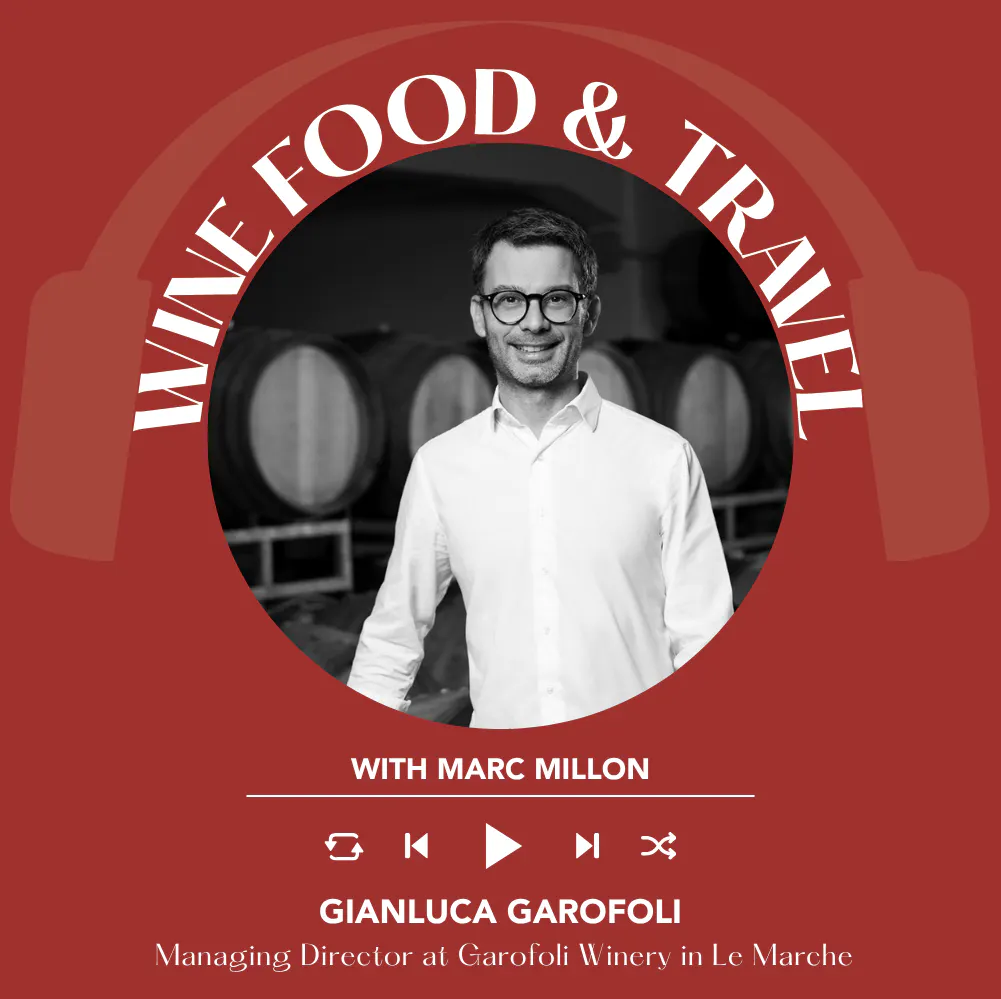
Ep. 2767 Le Marche: Verdicchio and the Wines that Shape the Region with Gianluca Garofoli of Garofoli Vini | Wine, Food & Travel with Marc Millon
Episode 2767
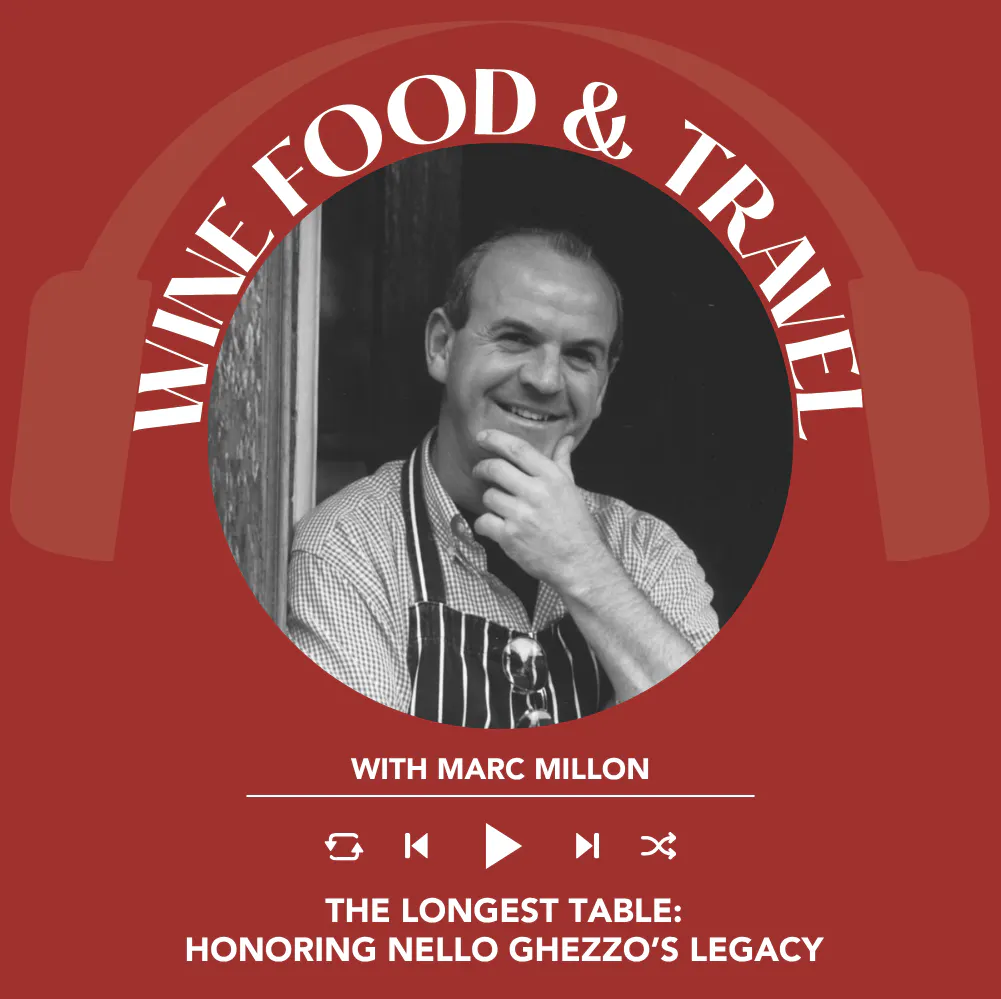
Ep. 2755 The Longest Table: Honoring Nello Ghezzo’s legacy | Wine, Food & Travel with Marc Millon
Episode 2755

Ep. 2712 Exploring Brda: Exceptional Wines and Slovenia's Culinary Traditions with Lan Kristančič of Movia | Wine, Food & Travel with Marc Millon
Episode 2712

Ep. 2700 Sardinia Beyond the Coast: Agripunica, Basso Sulcis & the Legacy of Giacomo Tachis with Salvatore Santus | Wine, Food & Travel with Marc Millon
Episode 2700

Ep. 2681 Giro d’Italia 2026 Special Episode 1: From Bulgaria to the Mezzogiorno in search of wine and cheese | Wine, Food & Travel with Marc Millon
Episode 2681