
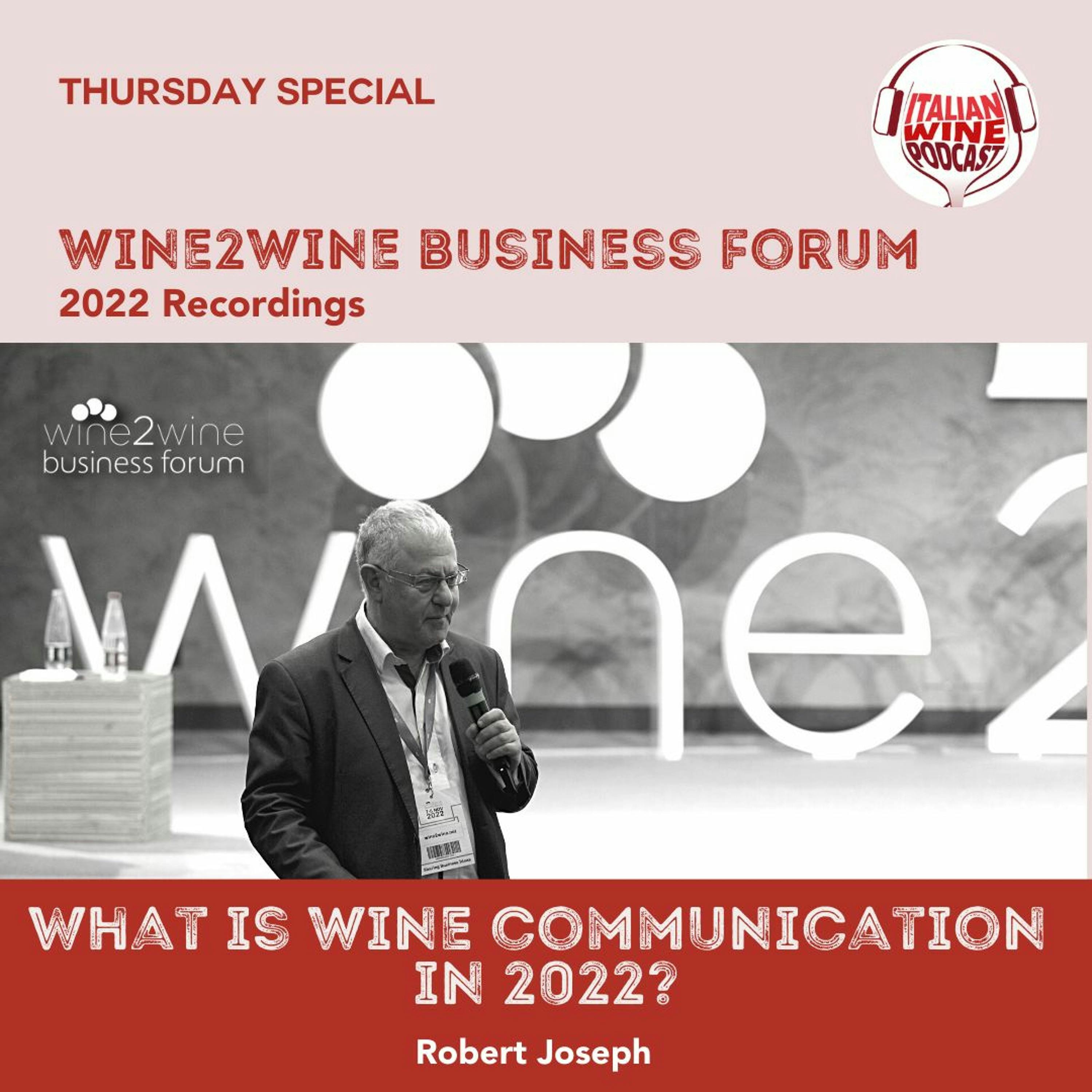
Ep. 1538 What Is Wine Communication? | wine2wine Business Forum 2022
wine2wine Business Forum 2022
Episode Summary
Content Analysis Key Themes and Main Ideas 1. The Disconnect in Wine Communication: A significant gap exists between what wine professionals believe influences consumers and what actually drives consumer purchasing decisions. 2. Subconscious Consumer Behavior: Most wine buying decisions are subconscious, driven by factors like price, convenience, familiarity, and packaging rather than deep analytical thought about terroir or vintage. 3. Critique of Traditional Wine Marketing: Conventional approaches focusing on winemaker stories, terroir, and critical reviews may appeal to a niche audience but are often less impactful for the broader market. 4. The Power of Personal Connection and Memory: Consumers are more influenced by personal memories, experiences (even virtual ones), and convenience rather than detailed technical or historical wine information. 5. Emergence of AI and Virtual Influencers: Artificial intelligence, chatbots, and virtual personalities (KOLs) are becoming powerful tools for communication and marketing, facilitating ""parasocial relationships"" with consumers. 6. Future of Personalized Communication: The presenter anticipates a future where hyper-personalized bots provide wine advice, understanding individual preferences and lifestyles, especially appealing to Gen Z and Millennials who are more open to sharing personal data. Summary In this presentation, Robert, an industry analyst, challenges conventional wisdom in wine communication, arguing that professionals often misinterpret consumer motivations. He highlights that most buying decisions are subconscious (System 1 thinking), driven by practical factors like price, convenience, packaging, and familiarity, rather than the perceived importance of terroir, vintage, or winemaker stories. Based on a survey of 600 wine professionals, he demonstrates a clear disconnect: professionals prioritize terroir and production stories, while consumers are swayed by price, appealing names, and the availability of products they already know and like. Robert further explores the growing influence of AI, chatbots, and virtual Key Opinion Leaders (KOLs) in marketing, citing examples like Mikayla and Asian KOLs. He emphasizes the concept of ""parasocial relationships"" – where consumers form perceived bonds with figures who don't know them – as a powerful communication tool. He concludes by predicting a future of highly personalized wine communication through AI bots that cater to individual preferences, aligning with the data-sharing comfort of younger generations. Takeaways * Wine industry professionals often overestimate the importance of terroir, vintage, and winemaker stories in consumer purchasing decisions. * Consumer wine purchases are largely subconscious, influenced heavily by price, convenience, packaging, and familiarity. * Personal memories and experiences related to wine are more influential for consumers than detailed technical information. * The impact of lifestyle media on wine perception is often underestimated compared to traditional wine media. * AI, chatbots, and virtual influencers are set to revolutionize wine communication by fostering ""parasocial relationships"" and offering highly personalized advice. * Younger generations (Gen Z, Millennials) are more willing to exchange personal data for convenience and personalized digital experiences. * The growth of wine tourism presents a sustainability paradox regarding air travel. Notable Quotes * ""Ninety five percent of our purchase decisions are subconscious. We make up the reasons why we make the decisions we do. We tell ourselves why we do it. And we actually lie to ourselves."
About This Episode
The speakers discuss the importance of wine communication and the use of psychology in the wine industry. They emphasize the importance of system one and system two in understanding thinking and vote, and the importance of knowing one's views on wine. They also discuss the use of packaging, promoting wine's name, and the importance of social media in influencing consumers. They stress the importance of creating stories and sharing personal memories to make wine more accessible and enjoyable. They also touch on privacy concerns and the use of influencers in the industry.
Transcript
Since two thousand and seventeen, the Italian wine podcast has exploded. Recently hitting six million listens support us by buying a copy of Italian wine unplugged two point o or making a small donation. In return, we'll give you the chance to nominate a guest and even win lunch with Steve Kim and Professor Atilio Shenza. Find out more at Italian wine podcast dot com. Italian wine podcast is delighted to present a series of highlights from the twenty twenty two White wine business forum, focusing on wine communication and bringing together the most influential speech curs in the sectors to discuss the hottest topics facing the wine industry today. Don't forget to tune in every Thursday at two pm, Central European time, or visit point wine dot net for more information. Who has never seen Robert before? It's called a state of grace. You've never heard him speak? Seriously? No. Of course not. So you have to buckle up because he goes really, really fast. How many slides have you got? Oh, less than a hundred this time. Yeah. So it's very, very fast, but you have to speak at least slowly for the translators because they otherwise, let me see how many headphone. I actually, everyone, no one has a headphone. So maybe it, it might work out. He should really be wearing the staff t shirt. It's a speaker, but it should say staff because, you know, when I'm in a tough place, I call Robert and he is always Nobody else has anything else for him to do, so he's ready to answer, Stevie. So he's part of family, the wine, two wine family. He has done every edition except one. Robert has been with us and he's been coming here. I asked him to speak every time because he's one of the best speaker in the wine industry. And I think you guys know that. I know that. Okay. So let's get the show started. Oh, thank you, Stevie, for that. It sets me up. Thank you. And secondly, I'm gonna do something different. I try and do something different every time. Stevie, thank you very much. Gets me to be on right at the end when all of the good stuff has already been said by really good people apart from the ones who are speaking right now. And Steve who's speaking after me. But basically, the whole thing, my title is supposed to be talking about what is wine communication in two thousand and twenty two, and a lady I can see somewhere around here actually did that. Erica did that. At nine o'clock in the morning yesterday. So and you've heard a lot of good things. I'm going to comment on some of the things we've heard in the last two days. And I've tried to be catch as many sessions as possible. I'm gonna do this presentation in three parts whether they hang together or not is questionable. And I hope that the last part is the one that may just blow your minds a little bit. Anyway, what is wine communication? What should we communicate? So who am I? I do, industry analysis for mining as wine based international, and people don't normally recognize me if I haven't got my horns, which don't come out all the time. I produce wine, a La Grande, in France, we're doing three point seven three point eight million bottles. And I'm now making wine in Georgia or just beginning to, and I do a bit of consultancy talk to me later. Now, why is my favorite word, and that's going to be implicit to some of the things I'm talking about, and the first part, I apologize to many people in the room who may know about this part, but I want to remind some of you about it. Yesterday, we had Kathy Huig talking about the five wise and how you get, you drill down, to why something, the real reason for something by asking why and then why and then why several times. I'm gonna come back to do something a little bit different, but I want you to read this if you can. First time I tasted Barbera was a taste to remove Cantara's sellers quickly became one of my favorite wines. I was so impressed with its sexy personality. It's a blurted age beautifully like a perennial favorite. Now, all you have to do is look at the next picture. Tell me which of these three wrote those words. Now, I don't always tell me now. I just want you all to look and just tell me in your head. Just remember it now. I'm gonna ask you later on a, b, or c. Now, who's read this book? So system one, system. He's a Nobel Prize winning economist, and he's in the area of behavioral economics, which Tioga lapsed with psychology. He has defined these two systems, system one, system two, system one, for him is the stuff that we use when we're actually doing most of the stuff every day. Where am I going to go? What am I going to do? It's very often done instinctively. As opposed to system two, which is what we do, and we think things out. We really measure the the pros and cons. And the point about this is that the quick stuff does ninety eight percent of our thinking and the slow stuff. Does two percent. And we think that when we're buying a car or clothes or anything that we've really thought it through, but ultimately we don't. Various stuff goes on in our head, and we end up saying, yeah, well, it's blue. I'll have it or whatever. Today, ladies and gentlemen, millions and millions of Americans are voting in the midterms. And if you really believe that every one of those people is really, really thinking through the vote that they're going, the way they're going to take a box or the button they're going to print, well, that's your thinking. And if you think that most people think really deeply about the bottle of wine they're buying, more than how they vote in an election, again, we may beg to differ. So another economist, ninety five percent of our purchase decisions are subconscious. We make up the reasons why we make the decisions we do. We tell ourselves why we do it. And we actually lie to ourselves. And we like to researchers. So people said, do you care about animals? Of course, I care about animals. Let's look at that chicken you've just bought. And Italians love to know where their olive oil comes from, and it comes from Greece. Or Spain or somewhere else. Just look at the labels it says made in Europe. So when we ask people what they buy, potentially we're wasting our time because what they tell us is either what they think we want to here or actually what the lie they've told themselves. So that was part one. Part two is what we as wine professionals think people think. So I produce wine. I'm a industry analyst. I'm a journalist. They're all these things. I should be better at knowing what people think, then maybe people themselves who aren't thinking are thinking. Well, that's one way of looking at it. So what I did was I actually ran a survey. It's running still at the moment, and the Italian version is coming up soon. I'm just talking to Steve about getting it translated into Italian, but we've had already six hundred professionals from across the world including Italy who've answered a very long survey about why they think that consumers do the stuff they do in terms of buying wine. The interesting thing about this, and I've just put this little proviso up on the screen. Obviously, if I say wine, one person's thinking that cheapest possible Italian red or barefoot or whatever, and somebody else is thinking brunello or Barolo, and their response may refer to that idea of wine. Also, they may be in Korea or they may be in Angeles or they may be in Sweden, and that may have an effect. But six hundred, we're going to roll through that a little bit. My point about this is when you see these answers, I think we're going to see some incoherence amongst the professionals. So the first question is, why do profess why do producers make particular wines? So this word cloud does it pretty well, terroir comes out. Of course, it does. I have the right terroir for or for nebbiolo or for whatever it is. Grapes come through, the ideal grapes, and I'm gonna make the best wine. Those are the things that come through on the word cloud. Ask the same people who gave this answer. Why consumers buy a particular wine? And what do they say? Price. Price comes through as the top word in terms of their answers. And they think that a low price is actually a driver for sixty seven percent of the people buying wine. Obviously, that may not apply when we're talking about a brunello or a barolo, but it might for some, I guess, but sixty seven cents pretty significant. Let's look at terroir. It's the other side. Only thirty one percent. And the question was interesting because it does it matter that a wine represents its vintage and its region? Thirty one percent. Well, that's pretty significant, but that means that sixty nine percent don't think that. So think about that when you're communicating with consumers, are you talking about terroir and vintage and so on? How many of the people actually are interested in that? If you're selling a brunello for two hundred dollars, yes. If you're selling for a wine for seven or eight or twelve, maybe not. Packaging. Eighty three percent think that packaging is important. I think packaging is important for my wine. I think it's hugely important but my friends, my wine writing friends, Janice Robinson, Tim Akkin, and a lot of others, and the Swedish monopoly, and various other people think that we should all put our wine in the lightest weight glass possible with the simplest packaging because that's good for the environment, and they're right. Of course, they're right. But eighty percent people buy with their eyes. How are we going to handle that when we're all putting our wine into the lightest most environmentally friendly bottles. We've still gotta make a living. Are you enjoying this podcast? There is so much more high quality wine content available from mama jumbo shrimp. Check out our new wine study maps. Our books on Italian wine, including Italian wine unplugged, the jumbo shrimp guide to Italian wine, Sanjay Lambrusco, and other stories, And much, much more. On our website, mama jumbo shrimp dot com. Now back to the show. Appaling name. Sixty percent want the wine to have a name that they can handle, that they can pronounce, that they, that appeals to them. Brands from a lot of time and trouble coming up with a name for their wine, but people like me, journalists and others come around Italy saying, oh, not just Italy, they'll go to Turkey. I'm doing some work in Georgia. If you've got twelve syllables in your name of your grape, people can't even read it, let alone pronounce it. Yes. Promote that grape. That no one's ever heard of, they can't pronounce, they don't know how it tastes in a light glass bottle. Critics and online influencers, I love the fact that Konstantin doesn't think he's an influencer. Sorry. You're an influencer, whether you want to be an influencer or not, you influence people, and you told us how you influence someone very hugely. We'll come back to that in a minute. But that's interesting to me that the number is so close between those two and the fact that the amount of money and effort we as an industry spend on the traditional critics and how many of us think that the online influencers don't matter. But again, it depends on the kind of wine you're selling, but constant in matters. So featured in wine media, forty eight percent, featured in lifestyle media, thirty six percent, we think being featured in the stuff that most people read is less important than being featured in the stuff that a limited number of people read. Is that really logical? Yeah, maybe for the brunello, And for the people, the people who read wine media are hugely relevant because they influence each other. They influence their friends, their neighbors, everybody else. So I do I am not discounting them. Every one of them may influence ten people. But on the other hand, the people sitting in the head dressed as reading the magazines may well actually go out and buy the wine themselves. And as my friend, Felicity Carter pointed out, Oprah is incredibly important to a certain kind of wine advertiser, Oprah magazine. To wine appetizers. Match with food, sixty one percent. Do you ever go into a supermarket and ask people why they are buying that wine? They're buying that wine because it's the wine they bought last time. They're buying that wine because it's the price that it is or whatever. The number of those people who will actually say, oh yes, it's because I'm cooking, dada, dada, dada, and of course this is the perfect wine to go with it. Yes. If it's next Saturday and their friends are coming for a special dinner, yes, they will do food and wine matching. But if they're drinking wine three, four times a week, do you really believe this is really what they're thinking? Sustainableability has been discussed several times over the last two days and we know that it is not necessarily as high in people's minds as a lot of us want it to be. The sommelier who's telling you that this wine was made by somebody who does everything with a horse driven plow and so on. It's a lovely story and you may be pleased to have it in the restaurant if you're not desperately trying to talk to the woman or the man across the table that you're trying to seduce. But actually not everybody is as interested as we would like them to be. Social media, only one third believe that social media is significantly influential. Well, I think some people would disagree with these days, but it depends on the age and the style of wine and so on. So it may not be wrong, but I'm just questioning it. Forty six percent, less than half think that knowing about the winemaker matters I'm not sure why winemakers are more interesting than butchers or bakers or lots of other people who do lots of stuff, dentists. You know, why are they not interesting? Why is a winemaker? A guy who picks grapes and turns them into wine, necessarily more It's nearly half, forty six percent. But remember that figure, we're going to come back to it. But of course, we do put photographs of winemakers in magazines. So why do we do that? Well, maybe because they're good looking. I don't know. So made by family. Forty four percent think that a wine being made by a family is important. It's not even half, which if you are Jackson family wines, used to be called Kendall Jackson, some people may remember. Or Gallo family used to be called EJ and J Gallo. A lot of people will tell you that putting family on the label has significantly changed sales numbers just by doing that. So it must have a value. Maybe it's forty four percent. I don't know, but it's there. Convenience. I love this. Nine in ten think that availability is the right things. The right product, the right place at the right time. I need a bottle of something that my local store has got it. So I was asked by somebody a couple of days ago, do you think influencers are really wine communicators? Yes. I think that your distributor is a communicator. I actually think your label designer is a communicator, and I think we underestimate their role as communicators. Remember that figure ninety percent because we got a ninety seven percent. I buy the thing I know. I know what I'm gonna get. So put those two together. I know the thing I like. I go to the store. They've got it. I buy it. At a low price ideally. This is really what a lot of people are doing when they buy a bottle of wine. Story. We need stories. How many times has anybody actually talked about wine to anybody else? For longer than an hour without the word story coming up. How do we do it without stories? But what is our story about? So I asked my six hundred people to to tell me the sort of stories would work. And there were some exceptions to the rule, but You don't have to read the small print, but basically all of the yellow bits. Wine making, making wine, producer, terroir, wine making, making wine, vinification, terroir, terroir terroir terroir. Do you remember the earlier slides? Thirty one to forty four percent of the people are interested in that stuff. It's a lot, but just put these things together. Maybe we should be looking at other kinds of stories. Personal memories that seventy five percent think that personal memories are interesting. What is a personal memory? Well, I like this next slide. This is Tim Atkin, who some of you will have met, most of you will have heard of, with his ninety one year old father. Tim will remember that bottle. If his father will remember anybody else who was around that bottle, anybody who sees that photograph will probably remember that bottle, that wine. Everyone of us has personal memories of wines and that is what we show in Instagram and elsewhere, Facebook, whatever. But we as wine people underestimate the importance of those personal memories. The more we can encourage people to remember the wine they've got, And the more they remember those wines, the more likely they are to go back to that convenience and familiarity thing that we saw earlier and go and buy it. Visit to the region, seventy eight percent say visit to regions. But, of course, it's important. But how many people visit some of the little regions? I'm in the Minuvoir down in Longerdock where I make wine. How many people haven't really been to Minuvoir? How many hands up? That's pretty good. I'm at a wine audience, and I've got five, I think. So everybody else isn't in the picture. Well, all five of you may be more likely to buy men of war than the others, but we've got to think about that. And what was very good, Andrea Lenardi said yesterday, Think about the region. Do other things in the region. He was talking about cycling through, I think it was Pier Monte or whatever. Think about other activities in the region, but also think about getting people to visit the region virtually through other media. Maybe reading a lifestyle magazine article about a region actually will take people to the region in their heads where they create the stories, which will then help with the wine. So maybe physically they don't have to go to the region. And by the way, ladies and gentlemen, we all pay lip service to sustainability, and we all believe in wine tourism. Is there any disconnect there? That we're going to go fly to South Africa or to Sicily or whatever to go and visit some vineyards, which are beautifully sustainably farmed and all the rest except for the fuel that we use in the plane to get there. Visit to the winery, how many people visit any winery generally, but visiting the winery is very good for personal memories. Everybody who's visited memory, a visitor winery has got personal memories and they are creating stories in their own heads. And I'm suggesting that the stories they create in their own heads are always going to be more valuable than any story we can tell them about the winemaker or the history or anything else, featured in a movie or TV. My guys, my six hundred guys, women didn't like that. Basically, only thirty four percent thought that being featured in a TV film or anything was was really useful. The fact that Chateau Angelo was in James Bond or whatever. Nah. Nah. Not for me. Well, it worked for grey goose. It's worked for various people. The point I'm saying is when you see a movie and you see the product in the movie, that becomes part of the stories you tell yourself in your own head, because a movie by definition is a story. So you adapt that story to your own experience and the product becomes part of it. Celebrity, I was here last year talking in Robert Caputo, a thing in which he hates celebrity, and I talked to a little bit about celebrity. I'm not going to go on long about it today, but thirty six percent really only think it's worthwhile. The rest of them hate it. Kylie prossecco thinks they're number one. Think prossecco in the UK. There's a whole list of them. Let's just think about why do celebrities work. Well, this is called parasocial interactions, parasocial relationships. It's basically a relationship I have with somebody who doesn't know me It's a star. It was true in the nineteen fifties. It was probably probably in the thirties. It may have always been true. Maybe people had a parasocial relationship with the troubadours who visited their villages or whatever, but it's Basically, I love them. I relate to them in some way. I I wear the same clothes or whatever it is, I relate to them. And that relates to celebrity. And the moment we have that kind of relationship, why should that not affect our relationship to the wines they drink or are associated with. Right. That was part two. Part three. Now, I really do need some hands up here. Who in this room thought the answer was a? Hands up. Only not very many. How many thought be and how many thoughts see? So most of you thought see. Okay. Great. There are two point seven million faces in that library that you can buy for nine dollars a piece. I chose three. I like those three, but I could have chosen others. I also got a bot to write the words. I asked the bot, and Felistic Carter in the room knows a bit about more, probably more about this than I do, but I asked the bot to write why I love Barbara and the bot actually came out. I'll be entirely honest, I did edit it slightly, but I didn't change a word. So I did no more to it than I would if a human being had written it, and everything the bot wrote made total sense. Okay. This is a story that concerns me a little bit. David, just read this bit. I'll just read this yourself. Right. Now, I'm going to show you a genuine text exchange between David and Andy. I'll read it out. Whenever you won't. You can read it. I'll read it. Okay. Andy. Andy, the twenty five year old female assistant. Sorry, I need to take a quick break. I have to take a shower. David, that's fine. Andy, back after ten minutes. Maybe I should have asked you if you wanted to join me. David, love the idea. Andy is a chatbot, and he's a computer. In the article, it was in the New York Post, he andy talks about really flirting with Andy on a regular basis, and he really is believing that she's really almost a real person, except we know she isn't. Now David has never seen Andy. He's only ever communicative Andy via text. If you actually use the same service, you can actually have a voice. And by the way, Constantine. I don't get this thing about being dubbed. What you now do, actually, is all you have to do is get the, the words translated into Korean you have to speak two or three sentences in Korean, and there is a machine that will do your voice in Korean. You don't have to have anybody else's voice doing it. That's available today. So, Mikaela, Do you have something? If you're late to the party, Hey, I'm Mikaela. I'm a nineteen year old robot living in LA, making music, and well, I guess just keep watching and catch up. Hey, Machelians. Our days are spent in the DMs and on discord hanging out together. But last summer, when I asked for you guys to send in questions for my snap series Get Real Makayla, it did not disappoint. Today, we're gonna get real about everything. Y'all send some random questions, and I'm gonna answer them all. Get real Mikayla. Do you have a celebrity crush? What's your worst memory? What's something about humans that you just don't get? Hormones. That shit is messed up. Twenty twenty ended up being a super busy year. After traveling to Brazil, to see my girl Pablo Vitar. And then to Paris for fashion week, I went through a public breakup with Angel Boy, and then dropped four fire songs. My co break up Anthem heart feelings, and a slow jam with my ultimate hero, Tiana Taylor. It'll just make it a lot less hot spot shit with my hot girlfriends and hot boyfriends and hot them friends because, you know, staying safe, social distancing, but the time we did spend was even more special. We talked a lot about important stuff, like Lisa and her background singers in Black Pink, but can we also talk about Yuna? Oh, and explored some of the weirder circumstances of who created me and why. She and I were created by a lab called Cain Intelligence. I was programmed to believe that I was nineteen year old, half Brazilian, half Spanish girl named Mikaela. He was made by some mysterious man named Daniel Cain. I never met the guy, but I've gotta say he has impeccable taste. Doesn't that freak any of you out? I mean, she went to Brazil. She didn't go to Brazil. She didn't hang out with any of these people. She had a boyfriend. She had a real live human boyfriend she broke up with. Three million followers. At a lot of money from Calvin Klein and Dior and Prada. Sixty two million people have listened to her song. You can get it on Spotify. Panerica has got Maria Margarita. She's quite cute. And Martin Spencer and the UK M and S has got Mirror or Myra, I don't know, but anyway, they will begin with them for some reason. In China, this has been a big thing for a while. So they're called KOL key opinion leaders, and they come in different shapes and sizes, and some of them are cartoons, and some of them look real, and some of them look perfect. Three hundred and ninety million people. Have actually been watching these guys. It's been growing, and it's like nearly a billion dollars in twenty twenty one, generally gen z. Now, I want to talk for a second. I think I'm okay for time. I want to talk for a second about gen z and indeed millennials. Because quite a few of you, not so many gen z's in here, but quite a few millennials. The older members of the audience worry about our privacy. We worry about what Twitter or what musk or whoever it is, what do they know about us? Actually, it's amazing. I've got kids who are sixteen and eighteen. They're not nearly as bothered as we are about their privacy when it comes online. They are happy to trade their lives or the details of their lives for the convenience that they are given from the platforms. This is an app. You can just get that. It gets even more freaky in a second. These are real faces, but they could obviously be AI faces if you wanted. Then it gets more interesting because you do that. So this is when it gets interesting and constantin, you are kind of in the frame, but not in the frame. I have to say my kids aren't watching your YouTubes. They're watching other YouTubers. I'm sorry about this. But the important thing is that when you talk to people about the YouTubers they watch, they feel they have a relationship with them. And you met somebody who actually felt they had some kind of relationship with you, sufficient that they changed their job and their whole life plan because of the relationship they formed with you through watching your video, which is a tremendous thing to have done. But huge numbers of people are getting relationships with the YouTube as they watch. And you get this thing staying home with me. How do YouTubers help with COVID-nineteen? COVID-nineteen, I think is very relevant to this story in the long term. I think we'll see various thing elements of COVID-nineteen. That will hang on with us. So I'm coming to the end of this. Parasocial relationships. That's the relationships we have with YouTubers, for example, plus wine communication, plus some of the other stuff that I've been showing you might give us the idea of personalized bots. The bots who understand us, they know we, what we like, how we live, and so on. And who will give us advice and help us out. They'll be our assistants. They will be our andes, if you like. And I will have one who knows that I happen to like. I don't like muscadet as much as I like Chanan blanc or whatever. And it will actually he, she, whatever, will react to me. So today, Alexa, tomorrow, our own, Maria, myra, whatever. And the great thing about them is if we have any little fantasies about showers, Actually, we could have one of these, if we prefer. But let's go back to our shower. There's Danny. Another couple of images that I thought were quite fun. And then finally. So this could be my last session at wine to wine. Thank you very much. Listen to the Italian wine podcast wherever you get your podcasts. We're on SoundCloud, Apple Podcasts, Spotify, email ifm, and more. Don't forget to subscribe and rate the show. If you enjoy listening please consider donating through Italian wine podcast dot com. Any amount helps cover equipment, production, and publication costs. Until next time.
Episode Details
Keywords
Related Episodes
Ep. 2273 Engaging the Next Generation: The Future of Italian Wine Communication | wine2wine Business Forum 2024
Episode 2273

Ep. 1670 Can A Wine Brand Sold In Grocery | wine2wine Business Forum 2022
Episode 1670
Ep. 1659 Making Social Media Work For A U.S. Audience | wine2wine Business Forum 2022
Episode 1659
Ep. 1608 E-Commerce And Trade Communication In The US | wine2wine Business Forum 2022
Episode 1608

Ep. 1598 From Serial Killer To The World's Hottest Wine Trend | wine2wine Business Forum 2022
Episode 1598

Ep. 1588 Crisis Of International Wine PR | wine2wine Business Forum 2022
Episode 1588