
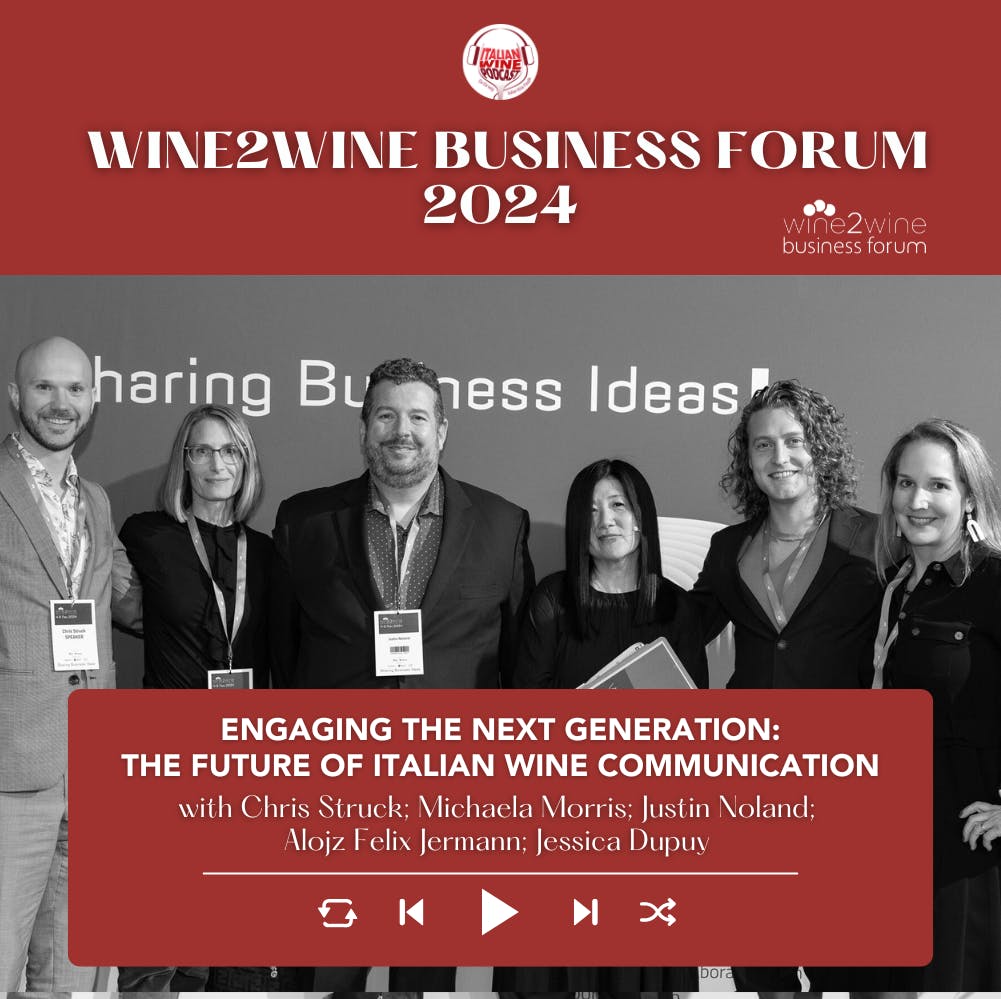
Ep. 2273 Engaging the Next Generation: The Future of Italian Wine Communication | wine2wine Business Forum 2024
wine2wine Business Forum 2024
Episode Summary
Content Analysis Key Themes and Main Ideas 1. Generational Communication in Wine: The central focus is on how the wine industry can effectively communicate with and engage younger generations (Millennials and Gen Z). 2. Authenticity and Digital Strategy: Emphasis on the ""how"" of storytelling, advocating for authenticity, personalization, and meeting consumers on digital platforms where they are. 3. Emerging Trends: Discussion of no-low alcohol wines and alternative packaging (e.g., lightweight bottles, cans, bag-in-box) as both challenges and opportunities. 4. Consumer Experience over Product: The idea that younger consumers prioritize experience, inclusivity, and lifestyle connections over traditional product-centric messaging. 5. Industry Adaptation: The need for wineries to be flexible, embrace new technologies, learn from other industries (like streaming services), and be transparent about their practices. Summary This content is an edited panel discussion from the 2024 Wine to Wine Business Forum, featuring industry professionals from various generations (Gen X, Millennials, and Gen Z) discussing the future of Italian wine communication. Hosted by Stev, the panel includes writers, educators, and digital strategists who emphasize that successful engagement with younger audiences hinges not just on the *story* being told, but *how* it is conveyed. Speakers, notably Justin Nolan, highlight the need for authenticity and personalization in digital marketing, drawing parallels to algorithms used by platforms like Netflix and Spotify. They discuss the challenges of visually communicating wine on platforms like Instagram and the untapped potential of influencer marketing, stressing that wineries must actively nurture these relationships. The conversation delves into two significant trends: no-low alcohol wines and alternative packaging. Opinions on no-low alcohol wines vary; some panelists, like Felix, see them as a potential entry point for new drinkers and a symbol of inclusivity, while others, like Mikaela and Chris, raise concerns about quality, market saturation, and the core definition of wine, suggesting that consumers often seek an *experience* that transcends alcohol content. Regarding packaging, the panel strongly advocates for eco-friendly, lightweight bottles for sustainability and financial benefits in e-commerce, though they acknowledge that alternative formats like cans and bag-in-box might require separate branding to avoid ""cheapening"" a premium image in certain markets. Ultimately, the panelists advise wineries to understand their diverse customer base, build community through common ground, embrace creativity and new tools, and foster an environment of transparency and even acceptable imperfection. They conclude that Italy's inherent cultural richness and ""vibe"" are powerful assets that should be allowed to speak for themselves, rather than being overshadowed by over-storytelling. Takeaways * Focus on 'How': Effective wine communication is less about *what* story is told and more about *how* it's presented, emphasizing personalization and authenticity. * Embrace Digital Personalization: Wineries should learn from platforms like Netflix, offering multi-layered engagement tailored to individual consumer preferences. * Strategic Influencer Engagement: Influencers can introduce brands to new audiences, but wineries must actively maintain and nurture follow-up relationships. * Nuanced Approach to No-Low: The no-low alcohol trend is driven by a desire for diverse experiences and inclusivity; wineries should consider offering non-alcoholic options, even if not producing them directly. * Prioritize Sustainable Packaging: Lightweight and alternative packaging (e.g., cans, bag-in-box) are crucial for sustainability and logistics, though brand perception in certain markets needs careful management. * Authenticity Over Perfection: Brands should be transparent, own their mistakes, and ensure ethical practices throughout their supply chain, as consumers value honesty. * Leverage Italian Culture: Italy's inherent cultural richness, food, and sense of ""La Dolce Vita"" are powerful, natural communication tools that resonate with consumers. * Listen to Younger Generations: The industry needs to actively listen to the preferences and expectations of Millennials and Gen Z, as they are the future consumer base. Notable Quotes * ""Reaching the younger generation is not about a story... It's the ways in which they are telling them."" - Justin Nolan * ""The younger generations want opportunity to engage at different levels based on authenticity and experience."" - Jessica Duplee * ""It's not about am I drinking wine tonight?... It's I'm going out with my friends, and we want an experience."" - Cosmopolitan editor (recounted by Jessica Duplee) * ""Drink less, drink better."" - Chris Truck * ""If you're not perfect as we all are not, don't try to hide it. Just own it."" - Chris Truck * ""Italy has so much going for it on so many levels... Just let people feel the vibe of it."" - Mikaela Morris * ""You have to give [your staff] the space to make mistakes because if they know they'll be struck with the lightning as soon as you make a mistake, this will not be a good fertile workplace."" - Stev (host) Related Topics or Follow-up Questions 1. How can AI and data analytics be specifically applied to Italian wine marketing to personalize consumer experiences effectively? 2. What are the most promising emerging digital platforms or technologies for engaging younger wine consumers beyond current social media? 3. How can the Italian wine industry develop clear guidelines or best practices for collaborating with influencers to ensure brand integrity and authenticity? 4. Beyond no-low alcohol, what other wellness or lifestyle trends are impacting wine consumption among younger demographics, and how can wineries adapt? 5. What are the financial and environmental trade-offs for Italian wineries considering a full transition to alternative packaging for their entire portfolio? 6. How can the wine industry foster greater inclusivity and diversity within its workforce to better understand and serve a broader consumer base? 7. What strategies can be implemented to educate consumers about the benefits of lightweight and alternative packaging, overcoming traditional perceptions of quality?
About This Episode
The speakers discuss the importance of personal connections and avoiding hiding them in the wine industry. They talk about their experiences with wine communication and how it has changed their approach to the topic. They also discuss the importance of personalization and personalization in the industry and the importance of understanding the audience's interests and language used. They also discuss the importance of privacy and experiences in the industry and the importance of being authentic and not trying to cover up mistakes. They also mention the importance of being creative and not trying to be perfect.
Transcript
None of us are professional influencers from the social media standpoint, but many of us have wide audiences of our consumers and others in our sphere and trying to decipher what are good investments of time and bandwidth and people going forward who can tell your stories in a meaningful way while making that important personal connection. But don't try to be perfect. It's impossible. I mean, try to achieve perfection. But if you're not perfect as we all or not, don't try to hide it. Just own it. Official media partner, the Italian wine podcast is delighted to present a series of interviews and highlights from the twenty twenty four wine to wine business forum. Bringing together some of the most influential voices in the sector we discussed the hottest topics facing the industry today. Don't forget to tune in every Thursday at three pm or visit Italian one podcast dot com for more information. So what we're going to do here is something different. For this year. We're going to close with some of the speakers that we've had. You've met all of them before. So what I'm going to ask is, starting from Mikaela, Justin, Jessica, Chris, and Felix, I would like all of you to just introduce yourselves and tell me which generation you belong to. Stev, I'm from Texas. We don't talk about our races. And just in less than two sentences, your role in the wine industry, just for those who are less familiar. Let's start with Mikaela. My name's Mikaela Morris. I am a freelance wine writer, so I contribute to Decanter Magazine as well as a few others like Minergar's wine business, international, and Quench in Canada, and I'm also a wine educator. I don't know why Stevie invited me to be on this panel because she knows that I was desperate. Yeah. Exact she knows that I'm a grandmother, so I don't I'm so far away from the millennials and the gen zetters, but I do belong to the gen x generation. Okay. Justin. I am technically an elder millennial. So I'm like, one of the one of the very first millennial And the reason that there is some levels there. I know a geriatric millennial. There you go. I remember the time growing up when the internet didn't exist where other millennials didn't do not remember that time. So there is like this subset between like nineteen eighty one. People are born between like nineteen eighty one and nineteen ninety ish that do remember a time before the internet. So we have like, a slightly different experience than the rest of the millennials do. So just for those who missed Justin's presentation, Justin Nolan, is the vice president, the chief, the big cheese for digital in treasury wine estates. Okay, Jessica. I'm just gonna interject real quick that according to Jean Twin, who's a PhD and wrote the book generations, nineteen eighty to ninety four is gen is millennial. So there you are. You're right? Me. And then ninety five to twenty twelve is gen z. And I'm not either of those. I'm a proud gen xer. Okay, gen x. Gen x. Yes. Gen x. So just to Duplee, I'm from Austin, Texas. I am also a freelance writer and write for different publications from Food and Wine Magazine to Decantor Forbes, Texas monthly wine enthusiasts who will ever take a story. Okay, Chris. My name is Chris Truck. I'm a former beverage director in restaurants, now wine educator and writer. I'm a middle aged millennial. Have the pleasure of being a nineteen ninety excellent vintage baby. Yeah. And I'm Feryxierman from Fluidveniete, Julia. Grown up in the wine world, still in it. However, I've taken a different path and sharing my passion for wine, tried to bring in closer to young generation into the wine world with a lot of videos and content and fun experiences. So do follow the journey. I would say I am a very young millennial, but, beginner of gen z, depending on where you get your data from, because, you know, ninety six could be the end of millennials. You just mentioned ninety five. Depends where you get your data from. So I'm from ninety six, so considerably right there on the edge between Well, you're the youngest kid on stage. Let's just put it. Put it that way. Okay. So we're going to do this. I'm going to ask them a few questions, but at any point, If you have a question, the session in theory is dedicated to engaging the next generation, the future of Italian wine communication. Very broad. I thought of this because everybody's talking about the next Jen. Then Justin, during his last session, he said, let me quote, reaching the younger generation is not about a story. Oh, I take a shoe. Oh, okay. So Justin, I I want you to can you expand a bit about that? Yeah. A hundred percent. So this isn't to say that the story is not important. It is. But there is room for a lot of different stories. There's room for a diversity of stories. There's room for a lot of different ways to engage an audience of people. The difficulty that I see that most wineries have and that most wine institutions, wine writing, have is not the stories that they're telling. It's the ways in which they are telling them. And that they are not reaching an audience. So it doesn't matter. Like, we can have, you know, we've had a really interesting conversation about come over October. Right? And you can talk about one way or the other. But the story itself doesn't make a difference unless it can reach a broader audience, unless it can reach the people that it's meant to reach. And that is where I see us having the biggest difficulty reaching younger audiences is simply not knowing how to reach them not necessarily trying to engage them in different stories and talking to them in different ways or trying to dumb down wine. We're just not great at being where they are. Okay. Would anyone else like to chime on this if I if I may, that is why you're not, you're not millennial. You're not gen z, so it's understandable that we have, differences and, how to say different, and different costumes. So maybe I would say that there should be more of a collaboration between the current, past, and future generation to talk to these people because, you have the experience of the market and how it has come but we do know how we like to be treated and what we want because I'm very happy that Steve actually brought me here and we're talking about how engaged in the next generation because this is the four sessions that I've had this this So tell us about your four sessions did you do? I mean, he's rooms. I don't know if you've seen during the networking sessions. It was always standing room only. It was very packed. What was the outcome of these? And we actually have one more guys coming up at five ten. Andresiglossi, which is back there. So don't leave for that. Don't leave for that. Oh, yes. The trotter wine dude. Trotter wine. Yes, sir. Right. He's the wine influencer. And then we'll get into that in a little second. Okay. The definition of wine influencer. But, I mean, I talked about, what I do every day and what I'm most passionate about, we had four different topics, on how to bring closer to next generation with different examples, pulling from no alcohol wines, bringing wine producer that is working on Norco wines, Martin Feradore, working with, Leonardo and Luigi that are experimenting with Noel wines, Franchesca nonino that was here yesterday. What can we learn from spirits? Because spirits is really engaging the next generation. And, of course, social media that is gonna be coming up next. So those were the sessions. Go ahead, Chris. Yeah. I think Felix raises a great point that's not unique to Italy, but unique to Italy compared to the United States is you have such a rich history here and such lineage in your winemaking that that gives you an edge in your storytelling and creates a personal connection because I agree with Justin in that if you're just telling a story and no one's engaged, then you're just telling a story who cares what's the virtue in terms of driving sales and awareness of your brand. But I think here, if you can get two, three, four generations, into an Instagram story for really human interaction that creates a buy in to your audience to say, oh, I want to be a part of this family. This has love and chaos and messy and and the fighting just like my own family. And I can watch someone else do this while sipping a glass of wine even if my own family is two thousand miles away. So I have an example of this. I'm a journalist. So I went journalistic on this, and I actually called my alma mater Northwestern University because they've had to launch an entire program on how to train journalists on using AI. And they've actually launched, their own research site in which they're only including millennials, gen z's, and and trying to track this and trying to understand how it's all being consumed. And I wanna give an example. First of all, think about Netflix. And I mentioned this in my session yesterday to a couple of people that if you think about Netflix or Spotify or Instagram, and your consumption of that, you're aware that over time, your account is putting out an algorithm that is giving you preferences based on what you've watched previously. Right? And this is something that these two generations in particular are used to and have grown up on and expect they want this personalization. It's how they're consuming information. And so if you think about Netflix as an example of what Justin was saying, When you're on Netflix and you happen to see from the list that's saying, Hey, you may like these based on the fact that you just watched this, click on a show or a movie, and it's gonna just give you a little piece. It's gonna give you the picture, and it's gonna give you a sentence, and the name. And it's gonna tell you, you know, stars or whatever. And then it gives you a chance to click deeper, and then you can read more of a paragraph about it, and you can opt if you wanna do a trailer. That is what you should be thinking about in terms of how to communicate whether it's on your website or even in social media. It's not that the younger generations want simple information. They want opportunity to engage at different levels based on authenticity and experience. And that's, I think, you know, when you were talking about that, we need to talk about and understand how this is the how. Would you like to say something to keep on? You have another question. And you wanna move on. I'm happy to answer, or I can just riff. No. No. This said here. So what Either way. What I want to ask you is we're talking about communication to the larger audience. Is that correct? But I think sometimes we're preaching to the choir because we are especially Most of you are considered wine experts, well, except you. I found out today, Justin. You're not just as me, so I think we can get on pretty well. So the wine experts tend to talk to the wine people. Right? The why an industry people. And that has a different kind of language. So I think it's very important to understand who our audience is, and you can't give the same messaging to all the different audiences. Would you agree with that? So I did a talk recently, and I did a small exercise. And I asked, what is your favorite wine producer? It doesn't have to be Italian, but who's your favorite wine producer? I can't answer that because I think I would get fired from my dog. Just whisper. We'll see. Okay. Proctorito del Babresco. Proctorito delresco. Justin. Don't say treasury. Take somebody a treasury. I'm gonna get fired too. I mean Penfell's. Okay. What about you, Jessica? I'll go non Italian and say the Mandela coat out of the Santiana's Valley. Oh, yeah. I haven't a clue. Choruson out of Napa. A Choruson? Okay. Lovelto Adije, and, I think Terlon is a wine that I drink all the time. Okay. So when we're talking about communication, let's just talk about Instagram moment because that seems to be a very popular channel right now. Right? You guys open any of your favorite, Italian wine producer. Let me just make some names like Antinori, twenty sixth generation of you know, Italian wine nobility or Fescobaldi, or all of the others. If you look at their feed, there are two typologies. One is the vineyard, the cellar, the barique, the family in the settler, the winemaker touching the grapes. Right? And then the other side, more young at the pool side with the rosé, you know, or scantily clothed females with a glass. So I see most most of them, I would say, in the two spectrum, fall into these two categories. So, why in a way, I feel like it is a difficult product to communicate? Because what is it really? Right? And I think this goes back to what Justin was saying. What is it? Because if you take up the label, It's a bottle, and there's wine, and it's either red, white, or maybe sparkling. And visually, it's not that easy. So, Justin, how do you at Treasury overcome this? In terms of what is what are some of the techniques or the strategies that you use at Treasury? So that's when we start thinking about Instagram or we think about social media just in general. Every brand has a different story. Every brand has a different feel. Every brand has a different way of being. So to some extent, it's very, you know, it's important to be putting out content that aligns with the kind of brand that you want to be. That being said, because of the algorithms that are going to serve the right content to the right people at the right time, most brands can be both. Most brands don't have to just be the super engaging story about the wine and the winemakers and everything else. They can also be lifestyle. They can also be food and wine pairing, and they can also be travel, and they can be engaging about the areas, or just simply have the influencer type imagery associated to them because when it comes to organic content on Instagram or on on Facebook, the people that are most likely to engage with the type of content that you put out are also the most likely to be served that content in the first place. So you don't have to be one or the other. And when I say one or the other, I really mean one of many, many, many, many different styles content. You can be more than just that. You can tell a much bigger, much broader story that is going to engage with a wider variety of people. If I could, sure, interject and maybe just move on from that, and particularly maybe talk to Felix. Thank you. I think one of the things that I see when I'm looking at Instagram and and different, different feeds is sometimes I feel like because a producer might want to engage with a younger audience, and perhaps engage an influencer to work with. I feel sometimes that they're throwing things at the wall and seeing what will stick. And so I think that part of what, has to be with this process is to have a better understanding of which influencers you're engaging with, and also not to rely on the influencer to carry that relationship forward. I think the influencer is there to make the introduction. And you as a winery, if you're continuing that relationship, you're the one that has to nurture it. So there has to be someone engaged at the producer level who can continue to engage with with with the younger generation. How many in the audience are doing influencer marketing? Raise your hands. One, two. So very few. This is it's completely untapped. Influencer marketing, which will maybe some of you can talk about. I want to go to the next topic, which is no low. Okay. Who wants to get a maybe you should start. I think, again, starting with no, you have to have a you have to know who you are trying to target because as Robert was saying in the very first session, the people that are drinking the no alcoholic wines, people who drink. And I don't know that it is necessarily the entry into engaging the youngest generation. I could be completely wrong. This is just, you know, the, again, the dinosaur speaking, but You know, and and I'll tell you a story. Just a a good friend of mine, who's a master of wine, his daughter, turned nineteen. And, you know, a lot of nineteen year olds, certainly in my generation, we were already well into our drinking years by then. But she abstains, like many people of her generation. And so he bought a nonalcoholic sparkling wine to celebrate her nineteenth anniversary. And she's like, dad, that's, her birthday. That's really nice of you. I appreciate it. But I don't drink wine. So why do you think that I would like this? So I think the audience has to be fair, and I also think that it is a market that can quickly become saturated. So I also think that, maybe if you're gonna make it a focus, make it a true focus, to make a very high quality product. I was just tasting with Robert Joseph, his wine, and he knows that there's work to be done with it because one of the things that's missing a lot of times in these no alcohol wines is the texture. And if you wanna make a wine, that has the Italianity, as Andrea says, there needs to be some sort of texture there. So I think there's still a lot of work to be done to make something that, in my opinion, as a no alcoholic wine, will have a sense, a real sense of an in wine. So you're not against, no low? No. I'm not I'm not against it. And I do think that there's, you know, when you look at Italian wine, yes, everyone gives a Moscato as an example. But I also think there's opportunities just in so many categories in Italian wine, I'm getting into the more modest alcohol when I talk about things like Dorello or Prosecco or Lambrusco, where they're they have less alcad. They have less alcohol than a lot of the other wines. And then I think right here in valpolicella, you know, Amaroni, I think is it is a struggle nowadays at seventeen percent alcohol, but there is an opportunity with a very fresh crunchy modest, let's say, twelve percent, twelve and a half percent alcohol, valpolicella. So I think that I mean, if the question is should everybody start making no alcohol wine, I would pause because I think, you know, you've mentioned some great low alcohol. I definitely think that that's something that people are interested in, but I do think authenticity still has a matter. And as Chris mentioned earlier, this is a, this is an, a unique place in that the heritage and culture is so much about wine. And I think it's important to note, you know, I was in France that there's Gerard Ratron Jazz Festival with a few other journalists One of whom is a twenty five year old editor at cosmopolitan magazine. And I talked to her. I was like, I'm so curious about this no low in the younger. And how are you consuming it? And she's like, it's not about am I drinking wine tonight? Right? It's I'm going out with my friends, and we want an experience. Sometimes that means we just don't wanna drink alcohol at all. It's not because we don't drink it at all. It's because we're just doing something that doesn't involve that. Sometimes we wanna go experience something Japanese, so we're only gonna drink sake. We're not gonna drink wine. Sometimes it is about wine. We're going to an Italian restaurant, and we want the Italian wine. So I think it's important to understand, again, break down and really understand who you're trying reach and whether or not that also fits you. Right? Like, we don't always have to bend to what every customer wants because you're never gonna make it ever. And so you need to really rely also on what it is you're great at. And understand that there's gonna be room in a lot of the different areas for everyone to be able to enjoy something, but it doesn't mean you're going away. And, Chris, you, as a Psalm, put your Psalm hat on. What is your take on Nolo? We're having trouble selling wine with alcohol in it right now. Right? So to then produce more wine that doesn't have alcohol in it, which is a lot of draw for consumers of wine. But is it wine? That's another I'm I'm not here to define that. I don't honestly care where you put it in your retail shelf or your or your emails contextually, does it serve the same place as wine socially? For an individual and in a group? Yes, it does. Does it need to be made from grapes and then processed to remove alcohol? That depends on your P and L and who your audience is. I think that, like, ask yourself, are people hell bent on drinking something that was made from grapes and thus is wine, or will they be content with something that has no alcohol and is delicious? There are plenty of products that are not wines that have no alcohol on our delicious and increasing number every day. So we have limited number of bandwidth and resources and money in time. What fights do we wanna fight? What conversations do we need to be in? Consistent with Jessica's point, do what you do really well. It's fine to experiment at, you know, creativity is very important. It drives us forward, but before making a major investment, ask yourself why. I I mean, I just saw it. I re and I think it was a couple of days ago, maybe last week. Timothy Chalamay came up with zero alcohol beer, and he seems to be hugely successful. Justin. Is that correct? Yes. Right? So what about what about you? What is your opinion on no low alcohol? So before Mikaela was talking about, her friend's daughter, the nineteen years old, I've actually got curious on the topic because, I've researched it, founded interesting, shared it online and got actually really good feedback from wine lovers, millennials, and gen zs being very curious on a particular story that I've done, actually seventy three percent of the people were eager to discover and appreciate it more. And so, say, get to know this product. They were all wine lovers. On the side of wine producers from Italy, I had different DMs with people that were here in opera wine as well yesterday, criticizing the story, or even afterwards when I did the collaboration with, a wine that was present here as well, also criticizing it. So I found it interesting how the young people wine lovers, though, were really eager to discover it, or at least curious. So there is some interest, whereas the on the winery end, in Italy, at least, they were actually quite skeptical and against it, from my, from my perspective, I'm curious, for sure, we are not there yet with quality. You know, I've tried only a few. There's plenty more to try, but if you think about it, I've made this example this morning in my session, wine in the fifties and sixties was not the wine that we're drinking today. It completely has evolved and has transformed. In those days, it used to be a foggy product that used to be drank at home and shared with family small consumption, small distribution. Now there's a whole industry and, you know, amazing aspects of wine. So I'm curious to see where this will go because technology is moving so fast And, if, we have gone so far in the wine world, why not also in the no alcoholic world? I don't know where it will go. I am not interested to make any at the moment, but I am very interested in communicating it and promoting it because I definitely see it as a possible introduction to a younger person or any person into the wine journey. I've, lived in San Francisco. When I was younger, studied there, I had no interest in wine, actually, apart from my family making it. And there was so there was a backbone into that, but I was drinking cocktails with my friends because that was, the vibe, and that's what we felt like at. Back then, I was maybe drinking, you know, easy classic whites, right now, I consider myself a little bit more well versed and educated. And so I appreciated so much more, but it's definitely a wine journey, and it's, I think, a possibility for wineries to you know, really bring close to the next generation and start them on a wine journey. You have to start somewhere. This could be an option. Can I make one just? Sure. Because I think it's a really good point in terms about, in terms of an inclusion, right, of people. So especially if you have people coming to visit you, and you know that more and more people are choosing not to drink. I think offering something other than just sparkling water or still water would go a long way. So if it's not white, if you're not making no alc wine. That's okay. But have something fun that you could offer them so that they don't feel like they're just sitting at the end of the table not participating because it is all about experience. I support that anecdotally. In twenty twenty two at the restaurant where I was the beverage director in New York, it was a twelve, thirteen year old restaurant at the time. I was the first to flush out an entire page in the beverage list of non alcoholic options. What we sold in all of twenty twenty two in terms of nonalcoholic options that were not coffee, tea, juice, or soda, or water, we sold in q one of twenty twenty three. We sold that value in q one of the next year. So this is not trend anymore. This is something that's gonna be around for a critical mass of time. And and I think that rather than fight it or thwart it or try to outmaneuver it, we should embrace it, reassert wine in the context where it belongs. But also keep in mind that people are going to drink less and hopefully better. I would like to see our messaging also include drink less, drink better. Spend more. Consider this not just investment in what you're ingesting into your body, but make it the only thing that bookmarks when you take a moment and take a beat. I mean, in New York City, the only quiet places are churches and libraries. Very few New Yorkers go to either. So if you're gonna carve out the time in your busy life, where your devices are always buzzing and people really need your attention, let wine be that thing for you. And it said Gina's point about come over October. It's not about drinking wine. We do wanna include wine in that conversation. It's an important part of it. We're not going exclude you from coming over if you're not drinking wine. That will encourage people to open more bottles of wine than they would just for themselves at home alone. Stev, if I can add to this point, I'm really loving this, sir, the young generation is really about inclusivity and feeling comfortable. You know, feeling like part that we belong. Okay. I feel like a lot. For me, at least, I felt like I didn't belong, even though I belonged. So here we have the almost gen zedder or you're really on the cusp. On the cusp. Telling us what we need to do. And I think this is just so important that we need to listen to this generation and the millennials. Those are the people we wanna speak to. And you're the ones that need to tell us. It's not us telling you or us telling the audience. It's really, I think, should be coming from you. I mean, it should be really a conversation like we said before. Absolutely. Yeah. And I feel like, you know, I'm just looking at my generation, and we talked a lot about mentorship, and I believe a lot in mentorship, but I think sometimes mentorship can be very patronizing. And I think rather than mentoring and get trying to bring the younger generation to our level, I think we need to listen to the conversation that you're having. So it's somewhat related. Is there a future for alternative packaging in the Italian wine sector? For example, like can wines or eco friendly bottles? Mikaela? Well, definitely eco family bottles, I would say. I don't understand truly why any producer would be putting their wine in a heavy bottle these days. If you're not on board with the whole sustainability thing at this point, I think you've missed the boat. You know, I'll give you an example. In Pemonte, the AlBeiza organization. So those people who are bottling Barolo and Barbarresco, they have a choice between, I think it's four hundred and fifty grams, five hundred and seventy five and seven hundred grams. I don't know why they just don't all go to four hundred and fifty grams. It's just yeah. I just think it's the way of the future. Well, I was taught in Sommelier's school that the heavier the bottle, the better the wine. No? That not the case anymore. Is that why they do it? Yeah. I think that's something we don't care anymore, guys. Exactly. Exactly. And that's why. They're the younger generation. They're not. They don't have the historic imprinting. Right? But even yesterday, got pedersen from system ball log it. I don't know how many of you were there for the tender simulation. And there's a text sheet, and most of the requirement is that the bottle has to weigh under. I believe it was four seventy. You can't even get consider into system ball log it, which is the monopoly for Sweden if your bottle is heavy. So that completely eliminates your chances of being accepted to into consideration for the general listing for the system to log it. I would like to make a comment about just all alternative packaging beyond glass. And that is that, especially if you're trying to export to, like, the US, for example, I know importers who import very fine wines into the US, and they want to maintain their level of premium marketability. And so there have been some producers that have put some fun wine into a can and want that same importer to also import that, and it's a hard pass because they don't want the rest of their portfolio to look like it's been cheapened. And so I think you need to think long and hard if you're gonna try to go into that direction about if you're gonna do it, that's fine. You might need to look at talking to someone else who'd be willing to import it and distribute it. You need to just really think about all the avenues for actually getting it out into the market. It's just in your in your location, then maybe that's fine. But I'd also personally say maybe don't put Bernelo de Montecino in a can. I don't think they're all okay. But but but but maybe even I mean, I know producers in the US who have said, okay. We have had customers react to us putting something in a can. So what we're gonna do is we're still gonna do it because there are people who do like it, but we're gonna create an entire different brand off it. So, you know, instead of it being William Chris Vineyards, which is a Texas based winery, they've got their wines that look premium and wonderful in a glass bottle, but then they also have a, yes, we can brand in which they put their suede Rosay and things like that. And so it's completely different branding, but it keeps them separate and allows them to maintain that that marketability. Yeah. I was gonna say consumer perception and quality perception within that brand almost requires you to separate the two. Not a hundred percent if you're getting to occasion specific stuff where you're gonna focus on, like, a sparkling that can go in a can or just even in smaller bottles so that you can focus in on part occasions or particular styles of campaigns, but structurally speaking from the US market, it almost needs to be an entirely different brand to do it well. That's not the case with lightweight bottles though. And sustainability is a huge component of why that's certainly something that Treasury is doing kind of across the board is how do we get into lighter weight bottles even with our higher end cabernets and various other things? But also financially as more and more of business comes through e commerce and comes through direct to consumer sales, the shipment of wine, the lighter we can get it, the more we can put into sort of the packaging around it to ensure that it arrives at the consumer's house in a much better way, but still meets all of the financial needs associated to it. So it's really a win win on both sides. It's great for the environment, but it can also be a tremendous win from a financial standpoint. I have a follow-up question for Justin and Felix in terms of one data of US consumer, two perception of younger generation wine drinkers. Do you foresee for both of you one at a time barriers to entry for those that wish to send bag in box. I think that I'll I'll speak from firsthand evidence and less so on premise as much as as retail. But the minds of consumers are slowly changing to embrace the idea that quality wine can be shipped in a bag in a box. It's no longer exclusively bad brands. I won't name any of them in case they're here. But I think that consumers are recognizing you can put great wine in this vessel, ship it with a lower carbon footprint, And it lasts longer. Would you agree with that? A hundred percent. I I do agree with it. And when you say barrier to entry, I actually think that this is it's kind of a weird spot because with the advancements in direct to consumer sales and the advancements in e commerce law specifically in the United States is how we can make things and do things differently. And we're continuing to see shifts in those laws. There is some aspect of the barrier to entry going down and dropping overall because our biggest barriers tend to be in distribution and how we get across the our three tier system. And there's absolutely opportunities for really, really smart people doing really, really fun and cool stuff. Where they build a brand that is specific to that that does the right thing. The funniest part, I think, though, is in we did a little bit of research on this when I was looking at some of these things for a, we kinda did like a hackathon sort of thing at Treasury, but Americans are terrible at math. Believe it or not. I believe it very much so. I think Italians too. Yeah. But so it's hard for them to understand if, you know, the box says one point five liters that all that means is two bottles of wine. Right? Like, So you have to kind of spell it out. Because we're not on the metrics. I know. I get it. It's just so some of those barriers are truly about just understanding that not only is it quality wine, but, like, there's a reason that, you know, this box of wine should cost you, you know, forty dollars or whatever it's really great wine, and you're actually getting plenty of it that's gonna last a while. And that's great. But I do think there's a lot of opportunity there. I mean, I was in Sweden last year in Norway, and I've seen lots of brands that are also in Oprah wine, that, create wines in, in the box, because Well, they're pioneers in, you know, in some packaging. I don't know. I'm not saying. I appreciate it. No. Because of sustainability, system belong. Yeah. Exactly. What I'm saying, they were acquire it and actually appreciate it and they incentivize it. You know, you're even more likely to be there if you have that. Personally, despite being a young generation, I am against it because I've been grown up with, actually very traditional, rules, sir, even though I fit in in a different category. So for me, it's not an answer, but definitely there's a lot of people that are open to it, and depending on where you're having a different home. Why not? You know? I mean, I drink apple juice in the can, somebody else can drink some wine. So I'm gonna have to close-up the room, but can each of the panelists just say one takeaway that you would like to say, or if you'd like to say anything that regards to today's session. Let's start with Mikaela. Absolutely. I think that, Italy has so much going for it on so many levels. And the culture, the wine, the food, everything around it is all part and and parcel of the love that people have for Italy And I think that you just need to relax into that, and rather than beat the story over the head with a lot of talking, just let people feel the vibe of it. Just let people enjoy it because it's naturally naturally there. And I think that from my understanding from the younger generation in my family is that they just want to enjoy. And sometimes that simply means just being with the wine without so much of the story being hit over the head. Yeah. I mean, the wine market council's recent study said that most of the great majority of the people drink wine to relax. That was the major choice why they drink wine. So, Justin, get used to learning more about your customers, finding out who they are, what do they like, what are the other kinds of things that they buy, what are the other kinds of ways that they spend their time, being really thoughtful about who your customer is and starting to understand how you can authentically engage with them in similarities. What are the things that you guys really like as brand as a winery, what are the things you care about, and start looking at ways you might be able to engage with an audience out there that also cares about that thing. The wine isn't necessarily a secondary aspect of it. But to some extent, you're becoming friends with people, and then you're telling them about the amazing product that you have, as opposed to always leading with product, product, product, product, because that's when it gets tough. Right? You almost think about it like it's a date. Right? The first thing you're doing is saying, here's all of my history and here's my resume and all that kind of fun stuff. It's probably not gonna go very well. But if there are things that you can find some common ground with and that are authentic that mean a lot to both of you, building that community of consumers around your organization is relatively easy to do today. So to echo that, I would say use chat u p t four point o to look up the book generations by Jean Twinge or you can read it for yourself. I would highly suggest it, but it's a great, great look at to at why and how each of the generations, what their intention is, why they are the way that they are. But you can ask Chat to BT to summarize that book for you and each of those generations. And that alone is gonna give you a key into unlocking a little bit about the market that you're trying to reach. But as Mikaela said, you guys already y'all are La Dolce Vita. So you you're already hitting the stride in terms of what people want when they enjoy wine. And so my takeaway for you is be authentic. Do not change who you are because that's why I'm here. I love what you guys are doing, and I know many other people do too. That struck a cord. Okay. Chris. Jessica stole mine. Please raise your hand if you've made a mistake this week. Raise your hand if you realize there's a pretty significant election in the United States today. Is that today? I knew I was forgetting to do something before I left home. The point that I wanna make, and I totally agree with everything that my colleagues here have said, authenticity is important. And in talking about authenticity, it means making mistakes. Hopefully, not glaring mistakes that are gonna cost you brand equity and lose you consumers. Right? But being honest, I'll tell you from a buyer perspective. I also do work with the consortium of Alto Adi Jay in New York. When you're talking to a buyer about the way you work in your vineyards, about any choice that you make in the grape growing the wine making, we would rather have honesty and here's something we don't like than be lied to. I'm telling you, you're you're getting it straight delivered. Please do not attempt to cover up or to subvert something that you know is not popular among consumers, own it. And if you don't wanna own it, change it. But do not try to cover it up. There are some very talented journalists in this room. They're very talented journalists in wine in general. And then social media, things go viral like this. Good or bad. You need to be prepared for this. And it's much easier if you're an authentic version of yourself and you're doing the right thing rather than trying to project something across the Atlantic or in other countries where you're working that that's not you. So Think about every point in the supply chain, how you're treating people, how you're treating people in your vineyards at your winery, because it may have not been a consideration in polishing your story in making sure that your wine tastes good, but it will catch up to you now more than ever. And if your house is not in order, begin getting your house in order because it's better to do it and be proactive. So none of us are professional influencers from the social media standpoint, but many of us have wide audiences of our consumers and others in our sphere and trying to decipher what are good investments of time and bandwidth in people going forward who can tell your stories in a meaningful way while making that important personal connection. But don't try to be perfect. It's impossible. I mean, try to achieve perfection. But if you're not perfect as we all are not, don't try to hide it. Just own it. Nice. Nice. Amen takeaways, learning as well. I think, think out of outside of the box, let's be creative. We have lots of options, lots of tools on our fingertips. You can use them. Lots of them are free as well. We just need to know how to use them. I think thinking outside of the box is, what I try to do every day, thinking creative, especially to come up all with these videos. But, yeah, think out think out of the box, and, let's surprise. Yeah. I just sent clothes. I would like to echo Chris Truck's message is that as a communicator, as a wine producer, you, please make space so that your people, your staff, your employees, your colleagues can make mistakes. You have to give them the space to make mistakes because if they know they'll be struck with the lightning as soon as you make a mistake, this will not be a good fertile workplace. So that's my, advice. And thank you so much with that. Felix Yerman, Chris Stroke. Justin Nolan and Mikaela Moore. Thank you very much. Listen to the Italian wine podcast wherever you get your podcasts. We're on SoundCloud, Apple Podcasts, Spotify, HimalIFM, and more. Don't forget to subscribe and rate the show. If you enjoy listening, please consider donating through Italian wine podcast dot com. Any amount helps cover equipment, production, and publication costs. Until next time.
Episode Details
Keywords
Related Episodes

Ep 2339 A Blind Tasting Journey exploring the nature of Natural Wine with Isabelle Legeron MW and Robert Joseph | wine2wine Business Forum 2024
Episode 2339
Ep 2332 Compiling a Vintage Report with Michaela Morris DipWSET, IWE | wine2wine Business Forum 2024
Episode 2332
Ep 2317 AI for Enthusiasts: tasting with Megan de Angelo and Danielle Callegari | wine2wine Business Forum 2024
Episode 2317

Ep. 2309 Understanding maturity by the glass: old whites from Italy with Cristina Mercuri DipWSET and Gill Gordon Smith IWE | wine2wine Business Forum 2024
Episode 2309
Ep. 2300 An Inside Look at Wine Competitions and 5StarWines - the Book with Robert Joseph and Andrea Lonardi MW | wine2wine Business Forum 2024
Episode 2300

Ep. 2291 Systembolaget, how the tender process and tasting works - one of the tools for reducing the climate impact with Gad Pettersson | wine2wine Business Forum 2024
Episode 2291