

Ep. 2138 What you need to know before approaching the US Wine Market | wine2wine Business Forum 2023
wine2wine Business Forum 2023
Episode Summary
Content Analysis Key Themes and Main Ideas 1. Current state and characteristics of the US wine market for Italian producers. 2. Italian wine's strong position and import trends in the American market. 3. Evolving US consumer behavior and generational preferences in wine consumption. 4. Complex US regulatory and distribution framework for imported wines. 5. Essential strategies and commitments for Italian producers seeking to enter or expand in the US market. Summary Murala Manglide from the Italian Trade Commission in New York provides an in-depth analysis of the US wine market for Italian producers. She addresses common fears, asserting that the market, while without guarantees, offers significant possibilities and is currently stable, not in ""free fall."" She explains the dominance of domestic wine production (80% from California) and the recent dip in Italian wine imports, attributing it to full warehouses post-pandemic rather than a decline in US interest, as ""the US loves everything Italian, especially wines."" Italy remains the top country for table wine imports by quantity and value, and Prosecco continues to be a favorite sparkling wine. Manglide highlights evolving consumer trends, noting a ""premiumization"" phenomenon where Americans buy less wine but at a higher price. Millennials are described as research-oriented and willing to spend, while Generation Z prioritizes experiences, social media appeal, and cocktails over traditional beverages, also contributing to the rise of non-alcoholic options due to a focus on wellness. A significant portion of the analysis details the intricate US regulatory environment: the mandated three-tier distribution system, multi-layered taxation (federal, state, and sometimes city), strict labeling requirements, and comprehensive FDA regulations (registration, prior notice, food safety plans, and the need for a PCQI – Preventative Controls Qualified Individual). Finally, Manglide offers strategic advice for Italian producers. She stresses the need for long-term investment (2-3 years before profit), direct engagement with the market, close and trusting relationships with importers, and a systematic project with detailed expenses. She warns against viewing the US as a fallback market and emphasizes the importance of a dedicated export department and continuous commitment. She also introduces the concept of non-traditional importers as a potentially beneficial alternative for producers seeking more control over distribution. Takeaways - The US wine market is stable and receptive to Italian wines, despite recent temporary import slowdowns due to inventory surpluses. - Italy maintains its leading position in US table wine imports, with Prosecco being a consistently popular sparkling wine. - US consumer trends include premiumization, a focus on experiential consumption (especially for younger generations), and a growing interest in non-alcoholic beverages. - Navigating the US market requires understanding its complex three-tier distribution system, multi-layered taxation, and stringent FDA and labeling regulations. - Successful entry into the US market demands significant long-term investment, a well-defined strategy, an adequate organizational structure, and strong, trust-based relationships with importers. - Producers should not expect importers to bear the full burden of promotion and must be prepared to contribute to marketing efforts. - Non-traditional importers offer alternative distribution models that can provide producers with more control. - Organic wines are now mainstream in the US and do not automatically command a higher price. Notable Quotes - ""The American market offers no guarantees, but the American market offers all possibilities."
About This Episode
The American wine market is potential for growth due to the decline of alcohol consumption and the rise in alcohol consumption by young consumers. The importance of moderation in drinking and the need for sophisticated consumers to buy organic wines is emphasized. The FDA's new drug safety modernization act requires the production of wine at US customs, and the importance of creating a food safety team and regular communication with the FDA is emphasized. The American market offers no guarantees, but the importer must make an investment in a project for two to three years to achieve a profit. Making a systematic project for two to three years is crucial for avoiding confusion and waste of time.
Transcript
The American market offers no guarantees, but the American market offers all possibilities. It's not the market that is in free fall. It's a market that's stable right now. Official media partner, the Italian One podcast is delighted to present a series of interviews and highlights from the twenty twenty three one to one business form, featuring Italian wine producers and bringing together some of the most influential voices in the sector. To discuss the hottest topics facing the industry today. Don't forget to tune in every Thursday at three PM, or visit the Italian wine podcast dot com for more information. Hi, and thank you for being here. My name is Murala Manglide. I'm with the Italian Trade Commission in New York, an Italian government agency that, handles the promotion of the Italian products into the US. I am with the food and wine sector. So today, I will talk to you about the US market. I will try to, lessen your fears for entering the US market. It's not that bad. We're starting with the local production of wine in the United States. California, Washington, Oregon, and New York, plus the state of Texas more recently, produced the most part of the domestic wine. California alone makes eighty percent. California makes a lot of Italian varieties, San Jose Marcella Cianti, and you would think that local wine or locally produced wine is cheaper. But it's not the case. California wines are always more expensive than the imported wines. And to be honest, a lot of California wines are very good. US wine imports. The present moment is one to be remembered after the boom during the pandemic when everybody drank no matter what. And, the, especially women drank a lot. Last year in twenty twenty two, we reached the top in Italian wine imports, but then the imports started to drop. Not for lack of interest of the US in, Italian wines. The US loves everything Italian, especially wines. But at the moment, the warehouses are still full. Of wines. So the importers are not looking to buy more product. By the end of the year, they hopefully, they will have emptied their warehouses and look for new products. There is also the known alcohol factor that's sweeping the United States, but we'll talk about that later. In Table wines, Italy has always been number one in quantity. And for a a year at least or two, also in value. If we're to believe what the press has Americans buy less wine, but at a higher price, And this is the phenomenon called the premiumization of the wines. As far as the, Vermont is concerned, Italy has the number one. No contestant. Sparkling wines. The prosseco has been the darling of the United States and still is due to its easy taste and affordable price. But the prosecco never reached the luxury status or the price levels of the French champagne. However, it is still the go to sparkling wine. This is a summary of the wine imports. You will all get the the slides if you want to. So, we can go on. These are a lot of a lot of figures, and this is the July stats. Meanwhile, I think we have the even the September stats. As you see, there was a drop even in French wine. If that's any consolation, the table wines, like I said, France takes the, the first place. They remove nobody but nobody, moves Italy from the first place. The sparkling wines, it's friends because because champagne And this is what I was talking about before. During COVID, everybody drank. After COVID, millennials decreased consumption. They decided not to drink during the week, to drink only during weekends. But when they buy a bottle of wine, they like to spend. They like to research. They like to find out about that wine. And they don't mind spending. The channel of e commerce that was obviously booming during the pandemic is losing steam. I I hear voices that say that the channels are down fifty percent. The e commerce. Why stress, stress about everything? High restaurant prices, and believe me, the prices are very high. And then Americans start cooking and drinking at home more than usual. The wine sales and wine consumption tend to slow down in this period due to new worries about health, about financial situation, and about the geopolitical situation that worries us all. America is involved in at least two wars that I know. So that's the reason to worry. In twenty twenty two, the consumption was one billion gallons. That's a lot. And California represents eighty one percent of the US sales. What happens is that wine is more expensive. Than other alcohol products. And Americans have started to buy a good bottle of wine, but for certain occasions, there is the, so called, new frugality of the American consumer. Who, is very, very prudent, very cautious in spending and has a growing attention to health. Here, you have a picture of who drinks in the US. You'll see that, it's pretty much divided equally with young people, drinking less And, baby boomer is drinking just about as much as they used to drink. And in terms of, ethnicity, non Hispanic, white, and black, adults lead to consumption. There's also a drop in the imports of certain foods considered fattening such as gelato, gelato, the imports of Italian gelato dropped thirty five percent if not more. The much coveted generation z, they like to shop in stores in wine stores. About seventy percent of them shop in stores once we But they are after experiences. They want they will drink alcohol when there is live music, when there is a show, when there is a party, this is what they want. And they go after cocktails, cocktails that look good that look good on social media, I mean. And they, you know, on social media is, is paramount. Whatever they see on social media they buy. The, the tendencies show that young drinkers don't are not interested in traditional beverages. They want they always want something new, something exciting. And they will age at some point. So, hopefully, they will come back to traditional beverages. The no alcohol beverages is the, the latest phenomenon in the United States. They sales rose exponentially. A crazy race that, not everyone understands, but it's also because people prioritize wellness and moderation in drinking. A curious statistic is that five states account for a thirty percent of the total amount of, no alcohol beverages, California, Colorado, Massachusetts, Michigan and Ohio. The highest growth rates occurred in Michigan, almost thirty eight percent. And Ohio, almost forty five percent. Nobody understands why. We know that California and Colorado are, obsessed with the wellness and health, but we don't understand why Michigan and Ohio raised so much. And consumers are increasingly ordering nonalcoholic beverages in bars and restaurants. One in seven consumers, buys soft drinks, and this percentage rises to twenty five percent of customers under the age of thirty five. So it's again the young people. The generational panorama post COVID. Like I said, it's almost equally divided. But generation z according to some opinions, they stopped drinking because it was too much. There was too much social pressure to drink at events, and everything was focused on drinking. So they started to say no. Baby boomers are still the most solid, part of the sector that will drink. We'll buy expensive wine and will continue to drink. Consumption of organic wines. In America, the organic trend came about thirty years ago, twenty five, thirty years ago, and to that extent that now it's not something special anymore. Everything is organic in America, from wines and food to, slippers and knives and, plastic boxes. Now organic is mainstream. It's everywhere in the supermarkets at the corner store, which is why an organic wine cannot have a higher price. Or nobody will buy it just because it's organic. People don't buy products just because they're organic. In America, they all look at the price. It's the prices to hide. They move over to the product with a lower price. All wine importers in America have a number of organic wines, but they don't market them differently, and they don't expect to sell them at a higher price. So much so that there are no, specialized US importers in organic wines. They all carry some organic wines, but they're just there. How Italy ranks, it ranks pretty good. In the twenty best selling wine brands in America, therefore Italian brands. La Marca Santa Margarita Kite and Munito. Among the one hundred best selling sparkling wines, twenty two Italians, among which Pefuela Marca, Rubino Muneto, and then there are some wines with fantasy names like Dansante Tiziano and Valdo. They could be produced by anyone. The legislation is an Eiki subject. From the prohibition times, the America was chained onto the three level distribution system, which means from the producer in Italy, the wine can only go by law. It can only go to the importer. From the importer, the wine can only go by law to the distributor. And from the distributor, the wine can only go by law to the retailer. Consumers can buy only from the retailer, from the wine shop, or in some, some states from the supermarket. Or consume the wine at the restaurant. Wine importers must have an import permit that is released by the government agents in Washington. It's called basic importer permit. Distributors must also have a distribution license for each each state in which they operate and the retailers must have a state license and must supply through distributors based in the state who, as I said, can buy only from importers. The there is also the, the issue of taxes in the United States. The wine, the imported wine pays a hefty US customs duty. After the wine is released from customs, the wine gets the federal tax, which is valid for the fifty states. After the federal tax, each state taxes the wine according to their law. New York State has another level of taxation, which is New York City. So, basically, in New York State, the wine gets taxed three times plus the customs duty. The label of the of an imported line must be registered with the government. Only the importer can do that. The importer will send the label with his name on it. To to, Washington. The label of imported wines must be created designed and compliance with US legal requirements and must contain certain words With writing of certain dimensions, you cannot make a label any way you lie. And manufacturers must comply with a million other legislation. For the drug administration Bio Terrace Act, which is the FDA registration and prior notice, as well as some requirements of the, food safety modernization act. If you have questions about that, we in the office are available for to answer any questions. The food safety modernization act was created in twenty sixteen, entered fully into effect in twenty twenty, which is, it comprises the FDA registration of production facilities that has been has been valid since, two thousand and three. Prior notice, each, exporter must notify the United States' customs of shipping the wine, not less than five days in advance, food safety plan, which is the plan that exists in all, Italian companies. There is no form, no specific form for that. It can be, however, you want to make it, but it needs to be translated in English and kept at the disposal of the FDA if they inspect the foreign facilities and they do inspect the facilities in Italy. And then there's a figure of preventive controls qualified individual who can be at the quality control expert who can be an a person who has worked for a very long time for a long time for many years in the company and knows, quality control because he or she will have to certify. The products before leaving for the United States. He will have to certify that the products are con in conformity with the US legislation. So it obviously needs to be a person that that knows, both the wines of the company and the laws of the United States. One good thing. The wines are exempt from two other procedures. HRPC, which is the old h a h c c p c, something like that. And from nominating a foreign, supplier, of FSPP. Four in okay. Four in supplier verification program. That's something that goes for food. Sometimes there are so many that it's impossible to remember them. The registration and prior notice the FDA registration, mandates the foreign companies to nominate, an agent, the US agent. The US agent registers of Italian facility online. They renewed the FDA registration. They modified. They update it. They do what they need to do with the Italian, a registration. It's not necessary that the agent be a salesperson. And it can be someone of trust for the Italian company because it's all based on trust. Prior notice, preferably done by the shipper, by the broker or by the customs broker, someone who knows how to do when the wine gets shipped when it will arrive into the United States. It cannot be done less than five days before shipping. The food safety plan, producers should create a food safety team. If they don't have it. And the team must be managed by people from the production department, and they have to be competent employees. The the company needs to develop a flowchart with every piece of information such as ingredients, packaging, storage, and distribution of the products. The food safety plan is specific to each plan. It cannot be borrowed. It cannot be copied. And it should be organized in a way that takes into account systems, employees, and customers. The plan must be kept current, well organized, translated into English and accessible for inspection by the FDA. The PCQI, essentially, is the presence in the company of a person responsible for the creation, implementation, and supervision of the food safety plan must be a qualified individual. This is the the key word qualified. And he will supervise the preparation and validation of the food safety plan, the preventive controls, the review of records, and the reanalysis of the food safety plan. The PCQI should, supervise the foods that the food and wine safety team. And, a person may be designated as a PCQI based on their qualifications and work experience. There are, a few courses offered on the internet for the companies who do not have a basic UI. They're not mandatory, but if you feel you need, to, train the PCQI. It's a good idea, and, they cost a little bit. Labeling the mandatory information on the wine label, the brand name. The class of the wine, type and designation. The name of the producer, as well as the name and address of a an importer and any butler. The quantity of wine contained must be indicated in metric measurements. All wine labels must indicate alcohol content. The labels of Italian wines intended for the US market must contain the words made in Italy or product of Italy. These are mandatory, information. Also mandatory on the label of any product containing alcohol is the government warning. And this must appear on the on on the back label, usually, even for, liquor, chocolates. Custom duties. The US customs, applies duties from, zero point five and twenty two percent. The wines of the alcohol containing, products. There are four categories of wines that can be distinguished from the point of view of the US customs. Natural and artificial treat sparkling wines. Table wines less than fourteen percent. Wines with alcohol between content between fourteen and twenty one percent, which is Marcella, vermouth and other wines, and wines with alcohol content between twenty one and twenty four. The the taxes, the highest taxes are on the sparkling wines and on the dessert wines. Very, very high. Market strategies. Now, what it says here is the the gist of it. But as a strategy, you should come to the United States. You should visit the stores. You should look at what they have on the shelves. You should figure out which label you can replace because nobody will keep the same wines on the shelves forever. And it's not advisable to propose your wine as the best, the most, the most beautiful. Americans don't believe in that. The new wines needs to fulfill, avoid an empty space, and you should look for that empty space, but that takes time and study. The relationship with an importer must be close, serious, timely, and based on trust and honesty. There's no other way. American importers are business oriented and profit minded. They're also punctual and very respectful of deadlines. If a shipment is expected on the X. And for whatever reasons, the exporter is not able to deliver She has a problem with the importer and most likely with other importers because the words goes around. It's a it's a small world. The importer may be sympathetic to a producer's problems. But he's more attached to his profit margin and to keeping his cost as his consumers happy. It's all business, but it'll must be based on trust and a serious approach to working with the United States. For a business done the right way, the rewards are very, very satisfactory. The consolidations of of companies a lot of small importing companies have been absorbed by larger companies. Some of them, they're public companies, but the this is because there was a point in the market when they couldn't float on their own and they needed help. So that's when they got bought. But this means reaching a US importer much more difficult because you have to go through the through the big company, the big conglomerate. Non traditional importers, this is a very interesting figure that becomes more and more common in the United States, they're the importers who have a permit to import wines, but they make an agreement with a producer. Make let's believe that the producer already has a restaurant or a two restaurant or, a hotel that would like to import their wines, but they are not ready to import pallets and pallets. The producer speaks to the, nontraditional importer, and the importer will bring the the producer's wines into the United States and deliver them to the restaurant or to the hotel that wants this wine. This way, the producer controls the product, the distribution of the product, and the importer has no say in it, and he washes his hand after delivering the product. Of course, the non traditional importers, charge their fee. The last the last alternative would be for an Italian company to open a US o US office, but that's costly, and it doesn't give any guarantees. As a matter of fact, no one gives any guarantees in, in the United States. At the bottom of this slide, there is a link to an interview that our president, Zophus, the president of the, ITA, interviewed, Bill Turlato, who is one of the oldest from the family of the oldest importers of Italian wine in the United States. He basically, created the Italian wine market. And from this, interview, just from the horse's mouth, you will find out what to do and what not to do. And it's a lot to be learned. The conclusion is that the American market offers no guarantees, but the American market offers all possibilities. It's not the market that is in free fall. It's a market that's stable right now. People don't buy also because they don't drink. Employers have the warehouses full. So everyone is sitting on what they have because they're worried about wars. They're worried about raising prices. They're worried about recession. They're worried about inflation. They're worried about health and so on. To come on the in the American market, you have to make an investment at least two, three years. And you have to understand that you need to spend money before making money. The importer will not do the work alone. The importer will ask you to contribute. You cannot expect to ship the wines to the importer and then the importer does everything to promote the wines. There's advertising, their demonstrations, their promotions, their sampling, their tasting, they cost money, and time, and the importer is not willing to put it in himself. Then before you come to the American market, you have to have a systematic project for two, three years with all expenses considered in detail. You need an export department. You need an export, manager, English speaking personnel everywhere. A large enough company organization to cover for the people who are away to sell wine or to trade shows or anywhere. You you can just have three people. And US is not a substitute for when the markets don't do well. You you cannot come to the US just because you want or you need to sell. You have to come with a purpose. It's you have to come to stay And also, you must continue the business once initiated in the United States. You don't sell ten palettes and then you go home. No. You continue the work. Maybe the work is harder than before. And when you come to the US, it's like, it's like a marriage. It's courtship, engagement, marriage, forever. And from that point on, a lot of work. There's the only way. It's hard work, but, I guarantee you it can be very rewarding. I thank you very much, and I wish you a good half day ahead or whatever the hours are. And thank you for listening. Listen to the Italian wine podcast wherever you get your podcasts. We're on SoundCloud, Apple Podcasts, modify email IFM and more. Don't forget to subscribe and rate the show. If you enjoy listening, please consider donating through Italian wine podcast dot com. Any amount helps cover equipment, production, and public costs. Until next time.
Episode Details
Keywords
Related Episodes

Ep. 2777 VIA Advanced Tasting Sessions with Sarah Heller MW | Masterclass US Wine Market
Episode 2777

Ep. 2422 Barbara Fitzgerald interviews Bourcard Nesin of Liquid Assets | Masterclass US Wine Market
Episode 2422

Ep. 2145 The influencer marketing playbook | wine2wine Business Forum 2023
Episode 2145
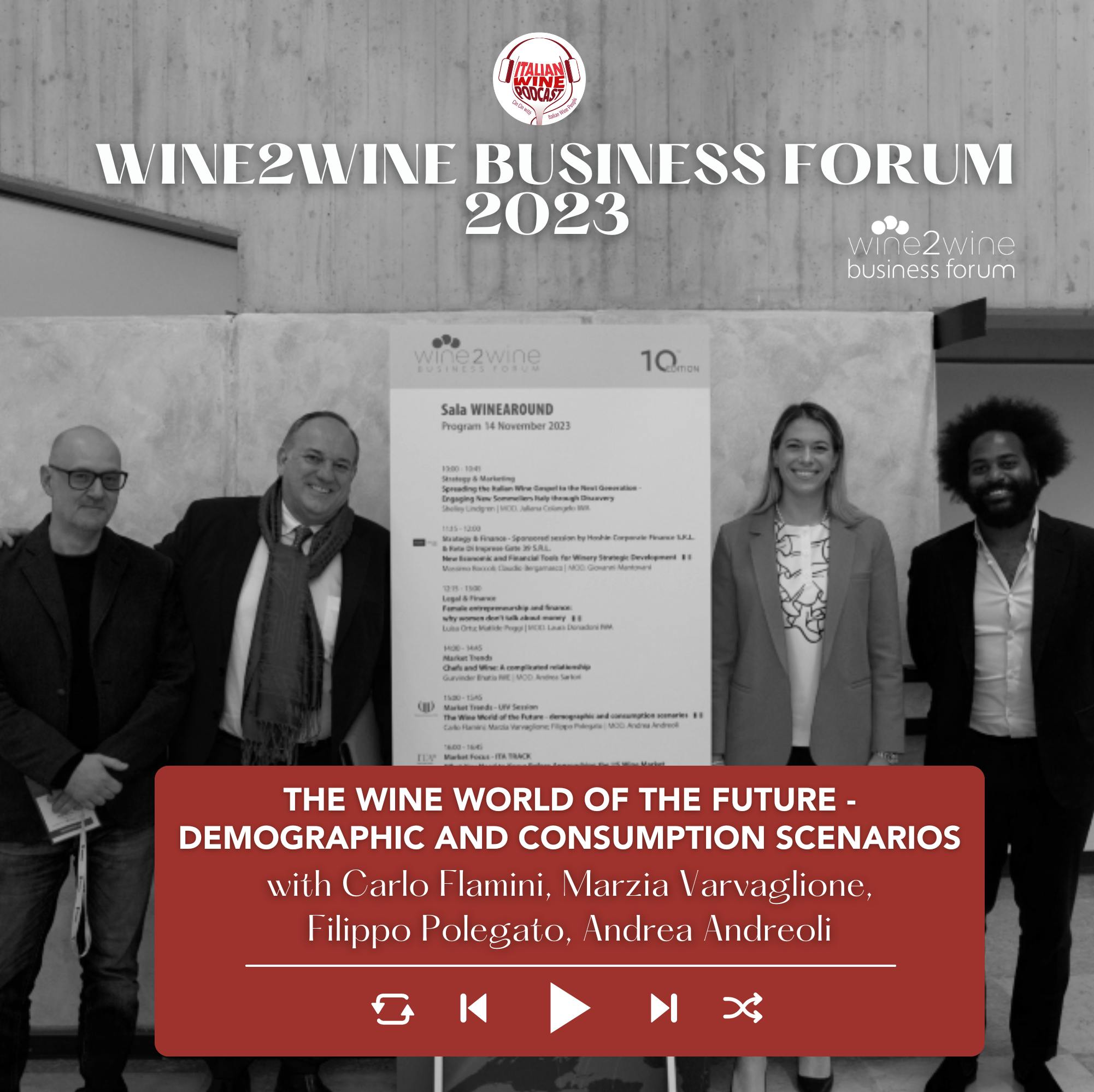
Ep. 2131 The Wine World of the Future - demographic and consumption scenarios | wine2wine Business Forum 2023
Episode 2131

Ep. 2123 Chefs and Wine with Gurvinder Bhatia and Gino Colangelo | wine2wine Business Forum 2023
Episode 2123

Ep. 2115 Why women don't talk about money with Luisa Ortu, Matilde Poggi, Laura Donadoni | wine2wine Business Forum 2023
Episode 2115