

Ep. 2123 Chefs and Wine with Gurvinder Bhatia and Gino Colangelo | wine2wine Business Forum 2023
wine2wine Business Forum 2023
Episode Summary
Content Analysis Key Themes and Main Ideas 1. The disconnect between consumer expectations and restaurant practices regarding wine lists and food pairings. 2. The importance of chefs' wine knowledge and collaboration between kitchen and sommelier teams. 3. The need for a fresh, imaginative approach to food and wine pairing, moving beyond traditional Western constructs. 4. The growing relevance of non-Western cuisines in mainstream dining and their potential for wine integration. 5. Opportunities for the wine industry to expand its audience by embracing diverse cuisines and breaking traditional norms. Summary In this interview, Gravinder, editor and publisher of Quench magazine, discusses the challenges and opportunities for Italian wines and the broader wine industry in navigating global cuisines. He presents findings from a survey conducted by Quench magazine, highlighting significant disconnects between consumer expectations and restaurant realities regarding wine lists, pricing, and food pairings. For instance, consumers prefer smaller, more affordable wine lists, while many restaurants offer over 100 labels at higher price points. The survey also revealed that despite consumers valuing wine-knowledgeable chefs and food-wine events, many pairings are deemed unsuccessful, and chefs often create menus independently of the wine program. Gravinder argues for a paradigm shift, urging the industry to move beyond the concept of ""perfect pairings"" and embrace ""different is different, and that's okay,"" especially when dealing with diverse, non-Western cuisines that are increasingly entering the mainstream. He emphasizes that traditional pairing rules are outdated and often ignore the vast diversity of global foods and simultaneous family-style dining. He sees a massive untapped market in non-Western fine dining restaurants, which currently often lack substantial wine programs due to historical perceptions. Gravinder concludes that there's an exponential opportunity for the wine industry to expand its user base by adapting to these new culinary landscapes, fostering greater collaboration, and educating both chefs and consumers about the successful integration of wine with diverse global flavors. Takeaways - There's a significant gap between what consumers expect from restaurant wine programs and what restaurants currently provide. - Many chefs lack sufficient wine education, leading to a disconnect between food menus and wine lists. - The industry's focus on ""perfect pairings"" can create unrealistic expectations and disappointment for consumers. - Traditional Western food and wine pairing rules are often irrelevant or limiting for diverse non-Western cuisines. - Non-Western fine dining restaurants represent a large, untapped market for wine sales and expanded wine programs. - Embracing diversity and challenging traditional norms is crucial for the wine industry to expand its audience globally. Notable Quotes - ""The industry is not in general meeting the consumer's expectations in terms of achieving this, this balance between food and wine."
About This Episode
The speakers discuss the importance of avoiding conforming to traditional ways of drinking wine and the need for a fresh approach to wine and food pairing events. They emphasize the need for more interaction between culinary schools and food and wine restaurants, as well as diversity in guest experiences. The success of pairing in restaurants is discussed, as well as the expansion of the Italian wine industry. The speakers are working on creating a balanced dish for pairing in both food and wine pairing events.
Transcript
So we have to remember that that food and wine is subjective, and each individual will have a different experience based on their own background, their environment, and their experiences. But we need to stop always trying to make things conform to the traditional way, which represents a very limited perspective. Official media partner, the Italian One past is delighted to present a series of interviews and hypex from the twenty twenty three Washington this one, featuring Italian wide users and bringing together some of the most influential voices in the center to discuss the hottest topics facing the industry today. Stage. Don't forget to tune in every Thursday at three pm. Today, sir. Or visit the italian wine podcast dot com. I have to be speaking about the topic with Grevinder, our our guest speaker today, about the need for Italian wines to get beyond Italian wine lists. It's critical for success in the US market, in the world markets to not be pigeonholed on in Italian restaurants for Italian wine. And Gravinda's gonna talk about the relationship between chefs and wine beyond Italian wine, but with world cuisines. Gravinda is the editor and, chief and publisher of Quench magazine. Quench magazine is the longest running Food and Wine Magazine in North America, and also Canada's largest Food and Wine Magazine. Gravindor has quite an interesting eclectic background. He's, been owner of a wine store, an award winning wine store. He's a wine columnist for Canadian broadcasting radio. He's this VIA Ambassador, but also one of sixteen. What is that designation, Kravindor? Italian wine experts, which is so rarefied. I didn't even know that existed. Because Gravindra is also a lawyer by training and has an MBA. It's a little intimidating to sit here and introduce him with all these credentials, but Gravindra, take it away. What's what how how can Italian wine companies do better with, world cuisines and working with chefs other than Italian chefs. Thanks, Gina. So the topic for this kind of started, for for this event, this summer, and, of course, initiated by Stevie Kim because Stevie initiates so many different things. But What we did was, we send out a survey through, Quench magazine's, e newsletter, and some of the considerations in forming the questions for the survey, and as a result, the responses are up, on the board. But gonna run through the results of the survey first and then provide some some food for thought. So the survey was conducted earlier this year by, by Quench magazine, and Quench is North America's longest running food and when publication started in nineteen seventy three. It's Canada's only nationally distributed, one in food publication, and it's Canadian based, but it is international and its editorial coverage distribution, readership, and contributors. So the survey was sent to Quench's weekly newsletter subscribers, over six thousand, subscribers, and just a little bit of data, in terms of the number of respondents. So it's good sample size, and the purpose of the survey is to understand the role and importance of wine selection and wine list to the overall dining experience in North America. So, of course, we ask some some demographic questions first. Ninety percent of the respondents were over the age of forty. Almost half were between the ages of fifty six to sixty nine. The same amount, just over twenty percent, were over sixty nine, and also between the ages of forty and fifty five. Just over fifty seven percent were male, just over forty seven female. The location, eighty four percent were, other response were in Canada, thirteen percent in the US, and three percent elsewhere. The ethnic cultural group that most of the respondents identified with, seventy nine percent white European. Now, that's an interesting thing because if we had done this five years ago, that number probably would have been over ninety percent. We have done quite a bit over the last five years in particular in terms of, diversifying our audience. Well, since I took over the magazine, as editor in chief, a few years ago, the idea was we really wanted to diversify the the stories, the voices, and as a result of that, also the audience. And so, although the percentage is still high in terms of what European I think we've made significant inroads to to really broaden the audience for, for the magazine and the readership, for food and wine in general. Annual household income, thirty nine percent over a hundred and fifty thousand and sixty three percent over a hundred. So they have some disposable income. Of the respondents, a but a third work in the wine industry, and two thirds do not consumer. So with respect to and I'm gonna go through a number of the questions that, that were asked just to give a bit of a framework in terms of when we talk about, some of the thoughts afterwards. The main factor when selecting a restaurant overwhelmingly food. Over eighty percent, said that food was the main consideration. The wine list, you know, relatively amount under ten percent as the main consideration, and location atmosphere is almost as much as the wine list. On a scale of one to ten, how important is the wine list to you when choosing a restaurant? Relatively so. In your opinion, how important is it for a chef to be wine knowledgeable? Response believed that the chef should be wine knowledgeable. They should know something about wine. In your opinion, how important is the wine is wine in the creation of a restaurant's food menu? Again, fairly important. Now, listen, if you work in a restaurant, how much is the chef influenced by the wine list when creating the food menu, over fifty percent said the chef doesn't take the wine list into consideration at all. And these are respondents from restaurants. Only a quarter said that the Psalm and the wine director and the chef actually work together, in terms of creating the the the menu and the wine program. So just keep those in mind. I think this is our first disconnect when between consumer expectations and industry practice If you work in a restaurant, how many labels does your wine list contain? Over half of restaurants have more than a hundred labels on their wine list. If you're a consumer, how many labels do you think a restaurant wine list should contain over ninety five percent of consumers think a restaurant wine list should have less than a hundred labels. And half of those think that the number should be less than fifty. So question, are restaurants making wine lists too complicated for consumer? If you work in a restaurant, what is the average price of a bottle on your wine list? Over half indicated that the average price is over eighty dollars a bottle and almost a quarter over a hundred. If you're a consumer in your opinion, which would be the average price of a bottle on a restaurant wine list, ninety five percent of consumers, want wines on the list to be less than eighty dollars. So, again, a little bit of a disconnect. If you work in a restaurant, how often is the wine list updated every month, every two months, so, relatively at least every year. And if you're a consumer, how often in your opinion should a restaurant update their wine list, then relatively same, I think, from, from the standpoint of consumer to what's actually happening? To what degree do you let the Somier or wine server influence you when selecting a wine in a restaurant? It's somewhat, but it's not putting the full trust in the Psalm. Why is this? Is it intimidating? Is there a lack of communication or ineffective communication between the Psalm and the consumer? If you're a consumer, what types of events would you like to see organized by restaurants? And it's very clear that consumers like winemakers dinners, they like food and wine pairing events. They like wine and food cooking classes, collaboration dinners, So they like wine and food events, more so than they like plasts. How much do you value events organized with wine producers in restaurants? Consumer strongly value events with wine producers. I think that's a a very important factor here. In your opinion, what is the primary reason for restaurants to organize events with wine producers? Consumers believe that events with wine producers in restaurants give wineries the opportunity to introduce themselves to consumers. Discovery, that's a very good thing, and also that it contributes to building a restaurant and communities wine culture. Now this is interesting during the last wine and food pairing event that you attended at a restaurant in your opinion were the pairing successful. Almost forty percent indicate that the wine and food pairings weren't great. At the last wine and food event they attended. So not a ringing endorsement, but honestly, I didn't find that all that surprising. I think all of this what do we take away from all of this? I think that number one, we do need to have a fresh approach to wine and food pairing. And I love this quote from Randall Graham. If you have imagination in the wine business, you can do something special. Because it's such an old business, sometimes there's a bit of a lack of imagination. So the survey shows that, you know, people believe that chefs should be knowledgeable online. That people think there should be some relationship between the food menu and the wine list. But the reality is that chefs create the food menu largely independent of the wine list. Is that because there's a lack of wine training education for chefs in culinary schools? When they're out working in the workforce, what is the interaction between the the front of house, wine director, Salay's, and the kitchen? And even though consumers value wine and food events often forty percent of the time, according to this survey, they find that the pairings aren't great. So the industry is not in general meeting the consumer's expectations in terms of achieving this, this balance between food and wine. What does this all mean? I think some obvious things like the discrepancy between consumer perceptions and expectations and the real reality in restaurants is, is clear. But I also wanna look at the current environment and and consider why. And here's some basic considerations. I think and I think one of the things is the beauty of food and wine is the discovery and the diversity. There's no disputing that food and wine can be sources of incredible pleasure or translators of people place culture and history. And they're they're wonderful partners, and they have the ability to make each other better. I think part of the problem may be this expectation of achieving perfect pairings, that our industry has really created. And I think that's one of the reasons why so many people said that the pairings at the events they attend aren't great. This concept of perfect pair perfect pairings creates these expectations. And then you combine that with a lack of wine knowledge experience with the chefs or lack of substantive interaction and communication between the wine directors, somebody is in a restaurant in the kitchen, and the result tends to be disappointment. I think if we look more to moving towards the concept of different is different, and that's okay versus having one to be better than the other in terms of people's experiences. I think it starts to change people's perceptions and their experiences in terms of what their expectations are in terms of of food and wine in general. There doesn't need to be more chefs that have wine training. My experience with a lot of culinary schools is that the chefs receive or people on the on the food side receive very little wine education. It's a very small minor component to their to their process. Are there some ex, exceptions to that? Absolutely there are, but I think in general, chefs really don't receive enough wine training or exposed to it enough. I think there needs to be more interaction between the wine director and the chef between the food menu and the wine list. And one of the other considerations in my opinion is the increased diversity in the types of cuisines that are being served in mainstream restaurants. With a lot of these cuisines, we have to go beyond the traditional constructs and conventions of food and wine pairing. And, you know, I think the first rule of food and wine should be to throw out the rules. Most were established decades ago when those that established them either ignored or were oblivious to the fact that of the existence of any sort of non western cuisine at a time when there wasn't the vast diversity, and of grape varieties and styles, being produced around the world. And without question, the overall quality of wine currently being produced in the world is at an all time high. I think there's also a lack of understanding that eating family style with numerous dishes simultaneously on the table is the norm in so many different cultures. So why is this relevant? I think It it's not the only reason, but I I believe there's a factor that is playing a significant part and at minimum is adding another dimension to the practical aspects of wine and food interaction. And I did a I I looked at, the New York Times top twenty five restaurants in LA, hundred restaurants in New York City, top restaurants in Seattle, London, Chicago, San Francisco. By far, half to seventy five percent of the restaurants on those lists serve non Western cuisine. So it goes to the need, I think, for this fresh approach to wine and food pairing beyond the traditional western way of doing things and this narrow perception that only certain wines can pair with non Western cuisine. And the homogenization and othering of non Western cuisines and trying to fit wine from non Western cuisines into the same wine with Western cuisine box. When non western flavors and cuisines become more widespread, they were often othered. And as being not suitable for wine or pigeonholed with only certain types of wine, for example, I don't know how many times I've been told that, you know, the only wine that goes with Indian food is, is off dry reasoning, or Gewirtzraminer, and, which is far the worst match for Indian cuisine. But, you know, one of the dangers of othering somebody's cuisine is that it also leads to othering their culture and othering the people. So we have to remember that that food and wine is subjective, and each individual will have a different experience based on their own background, their environment, and their experiences. But we need to stop always trying to make things conform to the traditional way which represents a very limited perspective. You know, our industry, I think, has a tendency. When I say our industry, I mean, the wine industry and the restaurant industry have a tendency to, to generalize and homogenize when it comes to Asian food, African food, Caribbean food, and there's a tremendous amount of diversity within these cuisines themselves. The regionality of Indian food, for example, is very similar to the regionality within Italy. And I don't think anybody in Italy would confuse a traditional distance from the Veneto with traditional dishes from Sicily. And so it's important that we don't homogenize and, and and genericize about these different cuisines. And non western cuisines, as we can tell by the number of these restaurants that are on these top restaurant lists, These restaurants have been brought into the mainstream. So now I think it's time to bring the wine component with these cuisines into the mainstream as well, but not by trying to make it conform to the conventional western way of looking at things, there's a tremendous opportunity, I, I think, here, to penetrate the growing number of non western fine dining restaurants. And I use the term fine dining very loosely, as only a small number of these restaurants currently have substantial wine programs because they themselves often think wine doesn't go with the cuisine because this is how it it hasn't been a part of their culture in general. But when we look at how these cuisines have evolved and developed in North America. It is very clear that, we're missing an opportunity by not, giving these restauranters, and the industry looking at it in terms of there's nothing that is happening at these restaurants that prevents wine and substantial wine programs from going with these restaurants. It it is not just non western cuisine. It's also restaurant serving cuisine that's influenced by the multicultural backgrounds of so many chefs that are entering the mainstream. So, I mean, third culture kids, I mean, look at Tatiana in New York. I mean, chef Quani's food is Afro Caribbean by way of the Bronx. You can't define that. Right? Nor should we try to define it? Indian restaurants where, the chef grew up in Canada or the US, but has Indian culture, they're gonna be influenced by their entire environment. And so we need to resist the urge to say that this restaurant isn't Indian enough or that this restaurant isn't Chinese enough or isn't whatever the case, because we have to understand that these chefs are bringing their own experiences, and the peers and the generation of these young chefs don't want to, and they don't approach food and wine pairings the same way with the narrow constructs as their parents and the older generation has. So I think we need to take a a different approach in terms of what has traditionally been done, discard the misperceptions and the constructs, traditionally surrounding food and wine, and really be innovative in, in our approach in terms of how we approach it. Very interesting and very challenging too. Sorry. Very interesting, very challenging. Gravinder, can you give an example of an Italian wine denomination or or even a producer that has successfully penetrated diverse, cuisines in on the restaurant scene. I can give you hundreds of examples. I mean, I I think again, we can't generalize. Right? Because the more we generalize in terms of, this, you know, producer goes with this food. Again, it it's it's about taking each, just as we would with any restaurant, taking the cuisine from that restaurant and matching the wines that go with that cuisine. Right? So, we can't genericize about Indian restaurants. I mean, I'll I'll take the unapologetic food food group in, in New York, for example. I mean, they have and they're called the unapologetic food group because they're creating Indian food in restaurants, the way it should be done and hasn't been done traditionally in North America, and they're not apologizing for it. So they have sema, which is Southern Indian. They have Demaka, which is Indian food, which almost the the unforgotten, dishes using offals and, and all, they have, masala walla, which is Bengali. They have, ratty rooster, which is their, Indian fried chicken place, and they have Adda, which is Indian street food. So each of their restaurants is completely different, whereas so many Indian restaurants in North America, really to, genericize their food to try to appeal to, the North American palette. And so with each of the unapologetic food groups, restaurants, are there some wines that'll fit on all? Sure. Absolutely. But I think that's true for any restaurant. So I think we need to look at it in, in each situation as opposed to trying to generalize in terms of what can and what can't. So of those restaurants, I mean, how do you rate their wine lists? Are they selecting wines, the specific to each of those cuisines and our and in your estimation, making successful for good choices, and how are those distributors knowing how to sell to which wine to those restaurants? Right. So, I mean, of their, of their restaurant, and they're kind of in the same boat where they are just starting to understand that wine actually does go with their cuisine. So Sema, which is their southern Indian restaurant just got a Mission Star, and it does have a really great wine list. I think it can be even more extensive than what it is. The other restaurants have very small wine lists, but they're starting to understand that they actually can pair one with their food. So there's an a great opportunity there to expand those wine programs. So in terms of how do you approach those restaurants, it's not by trying to force our, the traditional way on top of them and say, this should go on your restaurant wine list, it's to turn it around and understand that number one, the food don't eat eat at those restaurants, and and understand that, not every wine is gonna go with every type of cuisine. And we have this sometimes, uh-uh, misperception or misdirected idea in the wine industry that we can take a wine and it can serve everybody. An individual wine can serve everybody. And we need to be much more, open minded to taking a wine and saying, no, this is actually great for this type of cuisine in this particular restaurant. Or this is really good for this particular client, and and stop doing the we can play something in all situations. Can you give an example of what you consider to be a successful food and wine pairing that you've been to? Mhmm. Absolutely. And why? Sure. Let me give you an example of of actually an event we did, in New York at Masaloala in, in September. The idea was is that we we paired, Bengali food with Ontario wines. And we did this for two reasons. One is, I mean, Ontario makes great, great quality wine. Ontario is is very similar to, I think, what some of the Italian regions were twenty years ago, where producing great quality wine, but nobody really knew about it. And so but the idea at the restaurant, we didn't do a single wine with a single dish because Indian food is traditionally served family style. So what we did is we brought out waves. We had, the first wave was three whites with three different dishes. And the idea wasn't that you have this one wine with this one dish and this one with this dish. It was you try this wine with this dish and this wine with this dish and this wine with this dish, and and and the idea was not to create these perfect pairings. The idea was you're gonna have a different experience with each wine and with each dish. And when you cross over, and that's okay. And if you like one better than the other, that's okay because the beauty is actually in the discovery, and it's not about creating these perfect pairings. The idea is is let's experience and let's actually allow people to understand that different is not bad. Different is just different. And you can have these beautiful different experiences and you don't have to necessarily say, I like one better than the other. You can say I like one better than the other. That's fine, but it doesn't mean that one is good and one is bad. Right? And so we did that, and then we had a couple of reds with a couple more dishes. And then we basically, you know, turned the the room and and made it into, stations with, a selection of, food stations, selection of wine stations to make it even a little bit more informal. But the response from the people attending was basically that. Number one, they hadn't had that type of experience before because it was very different from traditional food and wine pairing event, but it made so much sense with that particular restaurant and with that particular food. And so to the point of, I mean, the even the restaurant was was somewhat shocked by, how well it went, and they wanna expand this now. And I And it was interesting because they are kind of the darlings right now in New York, in terms of getting reservations and everything else. So they had put this out on social media. The next day, I started to get messages from other Indian restaurants around the US, saying we had no idea. We also wanna try to, you know, incorporate wine into our our our program. So I think there's a great opportunity, but it has to be where we're not trying to fit the square peg in the round hole. We have to change the way the perceptions are so that we're not forcing the traditional way upon these these restaurants that because it's it's not a traditional way to do it, and it's not a traditional way to look at things if we really want to, make it work. Right? Because ultimately, there's a great opportunity to expand to a new audience, to a new group of industry that really don't have a lot of extensive wine programs, as a group of restaurateurs, but also to a new group of consumers that are looking at this and saying, oh, I didn't really I didn't realize that I could have wine with these sorts of cuisines. And I think that's a tremendous opportunity. So you talked about a successful pairing dinner, nontraditional, as you might say, diverse. Can you give an example of a pairing dinner you've been to regardless of the cuisine or the wines, but that you feel has not been successful and why? So I think, this this summer, one of the events that, we attended, And it was interesting because it wasn't so much that the wine didn't go with the food. And these were, I mean, these were, a couple of, Michelin Star restaurants. Back to back wine dinners, the main course on both nights was just not good. So it was a situation where it even didn't get to the point of the pairing. The fact that the you could tell that, I think the chefs were more concerned with creating a food menu as opposed as opposed to creating a food and wine creating menu. So they were doing something interesting different they thought with the main course, but the food itself didn't even work. So if the dish itself doesn't work, it's impossible for it to make it work with with the wine. You still have to create a situation where, you have a balanced dish with with what are you whatever it is you're creating. So I think it's part of it is Is it a event where, if it's a particular producer or particular wines, is the chef pairing the food the dishes to the wines? Or is the food menu coming first and are the wines being prepared and, or paired with, with the food? And in situations where the wines come first and the chefs have to pair the wines with the dishes, or pair the food with the, with, with the wines and create the, the menu. I think this is where often the downfall happens because the chefs don't have the wine education and the wine background. They're almost creating these dishes in a vacuum. So speaking of that, if you think of the chefs and the restaurant tours in a Thai restaurant, an Indian restaurant, a Japanese restaurant, in your experience, are are these restaurant tours and chefs open to learning more about wine, you know, they can increase their, you know, the size of their check. They can, be more interesting to their diner, or are they just too busy figuring out the menu to think about the wine program? Both. I mean, it, there's, again, partly because traditionally, these types of cuisines weren't looked at as, cuisines that went with wine. So there is resistance even amongst the restauranters themselves. But that is starting to change as so many more of these non Western cuisine restaurants are coming into the mainstream and being recognized by the food media being recognized by the press and having, not just, if it's a, you know, not just having the cultures of that particular cuisine going to that restaurant, having a broader range of consumers actually going to those restaurants who actually do enjoy wine. And then that's when a lot of these restaurants start thinking that, okay, maybe we actually should have and expand into wine programs. So is it happening more absolutely it is? Are more than understanding that wine can be a significant part to the experience and enhance the experience that people have in the restaurants? But, yes, absolutely. It can increase the revenue, and it's not something that has to be looked at as, an exception to the rule to have wine with these sorts of cuisines, but it's still in its infancy, I think. We we talk a lot in the wine industry about the need to expand the audience for wine, and and the threats to the wine industry of, you know, competitive alcoholic beverages and non and and non alcoholic lifestyle. But do you believe that these diverse cuisines are an opportunity for the wine industry to expand the the wine loving user base, so to speak? Exponentially so. Yeah. I think there's a a huge untapped, largely untapped, market to, from the restaurant standpoint and from the consumer standpoint. Because ultimately, if you change the expectations of the end user, which is the consumer, it's it's not just about their experience in the restaurant. They now take this home with them as well. And so I think there's such a tremendous opportunity right now in in not just North America, I think globally to really expand the the markets for for wine. I think that's a great place to end today's presentation. Thank you, Givrin. That's really fascinating. Huge opportunity, huge challenge for the Italian wine industry to get more diverse on more diverse list. Thank you. Listen to the Italian wine podcast wherever you get your podcasts. We're on SoundCloud, Apple Podcasts, Spotify, email ifm, and more. Don't forget to subscribe and rate the show. If you enjoy listening, please consider donating through Italian wine podcast dot com. Any amount helps cover equipment, production, and publication costs. Until next time, Cheaching.
Episode Details
Keywords
Related Episodes

Ep. 2145 The influencer marketing playbook | wine2wine Business Forum 2023
Episode 2145

Ep. 2138 What you need to know before approaching the US Wine Market | wine2wine Business Forum 2023
Episode 2138
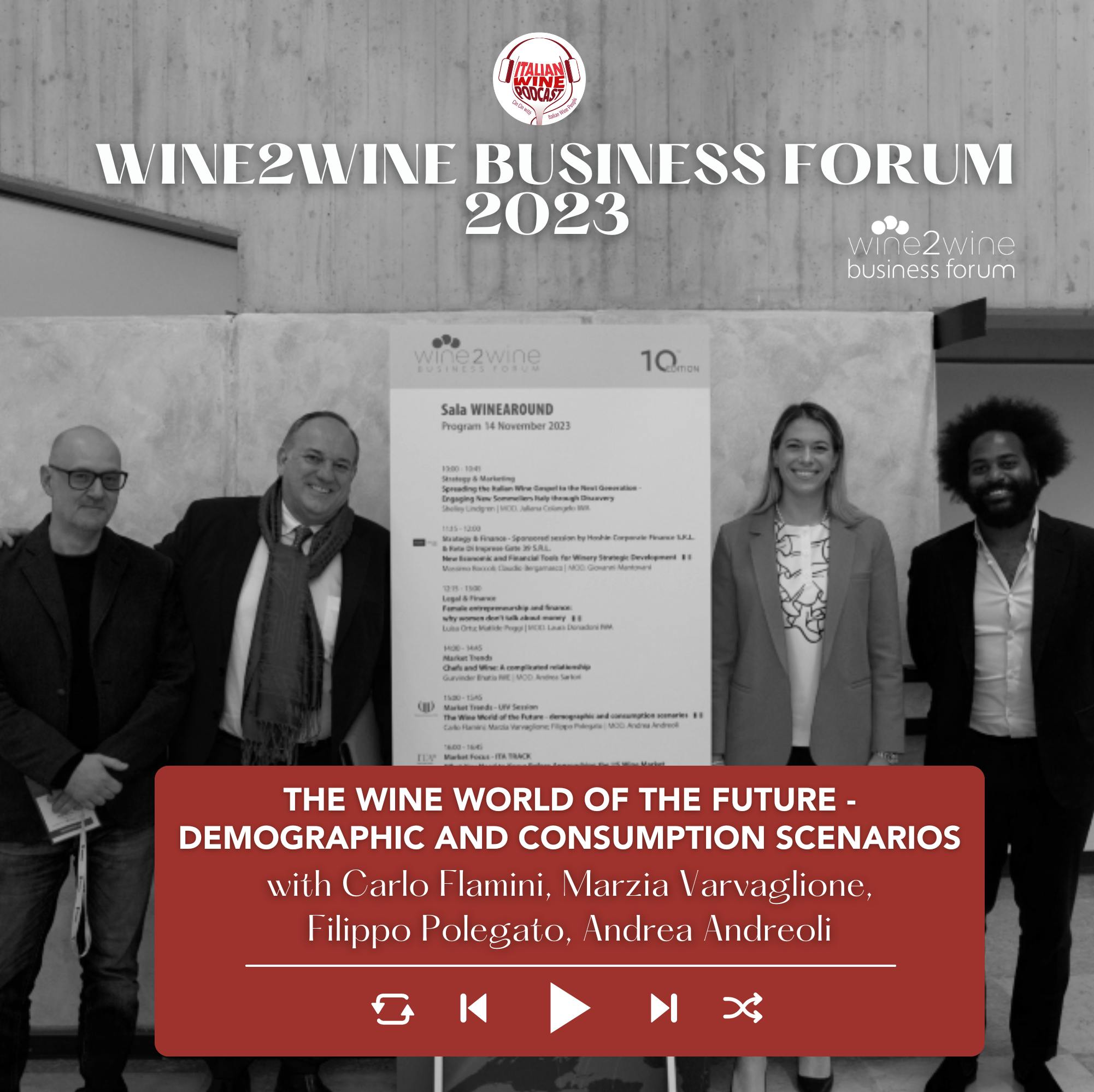
Ep. 2131 The Wine World of the Future - demographic and consumption scenarios | wine2wine Business Forum 2023
Episode 2131

Ep. 2115 Why women don't talk about money with Luisa Ortu, Matilde Poggi, Laura Donadoni | wine2wine Business Forum 2023
Episode 2115

Ep. 2106 Massimo Boccoli, Claudio Bergamasco, Giovanni Mantovani | wine2wine Business Forum 2023
Episode 2106

Ep. 2098 Uncorking the future of wine for Gen Z with William Predhomme, Valentina Abbona | wine2wine Business Forum 2023
Episode 2098