
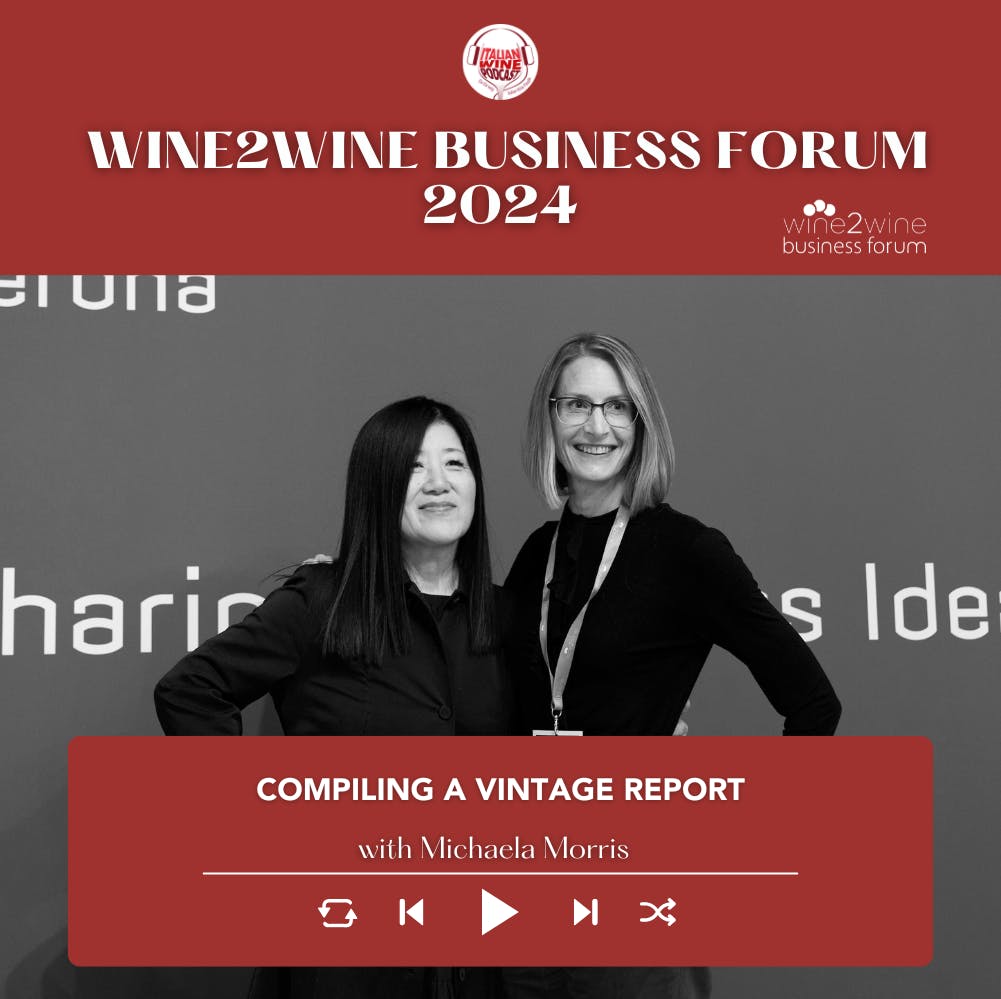
Ep 2332 Compiling a Vintage Report with Michaela Morris DipWSET, IWE | wine2wine Business Forum 2024
wine2wine Business Forum 2024
Episode Summary
Content Analysis Key Themes and Main Ideas 1. The primary responsibility of a wine journalist: serving the consumer with honesty, not the producer. 2. Mikaela Morris's detailed methodology for writing vintage reports for Decanter Magazine, emphasizing context and direct experience. 3. The distinction between individual vintage reports, blind panel tastings, and other wine assessment formats. 4. The profound influence of growing season conditions and challenges (e.g., climate, disease pressure) on wine vintage characteristics. 5. Nuance in wine scoring: the subjective yet consistent nature of assessment, and the importance of reading full reviews over mere numerical scores. 6. The specific characteristics and challenges of recent Brunello di Montalcino vintages (2017, 2018, 2019). 7. The significance of wines expressing their origin (vintage, grape, place) and their aging potential. Summary In this session, wine journalist Mikaela Morris, primarily associated with Decanter Magazine, elaborates on her comprehensive approach to creating vintage reports. She clarifies that her ultimate responsibility lies with the consumer, necessitating honest reviews despite acknowledging the immense effort producers invest. Morris details her process, which involves frequent, in-person visits to wine regions, observing growing conditions, and interviewing producers to gather crucial context. She highlights that her individual vintage reports differ from blind panel tastings but both aim to provide deep insights. Morris illustrates her points using recent Brunello di Montalcino vintages (2017, 2018, 2019), describing how specific weather patterns affected wine characteristics and how she assesses elements like structure, freshness, and aging potential. She stresses that scores should always be interpreted within the context of the wine's category and encourages readers to delve into the full vintage report for a complete understanding, emphasizing that wine assessment is not merely about numbers but about storytelling and context. Takeaways - A wine journalist's primary duty is to be honest with the consumer, serving as a guide. - Thorough vintage reporting requires deep immersion in the region, including observing growing seasons and understanding producers' challenges. - Challenging vintages can still produce extraordinary wines, providing rich narrative content for reports. - Wine scores, like Decanter's star system or points, are contextual; the accompanying detailed review provides crucial insight. - Vintage reports aim to capture the ""character"" of a vintage, not just its quality, by linking growing conditions to wine style. - Key assessment criteria for wines like Brunello include complexity, balance, substance, structure, sense of place, and aging ability. - Wines should ideally express their vintage, grape variety, and specific terroir. - Producers should read the full vintage report and tasting notes for context, not just focus on individual wine scores. Notable Quotes - ""I always have to be honest about what I'm tasting because my responsibility is actually to the consumer, not to the producer."
About This Episode
The importance of writing for both the consumer and the producer is emphasized, along with the virtual session for wine tasting and a focus on discovering the way wine communicators and wine producers approach vintage reports. Visiting the region during the entire season is emphasized, along with the importance of understanding the region and wines during harvest. The speaker emphasizes the importance of tasting in context of the category and finding balance between the fruit, alcohol, and structure, and provides examples of their top scores. They suggest doing a retrospective of the wine to determine its aging potential and offer networking opportunities for group therapy.
Transcript
It's also important to note that Decantor Magazine, there are a lot of people in the trade who read it, and I'm I'm very thankful for that, but it is ultimately a consumer magazine. And so I'm writing for the consumer. I'm not writing for the producer. So it is a fine balance. Because I know for the producers that they have spent a year and longer to put that wine in the bottle. So to me, writing a very negative review doesn't really have great sense. In the same breath, always have to be honest about what I am tasting because my responsibility is actually to the consumer, not to the producer. Official media partner, the Italian wine podcast, is delighted to present a series of interviews and highlights from the twenty twenty four wine to wine business forum. Bringing together some of the most influential voices in the sector, we discussed the hottest topics facing the industry today. Don't forget to tune in every Thursday at three pm or visit Italian One Podcast dot com for more information. This is our, I believe, eighth tasting, and we are here with compiling a vintage report as a wine journalist. She's also an Quisit one educator. She, helped us also create a program, not for the ambassadors, but for the level before that we are actually evolving that program. And we've used it for how many years now, like five years. Yeah. She was recording with her iPhone, like, in the middle of the street, doing lessons about grapes, and we have a lot of the students have undergone this program. But today, she does the vintage report for mostly Decanta. Is that correct? Or other organizations? I I do write for other magazines like Quench and Mingars and a few others, but Decanter is the main focus of the writing. Okay. So today, the focus will be to discover the way she taste, the rationale behind Mikaela Morris's brain when it comes to, wine tasting. And I think the whole exercise to this room, the tasting room, is not so much about the techniques about wine tastes Right? But because when you are scoring wines or when you're a wine reviewer, there is obviously some subjectivity. So for us, it's important for you as the wine communicators, wine producers, Wine educators to get into the head of those who are actually doing the writing and scoring your wines. So this is a special session dedicated to the vintage report. Okay, Mikaela Morris. Take it away. Thank you so much. I feel like it's more of a therapy session. Maybe for all of us. Group therapy. There we go. There we go. And then we can get up close and personal with the networking sessions. So thank you so much, TV Kim for inviting me back to wine to wine. It's been a few years since I participated. The last time was in the soul crushing zoom COVID years. So it's quite fantastic to be here in a room and see you face to face. Yesterday, when I did one of the tasting sessions, I thought I would be so intimidated. And then when I sat down, I didn't realize you were running late, and I saw that there weren't that many people in the room, and I was a bit crushed again. So thank you so much for showing up. And a special thanks to Stevey as well because I went through the Vineidly International Program, and after I finished, Stevy gave my name to Felicity Carter, who I hope all of you heard today at her session, and I'm very much in agreement with Devy in terms of the esteem that I have for her. She's a fantastic writer. It was also a fantastic editor, which she was at Meinegar's. So that was such an amazing opportunity for me, and I continue to write for Meinegar's today. So after that, after Stevie gave my name to Felicity, I started writing for a decanter, so that was in two thousand and seventeen. And quite quickly, after I started writing for them, they asked me to take in hand the vintage reports for Bruno de Montocino, Vino Nobile, and, Chianti Clastico, which was fantastic. I mean, I have a background before writing about wine, before doing Venili International Academy. I was an importer in Canada for many years. I worked at private wine store, and I've been tasting Italian wine for many years and had been visiting Italy since two thousand and four was my first wine visit here. So it was really exciting for me to take on those reports. Fast forward to today, I still cover those regions in the vintage reports, and I write other articles for Decantor as well. This year, I got to write my first ever vintage report for British Columbia, which is where I live. I don't spend a lot of time there anymore, but, it's it is my home base, so to be able to do a vintage report for an international magazine like to counter on the wines that I was first exposed to was pretty exciting and equally as exciting for any Piedmont producers in the room here. I will be doing the vintage reports now also for Barolo and barbaresco. So I have a lot on my plate. So I wanna talk to you a little bit about how I approach vintage reports who was here in the session yesterday with five star wines. I thought it was a really interesting presentation, and I think it gave a really great overview as to an approach because there are many different approaches to going about doing it's not just a competition, as they said, but a guide book, but really there is a collective process there. So you come to a group consensus, and there is discussion, which I think is very important. In terms of doing vintage reports, for Decatur, there's many different writers, and all of us, you know, we cover different areas. We have different areas of expertise and specialty. And I think that's really important, and because we're covering areas that we've been too many times, and we have a great familiarity with. But we're doing them on our own. So the vintage report is just one single taster So it's quite different from the approach that you would have with something like, five star wines or some of the other, the other wine competitions. A vintage report is also very different from writing reviews for a magazine. If you were here for the session with the Danielle, which I thoroughly enjoy because it's a very different process than what I go through with decanter, where wines are sent in, and all of them are tasted and reviewed and done blind. Vintage Report is, I think, geared to a different audience because if somebody doesn't know Bruno, I'd be very happy if they read the vintage report, and I wanna make it accessible to them. But generally, I would say that the vintage reports that we have at Decanter, they're geared very much to a collector audience, people who follow that region from year to year, and want to know what they should buy and why. But it goes beyond simply assessing the quality of the vintage, and we try to get into what the character of the vintages. So we look at what the growing season was like and how that shapes how the producers handled their grapes and the vinification and determine what the style of wines are from that particular vintage. So it is very different process. For me, it's extremely important to go to the region, not just once a year, but even multiple times during the year, to have a great understanding about the region as well as the wines that are made there. And I really like going during harvest because it tells you a lot. And when I say during harvest, maybe sort of leading up to that harvest time, late August, sometimes into September, I remember being in the Lange, so Barolo, Babresco, in two thousand and fourteen, for the entire month of September. And if you're familiar with Vintages, two thousand and fourteen was thought of as not a very good vintage, There was a lot of rain. It was cool. There was hail. Like, there's all these things going on. And I was actually doing a wine tour, so earlier on in September. And the the weather was just it was horrible. We were in good spirits though because we had lots a great wine. And as soon as, like, literally the day that everybody left and I stayed on, there were beautiful blue skies. And I think about that vintage a lot because it's easy to pan a vintage, but there are things that happen you know, that it's not just the summation of the growing season itself. It's about the different moments. I was back in, Piedmont again this September, and there was a very palpable sense of cern about whether they were gonna ripen their grapes or not, because they had other struggles, with with this vintage as well. In terms of Bernella, which we're gonna be looking at today. For example, in two thousand and seventeen, I spent, late August there, and I felt the suffocating heat. I saw how dry the landscape was. Banfis Lake, which they used for emergency irrigation was almost depleted. And people were already harvesting mostly Marlowe, but, you know, people were whispering in my ear that they were actually already harvesting San Jose, which for late August, is very early. And one of the producers described the fermenting Vats to me is jam. Now this is not to say that I take that information and say this is gonna be a bad vintage or this is gonna be a good vintage. It's simply to live through what the producers are living through because fast forward to four years in the case of Bruno, people don't have the same memory of what they were living through at that time. So it's really important for me to be there, write notes about what's going on, interview people during that time, I have a sense of what happens because we remember things differently later on. And I also think too, from these challenges, you can make extraordinary wines, and these are the stories that people wanna hear. If a vintage is great and nothing happens, there's a lot less for me to write about, but there's also a lot less for the consumer to understand that making wine is, you know, you have the challenges of mother nature, and there's a story there. We wanna share with people what producers are going through. And I like to use that vintage report to give the human aspect to wine as well, and I think that it's not just about the wines themselves and the ratings that they get, but also all the other circumstances around it. So a vintage report is really to give context. And so for any of the people in the room here who are producers, highly recommend that when a vintage report comes out, is not just to look at the score that your wine was given, but as so many people have said in these last couple of days, is to actually read the review that goes along with that score and to read the vintage report itself. Because I think that will give a little bit more context. So besides visiting the region plenty of times, I try to to taste as many wines as possible. And I'm a big believer in tasting wines blind, which is what we're gonna do here today. However, it's not always possible when I'm doing the vintage report. So I generally go when they're doing the previews of the wines. And in some regions, they'll do the tastings blind. In other regions, we don't have that opportunity. If I taste it home, I'm very lucky. I have a very patient and helpful husband, who will pour the wines for me blind. He's very good at opening bottles now. And the other issue that I come up against, for, tasting wines for the vintage reports is that not all producers will participate in the general tastings. So I've gotta go out to them and I have to get samples. On top of that, I wanna visit the producers. It's impossible for me to visit every producer, every single vintage. But every year, I try to to visit different producers so that at least when I'm tasting their wine next year, I have a sense of what their vineyards are like, what their philosophy is, what their approaches to wine so that when I'm tasting the wine, I have a better, hopefully, understanding of why the wine tastes as it does, and also maybe to share that information and to give some insight into that in the tasting note itself. And one of the things that I like about writing for a decanter magazine is that when we write our tasting notes, it's not just the laundry list of what we taste, fifty percent of what we write, is supposed to also be about other things that play into the wine. So, especially when I'm writing about the vintage report, I do talk about some of the specificities of what happened at that particular winery for that particular year if I'm able to have the interview with them. So we'll add in some aspects about perhaps, how they approach the fermentation, for example, or I talk about the specificities of their vineyard site just to give again more context to the wine. That's just to give you an overview of how I approach it just in terms of vintages in general. The best vintages don't necessarily mean that the weather was perfect throughout. As I said earlier, you can have great wines and very challenging vintages, What I look for when I'm going to make a judgment on a vintage, because I always have to do some kind of summary, is that I'm looking for a critical mass of successful wines across price point across categories. So, for example, if I'm looking at Kianti Clastico, I'll be looking at a Nata. I'll be looking at, to Grand Salazione, and then, of, of course, across sub zones. And that's actually how I try to approach the tastings is by sub zone, and it's not to say that this particular area within a region did better than another. Obviously, I will be looking to see if there were more successful areas than others. It's also to find the commonalities because it's just a great learning opportunity for myself to see how those sub zones expressed from vintage to vintage, and again try somehow to communicate that. To the readers as well. And of course, I'm looking to see when I look at all the wines I tasted, how expressive were they of the vintage itself of the grape that they're made from as well as of place? And do they have the ability to age well. And not to say that that is the one defining factor, but it is certainly something that I take into consideration when I'm evaluating a vintage. I never wanna write off a vintage. So even if In the end, I decide that a vintage, the overall, I don't want to say score, because we don't score. We use the star system and decantua when we're talking about vintage. So we will give it a score out of five stars. So let's say I give a vintage three stars, that doesn't mean to say that all of the wines will sit at a specific point score that would translate it as three stars. You have over performers in lesser vintages, and you've got disappointments in great vintages as well. And that's really something that I try to take out of every single vintage report who were the successful? What were the most successful wines in my opinion? Are there great improvements that I'm seeing in particular wineries that I taste year after year after year? Are there newcomers as well? So I'm looking at all of those things And I think it's also important to note that Decantor Magazine, there are a lot of people in the trade who read it, and I'm I'm very thankful for that, but it is ultimately a consumer magazine. And so I'm writing for the consumer. I'm not writing for the producer. So it is a fine balance because I know for the producers that they have spent a year and longer to put that wine in the bottle. So to me, writing a very negative review doesn't really have great sense. In the same breath, I always have to be honest about what I'm tasting because my responsibility is actually to the consumer, not to the producer. And I think that's really key to note. You know, and I, I like to have a relationship with the producers so that I, they have an understanding. I'm always open to off record information as well, and I'm, and I try to be very respectful of that. But I think as producers, you always have to remember that as as wine writers, our responsibility is to the sumer's. Luckily, when I write vintage reports, I'm not reviewing every single wine I taste, and I get to select my top. However, many picks I've been allocated for a particular region. So what else can I tell you? I'm not a big fan of points scores. I don't think anybody who writes about wine is, and we've heard that time and time again in many of the sessions, today, but it is one of the factors of reviewing wine. So I'm respectful of that, and I'm also very respectful of the fact, that I write for Decantor Magazine, and they have their own criteria for giving point scores. So just for those of you who aren't familiar with it, eighty six to eighty nine points is what we would consider a bronze medal if we were doing our Decantor World wine awards, that translates as a wine that's well made and it's balanced and perfectly suitable for drinking. So eighty six points is not necessarily a bad score. If I'm scoring wine eighty six, I should still be able to drink a glass of it. Okay? You have to remember though that these scores are always, and, particularly, because we know what the category of wine is that we're scoring, it's always in the context of the category. So a wine that's between ninety and ninety four, which we translate as our silver medal at Decantor. This is a wine that is an excellent wine, has a little bit more excitement to it and has a little bit more distinctiveness about it. And then you get into wines that over that are over ninety five points. And these are wines that we will call outstanding memorable and, have a high level of complexity and a high level of character to them as well. But remember, this is all in context of the category. I did a vintage report for a region. I wouldn't even mention the region a few years ago, and I got a note from my producer who was angry that I had given his well, I'll say it was a Bernelo, ninety two points. Ninety two points for me is not a bad score, but he made reference to another review, another reviewer, actually, from Decanter, who had given a higher score to a wine from Georgia. And he said, how could a wine from Georgia get a higher score than Bernelo? But he's taking it completely out of context. So I think just having some knowledge of the context of the tasting note is really key and that there's not the comparison. I typically don't respond to emails of the that nature just so just so you know. I think we should try some wines. And just maybe I can highlight some of the things that that I'm looking for. Obviously, here today, we're talking about Bruno. So I'm not looking for simplicity. I'm definitely looking for it for nuance and complexity. I'm looking I what the depth, the fruit is, and very much so, hoping to find some balance between the elements, like the oak, and the and the alcohol, and the fruit, and and the acidity. I'm looking for the substance and the structure that will give the ability to age. And I'm looking for sense of place, and I'm looking for that wonderful expression of Sanjay, which is a great variety that I absolutely adore. The other thing too, when I sit down and I taste these wines, I'm off to Montalcino quite shortly for Benvenuto Bernalo, is how are these wines showing after four years of maturation? These wines are not even technically brunello yet when I'm tasting them because they can't be called brunello until the fifth January after harvest. After that long four years of maturation, this is should be the beginning of their life. They should not be tired. And this is sort of a warning bell for me if I'm tasting these wines, and I'm finding the wines showing is already overdeveloped or to a ball. Just in terms of the tau, we're gonna approach this, tasting today. We have three brunello, and I've chosen three of the most recent vintages that I did vintage reports for. So that's two thousand and seventeen. Two thousand eighteen and two thousand and nineteen, but I'm not telling you what order we're trying those wines. What I want you to do is I want you to taste them. I'm gonna talk quickly about those three vintages and just think about which wine you might think comes from a specific vintage. And that's, again, not to say that one vintage is better than the other. Some of these wines are more challenging than others, but how do these wines express their vintage? You can also, if you care to do so, write your own score, and we can have a little bit of discussion about where you placed it. But I do think that how people score wines and how you might approach it and how I might approach it will be different. You may not even use the the hundred point scale. It isn't a science. So it is something that is rather subjective. I try to be consistent. So but we're human beings. And and wine isn't, again, it is not to be reduced to numbers. So just to talk about the two vintages. So two thousand and seventeen, I would have tasted three years ago. I I've already alluded to what the conditions were, in that vintage, where it was very, very arid, very, very dry. The wines went into hydric stress. You had, challenges with getting phenolic ripeness. So that translated overall into the wines when I tasted them into these more arid tannins, very dry tannins that, poke through. And not just in terms of how they felt, but also the shape of them. I kept thinking them as as being very kind of compressed and short, not those sort of longer leisurely tannins across the palette. And that this is just a vintage characteristic that I picked up on, more of a macerated fruit character rather than a fresh fruit character. But what was nice about, about the vintage is that there were a lot of producers that successfully managed to preserve a freshness in the wines, in the better wines overall. In general, though, I felt that the wines, with all of their exuberance and, rawniness upfront, I didn't feel that this was gonna be a long lived vintage. Certainly, there will be wines that age longer than others, but I just felt that if the wines were age too long, maybe some of those dry tannins would become a bit ungainly with time. So I gave sort of a shorter drinking window to the vintage as a, again, as a whole, right, because this is a snapshot. So that's two thousand and seventeen. Two thousand and eighteen was a very different vintage. It was much much cooler relatively, and it very unstable weather throughout. So there was a lot of rain, even when it did get warmer in the summer months, the rain was like clockwork. And again, I actually remember being there and you could almost set your watch to the time that the rain would start falling. There was a lot of disease pressure throughout that period. And then even when they got into September, despite the fact that they did have some nice weather with some warmer days and cooler nights, which is what Santa Basee likes, They had two significant rainfalls. And this was a challenge, particularly in certain areas because it was about when to pick. So the challenge with two thousand and eighteen was managing the phenolic and sugar ripeness against the risk of rot. And, you know, I take my hats off to wine growers because I do not think that making wine, growing grapes is an easy thing at all. And again, that's why I say to read the vintage reports because I do often allude to that and try to share those stories. Two thousand and nineteen as, the the loss of the trio that we're going to be trying. In some ways, this was an easier vintage. It was definitely a warm vintage, but not with the extremes that we see from some of these other vintages. So they had rain at the right time. And when I was getting closer to harvest, typically you had those warm days with the cooler nights, which allowed for this long ripening period. So again, it's gonna the wines are gonna show a little bit differently. Where the twenty eighteen's, I found a little bit more slender in structure, more mid weight, nice elegance, but again, not, vintage that I would look for for long aging, conversely, twenty nineteen was a beautifully fragrant vintage. I found a lot of perfume in in the twenty nineteen's overall, to the point, at the beginning, I thought there was a bit of a superficiality to the wines, but then you taste them and you put them on your palette, and you sense this real sort of structure and substance there. So Those are my short notes for the vintages themselves. Hopefully, you've tried the wines. If you haven't, take it just a couple moments to finish trying them, think about the wines in front of you, what's in the glass and what vintage might be represented by each of the glasses. So I'm gonna give them a taste as well. So let's start with why number one, and I'm gonna go through all three of them and just ask you what what vintage you think it is. I'll take a little survey here. So for why number one, who thinks that this is two thousand seventeen? Okay. So a few of you, who thinks it is two thousand and eighteen? Probably about the same. And who thinks it's two thousand and nineteen? Okay. So two thousand nineteen is seems to be more of the consensus here. Why number two, again, who thinks it's two thousand seventeen? Okay. Just a few. Two thousand and eighteen seems more of the consensus there, I think. And then two thousand nineteen, maybe a little bit of a split, but I cannot counting, not counting all the hands, the hands well. Okay. And then the final wine who thinks it's two thousand seventeen. Okay. Two thousand and, eighteen and two thousand and nineteen. Yeah. I mean, it's it's interesting to see this, but I can't even tell on that last wine where the consensus lays. And again, I mean, I I say this. I was hoping that maybe there would be some of the vintage, at least maybe one vintage here that really showed the vintage itself because I think it's important that a wine shows the vintage it's that it's coming from, but also I am hoping that what you're sensing is some very good wines here because I wasn't gonna make you try the dregs of any of those vintages. I really wanted to focus on the successes of those vintages. So I hope that you found some successes here. So let's start with the first wine here. This is two thousand and eighteen. So for those of you who who thought it was, yeah. Okay. Give yourself a pat on the back. So two thousand eighteen, as I said, this was a challenging year. The grapes came in for a lot of people with thinner skin, so a very careful maceration was necessary. And I found the wines overall less structured, and I remember sitting at the preview tastings And I kept hearing this word Bruno from the Italian. So a little Bruno, because maybe it didn't show the structure that we generally expect from Bruno de Montocino. But I found a nice elegant the wines. I thought maybe they were evolving a little bit faster, and there were some producers who made the decision, definitely do softer macerations, but also to take the wine out of wood sooner than they normally would, still within the regulations, because they saw an evolution in the wines as well. But what I think I found overall, and why I personally gave the vintage, because I have to write, rate it out of the star, I gave the wine three and a half. The consortium gave it four, although they're gonna be changing how they approach assessing vintages thanks to Gabriella Garelli and, Andrea Lenardi. I just felt there was a big range in expression. There were some very weight like wines. There were some of those nice midway elegant wines. And then there are wines that seemed very pushed in their extractions and some oaks mothering the more slender fruit. So I wasn't finding the consistency that I look for in, the top top vintages. Overall, and I, I never wanna reduce wines to point scores. I mean, I have to write these things down. But I think I gave my top score was, ninety six. But there were fifteen wines between ninety five and ninety six. So in my world, not bad at all, just to curious on this first wine, If you did use that hundred point scale, who put this under ninety? Thank goodness. Because, oh, maybe just one or two, one or two. Hopefully, it's not your wine. I'm joking. Because I wasn't really looking for wines under ninety. Here, what about between ninety and ninety two what about ninety three to ninety four? And then over ninety five and above? Not everyone maybe not everyone's doing the point score here. I was in the ninety three to ninety four point here, so it wasn't one of my top top wines But one of the things that I found with this wine is it did have a little bit more structure to the wines in a lot of the two thousand eighteen's, and I know a few people thought this might be a two thousand and nineteen, and that might have been something to do with the fact that I was saying that perhaps the two thousand eighteen vintage didn't have that structure. So let's move on to my number two. So my number two, this is the two thousand and nineteen vintage. I mean, really the challenge in two thousand and nineteen was not to mess up the vintage. And that's not coming from me. That's coming from what the producer, what most of the producers said to me. When I put my nose in the glass here, so remember we're in different parts of, Montal Chino, this is actually from the, the southwestern side of of Montalcino, and I really feel that sort of sunny character and what I call exotic because I'm from Canada, that exotic Mediterranean fruit characteristics, and yet through its generosity, there's this succulents and lusciousness to it, to it as well. And I just felt that this wine, when I tasted it, we would have been last year, that actually had the ability to age. I didn't wanna drink it right away. I thought it was gonna show bet even better with time and put it away. So point scores on this between lower than ninety. Let's just throw that one out. Between ninety and ninety two. Who gave this ninety to ninety two? No. Between ninety two to ninety oh, sorry. Ninety three to ninety four. Okay. And then ninety five plus. A few of you. That's where I was as well. And just to give you an idea in terms of, you know, if you wanna make a comparison, I had twenty five wines in my vintage report. I think I did a hundred and thirty wines from the two thousand and nineteen vintage, and and twenty five of them were ninety six and over. And then I even had a hundred point score, which is probably the first time I've done for Bernelo, and a couple ninety nines and a couple of ninety eights, just in terms of the point screws, there was more of a range in the upper register of that hundred point scale. Okay. Last, but definitely not least. Number three. So that leaves us with the two thousand and seventeen vintage, which was a struggle, you know, in in in terms of mother nature, but I do think that there were some wines that really shone I think overall the cooler parts of of Montalcino may have fared a little bit better as well as those that had soils that could retain a little bit of, a bit of moisture as well. This particular wine is coming from a fairly high altitude. It also sees a southeastern exposure, and that sort of more Easterly exposure is very helpful, because you don't have that hot afternoon sun of a more westerly exposure. So when I tried this wine two years ago, one of the things that stood out to me was that it was a wine that still had some nice freshness and had a little bit more gracefulness to it than I found in some of the other wines. And that again, it's not that I'm comparing necessarily like that. But just to point out to you why I may have pulled this out of my vintage report. So in terms of, scores, if you wanna play that game one more time, who gave this wine ninety to ninety two What about ninety three to ninety four? A couple of you and then ninety five plus? Nice. Okay. That's great. So the wine has done well. This one I gave ninety four to you for any of you who who who care to look at that. But again, I think I explained why my reasoning behind that, and I tried to express that in my tasting note as well. So I wanna finish on time, and we've got two minutes left. So just, you know, to make a nice little conclusion, remember that the vintage report is a snapshot of a vintage at a certain time. I tried the wines for my vintage reports at a very early stage. The best ideal situation for me would be to do a retrospective, which I am able to do once in a while and taste these wines ten years on to see how they're aging and also as a learning opportunity for myself when I'm writing my vintage reports to think about how these wines are gonna age in certain circumstances. And if for some reason, you know, you are produced in the room and you've sent the wine to me, or you have, put your wine into these tastings, and it's not included in the reviews or you're not happy with your score, there are many other opportunities at Decantor to put your wines in for assessment as well. We do panel tastings throughout the year. Sometimes I'm involved with them. Sometimes not. These are all done blind, and we're we do them as a panel of three. And there's to counter world wine awards as well, which we do every year, and you can submit any recent vintage for for that as well. So there's always lots of opportunities so that I can reassess the wine again or that somebody else would decant her will too. If you wanna talk to me more about how I approach, tasting wines, what I'm writing for decanter or how decanter approaches things or anything beyond that. If you want more group therapy, you can join me for the networking sessions. I'm in the glare room. I believe at two, the stipiolius at two, and then in the Nebula room at four twenty five. So I hope you enjoyed this session. I'm looking forward to seeing you in the breakout sessions. Listen to the Italian wine podcast wherever you get your podcasts. We're on SoundCloud, Apple Podcasts, Spotify, ImaliFM, and more. Don't forget to subscribe and rate the show. If you enjoy listening, please consider donating through Italian wine podcast dot com. Any amount helps cover equipment, production, and publication costs. Until next time, teaching.
Episode Details
Keywords
Related Episodes

Ep. 2570 Promoting wine - achieving success in a hostile environment | wine2wine Vinitaly Business Forum
Episode 2570

Ep. 2561 An Inside Look into Wine Enthusiast’s 100-point Rating System, Upholding Blind-Tasting Protocols, and Scoring Non-Imported Products | wine2wine Vinitaly Business Forum
Episode 2561

Ep. 2402 Margherita Andrenacci interviews Erin Kirschenmann of Wine Business Monthly | Next Generation
Episode 2402

Ep 2339 A Blind Tasting Journey exploring the nature of Natural Wine with Isabelle Legeron MW and Robert Joseph | wine2wine Business Forum 2024
Episode 2339

Ep 2317 AI for Enthusiasts: tasting with Megan de Angelo and Danielle Callegari | wine2wine Business Forum 2024
Episode 2317

Ep. 2309 Understanding maturity by the glass: old whites from Italy with Cristina Mercuri DipWSET and Gill Gordon Smith IWE | wine2wine Business Forum 2024
Episode 2309