
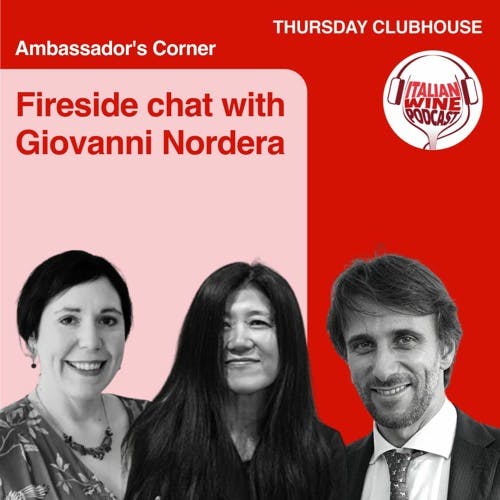
Ep. 1056 Rebecca Severs Interviews Giovanni Nordera | Clubhouse Ambassador's Corner
Clubhouse Ambassadors’ Corner
Episode Summary
Content Analysis Key Themes and Main Ideas 1. The legacy and evolution of Pasqua Vigneti e Cantine as a family-owned winery. 2. Giovanni Nordera's role as Technical Director and his journey in winemaking. 3. Innovations and challenges in winemaking, including technological advancements and generational shifts. 4. Specific Pasqua wines and their unique characteristics (""Hey, Friends,"" Amarone, Romeo & Juliet, rosés). 5. The impact of climate change and vine diseases on viticulture in Italy. 6. The passion and dedication involved in the winemaking process from vineyard to bottle. Summary In this episode of the Italian Wine Podcast, Rebecca Severs interviews Giovanni Nordera, the Technical Director of Production at Pasqua Vigneti e Cantine. Giovanni shares his nearly two-decade journey with Pasqua, highlighting how a generational shift within the company has profoundly impacted their focus on quality in both winemaking and viticulture. He discusses key changes he's witnessed, such as the adoption of chillers in fermentation, which he considers a game-changer for preserving grape aromas. The conversation delves into specific Pasqua wines, including the ""Hey, Friends"" blend that uses multiple vintages, the highly acclaimed My Dyer My Amarone, and the iconic Romeo & Juliet line. Giovanni provides insights into the challenges faced in the vineyards, notably the severe drought in Italy and the increasing intensity of the sun, which cause ""sun burns"" on grapes, prompting the exploration of ancient pergola systems and protective nets. He also addresses the serious resurgence of the Flavescence Dorée vine disease, emphasizing the need for collective action among producers. Giovanni expresses his deep passion for vineyard work and the fermentation process, viewing plants as akin to children. He also touches on the winery's resilience during the COVID-19 pandemic and Pasqua's operations beyond Veneto, in regions like Puglia and Sicily, reflecting the family's diverse origins. Takeaways - Pasqua Vigneti e Cantine has undergone a significant generational shift, leading to a strong focus on quality in winemaking and viticulture. - Giovanni Nordera views the use of chillers in fermentation as a pivotal advancement in enology for preserving grape aromas. - Pasqua employs unique techniques, like blending multiple vintages for wines such as ""Hey, Friends,"" to achieve complexity and aging potential. - The My Dyer My Amarone is distinguished as an ""unconventional"" and mineral-driven wine designed for long aging. - Climate change, particularly drought and intense sun, is a critical issue for Italian vineyards, prompting innovative protection strategies. - The re-emergence of Flavescence Dorée (Golden Flavescence) disease is a serious threat requiring collaborative solutions among winemakers. - Winemaking is a continuous process of research and evolution, exemplified by Pasqua's constant pursuit of refining their production and exploring new techniques (e.g., concrete vats). - Pasqua operates beyond its primary Veneto region, with vineyards and wines from locations like Puglia and Sicily. - The Pasqua winery welcomes visitors to its tasting room in Verona, offering an immersive wine experience. Notable Quotes - ""I didn't notice lots of changes because in my opinion, the game changer in enology was the user of chill in order to reduce the temperature of a fermentation. Keeping and preserving all the grape aromas."
About This Episode
The hosts of a wine podcast discuss the upcoming edition of the Italian wine to wine business forum, highlighting the success of the event and the importance of learning objectives for those interested in Italian wine. They also discuss the importance of protecting against UV rays and preserving family legacy. Speakers discuss the importance of protecting against heat and the need for a new system to protect against heat. They also touch on the importance of protecting against the pandemic and the use of a new system to protect against the virus. The speakers emphasize the importance of working with other winemakers and finding a great wine experience. They also mention their entry into the barrel room and their desire to control the maturation of wine. They emphasize their interest in tasting new wines and their efforts to support Makayla.
Transcript
Welcome to the Italian wine podcast. This episode has been brought to you by the wine to wine business forum twenty twenty two. This year, we'll mark the ninth edition of the forum to be held on November seventh and eighth of twenty twenty two in Verona Italy. This year will be an explosively in person addition. The main theme of the event will be all around wine communication. And tickets are on sale now. The second early bird discount will be available until September eighteenth. For more information, please visit us at wine to wine dot net. Welcome to this special Italian wine podcast broadcast. This episode is a recording off club house, the popular drop in audio chat. This clubhouse session was taken from the wine business club and Italian wine club. Listen in as wine lovers and experts alike engage in some great conversation on a range of topics in wine. If you enjoy listening, please consider donating through Italian wine podcast dot com. Any amount helps cover equipment, production, and publication costs. And remember to subscribe and rate our show wherever you tune in. Welcome to Ambassador's Corner. We're a couple minutes early, but, let's get going and, welcome. So I am, standing in for Stevie tonight, because she is still in London. Stevie and the team are doing, via in London. Yeah. I think they should be wrapping up. And so Yeah. I think it was a a success. So, yeah, Ambassador's corner here on Clubhouse. This is gonna be replayed on the Italian wine podcast, probably in the next few weeks. And we do that so that people from different time zones can tune in. Now, tonight, we have, Rebecca Severs speaking with Giovanni Nordera. And I'm gonna just, Rebecca, I'm gonna give you a a very quick, intro. And then, I got a couple questions before we get started. So, Rebecca Savers is from Memphis, Tennessee. And she is very passionate about wine and Italy. And she became a restaurateur at a very young age. She and her husband opened barely twenty years ago. She's the owner, front of the house manager, and wine backed buyer. And, yeah. So that's, that's awesome. And she also decided to get further into Italian wine correct me if I'm wrong. But you became a certified Italian wine professional twenty seventeen through the Napa wine Academy. And you are also a Vititalee Academy, which each national academy's master's student, and you travel to Italy whenever you you get the chance. Have I have I gone wrong anywhere, Rebecca? No. That is all correct. Okay. Yeah. So I actually remember most of that from an interview you did with the Rebecca other Rebecca. Yes. About a year and a half ago. I thought it was a really cool conversation. Yeah. So, so how are how's everything going? How how's Tennessee? It's it's good. Everything's fine. Awesome. What's the weather like? It's hot probably. Right? It's it has been insanely hot, but today, you decided to re you've got, floods today. So it's it's pouring down rain, and it eighty five degrees instead of a hundred and fifteen. So that's great. Okay. Alright. Well, I I won't complain then. It's pretty hot here too, but that sounds, a bit more drastic. It's very windy. Let me let me get get asking you these these questions. T. V. Loves the learning objectives. How did you discover the wines of Pascua vigneti and Cantina? A Cantina. Sorry. Well, we in Memphis didn't really have Pasquaux wines, but we are very fortunate to have their southeast regional manager that works for Pascquaux actually lives in Memphis. And so when when she started working for Pascquaux, She was instantly excited to have to bring the wines to Memphis, and she was, you know, equally excited to have to have us try the wines. And, that's kind of how it how it happened. You know, we we saw a lot of their wines by the glass. We saw a lot of their wines by the bottle. So that's kind of the they say, the rest is history. They were actually because the first ones to bring a prossecker Rosay, and so we started selling one mother glass when when that first came out when there were no other prossecker Rosays in the Memphis market. So that's kinda cool. So you cornered that. That's that's awesome. And, yeah, so so when, when did you why did you select Giovanni Nortera as your favorite producer? Like, what, is there anything we we should take away from this conversation? Like, I I selected him because we just my husband and I were actually in, Italy in June, and we visited the winery. After selling so much of their wines for the past few years, it was a really nice street to visit the winery. We actually toured the My Dyer My Vineyards with Giovanni. And he was just so open to all of our questions, and he was excited that we were excited about it. His passion was very obvious, with the in the vineyards, with the the grapes. We could have spent hours there just talking and looking at the grape vines. So I just think in general Passpot wines are really well made and people should be drinking them. So I just kinda wanted to to, continue the conversation with Giovanni and kind of share to share, my love of Pascual Lawrence. Super. Yeah. No. It's also it's also really great, you know, to sort of strengthen the connection when you get to to have these conversations and just, you know, just chit chat and, in a friendly way because it's, you know, it's It's not really formal. It's just it's really nice to connect. So so it's great. Let me let me just, let's let's see here. Are you there, Giovanni? Yes. I'm in there. Nice to meet you. Hello. So I'm gonna I'm gonna leave you in Rebecca's very capable hands. And at the end, if there are time for questions, usually there isn't, but, just because, you know, when you and you get to talking, but if there is, then I'll be back and and I'll I'll put those out. Enjoy. I'll be back. Alright. Hello, Giovanni. Hello. So I'm just gonna introduce, Giovanni, and give you a little a little background before I start asking questions. Giovanni was born in nineteen seventy eight. He is originally from Bachinsa, a small town near Verona. He joined the Pascua winery in two thousand five, and is the technical director of production. He graduated from he graduated in Viticulture and Enology from the University of Udine. I don't know if I'll say that correctly. After his studies, he had several international experiences as an technologist at Hamilton Russell in South Africa, in Chile at Santa Rita, and Vina Morande, studying, different aspects of analogy and fermentation techniques on different local varietals there. He then spent time at the University in Bordeaux where he studied different topics, of vineyards. He also worked at Piovane Portogodi. I don't know if I said that correctly. It's a family winery as a consultant and at a winery in Saint Emilium, where he supervised the vinification of chardonnay and Sabignon and other local red varietals. His international experience has given him a very broad knowledge the wine world. He's fluent in English and French. He is also an avid skier and surfer, which we talked about a little bit when we were there in the vineyards with him. He loves the sea and mountains. And he has two children, Tomasso, and Latitzia. So that is a little of Giovanni's background. So my here are my questions. Are you ready, Giovanni? Yes. I am. I'm ready. I'm ready. So family is very important to my husband and I. Barri is is family owned and run. We're very hands on. We work side by side with our employees our sons who are now teenagers are working with this in the kitchen. After we had tasted past wild wines and we we liked them the way they tasted, what really drew us more into past wild was learning about how family oriented and hands on Aliceandro and Ricardo are. Meeting some of their employees when we visited the winery, the the very first thing they mentioned, without us, you know, saying anything was that how family oriented they are and how they are all treated like family. So what drew you to working at Pascua? I started working for Pascua fifteen years ago. At that time, I moved there because, I made a promise to a promise to my grandfather to work in the family business, and, because at that time, Pascal, now, even is a it wasn't. He's a very important Italian company. Yes. It is a very it's just family. It's just kind of with me, and I I really love that. And I love to promote and sell Italian wines that are, you know, small family producers. So you you've said you've been with Pascois since two thousand five. Things change over time. What significant changes have you experienced in the past seventeen years that have affected your wine making that either good or bad? Yeah. I've been working since, seven teen years for the company. It, it is a long time, and, I experienced it many things. Since the at all, our internal generational change, That was a very important moment because, I think, turned the generation, changed the a lot of the idea of the company, focus the our aim in the quality. So quality of the wine, quality in Viticulture, and the quality of life. In, that long period, we noticed that, what people liked and how the taste change frequently. And, which are the preferences concerning the wine, technique. I think, I didn't notice lots of changes because in my opinion, the game changer in a analogy was the user of chill in order to reduce the temperature of a fermentation. Keeping and preserving all the grape aromas. So what do we can see today? We could, even use alternative tank, like, crit ones and the ceramic ones, But, I think that should be the biggest, game changer was the the use of the chiller for conducive fermentation. Alright. Yes. I think the generational changes. We've we're seeing a lot. And I think it, you know, in order to be relevant in the wine world, you have to preserve your family's legacy at the same time adapt. And I think you guys do a great job of that. So well done. So when when did you know that you wanted to be a wine maker? Or did the opportunity just present itself to you? I can answer you, that, at the beginning, I think the opportunity presented to myself, And, for that, I started to study with the culture and the knowledge at the university, but, I really decided to become a one maker while I wasn't working in Chile, it was in, two thousand three, for the company, you mentioned the Vigna Miranda. In fact, in that time, I had, the opportunity to work with, that was the daughter of the owner. And together, we were, tasting the wines while they were fermenting. And, in, that moment, I realized the the taste, was different day by day. And so in that, moment I decided to became winemaker because, my work would have not been boring, never. Because, I saw that every vintage, will be different from the others? Well, that kind of brings me to another question that I had about winemaking. So you Pascua has this one. The the label is, hey, friends. You could have made this, but you didn't. It's one of my favorite white wines that's out right now, and it's got this cool graffiti label. But there's also the concept of blending different different vintages of the same grape. And that's it's kind of intriguing to me. And it just it makes this beautiful complex line. So how do you decide Which vintages and what percentage to use in the blends? Yeah. Hey, hey, French, is, one of my favorite wine too. I think it's it is very exciting to have the opportunity to blend such a different vintages. Normally, we choose four or five vintages. And, with the side, the presentation depending of the characteristic of the vintages. I think that the result is, very interesting because finally, the wine is very complex, and, with a very longer aging potential given by this technique, by the the Garganaga that is the predominant cultivar and the by the volcanic soil that, characterizes all the area. We are growing vines out there at the six hundred meters above the sea level. So it is an important, place for the area. When was the first vintage of that create roll cut vintage, but bottling? How how many years have you been making it? Yeah. The the first experience, sir, so first edition, was released a couple of years ago, three years ago. So it's a recent, recent experience. Nice. So it'll be, be interesting to see just how long these can age and how they change with some bottle age. Yeah. That is a very interesting. So we we all know, you know, climate change is a big issue for for growing grapes and soil types can differ from, you know, a mile to a foot away. What are what are some of the climate changes that you face in the Montevay Grove vineyards that are situated on the top of the of a hill. What are just some of the have you seen any changes, or how does that affect? Yeah. This is an important question. Yes. I think, climate change is the the biggest issue of the moment. And, every day, I think on it. It is, like, an, obsession, you know, especially in this moment that, in Italy, We are, experiences the worst drought since ever. So, it's a really, an important topic. In Montevego, we are based on the top of the hill, and, the problem in the last years is that the sun is becoming more stronger. And, we should protect more the grape maybe with the with the the use of the shadow. So I think, could be interesting, to plan the pergola system. That was the ancient, system, over the area. Instead of Ocudio, we own the the French method in order to have a more protection because, in a pergola system, leaves can easily protect the great from the sun rays. And, when you were there, I I told you that, in the last fifteen years, we start to notice, what we call the sun burns. So so a part of the the cluster is a a factor is a and finally is destroyed by the UV race that are too strong. So another things, but it's a project, you know, is a thing is to, could be to, thinking to put, some nets over the plants in order to reduce the UV radiation. And also the temperature of the canopy. And, this system works for, other plantations in in Italy, like, for example, the the Kiwi. But, nobody experienced the, that technique for the wine grade. So it's only, an idea. But I think we have to to do something because, I we we realized that in the last, ten years, the the temperature, are augmenting, all the time. So we have to move it. We have to think, for the next, thirty for the years. So we have to to do the right choices. Yes. That's very important. So maybe you can be the first one to to figure that out a new system to protect the the vines. I know everybody has a favorite grape, but as a winemaker, is there a grape that you have a bug hate relationship with? And if so, why? I think I I I like a lot of grapes, you know, here in, in Verona, in, in other countries, and, it's really, interesting to see how they can, express during the the fermentation and, what different are, each other's, and, I like, Korvina, of course, I like cabernet Swignon. I I love Sumignon Blanca, for example, but, maybe the, the grape I I'm my best like is the the the pin on water, you know? Because I think, I could have, you know, some, similar with, that grape, because, you know, is gentle. He's delicate. I think he's a little bit shy at the beginning. Like me, But, once, you transform, pinot noir grape in the wine, maybe after years, you know, it it can make one of the best, wine, ever, I think, And, another thing I like, I like pinot noir because it's very, difficult to quantify, you know, because the skin is very delicate. It hasn't too much color. So you have to preserve it. You have to fix it. The tenants, sometimes are better. So you have to manage it. And so it is not it's not easy, but, and so you have to, interpret every vintage. So it's difficult, but it can give to you, such a lovely result. We had mentioned the Hey French, but can we talk about the My Dyer My Amaroni? It's been called Pasquoise new. I iconic camera running. It's it's scored ninety five points in the Decanner's World Wine Awards last year, and, was Wine of the Year for twenty twenty two. So can you tell us about it and how it differs from the the familiar pascua amaroni? Yeah. So the the varieties that make up the the blend of a made in my marijuana are a Corvina Corvinone, Rondinella, and, Ozoletta. The first three varieties are the dominant, in a valpolicella's valet. And the last one, is, an indigenous grape not so common. Corvina gives the, fruit aromas, you know, in particular cherry aroma. Corvina gives the, the spice, the spiceness to the wine Rondinela, the acidity, and the longness in the the Palata. And, Ozilator, finally, is very important for, our I'm not only because, it can, give to the wind, the structure, the color, and the acidity that we need. The soil in Montevegro is, predominantly calcareos, and, for that fact that the roots of the plains have to go deep in the soil to catch all the elements that the the the plant needs. And, that factor characterized the verticality and the minerality of the wine. It is, amarone is different from, Flamydia Passpa Marone, and from a traditional a maroni. It could say it's, unconventional. It's a, a new style, a maroni, maybe a a new school, a maroni, with, no residual sugar, a very complex, Marona, very mineral. We with a lot, lot of extractor. And, it's very important, even the acidity, because in this wine, it's very important, and guarantees the long life in bottle. At the beginning, when we started to do to produce, my team, was, thinking of an, marijuana that may have aged for many, many, many years. So We a little bit, we we change a little bit the style of, Maroney's, maybe a new, a new form of a, a new interpretation of, over the great, sir. Yes. It's, it's very different from from the Pascua and Maroney, and, which I love. Because they're both wonderful lines in their own. So if if anybody hasn't tried to, my daughter, my Ameroni, you should definitely grab a bottle. The valpolicella is really incredible too. I we got to taste that when we were there, and I'm waiting for its arrival in Memphis so I can share it with everybody else here. So, hopefully, we'll we'll have that soon. What is What is your what's the most favorite? You'd mentioned fermentation and tasting, you know, and changing, the taste changing daily? What is your most favorite part of the the winemaking process? Yeah. At the, when I started to work, I was, really look after the the fermentation. So I, I look after the the Easter that I used the the the temperature of fermentation, the bacteria for malolactic, and, after years after years, now I think one of the seems I like, best do is, to to taste the the the wine from the barrel, in order to make the the blends. And, what really I I love on our is, the the Viticulture because, I I really love to go to, to the vineyard and, see how the the grape are in, which condition, and, I think is, really, a tricky things because you have to, fight with, the weather, your, every day, you, you, you look at the forecast, and, you hope, in this case, we hope that, it rains, But normally, we we hope we don't like too much rain, but, I think that, the plants, I think the greater in the plants are like the, your children. So you have to look after with, with love. And, it's very it's very tricky. It's very passioning. And because, the grape and the plant are, are live. And so, I think, there are many, many, factor, many variables, so it's very, very tricky. And, I love that. I love to go to the vineyard and, check the quality, the maturity, and the taste of the the battery, and see, how the the vintages are different. You know? So that is what I I really love in my work. Are you enjoying this podcast? There's so much more high quality wine content available for mama jumbo shrimp. Check out our new wine study maps. Our books on Italian wine including Italian wine unplugged, the jumbo shrimp guide to Italian wine, Sanjay, Lambrusco, and other stories, and much much more. On our website, mama jumbo shrimp dot com. Now back to the show. I I knew that you loved that because we'd like I said, we could have spent hours just in the vineyard and we you would get you talking and you would start picking picking leaves off and getting really involved. And, I know you could you could spend hours there. And there's there's so many so many vines in one vineyard. So it could take you all day. I just didn't know if there was another part of the winemaking process that that really was, you know, more more favorite than than being in the in the vineyard. But, I I like fermentation because the fermentation is, the moment, you know, when you you wait, you wait, ten months, you know, to to keep the the grape, then you you crash the grape, and, you notice if the color is okay. And then, you wait three, four days that the fermentation starts, and the, the perfume comes out, and, you you you start to think, to think if, the the the the vintage is good, how is the, some, some, flavor, and so it's, exciting because we have expectation, expectation on it. So that is a very nice moment too. Nice. So what what wine are you most proud of, that you've made at Pascua? Yep. I think, they were very proud, and which are the the what we call the icons. So, like, I could say the Roman and Juliet family. Of course, the himalayan family saw the, Maroney and the, hey, French, then, eleven minutes, And, why? I think that these are the, see there what we call the icons or what we, really look after with a lot of patient and, and the love. Yes. Those are all they're such great wines. They really are. The eleven minutes is incredible. It's we sell a lot of it here. Yes. And the Romeo and Juliet, the the the whole line. Yeah. Yes. Is there are there any is there anything that you would like our listeners to know that that I haven't asked you about yet? But, I do not reco I think, I think I want to to to tell her, is, a problem that we have now in the vineyard. No? Because, it was a problem that, seemed to be resolved many years ago. Now I remember I I went to France in two thousand or to look after the Golden Flavish incident that was at the time was really a good, a very, big problem, very big issue. And now after twenty years, sir, we start to see here in Verona especially in the Swave area and prosaic area. There are a lot of, a lot of vineyards with, that illness. That is endemic. So it's very dangerous. That illness is, caused by a, a fit of plasma that is, bring by an insect. That's called the scaphoid deus tietanos that, goes to the vineyard and the spray, the there's a illness. And, when you realize that you have, this problem, you have to to cut the divine. Now that is the solution. You have to cut the divine, with the problem. Otherwise, in, a few years, sir, you will see in two or three years your whole vineyard, completely destroyed. And so this is a big problem. And, I think all the they wanna make it a producer, the great producer have to fight together to defend ourself from, that e insect. So we we have to work really close one, to each other because it's a big, big problem. And, it's a risk it's a risk for the whole, Viticulture. So but, it's not easy to resolve. So we have to to study different techniques or whatever. Yeah. Is there are you working with other, other winemakers to to figure out the problem? Is there a group or yeah? Yeah. Yeah. There is a group and we are working, for the extent with, consortium of a, soave, now that you see, soave, and we are talking, making group, talking with, the the region, and so to try the system, to, make the the region, solve the problem, go out and, look after, which, the vines are, affected, because the problem is, also that, people that, have this problem, they don't denounce it, you know, they and they don't want to denounce the the people that have a close to them, you know, and so we have it to to to solve this problem because, it's a risk it's a risk. Because if we don't do anything now, we will have, the problem in a few years, sir, and, we'll be a big one. And, also, we are to to solve now. Yes. Save the spa day. It's Yeah. Yeah. Yeah. So sorry and prosaic to a Let's let's get everybody on that. We wanna figure out figure out a solution. Yeah. Yeah. So can, the let's talk about the eleven minutes. Rosay. I know that, they're if you have a new version of that and it's it's aged a little. I don't it's not here yet, so I don't we haven't been selling it. But, is it called why? Is that correct? Yes. It is correct. Is that out, is it out now? Did it come out last year? Yeah. Yeah. They came out last year. So why is We can say, the bigger brother of, eleven minutes. Why is, I could say a a gastronomic wine? So, it's very, useful with the the foot, you know. And, the, the, the cultivars are similar So we have, cor Corvina. We have a Trevinaire. We don't have a Cira that, composer the eleven minutes. And so this, three, cultivar mix, the the blender is it's very interesting to mix, Corvina, that, Corvina represented the the backbone of the wine that that, it gives her to the wine, the acidity. Then, and the the, of course, the the the the cherry aromas, the food aromas, Then we have a a Trebiano de Gogana that is very unuseful and very interesting because, it gives the wine, a very, the the longness in the on the palate. So is very important. And then we have a carmenere. Carmenere is not a a common, vineyard here, but it's a very interesting in our, blender because it gives to the, to the rosette, to this rosette, the the structure that we need. And, I I say that is, the bigger, brother of the eleven minutes because, This wine is, more bodied, obviously, more structured, and, it's, fermenter and stay in a barrel for six months. So, there is also this creaminess given by the the boots that, bounce very well with, the taste of the wine. So, normally, y go to the, public after two years from the winter, you know, because it's a more complex process. And, eleven minutes is a more, ready product. Know that, comes out, normally six months, six, seven months after the vintage, the city of vintage. Alright. Well, that sounds good. I can't wait for it to be available in the the US. I have tasted it, but I I don't have access to sell it yet. So I'm excited about that. Can we talk about let's see the your the Romeo and Juliet line. I know it is very iconic for Pasquois and iconic for for Verona. The the label is the, you know, the graffiti from the the wall. Is there anything? I don't you do it's the prossecco prossecco Rosse. You have a Bianco, a Nuroso. What I don't know. What can you tell us about the the Bianco and the Rosseo? Yeah. You were referring, because I I did not hear you. What do you you were was referring to, Roman Juliet Lines. Am I right? Yes. Correct. Yes. Yes. So, Rosa and the Bianco Roman Juliet are, maybe the the first iconic wine we, introduced a few years ago. Maybe I don't remember where maybe was like, eight, nine years ago. And, they are, very typical from the area. I I can say because, both of them have the same method of a paciminto. In, in both cases, the, the the grape are harvest, and, are, a driver for a short period. Short period. It means maximum one month, and not more. And, in this, period that the the great loser a little quantity of water, so they can concentrate. And, about the pastiment to Obianco, it is made with, with Garganaga Oli. Garganaga is the main variety of, all area of so is a a very important white grape with a a a lot of acidity. And, after the the the period of, drying the we crushed the grape. We do a, a cold maceration, and, we ferment at lower temperature. And finally, we obtain a wine with no malolactic, very fresh, very crispy, about, around thirteen degree of alcohol. So very, intense in the nose and very pleasant. And, about the red, we use the the the grater from the area, from the venezuela, and, is, normally, we we do even in that case, we do a one month of drying process. So, we have a concentration and, after the fermentation that normally lasts, one month, We have a a big wine, very structured, and, with a pleasant, hints of food. And, the the with a lot of body and a long finish. So we have a a red wine, very modern, you could say. And, with a, a lot of success because, we we sold in all the world. So, it was really a good, a good item. Yes. I think they're very food friendly too. So you can either one of them or would just grill great with salads and pasta or fish. So they're they're very food friendly for sure. So you'd mentioned Pina noir as your one of your favorite grapes. Do you and you'd mentioned growing Carmen in that region, but it's not, you know, that's very rare. Do you Do you have a new pinot noir planted anywhere? But, yeah, we have a little, a little, vineyard of pinot noir. But, for the moment, we are not to make a a wine, from we are we are not selling a wine, from Pinonoa. I had, experiences in, you said in Hamit or us, you know, in South Africa was, very interesting. And Dave Pinolaj was, fantastic to work with, those grape. But, could be, I don't know if the future could be a label, but, Ricardo Passpar says that the pinon wire is, is not easy, you know. And so, if we go to the market with pinon wires, it should be a really fantastic pinon wire. So We we we we will take our time. Yes. And any anyone you put out is gonna have a really high quality. So take your time, perfect it, and we'll wait patiently. During the pandemic. What did you how was that for you in terms of working? Was it how did that affect you? How did you address the situation? Because I'm crazy for everybody. Yeah. I was crazy for everybody. You know, I I was really scared at the beginning. It was coming, here in the winery, like, a robot, not with, several masks, glasses. So I I wear, against, So it was really, really scared of the pandemic, even a a speaker with our colleague. So we we took the distances and, we we had to work. So It wasn't so strange, but it was stranger to go to the work and, in the street, you you you saw that the street empty, completely empty empty. It was a little bit, like, a post apocalypse, you know, was a really, strange moment. And, we did work. We work, all the day. We hadn't stopped for a while. We could, as a team, do what we we wanted to do. So I think it was, a really good time for us to, to understand that, human being, we in particular, we can, adapt, you know, to the moment. We can solve the the moment going forward and not, to stop about, thinking how to do, how to to go, go on, you know, it was a really a good, Jim, a good moment in that terrible period. I think we we we could, create a lot of things. Was a was a our reaction was very, very good, I think. We did we I think we all definitely learned how to adapt. Yeah. And, So things things are definitely better now is we are really, really enjoyed getting to go and visit the winery and be in the vineyards. It was wonderful. Yeah. Even for us, you know, to welcome you because, it's sad enough to, not see nobody, you know, Yeah. It is a part also of what I I love in my, in my work to when I I may met you to to, kinda, show my knowledge to give to you my what I I know, so that is a it's even, what they like to do. So, now, fortunately, we can't do it. Yes. Yes. We can. The, your winery is very sleek. I've really enjoyed all of the looking at all the barrel sizes and, the stuff going on in your in your tasting room. That's what I figured. Sorry. So is the is the winery somewhat new when? I don't know if you we we we bought a a lot of a big boat, you know, like two thousand five hundred liters I don't know if, when you came in the where, already, we're in a in the barrel room. So this is, a new entry, and, we are expecting, some, concrete, some concrete rats. So we are very curious on, work on it. Yeah. That'll be So we want to control the the the maturation of wine. So using different, different okay, you know, bigger than the tonneau and the barique. And so, changing a little bit, defining of our wine. So go. We are searching because we don't stop. We never stop, you know, we are looking for, the perfection, you know, but the perfection doesn't exist. So we we we follow the, we try to reach it, you know, and so we, we would try to use all the the technique that we can, understand when you can manage. So, it is a, a research, you know, it's ever a new research, and that is, fantastic for us, you know, to even to change in the bid, the the the wine, you know, Yeah. It's exciting. Because wine is an evolution, I think, you know, the taste change and the the profile that our expertise, and so I think, we will, do better and better, you know, in the future. Yes. I'm sure you will. You do it right now. So it's Yeah. That's exciting. So you do have you have a really pretty wonderful tasting room so maybe we just tell the listeners if you're in, in Verona. It's very close so they could stop by and taste some wine. Would they need to go to your website to to do that? Is there a way to set up a tasting? Yeah. Yeah. Yeah. Yeah. You can go to the website and organize, the tasting. All people are west camming here, and they they do their past experience. So they have a different cap. So they, we we show the binaries. So I think it's very interesting, and, we are ready to do that. So it's a way to, end enter more in contact with the the wine as you know, because, you can ask, if you have a question now, you you can really ask what you don't know in the wine, you know? What, even it's difficult to to read. I don't know, newspaper or whatever. Yep. I think it's a good experience and opportunity for the the customer. Yeah. Definitely. If you're there in the winery tasting wines with, you know, people that work there, work for your company. It's it is a great experience. And if anybody has the chance, they definitely should do it. You do because you do. There are a lot of you have a lot of wines. Yeah. It's a lot. But it's fun. I I'm excited, excited about to see what what the future holds with your wines. Yeah. We have to do. We have different wine because We are, concentrated in Venezuela, but we we work even in, with the wine from Pullia, you know, it's very important for us, even some of one from Sicily. So we we cover few return in Italy. So we have a different, that is a great, When, when I discovered it that you had a pully in San Joveza, and like, why? How why? Why do they have a pool yet, San Jovesy? And then, yeah. So I learned that the family was originally from Juliet. Exactly. Exactly. Yeah. Yeah. The first generation here. Yes. So that's I think that's awesome. And one more reason why we love, you know, to support support Pascua. Yeah. Alright. Well, before I give the room back over to Joy, I just I wanna say thank you so much for taking your time today, to let me ask you some questions. I hope that that some people learned something new. I I hope that you enjoyed this. It was fun. So thank you. Thank you very much. Now was, it's me that, thank you. It was, a great experience. It's my first, my first time that I do this thing, is very exciting, and the really I tell you thank you again because it was an opportunity. To me, I hope, to, see, to have, told something to someone, okay, to express, what we do here, and what how we do the wine? Yes. Thank you very much. So okay. Well, I'm gonna turn it back over to Joy. Hi. Yes. How are you at every it was a great interview. I, I'm not sure if we have any questions. If anybody has a question, feel free to raise your hand. And if you have a question, but you don't wanna speak live, you can always just send me an email at info at Italian wine podcast dot com, and I will forward it, to whichever whomever you have a question for. Like, do we have any anybody. I don't think so. But I want to, I want to just say thank you very much to both of you. That was absolutely fantastic. And it gets, August twenty fifth is our next one with Jay de Donato with Marco Zani of Castell No Arna. So definitely tune in for that on August twenty fifth. And as always, have a fantastic evening. Thank you both. Thank you Rebecca. Thank you. Thank you, Giovanni, for for the wonderful interview and the information. Thank you. Thank you. Thank you. Oh, and, Rebecca. Yes. It's like, oh, you must you must talk about luck as even Siri is agreeing with you. That's what I figured. I don't know how that happened. I don't know. I thought that was absolutely fantastic. I love it. Alright. Recordings. Have a wonderful evening, everybody. Thank you. You too. Bye now. Bye bye. We hope you enjoy today's episode brought to you by the wine to wine business for twenty twenty two. This year, we'll mark the ninth edition of the forum to be held on November seventh and eighth twenty twenty two in verona Italy. Remember, the second early bird discount on tickets will be available until September eighteenth. For more information, please visit us at white to wine dot net. Hi, guys. I'm Joy Livingston, and I am the producer of the Italian wine podcast. Thank you for listening. We are the only wine podcast that has been doing a daily show since the pandemic began. This is a labor of love and we are committed to bringing you free content every day. Of course, this takes time and effort not to mention the cost of equipment, production, and editing. We would be grateful for your donations, suggestions, requests, and ideas. For more information on how to get in touch, go to Italian wine podcast dot com.
Episode Details
Keywords
Related Episodes

Ep 2325 Anna Obuhovskaya IWA interviews Fabio d'Attimis-Maniago of Attimis-Maniago | Clubhouse Ambassadors’ Corner
Episode 2325

EP 2316 Alberto Martinez-Interiano IWA interviews Emiliano Giorgi of Progetto Sete Winery | Clubhouse Ambassadors’ Corner
Episode 2316

Ep. 2308 Anna Obuhovskaya IWA interviews Sara Repetto of Vigneti Repetto | Clubhouse Ambassadors’ Corner
Episode 2308

Ep. 2299 Beverley Bourdin IWA interviews Grégoire Desforges of Baglio di Pianetto winery | Clubhouse Ambassadors’ Corner
Episode 2299
Ep. 2290 Rebecca Severs IWA interviews Primo Franco of Nino Franco winery | Clubhouse Ambassadors’ Corner
Episode 2290
Ep. 2281 Julianne Farricker IWA interviews Mattia Montanari of Opera 02 Winery | Clubhouse Ambassadors’ Corner
Episode 2281