
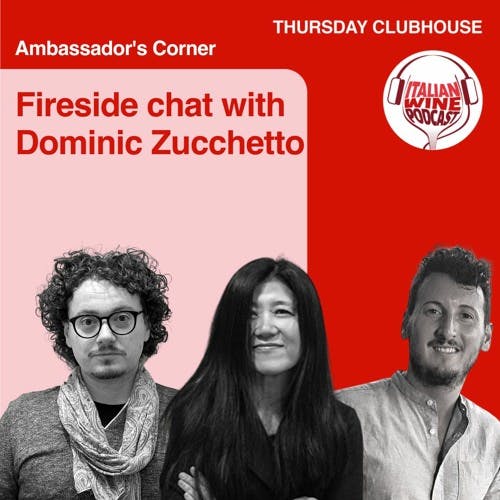
Ep. 1088 Michele Longari Interviews Dominic Zucchetto | Clubhouse Ambassador's Corner
Clubhouse Ambassadors’ Corner
Episode Summary
Content Analysis Key Themes and Main Ideas 1. The personal and professional journeys into the Italian wine industry. 2. In-depth discussion of Azolo Prosecco DOCG characteristics and distinctiveness compared to Valdobbiadene Prosecco. 3. Exploration of unique Azolo Prosecco selections from Loredan Gasparini (Tachaw, Monte, Cuvee Indigena). 4. The historical significance and unique terroir of Montello DOC, particularly its Bordeaux-style blends. 5. The history and importance of Capo di Stato wine from Montello. 6. The impact of climate change on viticulture and winemaking in Italian regions. Summary This Italian Wine Podcast episode, recorded from a Clubhouse session, features an interview with Dominic Zuketo from Loredan Gasparini winery, moderated by Mikaela Longadi. Joy Livingston, standing in for Stevie Kim, hosts the session. Mikaela Longadi shares her journey from computer engineering to a career in wine, while Dominic Zuketo recounts growing up in Italy's wine region and joining Loredan Gasparini. The discussion primarily focuses on Loredan Gasparini's two key appellations: Azolo Prosecco DOCG and Montello DOC. Dominic highlights how Azolo Prosecco DOCG, while smaller than Valdobbiadene, offers distinct characteristics, growing demand, and aging potential, debunking the myth that Prosecco must be consumed quickly. He details Loredan Gasparini's unique Azolo Prosecco selections: Tachaw (long fermentation), Monte (traditional method from old vines), and Cuvee Indigena (spontaneous fermentation with indigenous yeasts exhibiting vintage variability). The conversation then shifts to Montello DOC, emphasizing its rich history, unique red soil, and the winery's pioneering role in planting Bordeaux varietals. They discuss how Montello wines, particularly Loredan Gasparini's, combine varietal elegance with rustic, mineral notes, distinguishing them from other Italian Bordeaux blends. The flagship wine, Capo di Stato, is explored in detail, including its historical origins, royal endorsement from Charles de Gaulle, and distinctive dual-label marketing. Finally, they address the challenges of climate change, its impact on harvest timing, and the adaptability of indigenous varieties. Takeaways * Passion for wine can lead to significant career changes, as exemplified by Mikaela Longadi. * Azolo Prosecco DOCG is a growing appellation with distinct characteristics, offering a more complex and versatile profile than larger Prosecco denominations. * Certain Proseccos, especially those from focused producers like Loredan Gasparini, have significant aging potential and are not solely for immediate consumption. * Indigenous yeasts play a crucial role in shaping the unique character and vintage variability of wines like Loredan Gasparini's Cuvee Indigena. * Montello DOC has a unique historical context tied to the Venetian Republic and produces distinctive, terroir-driven Bordeaux blends. * Capo di Stato is a historically significant Italian Bordeaux blend, known for its unique blend and exclusive production. * Climate change significantly impacts harvest timing and viticultural practices, requiring producers to adapt quickly. Notable Quotes * ""I really think that, we could have, a very interesting chat about, prosseco, the from Colia Zolani GSEG, and that they're very, almost unknown, and very small affiliation from Montilo."" - Mikaela Longadi * ""We need to debunk this myth that percicle needs to be drunk. In twelve to eighteen months after the production."" - Dominic Zuketo * ""It's just a spontaneous fermentation of the mask. So no, not a marketing, not a first fermentation followed by the second fermentation, but it's such one fermentation where we don't add any sugars or any yeast, but the the wine, does everything on its own."" - Dominic Zuketo (on Cuvee Indigena) * ""Carbonamer lo blend created in Italy, because a lot of other producers that we know produced this type of wine came a lot a lot later in the the same day history."" - Dominic Zuketo (on Del La Casa) * ""He said in front of all of his guests, after the Somadiers served the wine, he said, oh, taste this incredible wine from Bordeaux. Isn't it great? Isn't it fantastic? And so the Somadiers said, I'm sorry, mister Degal, but this is not actually a wine from Bordeaux, but it's from, the from Vinegar tour, from, the Treviso area."" - Dominic Zuketo (on Capo di Stato) Related Topics or Follow-up Questions 1. What are the economic challenges and opportunities for smaller DOC/DOCG regions like Azolo Prosecco and Montello? 2. How do Loredan Gasparini's specific organic or sustainable practices contribute to their unique wine profiles? 3. Are there other historically significant Italian wines with fascinating backstories similar to Capo di Stato? 4. Beyond climate change, what other environmental factors (e.g., biodiversity, soil health) are influencing modern Italian viticulture? 5. How do winemakers in different Italian regions adapt their techniques to manage vintage variability caused by climate change? 6. What specific marketing strategies are most effective for promoting niche Italian wines in international markets?
About This Episode
The hosts of a wine podcast discuss the upcoming edition of the Italian wine to wine business forum, where they will be moderating an in-person episode. They introduce the moderator, Mikaela Longadi, who will be moderating the episode and discussing the importance of food and wine communication in the wine communication industry. They also discuss the importance of finding a good producer for a show and the importance of finding a good producer for a show. They also discuss the success of their own vines and the importance of diversity and complexity in the wine industry. They also discuss the challenges of producing wines with glare and red varieties and the challenges of producing wines with glare and red varieties.
Transcript
Welcome to the Italian wine podcast. This episode has been brought to you by the wine to wine business forum twenty twenty two. This year, we'll mark the ninth edition of the forum to be held on November seventh and eighth of twenty twenty two. In Verona Italy, this year will be an explosively in person edition. The main theme of the event will be all around wine communication. And tickets are on sale now. The second early bird discount will be available until September eighteenth. For more information, please visit us at wine to wine dot net. Welcome to this special Italian wine podcast broadcast. This episode is a recording off Clubhouse, the popular drop in audio chat. This clubhouse session was taken from the wine business club and Italian wine club. Listen in as wine lovers and experts alike engage in some great conversation on a range of topics in wine. If you enjoy listening, please consider donating through Italian podcast dot com. Any amount helps cover equipment, production, and publication costs. And remember to subscribe and rate our show wherever you tune in. Welcome to Club House. My name is Joy Livingston, and I am standing in for Stevie Kim. She is off in Compania, I believe, this week, doing, you know, food and wine tasting, and she's filming more content for the mama jumbo shrimp YouTube channel, which is the Italian wine podcast sister channel. So she's having fun down there. And, so here we are in Verona. And, clubhouse is, every Thursday usually, but this is a special one that we're doing. And today's fireside chat is, with Dominic Zuketo. And it's Mikaela Longadi, who's going to be, moderating. So, hi there, Mikaela. How are you? I'm gonna I'm gonna introduce you really quickly and then ask you a couple of questions. Before I hand you over and, and you take it away. So, you, were a computer engineer in Emilia Romania. But you always had a passion for food and wine. And then you went on to do your professional Somelier diploma course with the Italian Somelier Association and ended up taking the AIS Somelier diploma in twenty thirteen. Then that same year, you moved to the UK and started an MSC program in wine business management at the Royal Agricultural University. By the way, you can stop me at any point if I have anything wrong. No. That was good. Okay. And then you accepted a job offer from pay pays wines, pay wines, and, it's a an independent British wine merchant importers, and your official role is purchasing director, which, you you started eight years ago and you're still there today. Where where in the UK are you? So, the company, Hey, white, but first of all, thank you very much for having me. It's, it's a pleasure to be here because normally I listen to this, series, as a listener. So to be part of it, it's, quite exciting. So thank you very much for the for the invite. No. That's wonderful. At the moment, we have, only a few listeners, but it will be put on the Italian wine podcast, and it it's a super, popular show. So, that's where you get you know, many, many, many more listens. So this is just sort of like the the small precursor. But, anyway, go ahead. Yeah. So the company, Hey, Wise, is based in, Latbury, but I actually live in, the southwest of England in, endeavor. And, as you, quite rightly pointed out, until ten years ago, let's say, my professional life was, completely different. I was, a computer engineer with a very big fashion for y. But then, when I actually started my social media diploma in Italy, I wasn't even sure one of the first sites at the very beginning that I wanted to take the final exams. Because, to be honest with you, at the beginning, I just wanted to learn something more, about why. But, eventually, the more I got involved with with why, and the less I wanted to be involved with computers and coding, if that if that makes sense. And so this is this is why I decided to, let's say, change my career, take a big change in my career, and finish my diploma off to the UK, focus on, why business management, and in particular, on the business strategy. And, then, yes, as you pointed out, I received a job offer from Hey Y's, almost eight years ago, and, I'm still working from the same company. I mainly take care of, our impulse management from, Italy, France and Spain. And, actually, one month ago at the end of July, I also became an Italian while ambassador. I took my, Vineita International Academy exams, in London, at the end of July. So this is how, actually, I managed to, met the team, Steve, the first time. And, so this is, why, I'm here, today. So once again, thank you for having me. No. It's wonderful to have you. Actually, that's a really good point. I didn't mention that that that, I did know that that you had just recently become an an ambassador with us at, in London. So, yeah, congratulations for that because I'm told it's a very difficult program to to to go through. So before I I I should probably ask you Why did you choose the producer that you chose? Why did you, why did you choose Dominic to to interview today? Yeah. So, actually, when, you got in touch with me, and you asked me, to think about a producer to basically interview during this, series. I immediately talked about, lord Dungas Ferini, and, so, I immediately gave a call to Dominic who is actually the European brand ambassador, the for, Laura Dungas Parini. And, the main reason is because, obviously, Laura Dungas Parini is one of our suppliers. And, the more I, I've discovered the wine, and the more I got, excited about what they are doing. Because basically, they are focusing all their efforts on, two, let's say, two main applications, the Azolo Proseco docg and the Montalo doc, that, don't have the popularity, they deserve for completely different reasons. So when you asked me to contact the producer, I immediately thought about, Laura Dungas Perini, because I really think that, we could have, a very interesting chat about, prosseco, the from Colia Zolani GSEG, and that they're very, almost unknown, and very small affiliation from Montilo and, Okay. That's that's awesome. And and and so can you expand on what you you think that, the the listeners will take away, what they might learn about other than, you know, obviously, what you just mentioned. Yeah. Well, Joy, to be honest with you, I really hope that after, this interview, all the listener will be able, first of all, to get a better understanding of, the the two different operations. So the asolo DUCECO and the Montalo DOC, but also, it's, something that important that, I think we we probably are going to be able to, make comparison between the Azolo Proseco docG, as a relation and, the nearby Banto bialdene prosseco. And, also, we'll be able to make comparison between the border blend, the typical of, multelodio C and other border blend, made, in Italy. Perfect. Okay. Well, on that note, I'm going to pass you over. Is, is Dominic there? Yes. Hi. Hello. I'm here. Hi. How are you? Very well. Thank you. You. Thank you for having me. It's a pleasure to be here. No. It's a pleasure. Thank you. So, yeah, I guess, you guys take it away, and I will come back at the end. To stop you. And, perhaps you might have a question, and, either way, I will talk to you guys later. Okay. Thank you. Thank you. Thank you very much, Joy. So hi, Dominic. How are you? Hi, Vikeda. Very well. Thank you. Yeah. Not too bad. Thanks. And, thank you very much for accepting, my invite to be here today. I really I I really think we can have a very conversation about the work you have been doing, at, Laura Dungas Parini, and all the different, wise interpolation you're currently, focusing on. But, first of all, let me just give, to our listener, a brief, introduction about, yourself. So, you, were actually born in London, but then were raised in Italy, and, obviously, I guess that, the fact that you have been raised in, in Quire on Yaval du Guyatene has a lot of importance for how you, ended up working in, in the wine industry. Obviously, at the very beginning, you are starting economics and working, in, during the harvest just, you know, to get some, pocket money. But then when you finish your study, you really wanted to, become, let's say, an, a sales agent for, a winery and, for the fact that, obviously, we are raising an English speaking family, the foreign markets where the, forced, idea you you had. Then, it took some time for you to find that this way also because it's a very competitive, market in that, in that segment. But then, after, other job experiences five years ago, you accepted the job offer from, Vinikat Surini that basically is, a company that, unites, two different, family, vinyasa and the distillery. And so for that moment, you have been managing, let's say, the, Penegastoo, and also, then the lord, dungas, parent brand, worldwide. And, also, you take care of the, export markets. And that is actually how we, got in contact there. The first time. Did they miss something or do you think that I was able to, describe your, let's say, your bio pretty well? No. That was perfect, Nikita. No problem. It was really perfect. That's, yeah, that's how I got into wine. One of the jobs I did before, working here at Junica Salvini, Laura Dungas Parini, was, let's say, production in a winery and a small winery by Dolby Adene. So that's what really brought me into the the wine world. Getting to know all the process that goes from when the grapes arriving during harvest up to the setting of the final product. But then, yes, that's, that's exactly what you said. It's perfectly my history, let's say, very brief, but that's the important stuff. Yeah. And, obviously, I think that for, when, for people working in the wine industry, I think it's, always, account. I think we all had in common, is that, you cannot actually work in this industry without, a real passion for the product itself. And in your case, as I mentioned at the beginning, I think that, the fact that you were basically raised near, and basically you spent, all your, early years, seeing, grace, harvesting, and, all these kind of things. I think it was, very important also to bring you to the point where, you are today. So, Dominic, if, you're okay with that. Actually, I have prepared a, a few questions for you. And, if you are happy, I think we could kick off with the first one. And then, have, a chat about them. What do you think? Perfect. Let's go. Okay. So, Dominic, as I mentioned at the beginning, probably one of the main reason why I wanted to have this chat with you is because, when, I started to discover, the, the wise from Laura Dungas Parini, and I did the, obviously, with due diligence, my research, I found out that, the family has always been very much focused on, the Azolo, GSEG as a prosaic operation. Even when all the commercial interests were pushing towards, the family has always been, focused and committed to the absolute, to the colonial area for what concerns the, declare a grapes. So my question for you is at the same time, it's very simple and, I think, very complex. Do you think that, finally, the markets, and I'm talking about both local and international markets are starting to give the deserve visibility to the asolo SDG Prosecco, or do you think that there is there is still something that, needs to be done? Okay. So that's a very nice question. So, well, initially, we need to keep a consideration that well, the Galera vine, the proscikka vine as it used to be called once, but Galera now, has been present in the area for different centuries. But in our case, in order thanghaswadini's case, it's not the great variety with which the company started its business. So, the the founder of the company, Yonardo Loredana, was, was a, a big fan of your sea of, of wines from a Bordeaux because he was, a direct descendant from noble families in Venice. And because of this, obviously, they were used to drink, important wines, from the Bordeaux area. And so initially, when he let's say he saw the potential in the area to plant vines and create his own, particular special wine, the the varieties that you planted were actually covering, So, red varieties and not white grape varieties. It was only twenty years later, when the the the let's say the company passed under the property of the Pala family, that are family, from Theresa that are still, owners of the winery that, they saw the potential to plant, white grape varieties as well. So they decided to plant that is the most important, let's say, vine species in the area, chardonnay and manzoni Bianco. That's a particular indigenous variety, that we have there. So because of the belief in this potential for this white grape called Clara, they decided to buy thirty hectares of land in Javitha in Montello. That's one of the areas. So it's, on the south side of the Montello Hill. We have, Javitha in the Javitha in Montello state. That is thirty hectares where we grow, mostly ukulele grapes. And the the important thing here is that nowadays, our vineyards, so we planted them, at the time, And nowadays, the vineyards are, we have vines that are fifty to to seventy years old, and with which we're still producing wines. So as in the denomination, the the pilot family, always invested in growing this denomination and creating this nomination. And in fact, it was one of the families who founded in nineteen eighty five, the consortium. So the consultant And, after that, they pushed, until the DOCG denomination was recognized in, in two thousand and nine. So this is to make you understand how much, have been trying to promote and, let's say, give importance to the area because they truly believe, and we truly believe in a superior quality per se call. As in regards to your question, I mean, on the local markets and the international markets, we definitely have seen a great increase in demand for Azuloproseco. I know that especially abroad, it's difficult for people who don't, let's say, aren't that interested in denominations to just go to the supermarket to the one shop and buy, the first bottle with, a label with procedural written on it. But now we've seen that a lot of people are really looking for Azure as a denomination because they appreciate the characteristics it has. And just think, in regards to that that, the OCG denomination is now the fourth biggest sparkling wine appellation in Italy. And has gone from from a for a production starting in two thousand fourteen, more or less of three million bottles. Now is at over twenty million bottles. So it makes them understand how this increased during time and how, the demand increased also. And what I think is very interesting also is that, so the Azure denomination used to be referred to as the secret prosecco because, obviously, it was the smaller denomination of only eighteen municipalities. Now we can say it's not the case because as I told you, it's, arrived at twenty million bottles, but it's still very, very small, still a niche if you compare it to, that produces approximately one hundred million bottles a year, or the larger, DOC per seiko denomination. So between the regions of field, and Venetal, that produce over six hundred million bottles. So, yeah, I would say that, we're very happy with where this is going. And, obviously, we're, one of the biggest promoters of our Zulu Pacific or all around the world. Yep. Thank you. Thank you, Dominic. And, I remember we, discussed about this also, the last time we we talked. And, we are talking about, how, the absolute CG process call and, well, to be honest with you. And, you know, they are very close to each other. Actually, they are something completely different. And, actually, this is, the main reason why, I think that the absolute CG prosaic, because you're not be considered like, a direct competitor to, bad vocabulary. Because although we are still talking about the same great variety and the the same production method and the same wine, the final results in the class are, completely different. So would you agree that actually, Azolo and, are not like direct competitors, but actually, they can, work together and actually create even more, diversity and complexity in the, word of prosecco. Well, yes, definitely, I think that the two denominations were created with this intent because if I were to generally, let's say differentiate the two denominations, it would probably be with the we have a more vertical type of with a a a richer bouquet, more elegant bouquet on the nose. Well, for me, with the Azolo, it's a much richer, prosheco. We have a lot of minerality, a lot of versatility, that's given from, the soil that we have on the Montehill hill that is this red soil, very rich in iron and minerals that obviously reflect on the resulting wine. So I would say that both, have their reason to be on the market And I think, Azure has a lot more potential to grow than than than than let's say because if Adukan is already, let's say very well sold around the world. But Azure has this this great structure that makes it probably even a better type of procedure, to pair with all kinds of meals, not only as an imperative or with certain, types of dishes. But it has this this minerality, the structure that makes it perfect for every occasion. Yeah. I I totally agree, Dominic. And, actually, the the the other point I wanted to touch with you is the fact that, this, this structure and this, softness that is typical of, Azulogdochesi Proseco. I think it's also something that, let the white maker use a lack of a sugar to balance the acidity. So, for instance, the, your, as well as you see, prosseco, which is a a brute. Actually, is, I would say compared in terms of mouthfeel as the same sensation as you could add from, a much sweeter extra dry. And the only thing is because it has much more body and much more, structure. And for this reason, even with the lower silver sugar, you're still able to create this beautiful round character on the palate. And, also, as you mentioned, a lot of versatility in terms of, food and wine matching. And, I remember once, in a testing dinner, I also, were able to, match, one, Azolo DCG Proseco with a beef, carpaccio and was something quite provocative at the time. I remember, and people were gonna be, shocked. But then it worked very, very well because to some extent, the structure and the roundness of, the as you mentioned, doesn't need to be refined just in the affirmative moment, but can also, I can find you throughout the the lunch or, the dinner. Talking about this point in particular, they overall, let's say, difference between, valladine and Coli Zolani. I think it's important to note that within, your range of prosseco from Coli Zolani, you, don't have only the, traditional, spumante brute. In fact, you also have other three, prospos, that are very peculiar. And I would say different, in terms of, the standard style of, prosseco. Obviously, I'm talking about, your Kuvein Monte, the Taso, and also the Kuvein Digital. Could you, tell us a bit more about, these wise, and why Laura Dungas Perini decided to put, so much effort on these, unusual styles and, Yeah. Definitely. So these, as you said, there are three particular selections that we do. So it's important to say that, on our estate, we only I mean, in the production of our wines, we only use grapes from our own estate, so we don't buy grapes from others. And in our vineyard, the, as I said before, we have vines that are up to fifty seventy, years old of age. So with these types, of vines, with this, let's say, character, this DNA and the soil that we have in the area, we're able to offer, let's say more important, more particular wines. And, we could start probably with the one that's, the less particular of these three of these three selections that are that is the tashaw. So, the tashaw is a is a Prociko, an actual Procicle docg made, with grapes from my vineyard or van Hector, that, was planted back in the nineteen eighties. And so in this case, we have, obviously, our Martinati method, so traditional autoclave, second fermentation. The only difference is that this fermentation lasts for approximately a hundred and eighty days. And, obviously, this slow fermentation at low temperatures offers, a great elegance on the nose, but also a great creaminess from the bible because, one of the tricks when doing for sick, especially in our case that we are more producer. So we can it's not, let's say, an industrial production that needs to go out continuously. We can leave, fermentations there for a lot longer, and this results in a creamier bubble when you go and taste the wine, on the final product. And so, yeah, in this case, it's an extra brewed. So we're around four grams per liter of sugar residue. And the current vintage that we just, stopped setting because we're out of bottles was a two thousand nineteen vintage. So This also to make you understand that with Diage law, we have the potential, of making important wines important percicles that don't, necessary because we need to debunk this myth that percicle needs to be drunk. In twelve to eighteen months after the production. Because it's true in some cases, but in others, when people put a lot of work in it, you can really conquer great things. And with this, I would then move on to the other one that is the the Monty that is very interesting. So in this case, it's a traditional method as well as proceed with the OCG. So this is from the oldest female that we have in our estate. That was granted in nineteen seventy five. Port Monty. And so here, after the pressing of the grapes, we go for traditional circuit fermentation. So, in the bottle with the adding of leaves and, and sugar. So this lasts for approximately twelve months, and then we go and, discourse the wine, and we add the same one. So no, you could expedite you on, let's say, to give it sweetness, but we keep it as dry as possible. So here is still our next but we're really on the dry side. So this is to offer all of the minerality, the character that the Monteid can offer when talking about a Prasikka. In this case, the vintage that we're still setting is the two thousand seventeen. So just to remark, to think the the fact that they don't have to be drunk immediately, and they still have great potential. Last but not least, that I think is the most important and most, particular, creation that we we made in our, in our winery. Is the COVID design. And this is the, let's say, the selection that helped us, go and, study, recreate, the, let's say, the yeast that we use in all of our second fermentation because we're using in all of our second fermentation for the sparkling wines, we're using, indigenous yeast that were selected from our own grapes. So approximately ten years ago, we started trying these, spontaneous fermentations So just put in the the master, the wine juice, the grape juice, sorry, in the autoclave and doing one single fermentation. And with this method, we were able to see which ones were the natural yeast present on the on the vines, on the on the grapes that would, develop the alcohol and c o two in, in the second fermentation in the that's in, in this case, in the single fermentation. And so now we're still producing this wine. And it's, we're currently at the twenty twenty vintage. And as I told you, in this case, it's just a spontaneous fermentation of the mask. So no, not a marketing, not a first fermentation followed by the second fermentation, but it's such one fermentation where we don't add any sugars or any yeast, but the the wine, does everything on its own. So this fermentation lasts more or less, eight to ten months. And then when it naturally ends, we then go and filter the wine and bottle it without any adding of sulfites. So it's, let's say, on more, natural type of wine. And the lovely thing about this, the beautiful thing about this one is that for example, this year or the last year, two thousand nineteen vintage, the the fermentation stopped earlier. So we stopped at around fourteen grams per liter or sugar residue. So it's quite on the sweet side. But so we labeled it as an extra dry. In the twenty twenty vintage, the first time in ten years, the yeast ate all of the sugars, and we got down to approximately zero grams per liter of sugar residue making it and extra dry. And via this lab that, helps us study our yeast. We saw that we had, let's say, two new types of yeast that weren't even registered in, let's say, the yeast database. So that's really incredible. So it's beautiful because this wine changes from year to year based on what nature was. Nature wants. Sorry. So, yeah, I think, all of these, selections really make you understand how we believe the potential of the glare grape. And it's obviously, we have the the typical one that is the one we sell the most, but we do also offer these selections to show what the the glitter grape can really achieve if, if you put the work into it. Italian wine podcast. If you think you love wine as much as we do, then give us a like, and a follow. Anywhere you get your pods. Yeah. Dominic and, well, thank you very much. I think it was, very interesting to, learn something more about these, three, selections. And talking about just very briefly about the Kuvain Digital. In fact, I remember that the first time I tried the Kuvain Digital was, actually, the twenty nineteen vintage. And as you said, it was, like, on the extra dry side. So quite a good residual sugar. Let's say more in line with what we would expect on the pilot from, the traditional prosecco style. Then the next time I tried to convey an additional, and it was, I think, last year when, I came to visit you, in, when it got so. And I tried the the twenty twenty, and that actually it was bone dry. I think it was extraordinary because basically it shows the level of complexity that there is uh-uh in terms of microbiology when we are talking about yeast and fermentation. And I think that the fermentation is something that in particular for Martynote, sparkling wines. It's something we we we take for granted. But, actually, I think with Decuve, indigenous, Laura Dansmarin was able to show the real level of complexity that you can reach when you let, let's say, the widest, work that year's, production. And, is something very, very interesting. Something that also teaches a lot about, vintage variability, because also remember I'd partner, and please correct me if I'm wrong, apart from the fact that the residual sugar between the twenty nineteen and twenty twenty was completely different. I remember that, also, the twenty nineteen in terms of, aromas. And I think this were mainly secondary aromas brought out, out from the fermentation. They almost were much more on the on the warmer side while the twenty twenty was much more, on the the the mineral nose, fresh nose. And, so if they are not only affecting the time when the fermentation stops, but I also think with the combined digit, it makes very clear that I have a huge huge impact on also the aroma profiles and flavors that we can get from, a wine made by the same grade. Yeah. Well, definitely, as you said, those were all let's say on the nose, on the nose on the bouquet side, those were the major differences. With the twenty nineteen, you have this, as you said, warmer, more ripe fruit, very exotic, very particular also for for a prosecco. And while in the twenty twenty, probably having eaten all of the all of the sugar, it was much drier, much more similar to, let's say, a traditional extra broad wine, but also you have those notes from the long lasting in the, on the lease in the autoclave that give it a more complex, structure. So, yeah, I'm perfectly I perfectly agree with what you say. Okay, Dominic. Well, thank you very much. I think we're now I really think we should move to the Montalo, because that's the other big topic of, of the day that I would like to cover up with you. Also because I think Montalo doc is, a very small operation that, doesn't have, the popularity that it, deserves. It's, and also, by the way, and I think you can tell us something more about that too. The sub denomination of Vena Gazoo with within the Montalo doc appellation. It's basically something that can be used only by Laura Dansparin in a particular vigna. So actually, we are talking we are really, really talking about micro passes and, let's say, a micro, appelation, which makes everything, I think, even more, more interesting. So, can you tell us, a bit more, about, the identity and the history of Montelo of this area and the, what are the main characteristic when it comes to wine? Yeah. So, well, to, let's say, to fully understand, the history behind the the Montelo, DOC denomination, and the Vineika through summer production. We need to go back in time a little bit because, this area has always been recognized as a as a very important, wine production area. So we're on the Montela that is this first hill, small hill maximum height is three hundred and seventy meters, but it's the first hill you find when coming up, north from Venice and from the Adriatic sea. So obviously, this, with the other state is situated just at the south sides at the south foot of the Montego Hill. So this obviously creates a unique, microclimate. So, initially, the first documents that talk about, wind production in the area, date back to the thirteen hundreds. And this was when, monks used to live in a monastery, the San Diego monastery on the Montetto Hill. And, obviously, as you know, her monks are quite, quite enjoy the the production of wine, And so this obviously was already part of the the agricultural production in the area. But the really big boost that gave importance to the Vineigastuanda Montello, area was, with the Shelanissima Republic of Venice. So after the fourteen hundreds, this is because, the city of Venice, saw, on the Montego in the Montego, great, great possibility because the Montelo at that time was full of, oak trees. So for the construction of his ships, in the dockyard, they they were very interested in the, up to the point when they decided to get full property of the, And just think that during those times, if someone was found going around the Montello, even just minding their own business, you would either get fined or you could even go, to prison. They constructed three prisons around the Montello Hill, to put people that weren't supposed to be there. So just to let you understand how important this area was for them. Also, because just behind, we had the the the Priave River that, went down directly to near Venice. And so that was a perfect way to take the wood, directly to the dockyards. So, obviously, this interest from the city of Venice in the Vinegar two under Montello area, brought noble families from the city. To invest in the area, not only agriculturely, so by planting vines, but also in the construction of villas. So it's really we have a lot of villas dating back, but all one, the the loredan spinida loredan villa, that it's right next to, the winery. And unfortunately, it's not property, of the pilot family, but it's now property of a bank. So, yeah, that's really, really sad, unfortunately. But, that was one of the villas that was, constructing during the seventeen hundreds by these noble venetian families. And so the they decided to, invest in the area, and they started drinking the wine from Vinegar tour in the city of Venice also. And so after this, the wines from Venigasur started being, traded with, wines from abroad. They were compared to wines from Greece, Greece produced wines, and they were taxed one third more when sold than all other wines from the area. So this, lets you understand, makes you understand the understanding importance that the wines already had, in those times. We're now preparing, a document of paper with a few historic people of the area, historians, the, where we found out that during the, the eighteen hundreds, and in the eighty percent of the, of Vigny Gas, the surface of of Vigny Gas was, full of vines. So it's just to, even more show you the the the production, the important production that they had. So in our case, at the end of the nineteen forties, Cal Pilurdan, was a direct descendant of Lunard Dolurdan, who at the time, had been a doge of Venice, so a very important person in, in the in the city. He saw the potential, to go and plant these varieties. As I said before, to create a wine similar to the ones they used to drink from Bordeaux. So he visited Bordeaux, and he came back with the vines directly bought from the area from the south of France, and he planted them there. And so in, in the nine in nineteen fifty one, we have our first production of the the that is our historic wine, and it's, probably one of the first, if not the first, carbonamer lo blend created in Italy, because a lot of other producers that we know produced this type of wine came a lot a lot later in the the same day history. And, because of ray charisma that the the law the importance that the Lord of Dan family had, they were able to, let's say, give, sell these wines and make them, put them in all the most important restaurants, hotels, and bars that say in the city or Venice. So the this this is probably one of the regions why the denomination or the area, were already so well known. So in nineteen seventy two, when for various reasons, the winery, was bought passed under the direction of the Powder family. They obviously understood the the importance of this area. And, it was another fight as with the prosseco, to get to to, let's say, to receive to have a denomination, for this area. So in nineteen eighty five, again, the d o c montero, the nomination was created. And twenty three years later, in two thousand and eight, the Vignaga Sushabapilation was recognized. So the particular thing about the Vignaga Sushabapilation is that it's, so it's based on a border style blend. So under the DOC, you can make, document that is the general under denomination for red wines. Instead, the under denomination vinegar tool is still, this border style blend, but this is exclusive to an area to, let's say, a vineyard that is planted, inside inside our estate. So as you said correctly before, we're lucky enough to be the only company producing a vineyard through wine under the DOC Montero Azure denomination. It would be, like, if, if I can explain, there's another very famous winery that has this, this lock, let's say, I'm sure there's no need, for me to tell you the name, but it's in Tuscany. And so it makes you understand how exclusive this, terroir is, to to us and, and to be loaded on gas, but in the winery. What, you had in mind, does it start with s and ends with, asikaya? Yeah. Exactly. Yeah. Yeah. No. But I'm sure I'm sure everyone knows I everyone already knows that. But it's just to give an example, so to make people understand, easier what what on what I'm talking about. Yeah. It's exactly the same concept behind the, what happened in, Sashukaya. Actually, we sub denomination. I think it's, very important because, yeah, I think it gave lord Dungasparini the, the the idea that actually, lord Dungasparini started, a specific style of wine. And when you mentioned that the the the del the Rosule de la Casa was actually, probably it's likely to be the very first, bordeaux blend, the made made in Italy. It also, explains the level of, historic importance that, we have been in this wise. And, since, quite correctly, you were talking about also, other Bordeaux, blends made in Italy and throughout the twenty regions of Italy, we have a a more or less famous examples of, more or less successful, borderlands. During my tasting, I think the, the first thing I noticed was that, the Montalo wines, and, obviously, at the moment, I'm talking about the the, not just the higher end, like the Dela Casa, but also your, let's say entry level, varietal, Merlo, or Malbec, or even the Cabernet Souignon. I always noted that, they, to some extent, they combine the very elegant and refined flavors and aromas of, varieties. But, with more, what can I put it? Urty, even, rustic nose, like, forest floor or, wet leaves, even clay, And this actually brings the wine. First of all, this gives a lot of identity and character to the wines from Montana, makes them completely different to other border blends I tried before. And also it brings the wines to a level of complexity that is, completely different. Would you agree with the these these comments? And, do you think, if yes, obviously, do you think this could be one of the key distinction of, Montelo Zolano, bordeaux blend wise. I think you're completely wrong, Becca. No. No. No. I'm joking. No. Yeah. What you said is is correct because But so, what we need to specify about the denomination and, in our case, all lines, as you said, also for the, the single varieties, so the Malbec, the cabernet, and the Marlon, is that, so not only the Montelo, within soil and its particular terroir plays an important role in, in the character of the wines, but also you have to think that these, these vines that we have on the estate, these came directly from the South of France, in the nineteen forties. And even when, divine some of the vines die, we plant clones of the same vines. So just to make make an example, we have some clones on our estate that aren't even registered in the national Italian vine species database. So just to, they understand how particular the the production can be, how particular the wines can result. Then, obviously, there's the the, as I said, the the key factor of the that, gives audits particular that's in nuances to the to the wines. But then it's, part of it is definitely what we do in the winery. So, obviously, we want to keep the character of, the Monteira wine. We don't wanna go and cover these just to make a wine that's more pleasing for for the general public, let's say. Unfortunately, we have a there are a lot of wineries nowadays that do this. They obviously, they they aim to make a win that's super, super I mean, perfect for for the for the medium taste of the medium consumer. And so that's why they sell a lot of it. But in our case, all of the work we do both in the vineyard and then, in the sedar. So the aging, for the aging, we only use generally, we only use a large wooden casks with really light toasters. So these don't go and influence, the character of the wine too much. And all of these particular, let's say, procedures we do are to, offer, a selection, our carbonate and lo blend of the area that really reflects the potential of of the soil, of the terrain. So I think that's why then you have these more, particular notes that aren't, the typical ones you find in other types of ones like this. So I do a few notes. The forest floor and all those kinds of notes that you were referring to before. Yeah. And, I think that, yes, the the the the soul of Montal plus the the way making you're using, avoiding a lot of the use of work that some people would expect on a border plan. I think they all had to create this style of wine that, has a lot of, identity. Because, you know, some people when, maybe they, check your, portfolio and they notice that you have a cabernet sauvignon, a merlot or a cabernet sauvignon, Maryland. Probably, they they they can think, oh, this is something I I already tried. But actually, what I wanted just to point out is that, the combination between soil, microclimate of Montalo, and the fact that you are following very traditional and local while making techniques, you're not adapting to the market. I think it gives, to the, to the mentality you see, your mentality, you see wise, a lot of character and, a unique identity. And that actually this is what, made them very interesting for me at the, at the very beginning. So talking about the the Montano, I think there is a, this is a question that probably you are expecting because, I think we need to spend at least some wars on, a wine that, we can say became a a quintessential example of the outstanding results that can be reached. In the Montaylo. Obviously, I'm talking about the capital. Could you please tell us a bit more about the history of this wine and why it became so popular and, let's say, what is the idea behind this project when the, the one that restarted it? Yeah. So, the one you're referring to, the company starts, obviously, it's gem, let's say, is the most important, wine, in the winery selection. And, yeah, this was, this was created because, after the production of the first vinegar tour, count. Piddel Redang wanted, was continuously looking for new ways, new, new methods to create a unique line that truly could represent the potential of the Vinayo area of the Montelo. And so, later on, in nineteen sixty four, he created what it what initially was, a fervor server of this, the details of the And, this was made with, with grapes from the oldest vines planted back in nineteen forty six. The vineyard was called, which is, still called La Chinto Piante. That means the one hundred plants. And So, yeah, with this wine, obviously, as I said before, he was able thanks to the importance of his family and the contacts he had in the city of Venice to have it served in all the most important restaurants, and hotels around the city. And what happened once was that this wine was served, to French president Charles de Gaul at the Grated Paddlers in Venice. And he was there with his wife and, another few guests And he said in front of all of his guests, after the Somadiers served the wine, he said, oh, taste this incredible wine from Bordeaux. Isn't it great? Isn't it fantastic? And so the Somadiers said, I'm sorry, mister Degal, but this is not actually a wine from Bordeaux, but it's from, the from Vinegar tour, from, the Treviso area. And so, obviously, you can imagine that because of this situation, because of this moment, the wine got unincredible, boost in people wanted to try the wine, talking about the wine. A lot of other heads of state, wanted to try this wine because it made it conquered the call and his wife. And so why not, County decided to name the wine, capital that meets, head of state in Italian. And so, so after this, he decided to he wanted to make a special label for the wine. And he asked his friend, Thomas Ancanaro, who was an artist from, from padawan, to create this table. So he came back with two labels. One with a with a bacchus, a male, a male figure on the label, and one with a Venus. So, a female, let's say, presence on the label. And he said that he couldn't do only one label because producing only one label because to him, this label had to represent the the intensity, the power, of the wine with the with the bacchus, label and the elegance, let's say the, yeah, the elegance of the wine with the with female label with the Venus label. So initially, a couple of starter was sold, into, let's say, no. Within case with two different bot with two different bottles, with two different labels. And, unfortunately, later in the nineteen eighties, this was changed. The property decided to change this and, started doing only the backless version as in the one you normally find and used the Venus only in special occasions. So only every year when the vintage when we have a good vintage because couple of these starters only produce in the best vintages. We go and, offer a few cases, normally a hundred and fifty cases, with two bottles with the male and the female version. So just to say capo di stato is a selection nowadays. It's still a selection from the oldest vineyard called the cinto Piante. So here, it's the the last bin. It's the last vineyard we we harvest during harvesting season. When we have them a lot that's, need to overwrite and carbonate at, full potential. We then harvest it together. So the vineyard is composed of the four varieties, and we harvest it together. So the blender's already composed, when we harvest the grapes. Then, for the aging, it's not only, two thousand four hundred liter wooden carved, but also French oakberry that's only used once or twice. So this is to give extra concentration and extra character to the wine. It's a very limited production because it's from the oldest vineyard. So it's around eight thousand bottles a year and only in the best vintages. So it's definitely a wine to try and, to get all the the potential of the vinegar filtered water when you when you have it. Yeah. It's, as you as you said, it's, it's definitely, a little gem and also I think what is fascinating is the, the story behind this, this product that is quite, fascinating. Now I would like to slightly change the subject. And I wanted to ask you a question about, climate change. I mean, talking to my supplier and supposed to be this year that I I'm hearing a lot of, stories about how difficult also this harvest is going to be because obviously, climate has been changing quite rapidly in the last, vintages. And that this is obviously bringing a lot of, challenges to, wine producer. I guess in, in your case, probably the main concerns are going to keep, a good level of, acidity for, Daiglera in the call. Yes. And to, avoid the the, too much sugar concentration in the Cabernes Union and Maryland in particular. So, how is the climate change, let's say, changing your approach to agriculture and what kind of impact is this having on, your style of ways. Okay. So as everyone knows, probably this year has been quite tricky because we started harvesting a lot earlier than usual, and also this type of climate change that we're we're having lately is very difficult as in hailstorms because we lost approximately twenty percent of our, production for, in June when we had a big hailstorm in the area. We were lucky enough to only do this twenty percent because we have other producers nearby that lost approximately eighty percent. But, yeah, for at the moment, it's still quite bearable because it's just a matter of anticipating the the harvest. Obviously, the grades get ready much earlier. But with the the varieties that we say are, indigenous to us, like, because now we can say that glare is an indigenous variety of the area. But also Milan Cabernet because they've been planted there since the eighteen hundred. So to us, their indigenous, we see that they can still cope with this, with this climate change. It's a different obviously, it's different for varieties like chardonnay with which we produce, our traditional method, a small production of traditional method wine. In this case, we harvest the grapes on the eighth of August, and that's very, very early for us. So in regards to what you were saying, of the acidity, etcetera, with those grapes, it's gonna be difficult, especially to produce a traditional, style, wine. But with the glare, and the red varieties, we're still we can still cope with it. Obviously, production isn't gonna be very happy about losing the the holidays in August, but, you know, you gotta do what you gotta do. So, yeah, it's, I I guess it's, it's, very, very challenging, but the level of adaptability I've seen in, while producer has been, amazing over the year. So, Dominic, thank you. Thank you very much because, I I think we were able to cover, a lot of the important, question I wanted to ask you, and I really hope that we were able to give a listener, a clearer idea on the, the work we have been doing with Laura Dungas Parini. In particular for Viasolo Prosecco and all the history and the interesting things to discover about, Monty law, DOC. At the beginning of November, I will be, in Verona attending, a wine to wine, a business forum. So since I'm going to be close, probably I'm going to count and pay you a visit just to say child. That's great. Thank you very much. It was a pleasure. I hope everyone appreciates what we discussed, and I hope to see you and when you got through. So you can also not only hear about the history behind the winery, but also taste the wines with us. Okay, Dominic. Thank you very much. And, Joy, over to you. Thank you. Fantastic. And you guys went right to the wire. It is, six PM here. So I am going to close the room. Thank you both very, very much. That was a really great conversation. And, yeah, it just it was it was really great listening. So I, I will be posting it on the podcast soon in the coming weeks, and I will let you guys know through message or email. And, like, before I, I close the room, do you have anything to say, or do you know who might be coming up next on our next episode? Yes. So tomorrow, we're going to have Matt Pache, he's going to be interviewing Giovanni Pescrero, idea. That's gonna be at six PM. Alright. So, yep, that's it. Awesome. Okay. Well, thank you everybody. And, until next time. We hope you enjoy today episode brought to you by the wine to wine business forum twenty twenty two. This year, we'll mark the ninth edition of the forum to be held on November seventh and eighth twenty twenty two in verona Italy. Remember, the second early bird discount on tickets will be available until September eighteenth. For more information, please visit us at y to y dot net. Hi, guys. I'm Joy Livingston, and I am the producer of the Italian wine podcast. Thank you for listening. We are the only wine podcast that has been doing a daily show since the pandemic began. This is a labor of love, and we are committed to bring you free content every day. Of course, this takes time and effort not to mention the cost of equipment, production, and editing. We would be grateful for your donations, suggestions, requests, and ideas. For more information on how to get in touch, go to Italianwine podcast dot com.
Episode Details
Keywords
Related Episodes

Ep 2325 Anna Obuhovskaya IWA interviews Fabio d'Attimis-Maniago of Attimis-Maniago | Clubhouse Ambassadors’ Corner
Episode 2325

EP 2316 Alberto Martinez-Interiano IWA interviews Emiliano Giorgi of Progetto Sete Winery | Clubhouse Ambassadors’ Corner
Episode 2316

Ep. 2308 Anna Obuhovskaya IWA interviews Sara Repetto of Vigneti Repetto | Clubhouse Ambassadors’ Corner
Episode 2308

Ep. 2299 Beverley Bourdin IWA interviews Grégoire Desforges of Baglio di Pianetto winery | Clubhouse Ambassadors’ Corner
Episode 2299
Ep. 2290 Rebecca Severs IWA interviews Primo Franco of Nino Franco winery | Clubhouse Ambassadors’ Corner
Episode 2290
Ep. 2281 Julianne Farricker IWA interviews Mattia Montanari of Opera 02 Winery | Clubhouse Ambassadors’ Corner
Episode 2281