
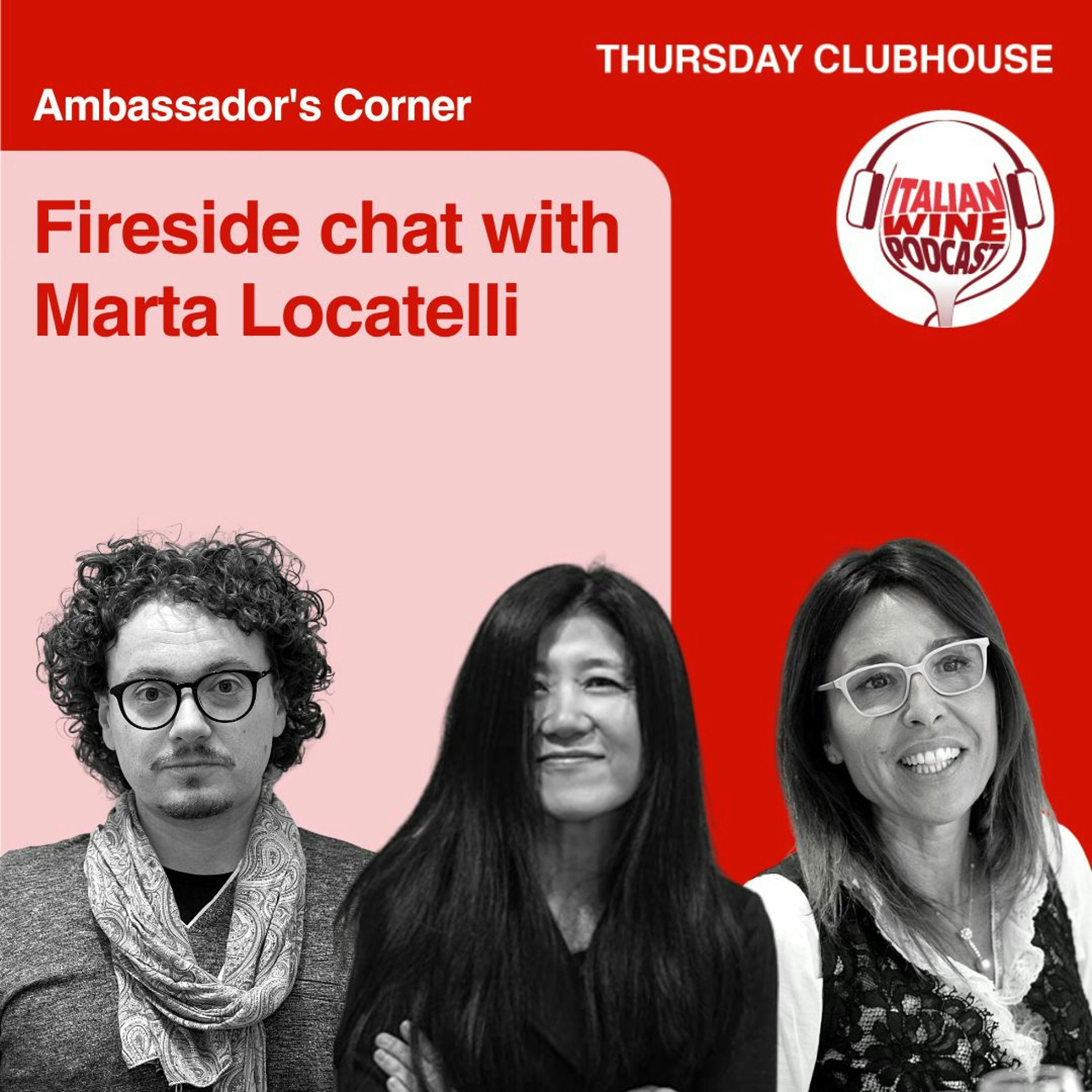
Ep. 1238 Michele Longari interviews Marta Locatelli | Clubhouse Ambassador's Corner
Clubhouse Ambassadors’ Corner
Episode Summary
Content Analysis Key Themes and Main Ideas 1. The history and unique multi-generational legacy of Tenuta Angoris, a family winery in Friuli Venezia Giulia. 2. The diverse terroirs and winemaking distinctiveness of Friuli Venezia Giulia's sub-regions: Friuli Isonzo, Colli Orientali del Friuli, and Collio. 3. Tenuta Angoris's winemaking philosophy, emphasizing a blend of traditional methods with modern techniques to achieve purity, elegance, and balance. 4. The importance of quality control, traceability, and sustainability throughout the wine production chain. 5. Strategies for marketing and promoting Italian wine globally, with a focus on wine tourism and hospitality. 6. The role of indigenous grape varieties and specific wines (e.g., Friulano, Pignolo, Pinot Nero Albertina) in defining the region's identity. Summary This special Italian Wine Podcast episode, recorded during a Clubhouse session, features hosts Stevie Kim and Italian Wine Ambassador Mikaela Micali, who interviews Marta Locatelli, President of Tenuta Angoris, a historic winery in Friuli Venezia Giulia. The discussion begins with an in-depth look at Tenuta Angoris's remarkable 370-year history and continuous family ownership, highlighting the significance of their recently published book, ""Landores: Stories of Wines and Knights."" Marta and her daughter Julia share insights into the family's legacy and its connection to the land and local community, including the villa's use as a military hospital during WWI. The conversation then shifts to winemaking, exploring the diverse grape varieties grown across Tenuta Angoris's three distinct DOC areas: Friuli Isonzo (known for fresh, crisp wines from fluvial soils), Colli Orientali del Friuli, and Collio (producing more structured, age-worthy wines from volcanic/ponca soils). Marta emphasizes the winery's commitment to ""purity and elegance"" by combining traditional practices with modern technology, exemplified by their Ramato Pinot Grigio. She also details the significant investments made in quality control, traceability, and sustainability, stressing the importance of managing the entire production chain internally. Concluding the interview, Marta discusses international wine promotion, asserting that identity, history, and a balance of quality and price are crucial for communicating Italian wine abroad. She strongly advocates for wine tourism and hospitality as the most effective marketing channels, believing they offer an emotional connection that resonates deeply with consumers. The episode provides a comprehensive overview of Tenuta Angoris's unique heritage and winemaking approach within the context of Friuli Venezia Giulia's rich wine culture. Takeaways * Tenuta Angoris is a historic winery with over 370 years of continuous family ownership, highlighting a rare legacy in the Italian wine industry. * Friuli Venezia Giulia showcases remarkable terroir diversity, with distinct wine styles produced from fluvial soils (Friuli Isonzo) and volcanic/ponca soils (Colli Orientali/Collio) within short distances. * The winery's philosophy blends traditional winemaking with modern techniques to produce wines characterized by ""purity and elegance."
About This Episode
The Italian wine club is hosting a wine and spirits exhibition, promoting their textbook, podcast, and their Italian wine club. They also discuss their history and the importance of learning about wine, while also emphasizing the importance of understanding the traditional lifestyle and varieties of their wines. The speakers emphasize the importance of the Locatellis Villa story and the importance of maintaining a healthy and safe relationship with clients. They also discuss the importance of maintaining a clear understanding of the quality and characteristics of their wine, and the importance of privacy and privacy in relation to their taste. The speakers emphasize the importance of hospitality, wine tourism, and hospitality in the Italian wine industry, and mention their involvement in promoting their brand. They also discuss their success in promoting their brand and their involvement in the Italian wine industry.
Transcript
Coming soon to a city near you, Vineita Lee Road Show. Have you ever wondered how to attend Vineita Lee for free? Are you a wine trade professional interested in a sponsored trip to Vienie to the International Academy, or Vien Italy, the wine and spirits exhibition. Coming soon to Princeton, New Jersey, Harlem, New York, and Chinatown in New York City, Cardiff in Wales, London, in England, and Roost in Austria. We'll be giving away our new textbook Italian Wine Unplug two point zero. Find out more about these exciting events. And for details on how to attend, go to live shop. Bn Italy dot com. Limited spots available. Sign up now. We'll see you soon. Welcome to this special Italian wine podcast broadcast. This app is episode is a recording off club house, the popular drop in audio chat. This clubhouse session was taken from the wine business club and Italian wine club. Listen in as wine lovers and expert alike, engage in some great conversation on a range of topics in wine. If you enjoy listening, please consider donating through Italian wine podcast dot com. Any amount helps cover equipment, production, and publication cost and remember to subscribe and rate our show wherever you tune in. Hello, everybody. My name is Stevie Kim, and this is the Italian wine club on Alpaus. Or we've been doing this for, well, this particular show, which is called the Ambassador Corner, about a year and then some. We are here with, clubhouse manager, like, and Joy is just right. She's really busy doing something. Our Italian wine podcast, producer, oh, there she is. And, today, our ambassador, our host, for today's shows. Steve, how are you? I'm very well. Thank you for being by. Yeah. Where are you? So I am, in, Dival, England. Okay? You're still there. Yeah. It's very close to Mark Villon, actually. Just the Oh, my goodness. Yes. Yeah. Did you go see him? Did you meet him? Yeah. I think, it was a couple of weeks ago. Yeah. Because, I came back from, a trip to Amelia Romania. So Mhmm. I brought him back from Parma. A few things that, I totally wouldn't enjoy. So I went there. And, actually, yeah, we are, is is very weird because I met him in London during my exams. And that this cover that he's just leaving, like, a few miles from, from me. It's Yeah. That's crazy. Right? Saryndipity. Listen. So, for those who are unfamiliar, Mark Millen is also our Italian wine ambassador, but he's also a podcast host for Italian wine podcast. He does a daily show every Tuesday about Italian wine and travel. So you should check that out. He speaks. He's very English. There's a little bit of Korean in him, but he's mostly English because he talks about the weather a lot. By the way, what's the weather like then now? It's, actually, a lovely weather. I mean, I'm not sure, British people are enjoying this weather because it's very, like, a continental climate because it's freezing cold, and with a lot of sun during the day. So, actually, I'm enjoying this because it's almost like being on the dolomites. But, the weather is changing this, this weekend, and things are going back to normal. So, like, like, yep. A lot of rain. Yes. A lot of rain. Yeah. So here, it's actually quite cold and in verona and also raining as well. So it feels more like England today. So Mikale, Mikale's a course are newly acclimated Italian wine Ambassador. He did the course at the Institute, where it was held Institute of Masters of wine, a small group, but a very good group, it it was a bump of crop. And he was part of the, the the newly acclimated certified Italian wine Ambassador. So but, how long have you been in England, Mikaela? Almost ten years, actually. I moved today UK, ten years ago. And what were you doing ten years ago? So back back in Italy back then. I was, working as a software engineer. So it's something completely different, but I was always, passionate about wine and, basically, all my holidays, were spent traveling around all the regions of Italy discovering new wines and new food. So with the first, let's say, salaries from my job, I decided to start the professional course for Sommelier with the, Italian Sommelier Association. Just, you know, to to learn something more about wine. I wasn't even one hundred percent sure to, take the final exams. But then as you probably would expect, the more I was involved with wine. And the less I wanted to be involved with computers and coding. So the This happens to some of you folks when you get the wine bug. Right? You Yeah. I mean, it's drop everything? From computer engineering to, you know. And so I moved to the Yeah. I moved to the UK ten years ago, to do, a master program in, wine business management. And then basically, while I was still writing my master dissertation. I got a job offer for, from hayWise, which is the company I work for, today. And, since then, I've been living here in the UK, basically, I am a purchasing director. So my main responsibilities within the company are to, making sure that our portfolio is, consistent and that basically we, are always up to date in terms of the nutrients or what consumers are asking. And in particular, I am, responsible for our direct imports from, Spain, France, and, obviously, Italy. Okay. So tell us a little bit about Hay wines. Yeah. It wise. It's, a very small, independent, family run business. Mhmm. It's based in a library here for share. So, actually, very close to the border with the ways. And, talking about ways, the other very weird thing about, the London exams is, it's also that, in London, I met also Robert Maji, that was obviously another ambassador Mhmm. That day. And, actually, he is very close to where the company is based. And, I never met him, not even, you know, in tasting or trade tasting and, But he's based in potest. Right? Yeah. He's in cardiff. And, basically, when, from, Devon, when I go to the to to eight wise, which is based up north, basically, I always pass from Bristol that is very close to Cardiff. And, but I never met him and, like, Mark Miller. So it's it was very real. It was almost like, a coincidence, but it was, incredible. And, it was very good to to meet also Robert because, obviously, he is, very much focused on, Pulia. And, I didn't know a lot about Pulia. And, spending more time with Robert was very helpful because, you know, he knows a lot about who you are wise. And talking about a wise, yes, it's a small independent business. In total, we are, seven employees plus, Jane and Chris that are the company owners. And, from the from the very beginning, I was very lucky because Jane and Chris gave me, a lot of trust. So, for instance, the first project they gave me was to basically update our prosecco portfolio And I remember that, we we took back then a very brave choice to talk to us specifically on Baldubiadene and prosaico docg. And, back then, Valdubiadene was not as famous as it is today, but they gave me a lot of trust. And, we were among the first, for instance, to import, like, Colfondo Proseco or, Cartice, and it was, very good. And, the thing I really like about A wise is the fact that, since the Jane and Chris have also also they have a different background. They are in they were in the pharmaceutical industry. They started the business just out of passion So there is not, like, the strategy is not like about profit or margin. It's it's more about making sure that we always have, legal gems or, something very interesting to offer to our customers. Okay. So he talked about this all day, but we have to get on with the show. And I know you you have chosen Martha Locatelli from Yep. To be on the call today. Why did you choose Martha? Well, it's, actually I think that, the wines from Frulio, Vanessa, are becoming more and more popular, on the international market. And I see this, every day with my job. However, I think that this region has a level of complexity, both in terms of, winestives and the culture and history that requires a lot of study and focus in order to fully appreciate their wines. So the Nuta dangores is a an historic producer of really Vanessa Julia. And I think they're wise, and, a good conversation with Mark. I will be able to give, our listener a clearer view on the region's potential in terms of, winemaking. Okay. And as you know, we get a little bit geeky around here because from the for the via community, what are the learning objectives that we should expect from your call today? Well, it's I think it it's important that, at the end of this session, we get, a better understanding of, the traditional lifestyle and grape varieties of really Vanessa, and, I think also what is very important is, to get a clear understanding of, three, very important subregions of relevant and said Julia, which are, these zones of Ali. They call you, entirely, and, obviously, call you. Because they have specific character listings, and, they are completely different. So I think that, if at the end of this session, we were able to get a clear understanding of just these three subregions, it will be, a very good outcome. Okay. Excellent. So, Mikaela, this is the the moment where I leave you and I get to shut up, which is, you know, never happens. You know, right? So and then I will mute myself and so you can start the show and I will come back, towards the end of the shows to see if there are any questions. Okay. Okay? Okay. Excellent. Alrighty. Thank you. Okay. Hi, Martha. How are you? Hi, Michele. Hi, Stevy. I'm very I'm very fine, and thank you very much for this opportunity. Really? It's a pleasure. It's a pleasure. So just, I'm going to give a brief introduction of, yourself. Obviously, you are Martalo Catelli, and, you are the president of, to Nuta Dangauris. Your background actually is, in law because you graduated in law, but then, you decided to combine your passion for wine with your deep, interest in the marketing and in particular for, events. Tanuta Dangori, as I mentioned before, is an historic producer of, really, Vanessa Julia. And, as I also mentioned before, one of the learning objectives of today is to get a a better understanding of, three, main dock areas of Frulio, Vanessa, Julia. So call you through your call your entirely and Frulis also. And, yeah, so this is why basically I wanted to have, a conversation with you. First of all, did I give a clear introduction or, about yourself, or do you want to add, something more? No. It's it's okay. You you told, enough about us? The first important thing that we are very, very historical state, very historical winery at the end and seventeen years old. And so it's a very long, long time that we produce wine. And I think that is one of the oldest winery in all the Italy. And the the DOC is very important because we we are very big. We have a lot of actors we have, near six hundred actors. And, for the Vigna, we have eighty five actors. And this actors is inside the three DOC. What you said before. You see also, you see Colio and you see Colio Rintali. It's a very, very important to to to have the, many kind of, wine, and many kind of, quality of the wine and the variety is, really a lot. Yeah. And, I think that, we could start our conversation. I think we need, before that, I think we need to talk about, a little bit about, the history of, I know that you have recently completed a very important publication together with, Stephanie Cosma. A book that actually has a very intriguing title that is, Langar is story, Divini, cavalieri, so Langore's stories of, wines and nights. Can you tell us a bit more about this important work? And, what are actually the most important and interesting things. You found out while, completing this, research. Sure. And thank you, Mikkele. This is very important for us. And, for this reason, I would like to introduce my, my daughter. Her English is really, everybody. Really better than mine. And for the first question, because it's, the heart of our wine the story. And the many things that, begin, in, in this in this period. And for the book, I I thought that it is better that Julia can explain in, in the short time, what is the focus in this book, in this big story? Yeah. Of course. Carl, Julia. Okay. Hello, everyone. I'm very glad to be this, this call. So, Angori has, like, my mother has just said, three hundred and seventy years of family and, culture history. Which I will resume in the most relevant facts. So, Angori's was founded in sixty forty eight. It was a part of the Austerong Garic Empire. Which, Ferdinand though the Ford, gave as a reward to, which is the first owner of our family, property. Since then, the property, has always belonged to our family. So, it has passed through generation. During the first world, Locatellis Villa turned also into a military hospital residence. For helping the the the the injured warriors. So it had many function over the years. The first thing that, we discovered during the research of, the book was the name Langores, which in Italian means a big land. Landores has born in the sixteen century during the the age of shuri, as you were saying before, nights and, and, and culture. But, the curious thing here is that the Italian culture relates the term night, not just to, meanings of strength and courage, but also of kindness, elegance, and rescuing the pure peep, the poor people. So it has a really deep and in my opinion, beautiful, meaning. That's it. Yes. Thank you, Julia. It's very beautiful because, cavalieri story, Divini Eddie Caballeri is uh-uh the person, the property inside this, state. And the style of this person is to help the worker. And to give some land to give the house. So everybody can work in the more, in better conditions. You know, in, in, in situation, more, better than, than, than before. And this is the reason because, we we introduced the the word Calieri. Another important thing in the book is that the family was only one the the only property. You know, this is very particular because It's a long time that the Locatelli family, in a in a many, many generation was the only owner. The name of Locatelli is very close to this land. It's very close to a language winery. This is very particular for me. Yeah. And actually, I always, since I discover your story, I always thought it was, incredible. The the fact that obviously the name locatellarney was, a name that actually, kept going on, during the centuries because it's something quite, unusual. And it's very unlikely that you have this, consistent presence of the same famine in particular because, obviously, Frulio, Vanessa, had a very, complicated history. If we think about all the different, brains and people that, came, and then, obviously, during, world war one, it was, a region that was deeply, affected. And, I remember also, correct me if I'm wrong. That, that basically is basically your, in the estate. Yes. During world war one, was used as, an hospital. Is it correct? Yes. It was an hospital. And one of the particular think is that Victoria Manuel, you know, the the king of Italy come to visit this hospital. This is what we we we found, into their search and come to visit the military and it was, great. Because we have pictures, that, Victoria Manuel come inside the villa in the park because, around is a very big park, a secular park, and is, one of the most, emotional, emotional, think that I I found I search, do during my research. Yeah. I I agree. Actually, the fact that, your villa was used as, a military hospital, and that, obviously, the king of Italy came to visit, your villa is something that, combined with the, even more ancient history of your estate is something quite, unique. Okay. Thank you very much, Martha. And Julia, I think this is the introduction was really necessary to give our listener, a better understanding of the important role, that Tenuta dangores had in the history of, your region and the very deep roots that, Tenuta dangores has, in, your region. I think now we shall finally move to the core of our conversation that obviously is wide. And, first of all, can you can you tell us what are, the main grape varieties, grown, in your state. And, generally speaking, how would you describe the style of your wife's? Okay. Thank you. Yes. You said before that, we have three d o c. I can explain it like this in the low land we produce, a variety, international, like, pinot grillo, and Sabignon. And this is the principle, wine that we have in the low land. In the hill, DOC callio and DOC callio Rintali, you can find a more indigenous wine that you know, Micali, that is very, very important now because the market is asked for this kind of wine. And in Freioli, the indigenous is, Frulano, Pripolajala, Scupetino, red, red, very particular, very fun red wine, piniolo, andrefosco. And, the particularity of my wines are in a in a three word I can explain. You know, me, Kelly, there are that we have, a white, but also the red wine, with a lot of acidity and with a lot of, minerality. And, I think that one of the most important characteristic that we have is purity purity because our wine is really elegant and clean. This is because, we try to, to use the traditional method with the modern technical. So we use we use both the way to have a really tradition but also purity and elegance wine. You know, it's very very interesting because when you taste, you feel that is, you feel that is, but you feel also the cleaning side and the great, great minerality. And you can drink more because the acidity and the minerality can drink more wine than, just one glass. This is very very important. You know? It is. It is obviously very important in particular for people doing our job, which is, sailing wine. If a wine is berries to drink is, obviously, much, much better for, for people doing our job. And, I must say that, I totally agree with your, without you described your wise, because I think that, from, the, let's say, the wise from the is also to the wise from call your Italian call, you know, I think all, your wines have encountered this very high acidity, incredible, freshness. Obviously, there is also elegance and, drinkability is very important. And, I totally understand what you mean when you say that you are trying to combine traditional winemaking with modern techniques. Because I think I don't know if you if you will agree, but I would say that the perfect example of this, is, for instance, the pinot grisio, you have, in the Angoris range, just so from color entirely. We're actually, you started to make it with the, Ramato winemaking, which is actually, pinot grisio was always made in, in your region, which is not like, pinot grigio blanche or Roset, is not completely white. Is Ramato so copper in color. And I remember the first time I tried that these, the pinoc rejo, in in, Ramato Verso with you. I was very impressed because, I think it's exactly what, what you just described. So the fact that there is this very traditional way making but made in a very modern and easy drinking style. Yes. Yes. It's true. This I think this is the the the only way for the wine now. And the different that you said, from, the lower from a DOC is also in the DOC call you, Colorado. The different is that, in, in the flat area, in the land, in the lower area, you find, a very fresh, very fresh wine. Also, the red is drinkable and fresh. And, no, so high graduation graduation, not so high. It's still, eleven, eleven, a half, twelve for the red. And, in the hill, like Pinogrillo that you said, we have more structural rate and more, intense wine, the white, and the red is aging wine. So we can produce like Pignolo, if I don't know if you if you know that Pignolo is, very difficult to find this variety in friuli. We are just one actor and we produce this wine for a traditional method. So four ears in the tunnel and two ears in the bottle. So it's a very particular aging red wine. And this one, we have the greatest in, on the hill, d o c, Colliorentale. So the different is, that the hill give us a very complex very complex white and red wines. And the low area give us a a crispy and freshness wine. Easy to drink and for in you can drink you can you can drink in, in in many way, not only for, for eat, but, for the parative. And this is very important because it's not too different wine. It's two different kind to drink. Italian wine podcast brought to you by mama jumbo shrimp. Yeah. Absolutely. And, I must say that, I noticed this every day since we, obviously, as, hayWines have been importing your wines for, I think, five or six years now, I always noted that, the different wines you have, between these also, call your Italian call you. They have a completely different ties and actually are able to, target different kind of, consumers, which I always thought was, from a strategic point of view, something, very important and actually very, difficult to find. And talking about, your, focus on, quality and, let's say, although we're making process, I know that in the last few years, so you have invested a lot of, resources on quality control and, traceability. So, basically, you made the huge improvements, to your chemical, analysis lab, And the lot, was was also done in order to make sure that you had the strict control over the, production process from, basically, Vineer Management to, the bottling process. Can I ask you, why did you decide to focus on these specific activities and, what kind of, results were you able, to achieve? Thank you, Mikaela. This is very, very important for us, and I think for the clients, between the between the wine, the winery and the clients, is very important that you're born a good relation. And it's very important that the client can find in the wine, all the descriptions that, he needs, that that they need. And for this reason, we invest in the seller, and we invest also in, many, many technicals for produce the wine. And one of the most important thing that you can find in a gory is that we have all the chain, the chain product wine, all the chain inside the winery. So the grape from the grape to the bottle from the grape to the glass, and we have inside all. And, the laboratory is very important because our one maker do the analysis and decide when is the time to harvest and we decide. And, it's important the, in Motila Treche. How I can remain in Motila Treche because, we, we, we have the the possibility to introduce our wine in the bottle after the time that we decide. So the traceability is important and you can do, I think only in a, a state similar to Angori's when you find all the chain productions wine inside. And this is, honest, onesto, is honest honest for, the client because, for every, questions that they have, we have an answer. And Yeah. I I think it's a very important point, Martha, because, obviously, nowadays, it's, very difficult to manage, an estate like authorities, without the need of, outsourcing any kind of, activities. And it's very difficult to do everything with, it's all stuff. So, I totally agree. Something very important is also is something that, I think gives, a a very clear idea on, how much is, important for you that your wines are able to describe and depict basically, your ideas. So the fact that you don't want to outsource anything is also because in this way, you are able to have, everything under your control. And, you are able to make sure that, when the wines are in the bottle is exactly the kind of price you're, you wanted. And, you know that in this way, you find the the quality because the quality is is this, is the control, is the, flexibility And, the quality is not only the is very, very important, the quality of the wine, but also for us, for our wine, it's a very important day. Health, you know, the health for productions. And another thing that we receive, from ten years ago, the certificate for the sustainability winery And this is a very, very hard work, but we we believe that the sustainability in the winery and the sustainability in the in the cellar and the sustainability also for the price is one of the most important thing, for your products, for my products. Yeah. Absolutely. And, Martha, going back to, the the three DOC, that actually you are making, internuta dangor. So the, Frulis also, the Frulis colli are entirely, and, obviously, call you. Could you please tell us what, what are the most important characteristics, and also the main differences of these, three, subregions, sub zones. Okay. The, thank you, Michael. The different is the, there are. Because we are very close. The, is also is, far from, call you, call you in tally, ten kilometers. But in this short, this very close, but it's completely different. And, it's also you find the, river, river, river. Rivers land. Rivers land. Yes. Because it is a land, that is also the the the river from, the is also area. Live. So there are a lot of stones and, many, many, dry. It's very dry land. And, this is the region, the reason because you find a very crispy and fresh wine because the, land is, the and the hill you have a volcanic soil. The name is is another thing is very different. You mean that you can taste the white chardonnay that we, you know, that we have a chardonnay and we make in a doc choloury and Cali. You can taste our chardonnay is very similar to the chardonnay you can find in the south of Italy because it's volcanic. So if the soil, is very heavy and they give many substance to the plant. And so the wine is full of body. Very intense. And the graduation is high. You know that the white on the hill that we produce in the hill have fifteen degrees. So it's very strong wine and red also. Yeah. It's, I think that for, one thing that, I found very interesting the first time I tried all, your wines, was that, obviously, if you do, a tasting and you start from, the wines from, is also, and then you go up. I call you. I call you. It is, incredible. They how different they are. So they taste likewise that comes from completely different regions. And, actually, when, I visited you, actually, the the vineyards of, they also and the color entirely are just maybe ten, fifteen minutes by car. But in just ten, fifteen minutes by car, you are able to get, a level of, a difference that is, just incredible. And, I think what you just said is very important. The main the main difference is obviously the type of soil where in this zone, so we have these, fluvial sediments, while on the heels, they call your Italian call you as mainly volcanic and punka. And, there is a difference in soil and microclimate in just a matter of a few miles, which makes gives a lot of complexity to, the range of wines you are offering. I I always, thought that this was, very, very interesting for, wine, enthusiasts. And, you just, touch, about your Spirit card on it, which is actually one of the wines that is in, your, reserve by Julia Locatelli Range, the reserve by Julia Locatelli Range is, I think, a quintessential expression of, your own terroir and also your history. Can you tell us a bit more about the four wines included, in this range? And, what do they represent for you as a at a personal level? I wanted to dedicate, for a special type of wine called, as you said, not just to make a different kind of, a special kind of wine, but also to remember his legacy, which represents, for us a beautiful perspective of the wine production. And especially, he's, concepts of, seeing the wine connected to the expression natural of mother earth, which is a a very, romantic way of seeing, the wine production on my point of view in a personal level as, as you said. You know me, Kelly, that, Julia, it was my grandfather, and it was Grand grandfather to Julia. And, for us to remember him is really important because, he gives to us really a lot. So this for wine is for him, and I think that, probably for lucky is for lucky wines because we we receive many grad graduations, many, certificate. And this is Yeah. Awards. Yes. Awards. We received many awards. And, it's a form. Fantastic wine, but you you you said before, and I'm really, really happy that you think, this for, for a reserve majority of time. Yeah. I mean, it's, I think is, is, is, a range of wine that is, very, very interesting because, obviously, as you mentioned, you have the the spielle chardonnay, which is the chardonnay, that has, almost like a, a level of, saltiness to it. It it it's very minor. A lot of, like, a almost salty character. Then, you have, obviously, your call you that has been winning the for many, many years and is consistently at the top in terms of, some of the best Italian white wise. And then, obviously, you have the the Merlo that was, which is like, a very powerful and strong Merlo. Then the pinolo. The pinolo, as you said, is, I think, a little gem, very difficult to find because pinolo is late ripening variety. It's very difficult to, grown pinolo. And, in the past, a lot of people decided to avoid using pinolo because it wa it was just, very difficult. And, you are among the few that still have, an authentic pinolo. And, in addition to this range of wise, which I think, are, unmissable for, while lovers to try at least once. One of the latest addition to your catalog was, a wine that, I think combines a great character and, a lot of, Phoenix and Deligas. I'm talking about, obviously, the pinonero, albertina. Do you believe that the pinonero has a great variety can play a more important role in the coming years for, the, really, Vanessa, Julia, wine industry. Okay. Thank you. Because, Alberto is, we, we we needed to, to give a little introduction because Albertina is dedicated to my grandmother, the wife of Julia. And because the characteristics, the elegance, and, strongness, is the same characteristics that's my grandmother has. So we have one, wine for my grandmother and four for my grandfather. This is really important. I think that is a a type of, wine, which has not a definite identity. Our pinot noir is elegant, is pressure, no ox, but, we can, you can produce in many way. And for this reason, I cannot answer mckenna to your question. I cannot answer yes or no because there are many, many kind of, many ways that you can produce the pinot noir. So you can taste a different pinot noir. And this wine don't have a a one identity, only one identity, especially in Frulina and Sejulia. Probably in you can find one kind of but in Frulli, there are a lot. And I don't know if, could be important, or a principal or, important wine for Freuryven institution. Yeah. I I totally agree. I think that, the level of diversity, of pinonero you can have in front of anesthesia Julia is at the same time as strength and the weakness. It's obviously less strength because you are able to taste the many different styles and version of pinonero. But then it's also a weakness because, probably for one consumer, it's difficult to understand what is the, the truly Vanessa, pinonero, what is, a specific style. Nevertheless, I think that, when you when you introduced the pinotero, Bertina, I think was very, very interesting. And, in particular, obviously, working in, an entire national market, like, the UK market where, obviously, Pinoneira, Pinoneira is a very, very important variety and very popular. It was great to, have a more customer. Try a pinonero from Frulio Vanessa, Julia, which is was something quite unique. And, I think that, the fact that you decided to go for a very fresh, light style was, a winning choice because, obviously, avoiding Oak, you were able to retain a lot of the freshness, acidity and the beautiful fruity character of, Pinonero And, yeah, this is why I wanted to ask you the question because I think it's, potentially a great variety that, I mean, it's a big question, Mark, but potentially is a great variety that can, give a lot, to Frillia, and, yes, your estate in particular. So we, there are, you know, that, this is one of my favorite swine in a in absolute pinot noir. Yeah. I know. I know. I remember when, I came to visit you for your event after the harvest. I remember that when you described the the pinonero, you were very, very, very passionate. And I could tell that pinonero was, one of your favorite varieties. And I must say that, it must be very nice for you to have that kind of wine within your, portfolio now. I I want to leave, a few minutes to, question for Stevie or the listener. So I have, a couple of very quick questions for you. And then, I will leave, the word to Stevie. So as you know, the twenty twenty two edition of, wine to wine, took place last month in verona. And, it was, a fantastic event. It was, the first time of the pandemic that was, like, an in person event. And, the topic of the business forum was, wine communication. My question to you, is, as a company's director, and with your experience in marketing and events, you have always, given a lot of importance to international market and the export markets. From your direct experience, could you tell us what are, the three most important, let's say, words or adjectives to be used when communicating and promoting Italian wine abroad. So I'm not talking about specifically to Frury, Vanessa, but more in general, when, you need to promote Italian wine abroad on the for markets. What do you think from your experience are, the three most important, worth to be used? Okay, Nicola. Very, very, very, short, three words. There are identity for me. History, and a good balance from, quality and price. Yeah. It's, I think it's, you cover very important, area because, obviously, identity it's, what does Christ, but, Italian wine. And, I think part of, the job of, Italian wine ambassador is to be able to share this kind of identity to, the consumers all around the world. And, the last question to you is something that, I wanted to ask you because, obviously, I know that, you are very much committed on marketing and events. And, so web and social media, PR and price, wine tourism and hospitality. So these are three big marketing channels. If you were given, for example, enough resources, time, money to be invested on only one of these three marketing channels. What will you do and why? Okay. For me, the best thing that I can do is only one is tourism, wine tourism, and hospitality. Because in this way, you can, give not only a taste, not only a glass of wine, but very interesting emotions. And people can remember you for many, many times. Yeah. It's, I think he's, the the answer where I was probably expecting, in particular, for the fact that I know, how much is important for you that, people and, customers are actually visiting your state and, visiting also the the the region. And, I totally agree. I I think that, hospitality and wine tourism is something very important for Italian wine in general, but, even more important for Frulie Vanessa, because as I mentioned at the very beginning, Frulie Vanessa, I think is a region that, as a very complex culture and history. And even if, it's a a small region, the level of complexity in just a matter of months is, you. So actually, the only way to get a clear understanding of, your region and then obviously your wine, I think is by visiting, your wine, your winery, your state, the vineyards, spending a bit time, and, that's the best thing that actually, people can do. Okay. So, I am, done with my question. Thank you very much, Martha, and, Julia. I will leave, the room for you. If you have any other questions to say. Hello. Excellent. Thank you very much. You you understand now why Mikaela has become our Italian wine ambassador. He's incredibly thorough. And doing the deep dive here with with his guest today. So, I have a question. What what I always ask is basically Can you give us and I know that you did the very specific questions with Mikaela. Can you just give us an overview of how many wines you have and the volume of production? Okay. Thank you. So how many, you know, how many labels? Yes. And also the number of bottles you produce? We have in totally twenty kinds of, wine. And A lot. Yes. A lot. Because we have a lot of vigna, and we have a lot of grapes, different grapes. And this is the So how many hectares? How many hectares do you have? Eighty five, but now we plan to more ten actors. So until one hundred. Right. You're getting towards one hundred now. Yes. Which is quite large. Six and a half hundred bottles. Six and so six million bottles? Six hundred and half. Oh, six hundred fifty. Six hundred and fifty. A thousand. Yes. It's thousands. Sorry. Six hundred and fifty thousand. Yes. Sorry. Yeah. Just to get get an idea. And so tell us a little bit about the different lines you have. The the line we have. Yes. We have two lines. The line, the first one's name is, Vila Locatelli. Because the Vigna is close to the villa. And this line, come from, land area. So it's the wine that are more fresh, more, drinkable. And, the second line is the line that, the name is Angoris, like the name of, our, estate. And this wine, come from the hill. And so it's a different line because like I said before, it's more substrate and, it's more better for, compare with the with the food. Okay. So how, do What would you consider your signature wine if you were to choose one? And I know the producers hate this question because they're like all of your children, right, all of the different wines. You have twenty. You feel like they're all your children, but If you were to choose one representative wine for for your company and yours, which wine would it be and why? Yes. Yes. Thank you for this question. For me, the the the wine that we have in, in Frioli, one of the best, not only for me, but for many, many producers, is a Friolano. You you remember that the the the name before, yes, was too kind. The Frulano, especially from Collio and Tali or Frulano from Colio is very particular. It's, seems like aromatic, a little bit. So it seems like, but more stronger. And, you feel like, how can I say, Like, flint? Flint. Yes. Yes. And can I also add the gunpowder, which is always when I I always try your, your fritulano? It it always might like gunpowder. It's, like, incredible and flint. Yes. Flink. And, another reason is because, Vigna, up on Roca Bernarda, is, DOC Colliorentale, is very, very old. Our Vigna, Frulan Vigna, is, from, the end of the second word. And so we have a very, very old plan to that give us a strong, very strong, intense, white line. Okay. And you make that boat in both in Angores and, locatelli line. Is that correct? It's very corrected. Yes. But it's two different Frulano. Like I said, the the locatelli is a Frulano for everybody. Okay. Okay. For That's neat. The first tapped to the Frulano. Mhmm. So when you when you want to introduce this kind of wine, it's best to begin to the Frulano Villa and the second is, is particular. It's very particular. So probably we produce not so many bottles for but it's good so because it's not so commercial. Okay. First of all, Marca, your English is fine. So you don't have to be afraid of speaking because you're we you you expressed yourself and we completely understand you. Having said that, I know you have a daughter, you said, Julia. Is she also working with your company? And are there other family members working in your company? Okay. Yes. He tried to begin. Okay. Yeah. Yeah. I'm twenty one and I'm starting to working with her, especially in the commercial areas. So I can also travel and last summer, we went to Barcelona to do a little journey and, and, yeah, it's really, it's really beautiful. It's a beautiful, world of working. And, I'm I'm I'm enjoying it. A lot. For travel, it's better the young. It's very hard to travel around, and you know that for, and michele, know better than me that, if you want to sell the wine. You you have to go, you have to travel, and you have to explain directly the quality and to taste together. Okay. And do you have other family members working with you? Yes. Now I I am inside with my sister and my father and my brother. And the four And how are the differentials? How do you divide? Like working in a family? How do how is that like? Okay. I'm the, administrator. Okay. The boss. You're the boss. My sister is Italian commercial. Okay. She she deals with Italian market. Italian market. Mhmm. And my brother is in the in the agriculture because six hundred acre that I that I said before is only one hundred Vigna. The rest is agriculture. Skorna is, naps, is a lot of fun. Yeah. You're doing other farming. Yes. Yes. And my father look, how we can do if we do well or not and decide. He's the conductor of the orchestra. Yeah. He's very worried. But he's still active. He's still working in the company. He's still, like, representing the the ideas that he wants us to carry on in the, in the, in the, in the state. But unfortunately his physical condition cannot, give him the the the strength to work. Sure. Sure. I understand. So listen, it was very nice to listen to you and get to know your family a bit. Thank you very much. Thank you very much, Mikaela. You know, we're doing a little, maybe, perhaps, something in February in your area. So we're going to reach out to you personally, later with, through Manuelila. So we'll Absolutely. Yeah. We'll talk about that. I'm going to bring back on like a child like a Okay. So tell us what else is going on. We're nearing the end of the year, but I know this wasn't the very last show before the holidays. Right? Yeah. So going to make me work a little bit more. No. This is the last one. I'm sure. So we've got Jamie. She's actually here in the audience. Mhmm. And, yeah, she's She's new on Clubhouse. So you see the icon there. Oh, great. Yeah. And then she's going to interview Valeria Gosta of Palmetto Costa. Okay. So that's December twenty. Yeah. The last next week. Okay. Excellent. Welcome, Jamie. I see your party hat. Also Mark the head of party hat. So thank you for coming on to, clubhouse. And I hope to see you soon. Bye. Bye bye. Listen to the Italian wine podcast wherever you get your podcast. We're on SoundCloud, Apple Podcasts, Spotify, HimalIFM, and more. Don't forget to subscribe and rate the show. If you enjoy listening, please consider donating through Italianline podcast dot com. Any amount helps cover equipment, and publication costs. Until next time.
Episode Details
Keywords
Related Episodes

Ep 2325 Anna Obuhovskaya IWA interviews Fabio d'Attimis-Maniago of Attimis-Maniago | Clubhouse Ambassadors’ Corner
Episode 2325

EP 2316 Alberto Martinez-Interiano IWA interviews Emiliano Giorgi of Progetto Sete Winery | Clubhouse Ambassadors’ Corner
Episode 2316

Ep. 2308 Anna Obuhovskaya IWA interviews Sara Repetto of Vigneti Repetto | Clubhouse Ambassadors’ Corner
Episode 2308

Ep. 2299 Beverley Bourdin IWA interviews Grégoire Desforges of Baglio di Pianetto winery | Clubhouse Ambassadors’ Corner
Episode 2299
Ep. 2290 Rebecca Severs IWA interviews Primo Franco of Nino Franco winery | Clubhouse Ambassadors’ Corner
Episode 2290
Ep. 2281 Julianne Farricker IWA interviews Mattia Montanari of Opera 02 Winery | Clubhouse Ambassadors’ Corner
Episode 2281