
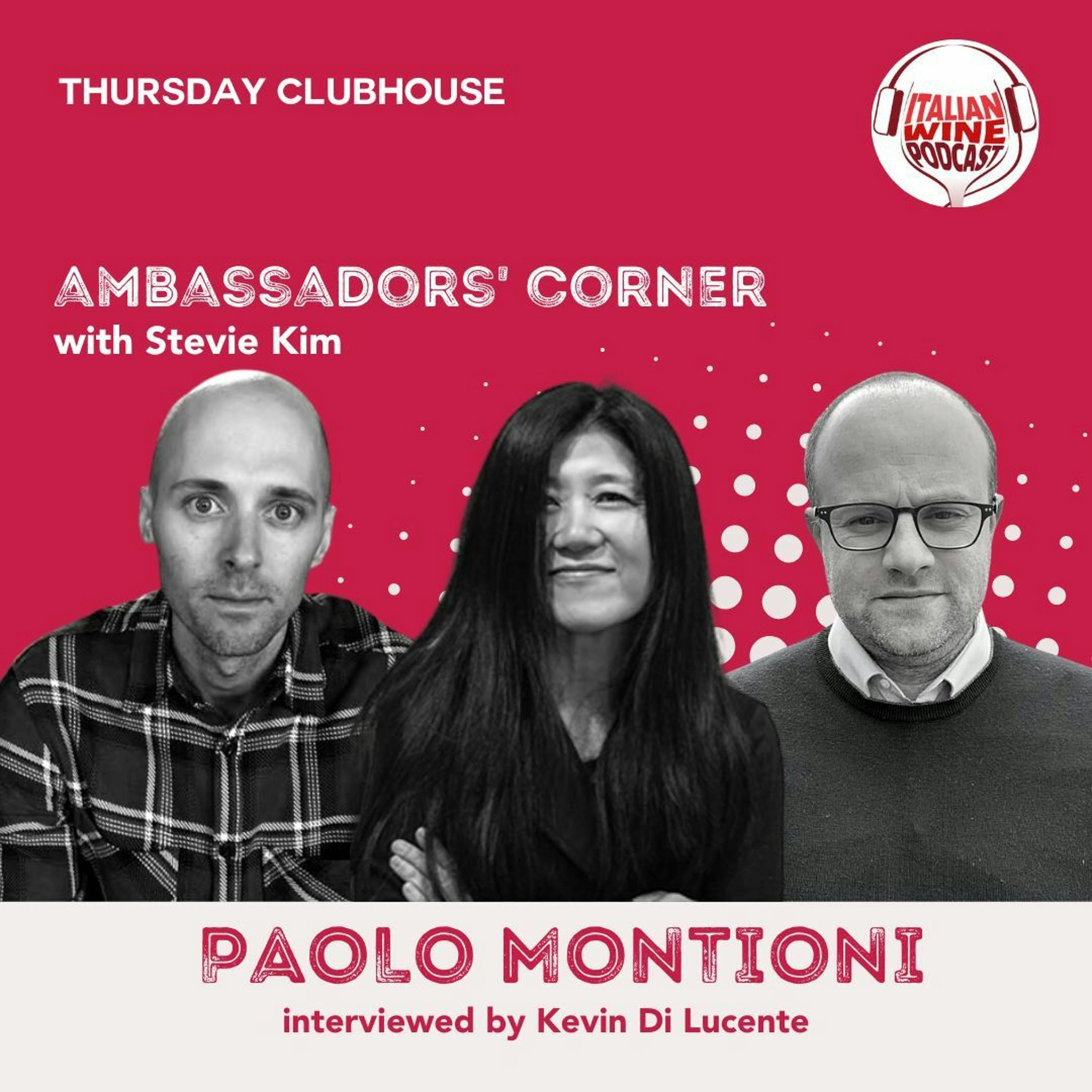
Ep. 1457 Kevin Di Lucente Interviews Paolo Montioni | Clubhouse Ambassador's Corner
Clubhouse Ambassadors’ Corner
Episode Summary
Content Analysis Key Themes and Main Ideas 1. The Italian Wine Podcast's ""Ambassador's Corner"" series and its community engagement. 2. In-depth discussion with Paolo Montioni, owner of Cantina Montioni, about his family's winery and vision. 3. The Montefalco region: its rich history, distinct climate (including climate change impacts), and unique soils. 4. The Sagrantino grape: its characteristics, winemaking evolution, and diverse expressions from Cantina Montioni. 5. Cantina Montioni's varied production, including Montefalco Rosso, Grechetto di Todi, and significant olive oil. 6. The business of wine: production levels, major export markets, and strategies for selling lesser-known regional wines. 7. The growing importance of wine tourism in Montefalco and at Cantina Montioni, along with local initiatives like ""Amanti Montefalco."
About This Episode
The hosts of the Italian One podcast thank their subscribers for their interest and promote their brand. They discuss their plans to sell wines and promote their brand, including their recent travels and their interest in promoting their brand. They also discuss their plans to produce high level segmentino wines and their philosophy on growing their own olive oils. They discuss their experience with traditional vines and their plans to produce new ones. They also talk about their love for learning from their web developer and their satisfaction with their current winery. They mention their plans to plant wines in the future and their interest in truffle hunting tours and truffle hunting tours. They also discuss their love for wine tourism and their desire to donate through Italian line podcasts.
Transcript
Since twenty seventeen, the Italian One podcast has exploded and expects to hit six million listens by the end of July twenty twenty three. We're celebrating this success by recognizing those who have shared the journey with us and giving them the opportunity to contribute to the on the success of the shows. By buying a paper copy of the Italian wine unplugged two point o or making a donation to help the ongoing running costs, members of the international Italian wine community will be given the chance to nominate future guests and even enter a price draw to have lunch with Stevie Kim and Professor Atilio Shenza. To find out more, visit us at Italian wine podcast dot com. Welcome to this special Italian wine podcast broadcast. This episode is a recording off Clubhouse, the popular drop in audio chat. This clubhouse session was taken from the wine business club and Italian wine club. Listen in as wine lovers and experts alike engage in some great conversation on a range of topics in wine. If you enjoy listening, please consider donating through Italian wine podcast dot com. Any amount helps cover equipment, production, and publication costs. And remember to subscribe and rate our show wherever you tune in. Hello, everybody. My name's Stevie Kim, and welcome to the Italian Pine Club on Clubhouse. And today, this is, of course, the Ambassador's corner We're approaching our hundred episode of this series, the ambassadors' corners. It's more like a fire chat style. And what it is is one of our Italian wine ambassadors at large. They get to choose their favorite wine producer in Italy. And they have this call for it. It's about sixty, sixty minutes, and it is actually one of our most popular shows in in, at which gets replayed on the Italian Mind Podcast. And today's mod is Kevin Deluchenne. Ciao, Kevin. Ciao, Stevie. Thanks for having me back. Yeah. How are you, Kevin? I'm doing great. Despite all the, the smoke, the Canadian wildfires. Yes. Yeah. You've you're surviving. That's good. Listen. So, of course, for those of you who are less familiar, Kevin Deliciente, he was the top student from our New York edition, Vineital International Academy, a few years back, like, three years back, I wanna say. July twenty twenty one, Stevie. July twenty. Yeah. You remember very well. And, and of course, he is has been in the wine industry for numerous years, I think about fifteen years, still represents Weinba from what I understand. And today, he has chosen, who is your favorite producer you've you've chosen? Paulo Montioni. Paulo Montioni. So tell us a little bit about Paulo. Why did you choose Paulo to be on your call today? Well, the the via community is is great at connecting people, and I I I'm not so secretly love Sabrentino, and I and I saw, last year, the Via community went on a, a cultural trip there. And you were jealous. For quite recent. I was jealous, and I saw that you and Liza were recently there in the videos that you've been producing, and I'm like, I wanna go. You will have to go. Okay. Swantastic. I definitely will. Yes. So what are the learning objectives, today? Well, aside from the obligatory learning about the region, the history, the estate, the native grapes, and all that. As someone who works in the wholesale fields. We quite often hear a lot of technical information, you know, how are the wines made and whatnot. But something I wanted to get into a little bit in this conversation is how are the wines? How do we sell the wines? How do we as ambassadors of of Montefalco, in in Tali wines in general, go into the markets, and and what do we be other than telling them about, you know, stories and history. How can we effectively sell the wines and represent them best in the market? Yeah. I that's a great point because I've been on kind of a talking tour lately in Italy and I've been trying to tell the producers and the winemakers. I mean, I we take it for granted that the wine is good. What's in the bottle. Right? But the most difficult part is selling the wine. So that's caused a lot of, discussion all over Italy. So, hopefully, we will be, listening to this conversation very quickly. So I'm leaving the mic over to you now. Kevin, and we'll come back towards the end of the show to see if there are any questions. Okay? Sounds good. Thanks, Stevie. Okay, Chow. Paulo, I'm going to, give a little quick synopsis of who you are real quick, and then we'll get into some questions if that's okay? Charles Kevin. Of course. Thanks for joining us. So Powell Montioni, he has been the owner of Cantina Montioni for the last twenty years and declares himself one hundred percent Chinto Pecento Montez, as he was born and raised there. He has a lovely wife Sarah and is a father of two children, Jachemo, and Mateo. And, has the the passion to cultivate, Sanrentino and promote the wines all over the world. He also loves traveling. He's traveled to over fifth fifty countries to date. Oh, my. Paulo, you are, definitely wrecking up the country. So I'm nowhere near that number. And, obviously, you just love, promoting Ombria in general throughout the world on all your ventures that you go on. Paolo, welcome. Thanks for joining. Chuck, Kevin. Welcome. Thank you. And, hello to everybody. Yes. Of course. I, visited fifty countries of the world for my pleasure and, of course, for my business. Terrific. So you go off on a adventure while you're you're in these countries. What are some of the adventures that you've been on? Depends. Adventure can be visit the city center, visit the the medina, or visit the the real style of the country. But the unique goal is to take culture to bring him a winery. So you're not climbing Mount Everest, you're saying? Yes. I'm kidding. So, let's get into some questions here. And and as we do, feel free to get as as nerdy as geeky as possible because, I know that a lot of listeners of this podcast, are are very, interested in in the minute details of things, filling in the cracks of things that are generally known about the areas. And and and, you know, I I know that there are people that maybe are listening to this that maybe are not as familiar with the region or the area, but I always think it's better to over explain and get into detail and and create curiosity rather than just be general. So don't be afraid to get really nerdy and geeky, as I ask these questions. And the first one I'm gonna ask you is about the the region of Monte Falco, its history. I understand that there's some ties to Feder Rico secundo and quite possibly Saint Francis Francis of assisi. Could you talk a little bit more about that? So, Monte of course, so Montefalco, it's, the balcony of Umbrias because it's in the center of Umbrias. It's a small town, not too far from Masisi or or Spell or Bevania. That's, a beautiful place where, the Federico, the Roman Empire, Federico, the Roman Empire, spend their time to, hunting Falcon. Montefalco, it before to give monte falcon name, it was cocorone. When arrived at federico secondo, and he chose, like, a beautiful place for hunting with Falcon, give the name, like, Mon, mountain, and Falcon, on. So the the current truly name, it's because of Federico, the king of the Roman Empire chose, like, beautiful place for Anting Falcon. Ah, do you have any falcons? Not. But you can find, in the springtime, a lot of Falcon, a round of MultiFA. Very, very nice. I like to I like to hear that, it's sort the tradition remains, since Federico secundo. So what is the the climate like in this area? Have you noticed because you've been there your entire life, have you noticed a change in in climate throughout I know there's talks of climate change all over the world. Have you noticed that in your region? Yes. I think, we are, looking for a climate change. So we, we, we, we don't have spring and autumn, but I think we have only summer and winter. So what happened? In general, the multifalco climate was moderate and continental, not to cold winter and not to dry and high temperature in the summer with the moderate rain in the spring and then out on summer. But since two, three years ago, we had, moderate climate winter, So not to cold, but it's about seven, ten degrees, and dry, dry plus summer until thirty eight, forty degrees. If you imagine, for example, that last year, we were four months without rain, and the medium temperature from May until August was thirty eight degrees. So the climate change arrived in Montefeld. Very interesting. So, talking more about the region in the soils. Not too far. What are the yeah. What are the soils like around your area? I I I understand that there's some clay in there and but how did they form? First of all, imagine that it's in a hill. The top, we are on four hundred fifty meters from the sea level, but the down part, it's about two hundred meters from the sea level. Because Montefalco originally was an ancient lake. So at the down part of Montefalco, we can find, aluvinal deposit on the top clay and sandstone soil. About the soil and about my philosophy. My philosophy is, grown, sargentino in different parts of Montifalc. Of course, in the high level part of MonteFalco, but in different place in in the place where we have windy, more windy area and the, like, clay soil in the in the southwest part of Monte Fargo where we have a lot of sun and less wind. Because the idea is give, is is produced, an unbelievable wine, like, we can reply in different place. So these areas that you're talking about, are these sub zones that you guys are isolating and and gave names to? Are these just general areas? It's all called Montefalco. Is, is in general, is in the multifarco denomination because Motifarco denomination is, is, the, communion of five towns. But, of course, the hill of Monte Fargo is the most prestigious and it, and it's it's the most important. And, of course, I have all of my property in the heart of the Montefalco denomination, like Montefalco Town. Alright. Terrific. So how how did your family first acquire the land, that you now have as your estate. And, you know, where are these sites in relation to all that and where where the lines? First of all, Monteoni family is one of the oldest family located in Monte five. We just are with at at the four generation, four generation with my children, Mateo, and I'm the third generation. So Montioni family, it's, like, a big fan of Montefalco. And, of course, my family always support Montefalco wines and, of course, Montefalco lifestyle. How we, arrive in this situation. Of course, my grandfather it was a a a a good farmer, but the the next idea, the international idea was mine. When I finished my accountancy, study, I enter immediately in my family company. I am honest. I fight with my father because the vision was completely different. I have a a international vision, and my father have a local vision. And, of course, after two, three years of fight, I take in my hand the old property, and, of course, I make the big investment of my life. Fibald, an ambitious and a beautiful winery not too far from the city center of Monte Fargo. And of course, step by step, I both, about twenty five hectares new of Newland. And, inside of the twenty five hectares of Newland, I, both two beautiful rural, like house or rural factory. And, of course, I planted the more Sanrentino or montefi wines. So when you say the that the difference in opinion you had with your father was, the difference between local and international So you're saying that your international vision was to expand and make a higher production instead of just a production for for your local, area. Yes. Of course. So my goal is produce high level segmentino. Awards Argentina and, of course, promote, around of the world, the Argentina, and, invest in the incoming sector. Terrific. And that brings us back to I really want to not move past Sanrentino too much in this chat. What makes a great Sanrentino? How do you work with a grape that is considered the the most tannic grape, one of the most tannic grapes in the world and certainly the most tannic grape in Italy? What do you need to do to make your balance. Kevin, in my opinion, it was one of the, tannic sacranti of the tannic wines of Italy, like, of the water. But why Sigruntino was tannic? Was stunning because the the wine area, it was too young. If you imagine that the the the the DLCG denomination of Argentina has only thirty, thirty five years about all forty maximum. So when we, when the winery, the win, the consortium, make the decision to invest stronger on the Sacramento vision, imaged that it was only twenty years ago. We planned in new vignettes. We planned a new strategic, about how old promotes Argentina. And now we take the result of twenty at the beginning of the beginning of the Sacramento investment, the the vines give us young young product, not to ready, not to, evolve with wine. Now with the oldest vines, we are looking to produce a more smooth wine, a more delicate segmentino wine. Is the result in my opinion of the time? Yeah. Terrific. So your your vineyards are some of them are, older than twenty years and but some are younger than twenty years. Right? Based on the on the history of what you said. Kevin, excuse me. Can you repeat? So the the the age of your vines presently at your state varies based on, you know, you doing some of those newer plantings, you know, when when you took over for your father, but there was some existing vines prior to that that you that you're still working with? Yes. Of course. And now we have all these vines, like, thirty five years old. Terrific. Terrific. Terrific. And, of course, Kevin, I'm honest. And with the twenty twenty three harvest. I'm looking to release, to produce a new wines, a new Sanrentino wines from a single part of my vineyards, my oldest vineyards, like thirty five years old. So as soon as I release another Saarantino from oldest vines, in a big jar fermentation. So what wines do you make now at the estate? Where are all the wines you make? Excuse me, Kevin? What are all the wines that you currently produce at the estate? We produce, montefalco, Sanrentino, Pacito, Montefalco segmentino regular black label. And, of course, my special selection from a best single vineyards in honor of my children. So, Margia. So in the Monte Falco Rosa, what is the the makeup of that line? Sixty five percent, San Giovanni, twenty percent Merlo, and fifteen percent, seventeen, of course. Arvest by hand, three different Arvest natural fermentation, one year in Hook Barlords and six months in the bottle, a perfect barbecue wine. Is it very common for people to plant merlot in the area? And do you find challenges in planting that bridle? Yes or not. But I'm a merlot fan because merlot, it's adapt grapes, give us, always the good result and a good wine. And, of course, a good color wine. So and when you're actually making it in, in specifically, the Sacramento wines, obviously, we know that the docG has a minimum aging requirement. Are you sticking to that? Are you going beyond that? What type of what are you using? Yes. Of course. A minimum of my segment. So now I produce a three different segmentino for in the in the past, in the future. So what happened? I produce a a black labeled It's my regular Saarantino, and, minimum mature twenty four months in a hockey bar also. Of course, we do the late harvest fifteen, twenty, October. And after the fermentation, in a in contact with the skins, my segmentino mature twenty four months in the wooden bottom. Plus, I have my special selection, a limited, addition, a limited production wine to celebrate the four generation. So at the the Sacramento gold label, the nickname is Majia, like the letter of my children, Matteo, and Jankamo, and we call inside of our winery how a four generation wine from the best grapes of my best vineyards. And, this kind of Sacramento, the grapes ferment for four months in the wooden barrel. So stay in contact with the skins, the wine stays in contact with the skins for four months. And after that, with the same barrels, the wine mature thirty six months in the wooden barrel. The third wine, it's our sweet wine. Does that wine with the same Argentina grapes? And the the Sacramento sweet wine mature twenty four months in a wooden bar? So, like, like very similar to you in the Vanito with Amaroni and Rachoto. Yeah. And, Sacramento was was traditionally made as a sweet wine. Correct? Yes. Of course. In the past, So the region of Sanantino was sweetness. Terrific. So you're still making that, as a a traditional line? Yes. In in honor of the tradition of Montevac. And, of course, in my opinion, because, because it's, convenient to have all the portfolio wine. So you can introduce with the Motorola also or continue with Argentina and the end of meal with a sweet wine with a tart cookies or a a good espresso. Oh, terrific. So, Just a a little side, detour here. Your family is also produces olive oil. Is that right? Yes. Of course. We grown five thousand olive trees, plus we have the olive mill. And, of course, we produce a two different kind of olive oil called extraction, healthy olive oil, because our CDG is around below zero point two. Yes. We can we we we work strong, also in the olive oil sector. So I read that, in the the bio that you sent over to me that you're the only mill left in the area. Is there a reason for that? Is this just something that, people will abandon over the years? Actually, in Montefalco, we are the only olive male. Italian wine podcast, brought to you by mama jumbo shrimp, I see. Okay. But there's others in in the region. Yes. Of course. In the region, I think there are, eighteen ninety olive male. What makes the two different, olive oils that you make different? It's it's the different olives that you're using? Yes. Well, of course, we grow we have the same philosophy of San Antonio, grown indigenous allies, and the indigenous allies are Morayolo and Frantoya. And I'm looking to produce two different type of olive oil. One delicate that the the consumer can use for everything. And they delicate its harvest by hand, crushing a cold extraction in my olive meal, and it's blend of two olives. So fifty percent more a yellow and fifty percent frontoio. The other one, it's a little bit intense. It's a little bit peppery spicy. And of course, it's a hundred percent indigenous olives more a yellow. So the way that you're farming the olive trees and farming your your vineyards, are there certain practices that you use that are universal across the two? Talk a little bit more about how you how you work your vineyards and your, working? First of all, fortunately, the the time of pruning the the olives and the time of pruning the the vignettes are not the same. So if you want to know our year, our ear work. We started, in January with with the pruning of vignasa, and, the pruning of our vignasa give us two months about after that, we pruning. We cut the olive tree in three months. So January and February, we have Lavinia's pruning. February, March, April and May, olive olive tree pruning. It's, to respect the, the environment. We don't use tractor or other things. We only use, battery scissor. Okay? The so we don't have, utensil that need the gasoline or other things. It's only by hand. We have Caesar with the electric force, and that we can use it by hand. After that, the the olive trees, sleep until the harvest. So we we must only control what happened in the, in the land. We must control what happened in the land. We spray. We give nutrients to the branches of to the lease, and nothing else. So we we are looking to attend the harvest. Completely different from the from the vineyards. From the vineyards, we have a lot of things to do during, May, June, and July. We must control that, that insect of fungus don't attack the grapes. So the work is too hard in the vineyards. So is that the biggest, challenge to things like Sacramento, you know, is there's, there's past due. You have to picture? In my opinion, no, because I'm looking to look of of our past. So I never changed the method, the the philosophy of grown Sanrentino. In my opinion, if you are if you want to produce an unbelievable wine, it's so important to work hard in the vineyards. And, of course, Sacramento is not, kind of grapes that we can, work with the mechanical machinery. The security is, work by hand, remove by hand the leaves pruning very well, the vines is so important. Understood. So, how many between the the wines in the olive oil you produce? What's your production level? Like, how many bottles of each do you make? I'm honest. This is So, Kevin, I know very well US wide market because in my winery, I arrive a lot of, US people. And, this is, this is a question that I heard frequently from my visitors. I in, and in the olive oil business, is not correct, tell how many bubbles, but how many liters, because our olive oil, we put in a cans and small cans, seven hundred seven hundred fifty ml bottle. So I can give you the exactly answer. I produce five fifty thousand liters of extra virgin olive oil, and sixty five thousand bottle of wines. Terrific. So, you export, outside of Italy. Correct? Where where are your major export markets? US. So US, who is your US importer? Total wine. It's a total wine. Very cool. Yes. So we we have a good agreement with total wine. We work strong with total wine. And, of course, we are, in the LCBO. Another strong market is Canada. Canada, we have a private importer and LCBO. And, of course, we are present in Puerto Rico. Very cool. So, you're you said many times your your fourth generation estate I always like to talk about, what it's like working with your family. I've got two brothers and a sister. Yes. And I don't know that I can work with. Brother and one sister, and they are twins. So so the fourth generation is getting involved at the winery. As soon as, because they are too young. Nine and eight years old, but they are now, coming in a winery. They help me to stay in the testing room. Yes. They are well involved. And one thing just kinda going back to the, export of your wines and and one of the points that I wanted to make sure that, we address during this conversation. So when you're presenting your wines in these, foreign markets, how are you communicating, to people? Because, you know, Segrentino and and Montefelco is not necessarily a huge category even here in the United States. We obviously love Italian wines, and it's a big, important market for Italian wines, but I would say that other, you know, certainly other wines are are more famous. How are you communicating to these people to sell your wines? Kevin, first of all, at the beginning, I never communicate my wines. I always communicated the ambiance, the territory. Hey, guys, come in multiple unbelievable place. So where we grown and unbelievable, Argentina. Yes. This is the reason. Okay. Great. So, do you ever look outside of of Italy or at MonteFocal at other wines, maybe other wines within Italy or other wines within other parts of the world as inspiration that you then take back to your winery. Have have you gone and visited other places? And that's that, hey, I wanna try this at my winery and and this on on Sacramento. I'm honest. So I'm always going the other wine area. Of course, my neighbor is a brunello or a multiple channel. Of course, I visited Hadilai Day Hills in Australia. I visited the Niagara Falls wine area, but it's, it's a little bit, it's a little bit difficult to find, a kind of wine near Argentina. Because a seventeen, you know, in my opinion, is a special. Yeah. Absolutely. But you you didn't you didn't go to any of these wires and go. Oh, there's a practice that there's a a practice that they're using in the vineyards. There's a practice that they're using in the sellers that I'm gonna try my own sellers. Is is this anything you've ever done before or thought to do? Yes. Of course. So, for example, I visited a different winery in the north of Italy, like Frito, Venezia, Julia. Where they produce a good tocai or a good red wine. And, of course, I learn about their experience for my future wine. So produce a wine, a Sacramento wine, and from all this, all these vines in a big jar, I learned from Fjoli Vanessa, Julia. So are you, speaking of that, that they obviously produce a lot of white wine there. Do you, do you pro you produce a white wine of the Grequeta variety? Yes. Right. And which grapequeta is it? Is it the the the Grequeta de Orvieto or d todi? D todi. Gricato. The clone is a Gricato Ditoni. So how do you make that one? I'll, of course, a strong work in the in the vineyards, Arvest by hand at the beginning of September, fermentation without skins, because the skins are too tannies for, delicate and smooth wine. So twenty days fermentation natural without nothing in the, in the big tank. After that, three, four months with the sediment in contact with the, in, in, in the, in the in the inox, and after that, go in the bottle. So twenty days fermentation, four months, contact with the sediment, in the stainless steel and after going above. So fresh mineral tropical fruit wine. Trop fruit. So Yes. The I know the region plants another white varietal that I've heard other producers in the area talk about called Treviano Solatino. Yeah. Do you have plans to do that or any other future projects at the winery that is that maybe not necessarily to that that you have on the on the the burner right now that you can talk about. Kevin, can be a future project. So you're you're you're that's something that's that you would consider planting in the future? Yes. Probably. Yes. Not yet, but probably yes. Why do you think it is that so many people are are planning that varietal? Excuse me? Why? Yeah. Why why do you think that this that that varietal is something that people have been concentrating on in that region? So I don't know. I'm honest. Oh, what Kevin, I don't understand now. Can you repeat, please? Because I my my internet is not too good. Please. Yeah. I'll I'll happily repeat for you. So the Treviano Spolitino, Viridal. Yeah. Why do you think it is that producers are using that Veridal? And why is it something that you might consider in the future? What what is it about that grape varietal? Because because, gray they have a good potential for aging for, for just one moment. For for for forgive a good opinion or a good, wine that can aging also for three four years. And you think that it can age for the same length as Grequeta Detoherty or longer? No. No. Longer. Longer. Turbiano have a good potential if you compare with Grequeta. Grequeta is a like immediate wine. Immediate wine, for one to one to year, says, Trebiano. It's for also three, four years. So going back to how you make the wines, and and your your background, you said you came from the accounting world. Is that right? Kevin, excuse me, can you repeat? I'm sorry. I'm sorry. So your background, how did you learn how to make wine? Was it just Oh, yes. Well, if you were yeah. Go ahead. Yes. Excuse me. Excuse me. Excuse me. All the members, but I I am in a in a in a not good position with my mobile. Excuse me. So, Kevin, I learned from my web maker. I started in accountancy, but I have a good passion. And, of course, I love, to learn from my web maker. And my, my collaboration with my web maker, to this year. It's at twenty three years. Terrific. So I know we don't often like to talk about our mistakes, but did you make any mistakes along the way as you were learning that you if you go back, you wish you hadn't done? Yes. Of course. I always tell, what happened, what yes. I always follow-up, the the word of my winemaker. Terrific. Yeah. I won't make a I won't make you draw dwell on your mistakes for too long. So, so you you've obviously, you've been there your entire life. What what are some of your favorite places in in and around your state. Is there a place that that you visit often and consider yourself very lucky? Like, it's a certain area? Yes. I understand. So, Kevin, I mean, I have two favorite plates. One is where I produce the wine in honor of my children, phone to Petrella, and when you are, when you are, of course, you are welcome here, and when you will be here in my winery, of course, I will bring there. So phone to Petriliza, beautiful place. It's a beautiful place because the environment, the the the situation is outstanding, because Fonte Petrella, it's in a Southwest part of Montefalco, four ten meters from the city level. Placed soil. The environment is beautiful. You can find in the early morning, wild rabbit, feather, and many birds. It's like, a microsystem and unbelievable for grown oldest for grown Argentina. So this is one of my favorite plates because no rumors quite green in especially in this moment. It's a beautiful place. Of course, I'm honest I have another beautiful place, and it's my special hill. I have an eel not too far from my headquarter where I grown all the olive trees until three hundred years old. And, the particularly of this hill is the view of. You can we have a three sixty view of on the Humbrian Valley. And, of course, we can admire the beautiful and most historical stages of Bumbria. Like Asisi or Bevania. So I certainly, if I, you know, when I visit your winery, I certainly won't won't ask you how many bottles of olive oil. I'll only ask how many liters you make. But Bro. But I'm gonna say I mentioned I I imagine I might, eat some good food there. What are some of the the foods that you use your olive oil in and then ultimately maybe pair with some of the wines that you, that you produce? Not good food, but unbelievable food. So, Kevin, I work with a lot of US travel agency. I look, I look, I work with, most, blogger or influencer from United States. And, one of the reason because, people want to come in Monte Fargo, it's because they are hungry. Because, of course, Montefar Sacramento is the star of Montefalco, but the food is the second star. It's amazing. So drink a bottle of Argentina with a with a a good result with Argentina or with a fillet of beef or with tartar or cook a a a a very good, soup of lentils within the top, hundred percent more a yolks of virgin olive oil. It's like, an outstanding, situation. So like, gave me kindly gave me, a recommendation to inquire with you more about, wine tourism in the area. What what is what is a typical visit to your winery like? And and just in general, what are some other things that the region offers to visitors? So there are many things to do in, about, wine tourism. So people can come. So I I want to explain, general wine tourists and Montyoni wine tourists. So general wine tourists, people from Rome, from France, so people fly to Rome, rent a car, or drive, or rent, or by taxi, and arrive in Uber regional. They can do, religion tours. So this is the most important church of Umbria. They can do truffle hunting tour. They can do, like, food tours or discover truffle lentils, or pecorino cheese or other things, or they can do wine tour. Montioni, my winery is so special from wine tour. If you go in my website or in internet, we are the first on tripadvisor, the first in Yelp, and we have a good marketing about the touring season. You can imagine that in my tasting area, arrive about seven, eight thousand people a year. And what we can do, people can book in advance the tour, and they can choose three different tour with food or without food. And if they choose the half day with Montioni, we bring in our vineyards. We bring in our whole, the solid trees. They can see, they can learn about how we produce olive oil, they can learn about, we produce wines, and, of course, finish their tour inside of our testing area with a lot of wine, of and, of course, a lot of eye level food. Well, that sounds lovely. It's it's just about lunchtime where I'm at right now. So I'm I'm in your house. Yeah. It's a mid mid afternoon. Terrific. Yeah. So when when these visitors come to your winery and you're you're, you know, they're going on a tour, what are what is something that you find most visitors are surprised to learn about a region that maybe they didn't know. Maybe something that's kind of a hidden secret about the area. Yes. First of all, the visit of the the right of the e MonteFA in my winery, they remain surprised about our professional, our smile, our passion. Second things, they remind surprise about our environment. So walk around around a green way or in in the fields of Argentina or find wild asparagus near the trunk of the olive trees. It's an amazing experience. And of course, it's natural without chemical product or other things. So the secret and the surprise of people is our identity, our lifestyle. I love that. You're welcome. Yeah. Oh, trust me. I will be there as soon as possible. So, Monte Falco has a consortium, and I noticed that there's a recent initiative, called Amanta Salco. Is that correct? Yes. And this is So can you talk a little bit more about that and what what that is doing for the region and and what the initiative is about? Am Montefalco is, as I told you. Montefalco is an an an initiative, an events that all the producer want to promote the culture of Montefalco, the good quality, the lifestyle in Montefalco, and what happened in Monte Fargo. I see. So you participate in this? There's one event that happens around the area. You took one event? Yes. I participated of the I'm Montefalkevent, since the first, the first time. Perfect. So, I think that wraps up pretty much most of the questions I had for you, Paolo. Is there anything else you wanted to share about your region or about your wines? I think everything is is is done. I always, I I appreciate the the podcast and I think the only thing is, come in Montefalco because it's a the one of the real, beautiful place of Italy where people work strong, where people are, professional and where people, work together to the same goal, the lifestyle in Montefalco. Well, thank you. It was definitely a pleasure talking to Apollo. I'm gonna hand the, the mic back to CVR Alika now. Well, thank you. Thank you so much, Paulo and Kevin. Like Paulo said, I think the best way to discover Montefaca is actually go there yourself. So Kevin, I'm sure they'll be expecting on you. So I'm going to close. That is, all for now. See you next time, everyone. Till the next episode. Listen to the Italian wine podcast wherever you get your podcasts. We're on SoundCloud, Apple Podcasts, Spotify, Himalaya FM, and more. Don't forget to subscribe and rate the show. If you enjoy listening, please consider donating through Italianline podcast dot com. Any amount helps cover equipment, production, and publication costs. Until next time, chi chi.
Episode Details
Keywords
Related Episodes

Ep 2325 Anna Obuhovskaya IWA interviews Fabio d'Attimis-Maniago of Attimis-Maniago | Clubhouse Ambassadors’ Corner
Episode 2325

EP 2316 Alberto Martinez-Interiano IWA interviews Emiliano Giorgi of Progetto Sete Winery | Clubhouse Ambassadors’ Corner
Episode 2316

Ep. 2308 Anna Obuhovskaya IWA interviews Sara Repetto of Vigneti Repetto | Clubhouse Ambassadors’ Corner
Episode 2308

Ep. 2299 Beverley Bourdin IWA interviews Grégoire Desforges of Baglio di Pianetto winery | Clubhouse Ambassadors’ Corner
Episode 2299
Ep. 2290 Rebecca Severs IWA interviews Primo Franco of Nino Franco winery | Clubhouse Ambassadors’ Corner
Episode 2290
Ep. 2281 Julianne Farricker IWA interviews Mattia Montanari of Opera 02 Winery | Clubhouse Ambassadors’ Corner
Episode 2281