
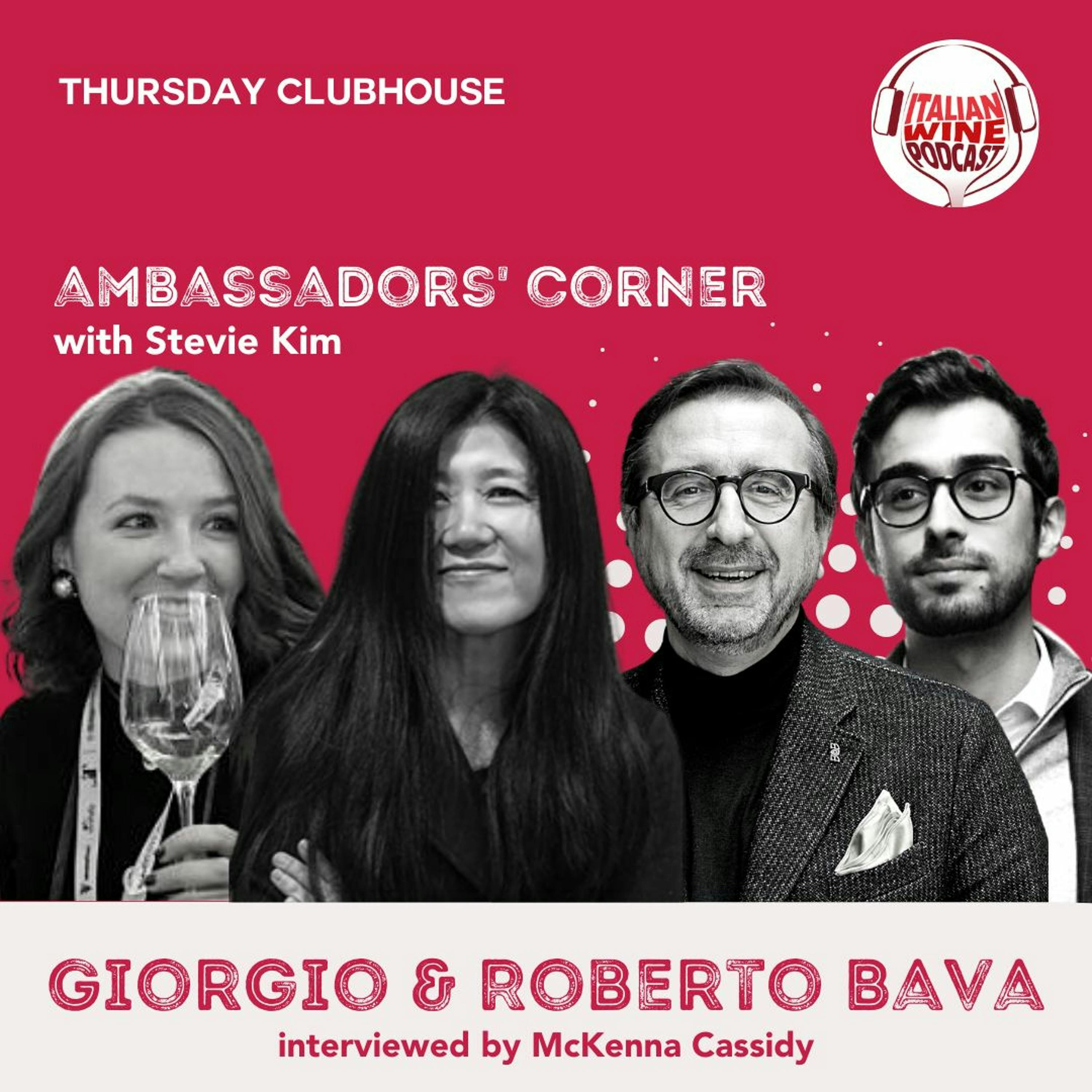
Ep. 1526 McKenna Cassidy Interviews Giorgio & Roberto Bava | Clubhouse Ambassadors’ Corner
Clubhouse Ambassadors’ Corner
Episode Summary
Content Analysis Key Themes and Main Ideas 1. The unique history and pioneering role of Giulio Cocchi in Italian aromatized wines (vermouth, Barolo Chinato). 2. The Bava family's multi-generational commitment to winemaking and their foundational role in the Alta Langa DOCG. 3. The establishment and strict production protocols of Alta Langa, emphasizing its high-altitude traditional method sparkling wines. 4. The Bava winery's innovative approach, particularly its connection between music and wine and its focus on native Piedmontese grape varieties. 5. The intersection of tradition, innovation, and storytelling in the Italian wine and spirits industry. Summary This special Italian Wine Podcast broadcast features an interview with Roberto and Giorgio Bava, representatives of Giulio Cocchi and Bava winery, conducted by Italian Wine Ambassador Mckenna Cassidy. The discussion first delves into Giulio Cocchi, a historic producer of aromatized wines. Roberto and Giorgio explain Cocchi's unique position bridging the wine and cocktail worlds, highlighting products like Barolo Chinato and Vermouth di Torino, and their efforts to promote the Vermouth di Torino appellation. They touch upon the ""futurist mixology"" movement and Cocchi's historical significance. The conversation then shifts to Alta Langa DOCG, a sparkling wine appellation where the Bava family were founding members. Roberto shares the ""new name with an old soul"" philosophy, detailing Alta Langa's strict requirements, such as high altitude vineyards, vintage-only production, and extended aging on lees. Finally, the Bava winery's deep roots in Monferrato are explored, including their unique integration of jazz and classical music into their winemaking philosophy to describe wine characteristics. They also discuss their cultivation of diverse native grape varieties like Albarossa and Nebbiolo in the region, emphasizing the rich, often overlooked, viticultural heritage of Piedmont beyond its most famous wines. Takeaways * The Italian Wine Podcast has reached significant milestones, including 1500 episodes and 6 million listens, and received an OIV wine award. * Giulio Cocchi produces historic aromatized wines like Vermouth di Torino and Barolo Chinato, bridging the gap between wine and cocktail culture. * Barolo Chinato, once used as an anti-malarial, is a versatile and elegant wine-based aperitif/digestif. * The Bava family played a pivotal role in establishing the Alta Langa DOCG, Piedmont's traditional method sparkling wine appellation. * Alta Langa wines are characterized by strict production rules, including high-altitude vineyards, exclusive vintage declaration, and a minimum of 30 months on lees. * The Bava winery pioneered the unique concept of pairing wine characteristics with music (e.g., acidity with violins, body with double bass) for sensory storytelling. * Piedmont, particularly the Monferrato region around Coconato, boasts a rich diversity of native grape varieties beyond Nebbiolo and Barbera, such as Albarossa and Ruche. * Authentic Italian aromatized wines (like vermouth) are wine-based and should be treated like wine, requiring refrigeration after opening. Notable Quotes * ""We are one of those of the Italian family who only know what to do, is is making wine."
About This Episode
The speakers discuss the Italian wine club and its success in promoting the clubhouse. They talk about the Italian wine industry and its importance in the luxury portfolio, as well as their upcoming tour in Northern Italy. They also discuss their experiences with the Italian wines and their partnership with small farmers to grow and plant their own vineyards. They also talk about their success in touring a barolo and barbecue, their love for local cuisine, and their success in the Italian wine industry. They also discuss their experiences with the Bava and their love for local cuisine.
Transcript
Since twenty seventeen, the Italian One podcast has exploded and expects to hit six million listens by the end of July twenty twenty three. We're celebrating this success by recognizing those who have shared the journey with us and giving them the opportunity to contribute to the on success of the shows. By buying a paper copy of the Italian wine unplugged two point o or making a donation to help the ongoing running costs, members of the international Italian wine community will be given the chance to nominate future guests and even enter a price draw to have lunch with Stevie Kim and Professor Atigioshenza. To find out more, visit us at Italian wine podcast dot com. Welcome to this special Italian wine podcast broadcast. This episode is a recording off Clubhouse, the popular drop in audio chat. This clubhouse session was taken from the wine business club and Italian wine club. Listen in as wine lovers and experts alike engage in some great conversation on a range of topics in wine. If you enjoy listening, please consider donating through Italian podcast dot com. Any amount helps cover equipment, production, and publication costs. And remember to subscribe and rate our show wherever you tune in. Okay. Hello, everybody. My name's Stevie Kim, and welcome to the Italian wine club or house, whatever it's called now. Unclubhouse. This is of course the Ambassador Kona. And today, we have from the mod Host is Mckenna Cassidy. Hi, Steveie. Hello. Where are you? Where are you are you? New Jersey? Yeah. I'm in Hoboken, which is right across from New York City for contact. I met Mckenna this year for the first time. Was it in January when I met you at Hugh? Yes. That's all Greek girl in Princeton. Totally. Yes. All. And I said, and it was kinda late into the game, but he was like, you have to get her into the program. And it's very late. You have to study a lot. And then if she fails the exam, she'll blame it on you, you know, and and it was great because you passed the exam. Congratulations. Yes. Thank you. That was difficult to do in two months. But it was worth it. Awesome. Awesome. Makenna, so, you know, I know you love Italian wine, of course, and you work for EJ Gallo, but it's kind of different in New Jersey. Right? Is it a different company? Or how does it Yes. Yeah. So I I'm in a leadership training program with the winery. But I work for one of their affiliate distributors because in the United States, liquard distribution happens through a separate company than the people who make the the alcohol. So, I work for Galla wine sales of New Jersey selling our luxury portfolio in New Jersey. Okay. And how significant is the Italian wine in the luxury portfolio? Oh, yes. It's my favorite wines to sell. It's called the maze row portfolio, but it includes a la Grini, known for the Amaroni, Natorre, known for their wines of Aetna, Arjano and Brancaia from Tuscany and Yerman, from the Northeast and Puro Pan just outside Verona. So it's a great group of brands. Yeah. We're very familiar with all of them. But, you know, McKinna, I have your bio in front of me, and it says you love country swing dancing. What what is that? First of all, I don't even No. Like, where do you even go in New Jersey to do something like that? Yeah. Sadly, we can't. It's an Arizona thing. Oh, okay. I was like, I've lived there for some time. I mean, New York area. And I'm like, I've never heard about any parties that entails country swing dancing per se. This is a great question. Very valued question. I'm from I'm originally from Phoenix, Arizona, and I go up, like, swing dancing every week. So it's like a fast paced version of East Coast swing. With a few more dips and spins and aerial moves that make it really fun. But is it more country or is it more swing? It's two country music. So more country. Okay. Okay. Yeah. That's interesting. I think you're the only person I know. Who has the sun in their bio. So congratulations. This is an important part of my life. Yes. Okay. But I mean professionally, of course, you're certified specialist, the wine, certified, and the most important thing is that you are a via Italian wine Ambassador now. So congratulations again. And we will go on to the show. This week it's kind of the summer marathon as like I would like to call it like us right there. And cha Laika. Hi, Stevie. Have you guys started the appetitivo without me? Oh, no. We're waiting for you before you go to Pompei. Okay. No. Because we're closing up the office for a couple of weeks, but don't worry. We will still be podcasting every day. Is that correct? Yes. That's right. Okay. So Joy's no longer with those and Mike is kind of the main squeeze right now. So we did a podcast, a clubhouse yesterday, today, and also tomorrow. Like, you might have to fill in tomorrow because I might be you know, in Pompe. Okay. Sure. Okay. Alrighty. And who's coming up tomorrow? Tomorrow is Yosia Van Oström. She will be interviewing, Heidi Bonenini. Oh, I'm sorry. I'll miss that. She's like highly energetic. McCann, you met her. Remember? She's the only Dutch lady. Yes. She was awesome. Yeah. And so she's incredibly. She has incredible, yeah, energy. So let's get back to the show today. Nikina, why did you choose I understand there are two guests today, Georgio, and Roberto. Is that correct? Yes. It's true. It's quite a treat. I met both of them very recently at bar convent in Brooklyn, which is a convention of spirits that takes place in both Brooklyn and Berlin. It's the only places it takes place. And I I was attracted to the Cokie table because of the Barolo Kinato And there, I met Georgio and Roberto, and they were kind enough to do this interview. I'm really excited about it. Okay. So what are we looking into learning from your conversation today? What are the learning objectives? You know, we're very geeky around here? Yes. And I talked to Georgio about how geeky we actually need to get in this conversation. So first, it's pretty cool to get to learn about some more, like, higher ABV than just our normal wine. So Kokia Perez Heifs and the history of that important brand is something we'll be discussing. And then Georgio Roberto and their family are one of the co founders of the Alta Longa DOCG project in Piamonte, which is, sparkling wine, obviously, in Piamonte. And I think that it's really important for the Via community to hear the story of Alta Longa and how that came about and what the founders were thinking when they're designing, this vessel DSCG. And then lastly, the Vavas have their own wine label. So they're based in Coconato. Which is, like, nineteen miles northwest of Esti and about thirty miles east of Turino. And so they have a beautiful vineyards and grapes they've beenify in Coconut as well, so learning about that. Okay. So I'm gonna to hand over the mic over to you, Makenna. And before we go, I just wanted to remind our audience that all of our clubhouse calls are replayed, of course, on Italian Wayne podcast. By the way, we've reached fifteen hundred episodes and six million listens just recently. So we are very, very happy about that. And also the book Italian wine unplugged book has received the OIV wine award. So we are very excited. Everyone is happy around here. Before going on their holiday. So, okay. This is where I get to mute my mic. Have a glass of wine with my colleagues because it's kind of my last day before going off and we'll come back to you towards the end of the, session. Okay? Awesome. Thanks, Stevie. Okay. Tell me, Kayna. Tao. Alright. Hi, everyone. Again, my name is Makenna, and I'm here with Roberto and Georgia. Hello. All all is well here. Thank you. Quick introduction. Regards to Baba is the president, and Georgio is the expert brain manager of Julio Cokie winery. It's a boutique house of premium sparkling wines and aperitifs in Esti, Bimonte, and together with a family, they're also run the Bava winery. So these are vine growers of classic and innovative flines in the Barolo and Asti areas. So it's pretty exciting. How is it in Italy today? I know you're going on vacation tomorrow too. Right, Georgia? Yes. Actually, that's that's the reason why you managed to find both of us at the same time here in the winery. We are literally alone. Everybody's already gone. And that's why we do this combo kind of father and son interview. And it's hot. It's good. Not like last year. This time is definitely fresher. It's a bit more windy as well. Anyway, we are, we are cruise to see what's gonna happen in the video because this is, the, the, the watching time. So probably, probably the the team will come back a little earlier for for harvesting, again. Everything is under control until today except everything which is not under control, which is the weather and so on. Of course. Wow. There's always some variables you have to monitor. Anyway, so we here we are. We are one of those of the Italian family who only know what to do, is is making wine. So we've been there. We've been there for several generations, the Baba, the Baba winery, which is the family name. It's been there already for more than one hundred, today, we are one hundred and fifteen years. In, in but the family said is wine grower back to the sixteen hundred, the same place, the same vineyard. So one of those boring, old family, which, which grow the vineyard for a few, a hundred years. So we are this one, but we all, we also have a lot of fun. And, so with research, we we are in some time visionary, maybe too early in some of these ideas of production, and actually yesterday, the famous story, and the Alta Langa story are the new interesting, cool story in in Piedmont. And it happened we are we are the one, we will explore the two, the two, worlds. Yes. Fabulous. And so I'll let you choose. Would you like to talk about Bava first or Koki? And then we'll save Altaonga for after? Well, you at the beginning, we are talking about Koki. Because you you may not at least be, and you were captivated by the by that part. So after you Perfect. If you want. Okay. Great. So for everyone listening, Hoki is the aperitif's that they're famous most famous at least in America for the white one and the red one with the big rooster on the front. And, they're coming the aromatized wine with the herbs in it. You can treat it very like and aperitif, and a morrow, things like that. And I know our guests will be able to speak even more eloquently about it. I recognize the coqui, but they also have the vermouth de Torino, which I know Roberto is closely connected to. So for context, the Cokie itself was born in ASTy in eighteen ninety one. And Julia Kokie was a young pastry chef at Piazza del duomo. Is that right, Georgio? Yes. That's correct. And he I understand he fell in love with a daughter of one of the low Co bars in town, and then he opened the barcode key right there. Is that how the story goes? Yes. The bar is still there. It was starting with a kind of, a mistake. Actually, this apartment, took off the train too early, was going to toino to make his own Vermont and sparkling wine. And, he came out in Asti, and, for some interesting, things that happen, he married a daughter of the owner or the main bar in town. And since, then, the the policy, they are still call it BarKokie. Kokie is is a is a is a maybe a Florentine name. It's not a typical piedmont. So it's the store is two. Oh, man. I don't want the shots. So, it was, like, it was one of the most, bizarre moment of my career recently, actually. This is actually the junior call. So, yeah, I have people who specialize. I didn't believe it. Anyway, so the cocky family was there for long, and it was an incredible family, just to mention that we're kind of inventive of a biofranchising because ten, fifteen years later, he was the one in South America. So they were very dynamic. Julia got himself was a botanist, liquor took his, his history in the bar, and, he started to produce, vermouth, but also one of those recipe, which is the ball the ballolocinato you tasted. Really became for him, like, a benchmark of the old category. And also, it was, if not the inventor, but for for sure, one of the first bottler of, the category, I mean, I can't which is, of course, not the coffee and not the cocktail. It's, an almatized wine, on the bitter side closer to the vermouth, but using a mainly gensiana, the blue flowers on the mountain instead of, Altennesia. So to give this bitterness. So it became a classic, aperitivo, wine based. And since then, we still produce the same recipe with the label which was moving from the statue of liberty to the booster, but today is the booster and is still winning, as a natural low APV agricultural product where you just need to add a splash of soda, some ice, and a zest of orange, and you have the best interesting and most interesting ability in Italy. So we are sitting on on on jewel of what is the, Italian gastronomy. The Barolo Kinato itself, was one of these Van de rigueur, a wine also against the fever. Remember, we had those, unsuccessful campaign in Africa at that time, and, and, by all of you know, was, was a kind of medicine, anti political, anti malaria. Thanks to his Kina and Kining content. So still exist, there are a piece of history, and we still think it. Bubble can add to it with chocolate, specific with that chocolate, but also, as a wine for the cigar, for end of the, or the meal. It's a boutique, store. It's not an amaro. But always the liquid is kind of expensive. It needs to be barolo, to be a baller, you know, to buy low. So it's in the upper, range of, deal with the justice team of Kimonte. That's fabulous. Thank you so much, Roberto, for sharing. I just, for everyone listening, want to attest to how delicious the Vurola Kinato is. And the reason why I was so attracted to it, when I saw it at bar convent in Brooklyn was because it's not a part of my generation's drinking culture, but I think it's a beverage that has so much value. I have a summer cold right now, and I went and got some Borola Kinato and was enjoying that to help heal. I just think that learning more about it is something so important, especially for I'm mid twenties. And so for me who's attesting to Italian wine with the Americans, teaching them that it's a part of life to drink Laurel Okinato or those aromatized wines during different parts of the day or different parts of the year is beautiful and delicious. And of course, being being the Bala family go over and dinner, as soon we we both Cockey. We took over the, the winery of for Julia Cockey. This was only forty two years ago. It's a little, story. Forty two years for us. It's not a lot being four hundred years old. Actually, we we really made a a kind of upgrade to all the product thanks to our wine connection. So even Barolo O'Connor can come from our state in Castillo and Foleto. And we actually I don't want something here because I don't really know exactly what the the listener and so on. Like, when I when we go around, well, the first thing that we actually explain is what we're talking about because we live in a very interesting situation where we are neither with hockey, we are neither a producer of spirits. Just a brand, a lead core producer, and only winemakers. The beautiful things about vermouth and, aperitivos and Barolo Kinato is that we see it literally in the middle of the two worlds. So the exciting things that we've been able for the last forty years to talk both to Sumelis and to bartenders. And this is where we really had to it's been interesting because when me and my father, we go around, we always have two different hats. We go around with our bartender vermouth hats, and we talk about negronis, we talk about Manhattan. We talk about, essences, extract. And then we, nothing in cocktails. And then we also go around with our one makers hat. We instantly talk about three selling systems. And we talk about VINification. When, for example, just because we mentioned Barulcanato and vermouth, these are automatized wines, wine based product with natural structural botanicals, sugar, and spirits. That's it. But it's just something that, I discover in my little career that is not clear for everybody. Many people still consider vermouth, a spirit, or treat it as a spirit, like, leaving it open for months or years on the back bar. Instead, I the first thing that we always say when we do any kind of training or presentation is this is wine. This is natural. This is agricultural. Once open, keep it in the fridge. And it's sound silly, but it's literally how we build these products, almost this category for the last, well, twenty years of growth. Actually, it's it's a bridge between, a wine list and the cocktail list. So it's in the last page of the wine list, the cert, end of the dinner, they're just a, product for some AA, but also the the, the first category in a catalyst before touching the spirits, themselves. So it's quite an interesting category to explore. This is where the renaissance of Belmuth came out. I mean, Vermuth was for long, a boring product, I would say, in the eighties, the nineties, etcetera. And and when we came out with this, new energy to, underline the the wine side of the mood, asking our colleague to write together the law for the appalachian bermuditoino, then it was like, wow, like, a new birth, for the category. So the those were, like, the early two thousand ten, two thousand twelve, and and KOCI definitely was was the pioneer in this. And thanks to God, all the industry has been joining and following. So we we created also, altogether, the consolidated to Taylor, which is, the, the Italian European way to, guarantee and control the quality and production. So so today, Vermudito is the only, guaranteed, product with, with an appolation. In in the Vermud, worth. I'm sure if we're going too much outside the the path, if Mckenna, you have some, you want to steer us in some directions. Please do interrupt us because we tend to easily go for the next three hours. Of course. No. You don't feel like I left you to your own devices. You were saying things of such value I was letting it go, but I did wanna add. So it seems like Camilla's can continue supporting Italian wine even on their spirit, like, in their cocktail list, even though it's in aromatized wine, not only do we focus on honoring Italian wines on our wine lists, but also on our bar menus because of the aromatized wine that Koki is, which is really, I think you made a great point there. And what I thought was partly cool about the you're consulting with bartenders, do you ever talk about that futurist mixology? Cause Kokie came about in the Belipoc era around a lot of, like, futurism, artists like Vissado, degas, Toulous Latrec, which are artists that I personally really enjoy. This is bridging the, twentieth century. Do you ever talk about the futurist mixology and what those drinks look like? Most of those were the years. So the twenties, the thirties, even even earlier, and, and, actually, there's a kind of vintage, arrogant vintage in also in our communication. But even more, we have been, researching on this, finding that, Italian futurist invented cocktails. And considering that everybody linked Italy, mixology, normally, to Nagoni, bellini, well, very few. You can count on one hand. At the very end, the the the futurist, the painters, architect, and musician, parts, they made, original cocktail, but during the Autaski, they couldn't call them in a with an English word. So the the the original name was, like, a multi drink. And and it was definitely worth it. Fascinating. So what we did in our research was to print a book call it the futurist mixologist, where everything is written there, and it's like, a accountable for parliament because they can go and, repeat, this original couple from the filter is the, artistic movement. So, yes, it's, the cut off side of, of, of those product is really dense, and you really could even open a bar only doing this style of cocktail. We discovered nineteen different recipe, which we've already written in Marinetti, cuisine book, the Futris cook book, but, what we did was we need to make them, I'm gonna say repulling, which you can now remake it with the original ingredients, etcetera. So, yes, We belong to, to that part of the history, and they were really, incredible. We still do things, link it back to that times. Fabulous. I think it attached to the versatility of the aromatized wines, and I have a a customer actually in New Jersey doing Minionette, for oysters with aromatized wine. So making a homemade kind of champagne vinaigrette with an aromatized wine for oysters, which we eat a lot of here. So that's really cool. Thank you so much for sharing about that. Roberto and George Jones. And okay. Great. So let's maybe make sure that we have time for everything we wanna talk about. So we'll continue on to the Alta Longa questions. So Roberto, I know you have your personal story here, and Georgia is a great witness to that as well. So could you tell us, I know you're one of the seven founders of the Alta Longa project, and people listening to this podcast love stories like this. So dive all in. But, This is a very important sparkling wine, DOCG, in Pemonte. Could you tell us how that began and with your relationship with the other founders? Yes. Well, Altaanga is is a new name with the old soul. Also, because Pierre Monte was, the second producer of sparkling wine in the history after Champagne. And sometime, the new generation for as it's not clear the point. Really, we, in PMonta, producing, bottle fermentis badly wine for more than one hundred and fifty years. So it's it's it's really a long tradition inherited. What we didn't have for long was an appellation to to, to name this tradition. Actually, we were even producing our sparkling wine, Milacime, in the seventies, the the the sixties. It was college, you is held at the seat, to to his end, etcetera. Now, starting in in in the two thousand, early two thousand, seven producer put together in, in an association called it, the Caststolic, historical, sparkling wineries. And we were one of those. So altogether they understood it was time to give a name and to give a protection to to provide protocols on on how to make the perfect, sparkling wine from Pemonte. In an evolution of, meetings, etcetera set up the static what is today, the Alta language, the OCG, it's more than just as sparkling wine. It started like an anthropological, project because, remember, we are all familiar with, with the parolo area, the the the the the birth of the amount of a a hole there, the eleven common but out of there, there's a, there's a world that is, it's the upper heels, and above all, but also going to Alexandria and nasty district, where the area was kind of four. The price for actor was, ridiculous compared to to the to the highest expensive by all of, actors' price of today. And and people had to to to look for a way to sustain themselves for living, in the upper eelsdale. I mean, the gold cheese was one, hazelnuts, but, actually, You had really not so many reason to live up there. It was not economically sustainable. So the planting, chardonnay, and pinot noir, after it became, an incredible opportunity. And, and also for the operation, we we started from zero in a way, planting the perfect, clones in the perfect position so it became step by step and it is coming to go and go an incredible opportunity not only for producer, but for the whole region up there. That's great. And so what is the altitude of these highest hill in Alange, where the chardonnay and pinot noir are planted. The low the final Talanga requested two hundred fifty, meters. But actually, the average is upper. It goes to hundred, and even to eight hundred. Think about that this is also an opportunity in, to fight the weather change because, we, we need, graves, to go in, in a different weather. Where you can harvest in a different time compared to the nebbiolo de paolo. So, you need acidity, you need, you need the certain soil. So we found that up there, the perfect, scenario for this project. It's now twenty five years, roughly of history. Every vineyard was planted to become Alta Langa. That's it. So you can't plant a chardonnay and or Pino and do white wines, and wines, what else? You are involved in a precise product, project. And this is the Alta manga. So even in, even in term of, fermentation and staying on the East, etcetera. This is very precise. Alta Lanka needs to stay at least thirty months on East, which is the longest possible Uh-huh. In in compared to other, similar, products. And it's always vintage. Is that right? It's only vintage. Yes. This doesn't exist at the non vintage. So it's the the size. Yeah. The the clothes, mainly for, for from burgundy, but actually there are several vineyards. It's not only one clone, and and as you're well known, a great sparkling wine, both of a man to start from a So even here talking about a single vineyard, it's not in the philosophy of a of a quality is back in wine. It need to be a covet coming from different, maybe institutes, because the skill here is also the skill of, of the blender and the analog in, in the in the seller, of course. You know, so because the it was chosen to actually have to invest among different vineyards rather than different years. Because the producer really wanted the analogs, really want to show the different variation, the different ears, and so on. So that's why the the the the role is very strict on this. So no no vintage, only single vintage, but the air itself is quite, it's quite broad. It's quite white. So that's also quite interesting. And only given what I should mention. I'm not sure if the interesting, about the production, because, it's only three million bottle today. It's going to go step by step but it will never double in a year or two years. I mean, the grow has been very instrumental to the sales, to the sale, but also to the plenty of the vineyard, etcetera. You cannot go and buy someone generic and make a feature in Los Angeles. That's that's a fantastic, strict point. Yeah. Because it was actually in the, in allowing new vineyards. He planted new vineyards to be allowed to produce chardonnayton were for Atalanga. So it's been quite hot and in demand recently. And production is, doesn't even need demand. It's been really, really requested. It's very interesting to talk about the territory, the land, the, the project itself. Don't we haven't talked about the long term contracts that we all have with farmers, with the growers of the plants as well. Yeah. We support a small farmer to to to grow and to plant their their own vineyards, and and we guarantee there a continuity in in terms of money. And the price of grape is is definitely a premium price so that they can resist and stay in a in a land, whereas really not always easy. But back to your question, yes, we we have a very good connection and became friends from the original, group of, producer, which were, even bumpy, and, of course, cocky. Actually, the the man, here was more of my, my brother, Julia, who who was one of the of the president today, and and also has been running the consultry for nine years recently. So he's really the one who had, in the family division, with, with those first names. Now producer, around fifty, I guess. So it has been also growing in in a proper way step by step. And, now it's a it's a real, serious, story for the future. The key is the for us or for Kaki, Alanga is not just an extension of a line. It's really been the heart of our spartan wine production for quite a few decades. I don't know. So it's not just like, well, with with Baba, with other winery that we have we we decide to add one line. So we add one product. We add, I don't know, a ruke of for for hockey. It's been really hard. It's, we only make a sparky wine. Not still wine. We copy, we only make, but, aromatized, and sparkling wine, which is why still the company itself is called Twilio Cokis Monte. We define ourself as a winery. Yes, then we also make it removed, but it's a winery. Yes. Absolutely. Okay. Makes sense. Thanks for clarifying. And then to that end, could you speak on a few of the expressions you make, in the Alta Longa, like the Pazdulce melisimato, or the Toto Chorde? And then are the other producers making winds of similar style and what sets these wines apart? Oh, we we, we worked on all this fashion because, again, we were in a way, pioneer, actually Kokie was was the first to do, a blonde de Blonde, which we call Bianca, Bianca. So this was the first expression in the docG with hundred percent Chardon me. We we also explore the OC very, very early OC, made hundred percent of, of Pineonua senior. The classic protocol that is the is the classic seventies. So, Pinonua and and Sheldon in a way, the French cut. No worries, please. And, Total call, they also was the the first special of this this challenge, the name itself, is from Latin in Total's call with all your passion, with all your out. So this was really, like a challenge. We came late, little later with the, Adose, which is the expression, specific of of the soil, actually, these pados a saw, ancient creami, sea or sugar, but that kind of elegance that come from the soil. We released it after eighteen months on yeast. So it's quite a reserve if you want. Eighty. Okay. It is yeah. The normal the average of COK is forty eight to sixty. So again, we we play serious with long staying on East, small bubbles, very, very fine, product altogether. So the range is four labels today. But thankfully, we have, but it comes to come out. We'll be probably releasing a few more product, including, a hundred percent deal, deal product in the early, in the probably next year. So Beautiful. That's great. That also, just just a word about the middle of the multi knotty because Kokie is also one of those pioneer Mhmm. Doing the first, multi knotty, Salma, style because Julio Kokie, the one who was, like, four hundred meters from the the Royal Institute of Viticulture, or Fasti, well, mister Matinosti was the director. And, and when we, we, we, we, we both at the building, and we, we, we, we went on making cocky nasty. Actually, we are very dinosaur of, of COVID, close, to do sparkling wine. So we really think that we belong to this kind of history, which is incredible. So, almatize, wine. Okay. But even sparkling wine, like, aromatic. So, Brachette or the aste made in aste, and even the dry, chardonnay, and sparkling wine. So, again, sparkling wine was really, a big part of, of, this heritage. Just allow me a second. Martinotti actually invented a developer patenters, the the multimedia in eighteen ninety five. While, eighteen ninety five. Eighteen ninety five. Founded the first put the bill the first building block, the first production in eighteen ninety one. That was literally those years, and they were like neighbors in the same square. Is that the same time? That's awesome. This kind of Italian things were, we are old enough, but I know that myself first person. You there's no doubt you're a part of the history of the sparkling wine. That's wonderful. That's awesome. And which is your favorite to drink in your free time and who does the Remwaj on the Pupitra by hand? Is that Georgia? Is that his junk? Yes. Well, they They prefer to send me, around the world because I I sleep quite well on on airplanes, and I usually take over my flight. I do know how to do it a little bit. It tend to have more people that do it and to have more muscles than what I what I have, unfortunately. But we have, we have a little team of, a couple of people led by my uncle doing the remarks. Actually, one of them was, one of the original, hockey employee that we had, the the just a couple of months ago retired after forty two years with us. Wow. So yeah. When you talk about being Aljisane, he has been touching. We say, we don't okay. We're touching the bottle, for thirty eight years nonstop. So all the bottles we produce were been personally touched, by these two guys. One is still here. Oh my goodness. And now we have a new generation coming. So it's fascinating. Very hard to say that in a way. I do drink the rosar by the way. That's the the one I always been told from is that I I do Bianca at Bianca because it's very judge of mani style. So clearly, the white bottle transfer bottle, it's, to die for all the food that we are a little bit. Don't forget antipasti. It's not only aperitivo. Mhmm. So we use a wine glass and then, anything higher than last, but also risotto. So until the risotto, we normally now have a lunch and dinners with Atlanta. That's, to die for. Oh, fabulous. This is perfect because what's that, Rojo? No. Just because they're not overly sparking. We're not talking about, heavy bubble. We're still talking about at least three, four years. Our hours, our Alta landed, we're a minimum of four years, so they tend to be extremely delicate, even the the, the double edge itself, I should let it have it, for the whole, the whole meal from some sparkling wine, after a while, I really can't have them. Instead, for Alta line, they tend to be very rich, very creamy. That's a beauty of it. It's very cool. Mhmm. Because of that depth of flavor and the structure, which lets it pair with so many different things. So what do you pair with the Rosa? If, Roberto has the Vitello donato. Yes. Well, when I go with the pizza, then We One place. Tend to, you know, consume a bit of, charcutter in here. But, remember that, the aim is to drink it around the world and not only in Montalat or language. So, actually, there's, there's, big exercise, with, foreign cuisine, any international cuisine. Three days ago, I was in Cancun, with, Virgenio Fernandez. It was today the best chef, number one, the best fifty, and the Ricardo Fringer. So Super Chef, we have been using a bianca bianca with, with Mexican food, and, and this was phenomenal. So so I'm limited to local ethanique Italian food. It's really open to good food around the world. That's great because I'm from the desert where we eat Mexican food weekly and almost daily, like quesadillas, intosadas, and enchiladas, so it'd be fabulous so I can have your wines with it now. That's great. And then I'm so excited because I've been on the, Bava mailing list for several months now, and it's been so fun because I have my cookbook that I got. Which is this really awesome food and wine book. So now I know how to make Vitello Donato, and I can make, annualotti and several that go with not only your Altilanga wines, but I think also your Baba family minds. Let's transition into your family swinery. I remember it was founded because I think someone was building a railroad through the land, and they started making bread and wine to give to the workers. Is that kind of how that story all started? Yes. That's that's great. I don't recall we had time at VisB to talk about it, so you did very good research when I That's a that's a that's a story. That there is a true story. Yeah, when the family actually moved the, from the from the top of the hill here in Colorado where we had our historic farmhouse since the early sixteen hundred they simply moved, to the ballet where they were building, the the the railroad, whether it'd been the railroad, and so there was the the occasion to build a restaurant there in an oven, a bread making oven for the people there and for a surrounding farmer. Farms. And then, of course, the the wines that the family used to produce start to be sold there. That's how how everything started and grew from there, like, you start shipping wise with the with the right way. And then, think feel sad from there. We always do quite focus on the Mufferato. We're in literally the center of, the north part of Mufferato. So we have a very big variety of different native grapes. It's a we spend our time talking about how many different grapes we have in here of course, mostly Barbera, internal production. So, let's say, a Barbera house, but also Napiola because we we then go all the way then to Castillo and Ephonlet to where we have a little state, a little farmhouse. In the cruise car. And plus we make Monferata epidemiology is quite fun. Oh, fabulous. Yes. So coconuto is in Monterato Estigiano or is it Casaloisse? Which is it considering? Yeah. You're it's not a tropical drink instead of the name. You will say coconut. But, I don't know how it came out. It was from Romans. Uh-uh. Oh, that's awesome. Perfect. Yeah. And you're so you're Barbara your Barbera is the Stra de badio. I think is the title of your wine. In that, can you tell us about the connection between the music and the wines of Bava? I know that there was a few composers that would inspire, like Barbara who makes who does the song Adagio for strings, which is such a gorgeous, like eleven minute song. Everyone should go listen to it after this while you're drinking Bava wines. But could you tell us about the relationship with the music for the Barolo and the Barbana? Yeah. That's interesting. In nineteen eighty, in the early eighties, we, we had this very old seller available to do things. And our father, so He's still alive, by the way. My father is still alive. Ninety three years old, still in the winery today. And Beautiful. And he, he gave us the seller to do things, and, my brother and I, we were, fanatic of jazz. So we decided to do to host a whole orchestra for several years, actually, but hosting in August of twenty people, with a lot of chess people coming from all over, etcetera. This gave us the opportunity to to understand how the music could be a mental language in a sensorial way to explain, in, in an unusual at the time storytelling about the wine. So we have been asking those musicians coming to play something like acidity, body, aromas, etcetera, etcetera, using something which is was very early for factorial marketing, which is today normal. But at that time, having, jazz in the, in the, in the seller, this was over Mondavi in Napa, and actually it was us. So the only two funny, scene like, out of the box, but actually still today, the story works because we may explain, certain Babira using Majko Marodal better than Savizki, according to the character of the Babera. And, it's not it's not a science. It's it's written that if you ask people, to taste the two different Babera and period with different, sound, they come to a point that, probably higher Cbt is better explained with violins and low boat body wines is more double bass, and viola a catalog, etcetera. So, again, it's not a science. It's, it's something that your brain understand, and we still do things after so many years. If you're going now, while Baba TV or YouTube some place passing maybe to the to the web. Yeah. It's a good YouTube channel. I like it very much. It's not on YouTube. You you would find what we did last year was we went to the vineyard to encourage the vineyard because there was this very dry, whether it was like, like, kind of problem, divine, whether it is suffering. So we asked the five musicians from the Royal, Orchestra of Torino for the world theater to come and play Barroco wins music like, like, aid in, Philip Telemagne, the back, it's data. It was so incredible, so funny, but so logic. And it was a great fun. So we still do these things. Are are not scientific, but people love it, and we talk to the brain, of people, and it's a perfect storytelling of flavor, taste, history, etcetera. So that's how it started. And this is why we call a study value, our super Babira, which we a we a user for ten years before selling it, but it's one of those of Super Babella, the change of days of the Babella forty years ago, still producing mail. And we are still selling it, in, like, a several vintages available, even in the United States to to government. So we do vertical, and we are violin playing the taste, the body, and all the characteristic that can explain it to a sound. Okay. So That's yes. Thank you for explaining that. That is more than I could have asked for in an answer. That was awesome. I haven't heard someone doing that in in such quite depth before. And so for those of us who haven't been to Cogonado specifically, it sounds like clearly you have wonderful musicians there. The town itself has been ranked amongst the most beautiful towns in Italy. Obviously, a variety of grapes grow well there, but it sounds like there's several kind of ancient churches. One of your vineyards is by Moderna Delaeneve, the snow, obviously. And which grapes are you seeing, or, like, driving right now? Which are you gonna have to harvest first? Well, in here in particular, we consider that we do harvest many different type of grapes. We are quite a wide type of, range between baba and coffee. So, yeah, so in terms of harvest time, I was talking with my uncle just a couple of days ago, and we would probably start with the, but we will start, of course, with them with Sparkywine, with wines with the grapes from the Sparkywine, more or less on the twenty, twenty fifth of August. Which is far away, again, the atalanga. In in here, we have a slightly warmer, a slightly warm climate, which is very good for right folks as well. We do start usually with Albaasa in Kokonato, which is a very niche and rare, gray variety. Super interesting. Yeah. That's the Go ahead. Sorry. I got excited because it's Chatus and Barbera. Yeah. Oh, correct. Very impressed. I really are very impressed. We cannot. Thank you. Well, and the devil's knowledge is, well, I'm sorry. Sorry. Sorry. We're we're surprised just because usually we're even with with nobody knows all but also, I mean, nobody knows all but Oh, yes. Alvaros is very important and special. Yes. Oh, it is for us. Hopefully, we we we are working to make it important also for the market for some of the end and consumers. It's taking some time. Let's say that before it will become the next cover, this is gonna be a long way. But anyway Yeah. Why why do you think why do you think what's the value of Abarosa for you? Like, why do you what do you think people misunderstand that's beautiful about it that you're evangelizing. Well, it's not like a misunderstanding. It's not like, it's just like it's one out of endless niche native. Right? We also make it okay. For example, which I personally love for us being a photographer. Okay? We do a steel tank version of, okay, Anedge, Anoke, super vibrant, amazing. You can talk about Gavi, you can talk about native variety. You can talk about read Malvasia from Castel Novo Dombosco. I mean, that's why what I was saying at the beginning, Montvarado is crazy for so many small niche varieties. So it's not that it's misunderstood. It's just that it's lot. And there are a lot of fantastic varieties that are fighting for a space. Nitsat itself, super interesting. I mean, even for Barbera, we talk about the difference in all the different soil, the different unification, Yes. It is a a a grape that is made by many, many different pollution in Kimono. Fabulous. Yeah. It's like so detailed, I think. The way people understand is the storytelling. Oh, you cut out. Sorry. Go ahead. Oh, yeah. Sorry. I mean, I'll I'll send it even because you are asking me about, the the harvest time as well, like, in Nitza, is also slightly earlier usually for Conato. And that's now a Nitza DOTG. So that's even, his own denomination. So even inside one grape world, we make a difference between different soil of Pemento, of Monteferato, of the asti province. Okay. I'm with you. And then so what could you just describe briefly the piano alto crew and maybe, like, the Rosid Rosidana Hill? Are those, like, closer to each other? What's different about them? For PL Multi standard, they're actually quite far from each other. Let's say, maybe from, from New Zealand, Australia, distances is nothing. But for us, it's something like, forty minutes drive. Thirty minutes drive. Okay. So Nitsa is in the south is if you take Astis in the south of ASTi, so it goes more is southern. It's more in the direction of language, let's say. And it's, what I will describe more rolling hills So lower hills, you get less, inclination and less, the altitude is is lower. The altitude is lower. And at the same time, you get more sun because there is no much shadow comparing to, for example, our steep hills in the Langiera, steep hills in, North of Mont where we are, where our grapes get shadow sometimes needs a most vineyards, and I'm talking in particular now, we're vineyards. So I cannot really talk about the whole population. We get way more sun sometime. In the north, in Mufferato, in the northern part of Mufferato where we are, and for example, our hill here in Coronado where we made the stradivariio. It tend to be steeper. It tend to have, like, a richer, richer soil. It tend to give the soils a lot in particular, we have the oldest, vineyard, the oldest vines here in concurrent. So I'm under meters altitude. Oh, wonderful. How how old are they? Oh, we go between the forty, forty five years old. You said they're what vine are that old? That's both for the Barbera and for the Nebula. So we'll be making the Bureau of Monterado here for for family reasons and family consumption literally for hundreds of years. Right. Actually, the relation is something new anyway. It's only two or three years, has been, made available and adopted. So, eventually, we have a name of of these, nevialo, which is midway between the upper northern nevialo, gatinala area in the language. So it happened that this Montalante is reading the, in the heart and in the center geographically of Pemonte. And, yeah, it's, it's, going. It will, that's a new name to, to follow. So, Montella Antonio, and even Alboniano, one of these local village with a hundred percent nebbiolo. Will be all great next to Kokamoto. So, again, it's never boring, flavors altitude, clone, iPhone. Right. It's so, so much to discover. That's fabulous. I have one more question, and then I'd love if you would share any last words you'd like to share about. Anything you do that, you'd love the platform to share. I've just noticed that you make a Ray Ali Blanc, which is Sabayam, And I was just wondering in which of your vineyards that grows, and then I'll turn the floor over to you. I'd love to hear anything else you'd like to share in our last three minutes. Italian wine podcast brought to you by mama jumbo shrimp Yeah. We only have one vineyard of, Sabinova. It's, it's, like, one of those tested to understand how this, this vine, adopted, by the soil we have here. We discovered that, the Coronado area is like an island of white soil, soil, similar to away, and so suitable for, by, white wine. We also have a mindset or queries of, choke here, which is, which is the crystals, so it gives very, very white, white soils for the other vineyards. And then so it was we were curious to understand what else out of the classic red. This is why years ago we started to we were one the very first of Chardonnay, state here in Piedmont, actually. And, and, and, sovignon was one of those. It happened to be, good. Less, happy, if I can say, compared to other world, shall, sovignon, is probably a wine will will go on producing because it's very good, long staying on on the lease, etcetera, etcetera. But it's also true that if there's a next step, this will be on some probably, native, grapes, which which we still have to to discover. So so we want to be an open system, a laboratory of, of, varietals and diversity. That's so wonderful. Your winemaking philosophy really coincides with our values at the Van Italy Academy because we spend a great deal of time talking about the native grape varieties and their stories of how they arrive to the lands they are in. And their uniqueness and the creativity, and the different crossings. So thank you so much. I'll turn it back over to Stevie and Roberto and Georgios so, so grateful for your time. Thank you. That was me. That was me. Oh my goodness. You guys. This was such a wonderful session. First of all, Georgia and Rebecca. I I want to come to Kokonato because what a fun name, just the name. I've never been. So I hope we can come and visit you very soon. Thank you for joining us. And Makenna, you give me hope for the next generation because you how old are you? Thank you, Stevie. I'm twenty five years old. Oh my gosh. I need more Makenna of twenty five year old Makenna's because then I think there is really hope for the future of Italian wine. You were so competent, but fun and friendly, but in-depth, I think Georgia and Ervelda would agree. She's incredibly knowledgeable in this area. And I, you really did your homework. No wonder you passed. Congratulations, and I hope you will bring more guests because I think this was a fabulous session and I I can hardly wait to share with the rest of the world on the Italian Wine podcast. Thank you all very much. I'm going to join my my staff at the bar now, so I'm going to close-up the room. But thank you all very much. And, McKenna, I know you're not even feeling well, so feel better. And I I want to connect with you. I'm going to state, sorry, on Sunday, and I'm going to ping you because I have some ideas for you. Okay? Fabulous. Please do. Talk then. Okay. Listen to the Italian wine podcast wherever you get your podcasts. We're on SoundCloud, Apple Podcasts, Spotify, EmailIFM, and more. Don't forget to subscribe and rate the show. If you enjoy listening, please consider donating through Italian wine podcast dot com. Any amount helps cover equipment, production, and publication costs. Until next time.
Episode Details
Keywords
Related Episodes

Ep 2325 Anna Obuhovskaya IWA interviews Fabio d'Attimis-Maniago of Attimis-Maniago | Clubhouse Ambassadors’ Corner
Episode 2325

EP 2316 Alberto Martinez-Interiano IWA interviews Emiliano Giorgi of Progetto Sete Winery | Clubhouse Ambassadors’ Corner
Episode 2316

Ep. 2308 Anna Obuhovskaya IWA interviews Sara Repetto of Vigneti Repetto | Clubhouse Ambassadors’ Corner
Episode 2308

Ep. 2299 Beverley Bourdin IWA interviews Grégoire Desforges of Baglio di Pianetto winery | Clubhouse Ambassadors’ Corner
Episode 2299
Ep. 2290 Rebecca Severs IWA interviews Primo Franco of Nino Franco winery | Clubhouse Ambassadors’ Corner
Episode 2290
Ep. 2281 Julianne Farricker IWA interviews Mattia Montanari of Opera 02 Winery | Clubhouse Ambassadors’ Corner
Episode 2281